
Written and collected by Zia H Shah MD, Chief Editor of the Muslim Times
Meteor strikes were not on the minds of 7th-century Arabs. Nevertheless, the Quran describes the sky as a protective roof over our earth in a few verses. Traditional commentators understood the verses in light of their knowledge about the universe. Still, today, we have no choice but to read those verses in light of our current understanding of defense against meteors, solar winds, and any other threat coming from outside our planet. This illustrates that the Quran from the All-Knowing always needs to be read in light of our best knowledge and information.
Now, let me quote some of the verses talking about protective roof:
And We made the sky a well-secured canopy –– yet from its wonders, they turn away. (Al Quran 21:32)
Have you not considered how God has made everything on the earth of service to you? That ships sail the sea at His command? That He keeps the heavens from falling down on the earth without His permission? God is most compassionate and most merciful to mankind. (Al Quran 22:65)
O mankind, worship your Lord Who has created you and created those who were before you, that you may be shielded against all ill; Who has spread out the earth like a bed for you and has made the heaven like a safe canopy, and has caused water to come down from the clouds and has therewith brought forth provision for you in the shape of fruits. (Al Quran 2:21-22)
It is God who has given you the earth for a dwelling place and the heavens for a safe canopy. (Al Quran 40:64)
Earth is shielded from frequent meteor impacts by a combination of natural astronomical mechanisms that have evolved over billions of years. These processes work synergistically to reduce the likelihood of catastrophic collisions, ensuring the planet’s relative safety in a dynamic solar system. Below are the key mechanisms:
1. Earth’s Atmosphere: A Natural Shield
- Ablation and Fragmentation:
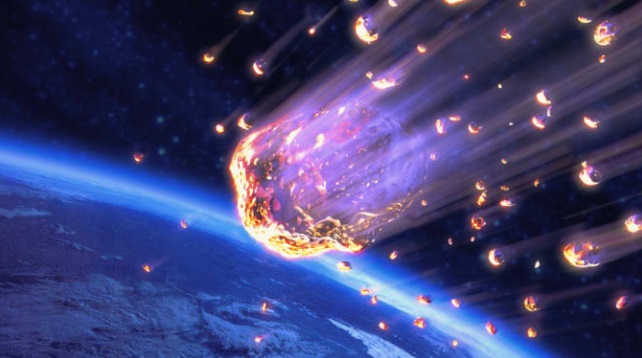
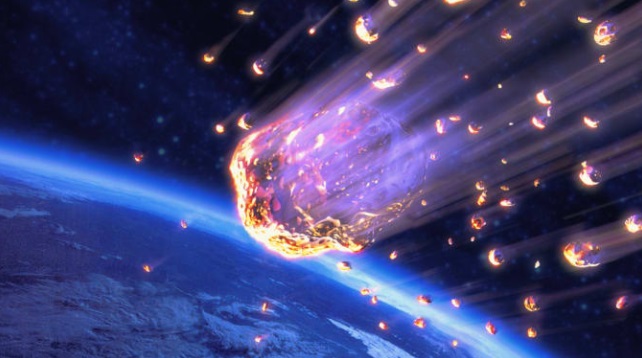
When meteoroids (small space rocks) enter Earth’s atmosphere at high speeds (up to 72 km/s), air resistance compresses the gas ahead of them, generating intense heat. Most objects smaller than ~25 meters burn up entirely due to this friction, a process called ablation. Larger objects often fragment explosively in the atmosphere, as seen in the 2013 Chelyabinsk meteor (17–20 meters wide), which disintegrated before reaching the ground. - Angle of Entry:
Meteors entering at shallow angles may “skip” off the atmosphere or break apart more easily, reducing their destructive potential.
2. Jupiter: The Solar System’s Cosmic Vacuum Cleaner
- Gravitational Shielding:
Jupiter, the solar system’s largest planet, exerts immense gravitational pull. It redirects or captures many comets and asteroids (e.g., from the Kuiper Belt or Oort Cloud) that might otherwise head toward the inner solar system. For example, in 1994, Jupiter’s gravity tore apart Comet Shoemaker-Levy 9, causing its fragments to collide with the planet instead of Earth. - Orbital Resonance:
Jupiter’s gravitational influence creates stable or unstable orbital resonances. Many asteroids in the main belt between Mars and Jupiter are locked in stable orbits, preventing them from drifting toward Earth.

3. The Asteroid Belt: A (Mostly) Stable Reservoir
- Orbital Dynamics:
While the asteroid belt contains millions of objects, they are spread over vast distances (average spacing: ~1 million km). Gravitational interactions with Jupiter and Mars stabilize most orbits, limiting collisions that could send debris toward Earth. - Yarkovsky Effect:
Thermal radiation from sunlight can subtly alter an asteroid’s orbit over time, nudging some away from Earth-crossing paths.
4. Tidal Forces and Planetary Tug-of-War
- Tidal Disruption:
When small bodies pass close to large planets or the Sun, tidal forces can stretch and fragment them. For example, comets nearing the Sun often break apart into smaller, less hazardous pieces. - Ejection from the Solar System:
Gravitational interactions with planets can eject asteroids or comets into interstellar space, permanently removing them as threats.
5. The Moon’s Role: A Secondary Defender
- Collisional Buffer:
The Moon’s surface is heavily cratered, indicating it absorbs some impacts that might otherwise target Earth. While not a primary shield, its presence slightly reduces Earth’s collision risk.
6. Solar System “Housekeeping”
- Early Bombardment Phase:
During the solar system’s formation (~4.5 billion years ago), frequent collisions were common. Over time, gravitational interactions cleared much of the debris, leaving fewer hazardous objects. - Orbital Resonance Clearing:
Regions like the Kirkwood gaps in the asteroid belt are emptied by orbital resonances with Jupiter, preventing asteroids from lingering in unstable orbits.
Modern Human Efforts: Enhancing Natural Defenses
While not astronomical mechanisms, human initiatives complement these natural systems:
- Near-Earth Object (NEO) Monitoring:
Programs like NASA’s Planetary Defense Coordination Office track asteroids to predict potential impacts. - Deflection Technologies:
Missions like NASA’s DART (Double Asteroid Redirection Test) test methods to alter an asteroid’s trajectory through kinetic impact.
Conclusion
Earth’s protection from meteor impacts is a testament to the finely tuned dynamics of the solar system. From Jupiter’s gravitational dominance to Earth’s life-sustaining atmosphere, these mechanisms collectively minimize risks. However, the 1908 Tunguska event (flattening 2,000 km² of Siberian forest) and ancient impacts like the Chicxulub asteroid (linked to dinosaur extinction) remind us that vigilance—through science and technology—remains critical to planetary defense.




 The Glorious Quran and Science
Leave a reply to Heavenly Shield and Cosmic Catastrophe: Scientific, Philosophical, and Theological Reflections on Qur’an 22:65 – The Glorious Quran and Science Cancel reply