
Epigraph
Have you not considered how God has made everything on the earth of service to you? That ships sail the sea at His command? That He keeps the heavens from falling down on the earth without His permission? God is most compassionate and most merciful to mankind. (Al Quran 22:65)
Written and collected by Zia H Shah MD, Chief Editor of the Muslim Times
Several verses in the Quran discuss meteors and the earth being provided with a protective roof. But we do not find any inaccuracies or myth making.
Contrary to the holy Quran throughout history, shooting stars have sparked a wide variety of myths and legends across different cultures. Here are a few common themes:
- Ominous Signs and Prophecy:
In many ancient cultures—including those of Babylon, ancient China, and medieval Europe—shooting stars were seen as portents of significant events, such as disasters or the downfall of a ruler. They were often interpreted as messages from the gods or as signals of impending change. - Fallen Souls and Spiritual Messengers:
In some Native American and African traditions, shooting stars are thought to represent the souls of the departed or the spirits traveling from the heavens to Earth. They can be seen as the souls of ancestors watching over the living or even as signs of a soul being reborn. - Wishes and Good Fortune:
The popular notion of “wishing upon a star” can be traced back to various European folklore traditions. In these stories, a shooting star was believed to carry your wishes up to the heavens, where they might be granted by benevolent deities. - Divine Intervention or Love:
In some cultures, such as parts of ancient Greek mythology, shooting stars were sometimes associated with the fleeting presence or actions of the gods—whether as a symbol of their fleeting attention or as signs of divine love and blessing.
These myths illustrate how shooting stars have been woven into the fabric of human storytelling, symbolizing both hope and warning. They reflect humanity’s deep curiosity about the cosmos and our attempt to find meaning in natural phenomena.
The beauty of the Quran is that it imparts a lot of information in a subtle language that does not shock the 7th century readers and also has a profound message for the modern readers that do not conflict with our modern science. Carefully read the verse quoted above as epigraph:
Have you not considered how God has made everything on the earth of service to you? That ships sail the sea at His command? That He keeps the heavens from falling down on the earth without His permission? God is most compassionate and most merciful to mankind. (Al Quran 22:65)
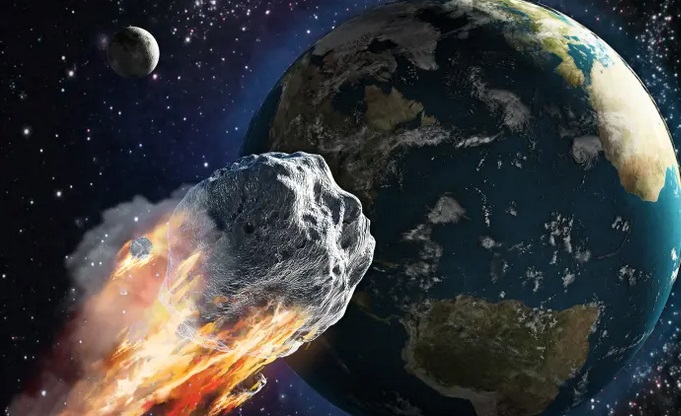
God, in His infinite wisdom, has bestowed us with countless blessings on earth, providing us with a secure abode and shielding our planet from the cosmic upheavals. Yet, when He permits such an upheaval, it may serve as a profound part of His intricate plan. A single meteor strike, in the distant past, set the stage for the emergence of hundreds of mammalian species, eventually leading to the evolution of humans. This underscores the profound role of historical events in shaping the course of evolution.
The extinction of the dinosaurs, marking the end of the Cretaceous period approximately 66 million years ago, was triggered by a catastrophic asteroid impact known as the Cretaceous-Paleogene (K-Pg) extinction event. Here’s a concise summary:
Key Details of the Meteor Impact that Destroyed the Dinosaurs
- Asteroid Size:
A massive asteroid, 10–15 kilometers (6–9 miles) in diameter, struck Earth near the modern-day Yucatán Peninsula, Mexico, creating the Chicxulub crater (∼150 km wide). - Immediate Effects:
- Energy release equivalent to billions of atomic bombs, igniting global wildfires and generating mega-tsunamis.
- Vast amounts of debris, soot, and sulfates ejected into the atmosphere.
- Long-Term Climate Impact:
- Sunlight-blocking particles caused a “nuclear winter”, plunging temperatures and disrupting photosynthesis.
- Collapse of food chains led to the extinction of 75% of Earth’s species, including non-avian dinosaurs, marine reptiles (e.g., mosasaurs), and ammonites.
Evidence Supporting the Theory:
- Iridium Layer: A global layer of iridium (rare on Earth but common in asteroids) found in sedimentary rock.
- Chicxulub Crater: Discovered in the 1990s through geophysical surveys, confirming the impact site.
- Shocked Quartz & Tektites: Minerals altered by extreme pressure, found worldwide.
Additional Factors:
- Deccan Traps Volcanism: Massive volcanic eruptions in India (releasing CO₂ and gases) may have exacerbated environmental stress, though the asteroid is considered the primary driver.
Aftermath:
- Rise of Mammals: The extinction of dominant reptiles allowed mammals to diversify, paving the way for modern ecosystems.
- Avian Survival: Birds, descended from theropod dinosaurs, were among the few dinosaur lineages to survive.
Scientific Consensus:
Proposed by Luis Alvarez and colleagues in 1980, the asteroid impact theory is now widely accepted, supported by geological, chemical, and fossil evidence. It underscores the role of cosmic events in shaping life’s history.



 The Glorious Quran and Science
Leave a comment