

Written and collected by Zia H Shah MD, Chief Editor of the Muslim Times
The Quran, while primarily a spiritual and moral guide, contains numerous references to celestial phenomena, timekeeping, and the natural order. These verses not only deepened Muslims’ reverence for creation but also served as catalysts for scientific inquiry during the Islamic Golden Age (8th to 13th centuries). By blending Quranic inspiration with empirical study, scholars laid the foundations for advancements in astronomy, mathematics, and calendar systems that would shape global knowledge. Below, we explore key Quranic themes and their influence on this era of intellectual flourishing.
The Quran’s references to the movements of the sun and moon, as well as its guidance on timekeeping and calendars, played a pivotal role in inspiring the study of astronomy and mathematics during the Islamic Golden Age. By emphasizing observation, calculation, and reflection upon the natural world, the Quran motivated Muslim scholars to pursue knowledge that bridged religious practice and scientific inquiry, leaving a lasting legacy on the development of these disciplines.
Quranic Verses on Celestial Order and Time
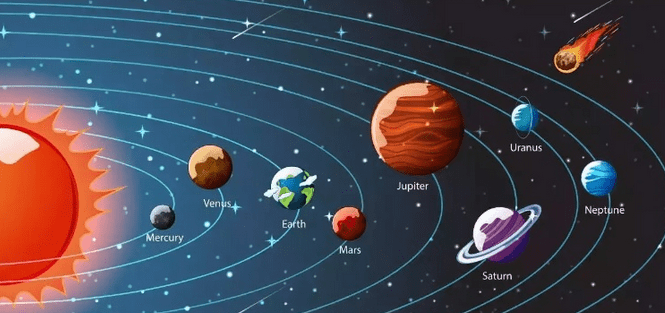
The Quran repeatedly directs attention to the heavens, emphasizing the precision of celestial motions and their role as signs (ayat) for reflection. Notable verses include:
- Quranic Verses on Celestial Motions and Timekeeping The Quran emphasizes the precision and order in the movements of celestial bodies, highlighting their role in measuring time: “The sun and the moon [move] by precise calculation.” (Quran 55:5) “It is He who made the sun a radiant light and the moon a light and determined for it phases—that you may know the number of years and account [of time].” (Quran 10:5) These verses underscore the importance of the sun and moon in regulating time and establishing calendars. The Quran further specifies the structure of the year: “Indeed, the number of months with Allah is twelve [lunar] months in the register of Allah from the day He created the heavens and the earth; of these, four are sacred.” (Quran 9:36) This passage indicates a lunar calendar comprising twelve months, with four designated as sacred.
- The Sun and Moon in Calculated Orbits “And the sun runs [on course] toward its stopping point. That is the determination of the Exalted in Might, the Knowing. And the moon – We have determined for it phases, until it returns [appearing] like the old date stalk. It is not for the sun to overtake the moon, nor does the night outrun the day. They all float, each in an orbit.” (Quran 36:38–40)This verse underscores the regularity of solar and lunar cycles, rejecting the pre-Islamic notion of celestial deities in favor of a divinely ordered cosmos. It inspired scholars to study planetary motion and refine calculations of time.
- The Moon as a Calendar Marker “It is He who made the sun a shining light and the moon a derived light and determined for it phases – that you may know the number of years and account [of time].” (Quran 10:5)The Quran’s emphasis on the moon’s phases for timekeeping directly influenced the Islamic lunar calendar. Scholars developed sophisticated methods to predict lunar months, critical for religious observances like Ramadan and Hajj.
- The Challenge to Calculate Time “Indeed, the number of months with Allah is twelve [lunar] months in the register of Allah [from] the day He created the heavens and the earth…” (Quran 9:36)This verse reinforced the Islamic lunar calendar’s structure, prompting mathematicians to reconcile lunar cycles with seasonal solar events, leading to innovations in trigonometry and spherical geometry.
- Universal Reflection “Indeed, in the creation of the heavens and the earth and the alternation of the night and the day are signs for those of understanding.” (Quran 3:190) Such verses encouraged Muslims to study the cosmos as a form of worship, blending faith with reason.
From Quranic Inspiration to Scientific Revolution
The Quran’s emphasis on celestial order and timekeeping intersected with practical religious needs, such as determining prayer times, the direction of Mecca (qibla), and the start of lunar months. These challenges drove scholars to innovate:
- Astronomy for Worship
Accurate prayer times required understanding the sun’s position, leading to the development of:- Astrolabes: Portable devices to calculate celestial positions.
- Shadow Schemes: Using sundials and trigonometry to determine prayer times.
- Qibla Calculations: Applying geometry to align mosques with Mecca.
- Lunar Calendar Refinement
The Hijri calendar, based on Quranic lunar reckoning, posed challenges for agriculture and taxation tied to solar seasons. Scholars like Al-Biruni (973–1048 CE) compared lunar and solar cycles, advancing mathematical astronomy. - Trigonometry and Algebra
To model celestial motion, mathematicians like Al-Battani (858–929 CE) refined trigonometric tables, while Al-Khwarizmi (780–850 CE) systematized algebra—tools critical for predicting planetary positions. - Observatories and Critical Inquiry
Institutions like the Maragha Observatory (13th century) emerged, where scholars such as Nasir al-Din al-Tusi (1201–1274 CE) critiqued Ptolemy’s models, paving the way for later heliocentric theories.
Key Contributions and Legacy
- Al-Battani: Calculated the solar year’s length with remarkable accuracy and improved Ptolemaic models.
- Ibn al-Haytham: Revolutionized optics, emphasizing empirical observation over speculation.
- Ulugh Beg: Mapped over 1,000 stars in his Samarkand Observatory.
- The Zij Tables: Astronomical handbooks combining Quranic timekeeping with Greek, Persian, and Indian data.
These works preserved and expanded ancient knowledge, later transmitted to Europe via translations, catalyzing the Renaissance.
Conclusion: Faith and Reason in Harmony
The Quran’s verses on celestial phenomena did not provide technical scientific formulas but ignited a cultural ethos of inquiry. By framing the cosmos as a “book” of divine signs, Islam elevated the study of astronomy and mathematics to acts of devotion. The Golden Age’s legacy demonstrates how scripture, when interpreted as an invitation to explore rather than a substitute for empirical inquiry, can harmonize faith and science. As Ibn Rushd (Averroes) argued, “Truth does not contradict truth”—a principle that guided Muslim scholars to unlock the heavens’ mysteries while upholding the Quran’s spiritual wisdom.
Today, the Quran’s call to “reflect on the heavens and the earth” (3:191) remains a timeless reminder that curiosity and reverence can coexist, driving humanity toward both spiritual and scientific enlightenment.
To review all the contributions in the early history of Islam inspired originally by the Quran, here is a three hour documentary from BBC by Prof. James Al Khalili



Leave a Reply