
Epigraph
Man, what has emboldened you against your Gracious Lord, who created you, then perfected you, then proportioned you right? He fashioned you in whatever form He pleased. (Al Quran 82:6-8)
Written and collected by Zia H Shah MD, Chief Editor of the Muslim Times
Michael Servetus was burnt on the stake on 27 October 1553 in Geneva by the orders of John Calvin for writing two books refuting Trinity in a Trinitarian Christian Europe.
Servetus (29 September 1509 or 1511 – 27 October 1553) was a Spanish theologian, physician, and Renaissance humanist. Born in Villanueva de Sigena, Spain, Servetus is renowned for his unorthodox views on the Holy Trinity and his pioneering work in medicine.
Servetus studied law at the University of Toulouse, where he developed an interest in theology. His critical examination of the Bible led him to question traditional Christian doctrines, particularly the concept of the Trinity. In 1531, he published “De Trinitatis Erroribus” (“On the Errors of the Trinity”), challenging the orthodox understanding of the triune nature of God. This publication drew ire from both Catholic and Protestant communities, marking him as a heretic.
Beyond theology, Servetus made significant strides in medicine. He was the first European to correctly describe the function of pulmonary circulation, detailing how blood moves from the heart to the lungs and back. This groundbreaking discovery was published in his work “Christianismi Restitutio” (“The Restoration of Christianity”) in 1553.
Servetus’s theological positions, especially his anti-Trinitarian views, led to severe persecution. After years of evading authorities, he was arrested in Geneva under the influence of Protestant reformer John Calvin. Found guilty of heresy and blasphemy, Servetus was sentenced to death and was burned at the stake on 27 October 1553.
Despite his tragic end, Servetus’s work has had a lasting impact. His challenges to established doctrines contributed to religious discourse during the Reformation, and his medical discoveries have been recognized as foundational in the study of human physiology. Today, he is remembered as a courageous thinker who dared to question prevailing beliefs in pursuit of truth.
To me personally his greatest contribution is a pithy quote that has become a mantra for me:
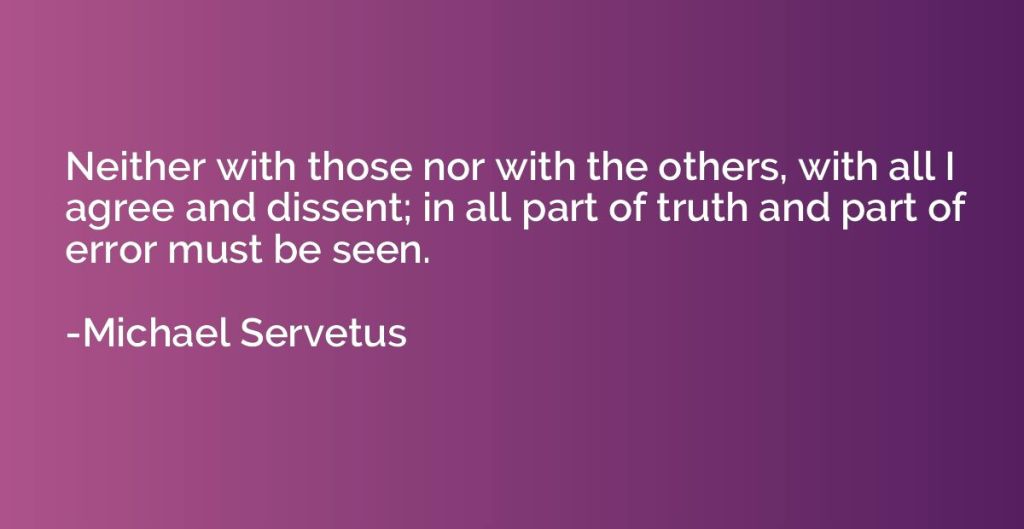
Until we give up the worship of our heroes and leaders we cannot think clearly.
If I were to try to rationalize every thought and statement of my spiritual leader, as is the case in many Shiite traditions and a few Sunni traditions, then I am merely a robot. A somewhat pathetic situation both in worldly terms and possibly in Afterlife as well, as the All-Knowing God will judge us on our individual intentions and deeds.
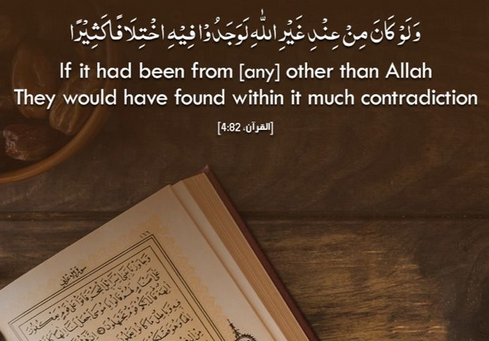
So, what I have found most helpful is to have the wisdom and courage to agree and disagree with anyone in pursuit of knowledge, especially religious knowledge. It is actually most helpful in understanding the holy Quran, how else would I try to resolve any apparent conflict or contradiction in the understanding of the Quran, as it states:
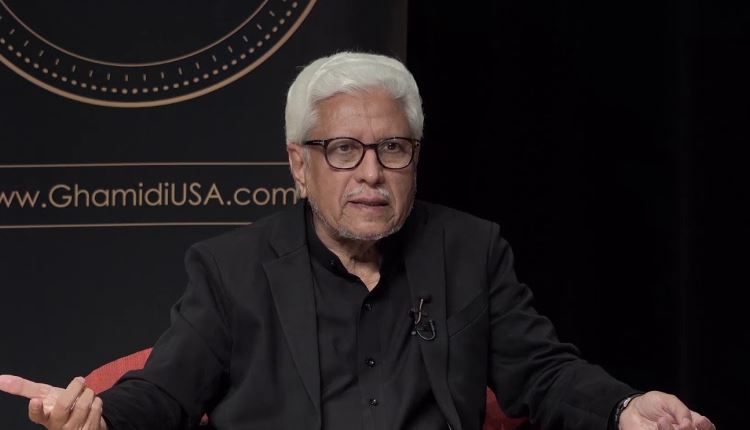
Now, I want to share my journey with Javed Ahmed Ghamidi, as he is my teacher and I have learnt more than a few things from him.
Ghamidi’s Pluralism
Javed Ahmed Ghamidi is the most pluralistic teacher of Islam from Pakistan background. He has stated that everyone who calls himself or herself a Muslim is a Muslim. He has acknowledged Islam of the Ahmadiyya sect as well, who have been declared by Pakistan legislation to be non-Muslim since 1974. I applaud him for his pluralism.
Ghamidi’s Relationship with Syed Abul A’la Maududi
Ghamidi has had a complex relationship with the teachings of Syed Abul A’la Maududi, the founder of Jamaat-e-Islami. Initially, Ghamidi worked closely with Maududi for approximately nine years. However, over time, he developed differing views, particularly concerning the role of an Islamic state and the concept of jihad. Ghamidi believes that the primary obligation in Islam is servitude to God, rather than the establishment of an Islamic political order. Despite these differences, Ghamidi maintains deep respect for Maududi, acknowledging his significant contributions to Islamic thought.
I take a stronger exception against Maududi’s Islamism.
The Quran’s Purpose and Scientific References
Ghamidi holds nuanced views on the relationship between the Qur’an and science. He emphasizes that the Qur’an is fundamentally a book of guidance, focusing on moral and spiritual teachings, rather than a scientific manual. Ghamidi cautions against interpreting the Qur’an primarily through a scientific lens, suggesting that such an approach may lead to misunderstandings of its core message.
According to Ghamidi, the Qur’an’s primary objective is to provide ethical and spiritual guidance to humanity. While it may reference natural phenomena, these mentions are intended to encourage reflection on the Creator’s signs, not to serve as scientific explanations. Ghamidi asserts that the Qur’an should not be conflated with scientific textbooks; instead, it uses observations of the natural world to draw attention to divine wisdom.
Ghamidi approaches claims of scientific miracles in the Qur’an with caution. He acknowledges that while some verses may align with modern scientific understanding, asserting that the Qur’an contains explicit scientific revelations can be problematic. Ghamidi emphasizes that the Qur’an’s language is often allegorical and context-specific, and extracting scientific facts from its verses may lead to misinterpretations.
I partially agree with him on these issues, but I want to highlight the importance of science in the interpretation and commentary of the Glorious Quran and our Homepage and header menu is a testament for that:
Ghamidi’s Views on Evolution
Despite recognizing evolution as a general principle, Ghamidi critiques Charles Darwin’s theory of common descent. He questions the adequacy of fossil records and other evidence supporting the notion that all species, including humans, evolved from a single common ancestor. Ghamidi suggests that the current form of Darwinian evolution lacks sufficient empirical support and should be considered a theoretical framework rather than an established fact.
I am absolutely convinced of the common ancestry of all life forms, possibly as many as 9 million presently on our planet. Here, is a short article to demonstrate that:
Summarizing Fool Proof Evidence for Evolution, Namely Common Ancestry, If You Are Still on the Fence
Here, is more detailed exposition of evolution:
Molecular Evidence for Evolution: How DNA and Proteins Prove Common Ancestry
The Glorious Quran: ‘Humanity Came from a Single Soul!’
Introduction of the Book: The Quran and the Biological Evolution
A New Book: The Quran and the Biological Evolution
The Grand Show on Earth: From Embryology to Evolution to Afterlife
Two Words for the Christian Apologist Ravi Zacharias: Biological Evolution
Ghamidi’s Understanding of the Sufi Tradition
He holds critical views on the Sufi tradition, or Tasawwuf, within Islam. He contends that Sufism has evolved into a parallel religious system that diverges from the foundational teachings of the Qur’an and Sunnah.
Ghamidi argues that Sufism introduces concepts and practices not rooted in the primary Islamic texts. He believes that certain Sufi doctrines, such as the concept of the “unity of being” (Wahdat al-Wujud), lack clear corroboration from the Qur’an. Additionally, he expresses concern that the Sufi notion of saints (Awliya) possessing exclusive access to divine truths challenges the finality of prophethood (Khatm-e-Nabuwwat). Islam and Diversity
While acknowledging the importance of spiritual excellence (Ihsan) in Islam, Ghamidi distinguishes it from Tasawwuf. He asserts that Ihsan pertains to sincerity and excellence in worship and conduct, as emphasized in the Qur’an and Sunnah, whereas Tasawwuf encompasses additional esoteric practices and beliefs not mandated by Islamic scripture.
Ghamidi acknowledges the spiritual experiences reported by Sufis but maintains that such experiences are personal and subjective. He cautions against elevating these experiences to doctrinal status, emphasizing that personal spiritual observations should not override the explicit teachings of the Qur’an and Sunnah. Website for Javed Ahmad Ghamidi
Discussing the historical context of Sufism in the Indian subcontinent, Ghamidi notes that while Sufi orders played a role in the spread of Islam, they also integrated local cultural practices that may not align strictly with Islamic teachings. He advocates for a return to the foundational sources of Islam, free from cultural accretions introduced through Sufi traditions. YouTube
In summary, Ghamidi views Sufism as a parallel tradition that incorporates beliefs and practices beyond the scope of the Qur’an and Sunnah. He emphasizes adherence to the original sources of Islam and cautions against integrating esoteric doctrines that lack clear scriptural support.
For a more in-depth understanding of Ghamidi’s perspective on Sufism, you may find the following video insightful:
Again in this domain I will agree and disagree with Ghamidi.
My nuance on the subject is somewhat different from him and will require a whole article in due course of time.




 The Glorious Quran and Science
Leave a reply to Javed Ahmad Ghamidi’s Perspectives on Sufism (Tasawwuf) – The Glorious Quran and Science Cancel reply