
Epigraph
Did We not relieve your heart for you [Prophet], and remove the burden that weighed so heavily on your back, and raise your reputation high? So truly where there is hardship there is also ease; truly where there is hardship there is also ease. The moment you are freed [of one task] work on, and turn to your Lord for everything. (Al Quran 94:1-8)
Written and collected by Zia H Shah MD, Chief Editor of the Muslim Times
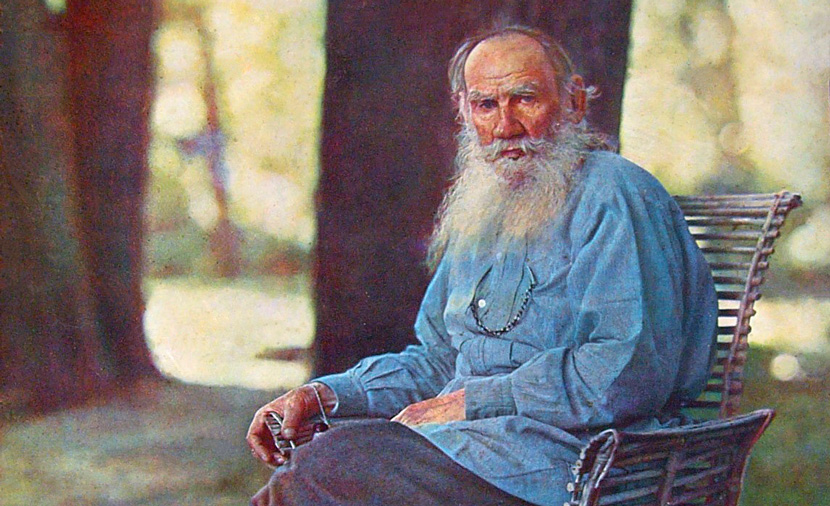
Leo Tolstoy (1828–1910) was a Russian novelist and moral philosopher, renowned for his profound impact on world literature. Born into an aristocratic family at the Yasnaya Polyana estate, about 130 miles south of Moscow, Tolstoy’s early life was marked by personal loss; his mother died before he was two, and his father passed away in 1837. These experiences of loss and displacement influenced his later works, which often explore themes of family, morality, and the human condition.
Tolstoy’s literary career began with semi-autobiographical works such as “Childhood,” “Boyhood,” and “Youth,” reflecting his own experiences and observations. However, it was his epic novels “War and Peace” (1869) and “Anna Karenina” (1877) that cemented his status as one of the greatest novelists of all time. “War and Peace” is celebrated for its intricate depiction of Russian society during the Napoleonic Wars, while “Anna Karenina” delves into the complexities of love, family, and societal expectations.
Beyond his literary achievements, Tolstoy underwent a profound spiritual transformation in the 1870s, leading him to adopt Christian anarchism and pacifism. He emphasized nonviolent resistance and the moral teachings of Jesus, influencing notable figures such as Mahatma Gandhi and Martin Luther King Jr. His later works, including “The Kingdom of God Is Within You,” reflect his philosophical and ethical contemplations.
Tolstoy’s legacy extends beyond literature; his ideas on nonviolent resistance and social reform have left an indelible mark on global movements for peace and justice. His life’s journey—from a nobleman to a moral philosopher—continues to inspire and provoke thought, underscoring the enduring power of literature to challenge and transform society.
General Overview of Tolstoy’s Perspective on the Quran
Tolstoy developed a deep interest in the Quran and Islam, especially in the later years of his life. His general impression of the Quran was highly positive and respectful. Tolstoy regarded Islam’s core teachings – as derived from the Quran – with great admiration, often considering them purer and more rational than some aspects of Christianity as practiced in his time. For instance, he praised Islam’s strict monotheism and rejection of deifying any human, seeing this as a clear, uncompromised concept of God. In a conversation recorded by his physician in 1909, Tolstoy remarked that “Muhammad has always been standing higher than Christianity. He does not think man as God and never makes himself equal to God. Muslims do not have any other gods but God and Muhammad is His messenger. There is no secret and doubt in it.” emaanlibrary.com Here Tolstoy favorably compares the Islamic understanding of God with the Christian doctrine of Jesus’s divinity, implying that the Quran’s conception of God is straightforward and devoid of mystery (such as the Trinity) that he found problematic in Orthodox Christianity.
Comparison with Other Scriptures: Tolstoy did not see the Quran in isolation, but as part of a continuum of world religious wisdom. He believed that all major faiths share the same fundamental truths. In a letter to the Grand Mufti of Egypt (Muhammad Abduh) in 1904, Tolstoy expressed that despite coming from different religious backgrounds, he and the Mufti shared “the same faith” in terms of core principles alhakam.org. He wrote, “faiths are different and there are many of them, but there is only one faith, the true one… consisting in acknowledging God and His law, in loving one’s neighbor and doing to others what one would like done to oneself. I think that all true religious principles flow from this, and that they are the same for Jews, Brahmins, Buddhists, Christians, and Mohammedans alike.”
This statement shows that Tolstoy placed the Quran’s teachings on an equal footing with the moral core of other scriptures like the Bible, the Vedas, etc. In fact, he held that as religions rid themselves of dogma and superstition, they converge toward a common, ideal faith of love and unity alhakam.org. Within this framework, Tolstoy viewed Islam (and the Quran) as a later revelation that avoided certain “misapprehensions” or distortions that had crept into previous faiths researchgate.net. He even stated explicitly that Islam “compared favorably” with Orthodox Christianity in its teachings. According to Tolstoy, the Quran reinforced the universal values also found in other scriptures, but with a clarity and consistency he admired.
Moral and Ethical Teachings: Tolstoy was particularly drawn to the Quran’s moral and ethical guidance, which he found in harmony with his own ethical ideals (such as compassion, non-violence, charity, and the brotherhood of man). He noted the “high spirit” of morality in the Quran safaafromcaeg.wordpress.com. In one of his writings, Tolstoy advised that “Anyone who wants to verify the tolerance in Islam should only read the Quran carefully. Its verses are indicative of the high spirit of Islam” safaafromcaeg.wordpress.com. He appreciated Quranic passages that promote unity and compassion; for example, he quoted Quran 3:103 which calls on people to “hold fast, all together, by the rope of Allah, and be not divided… [remember that] by His Grace, ye became brethren.”
Such verses, Tolstoy believed, exemplify Islam’s emphasis on social harmony and mutual love. In general, he saw the Quran as a scripture that encourages virtue, humility, and kindness among people – values that Tolstoy himself championed throughout his life. This positive appraisal extended to practical ethics: Tolstoy admired how Islamic teachings urge care for one’s neighbors, mercy towards others, truthful conduct, and avoidance of vices, much like the moral tenets of the Gospels. He even remarked that the ethical teachings of Islam did not demand an impractical change in one’s life but rather guided people in a sensible, righteous way researchgate.net.
It should be noted that Tolstoy’s view of the Quran and Islam evolved over time. In earlier years, he had been influenced by common prejudices and initially thought Islam was simply an offshoot of Christianity. For example, he once commented that “I consider Islam as a form of Christianity, which has emerged from apocryphal Christian traditions… Whatever has passed into Islam from Christianity is good, whatever comes from Muhammad is coarse.”
This dismissive early view shows that he originally believed Islam borrowed its good morals from Christianity while adding some “coarse” elements of its own. However, as he studied more deeply, Tolstoy discarded these misconceptions. By the end of his life, his general overview of the Quran was overwhelmingly positive – he regarded Islam as a religion that preserved core truths and moral clarity. In 1909 he declared, “Islam stands higher [than Christianity]… Islam illuminated me a lot” emaanlibrary.com, underscoring how much his estimation of the Quran and its teachings had grown.
Specific Quotes from Tolstoy on the Quran and Islam
Tolstoy discussed the Quran and Islam in several letters, diary entries, essays, and recorded conversations. Below are some exact quotes (in translation) from Tolstoy’s writings and speech, along with their context:
- On the Quran’s Concept of God: “Muhammad has always been standing higher than Christianity. He does not consider God as a human being and never makes himself equal to God. Muslims worship nothing except God and Muhammad is His Messenger. There is no any mystery and secret in it.” emaanlibrary.com – (Tolstoy’s words in a family conversation on March 13, 1909, recorded by his physician Dushan Makovitsky. Here Tolstoy contrasts Islam’s pure monotheism, as taught in the Quran, with the Christian idea of Jesus as God, praising the clarity of Islamic theology.)
- Tolstoy Favoring Islam over Christianity: “Which one is better: Christianity or Islam? … For me, it is evident that Islam is better and higher… If we compare Islam with Christianity, Islam stands higher. Islam illuminated me a lot.” emaanlibrary.com – (From the same 1909 conversation, Tolstoy openly asserts the superiority he perceives in Islam’s teachings. This candid quote shows his high regard for Islam and implies that reading the Quran and learning about Islam “illuminated” or enlightened him.)
- On the Quran’s Spirit of Tolerance and Unity: “Anyone who wants to verify the tolerance in Islam should only read the Quran carefully. Its verses are indicative of the high spirit of Islam, such as: ‘And hold fast, all together, by the rope which Allah stretches out for you, and be not divided among yourselves…’ (Quran 3:103).” safaafromcaeg.wordpress.com – (Tolstoy wrote this in his later compilation Selected Sayings of the Prophet, highlighting a Quranic verse. He uses the quote to demonstrate Islam’s emphasis on societal harmony and brotherhood as a core value.)
- On Prophet Muhammad and Previous Prophets: “I am one of those who are very much impressed by Prophet Muhammad who was chosen by the One God to have His last message revealed through his soul, heart and mind. He chose him to be the last prophet; hence, no other prophets would come after him. His acknowledgment of the prophets who had been sent by God before him… is indubitable evidence that he came with Islam to complete the social building for the entire humanity everywhere.” safaafromcaeg.wordpress.com – (Tolstoy’s words from the same Selected Sayings compilation or a letter, expressing his admiration for Muhammad as a true prophet. He notes that Muhammad and the Quran affirm earlier prophets like Moses and Jesus, seeing this continuity as proof of Islam’s mission to perfect religion for all humankind.)
- On the Prophet’s Character and Impact: “Undoubtedly, Prophet Muhammad is one of the greatest reformers who rendered extensive service to the human community… he guided an entire nation to the light of truth and made it incline to serenity and peace… He forbade acts of bloodshed or human sacrifice. He opened up for his nation the way to progress and civilization… Such a man, indeed, is highly respectable and estimable.” islamweb.net – (Tolstoy’s praise for the Prophet, likely from an essay or recorded reflection, acknowledging Muhammad’s immense influence in uplifting his people morally and socially. It shows Tolstoy’s respect for the ethical and civilizational contributions of Islam as taught in the Quran.)
- On Common Ground in All Religions (Including Islam/Quran): “What is common to religions is also in the Qur’an: [the] proclamation of love. The Qur’an is consistent and Muhammad forbids war as a means to expand Islam and [forbids] killing… in fact, we do not know Islam as [well as] Muslims know Christianity, and a nation without a religion is doomed to be in a deplorable state…” researchgate.net – (Tolstoy observed this in a late 1909 diary note. He emphasizes that the core message of love is present in the Quran just as in other faiths. He also notes that the Quran is internally consistent and that Islam, contrary to misconceptions, forbids forced conquest for religion. The remark about mutual ignorance suggests Tolstoy felt Russians misunderstood Islam, while Muslims were more familiar with Christianity.)
- On the Unity of True Faith: “I hasten to reply… that it has given me great pleasure to come into contact with an enlightened man, though of a different faith from that in which I was born and brought up, but of the same faith with me… there are many [religions], but there is only one faith, the true one… consisting in acknowledging God and His law, in loving one’s neighbor as oneself… I think that all true religious principles flow from this, and they are the same for Jews, Brahmins, Buddhists, Christians, and Mohammedans alike… The more [religions] are purified from superstitions, the closer they come to the ideal of common unity.”alhakam.org – (From Tolstoy’s letter to Mufti Muhammad Abduh in May 1904. While not mentioning the Quran by name, this quote encapsulates Tolstoy’s view that the Quran’s core message is fundamentally in line with the one true faith of love of God and neighbor. It shows his belief in the underlying unity between Islam and other religions, once superficial dogmas are removed.)
Each of these quotes (from private conversations, published writings, and correspondence) illustrates Tolstoy’s engagement with Islamic scripture. They range from theological observations to ethical evaluations, and they show Tolstoy’s progression from a critical stance to openly honoring the Quran and Prophet Muhammad in his search for religious truth.
Thematic Analysis of Tolstoy’s Reflections on the Quran
Tolstoy’s commentary on the Quran can be analyzed along several key themes: theological beliefs (concept of God), moral-ethical teachings, and prophethood (especially his view of Prophet Muhammad). His thoughts in each area reveal both what he found appealing in the Quran and how it related to his broader philosophy.
Theology and Concept of God
Monotheism and God’s Nature: Tolstoy was deeply struck by the Quran’s uncompromising monotheism. Coming from a Christian background that preached the Trinity and the divinity of Christ, Tolstoy appreciated that Islam emphatically insists God is One and transcendent, never taking human form. He highlighted that Muslims “do not have any other gods but God” and that Muhammad never claimed anything more than a mortal messenger status emaanlibrary.com. This aspect of Quranic theology resonated with Tolstoy’s rational spirituality – he himself had rejected the idea that “God had come down to earth and then gone back up to heaven” as unreasonable alhakam.org. Thus, the Quran’s portrait of God aligned with Tolstoy’s own belief in a single, indivisible deity. He felt Islam avoided what he saw as the theological errors of Christianity, such as the deification of Jesus. As he explained to his family, in Islam “there is no any mystery and secret” about God emaanlibrary.com – meaning God’s unity is a simple truth, not a complicated doctrine. In Tolstoy’s eyes, this made the Quran’s message about God purer and more accessible than the complex creeds of the Church.
Universality of God’s Law: Tolstoy also observed that the Quran’s concept of God comes paired with a universal moral law (or divine commandments) similar to that of other faiths. In his letter to Mufti Abduh, he wrote that true faith consists in “acknowledging God and his law” and living by the Golden Rule of loving one’s neighbor alhakam.org. He believed the Quran, like other holy books, proclaims this eternal law. Tolstoy saw the Quran’s teachings about God’s will (such as doing justice, showing mercy, etc.) as consistent with the teachings of Jesus and the prophets. In fact, in one late diary entry, Tolstoy noted that “What is common to religions is also in the Qur’an: [the] proclamation of Love.” researchgate.net. To him, the theological message of the Quran confirmed the unity of all religions in valuing love and righteousness as God’s primary demand on humanity. Thus, Tolstoy’s theological takeaway from the Quran was that it reaffirmed a faith in one God who calls for a life of conscience and compassion – a view very much in harmony with Tolstoy’s own religious philosophy.
Moral and Ethical Teachings
High Ethical Standards: The moral teachings of the Quran impressed Tolstoy and he often commented on their excellence and practicality. He found that the Quran advocates virtues that he cherished: kindness, honesty, charity, self-discipline, and justice. Tolstoy noted “the high spirit of Islam” apparent in the Quran’s verses safaafromcaeg.wordpress.com, meaning the scripture consistently urges believers to uphold goodness. One aspect he highlighted was the Quran’s call for social unity and brotherhood – for example, he quoted Quran 3:103 about God uniting the hearts of former enemies so that they became brethren safaafromcaeg.wordpress.com. This emphasis on community and overcoming divisions appealed to Tolstoy’s hope for a more harmonious human society.
Compassion and Charity: Tolstoy was drawn to Quranic ethics of compassion. In the collection Selected Sayings of the Prophet Muhammad that Tolstoy compiled, many of the sayings he chose (drawn from Islamic tradition and reflective of Quranic principles) focus on mercy and altruism. Some examples he included: “Those who show mercy have Allah’s mercy shown to them. Have mercy on those on earth, and the One in heaven will have mercy on you,” and “A believer is not one who eats his fill while his next door neighbor goes hungry.” islamweb.net. These moral aphorisms, which echo Quranic values, mirror Tolstoy’s own ethic of caring for the less fortunate and responding to evil with good. He saw the Quran as a text that promotes social justice – condemning oppression and urging aid to the poor – much like the Sermon on the Mount which Tolstoy adored. The Islamic prohibition of alcohol and emphasis on personal responsibility would also have aligned with Tolstoy’s advocacy of temperance and moral living (though in our sources Tolstoy doesn’t explicitly mention Quranic dietary or personal laws, he generally approved of religious teachings that lead to moral improvement and self-control).
War and Peace: A particularly interesting facet of Tolstoy’s moral analysis of the Quran is his view on violence and war. As a Christian pacifist, Tolstoy was initially skeptical about Islam’s record regarding war. However, after studying, he remarked that “The Qur’an is consistent and Muhammad forbids war as a means to expand Islam and [forbids] killing.” researchgate.net. This indicates Tolstoy came to believe that the Quran, properly understood, does not condone aggressive violence or forced conversion. He admired Prophet Muhammad for “forbidding acts of bloodshed” and leading people to peace islamweb.net. This interpretation was likely influenced by Tolstoy’s reading of Muhammad’s teachings on mercy and restraint in war. It also reflects his tendency to see all true religion as fundamentally non-violent and benevolent. In summary, Tolstoy regarded the Quran’s moral teachings as highly enlightened and humane, providing guidance that is both spiritually uplifting and practically beneficial for humanity. He felt these teachings were not alien or inferior to Christian ethics but rather very much in concord with the highest moral ideals he held.
Prophethood and the Role of Muhammad
Tolstoy’s engagement with the Quran naturally led him to consider Islam’s Prophet, Muhammad, and the Quranic stance on prophethood. Over time, Tolstoy developed a great respect for Prophet Muhammad, seeing him through the lens of the Quran’s portrayal and the historical impact of his message.
Muhammad’s Status as Prophet: Initially, Tolstoy may have harbored doubts about Muhammad, possibly viewing him as an imposter or lesser religious figure (as was common in 19th-century Christian Europe). But his later writings show a full acknowledgment of Muhammad’s prophetic mission. Tolstoy recognized that Muhammad did not claim divinity but presented himself as a messenger of God – something Tolstoy appreciated given his aversion to elevating humans to divine status emaanlibrary.com. In Selected Sayings of the Prophet, Tolstoy explicitly refers to Muhammad as chosen by God to receive His final revelation safaafromcaeg.wordpress.com. He was impressed that the Quran describes itself as the “last message” and Muhammad as “the last prophet” safaafromcaeg.wordpress.com. Far from viewing this negatively, Tolstoy saw it as Muhammad’s role to complete the building of religion for humanity by confirming the truths of prior prophets and adding his own contributions. He admired that Muhammad acknowledged previous prophets like Abraham, Moses, and Jesus, and he cited this inclusiveness as “indubitable evidence” of Muhammad’s genuine mission to unify and perfect religion.
Reformer and Teacher: Tolstoy often spoke of Muhammad as a great reformer and moral teacher, which is very much in line with how the Quran presents Muhammad – as one who enjoins good conduct and purity of faith. In one assessment, Tolstoy wrote, “Prophet Muhammad is one of the greatest reformers who rendered extensive service to the human community… guiding an entire nation to the light of truth… opening up for his nation the way to progress and civilization.”
This statement reflects Tolstoy’s high esteem for Muhammad’s achievements, crediting him with uplifting a whole people from ignorance and violence (the “Age of Ignorance” in Arabia before Islam) to a life of faith, knowledge, and societal order. Such a transformation, in Tolstoy’s eyes, could only be accomplished by a true prophet armed with profound truth. He was particularly struck by the Quran’s success in turning people away from idolatry and cruelty towards the worship of one God and compassion for others. That, to Tolstoy, proved Muhammad’s authenticity as a messenger of divine wisdom.
Finality of Prophethood: Tolstoy appeared to agree with the Islamic idea that Muhammad’s prophethood was final and conclusive. He noted with interest that no further prophets were expected after Muhammad, as Islam considers its message complete. Tolstoy interpreted this to mean that Islam’s scripture (the Quran) and the Prophet’s example provide a complete moral framework for humanity going forward, something he found plausible and even admirable. It suggested to him a sense of completion and maturity in Islam – as if religious truth had progressively developed from earlier revelations and reached a kind of culmination in the Quran’s teachings. This may relate to his belief (mentioned in 1909) that Islam, being a later religion, benefited from coming “after” Christianity and therefore avoided its pitfalls. In essence, Tolstoy saw Muhammad as a prophet who affirmed what came before and brought mankind a final testament of how to live in accordance with God’s will. This view shows a notable shift from any youthful skepticism to an almost reverential outlook: by the end of his life Tolstoy spoke of Muhammad in the same breath as other great prophets and had no hesitation in praising him highly.
In summary, Tolstoy’s thematic reflections on the Quran cover its monotheistic theology, its ethical instructions, and its messenger. Across all these themes, his writings convey a profound respect. He found the Quranic concept of God to be rational and elevating, the Quran’s moral code to be compassionate and just, and the Quran’s Prophet to be genuinely great and inspired. These conclusions greatly influenced Tolstoy’s own religious thought, as we shall see next.
Influence on Tolstoy’s Own Religious and Philosophical Thought
Reading the Quran and learning about Islam had a meaningful impact on Tolstoy’s spiritual journey. By the late 19th century, Tolstoy had already broken with the Orthodox Church and was formulating his own faith based on reason, conscience, and the teachings of Jesus (especially the Sermon on the Mount). Engaging with the Quran reinforced many of his beliefs, introduced new perspectives, and became part of his critique of institutional Christianity.
Spiritual Influence and Personal Beliefs
Tolstoy’s exposure to the Quran confirmed to him that true religion is universal. As noted, his letter to Mufti Abduh asserts that all religions, when distilled to their essence, share the same core of truth. The Quran played a role in solidifying this conviction. It wasn’t merely theoretical – Tolstoy actively read Islamic scriptures and writings to seek wisdom. He had even studied Arabic briefly in his youth at Kazan University (though he later admitted he forgot most of it except how to read a little), indicating a longstanding interest.
In 1905, Tolstoy came across a book titled The Sayings of Muhammad (a collection of the Prophet’s sayings, likely drawn from Hadith, compiled by Abdullah al-Suhrawardy) heritagetimes.in. This book proved to be pivotal for him. It “won the heart of the famous Russian writer Leo Tolstoy,” according to historical accounts heritagetimes.in. Tolstoy was so impressed by these Islamic teachings that he entered into correspondence with the compiler, Al-Suhrawardy, and expressed a desire to translate the work into Russian for a wider audience heritagetimes.in. His daughter Alexandra later confirmed that in the final years of Tolstoy’s life, The Sayings of Muhammad was one of the books on his reading table heritagetimes.in. The wisdom he found in these sayings – many of which reflect or quote Quranic principles – resonated with his own ethical ideals and likely found an echo in his last major project, A Calendar of Wisdom (an anthology of spiritual quotes Tolstoy compiled from various traditions, published in 1909). It’s quite probable that Tolstoy included or considered including Quranic verses or Prophet’s sayings in that work, given his esteem for them, thereby directly incorporating Quranic wisdom into the fabric of his personal philosophy.
Tolstoy’s moral philosophy of simple living, compassion, and non-violence was bolstered by what he read in the Quran. For example, the emphasis on caring for neighbors and the poor in Islamic teaching would have reinforced his advocacy of love and charity. The Quranic disapproval of arrogance and materialism aligned with Tolstoy’s own renunciation of his aristocratic privileges and his call for humility. In this way, engaging with the Quran didn’t so much change Tolstoy’s core beliefs as strengthen and expand them. It gave him additional examples and proof that the values he held dear were universal and timeless. In his diary, he acknowledged having “always referred to Islam with great respect” and said it “compared favorably with the Orthodox teachings” of his own church researchgate.net. Such respect only grew as he delved deeper, indicating that Islam (through the Quran and Hadith) became a trusted wellspring of insight for him.
Adoption of Quranic Principles in Tolstoy’s Ethics
While Tolstoy did not convert to Islam, he integrated some Quranic teachings into his life and work insofar as they aligned with his pursuit of truth and goodness. The clearest example is his compilation Selected Sayings of the Prophet Muhammad. In 1909, Tolstoy published (privately or in a small press) this collection of hadith and Quranic wisdom, essentially curating Islamic teachings he found valuable. In the foreword to this little book, he wrote passages praising the Quran’s tolerance and highlighting its verses (like the unity verse from Surah 3) safaafromcaeg.wordpress.com. By distributing such a book, Tolstoy was actively promoting the Quran’s message among his Russian readers. This can be seen as an attempt to share Quranic moral guidance (truthfulness, mercy, kindness, etc.) with others, thus practically incorporating it into the moral discourse of his society.
Tolstoy’s personal belief system — often called “Tolstoyism” — was an amalgam of Jesus’s ethical teachings and other religious philosophies (Buddhism, Taoism, etc.). After his exposure to Islam, Quranic ideas clearly found a place in this amalgam. For instance, Tolstoy’s emphasis on the oneness of God and rejection of the Trinity in his later writings mirrors the Quranic creed “There is no god but God”. Also, his stress on living by the Golden Rule and loving one’s neighbor, which he saw as the heart of all religions, was something he felt the Quran strongly upheld alhakam.org. He even remarked that a nation without religion (i.e. without moral guidance from faith) is in a deplorable state researchgate.net – a viewpoint that matched his argument that modern society needed the spiritual and ethical anchor that true religion (be it Christianity, Islam, or others) provides. In practical terms, Tolstoy’s farm life at Yasnaya Polyana, his advocacy for the poor and for non-violent resistance, could find inspiration in Islamic teachings about modest living, charity (zakat), and patience (sabr). We see Tolstoy echoing the Quran’s values when he extols virtues like compassion and denounces evils like greed or violence in his own essays. Therefore, one can say the Quran’s teachings became part of the moral vocabulary Tolstoy used to articulate his vision of a just and godly life.
Contrast with Institutional Christianity
Tolstoy’s engagement with the Quran also served as a foil to critique the shortcomings of institutional Christianity. By the late 1800s, Tolstoy was a fierce critic of the Russian Orthodox Church and organized religion in general. He accused the Church of straying from Christ’s true message, being preoccupied with rituals, dogmas, and power rather than genuine spirituality and morality. In Islam – or at least in the Quran and the prophetic example – Tolstoy found elements that contrasted sharply with this hypocrisy he saw in his own church.
For example, the Quran has no priesthood hierarchy and no elaborate rituals required for salvation, and this likely appealed to Tolstoy’s anarchist Christian sensibilities. He observed that Islam did not demand belief in incomprehensible doctrines (e.g. the Trinity, the atonement) but rather a direct faith in God and good works. He noted that Islam’s superiority lay in its later appearance, which allowed it to avoid the “misapprehensions” that had, in his view, corrupted Christianity researchgate.net. Those misapprehensions included the deification of Christ and perhaps the Church’s authoritarian structure. In contrast, the Quran requires no “dramatic change in the life of the individual” to be a good believer researchgate.net – meaning one can serve God while remaining in normal society (with family, property, etc., albeit ethically). Tolstoy, who was critical of how churches demanded blind faith or ascetic extremes, saw in Islam a faith more compatible with reason and daily life.
Additionally, Tolstoy praised the Quran’s focus on deeds over creeds. He famously argued that what matters in religion is how one lives, not the intricate theological assertions one professes. The Quran’s constant urging towards charity, honesty, prayer, and community solidarity meshed with Tolstoy’s view, whereas he felt the Church had lost this practical orientation. In his letter to Abduh, Tolstoy said that when religions accumulate “dogmas, precepts, miracles, superstitions,” they divide people and stray from the truth alhakam.org. This was a thinly veiled critique of institutional Christianity, and by implication he found Islam admirable for having fewer such accretions. (He was aware that Islam too has various sects and dogmas, but he tended to focus on the Quran itself and the simple creed of Islam which he saw as relatively unencumbered.)
In summary, interacting with the Quran allowed Tolstoy to sharpen his arguments against the Church by pointing to a successful religious tradition that functioned without popes or elaborate dogmas. It reinforced his belief that Christianity needed to be purified back to the simplicity that, in his mind, Islam had somewhat retained. It’s important to note, however, that Tolstoy did not renounce his love for Jesus’s teachings; rather, he used the Quran and Islamic teachings as another testimony to the same eternal truths and as a yardstick against which he could measure the excesses of his own religious institution. This alignment with Islam on key principles (one God, moral living, rejection of violence, etc.) highlighted for Tolstoy just how far official Christendom had drifted, and he didn’t shy away from pointing this out, even if it was controversial.
Reception and Controversy Surrounding Tolstoy’s Views
Tolstoy’s positive views on the Quran and Islam were quite radical for his time and did not go unnoticed. How were these views received in his era? Generally, his openness to Islam contributed to the existing controversy around him. By 1901 Tolstoy had been excommunicated by the Russian Orthodox Church, so he was already considered a heretic in religious circles. His favorable remarks about Islam and the Quran only cemented that reputation. Many in Orthodox Christian society would have found his statements shocking – effectively saying Islam is superior to Christianity emaanlibrary.com was a bold affront to prevalent attitudes. Within Tolstoy’s household and friends, such views sparked debate: the 1909 conversation notes show his wife countering half-jokingly about polygamy when he spoke well of Islam emaanlibrary.com, indicating that even those close to him were taken aback by his inclination toward Islam.
Public and Press Reactions: During Tolstoy’s lifetime, there wasn’t a wide public scandal specifically about his Islam-related comments, likely because he expressed many of them in private letters or diaries or limited-circulation publications. Russia’s tsarist authorities kept a close eye on Tolstoy’s works. In fact, there is evidence that some of Tolstoy’s writings on Islam were suppressed or censored. A letter Tolstoy wrote to a Muslim woman (identified later as Elena Vekilova) discussing religion was not published widely at the time. Decades later, a newspaper revealed portions of it and even then apologized that they had no further information on that woman, hinting at the secrecy surrounding such correspondence. Tolstoy’s treatise Selected Sayings of the Prophet was published in an extremely limited manner. Russian officials likely did not want a famous Russian count distributing Islamic wisdom to the masses. Scholars from Azerbaijan have noted that Tolstoy’s admiration of Muhammad and interest in the Quran “had been hidden from readers for long years” by the authorities emaanlibrary.com. They suggest that the Russian government did not allow the full extent of Tolstoy’s pro-Islam sentiments to be publicized, fearing it would encourage Russians to question their own faith or even convert. This suppression effectively kept Tolstoy’s Islamic studies a relatively low-key matter until long after his death.
Backlash and Criticism: Even with limited dissemination, Tolstoy did face criticism from those who learned of his views. The Orthodox Church and conservative Christian writers already disapproved of Tolstoy’s religious unorthodoxy; his praise of Islam would be lumped in as further evidence of his apostasy. We don’t have records of a specific official censure just for his comments on the Quran (since he was already excommunicated), but we can infer that it bolstered the Church’s narrative that Tolstoy had strayed into dangerous territory. Some European colleagues may have been puzzled or critical as well. However, Tolstoy also received positive feedback from Muslims and progressive thinkers. For instance, when Tolstoy expressed admiration for Islam, Muslim intellectuals like the aforementioned Mufti Muhammad Abduh and Indian scholar Al-Suhrawardy were delighted and corresponded with him. They saw Tolstoy as a rare Western figure who treated Islam fairly and with esteem. This cross-cultural friendship was welcomed on the Muslim side. There were even unsubstantiated rumors that Tolstoy might have secretly converted to Islam because of how warmly he spoke of it. (Tolstoy did not convert in reality – he maintained his own form of Christian faith until the end, albeit a non-Church one.) Still, those rumors were strong enough that, as modern researchers point out, Soviet-era and Russian sources tended to downplay Tolstoy’s engagement with Islam to avoid fueling thememaanlibrary.com.
In essence, Tolstoy’s positive remarks on Islam and the Quran were controversial primarily in Christian circles. He was ahead of his time in interfaith appreciation, which meant many contemporaries either didn’t know how to respond or simply dismissed it as another eccentric idea from the aging sage of Yasnaya Polyana. After Tolstoy’s death in 1910, as his diaries and letters became more public, readers discovered just how far his admiration went. This has since become a topic of interest among historians and scholars, who note how extraordinary it was for a 19th-century European aristocrat to praise the Quran so highly. In Tolstoy’s own time, however, the full impact of his views was mitigated by censorship and his marginalization by the Church.
It’s worth noting that today, Tolstoy’s engagement with the Quran is often celebrated as a bridge between Russia and the Muslim world. In his time, though, it would have been seen as controversial or even heretical by many of his peers. Tolstoy, characteristically, did not seem to mind. He was steadfast in seeking truth wherever it could be found, and if that meant extolling the Quran’s virtues in the face of criticism, so be it. His intellectual honesty and moral courage in this regard remain a remarkable aspect of his legacy, underlining the universalism that he preached – the idea that wisdom and goodness are not confined to any one holy book or tradition, and that the Quran, like other scriptures, can be a source of enlightenment for all mankind.
Sources:
- Tolstoy’s recorded conversations and diary entries (1890s–1909) emaanlibrary.com researchgate.net
- Tolstoy’s letters, including correspondence with Muhammad Abduh (1904) alhakam.org
- Selected Sayings of the Prophet Muhammad – Tolstoy’s compilation (1909), as cited in translations safaafromcaeg.wordpress.com
- Islamweb and Safaa blog articles summarizing Tolstoy’s views with quotes safaafromcaeg.wordpress.com islamweb.net
- Heritage Times on Tolstoy and The Sayings of Muhammad heritagetimes.in
- Academic analysis by Piotr Stawiński, “Leo Tolstoy and Islam” (2010)researchgate.net (providing context on Tolstoy’s attitude and Russian reception)
- Al-Hakam Archives on Tolstoy’s interactions with the Ahmadiyya and other Muslims alhakam.org emaanlibrary.com.





Leave a Reply