
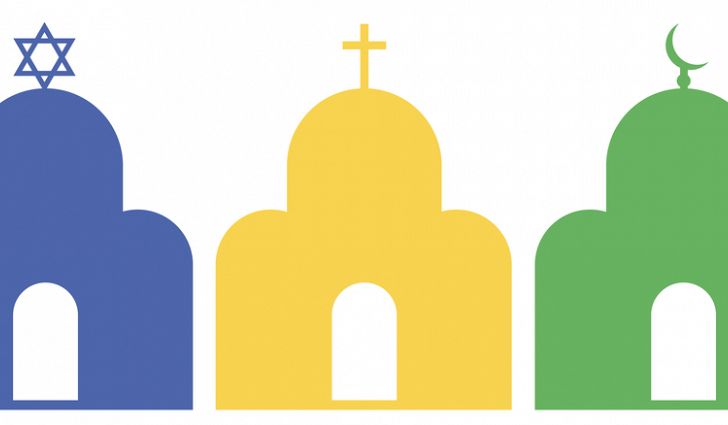
Epigraph
Say, ‘O People of the Book! come to a word equal between us and you — that we worship none but Allah, and that we associate no partner with Him, and that some of us take not others for Lords beside Allah.’ But if they turn away, then say, ‘Bear witness that we have submitted to God.’ (Al Quran 3:64)

Written and collected by Zia H Shah MD, Chief Editor of the Muslim Times
Shared Theological Foundations
Jewish, Christian, and Muslim traditions share core theological tenets that unite them in defending belief in God. All three are monotheistic, affirming the existence of a single, transcendent Deity who is the ultimate reality. They hold that God is the Creator of the universe, bringing it into existence from nothing and continually sustaining it with purpose and order. This implies that creation is intentional and meaningful, not a random occurrence, reflecting a divine purpose behind the world. Moreover, each faith teaches a moral order ordained by God – an objective distinction between right and wrong grounded in divine law or character. For example, all three uphold ethical principles like justice, charity, and honesty as universally binding, seeing these moral truths as rooted in God’s will. Such shared beliefs can be summarized as follows:
- One God: All three faiths worship the same one God (albeit understood in different ways) and reject polytheism. This common affirmation of a sole supreme being forms the basis of their united front against atheism, which denies any deity.
- Creation with Purpose: They agree that the universe is God’s creation and not an accident. The world is viewed as fundamentally good and purposive, reflecting God’s intent and design. Human life is thus imbued with meaning as part of a divine plan, a view starkly opposed to the atheistic idea of a purposeless cosmos.
- Divine Moral Order: Each tradition teaches that moral values are not human inventions but grounded in God. Whether through the Torah’s commandments, the teachings of Christ, or the Sharia, there is a shared conviction that ethical duties (like prohibitions against murder or injustice) have divine authority. This provides a unified stance that without God, objective moral obligations would lack any solid foundation.
Because of these shared theological foundations, the three Abrahamic faiths find common cause in defending theistic belief. They jointly argue that belief in one God who created the world with purpose and imbued it with moral order is more reasonable and compelling than atheistic or agnostic worldviews. In dialogue with skeptics, a Jew, Christian, or Muslim can each appeal to the idea of a transcendent Creator and lawgiver – a concept all of them endorse – thereby reinforcing one another’s case for theism. The unity on fundamentals (creation, divine purpose, morality) means an attack on one faith’s basic view of God is often seen as an attack on all. This solidarity encourages collaborative defenses of those fundamentals. By affirming a common ethical and metaphysical framework, Jewish, Christian, and Muslim philosophers present a united front: for example, the notion of God as the continuously creating and sustaining source of existence is central to all three, so they collectively counter any claim that the universe could exist and function meaningfully without such a divine source. In sum, their overlapping doctrines – one God, Creator, moral governor – give them a strong shared platform from which to champion theism over atheism.
Philosophical Traditions Bridging the Three Faiths
Beyond theology, there is a rich history of philosophical interchange among Jewish, Christian, and Muslim thinkers that enables them to speak a common intellectual language in defense of God’s existence. All three traditions have drawn on classical theism – a philosophical conception of God inherited from Greek thought (especially Plato and Aristotle) – which portrays God as the necessary, absolute, and perfect Being. In the medieval period, scholars of each faith embraced and developed this classical theistic model. For instance, the 12th-century Jewish philosopher Moses Maimonides emphasized God’s unity and transcendence in terms very similar to his Muslim and Christian counterparts. Maimonides’ Guide for the Perplexed articulates a conception of God as one, unchanging, and utterly beyond full human comprehension, reflecting principles of divine simplicity and perfection that Christians like Thomas Aquinas and Muslims like al-Ghazali or Avicenna also affirmed. Likewise, Islamic philosophers such as Avicenna (Ibn Sina) described God as the necessary existent – the one self-sufficient cause of all being – a notion that aligns closely with the Jewish and Christian understanding of an ultimate Creator. In short, thinkers in each tradition adopted and refined a common philosophical portrait of God (e.g. God as Unmoved Mover or Necessary Being), providing a unified intellectual framework for arguing God’s reality. This shared foundation in classical theism means that a proof of God’s existence formulated by a Muslim philosopher could be readily appreciated by a Christian or Jewish philosopher, and vice versa, because all recognize the same concept of a single, transcendent deity.
Crucially, medieval philosophers from the three faiths did not work in isolation – they built upon each other’s insights. There was a vibrant exchange of ideas that created bridges between their philosophical traditions. A famous example is the influence of Arabic philosophy (developed under Islam) on Jewish and Christian thought. In medieval Islamic lands like Baghdad and Al-Andalus (Muslim Spain), scholars of different religions collaboratively studied and translated Greek philosophical works, which fostered an interfaith philosophical enterprise. Many key texts of Aristotle were rendered into Arabic by Christian and Jewish translators and then studied by Muslim philosophers. These Arabic texts later reached Christian Europe (often via Jewish intermediaries in Spain), allowing Latin scholars to learn from Muslim commentaries on Aristotle. Thomas Aquinas, the great Christian theologian, openly acknowledges his debt to Islamic and Jewish thinkers. Aquinas interacted with the ideas of Avicenna and Averroes (Ibn Rushd) frequently in his writings, and he even cites Maimonides (“Rabbi Moses”) with respect. Historians note that Aquinas “studied Avicenna and learned Aristotle through Arabic translations”, as did Maimonides to an extent. In turn, Maimonides himself was influenced by earlier Muslim philosophers like al-Farabi and Avicenna in framing his arguments about God’s existence and attributes. This cross-pollination meant that a core body of philosophical arguments for God – such as versions of the cosmological argument or proofs from design and morality – was jointly developed. All three traditions cultivated forms of natural theology, using reason and evidence from nature to infer God’s existence. For example, Aquinas’s famous “Five Ways” of proving God (cosmological and teleological arguments) were built on Aristotle’s logic and overlap with Avicenna’s argument from contingency (the need for a necessary being) and with Maimonides’ rational proofs in the Guide for the Perplexed. The philosophical bridge is so strong that scholars speak of a single classical theistic heritage spanning the Abrahamic faiths: concepts like the soul’s immortality, the hierarchy of being, or divine providence were discussed in a comparative, interreligious context. Leading figures from each faith learned from and even depended upon one another’s work. Thus, when confronting agnostic or atheist viewpoints, Jewish, Christian, and Muslim philosophers can draw on a common arsenal of arguments honed collectively over centuries. Whether it is the ontological argument of Anselm and later Muslim theologians, or the cosmological arguments found in Aquinas, in kalām (Islamic theology), and in Maimonides – these become a shared intellectual property. The centuries-old dialogue among the three has created an interwoven philosophical tradition, enabling contemporary theist philosophers from each community to understand each other and present a unified philosophical defense of belief in God.
Common Moral and Existential Arguments
In addition to abstract metaphysics, Jewish, Christian, and Muslim thinkers collaborate by advancing moral and existential arguments for God’s existence that resonate across their traditions. All three faiths contend that without God, fundamental aspects of human experience – such as morality, meaning, and purpose – would be inexplicable or severely undermined. This gives rise to several common lines of argumentation against atheism:
- Objective Moral Values Require God: Each tradition strongly affirms the reality of objective moral truths – certain actions are truly right or wrong regardless of human opinion – and they often argue that such moral law presupposes a divine Lawgiver. If there were no God, these philosophers ask, what would ground the objectivity of moral values or duties? They maintain that moral realism (the view that some moral principles are universally true) “necessitate[s] belief in God’s existence, as if God does not exist, every evil and criminal activity would be permitted, and objective moral values would crumble.” In other words, without a higher moral authority, concepts of good and evil lose their foundation and we are left with mere personal or cultural preferences. This argument appears in all three faiths’ apologetics. For example, medieval Jewish and Muslim thinkers held that God’s commandments (mitzvot or the Sharia) define goodness, and scholastic Christian philosophers like Aquinas taught that the natural law is part of God’s eternal law. Historically, religion and morality were tightly interwoven in Western thought, so it is natural for Jewish, Christian, and Muslim philosophers to jointly insist that atheism fails to account for our deep-seated moral intuitions. They often point out, for instance, that our sense of human rights and dignity stems from the belief that humans are created in God’s image or are especially valued by God. Without theism, such inherent dignity and rights lack a secure basis. This moral argument for God’s existence is deployed across interfaith dialogues: a Muslim scholar and a Christian philosopher might together argue to a skeptic that the very fact we consider Nazi atrocities objectively evil (not just “in our opinion” evil) makes best sense if a righteous God exists to anchor moral truth. By collaborating on this point, the Abrahamic faiths present a united moral challenge to atheism – echoing Dostoevsky’s suggestion that “if God does not exist, everything is permitted.” Indeed, contemporary Muslim and Christian scholars explicitly state that if God is absent, “objective moral values” have no firm ground and all sorts of evil would be permissible.
- Meaning and Purpose in Life: The Abrahamic traditions also share an existential argument: they claim that life’s meaningfulness and human purpose fundamentally depend on God. In their view, a universe without God would be cold and indifferent – human life would have no ultimate goal, destiny, or reason for being. Theists from all three faiths often argue that on atheism, life has no ultimate meaning, value, or purpose. This sentiment has been articulated in modern philosophy of religion (for example, by Christian philosopher William Lane Craig, and echoed by Jewish and Muslim thinkers in their own words). All three religions teach that human existence is teleological: we are meant to fulfill a purpose designated by our Creator (such as serving God, cultivating virtue, or building a just society) and oriented toward a larger plan (like salvation or the hereafter). An atheist outlook that denies any creator or cosmic plan renders human life “accidental,” as Craig puts it – “the accidental by-product of nature… There is no reason for your existence. All you face is death.” Jewish, Christian, and Muslim philosophers argue that such a conclusion is existentially bleak and, importantly, untrue given our natural desire for meaning. Instead, they propose that the widespread human search for meaning is itself evidence of a higher truth: as C.S. Lewis (a Christian) once said, the fact that we thirst for meaning suggests we were made to find it – ultimately in God. Islamic writers, for instance, often note that the Quran states God created humans “only to worship Me” (Quran 51:56), implying a divinely ordained purpose, and similarly, Christian and Jewish scriptures affirm that “the whole duty of man” is to revere God and keep His commandments (cf. Ecclesiastes 12:13). In interfaith discussions, one might see a rabbi, priest, and imam all agreeing that if there is no God or afterlife, then noble endeavors (like moral striving or the pursuit of truth) have no ultimate payoff – an implication they find deeply unsatisfying and at odds with our moral experience. By emphasizing the despair or nihilism that atheism could entail, these philosophers collaboratively make a case that belief in God bestows meaning, hope, and direction to human life, whereas rejecting God risks moral nihilism and existential crisis. The moral and existential arguments thus reinforce each other: a personal God is presented as the answer to both the ethics question (“Why be good if no one made or judges the moral law?”) and the meaning question (“Why do we exist, and what gives our lives ultimate value?”). Across the Jewish, Christian, and Muslim spectrum, defenders of theism frequently return to these themes, supporting each other’s claims by drawing on shared values and narratives. For example, all can appeal to the story of Abraham or other figures who found purpose in serving the one God, as a counterpoint to modern tales of individuals lost in a godless universe. In sum, by arguing for a God-based foundation for morality and purpose, the three faiths collectively offer a powerful rebuttal to agnosticism and atheism on the level of human experience: they maintain that only theism can do justice to our conviction that life matters and moral duties are real.
Cultural and Historical Factors
The collaboration among Jewish, Christian, and Muslim philosophers is not just theoretical – it has been fostered by concrete cultural and historical interactions, as well as by facing common challenges. Throughout history, the Abrahamic faiths have frequently engaged in interfaith dialogue and scholarly exchange, creating a legacy of cooperation that modern thinkers can build upon. For instance, in the medieval Islamic world, especially in cosmopolitan centers like Abbasid Baghdad and later in Moorish Spain, scholars from all three religions worked together in translating and commenting on philosophical and scientific texts. This era of convivencia (“living together”) produced remarkable partnerships: Muslim, Christian, and Jewish intellectuals literally sat at the same tables in libraries and translation houses, sharing knowledge. A notable case occurred in 12th-century Spain after the Christian reconquest of Toledo. There, a Jewish scholar named Ibn Daud (Avendauth) collaborated with a Christian, Dominic Gundisalvi, to translate works of the Muslim philosopher Avicenna from Arabic into Latin
aeon.co. Such joint efforts made Greek and Islamic philosophy accessible to Europe and demonstrate that philosophy was an interfaith endeavor in practice. Likewise, medieval debate circles and letters show religious boundaries being crossed: the Jewish philosopher Maimonides and the Muslim Averroes were contemporaries in al-Andalus, studying many of the same ideas, and in Baghdad the Christian philosopher Yahya ibn ‘Adi corresponded with Muslim colleagues about Aristotle. These historical examples illustrate a tradition of intellectual cooperation – despite theological differences, thinkers of the three faiths recognized one another as partners in the pursuit of truth and as allies in defending belief in a higher reality against skepticism.
This legacy continued (with ebbs and flows) into later periods. Even amid religious conflicts, there were always voices calling for dialogue and mutual learning. In the modern era, common challenges posed by secularization, scientific materialism, and atheistic ideologies have prompted renewed collaboration. From the Enlightenment onwards, as Europe and the Middle East grappled with the rise of skepticism and the decline of religious authority in public life, Jewish, Christian, and Muslim scholars often found themselves in a similar position – needing to respond to criticisms of faith coming from rationalist or secular quarters. During the 19th and 20th centuries, all three communities confronted movements that marginalised religion (for example, communism or aggressive secular nationalism), and this encouraged a sense of shared fate. At times, they presented a united front on social and ethical issues: for instance, in defending the value of religious education or the importance of spiritual values against a purely materialistic worldview. The rise of “New Atheism” in the early 21st century (figures like Richard Dawkins and Sam Harris who were stridently critical of all religions) particularly galvanized interfaith cooperation. When atheists generalized their critique to all God-belief, it was natural for Jews, Christians, and Muslims to jointly rebut those critiques. A concrete example is the flurry of responses after Dawkins’s The God Delusion (2006): Christian apologists wrote detailed refutations, and Muslim intellectuals did as well – often echoing similar rebuttals (pointing out philosophical flaws, or defending the idea of revelation). Rather than working in isolation, there have been interfaith panels and publications addressing the claims of the New Atheists. For instance, conferences have been convened in which rabbis, priests, and imams publicly discuss why science and faith need not conflict, countering the atheist narrative that religion is obsolete. Such dialogues are sometimes sponsored by academic or interfaith centers and demonstrate a collegial approach to shared concerns. In some cases, documents or statements have been issued jointly by Jewish, Christian, and Muslim leaders affirming their common beliefs in God in the face of secularism. An example is a 2008 open letter titled “A Common Word Between Us and You,” initiated by Muslim scholars to Christians, which, while primarily about love of God and neighbor, also implicitly presented a united theological front; Jewish representatives later engaged with that initiative as well.
Importantly, modern scholars recognize that atheism as a widespread social stance is a relatively new development. Historically, open atheism “did not attain historical prominence” in most societies – for centuries, virtually everyone took some form of theism for granted, and debates were more often between different religions than between belief and unbelief. Now that atheism and agnosticism have become more common, religious philosophers have turned more attention to defending theism itself rather than just their denominational doctrines. This shift has encouraged solidarity among the Abrahamic faiths, who see that they have more in common with each other than with a materialistic or atheistic outlook. As one scholarly article notes, contemporary Muslim and Christian scholars seek forums to “respond to common challenges” together – challenges such as moral relativism, secularism, and unbelief that confront all faith communities. In sum, cultural and historical factors – from the golden age of interfaith scholarship in medieval times to the shared trials of modern secularization – have continually brought Jewish, Christian, and Muslim thinkers into conversation and alliance. This enduring tradition of dialogue and the recognition of common challenges have laid the groundwork for their collaborative efforts today in upholding theism.
Contemporary Interfaith Cooperation
In the present day, collaboration among Jewish, Christian, and Muslim philosophers continues robustly, often in academic and interfaith contexts aimed specifically at defending theistic belief in a secular age. Scholars from these three faiths regularly engage one another through conferences, journals, and organizations devoted to the philosophy of religion and theology. A number of interfaith academic initiatives explicitly bring together Abrahamic thinkers to explore and bolster the intellectual case for God. For example, the field of comparative theology and philosophy has produced projects like Towards a Jewish-Christian-Muslim Theology by Professor David Burrell, which examines how each tradition grapples with similar philosophical problems and how insights from one can enrich the others. Likewise, collaborative volumes such as Judeo-Christian-Islamic Heritage: Philosophical & Theological Perspectives (Marquette University Press, 2012) gather essays by Jewish, Christian, and Muslim scholars in dialogue. The introduction to that work emphasizes that these essays “represent a dialogue” among the three faiths and “highlight collaboration and common ground between these religious and philosophical traditions.”
In other words, contemporary academics are consciously building on the shared heritage to address new questions. They discuss topics like divine attributes, human freedom, and the challenge of scientism from a tri-faith perspective. A Muslim philosopher might contribute a paper on Avicenna’s proof of God alongside a Christian’s paper on Aquinas’s arguments and a Jewish thinker’s analysis of Maimonides – all in the same volume seeking a coherent theistic worldview. Such scholarship not only advances intellectual understanding but also sends a message of unity: it shows that belief in God is not parochial to one community, but a broad conviction upheld by multiple traditions in concert.
Beyond print, there are numerous interfaith forums and institutes where philosophers and theologians of the three faiths collaborate. Universities and think-tanks often host interfaith dialogues on science and religion or public debates pitting theists versus atheists where the theist side might be composed of a multi-faith panel. For instance, one might find a Christian philosopher and a Muslim philosopher co-authoring an article defending the rationality of belief in God in a secular philosophy journal, or jointly engaging an atheist philosopher in debate. Organizations such as the Templeton Foundation have funded projects that involve Jewish, Christian, and Muslim researchers examining questions like the origin of the universe or the nature of consciousness from a theistic perspective, thereby collectively responding to materialist interpretations. In the realm of public philosophy, we also see cooperative efforts: interfaith apologetics groups have emerged to address the youth on university campuses, where a rabbi, pastor, and imam might together answer questions about why God matters. These efforts underscore that while Jews, Christians, and Muslims have distinct doctrines, they can stand together on foundational assertions like “God exists and cares about humanity.” This unity is especially visible in ethical discussions – for example, interfaith coalitions defending the sanctity of life or the importance of spirituality for mental well-being, often countering secular arguments by appealing to shared theistic principles.
On a more institutional level, formal bodies like the Council for Interreligious Dialogue (in the Vatican) or various national interfaith councils include Jewish and Muslim representatives and frequently produce statements affirming belief in God and mutual respect. While these are not purely philosophical, they create a climate in which cooperative philosophical work thrives. Joint educational programs have also developed: courses on Abrahamic religions sometimes feature instructors from all three faiths teaching side by side, allowing philosophical comparisons that bolster each tradition’s understanding of theism. An illustrative modern practice is “Scriptural Reasoning,” where Jewish, Christian, and Muslim scholars study their scriptures together – often finding overlapping philosophical themes (such as creation or justice) and reinforcing the idea that revelation complements reason in upholding faith. Through these kinds of engagements, philosophers from the three religions not only defend theism but do so in a way that shows a unified front. It is not uncommon at academic conferences to hear a Muslim philosopher reference Aquinas or a Christian refer to al-Ghazali, acknowledging each other’s contributions in arguments for God’s existence. This cross-reference signals a continuation of the mutual learning that has been ongoing for centuries. Finally, contemporary interfaith cooperation is driven by a recognition that global challenges – including aggressive secularism, but also moral issues and even technological ethics – benefit from a united religious response. In confronting a worldview that discounts faith, Jewish, Christian, and Muslim intellectuals often find strength in solidarity. By pooling their rich intellectual resources, they present more compelling arguments than any could alone. For example, in tackling questions from neuroscience about the soul, a Christian philosopher might bring in Thomistic ideas, while a Muslim brings in Avicennian ideas about the mind, and a Jewish scholar adds Maimonides’ perspectives – collectively showing that belief in a soul and God has robust, cross-cultural support. This kind of synergy is increasingly common in academic journals and edited books. The overall result is a strengthening of the theistic position in contemporary discourse, backed by a chorus of different religious voices harmonizing on the same points. In summary, modern Jewish, Christian, and Muslim philosophers actively collaborate through scholarly dialogue and public engagement to defend theism. Their interfaith cooperation – visible in joint publications, dialogues, and organizations – demonstrates their shared commitment to upholding belief in God in the modern world and exemplifies how common theological ground and philosophical heritage translate into a common intellectual mission today.
Sources: The analysis above draws on historical and contemporary accounts of interfaith philosophical collaboration. Notably, all three Abrahamic religions uphold belief in one God as Creator and moral lawgiver ismailignosis.com, providing a united basis for theistic arguments. Classical theism’s concepts (e.g. God’s unity and transcendence) were embraced by medieval Jewish, Christian, and Muslim philosophers alike en.wikipedia.org, who frequently learned from each other’s works news.cornell.edu insightturkey.com. These traditions collectively argue that without God, objective morality collapses and life’s meaning is diminished ejrss.com reasonablefaith.org, reinforcing each other’s apologetic arguments. Historically, inter-religious scholarly cooperation — from translation projects in medieval Spain aeon.co to joint academic dialogues today — has strengthened their shared defense of theism epublications.marquette.edu. Each citation supports specific points made in the discussion.





Leave a Reply