

Epigraph
God is the Light of the heavens and earth. His Light is like this: there is a niche, and in it a lamp, the lamp inside a glass, a glass like a glittering star, fueled from a blessed olive tree from neither east nor west, whose oil almost gives light even when no fire touches it –– light upon light –– God guides whoever He will to his Light; God draws such comparisons for people; God has full knowledge of everything. (Al Quran 24:35)
Written and collected by Zia H Shah MD, Chief Editor of the Muslim Times
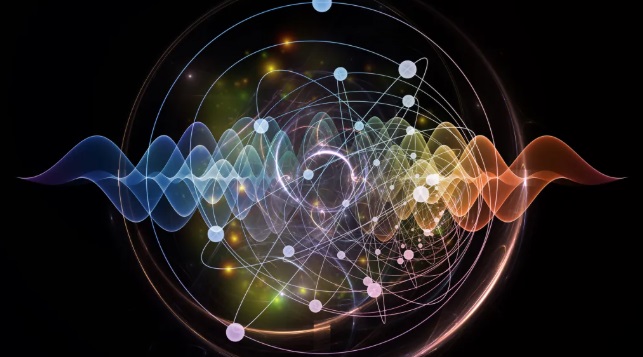
The central mystery of the double-slit experiment lies in the phenomenon of wave-particle duality, where particles such as electrons or photons exhibit both wave-like and particle-like behavior depending on the experimental setup.
Experiment Overview:
- Without “Which-Path” Detection: When particles pass through two slits without any measurement to determine their path, they produce an interference pattern on a detection screen, characteristic of wave behavior.
- With “Which-Path” Detection: If detectors are placed to ascertain through which slit each particle travels, the interference pattern disappears, and particles behave as individual entities, producing two distinct clusters on the screen.
This experiment challenges classical intuition, as it suggests that the act of measurement influences the behavior of particles, a concept that has profound implications for our understanding of reality.
Let us look at the mystery or the miracle of light from a different perspective.
Snell’s law describes how light bends, or refracts, when it passes from one medium into another with a different refractive index. It states that the ratio of the sine of the angle of incidence (the angle between the incoming light and the normal to the surface) to the sine of the angle of refraction (the angle between the refracted light and the normal) is equal to the ratio of the refractive indices of the two media. It is expressed in a simple equation. This law explains phenomena such as the apparent bending of a straw in water and is fundamental in understanding how lenses focus light.
In optics, the terms s-polarized and p-polarized light describe the orientation of light’s electric field relative to the plane of incidence when it interacts with a surface.
- Plane of Incidence: This is the plane defined by the incoming light beam and the normal (perpendicular) to the surface at the point of incidence.
- S-Polarized (Senkricht): The electric field of the light wave oscillates perpendicular to the plane of incidence. The term “s-polarized” originates from the German word “senkrecht,” meaning perpendicular.
- P-Polarized (Parallel): The electric field of the light wave oscillates parallel to the plane of incidence.
Understanding these polarization states is crucial in optics, as they influence how light reflects, refracts, or absorbs at interfaces between different media.
With little more sophistication and basic math we can calculate that at an angle of incidence of 60 degrees, approximately 2.07% of s-polarized light and 0.03% of p-polarized light is reflected from the water surface. For unpolarized light, the average reflectance is about 1.05%. The remaining light is primarily refracted into the water, with minimal absorption at this interface.
So far so good. Science is able to predict percentages and that is why our cameras and so many other technologies work.
But, what is not mentioned in undergraduate textbooks is that we are able to calculate percentages or probabilistic measurements. We know close to nothing about individual photon.
It’s impossible to predict with certainty whether a specific photon will reflect or refract; it’s a probabilistic process, determined by the material’s properties and interaction of the light with the material’s constituent atoms or electrons. While we can calculate the likelihood or proportion of reflection or refraction, individual photons don’t “choose” their path.
Here’s a more detailed explanation:
- Interaction of Light with Matter: When light encounters a material, the photons interact with its constituent atoms or electrons.
Reflection vs. Absorption/Re-emission:
- Reflection: Some photons may be scattered or re-emitted by the electrons, effectively reflecting the light.
Absorption: If a photon’s energy matches an energy level of an electron, it can be absorbed, and the energy is then converted to heat. This absorbed photon is effectively no longer there as a photon. Re-emission (Refraction): If a photon is absorbed and then re-emitted by an electron, the re-emitted photon’s energy can continue through the medium, causing a change in direction (refraction).
What determines the behavior of individual photons, is it reflected, refracted or absorbed? Scientists don’t have a clue. I am not proposing a God of the gaps. There is nothing that we can discover in the present three dimensions that we know that will give us more information about individual photons. They are being governed from some additional dimension that we cannot peep into. At least not at present!
Al-Ghazali’s occasionalism is a philosophical doctrine asserting that all events and interactions in the universe are direct results of God’s will, denying any inherent causal power to created entities. This perspective emphasizes God’s absolute omnipotence and the contingent nature of creation, challenging the notion of intrinsic causality within the natural world.
Key Aspects of Al-Ghazali’s Occasionalism:
- Denial of Secondary Causation: Al-Ghazali argued that what we perceive as natural causation is merely a habitual sequence established by God. For instance, when fire comes into contact with cotton, the cotton burns not because of the fire’s inherent properties, but because God directly causes the combustion at that moment.
- Critique of Philosophers: In his work The Incoherence of the Philosophers, Al-Ghazali challenged the views of Islamic philosophers like Avicenna, who posited that the world operates through secondary causes. Al-Ghazali contended that such a belief undermines God’s omnipotence, as it implies the existence of autonomous causal powers apart from God.
- Theological Foundation: Rooted in Ash’arite theology, Al-Ghazali’s occasionalism emphasizes that God’s will is the sole active force in the universe. This perspective maintains that attributing causality to created things detracts from divine sovereignty and leads to theological errors.
Implications of Occasionalism:
- Understanding of Natural Laws: While natural laws appear consistent, occasionalism posits that this regularity is due to God’s habitual practice rather than any intrinsic power within the objects themselves.
- Human Agency: This doctrine raises questions about human free will and agency, as all actions are ultimately attributed to God’s direct intervention. Nevertheless, free will can be understood as a contingent agency. It has causal power unless prevented by God.
Al-Ghazali’s occasionalism significantly influenced Islamic theology, reinforcing a worldview centered on divine omnipotence and the contingent nature of the created order.
Understanding the limitations of our scientific paradigm, which are not apparent in our secular culture, is the key to truly understanding God’s Providence and man’s free will. The universe we live in is not deterministic. It has enough indeterminism to provide for God’s Providence in all situations and ensure our free will in some domains.
If you have ever wondered that the Light verse of the Surah Noor is a seminal and fundamental verse of the Quran:
God is the Light of the heavens and earth. His Light is like this: there is a niche, and in it a lamp, the lamp inside a glass, a glass like a glittering star, fueled from a blessed olive tree from neither east nor west, whose oil almost gives light even when no fire touches it –– light upon light –– God guides whoever He will to his Light; God draws such comparisons for people; God has full knowledge of everything. (Al Quran 24:35)
If you haven’t pondered before, may I suggest doing so now and also respectfully request that take this article as a possible scientific commentary of this verse.
I conclude with a pithy quote from the best-known hero for the atheists, none other than Charles Darwin, as he quoted Francis Bacon from his book, Advancement of Learning, in the later editions of Origin of Species to establish the proper relationship between religion and natural science:
To conclude, therefore, let no man out of weak conceit of sobriety, or an ill-applied moderation, think or maintain, that a man can search too far or be too well-studied in the book of God’s word, or in the book of God’s works; divinity or philosophy; but rather let men endeavor an endless progress or proficiency in both.




Leave a Reply