
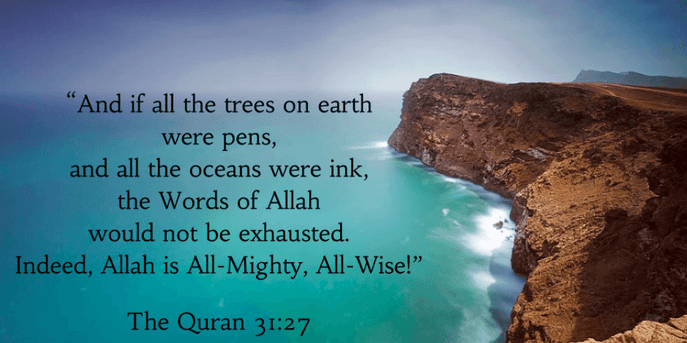
Verse Text:
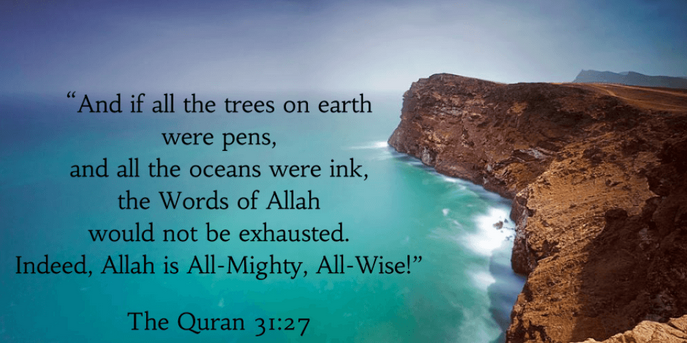
“And if all the trees on earth were pens, and the sea (were ink), with seven more seas added to it, the words of Allah would not be exhausted. Indeed, Allah is Almighty, All-Wise.” (Quran 31:27)
Written and collected by Zia H Shah MD, Chief Editor of the Muslim Times
This verse (Surah Luqman, Ayah 27) presents a vivid analogy to illustrate the infinite nature of Allah’s words, knowledge, and wisdom. Below is a comprehensive commentary that explores the verse from multiple angles:
- Classical Tafsir Analysis – insights from early Quran commentators (Ibn Kathir, Al-Tabari, Al-Razi, Al-Qurtubi, etc.) and the verse’s historical context.
- Linguistic Analysis – breakdown of key Arabic terms and rhetorical devices, highlighting the verse’s metaphorical and hyperbolic style.
- Theological Insights – the concept of Allah’s infinite knowledge, the relationship between divine speech and creation, and the attributes “Al-‘Aziz” (Almighty) and “Al-Hakim” (All-Wise).
- Philosophical & Spiritual Reflections – implications of infinite knowledge for human humility and understanding, including connections to epistemology and human limitations.
- Comparative Analysis – parallels with other Quranic verses (like 18:109) and similar concepts in other religious traditions (Judaism, Christianity), as well as perspectives from different Islamic schools of thought (Sunni, Shia, Sufi).
- Modern Reflections & Relevance – how this verse relates to contemporary discussions on science and knowledge, and how believers today can draw guidance and inspiration from it.
Each section below is structured with clear subheadings and concise paragraphs for readability.
1. Classical Tafsir Analysis
Early Commentators on Quran 31:27: Prominent classical scholars unanimously regard this verse as highlighting the boundlessness of Allah’s words, knowledge, and creative power. They stress that this imagery is metaphorical and not meant to imply a literal count of pens, seas, or words.
- Ibn Kathir (d. 1373 CE): In his Tafsir, Ibn Kathir explains that even if every tree were turned into pens and the ocean into ink (augmented by “seven more” oceans), those resources would break and run dry before encompassing all of Allah’s “words” – meaning His might, attributes, and majesty. The number seven is described as a symbolic figure indicating a huge quantity, not a literal limit. Ibn Kathir explicitly warns against assuming that exactly seven oceans exist beyond our world, noting this notion came from some Isra’iliyyat (Israelite stories) which cannot be confirmed. Instead, “seven” in Arabic often signifies countless abundance. He supports this with Surah Al-Kahf 18:109, where Allah says even if another ocean were added “like it” (implying repeatedly, one after another), the Words of Allah are inexhaustible.
- Al-Tabari (d. 923 CE): Although his full commentary on this verse is lengthy, Al-Tabari typically compiles narrations from the Prophet’s companions and their students. On 31:27, he would include reports (such as those from Ibn Abbas) affirming that Allah’s “words” refer to His knowledge and decrees, which are beyond measure. Tabari often quotes early Muslims like Qatadah and Ikrimah, who likely reiterated that kalimatullah (Allah’s words) encompasses everything Allah has ever said, commanded, or created by the word “Be” – an infinite reality that finite means (pens and ink) cannot record in full. (In Surah 18:109, it’s noted that Qatadah said: “The knowledge of Allah cannot be enumerated” in explaining that similar verse).
- Al-Qurtubi (d. 1273 CE): Al-Qurtubi, known for his legal and linguistic focus, emphasizes that the verse uses imagery to convey Allah’s infinite speech. He likely discusses that “words of Allah” can refer to:
- Revelations and Scriptures (though all revealed books combined are only a fraction of His words).
- Divine decrees and creative commands – since in Islamic theology, Allah says “Be, and it is” for everything that exists (His word “Kun” brings forth creation).
- His praises and attributes – which human language and writing can never fully encompass. Qurtubi would concur that “seven seas” is figurative, alluding to boundless replenishment.
- Fakhr al-Din al-Razi (d. 1209 CE): Al-Razi’s commentary (Mafātīḥ al-Ghayb – Keys to the Unseen) often delves into rhetorical subtleties. He notes the nuanced wording: “ ولو أنما في الأرض من شجرة أقلام…” – “If what is on the earth of (every) tree were pens…” Here, Razi observes the singular “tree” (shajaratun) is used in Arabic, followed by plural “pens” (aqlām), instead of saying “all trees” outright. This style paints a picture: imagine every tree (down to the last one) fashioned into writing instruments. He also explains why the verse mentions adding specifically seven seas of ink. Razi lists some classical reasons for the choice of seven:
- In many cultures (including Arab tradition), “seven” represents completeness or a very large number, as people commonly enumerate things in sevens for emphasis. For example, the sky is described in seven heavens, the week in seven days, etc., giving “seven” a sense of encompassing a full set. Razi explicitly states the intent is “not confinement to just seven”, but to imply “even if you added thousands of oceans, the point stands”. He cites that even if 1,000 oceans were added, they would still be finite.He mentions a linguistic subtlety: in Arabic counting, numbers restart after ten, so “seven” often stands as the remainder of a complete decade (10) to signify a large remainder or majority. Thus, invoking seven hints at pushing beyond the complete basic set of ten – symbolizing an overflow beyond completeness.Classical Arabic usage has the notion of “وَاو الثمانية” (“waaw of eight”) – adding “and” before mentioning an eighth item was seen as a stylistic marker because seven was mentally a stopping point. This implies the list (or quantity) has gone beyond the norm when you reach eight. Here, by the time you imagine an eighth ocean (the original sea plus seven more), you’ve already exceeded any normal measure.
- Writing typically runs out of ink before pens. A single pen could write volumes if constantly dipped in ink; it’s the ink that gets depleted fastest. Thus the verse underscores adding ink upon ink, yet still failing to write all of Allah’s words.By using all trees as pens, it shows an uncountable number of pens, and by multiplying the ink, it shows even limitless ink would dry up.
- Almighty (Al-`Azīz) – Allah’s power is absolute, hence His “words” (commands, creations) are limitless because His power to create and decree has no end. If His power had an end-point, the “words” (acts of creation or knowledge) would end – but they do not.
- All-Wise (Al-Ḥakīm) – Allah’s wisdom and knowledge are perfect and endless, and this verse affirms that by stating no amount of writing could capture the full scope of His wisdom.
- Historical Context (Asbāb al-Nuzūl): While Surah Luqman is generally a Meccan surah, some commentators (e.g., in Ma’ariful Qur’an and by Ibn Kathir) mention a story that this verse was revealed in Madinah. According to this report, Jewish scholars challenged Prophet Muhammad ﷺ after he recited the verse “You (all) have not been given of knowledge except a little” (Quran 17:85). They asked whether this referred to the knowledge of Muslims only or included Jews (who had the Torah). The Prophet ﷺ replied it included everyone – humanity at large. The rabbis protested, claiming that the Torah is a divine book of great knowledge (“an exposition of everything”). The Prophet ﷺ responded that even the total knowledge in the Torah is “little” compared to Allah’s infinite knowledge. Humans only grasp a fraction of even their own scriptures. It was to reinforce this point that Allah revealed 31:27, vividly affirming that even if you tried to write down all divine knowledge, you never could. This context (though not found in all tafsir works) illustrates the verse as a direct answer to those boasting of their scripture’s knowledge – all created knowledge is finite, whereas Allah’s “Words” (knowledge, commands, creative power) are infinite.
- Tafsir al-Jalalayn (15th c. Tafsir by Jalal al-Din al-Mahalli and Jalal al-Din al-Suyuti): The Jalalayn concisely paraphrases the verse: even if all earthly trees were pens and the sea, replenished by seven more seas, were ink “the Words of God would not be spent” – meaning all the things God knows and all His commands could never be fully written down. They add, “for His knowledge is infinite.” They also briefly parse the grammar, noting how “the sea” (al-baḥr) in Arabic is left indefinite here to generalize it, and how “seven more seas” is to stress overflowing replenishment, not a specific cosmic count. Jalalayn concludes: “Truly God is Mighty – nothing escapes His power – and Wise – nothing escapes His knowledge.” This ties Allah’s might to His infinite creative word, and His wisdom to His infinite knowledge, just as Ibn Kathir and Razi noted.
In summary, classical commentators understood 31:27 as an awe-inspiring parable about Allah’s limitless knowledge and power. They unanimously reject any literal interpretation that confines the meaning to a physical count of “seven seas” or tangible “pens.” Instead, they focus on the intended lesson: humanly imaginable resources would all be insufficient to enumerate Allah’s knowledge, wisdom, creative commands, and praises. This underscores both Allah’s majesty and our own limitations.
2. Linguistic Analysis
This verse is rich in Arabic rhetorical devices and choice vocabulary that deepen its impact:
- Key Terms and Phrases:
- “Kalimat Allah” (كَلِمَاتُ اللَّهِ) – “Words of Allah”: In Arabic, kalimat (words) can mean spoken or written words, but here it is a broad metaphor. Classical lexicons and tafsirs explain it as Allah’s commands, promises, praises, decrees, and knowledge. It includes:
- Revelatory words: His scriptures and revelations to prophets.
- Creative words: His command “Kun” (Be) that brings things into existence (every created thing is considered a “word” from Allah, as implied by some mystical interpretations; more on that later).
- Decrees/Qadar: Every destiny or decision from Allah is a “word” in the sense of His directive will.
- Attributes/Praises: Allah’s own descriptions of Himself, or words that would praise Him – these are endless because His perfection has infinite facets.
- “Midad” (مِدَاد) – “Ink”: The word midad literally means liquid for writing, i.e., ink. It comes from the root m-d-d, which conveys the idea of extending or replenishing (indeed, madd means to extend). Ink is called midad perhaps because it extends the writing or because it is poured out. It has a synonym ḥibr, but midad is used here likely due to its root connection to the next phrase (yamudduhu).
- In the verse, “al-baḥr u yamudduhu… midadan” is implied – “the sea, extending it (i.e., feeding it continuously) with seven more seas…” Here yamudduhu (extends it) echoes the same root m-d-d. This repetition is a subtle wordplay: the ink (midad) is “extended” (madd) by more seas. The alliteration and root echo reinforce the image of something being drawn out continuously, yet still running dry when faced with Allah’s words.
- “Sab‘atu abḥur” (سَبْعَةُ أَبْحُر) – “Seven seas”:
- Abḥur is the plural of baḥr (sea). By saying “seven seas” in addition to the first sea, the Quran illustrates a total of eight seas worth of ink (one original + seven added). But as mentioned, “seven” in Arabic often implies indefinite plurality. Much as we say in English “a million times thank you” meaning countless thanks, Arabic might say “seven” to mean several upon several.
- The use of “seven” also resonates with the listeners’ sense of completeness and superlative quantity (as discussed in Razi’s tafsir above). There’s also a rhythmic symmetry: sab‘atu abḥur has a ring to it, each word ending in “-u” in the classical pronunciation, giving it a poetic cadence.
- “Kalimat Allah” (كَلِمَاتُ اللَّهِ) – “Words of Allah”: In Arabic, kalimat (words) can mean spoken or written words, but here it is a broad metaphor. Classical lexicons and tafsirs explain it as Allah’s commands, promises, praises, decrees, and knowledge. It includes:
- Rhetorical Devices:
- Hyperbole (Mubālaghah): The entire verse is built on hyperbole – an intentional and obvious exaggeration to make a point. Classical Arabic literature uses hyperbole to praise, to vilify, or to express wonder. Here it’s to express wonder at the infinite nature of Allah’s knowledge. It’s effective because the audience can imagine the scenario (an impossible amount of writing materials) and then realize even that is not enough.
- Importantly, Quranic hyperbole is always in service of truth. It’s not lying or myth-making; it’s illustrative exaggeration. Similar hyperboles in Arabic include expressions like, “I’ve told you a thousand times” or “not even the seven heavens can contain…,” etc., which mean a great many times or nothing can contain respectively.
- The Quran itself uses hyperbolic language in other verses to emphasize magnitude. For instance, in Surah Al-Kahf (18:109), a verse almost identical to 31:27 is stated. Also, Surah Az-Zumar (39:67) says: “The entire earth in His grip on the Day of Judgment and the heavens rolled up in His right hand” – a visual hyperbole for Allah’s power over the universe. These devices make abstract ideas (like infinity) more graspable by human imagination.
- Metaphor and Imagery: There are layered metaphors here:
- Trees as pens: Trees don’t literally become pens, but this implies all natural resources dedicated to writing. In a pre-paper age, pens (qalam) were often reeds or sticks – essentially wood. So every piece of wood on Earth becomes a writing tool.
- Ocean as ink: The vast ocean is likened to an inkwell. Interestingly, calling the sea “ink” also hints that the ocean’s water is like fluid ink in quantity – that’s a lot of ink. It evokes the image of the ocean’s blue/black depths as an ocean of ink. Ancient listeners surrounded by deserts would appreciate how boundless the sea seems – and yet, even that is not enough.
- The Inexhaustible Speech: The notion of writing down “Allah’s words” until materials are exhausted is itself a metaphor for trying to enumerate Allah’s knowledge or describe His power – an impossible task. The pens and ink symbolize means of recording knowledge. Humans, even if immortal and equipped with infinite stationery, couldn’t catalogue all of God’s wisdom and creative acts.
- Syntax and Style:
- The verse starts with “ ولو ” (walaw), “And if…”. This construction sets up a conditional clause. Normally, a conditional sentence has two parts: “If X, then Y.” Here, the “if” part is extremely long (spanning the pens and ink scenario), and the “then” part is simply “ ما نفدت كلمات الله ” (the words of Allah would not be exhausted). By the time the listener hears the condition (imagine all these pens and ink), they’re anticipating the result. The stark brevity of the result clause – just a negation of exhaustibility – drives the point home. It’s like saying: “No matter what you had… you still wouldn’t finish writing God’s words.”
- Repetition of structure: “And if ALL the trees… and the sea… with seven more seas… (even then) not exhausted are Allah’s words.” The structure piles clause upon clause (“and… and… and…”) before negating the possibility of encompassing Allah’s words. This piling on in language mirrors the piling on of resources in the imagery – it’s cumulative.
- Climactic ordering: The verse could have said “If one sea were ink it wouldn’t suffice.” But instead it builds: first all trees as pens (a huge number of pens), then the sea as ink (a huge amount of ink), then seven more seas (multiply that ink many times). This escalation in the conditional part creates a climax – after which the statement “Allah’s words would not be exhausted” lands as a powerful conclusion.
- Sound and Rhythmic Elements: In the original Arabic, the verse has a beautiful rhythmic flow and end rhyme:
- The end of the “pens and ink” scenario is “…mā nafidat kalimātullāh”. The final clause is “…‘Azīzun Ḥakīm.” The -āt sound in kalimāt and the -īm in Hakīm give a pleasant rhyming closure with the next verse (31:28) which continues the rhyme scheme in that section of the surah.
- Many words in the verse carry long vowels and “m” sounds (shajaratun aqlām (tree[s] pens), sab‘atu abḥur (seven seas), kalimātullāh (words of Allah), ‘Azīz Ḥakīm). The recurrence of m (mīm) and a sounds produces a rolling, prolonged phonetic effect, perhaps subconsciously reflecting the idea of something being extended or unending.
- Hyperbole (Mubālaghah): The entire verse is built on hyperbole – an intentional and obvious exaggeration to make a point. Classical Arabic literature uses hyperbole to praise, to vilify, or to express wonder. Here it’s to express wonder at the infinite nature of Allah’s knowledge. It’s effective because the audience can imagine the scenario (an impossible amount of writing materials) and then realize even that is not enough.
- Significance of Hyperbole in Classical Arabic & Quran: As noted, hyperbole (mubālaghah) is a common feature in Arabic rhetoric. Importantly, when the Quran uses it, it often echoes known expressions or magnifies them further. There is evidence that the idea of “if the seas were ink and trees pens…” existed in various cultures:
- Jewish Tradition: Early rabbinic sayings have striking parallels. For example, Rabbi Yochanan ben Zakkai (1st century CE) is quoted saying: “If all the heavens were parchment, and all the trees pens, and all the oceans ink, they would not suffice to write down the wisdom I have learned…” and his student Rabbi Eliezer expanded similarly about scripture and wisdom. These expressions were meant to show that personal knowledge or Torah wisdom is inexhaustible. The Quranic revelation in 31:27 (and 18:109) might be seen as taking that familiar hyperbole and redirecting it to Allah’s knowledge instead of any human’s knowledge, thus correcting any exaggeration about human wisdom. It’s as if to say: if you think a sage’s wisdom cannot be fully recorded, then know that Allah’s knowledge truly cannot – by an even greater, unimaginable degree.
- Pre-Islamic or Other Cultures: Some research (notably by scholars like Reinhold Köhler) suggests such hyperbolic imagery might also appear in Indian traditions or other Middle Eastern culturestibeto-logic.blogspot.com. However, in the Quran it serves a clear theological purpose. It’s not borrowed without reason; it’s a familiar image used to convey the concept of infinity in a way listeners could grasp.
- Quranic Usage: The Quran uses hyperbole carefully to inspire reflection. Another Quranic hyperbole: “Even if you ask forgiveness for them seventy times, Allah will not forgive them” (9:80) – “seventy” here means no matter how many times (since Prophet Muhammad is not literally limited to 70 requests; it means their hypocrisy makes forgiveness untenable due to their own state). Likewise, “seven heavens” and “seven earths” in Quranic cosmology have sparked debate if “seven” is literal or a symbol of layers/magnitude. In 31:27 and 18:109, the context clearly shows it’s symbolic for a huge, uncountable quantity. This is widely accepted in tafsir.
- Idiomatic Interpretation: A loose paraphrase capturing the idiom could be: “Imagine using every tree for pens and the ocean as ink, refilled again and again seven times over – even then, you could never write out all of God’s words.” This helps non-Arabic speakers feel the idiomatic weight. It’s akin to saying “You could have endless ink and still fail to list everything about Allah.”
In summary, the linguistic aspects of 31:27 combine to produce a message that is expansive, eloquent, and emphatic. The vocabulary connects to themes of writing and abundance (pens, ink, seven seas). The rhetoric uses hyperbole and metaphor to drive home Allah’s infinitude versus creation’s finitude. The style (conditional clauses, rhythmic build-up) ensures the audience’s attention crescendos to the realization of Allah’s limitless nature. All these elements make the verse memorable and deeply moving, inviting believers to ponder the grandeur of divine knowledge in contrast to the narrow scope of human understanding.
3. Theological Insights
The verse carries profound theological implications about Allah’s nature and how we understand His attributes:
- Infinite Knowledge and Wisdom of Allah: The primary theological message is that Allah’s knowledge (‘ilm) is truly infinite and His wisdom (ḥikmah) is boundless. When it says “words of Allah” would not be exhausted, it conveys that:
- Allah knows all that has happened, is happening, and will happen – without any limit or lapse.
- His knowledge isn’t just broad in scope; it’s also deep in detail. Were one to start writing God’s knowledge of even a single subject (say, the biology of a leaf, or the life story of a single human), it would branch endlessly.
- Classical scholars sometimes differentiated knowledge (`ilm) and wisdom (ḥikmah): knowledge can encompass all information, while wisdom is knowing the proper context, purpose, and best course for everything. Allah is Al-‘Alīm (All-Knowing) and Al-Ḥakīm (All-Wise). This verse indirectly stresses both – because “His words” include wise purpose and governance of creation too. The last part “Indeed Allah is Almighty, All-Wise” explicitly ties the concept of unending words to these two names of Allah:
- Al-‘Azīz (All-Mighty): Allah’s power has no challenger and no end. Thus, the acts of power He can perform (each could be seen as a “word” of command) are endless. For example, creating one human or a billion humans is equal in ease to Allah (as the next verse, 31:28, states “Your creation and resurrection is only like that of a single soul”). He never tires from creating or decreeing.
- Al-Ḥakīm (All-Wise): Allah’s wisdom is perfect. There is no scenario, no possible question, no possible event outside the purview of His wise knowledge. So the meanings and purposes behind everything are fully known to Him – if one were to write those, it’s infinite. A scholar like Al-Razi pointed out: if Allah’s power were not limitless, His “words” (creative commands) would end; and if His knowledge were not limitless, the parable of the oceans wouldn’t make sense – but the verse affirms both are limitless.
- Divine Speech (Kalām) and Creation: In Islamic theology, there’s a concept of Kalāmullāh (Allah’s Speech). Traditionally, Ahl al-Sunnah (Sunni orthodoxy) say Allah’s speech is an eternal attribute – not a created thing – and the Quran, as Allah’s speech, is uncreated and part of that infinite speech (though the physical copies and the expressions in our world are created). This verse is often cited as evidence of the unending nature of Allah’s speech and knowledge.
- It also hints at the relationship between speech and creation: According to the Quran, Allah created the universe by His word “Kun” (Be). If each thing created is like a “word” from Allah (because it came by “Be”), then indeed the “words of Allah” in creation are as many as the things in existence – which are beyond count.
- Some theologians and Sufi mystics took this further, saying all existent things are “kalimat Allah,” words of God manifested in creation. For example, the great Sufi Ibn ‘Arabi said: “All existent things are the words of Allah which are inexhaustible because they originate from ‘Kun’…”. This means every creature, every atom, every event is like a word uttered by God’s creative command. Therefore, attempting to write down everything God has brought into being (and their inner realities) would indeed require infinite resources.
- Allah’s Attributes – Transcendence and Immanence: The verse balances two attributes:
- Transcendence (Allah’s Otherness): Emphasized by the unimaginable quantity of His words. It tells us that Allah is far beyond our finite world. No matter how vast the seas or abundant the forests, they are nothing next to His being. This fosters a sense of Allah’s transcendence (tanzīh – that He is utterly unlike creation in greatness).
- Immanence (Allah’s Nearness): Not directly mentioned, but implicitly, if Allah’s words are infinite, it also means His communication and involvement with creation is continuous. For believers, this can be comforting: Allah’s guidance, care, and responding to prayers are never “used up.” He speaks to us through revelation and inspiration without ever running out of words. (As an analogy: humans might run out of advice or patience, but Allah never runs out of guidance or mercy – those are also from the “words” of Allah in a broader sense).
- The combination “Almighty, All-Wise” also assures us that Allah’s power is always exercised with wisdom, and His knowledge always aligns with His power. He is not just infinitely knowledgeable while powerless, nor powerful without knowledge – He is perfect in both, which is essential to Islamic theology.
- Humans Given “Little Knowledge”: As referenced in the reported context (17:85 – “You have been given only a little knowledge”), our portion of knowledge is intentionally limited. Theologically, this humbles humanity: No matter how advanced science or scholarship becomes, compared to divine knowledge it is microscopic. This is a recurring Quranic theme:
- In Surah Al-Isra (17:85), the context was the soul (ruh) – a mystery humans can’t fully grasp, prompting that verse.
- In Surah Al-Kahf (18:66-70), Prophet Moses meets Khidr to learn humility in knowledge, and Khidr illustrates that Moses’s knowledge vs. Allah’s is like the water a bird takes from the sea vs. the sea itself. That famous hadith (found in Bukhari and Muslim) beautifully parallels 31:27’s message: the bird’s beak dripped a few drops from the ocean, symbolizing how even prophets and sages only have a few drops of the ocean of Allah’s knowledge.
- The verse thus reinforces a theological point: Only Allah is All-Knowing. Any claim of comprehensive knowledge by humans is false. Even the combined knowledge of all humanity (or all scripture) is “little”. In fact, no one can enumerate Allah’s praises or knowledge; a hadith from the Prophet ﷺ says: “I cannot count Your praises – You are as You have praised Yourself.” This hadith, quoted by Ibn Kathir, ties directly to the verse: if the Prophet himself says he can’t fully praise/describe Allah, it underscores the infinite gap.
- Divine Speech and the Written Word: The imagery of writing Allah’s words leads to a theological reflection on the nature of revelation and scripture:
- The Quran (and earlier scriptures) are a subset of Allah’s words – a set of communications suited for human guidance. They do not contain every detail of Allah’s knowledge (how could they!). Instead, they give us what we need for salvation and righteousness. This verse implies that not everything true or real is in scripture – only a selection, because the totality is endless. This counters any claim that God’s entire knowledge is encapsulated in any one book or books.
- Yet, the Quran calls itself “Tibyānā likulli shay’” (an explanation of all things, 16:89) and similarly the Torah as “containing guidance and light”. How to reconcile? Classical scholars say: “explanation of everything” means everything needed for faith and practice, or everything of its kind (principles that can be extended). Not literally every fact of physics or history. Quran 31:27 helps clarify that understanding – humans were boasting of having a complete record of knowledge (the Torah), and Allah corrects that perspective.
- Creativity and Ongoing Creation: Some theologians reflect that Allah’s creative activity could be ongoing. He is “Al-Khallaq” (The Ever-Creating). Modern cosmology aside, even within an Islamic view, Allah is continuously sustaining and bringing forth new events. Each of those is like a new “word” from Him (“Be, and it is”). Therefore, the inexhaustibility of His words can also hint that creation isn’t a one-time act after which God stopped “speaking”. Rather, every moment in time, every new occurrence is from His command. Theologically, this ties into concepts of continuous creation (tajaddud al-khalq) and the idea that if Allah ceased willing everything for even a moment, it would all vanish – thus His “speech”/will is constant and unending as the sustenance of existence.
- All-Mighty (Al-‘Aziz) and All-Wise (Al-Hakim):
- Al-‘Aziz implies might, glory, and that none can prevent His decree. In context, it reassures that if Allah wills to reveal something or create something, nothing could stop it – but also that He has the might to have endless words. Unlike humans who run out of strength or resources to keep speaking or creating, Allah never faces any such limitation.
- Al-Hakim implies every act or word of Allah is done with wisdom and purpose. If someone imagines “infinite words” they might think of babble or endless data with no point. The name Hakim clarifies that every one of Allah’s endless words is full of wisdom. He doesn’t just have quantity, He has quality in perfection. Thus, not only are we unable to write down all His words, we also cannot fathom the wisdom in each word without His guidance.
In theological summary, Quran 31:27 magnifies Allah’s transcendence and omniscience, positioning all creation as negligible by comparison. It humbles humans and jinn, and by extension, tells even the People of the Book (with their revered scriptures) that divine knowledge far exceeds what has been revealed. It encourages believers to acknowledge human limitations and to trust in Allah’s infinite wisdom and power. The verse steers us away from any arrogance of knowledge and towards a deep awe of God’s limitless attributes, emphasizing that only the Almighty, All-Wise could have such inexhaustible words.
4. Philosophical and Spiritual Reflections
Beyond formal theology, this verse invites profound philosophical contemplation and personal spiritual reflection. It has implications for how we view knowledge, reality, and our own limitations:
- Philosophical Implications of Infinite Knowledge: The concept of actual infinity has long been pondered by philosophers and mathematicians. Here we have a theological assertion of an actual infinity: Allah’s knowledge (and words) are not just extremely large, but truly infinite – they “would not be exhausted” no matter what.
- This touches on epistemology (the theory of knowledge): For humans, any knowledge we have is finite and bounded. We can’t even imagine holding an infinite set of facts. Our libraries, hard drives, and brains have limits. Even the idea of writing indefinitely is constrained by time if not materials. This verse suggests that what Allah knows is qualitatively different from human knowledge – not just more of it. It’s an entirely different order: unlimited in quantity and perfect in quality.
- Infinity in logic: If one tried to “record infinite knowledge,” one would never finish – it’s an unending task. This aligns with the verse’s scenario: no matter how many pens or how much ink, the task can’t end. It’s interesting that centuries before modern set theory or talk of actual infinities, the Quran gave an image for a set of knowledge so large that adding more writing resources doesn’t get you closer to the end (a bit like how in math, infinity plus infinity is still infinity; adding seven oceans still doesn’t bridge the gap between finite and infinite).
- Philosophers might ask: Can the infinite be truly comprehended by the finite? The Islamic answer implied here is no – we can’t fully comprehend Allah’s essence or His complete knowledge (as that would require us to have infinite capacity ourselves). This leads to an attitude of Agnosticism about the divine essence (we know that we cannot know it fully).
- Yet, we are invited to know something of God – enough for guidance. So Islam encourages knowing God through His names and signs, but also accepting the mystery of His total reality. This tension is present in the verse: it tells us about God (so we know He is infinite in knowledge), but also tells us we cannot fathom it completely.
- Humility and Human Limitations: Spiritually, reflecting on this verse instills humility (tawāḍu‘). When one realizes even an army of writers with endless ink could not enumerate what Allah knows, one is humbled about one’s own knowledge.
- Imam Ali ibn Abi Talib is reported to have said: “Knowledge is of two types – that which is absorbed and that which is just heard. The heard knowledge doesn’t benefit without the absorbed (internalized) knowledge. And no one will truly understand knowledge of God except that person who realizes God’s knowledge is far beyond him.” (Paraphrased) In other words, recognizing that Allah knows infinitely more is the beginning of wisdom for a person.
- This humility is not meant to discourage learning, but to keep intellectual arrogance in check. A scientist, scholar, or religious teacher might know a lot in their domain, but this verse reminds: compared to divine knowledge, it’s negligible – like a drop in an ocean.
- Such humility can lead to reverence (taqwa). When you feel awe at Allah’s knowledge, you become more conscious of Him. You might think: “Allah knows every thought I have, every secret in the universe; He knows the future and past completely.” This inspires one to be in awe and also to seek His guidance since He knows best.
- Reverence for Divine Wisdom: The mention of Allah being All-Wise (Hakim) suggests that everything in existence has wise purpose – even if we don’t understand it. Spiritually, a believer reflecting on 31:27 would be comforted that no problem or question is beyond Allah’s knowledge. When confused or facing unknowns, one trusts the One whose knowledge is limitless. This can bring solace: e.g., “I don’t know why this hardship befell me, but Allah’s wisdom is infinite; He knows things I don’t.”
- It reminds us of the lesson from the story of Moses and Khidr (in Surah Kahf 18:60-82): events can be puzzling or appear “bad”, but Allah’s knowledge holds the full picture. Moses saw seemingly bad events (a boat damaged, a boy killed) and objected, but Khidr (through Allah’s knowledge) showed the wise purpose behind them. At the end Khidr says (18:68) “How could you have patience in matters beyond your knowledge?” Indeed, humans often lack patience because we don’t see the whole story. 31:27 reassures that Allah does see the whole story – in fact, the story never ends for His knowledge. So, spiritually, this invites trust (tawakkul) in Allah’s wisdom.
- Inspiration to Seek Knowledge: Interestingly, while humbling, the verse can also inspire the pursuit of knowledge. Because if God’s words and wisdom are so vast, then any bit of knowledge we gain (scientific, spiritual, etc.) is a tiny sip from a vast ocean. It can ignite curiosity: What we don’t know is far more than what we know. For Muslim scholars, this has been a motivating factor historically to explore and learn, knowing that they’ll never exhaust the treasury of knowledge Allah placed in the world. Each discovery is like picking one seashell off an infinite shore.
- The humility prevents arrogance but the wonder fuels exploration. In that sense, the verse is connected to a kind of Islamic epistemic optimism: Allah’s knowledge is infinite, and while we can never reach its end, we are invited to keep seeking and be lifelong students. This is balanced by the realization that we must always say “Allahu a‘lam” (Allah knows best) about the many things we don’t know.
- Epistemology and the Value of Revelation: From an epistemological perspective, humans cannot know everything by themselves. So Allah, out of mercy, reveals some of His words for our guidance. But He chooses what to reveal in accordance with our needs and capacities, not everything He knows. This verse highlights the selective and merciful nature of revelation: God gives us what we can handle. For instance, had He tried to explain all secrets of the cosmos in the Quran, it would be overwhelming and mostly irrelevant for moral guidance. Instead, He reveals verses like 31:27 to let us know that there’s a vast unseen reality and that should be enough to instill humility and faith.
- Philosophically, one could say there’s an epistemic limit placed on creation by design – only Allah is Omniscient. All other minds are limited. This ties into the Islamic principle that certain knowledge (like the timing of the Hour, the reality of the soul, etc.) are known only to Allah (31:34 later in this surah gives examples: only Allah knows when and where one will die, what is in the womb fully, etc.).
- Spiritual Metaphor – Ocean of Knowledge: Many Sufi poets and thinkers expand on the metaphor of the ocean to symbolize divine knowledge or divine presence:
- Rumi, for example, might say we are like cups trying to hold the ocean – we can’t; instead we should dive into the ocean. The verse can be seen as an invitation to submit to the vastness of Allah – to metaphorically drown in that ocean of His attributes (meaning to lose one’s ego and accept God’s greatness).
- Attar or other mystics might interpret that the pens (trees) represent human intellects and tongues trying to describe God; the ink represents all efforts and expressions. It will end in silence and wonder, because one cannot enumerate Him fully. Thus, the highest state of knowing God might be a kind of silent awe (when the ink is exhausted and the pen breaks, one is left only with awe).
- This aligns with apophatic theology (known in Christian mysticism too): that ultimately God is beyond words (“ineffable”). After you say all you can, there is infinitely more unsaid. Spiritually, this means a true knower of God is one who deeply realizes how unknowable (in full) God is. Paradoxically, that ignorance is the beginning of real knowledge (knowing that one does not know except what God allows).
- Connection to Divine Love and Worship: When believers reflect on God’s infinite qualities, it can increase their love for Allah. Why? Because we usually love what we find admirable and beautiful. The idea that Allah’s attributes are inexhaustibly praiseworthy means one can never stop discovering new reasons to love and glorify Him. It prevents spiritual boredom or stagnation – worship of Allah remains ever-fresh, since there’s always more to appreciate.
- It’s said that in Paradise, part of the reward is that one continuously gains a deeper understanding of Allah’s names and attributes, an endless journey of knowing God, which results in endless increase in joy. Verses like 31:27 hint at that infinite horizon of knowing the Divine.
- Practically, even in this life, a reflective person might look at nature, the stars, or science and each time be struck by a new aspect of God’s wisdom, leading them to say “SubhanAllah!” (Glory be to God!). The words of praise also never exhaust because what they’re praising is endless.
In essence, Quran 31:27 beckons us to stand at the shore of an infinite ocean – Allah’s knowledge – and feel both small and uplifted. Philosophically, it separates Creator from creation in a clear way (infinite vs. finite). Spiritually, it encourages an attitude of perpetual learning, perpetual awe, and deep trust in Allah’s wisdom. It reminds us that our journey of understanding is eternal – there will always be more to discover about truth and about our Lord, so long as we remain sincere seekers.
5. Comparative Analysis
Within the Quran: This verse (31:27) has direct parallels elsewhere in the Quran and resonates with a broader Quranic theme of Allah’s unlimited knowledge:
- Surah Al-Kahf 18:109:“Say: If the ocean were ink for [writing] the words of my Lord, the ocean would be exhausted before the words of my Lord were exhausted, even if We brought the like of it as a supplement.” This is almost a twin of 31:27. The difference is that 18:109 is phrased as a direct command to the Prophet Muhammad ﷺ to “say” this statement, and it mentions “brought the like of it” (which as Ibn Kathir noted, implies you could bring another, and another, ad infinitum). Luqman 31:27 is phrased as a general statement (not a direct speech quote) and uses the tree pens imagery plus the number seven. Both together reinforce each other. It’s notable that one was revealed in Mecca (18:109) and one in Medina (per some accounts, 31:27) – showing the idea is fundamental enough to be repeated in different contexts.
- These verses also echo Quran 6:34 which says “There is none that can alter the words of Allah”, though there kalimat Allah might mean His decrees or promises specifically.
- Another related verse is 46:2 (and 41:42) describing the Quran: “It is sent down by the All-Mighty, All-Wise.” The pairing of ‘Aziz and Hakim is common when emphasizing the power and wisdom behind revelation or creation.
- Different Islamic Schools of Thought:
- Sunni Perspective: Largely covered above via Sunni tafsirs (Tabari, Qurtubi, Ibn Kathir, etc.). Sunnis see this verse as glorification of Allah’s attributes, and as an admonition against speculative theology that oversteps (as some Mu‘tazilites might over-rationalize divine attributes, Sunnis would say, “We accept He is infinite in knowledge as He said, and we stop there without trying to fully grasp the how.”). Sunnis also frequently quote this in discussions about the Quran being Allah’s uncreated word (since created things are finite, Allah’s speech is presented as infinite, hence uncreated).
- Shi’a Perspective: Shia commentators like Allamah Tabataba’i in Tafsir al-Mizan would agree on the fundamentals. Shia theology similarly holds God’s attributes are boundless. They might, however, bring in sayings from the Imams that echo the sentiment. For example, Imam Ali (a cousin and son-in-law of the Prophet, central figure in Shia thought) has many sayings about the knowledge of Allah. One du’a (prayer) attributed to Imam Ali says, “O God, even if all the pens in the world and all the ink in the oceans were used to write Your knowledge and praises, they would dry up before even a fraction of what could be said of You is recorded.” This is essentially a rephrasing of 31:27, indicating how deeply that concept is ingrained.
- Shia thought also often focuses on the infallible knowledge given to the Prophets and Imams, but always clarifies that even their knowledge is finite compared to Allah’s. For instance, Imam Ja’far al-Sadiq said: “Whatever knowledge we (the Ahl al-Bayt) have, Allah has more beyond it. We only have what He has gifted us.” This aligns with the Quranic perspective.
- Sufi Perspective: Sufis (Islamic mystics) might interpret “words of Allah” in highly spiritual ways. As mentioned, Ibn Arabi views every creature as a word. Sufis sometimes speak of the “endless ocean of Oneness” (Bahr al-Wahdah) from which creation’s waves arise. They would use this verse to dissolve the ego: “You, oh seeker, cannot fathom Allah – rather lose yourself in loving the One whose beauty and knowledge are infinite.” Sufi poetry might reference the idea:
- E.g., “The ink of the ocean is love, the pen of the tree writes fate; Who can recount the Beloved’s tale? The ink and pen break in awe.” (This is a hypothetical couplet aligning with the theme.)
- Many Sufi commentaries also take “Allah’s words” to include the ongoing revelation in the heart that a mystic perceives – endless insights and divine lessons unfolding within.
- However, mainstream Sufis would still stay within orthodoxy that God’s essence is ultimately unknowable fully and that any unveiling (kashf) a mystic receives is still just one drop from the ocean.
- Other Religious Traditions:
- Judaism: We saw parallels in rabbinic sayings. Judaism strongly emphasizes God’s wisdom, especially in the vastness of the Torah. There is a concept that Torah (as God’s word) is infinitely deep – every letter has layers of meaning. However, mainstream Judaism doesn’t describe God’s “words” in exactly the same imagery as 31:27 outside of those rabbinic hyperboles. They do, however, speak of Ein Sof (the Infinite) in Kabbalah – God’s infinite light and wisdom that transcends creation.
- Christianity: Christian theology also holds that God is omniscient (all-knowing). While not having a direct equivalent verse, Christians might relate 31:27 to verses about God’s unsearchable judgments and untraceable ways (Romans 11:33: “Oh, the depth of the riches and wisdom and knowledge of God! How unsearchable his judgments and untraceable his ways!” – here Paul expresses a similar awe that God’s wisdom is beyond tracing out). The Gospel of John verse already mentioned indicates a sense that Christ’s deeds (and by extension God’s works) are too many to be fully recorded.
- In some Christian hymns or writings, you find expressions like “Could we with ink the ocean fill, and were the skies of parchment made… To write the love of God above would drain the ocean dry.” Interestingly, this is from a 19th-century Christian hymn (The Love of God), which almost exactly mirrors the Quranic verse’s imagery. It’s said to be inspired by an 11th-century Jewish poem. Many Christians hearing 31:27 would find it a beautiful expression of God’s greatness that resonates with their own tradition of praising God’s infinite love and knowledge.
- Eastern Traditions: While not directly related, one could find analogous concepts in Eastern religions. For example, in Hindu thought, the Vedas are considered so vast that humans on their own can’t compile all divine knowledge – hence revelation is needed. Some Hindu texts have hyperbolic praise of Krishna’s knowledge or the knowledge in sacred scriptures in similarly poetic terms. Buddhism doesn’t speak of God, but it does speak of countless scriptures and teachings (the Buddha dharma is vast), though the parallel is weaker there since Buddhism isn’t theistic about an omniscient creator in the same way.
- Universality of the Concept: The idea that the Divine or Absolute truth is infinite and human expression falls short is a recurring theme across spiritual traditions. What the Quran does is give it a very concrete form (pens and ink) and ties it directly to Allah’s attributes.
Comparatively, therefore, Quran 31:27 stands as part of a tapestry of religious expressions pointing to transcendence. But it is uniquely authoritative for Muslims as the Word of God stating His own infinitude. It also serves as a point of bridge-building in interfaith understanding: a Jew or Christian can hear this verse and find familiarity and agreement in concept, even if the source is different. It highlights how all faiths ultimately acknowledge a gap between the finite and the Infinite.
6. Modern Reflections and Relevance
In the contemporary context, Quran 31:27 continues to be profoundly relevant – perhaps even more appreciable as human knowledge expands, yet the unknown expands even faster:
- Relation to Science and Knowledge Explosion: We live in an age of information explosion. Scientific knowledge has grown exponentially; libraries of data are accumulated; AI and the internet process billions of words. Yet ironically, the more we discover, the more we realize what we don’t know. For instance, cosmologists map billions of galaxies, but then grapple with dark matter and dark energy, which constitute the majority of the universe yet are unknown. On a tiny scale, biologists map the genome and then find complexity upon complexity in epigenetics, etc. The statement “you have not been given of knowledge except a little” (17:85) rings true even in the 21st century.
- Quran 31:27 in a scientific lens: Imagine using all the world’s supercomputers (the “pens” of today) and all the oceans turned into printer ink – you still could not print out a complete account of the universe. In fact, modern physics often describes the universe in terms of information. Some theorize the universe might be infinite or that there are multiverses. These are mind-boggling ideas, but a believer can reflect that even if multiverses exist, they too are within Allah’s knowledge, and His knowledge extends beyond even what exists.
- When scientists speak of theories of everything or final equations, an informed Muslim remembers this verse and stays humble: any theory of everything would still only describe the physical regularities Allah set in our observable universe. It wouldn’t encompass Allah’s own knowledge or purposes.
- Also, in an age where some put almost blind faith in science or human intellect, this verse is a beautiful reminder of intellectual humility. It’s not anti-science at all; rather it encourages science within the framework of humility and ethics, acknowledging a higher omniscience.
- Technology Metaphor: One could update the metaphor: If all hard drives on Earth were storage and all oceans were turned into ink for printers (or electricity for computers) and even multiplied by seven, the data of God’s knowledge would not be finished. Some modern Muslim educators actually use such analogies to explain the verse to youth, who might relate more to terabytes and clouds than to pens and ink. It shows the timelessness of the concept – whatever the peak of writing technology (quills, printing presses, supercomputers), the infinite gap remains.
- Divine Infinity in Philosophy and Physics: Modern philosophy grapples with the concept of actual infinities. Georg Cantor’s set theory proved that infinities can have different sizes (countable vs uncountable). Some cosmologists contemplate an infinite past or future. However, even if time were infinite or space infinite, those are still created infinities (if they exist) and would be fully known to Allah. The verse might challenge a philosophically inclined person to consider that the only true infinity is Allah (and His attributes). Any other “infinity” in math or physics is either an abstraction or something Allah willed and still encompasses.
- In contemporary debates about the universe, sometimes atheists say the universe could be eternal and infinite, removing need for God. But this verse and its like (and Islamic theology) assert that even if the universe were infinite, it’s not self-sufficient – it still wouldn’t match the knowledge and power of an infinite Creator. In fact, an infinite creation would demand an infinite Creator even more, one might argue, because sustaining an infinite existence requires infinite capability.
- Modern physics also hints at the informational content of black holes, entropy, etc. It’s as if the more we peer, the more it humbles us. A Muslim sees in those mysteries a sign of Allah’s wisdom that we have yet to grasp.
- Practical Life Application for Modern Muslims: How can a Muslim apply this verse in daily life today?
- Intellectual Pursuits: A Muslim scientist or student recalls this verse to maintain humility in research. For example, a physician might be highly knowledgeable, but this verse reminds them that healing ultimately is with God who knows the patient better than they ever could. So they combine their medical effort with du’a (prayer) to the All-Knowing for success.
- Dealing with Uncertainty: Life is full of uncertainty – personal, societal, global. This verse encourages reliance on Allah when we face the unknown. For instance, during a pandemic, there were many unknowns. Believers do their best (use medicine, precaution, knowledge) but also trust the One whose knowledge about the virus and everything is perfect. This can reduce anxiety – knowing an All-Wise God is in control even when humans are perplexed.
- Ethical Restraint: Sometimes the limitation of our knowledge is a reason to adhere to ethical guidance. For example, Islamic law might prohibit something that at first glance seems okay to us. A humble believer might say, “Perhaps there are harms I do not know; Allah’s knowledge is more – hence I obey His word.” Conversely, in doing good, we might not see the results, but trust that God knows the ripple effects (like charity or kindness, Allah’s words hint at unseen blessings that we may never fully trace).
- Continuous Learning and Adaptation: Muslim communities can take from this the impetus to always seek knowledge (the Prophet said seeking knowledge is a duty on every Muslim). This verse assures that learning is an endless well – there’s no point a community can say “we know everything, we can stop now.” This means embracing education, research, and scholarship as acts of worship, as long as they bring us closer to appreciating God and serving humanity.
- Interfaith and Dawah: In explaining Islam to others, one can use this verse to illustrate the Islamic concept of God’s greatness. It’s a very relatable image that often impresses non-Muslims. It can also show that Islam isn’t anthropomorphic (we don’t imagine God as a limited being), and that our scripture itself acknowledges the beyondness of God in a poetic way. In an age of sometimes overly literal or legalistic portrayals of religion, verses like this bring out the majestic, spiritual beauty of the Quran’s message.
- Contemporary Philosophy and Theology: Philosophers of religion today discuss “Divine Infinity” and “Omniscience vs. human free will” etc. A verse like 31:27, while not solving all philosophical puzzles, sets a clear scriptural foundation: God’s knowledge has no bound. This can play into discussions on open theism (which suggests God’s knowledge of the future might be limited – an idea the Quran would refute by verses like this) or process theology. Islamic thought, grounded by such Quranic verses, firmly maintains God’s omniscience is absolute and not subject to time. Modern Muslim theologians bring this verse in arguments about, say, the compatibility of God’s foreknowledge and our free will, emphasizing that God’s knowing everything doesn’t force us; it just means nothing is outside His sight.
- In quantum physics and chaos theory, unpredictability is key. But it’s unpredictable to us, not to God. Believers often take comfort that even if the world seems random (like particle behavior or weather systems), it’s all within Allah’s knowledge (and “written” in a metaphorical Book per Quran).
- Infinity in Mathematics vs. God: Mathematicians like Cantor were devout and saw in actual infinity something of the divine. Some Muslim thinkers today also reflect on how certain modern concepts echo this verse. For example, Cantor showed the set of real numbers is “uncountably infinite,” which is a larger infinity than countable infinity. A creative reflection: if we think of each real number as unique information, even that infinity is nothing to God’s knowledge – He knows not just a bigger infinity, but all levels of infinity and beyond, because numbers are merely abstract creations in minds.
- While such musings are not explicitly in the verse, they show how one might integrate faith with intellectual wonder: everything we discover that hints at boundlessness in the cosmos or mathematics can be seen as a sign (ayah) pointing to the truly Boundless One.
Relevance to modern discussions on divine infinity in philosophy and physics: Philosophers like William Lane Craig have debated the actual infinity concept in relation to cosmology, often arguing actual infinities can’t exist in reality (to defend the Kalam cosmological argument). However, even they would usually except God’s attributes as actually infinite, seeing them as qualitatively different. A Muslim could say: No actual infinity exists within the created order (space, time, matter might be finite or if infinite, bounded by God), but actual infinity does exist in the Creator. This verse is a strong textual proof that in Islam, God’s infinite nature (at least in knowledge and words) is taken as a reality, not just a metaphor.
Finally, for a general reader or believer, the enduring relevance is perhaps best captured emotionally: when you stand at a beach and look at the endless horizon, or when you see images from a space telescope of countless galaxies, you can recall this verse and feel a connection to its message. The world’s vastness gives a hint of Allah’s greater vastness. That feeling can make one both insignificant and significantly cared for (since Allah pays attention to even a sparrow, while holding all knowledge). Modern life’s complexities and uncertainties are thus framed within the care of an All-Knowing, All-Wise God. For modern Muslims, living perhaps in times of doubt or materialism, verses like 31:27 re-anchor the heart to the grandeur of Allah. It reminds them: there is an Author behind this cosmos whose intellect and power exceed all of human genius; align with Him, trust Him, and never think that the journey of understanding truth will run dry – it’s an endless adventure under His guidance.
Conclusion: Quran 31:27, with its eloquent hyperbole of pens and oceans, encapsulates a myriad of lessons. Classically, it taught the early Muslims and People of the Book that Allah’s wisdom far exceeds scripture and human knowledge. Linguistically, it mesmerizes with metaphor and alliteration, driving home the point of infinity through language. Theologically, it asserts Allah’s unique omniscience and omnipotence, forming a basis for humility in aqidah (creed). Philosophically, it beckons one to ponder infinity and recognize the limits of reason, while spiritually it guides the soul toward awe and trust. Comparatively, it aligns with a universal intuition across faiths that the Divine is beyond full expression. And in modern times, its truth only shines brighter as our intellectual horizon expands yet the unknown ever outstrips the known, reminding us that Allah’s knowledge is truly boundless – a fact that brings both wonder and comfort.
In short, Quran 31:27 humbles the intellect and elevates the spirit. It tells us: no matter how many words we speak or write in praise or description of God, there will always be “more” – for His attributes are inexhaustible. Thus, we bow in reverence to Al-‘Aziz, Al-Hakim – the Mighty in power and Infinite in wisdom – whose every “word” sustains creation and yet whose full story can never be penned by creation.
Sources:
- Tafsir Ibn Kathir (31:27)
- Tafsir al-Jalalayn (31:27)
- Ma’ariful Quran by Mufti Muhammad Shafi (interpretation of 31:27)
- Ruh al-Ma’ani (Al-Alusi) & Tafsir Mazhari – as quoted in Ma’ariful Quran (re: kalimatullah = Allah’s knowledge and wisdom)
- Tafsir Fakhr al-Razi (Mafātīḥ al-Ghayb) – analysis of the number seven and pens/ink metaphor
- Classical Jewish sayings (via Jacob Neusner’s work) showing parallel hyperbole
- Hadith of the bird and the sea (Moses & Khidr) – Sahih Bukhari, etc.islamqa.info
- AboutIslam.net – Allah is Infinite: How Can Human Minds Comprehend Him? (using 18:109 to discuss God’s infinitude)
- Reddit Islam Q&A quoting Tafsirs (Ibn Kathir, Jalalayn, Ma’ariful Quran on 31:27)
- Tibeto-logic blog citing the hymn “The Love of God” and Jewish parallels.
- Quranic verses: 17:85, 18:109, 42:11, 79:13 (implied by Razi’s reference to commands being one, like an eye blink) etc.


 The Glorious Quran and Science
Leave a reply to Hadith Qudsi for the Month of Ramadan – The Glorious Quran and Science Cancel reply