
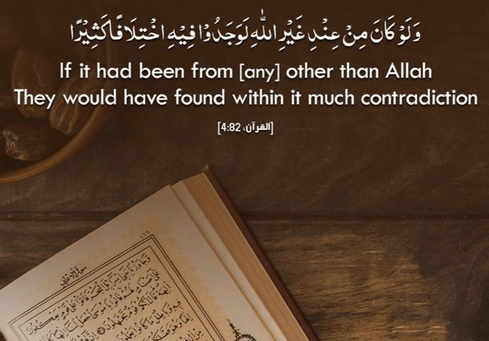
“Then do they not reflect upon the Qur’an? If it had been from [any] other than Allah, they would have found within it much contradiction.” (Al Quran 4:82)
Written and collected by Zia H Shah MD, Chief Editor of the Muslim Times
This profound verse challenges readers to ponder the Qur’an’s origin by examining its consistency. It asserts that true divine revelation will be free of internal discrepancies. Below, we explore classical and modern interpretations of this verse, its linguistic nuances, and its significance for Islamic thought, with references to scholarly sources.
1. Classical Exegesis (Tafsir)
Linguistic and Contextual Analysis
The verse opens with the rhetorical question “afalā yatadabbarūna al-Qur’ān” (أَفَلَا يَتَدَبَّرُونَ الْقُرْآنَ) – “Do they not then contemplate the Qur’an?” The key term here, yatadabbarūn (from tadabbur), means to ponder or reflect deeply. Classical scholars note the Qur’an deliberately uses this word instead of simply “read” or “listen,” indicating that careful reflection (not just cursory recitation) is required to appreciate the Qur’an’s truth. As one commentator observes, a superficial reading might lead one to imagine contradictions where there are none, whereas deep contemplation reveals the scripture’s harmony.
The latter part of the verse uses the phrase “ikhtilāfan kathīrā” (اخْتِلَافًا كَثِيرًا), meaning “much discrepancy/contradiction.” The word ikhtilāf in this context refers to disharmony or inconsistency in the message. By saying “much contradiction,” the Qur’an implies that a false scripture would contain numerous inconsistencies – in contrast, the Qur’an famously contains none. Even a single true contradiction would call its divinity into question, so the verse posits that the absence of contradictions is a hallmark of divine origin. Early Muslim authorities linked this verse to events in the Prophet’s time: it was addressed partly to hypocrites and skeptics who doubted the Qur’an. They are urged to reflect on the Qur’an’s content and recognize that its unity of message, despite being revealed over many years, is “a strong, persuasive testimony to its divine origin.”
Tafsir of Al-Tabari (9th Century)
Imam al-Tabari (d. 923), one of the earliest and most authoritative exegetes, explains that this verse challenges those who secretly plotted against the Prophet to consider the Qur’an objectively. He writes that if they examine “the Book of Allah” they would realize “that what you (O Muhammad) have brought them is from their Lord” because of “the coherence of its meanings and the harmony of its rulings”, with each part of the Qur’an confirming and supporting the truth of the other parts. In other words, the Qur’an’s teachings align perfectly with one another – its theological principles, moral laws, and spiritual themes form a unified whole. Tabari says had the Qur’an been from anyone other than God, “its rulings would have differed and its meanings contradicted, and some of it would point out the corruption of other parts.”
But since no such disharmony exists, the only conclusion is that it is entirely from Allah.
Al-Tabari bolsters his interpretation with reports from earlier authorities. For example, the renowned scholar Qatādah (d. 736) remarked: “Allah’s speech does not contradict itself; it is truth in which there is no falsehood. But people’s speech does contradict itself.”
This succinct observation – transmitted by al-Tabari – highlights the classical view that human words inevitably exhibit inconsistency, whereas God’s Word is perfectly self-consistent. Another early commentator, Ibn Zayd, is quoted by Tabari emphasizing that the Qur’an “does not negate some parts with others, nor cancel out itself.” Any perceived discrepancy, Ibn Zayd argues, is due only to “the deficiency of people’s understanding”, not any flaw in the revelation. He advised that a believer should accept “all of it is from our Lord” (echoing Qur’an 3:7) and “not strike some passages against others,” trusting that Allah never issues a statement only to contradict it later. Such early interpretations underscore that apparent contradictions are reconciled by knowledge, and believers must approach the text with humility and study, rather than haste in judgment.
Tafsir of Ibn Kathir (14th Century)
Ibn Kathir (d. 1373), another influential medieval exegete, echoes these themes in his commentary. He begins by noting that Allah “commands them to contemplate the Qur’an and forbids them from ignoring it or its wise meanings and eloquent words.”
Ibn Kathir emphasizes that the Qur’an is entirely true and perfectly wise. He writes: “Allah states that there are no inconsistencies, contradictions, conflicting statements or discrepancies in the Qur’an, because it is a revelation from the Most-Wise, Worthy of all praise.”
If it were otherwise – “had it been fraudulent and made up, as the ignorant idolators and hypocrites assert” – then “they would surely have found therein contradictions in abundance.”
The fact that the Qur’an contains no such conflict is, for Ibn Kathir, positive proof that “the Qur’an is the truth coming from the Truth – Allah.”
In support, he cites another verse with a similar admonition: “Do they not then think deeply in the Qur’an, or are their hearts locked up?” (47:24), linking a lack of reflection to spiritual blindness. Thus, Ibn Kathir frames 4:82 as both a challenge to skeptics and a reminder to believers: the Qur’an’s flawless consistency attests to its divine authorship, so one should deeply engage with it rather than turn away.
Ibn Kathir also relates a telling hadith (Prophetic report) about how Muslims should handle the Qur’an’s meanings. A group of the Prophet’s companions once debated the interpretation of a verse, raising their voices in disagreement. The Prophet Muhammad (ﷺ) became angry and said: “Indeed, the nations before you were destroyed by their disagreements over their prophets and by setting parts of their scriptures against others. The Qur’an was not revealed to belie (contradict) itself, but rather to confirm itself. So whatever you understand of it, act upon it, and whatever is unclear to you, refer it to those who have knowledge.”
This profound instruction — “the Qur’an does not contradict itself; it only confirms and clarifies itself” — was preserved by Ibn Kathir and others. It reflects the early Islamic understanding that any internal tensions in the text are only apparent, and with proper knowledge one finds all verses in agreement. Believers are thus urged to practice what is clear and seek guidance on what is unclear, rather than hastily declaring verses at odds. This hadith powerfully reinforces Qur’an 4:82’s message: sincere, holistic reflection will find unity, not discrepancy, in Allah’s book.
Tafsir of Fakhr al-Din al-Razi (13th Century)
Fakhr al-Dīn al-Rāzī (d. 1210), known for his analytical and philosophical approach in Mafātīḥ al-Ghayb (also called Tafsīr al-Kabīr), sees 4:82 as providing a logical proof of the Qur’an’s divine origin and of Prophet Muhammad’s prophethood. Razi explains that the disbelievers and hypocrites accused the Prophet of fabricating the Qur’an himself. Allah responds by pointing out that if that were true, the text would not be so internally consistent. Razi notes that over 23 years of revelation, delivered in varied circumstances, any human author would have erred or contradicted himself many times. The Qur’an’s complete freedom from inconsistency is therefore a compelling sign that it is “the Word of Allah Ta’ala (God Almighty)”, and thus Muhammad (ﷺ) “is a true Messenger of Allah.”
In Razi’s analysis, 4:82 is essentially a challenge and a verification principle: search all you want, it tells the skeptics – if this book were man-made, you would find many mistakes and contradictions in it. The absence of such flaws serves as tangible evidence of its divinity. Razi’s tafsir connects this verse to the broader doctrine of I‘jāz al-Qur’ān (the Qur’an’s miraculous inimitability), a point we will revisit later.
Al-Razi also discusses a topic that naturally arises from 4:82: the concept of naskh (abrogation) in the Qur’an. The Qur’an in a few cases replaces an earlier command with a later one (for example, a gradual prohibition of alcohol or changes in rules of warfare). Critics might question: isn’t abrogation a “contradiction”? Razi and other scholars answer no – abrogation is not a flaw or error, but a part of the divine plan in legislation. It means different rulings applied at different times, not that the Qur’an is internally incoherent. Classical scholarship developed the science of nasikh wal-mansukh precisely to examine apparently conflicting injunctions and determine which verse’s ruling is final. Verses that seem contradictory are studied in light of chronology and context, so one can understand which command was meant for earlier Muslims and which for later. As the Islamic scholar al-Khu’i summarizes, “two ordinances may appear contradictory; hence the later verse is regarded as the abrogator of the earlier.”
This process shows that no two definitive rulings ever applied at the same time in a conflicting way. In essence, what might superficially look like a contradiction is actually a repeal and replacement, both coming from the same divine source. Thus, classical exegetes did not view abrogation as violating Qur’an 4:82. On the contrary, they saw it as further evidence of the Qur’an’s wisdom and consistency – God’s message remained internally harmonious, while its practical legislation adapted perfectly to the evolving situation of the Muslim community. As Qatadah said, “God’s word is truth, not to be doubted,” and “people’s words (or understandings) are what differ.”
The onus is on the reader to study and understand, and when they do, the Qur’an’s perfection of design becomes apparent.
In summary, classical scholars like al-Tabari, Ibn Kathir, and al-Razi all converge on the view that Qur’an 4:82 is both an invitation and a challenge. It invites people to engage their intellect and heart in pondering the Qur’an’s message, promising that such pondering will reveal the scripture’s divine quality – its seamless unity and truth. And it challenges skeptics by providing a clear test: find a contradiction if you can. None has been found, as these scholars confidently assert, which only reaffirms faith in the Qur’an’s heavenly origin.
2. Modern Scholarly Perspectives
In modern times, Qur’an 4:82 continues to be a focal point for discussions on the Qur’an’s authenticity and miraculous nature. Contemporary Islamic scholars and thinkers have built upon the classical understanding with new insights, addressing scientific and historical questions and responding to modern critiques. Here are several perspectives:
- Single Authorship & Coherence Across 23 Years: Modern commentators frequently highlight how remarkable it is that the Qur’an remained consistent over the 23-year period of its revelation. Revelation came in pieces addressing varied situations – peace and war, family disputes, legal matters, spiritual themes – yet when compiled, those pieces form a perfectly integrated whole. Sayyid Abul A‘lā Mawdudi (d. 1979) writes that it is “inconceivable that any human being should compose discourses on different subjects under different circumstances and on different occasions, and that the collection of those discourses should then grow into a coherent, homogeneous and integrated work.” He notes that no part of the Qur’an is discordant with the others, and the entire book is “permeated through and through with a uniform outlook and attitude,” reflecting a consistent mood and spirit of its author. Moreover, the Qur’an is “too mature [from the start] ever to need revision” – unlike human works which often reveal growth, change, or edits over time. This constancy, Mawdudi argues, is persuasive evidence that the Author is one and the same throughout – not a human being, but God Almighty. Other scholars have made similar observations: the Prophet Muhammad ﷺ, being unlettered and without an editorial team, could not have kept the message so consistent if he were inventing it. Thus, 4:82 serves as what modern apologist Gary Miller called a “falsification test”: if someone doubts the Qur’an, they should try to find inconsistencies in its voluminous text revealed over two decades. The Qur’an essentially says “check for yourselves” – a very open invitation. The fact that it passes this test in the eyes of believers (and even many objective non-Muslim analysts) strengthens conviction in its divine authorship.
- Consistency with Scientific and Historical Truth: In the 20th century, with the rise of science, Muslim thinkers applied the logic of 4:82 to the realm of factual accuracy. If the Qur’an is from God, its statements should not conflict with the realities of the natural world or proven historical facts (since God, in Islamic understanding, is the Creator of the world and Knower of all history). Dr. Maurice Bucaille, a French medical doctor who studied the Qur’an in light of modern science, famously concluded: “Nothing here contradicts today’s data and, furthermore, none of the mistaken ideas of the time have crept into the Qur’an.” Bucaille was struck by the absence of any scientific errors or anachronisms in the Qur’an – which is extraordinary given the prevalent but incorrect scientific notions circulating in 7th-century Arabia (and medieval times generally). For example, the Qur’an describes stages of embryonic development, the role of water in life, the orbits of celestial bodies, etc., in ways that do not clash with modern scientific understanding – a fact that Bucaille and others argue would be impossible for an uneducated 7th-century man to achieve on his own. To Muslims, this is seen as the Qur’an’s knowledge coming from a divine source, the same point that 4:82 makes in general. Likewise, regarding history, the Qur’an’s accounts (e.g. of past prophets or events) have not been definitively proven false by any historical or archaeological evidence. On the contrary, in some cases the Qur’an resolves historical puzzles (for instance, identifying the Pharaoh of the Exodus as “Fir‘awn” without naming, which avoids chronological errors found in some Judeo-Christian sources) – again showing a consistency with reality that one expects of divine revelation. Modern scholars note that after 1,400+ years of scrutiny, the Qur’an has not been shown to contain a single confirmed historical contradiction or scientific falsehood. This empirical track record underscores the claim in 4:82 in a broader sense: had it been from other than God, errors would have been found within.
- Philosophical and Logical Insights: Some modern thinkers highlight the philosophical significance of Qur’an 4:82. The verse in effect teaches a rational criterion for truth in scripture – non-contradiction. This resonates with the law of logic that truth is self-consistent. In philosophy of science, a theory that produces contradictions is considered falsified. The Qur’an invites the same test upon itself, demonstrating a confidence in its own veracity. Noted scholar Fakhr al-Din al-Razi (as mentioned) took this verse as an proof of prophethood: if even one clear contradiction were found, that would be evidence against it being from God. Conversely, the more one fails to find contradictions, the more one’s confidence grows that the text is indeed from an Omniscient source. Some contemporary writers, Muslim and non-Muslim, have marveled at the boldness of this verse – that the Qur’an essentially dares critics to examine it. This has led certain modern apologists to call 4:82 “the Qur’anic challenge of consistency.” It’s often pointed out that it would have been unwise for an imposter to include such a verse in his own concocted book – for it gives enemies a clear target (find a mistake!). The fact that Prophet Muhammad did promulgate this verse, and the scripture emerged unscathed from centuries of scrutiny, is seen as confirmation of his sincerity and the Qur’an’s truth.
- Responding to Alleged Contradictions: Of course, detractors over the ages have attempted to point out contradictions in the Qur’an. Especially in polemical literature, one finds lists of “Qur’an contradictions” compiled by critics. Modern Muslim scholars have engaged with these critiques in detail, demonstrating how they stem from misunderstandings of the text. Common allegations involve things like differing accounts of the same story, or verses that appear to give different laws, or numerical discrepancies. Islamic scholars respond by carefully examining context, language, and the holistic Qur’anic narrative. Often, what seems like a contradiction is a matter of two verses addressing different aspects or circumstances. For example, one verse may seem to encourage patience with enemies while another permits fighting – but the contexts differ (one refers to times of peace, the other to active aggression), so there is no contradiction when context is restored. Another example: the Qur’an in one place says God created the heavens and earth in “six days” but elsewhere a total of “eight” days seem to be implied – scholars explain that the latter counts the same days differently, and a close reading shows it still sums to six overall (as the Arabic wording indicates overlapping timeframes). Such explanations show that the original Arabic and a proper contextual reading resolve the issue. Additionally, the science of naskh (abrogation), as noted, addresses apparent contradictions in legal rulings: if two commandments seem at odds, one might be a later update of the other, not an accidental discrepancy. Far from undermining 4:82, the concept of abrogation was historically seen as a way to maintain the Qur’an’s consistency: God revealed the appropriate rule at the appropriate time, and once the context changed, He revealed a new ruling – both are true in their respective contexts, and no two conflicting rulings applied to believers simultaneously. Modern scholarly responses also point out that many alleged “contradictions” are in fact due to translation issues or taking verses out of narrative order. The Qur’an is not arranged chronologically, and it often addresses multiple topics in one surah, so an inattentive reader might connect verses that were never meant to be compared directly. By doing “tadabbur” (deep analysis) as the verse commands, these issues are usually cleared up. In recent decades, numerous books and articles (and now, online resources) have been published by Muslim scholars addressing each claim of contradiction in turn, and showing harmonizing interpretations. One such resource remarks: “The words of Allah Ta’ala cannot have any discrepancies” – any perceived discrepancy in scripture must be resolved through scholarship, and indeed with proper understanding “the Words of Allah” are found perfectly consistent. This robust engagement in modern times demonstrates that Muslims take the directive of 4:82 seriously: the Qur’an invites scrutiny, and Muslims believe it withstands every scrutiny. In academic settings, some non-Muslim scholars have even acknowledged the Qur’an’s unusual consistency given its provenance. The Cambridge professor of Islamic studies, AJ Arberry, once noted that the Qur’an’s text has a “remarkable homogeneity” despite its length and varied content – a comment in line with 4:82’s claim. Overall, to this day no clear-cut, irreconcilable contradiction has been proven within the Qur’an’s text, and Muslims confidently uphold 4:82 as a standing challenge.
- Scientific and Philosophical Convergence: Interestingly, modern discussions also highlight how 4:82 bridges religious thought and rational thought. The verse validates the use of reason in examining revelation. This is in harmony with the Islamic view that authentic revelation and sound reason cannot truly conflict (since both come from God – one via scripture, the other via the intellect given to humans). As one writer put it, “By emphasizing observation, reflection, and reason, the Qur’an anticipates the scientific method.” While that may be a broad statement, the point is that verses like 4:82 encourage a rational, almost investigative approach to faith. Muslims today often quote this verse in interfaith dialogues to show that Islam does not demand blind belief – the Qur’an itself says, test this scripture. This rational test of coherence is appealing to many truth-seekers. In fact, some converts to Islam (especially from a scientific background) cite the intellectual satisfaction they derived from the Qur’an’s consistency as a factor in their conversion. They found that the more they studied, the more the pieces of the Qur’anic puzzle fit together, whereas in other texts they studied, contradictions multiplied. Such experiences are seen as personal validations of 4:82’s promise.
In summary, modern scholarship upholds Qur’an 4:82 as a timeless principle. Whether discussing theology, science, or history, contemporary Muslim thinkers use this verse to argue that the Qur’an’s truth is evident in its consistency. As one recent publication stated succinctly: “The Qur’an claims that it is free of contradictions. Any internal contradiction or a contradiction between the Qur’an and God’s laws in nature would disprove its divinity – yet none has been found.”
This confidence, born of both faith and analysis, keeps 4:82 at the heart of apologetic and scholarly discourse about the Qur’an in the modern world.
3. Implications for Islamic Thought
Beyond academic interpretation, Qur’an 4:82 carries profound implications for how Muslims approach their scripture and faith. It reinforces certain key concepts in Islamic thought: the importance of reflection (tadabbur), the doctrine of the Qur’an’s miraculous inimitability (i‘jāz), and an intellectual approach to faith that is used in dialogue and apologetics.
The Duty of Reflection (Tadabbur)
The first part of the verse – “Do they not reflect upon the Qur’an?” – establishes reflection on the Qur’an as an intellectual and spiritual duty. The Arabic word tadabbur connotes deliberation, analysis, and thoughtful engagement. This verse, therefore, is often cited by scholars as proof that every believer is obligated to ponder the meanings of the Qur’an, not just recite its words. As one modern exegesis says, the Qur’an “itself demands that every human being should ponder over its meanings”, and not assume that deep understanding is only for scholars. All Muslims, within their capacity, are encouraged to contemplate the teachings of the Qur’an and seek wisdom from it. This democratization of scholarship (with the caveat of proper method) has been important in Islamic history – it spurred the development of ‘ulūm al-Qur’ān (Qur’anic sciences) and tafsir literature by generations of scholars, all aiming to delve into the Quranic text. Indeed, as the Quranic verse at hand suggests, true understanding comes from reflection. For a Muslim, reading the Qur’an without reflection (tilāwah without tadabbur) is considered insufficient. The Qur’an in Surah 38:29 similarly says: “[This is] a blessed Book which We have revealed to you, [O Muhammad], that they might reflect upon its verses…”, and in 47:24 warns: “Will they not contemplate the Qur’an, or are locks upon their hearts?”. These verses reinforce the same principle found in 4:82 – that unwillingness to think over the scripture is a spiritual malady, while sincere contemplation opens the heart to guidance.
Classical scholars like Ibn Kathir took such verses as evidence that pondering the Qur’an is essential for strengthening one’s faith. And if one does ponder and still struggles, the solution is not to give up, but to seek knowledge from those more learned (as the hadith cited earlier instructs). In practical terms, Muslims are encouraged to study tafsir, learn Arabic, and discuss the Qur’an in study circles – all forms of tadabbur. The verse’s phrasing as a question (“do they not reflect?”) is also seen as gentle reproach; it’s as if Allah is saying there is no excuse for not thinking about the message He sent.
Furthermore, 4:82 implies that faith and reason go hand in hand. Far from portraying faith as irrational, Islam here makes using one’s reason an act of faith. To “reflect upon the Qur’an” is to use critical thinking in the service of understanding God’s word. Many Muslim thinkers have lauded this as one of the Qur’an’s unique aspects. It essentially tells the believer: the more you scrutinize this Book, the stronger your belief will become. This has shaped an Islamic intellectual culture that values reason and research. As the Encyclopaedia of the Qur’ān notes, “the Qur’an repeatedly invites people to think, reflect, use their intellect (aq’l)” – a tradition stemming from verses like 4:82.
It’s worth noting that this spirit of reflection isn’t meant to lead to endless skepticism, but rather to an ever-increasing appreciation of the Qur’an’s guidance. The verse indicates that honest reflection will yield the conclusion that the Qur’an is free of flaws – which in turn bolsters one’s faith in its guidance. Thus, tadabbur is portrayed as a path to conviction and deeper spiritual insight. Islamic devotional literature also picks up on this: Muslims are taught that reading a small passage of Qur’an with understanding is better than rushing through many pages without thought. The “light” of the Qur’an enters the heart of the one who contemplates it. This is beautifully summarized by the renowned scholar Imam al-Ghazali, who said that when one reflects on the Qur’an, one should “pause at every verse and seek to understand it, as if Allah were speaking to you directly.” Such an approach transforms the act of reading into a thoughtful conversation with the Divine, exactly as Qur’an 4:82 urges.
In contemporary times, there is renewed emphasis on ordinary Muslims engaging in tadabbur. Educational initiatives, books, and lectures often cite 4:82 to remind the Muslim community that the Qur’an invites questions and contemplation. Far from being discouraged, asking questions with sincerity is considered part of Islamic learning. The verse assures believers that they will not be led astray by questioning the text’s meanings – if done respectfully – because deeper study will only uncover more wisdom and consistency. This has also played a role in Muslim responses to doubts: rather than shying away from verses that are difficult or often attacked by critics, scholars encourage believers to dig into those verses even more, trusting that clarity will emerge. All of this reflects the Quranic philosophy encapsulated in “afalā yatadabbarūn al-Qur’ān” – reflecting on the Qur’an is not only an intellectual exercise but a form of worship that can strengthen one’s bond with Allah.
Reinforcement of Qur’anic Inimitability (I‘jāz al-Qur’ān)
The doctrine of I‘jāz al-Qur’ān holds that the Qur’an is a miracle – inimitable by human effort – and thus proof of Muhammad’s prophethood. Traditionally, this doctrine has several facets: the Qur’an’s unparalleled eloquence, its profound guidance, its prophecies, its impact on hearts, etc. Qur’an 4:82 highlights another facet of this miraculous quality: the Qur’an’s internal consistency. The argument is that no human, especially one who is unlearned and living in a challenging environment, could author a book of such breadth without slipping into contradictions. The Qur’an’s unity of message and freedom from discrepancy is therefore seen as miraculous. Classical scholars like al-Baqillani (d. 1013) wrote about the Qur’an’s consistency as one aspect of its inimitability – noting, for instance, that unlike other religious or literary works that show multiple styles or evolving ideas (especially if authored by multiple people or over a lifetime), the Qur’an reads as if it were delivered all at once, even though it was revealed gradually. This, they argued, is part of its “amazing” nature granted by God.
Qur’an 4:82 itself can be viewed as a statement of i‘jāz. By stating that no contradictions are found in it, the verse is effectively claiming a miracle (since every large book by a human has at least some inconsistencies or errors). History has borne out this claim in the eyes of Muslims: many have tried to find faults, but each attempt has been resolved or rebutted. The challenge aspect of this verse complements the other Qur’anic challenge (found in verses like 17:88 and 2:23) to “produce a surah like it”. In Islamic apologetics, these challenges are often presented together: If you think Muhammad authored the Qur’an, then produce even a single chapter with the Qur’an’s literary excellence (you won’t be able to), or find a contradiction in it (you won’t be able to). Either feat would disprove Islam – but neither has ever been accomplished. The inability of opponents to meet these challenges is taken as a sign of the Qur’an’s miraculous nature. As one scholar quipped, the Qur’an is self-authenticating – it carries the proof of its divinity within its own content.
The consistency of the Qur’an also reinforces the Muslim belief that the Qur’an has been perfectly preserved. Since God promised a scripture without contradictions, Muslims hold that He also ensured its text was reliably transmitted so that no alterations introduced contradictions either. (The Qur’an itself in verse 15:9 promises to guard the revelation from corruption.) This preservation is another element of i‘jāz: the Qur’an remains today in the same form, and with the same consistent message, as when revealed. So 4:82 indirectly ties to the idea of textual integrity – the Qur’an’s message could only stay contradiction-free if it was not tampered with. Indeed, Muslim tradition maintains that the companions of the Prophet compiled the Qur’an exactly as revealed, and since then, countless memorizers (huffāz) and manuscripts have preserved it across the world. Thus, anyone, anywhere, in any era, can apply the test of 4:82 to the Qur’an and get the same result. This global and timeless applicability of the verse’s challenge is in itself remarkable and speaks to the Qur’an’s universality.
Moreover, the Qur’an’s internal harmony enhances its spiritual impact. Believers experience the Qur’an as a coherent conversation with their Lord – a text where themes interweave and ideas reinforce each other, creating a powerful cumulative effect. One scholar of Quranic linguistics, Neal Robinson, likened the Qur’an to a symphony: motifs (themes) are introduced, dropped, and later picked up and expanded, all in perfect balance. This literary and thematic coherence moves listeners emotionally and intellectually – a phenomenon noted since the first listeners of the Qur’an, who despite rejecting its message, often admitted that “it deeply affected them and was unlike any human speech” (as in the famous account of al-Walīd ibn al-Mughīrah). Such coherence, especially coming from an untutored person, was seen as beyond human capacity. Thus, 4:82 underpins the broader Muslim conviction that no human or group could replicate the Qur’an, because even if they tried to copy its style, they could not guarantee the total absence of mistakes or contradictions over a large text. Human fallibility would show itself sooner or later – but the Qur’an exhibits no such thing, hence it is infallible and divine.
In summary, Qur’an 4:82 strengthens the doctrine of i‘jāz by highlighting a miracle of consistency. It reassures believers that studying the Qur’an deeply will only reveal more layers of wisdom and agreement, not hidden flaws. This feeds into a virtuous cycle: the more one studies the Qur’an, the more one is convinced of its perfection, which in turn inspires deeper love and adherence to its guidance. For the Muslim mind, the unity of the Qur’an is reflective of the unity of God (tawhid) – just as God is one and without partner, His message is one without contradiction.
Use in Contemporary Apologetics and Interfaith Dialogue
Finally, Qur’an 4:82 plays a significant role in how Muslims present their faith to others and defend the Qur’an against criticism. In dakwah (inviting others to Islam) or interfaith dialogues, it is common for Muslim speakers to reference this verse. It encapsulates a talking point that Islam prides itself on: the harmony between faith and reason. While adherents of other faiths may shy away from examining their scriptures’ consistency (knowing there are problematic passages or contradictions within), Muslims often encourage an open examination of the Qur’an. They will say, “By all means, read our holy book critically – you won’t find it wanting.” This confidence largely stems from the Quranic assurance in 4:82.
In debates, Muslim apologists sometimes contrast the Qur’an’s coherence with the textual issues in other scriptures. For instance, they might point out that the Bible, as it exists today, contains multiple authors and versions that lead to internal discrepancies – whereas the Qur’an, with one author (God) speaking through one messenger, remains consistent. This is not meant to disparage others’ faith as much as to highlight what Muslims see as a unique strength of the Qur’an. The argument goes: God’s message should be uniform and free from error; the Qur’an meets that criterion, which is why Muslims trust it as the final revelation. Indeed, early Muslim scholars like Ibn Hazm (d. 1064) wrote works enumerating contradictions in the Bible to argue that previous scriptures had been altered, whereas the Qur’an came to restore the pure monotheistic message without contradictions. Such arguments, while apologetic in nature, are rooted in the principle of 4:82 – that contradiction is a sign of human interpolation, not divine revelation.
In interfaith panel discussions today, a Muslim might politely challenge others with something like: “My scripture explicitly invites me (and you) to verify its authenticity by searching for errors. Has any other religious scripture put forth a similar challenge?” This often sparks fruitful conversation. Even if non-Muslims don’t accept the divine claim of the Qur’an immediately, they gain respect for the Islamic emphasis on reason and textual integrity. Many are intrigued that a religious text is confident enough to invite critique. In some cases, this has led skeptics to read the Qur’an looking for contradictions – only to emerge impressed by its coherence and, in a number of instances, embracing Islam as a result. Such stories are often shared in the Muslim community as modern testimonies to the power of Qur’an 4:82.
Moreover, this verse has shaped a common Muslim approach to doubt: when Muslims themselves encounter anti-Islamic writings that claim the Qur’an has contradictions, they remember 4:82 and take heart that there must be an explanation even if they don’t see it immediately. It encourages them to research and ask scholars, rather than lose faith. Thus, 4:82 functions almost like a safety net for believers’ faith in times of confusion. It’s not uncommon to hear a Muslim say, “I don’t have the answer to this apparent contradiction right now, but I’m sure one of our ulema (scholars) has explained it – because Allah told us in the Qur’an there are no contradictions.” This confidence is not blind; it is based on the historical track record of the Qur’an surviving all such scrutiny. It motivates continued learning and engagement with the text.
Conclusion
In conclusion, Qur’an 4:82 is a verse of immense significance in Islam. Classical scholars read it as a profound argument for the Qur’an’s divine origin and a directive to engage deeply with scripture, and modern scholars have expanded that discussion to science, history, and interfaith relations. The verse encapsulates the Qur’anic worldview that truth stands clear and can be discovered through earnest reflection. It has inspired a rich tradition of tafsir and intellectual inquiry in the Muslim world, and it remains a linchpin in the Muslim assertion that the Qur’an is a flawless, living miracle. As Allama Muhammad Iqbal, a 20th-century Islamic thinker, once noted (paraphrasing 4:82): “Open the Qur’an and read it with an eye to find its weaknesses – and you will instead find a wondrous coherence in every page.” That “wondrous coherence” is what Qur’an 4:82 directs us to witness, as a proof and a reminder of the Qur’an’s source: “from none other than Allah.”
The apparent contradictions are resolved as we ponder the Quran and enhance our religious, scientific, and philosophical knowledge. In an exceptional situation, if we find the Glorious Quran in conflict with contemporary secular knowledge, advances in the latter will eventually resolve the conflict.
Inspired by its truth, when we give it reign over our emotional, intellectual, and spiritual lives, the paradoxes in our lives resolve into a harmonious and serene daily existence in all aspects.
Sources
surahquran.com Ibn Kathir, Tafsīr al-Qur’ān al-‘Aẓīm, on Qur’an 4:82 – Emphasizing that the Qur’an, as Allah’s revelation, contains no inconsistencies or conflicting statements, unlike any human-authored text.
surahquran.com Al-Tabari, Jāmi‘ al-Bayān fī Tafsīr al-Qur’ān, 4:82 – Explaining that the Qur’an’s perfectly aligned meanings and rulings testify to its divine origin, since a non-divine source would have produced many discrepancies, with parts negating each other.
surahquran.com Sayyid Abul A‘la Mawdudi, Tafhīm al-Qur’ān, commentary on 4:82 – Arguing that it is inconceivable for discourses delivered over years by a human to form such a consistent, integrated work as the Qur’an does, thus the Qur’an itself powerfully bears witness to its divine source.
muslimanswersfiles.wordpress.com Fakhr al-Din al-Razi, Mafātīḥ al-Ghayb (The Great Tafsir), on 4:82 – Noting that Allah revealed this verse to prove Prophet Muhammad’s truthfulness: if the Qur’an were his own invention, it would contain “a great deal of discrepancy,” but its total consistency proves it is the Word of Allah and a miracle of Prophethood.
quran.com Mufti Muhammad Shafi, Ma‘āriful Qur’ān, vol. 2, p. 404-405 – Highlighting the choice of the word “yatadabbarūn” (ponder) in 4:82, which indicates that everyone is encouraged to reflect deeply on the Qur’an. Only through thoughtful deliberation (tadabbur), as opposed to mere cursory reading, can one appreciate that the Qur’an has no real contradictions.
adelhasanin.yolasite.com Dr. Maurice Bucaille, The Bible, The Qur’an and Science – Observing that the Qur’an shows an astonishing absence of scientific errors or the common myths of antiquity, such that “none of the mistaken ideas of the time have crept into the Quran.” This scientific consistency aligns with Qur’an 4:82’s claim of no contradictions.
en.wikipedia.org“Muslim views of criticism” in Wikipedia: Criticism of the Quran (retrieved) – Describing the Islamic science of naskh (abrogation) which deals with apparently contradictory verses by determining which verse supersedes the other. This is cited to explain that classical scholars managed seeming conflicts via abrogation, thus maintaining the Qur’an’s overall consistency as per 4:82. A better way is to consider one of the verses as fundamental and explaining the other in its light.



 The Glorious Quran and Science
Leave a reply to Pondering Qur’an 4:82 – A Psychological, Philosophical, and Theological Commentary – The Glorious Quran and Science Cancel reply