
Epigraph
الَّذِي خَلَقَ سَبْعَ سَمَاوَاتٍ طِبَاقًا ۖ مَّا تَرَىٰ فِي خَلْقِ الرَّحْمَٰنِ مِن تَفَاوُتٍ ۖ فَارْجِعِ الْبَصَرَ هَلْ تَرَىٰ مِن فُطُورٍ
ثُمَّ ارْجِعِ الْبَصَرَ كَرَّتَيْنِ يَنقَلِبْ إِلَيْكَ الْبَصَرُ خَاسِئًا وَهُوَ حَسِيرٌ
He is the Mighty, the Forgiving; Who created the seven heavens, one above the other. You will not see any flaw in what the Lord of Mercy creates. Look again! Can you see any flaws? Look again! And again! Your sight will turn back to you, weak and defeated. (Al Quran 67:3-4)
Written and collected by Zia H Shah MD, Chief Editor of the Muslim Times
The claim that I am making in the title of this article is not a flight of my ideas. It is a proposition fully endorsed by the Glorious Quran, the literal word of All-Knowing God, not once or twice but numerous times.
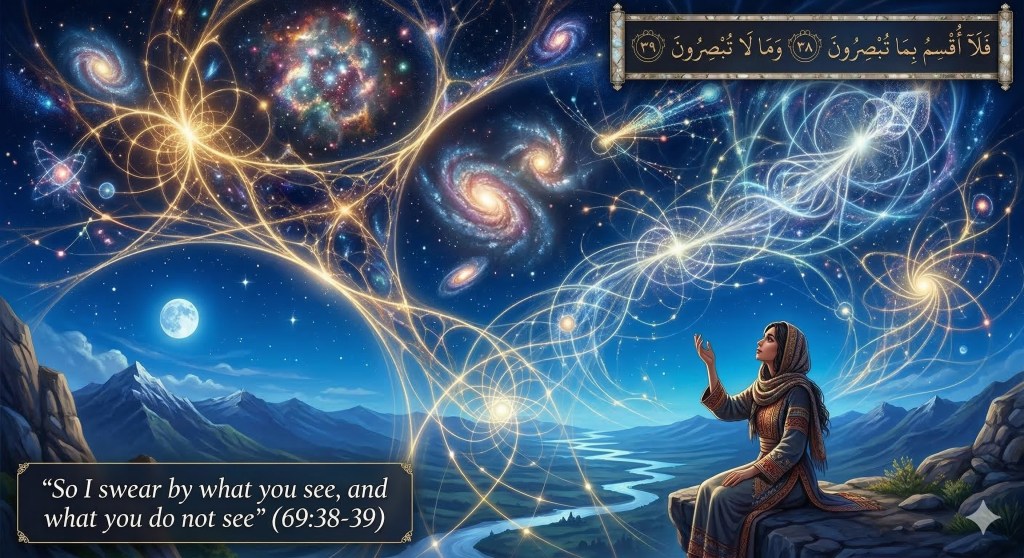
Quranic translations in this article are drawn from M.A.S. Abdel Haleem’s English rendition of the Quran. Classical exegesis provides context on interpretations of symbols (e.g., fig and olive as places, “returning sky” as rain, horses as literal war steeds. There are several verses in the Quran, where God swears by or takes oaths on different aspects of nature. When Allah swears by any of His creation, He is presenting it as testimony of His truth and the Quran as His final message. Divine claim is that all aspects of His creation, all of cosmology including the constellations and all terrestrial aspects of nature glorify Him. These oaths illustrate the Quran’s unique rhetorical method of linking the observable world to unseen truths, fulfilling its role as “a reminder to all the worlds” (81:27). Each natural element invoked becomes an oath, a sign, and a parable in one – emphasizing Allah’s majesty and the truth of His revelation in a manner that is both comprehensive and profoundly elegant.
In other words the Quran argues from the tangible to the intangible both to teach morality as well as spirituality.
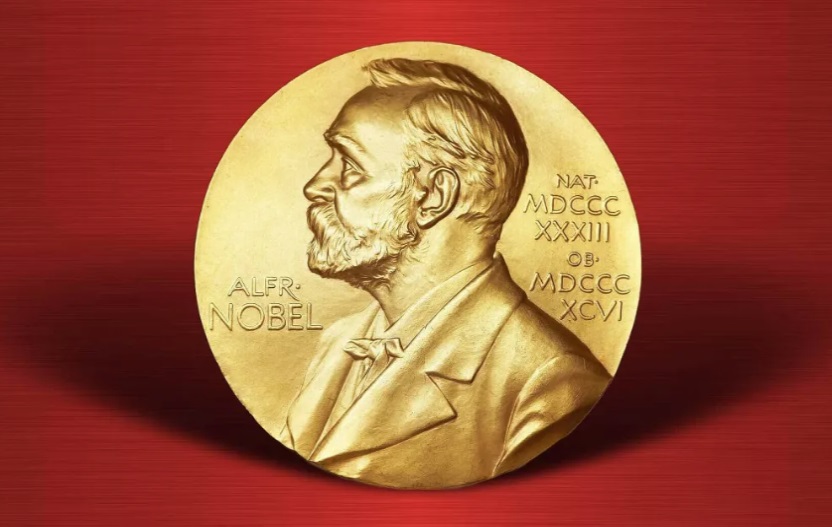
The Nobel Prize in Physics has been awarded 118 times to 227 Nobel Prize laureates between 1901 and 2024. John Bardeen is the only laureate who has been awarded the Nobel Prize in Physics twice, in 1956 and 1972. This means that a total of 226 individuals have received the Nobel Prize in Physics.
The Nobel Prize in Chemistry has been awarded 116 times to 197 Nobel Prize laureates between 1901 and 2024. Frederick Sanger and Barry Sharpless have both been awarded the Nobel Prize in Chemistry twice. This means that a total of 195 individuals have received the Nobel Prize in Chemistry.
As of 2024, 115 Nobel Prizes in Physiology or Medicine have been awarded to 229 laureates since 1901.
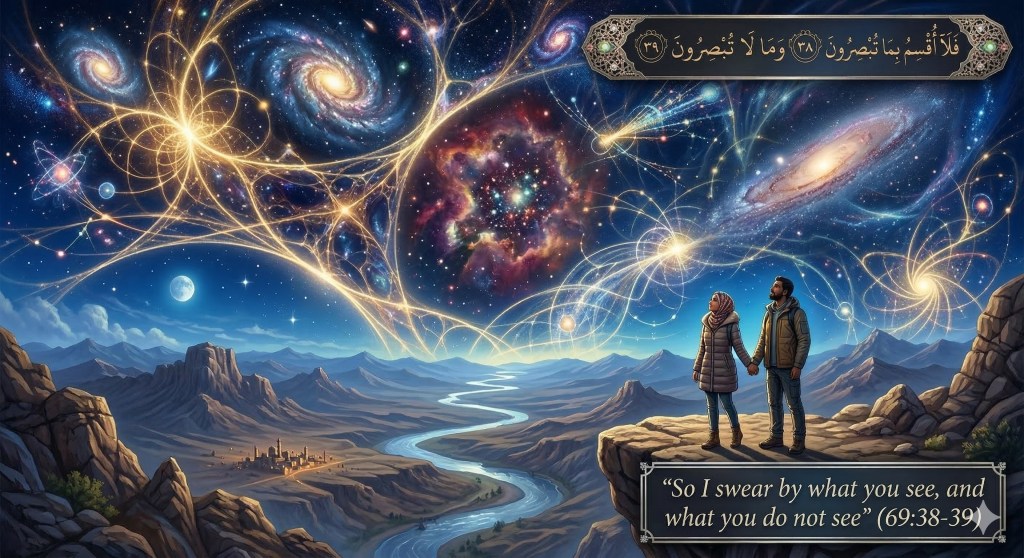
Each amazing discovery in hard sciences speaks of the awe-inspiring creativity of the Creator and it may be that scientists are still merely scratching the surface of the total reality out there in our universe.
Celestial Bodies (Sun, Moon, Stars, Sky)
Sun – “وَالشَّمْسِ وَضُحَاهَا” “By the sun in its morning brightness,” (Quran 91:1). Allah opens Surah Ash-Shams by swearing by the radiant sun at daybreak. The sun’s brilliant light symbolizes the overpowering evidence of divine power that illuminates creation. By invoking the sun – the greatest light in our sky – as an oath, the Quran emphasizes God’s role as the Light-giver and Sustainer of life. Theologically, this oath underlines that just as the sun governs the day, Allah’s guidance is the ultimate source of enlightenment in our lives. Philosophically, it reminds us that the cosmic order (like the sun’s precise rising) is a sign of deliberate design. Rhetorically, swearing by the sun grabs the listener’s attention, preparing them for the important message that follows about the soul’s purity (91:9-10). It shows that as surely as dawn follows night, Allah’s truth is certain.
Moon – “وَالْقَمَرِ إِذَا تَلَاهَا” “and by the moon as it follows it,” (Quran 91:2). In the next verse of Ash-Shams, God swears by the moon following the sun. The moon’s reflected light trailing the sun’s daytime radiance highlights the harmonious cycle in nature. The moon, with its gentle glow, contrasts the sun yet complements it, symbolizing the balance Allah created (day and night, light and dark). Theologically, this oath asserts that the moon’s phases and order are signs of the wise governance of Allah. Each month the moon “follows” the sun’s course (appearing after sunset), illustrating obedience to divine law. This serves as evidence that humans too should follow God’s guidance. The rhythm of lunar cycles underscores that just as the moon reliably reflects sunlight, creation faithfully reflects its Creator’s will.
Stars and Constellations – Allah also swears by the stars and constellations, the brilliant lights scattered across the night sky:
- “فَلَا أُقْسِمُ بِمَوَاقِعِ النُّجُومِ” “I swear by the positions of the stars,” (Quran 56:75). This emphatic oath in Surah Al-Waqi’ah is followed by the remark, “if only you knew, this is indeed a mighty oath.” The “positions of the stars” may refer to the precise cosmic order or the moment when stars set/rise. By calling them to witness, the Quran draws attention to the vastness and precision of the cosmos. The stars’ fixed courses in the galaxy are so awe-inspiring that God Himself says it is “a mighty oath” (56:76). This underscores the gravity of what follows (the truth of the Quran, 56:77). Philosophically, it invites us to contemplate how innumerable stars follow physical laws – a testament to a deliberate Creator. The oath highlights divine power over the cosmos: just as the stars are perfectly positioned, so is the truth in the Quran perfectly ordained.
- “وَالسَّمَاءِ ذَاتِ الْبُرُوجِ” “By the sky with its towering constellations,” (Quran 85:1). Here “al-Burūj” refers to the great stellar formations or zodiacal constellations. Swearing by the starry sky celebrates the majestic architecture of the heavens. The ancients navigated and marked time by the constellations – their permanence signified order in the universe. By this oath, the Quran implies that the same Lord who fixed the stars in stations has revealed the scripture. It emphasizes Allah’s sovereignty over space and time: the constellations are “towering,” showing grandeur, yet they are His creation. The rhetorical effect is to humble the listener – if even the glittering galaxies are under God’s sway, how could one doubt the message coming from that same Almighty? It assures that the truth of Judgment (referenced soon after in 85:2-3) is as guaranteed as the stars in the sky.
Sky/Heaven – The Quran often calls the sky itself as witness, highlighting different aspects of it:
- “وَالسَّمَاءِ وَمَا بَنَاهَا” “by the sky and how He built it,” (Quran 91:5). In Ash-Shams, after the sun and moon, Allah swears by the sky and its Builder (Himself). This oath invites us to reflect on the sky’s construction – its expanse, stability, and protective canopy. The phrase “and the One who built it” folded into the oath stresses that the sky’s very existence is an active proof of God’s creative power. Theologically, it asserts Allah as the Master-Architect of the cosmos. The perfectly proportioned heavens, with no cracks or pillars, display divine perfection. Rhetorically, invoking “He who built it” within the oath reinforces that these natural marvels did not arise by themselves – they stand as witnesses to God’s agency. It impresses upon the listener that just as the sky’s design is intentional, so is Allah’s moral command that follows (in 91:7-10 about the soul).
- “وَالسَّمَآءِ ذَاتِ الْحُبُكِ” “And by the sky with its pathways,” (Quran 51:7). Here the oath refers to the heaven “full of paths” – which commentators take to mean the orbiting tracks of stars and planets or the woven texture of the sky. Swearing by the heavens’ intricate pathways underscores cosmic order. Every celestial body moves in its ordained course (scientifically, planets orbit stars, galaxies rotate). The oath thus points to a universe governed by laws – evidence of divine command. The implication is that just as stars don’t stray from their paths, the truths and promises of Allah (the context in Surah Adh-Dhariyat is about the truth of Resurrection, 51:5-6) are firmly set and cannot fail. It highlights the reliability of God’s decree, mirrored in the reliable motions of the sky.
- “وَالسَّمَآءِ وَٱلطَّارِقِ…ٱلنَّجْمُ الثَّاقِبُ” “By the sky and the night-comer – …the piercing star––,” (Quran 86:1-3). In Surah At-Tāriq, Allah swears by the sky and the “Night Visitor,” clarified as a piercing star. This likely refers to a bright star or meteor that pierces the darkness. The oath evokes the image of a clear night sky suddenly cut by a vivid light. Symbolically, the “piercing star” is likened to divine revelation piercing the hearts of deniers (some exegetes compare it to angels or the Quran itself arriving at night). Theologically, the sky full of stars is a vast witness to God’s watch over us (86:4 affirms every soul has a guardian). Calling the star “At-Tāriq” (one that knocks or arrives by night) emphasizes how Allah can send a sign or angel at any time, unseen yet real. It reminds us that no secret is hidden from the Lord of the heavens. The rhetorical effect is one of vigilance: as a sudden star can appear in the night sky, so will God’s judgment or aid arrive unannounced. Thus, the oath by heaven and star underscores Allah’s ever-watchful power in the universe.
Overall Significance: These celestial oaths highlight cosmic grandeur as testament to God’s majesty. The sun’s brilliance, the moon’s phases, the fixed stars and constellations, and the lofty sky all serve as cosmic witnesses. They emphasize that the Creator of these mighty phenomena surely has the power to guide mankind and bring about the promised Resurrection. Philosophically, the regularity of celestial motions points to an underlying Purpose and Intent – reinforcing the Qur’anic argument that the universe is not random but a deliberate sign-post to the Truth. The oaths also carry a moral dimension: the sun and moon define day and night, which in Islamic symbolism often correspond to guidance and ignorance or good and evil. By swearing upon them, Allah subtly urges us to discern light from darkness in our own lives. In sum, the celestial oaths not only glorify God’s dominion over the cosmos but also prepare the human soul to receive guidance, much like the break of dawn ends the night. As the Quran says regarding the star-oath, “Indeed, it is an awesome oath, if you but knew” – meaning these natural signs have profound weight in affirming the truth of revelation.
Celestial Phenomena & Time (Day, Night, Dawn, Twilight, Time)
Daybreak (Dawn) – “وَالْفَجْرِ” “By the Daybreak,” (Quran 89:1). Allah opens Surah Al-Fajr with an oath by the dawn, the first light of morning that cleaves the night. Dawn is a daily rebirth of light, symbolizing hope, guidance, and the victory of illumination over darkness. By swearing by daybreak, the Quran highlights that just as dawn certainly comes after every night, so Allah’s promises (of justice and salvation) are certain to come. Theologically, al-fajr marks the time of the first prayer, a sacred start to the day – underscoring humanity’s connection to the natural cycle ordained by God. Philosophically, dawn’s reliable arrival is a sign of divine mercy and order; no matter how long or dark the night, the morning is inevitable. Rhetorically, invoking the breaking of dawn creates a powerful analogy: the surah goes on to discuss past peoples and the imminent “Day” of Judgment. The oath suggests that the dawn of reckoning will likewise break forth, ending the “night” of injustice. Thus, the daybreak oath emphasizes Allah’s power to bring light (guidance or victory) after darkness (ignorance or tyranny).
Ten Nights – “وَلَيَالٍ عَشْرٍ” “and by the Ten Nights,” (Quran 89:2). Following the dawn, Allah swears by “ten nights.” Traditionally, these are understood as the first ten nights of Dhul-Hijjah (the sacred season of pilgrimage) or the last ten of Ramadan. Both interpretations link to periods of intense worship and divine favor. By sanctifying ten nights as an oath, the Quran signals that certain times are imbued with special spiritual significance. These nights—whether of hajj or Ramadan—involve heightened devotion, sacrifice, and forgiveness. The oath thus elevates the value of holy time in the cosmic order. It implies that time itself can bear witness when spent in Allah’s obedience. If humans honor these ten nights through prayer and repentance, the nights “testify” to their faith. From a rhetorical view, invoking ten consecutive nights draws the listener into a sense of sacred rhythm and anticipation. It stresses completeness (the number ten) – possibly alluding that the evidence for God’s guidance is complete and abundant (just as a full set of ten). Theologically, it reminds us that the Lord of Daybreak (89:1) is also Lord of the Night – all time spans, short or long, are under His command and can be sworn by to underline a point.
Even and Odd – “وَالشَّفْعِ وَالْوَتْرِ” “by the even and the odd,” (Quran 89:3). Here Allah swears by “even” and “odd,” which commentators interpret in various ways – possibly all paired things vs. singular things, or specific ritual nights (like the even and odd-numbered nights of pilgrimage). Taken generally, it denotes all numbers and by extension all things – since creation consists of binaries and unions (night/day, male/female, etc.). Swearing by even and odd underscores totality and balance. Nothing is outside God’s knowledge: whether something comes in a pair or stands alone, whether a day is even-numbered or odd-numbered – all is encompassed by His oath. This can be seen as a way of saying “by everything in its duality and unity.” Theologically, it hints at Allah’s creation of all opposites (cf. 51:49) and that He Himself is One (odd) while His creation often comes in pairs (even). By this oath, the Quran subtly teaches that the harmonious functioning of the world (evens and odds working together) is evidence of a Wise Creator. It also resonates with acts of worship: in Islam, some acts are in even units (like two-rakat prayers) and some in odd (witr prayer). The oath may allude to these forms of devotion that connect humans to the divine order. In sum, “the even and the odd” as witnesses emphasize comprehensiveness – Allah’s swearing by them covers every aspect of existence, strengthening the certainty of the surah’s ensuing warning about people who deny the truth (89:6-14).
Night – “وَالَّيْلِ إِذَا يَسْرِ” “and by the night when it passes,” (Quran 89:4), as well as “وَاللَّيْلِ إِذَا يَغْشَىٰ”“By the night when it enshrouds,” (Quran 92:1) and “وَاللَّيْلِ إِذَا سَجَىٰ”“and by the night when it grows still,” (Quran 93:2). The Quran frequently swears by the night in different states: when it covers the world, when it is serene and quiet, and when it departs. Each aspect of night offers a nuance:
- Enshrouding darkness (Layl 92:1) – The phrase “when it enshrouds” or “covers” depicts nightfall blanketing everything. Swearing by this evokes the all-encompassing nature of Allah’s control: as night unfailingly spreads over the day, so Allah’s will encompasses His creation. The sudden coming of night also symbolizes ignorance or misguidance overtaking people – yet the oath hints that the One who created the night can just as surely bring relief (the corresponding oath in 92:2 is the radiant day). Thus, the “enshrouding night” is a witness to the cycle of trials and relief that God ordains.
- Profound stillness (Duha 93:2) – “when it grows still (sajaa)” refers to the deep tranquility of late night. By swearing on the peaceful night, Allah underscores solace and refuge. This was particularly comforting to Prophet Muhammad – Surah Ad-Duḥā was revealed during a period when revelation had paused, and the Prophet feared being forsaken. The oath assures him that the calm of night is not abandonment but a prelude to the dawn of renewed favor. In general, the still night testifies to Allah’s gentleness and the opportunities in solitude (for prayer or reflection). The quiet night can heal the weary soul, just as Surah Duḥā goes on to console the Prophet (93:3-5). So the night’s stillness is invoked to guarantee God’s care and intimacy with His servant.
- Passing of night (Fajr 89:4) – “when it passes (or departs)” highlights the transience of darkness. No matter how long the night feels, it always journeys to an end. By swearing on the passing night, the Quran emphasizes that hardships or the era of wrongdoing will inevitably pass, yielding to dawn (an idea reinforced by the preceding “daybreak” oath). In a broader sense, this oath calls attention to time’s swift movement – a warning that one’s opportunity to do good or repent is slipping away like the night fading. The departing night bears witness that time and tides wait for no one, urging us to heed the Quran’s message before it’s too late (89:5 pointedly asks “Is there not in these oaths sufficient evidence for the wise?”).
In all these, the Night is personified as a cosmic entity obeying Allah: spreading, stilling, then yielding. Theologically, it affirms Allah’s dominion over times of darkness as well as light. For the Arabs experiencing the intensity of desert day and night, these oaths struck a chord – night’s cool relief and sometimes fearful darkness were both in God’s hand. Philosophically, night exemplifies how opposites are part of a whole (no night, no dawn). Thus, swearing by night complements swearing by day; together they indicate the completeness of Allah’s management of the universe. Moreover, the dual oaths “By the night… and by the day…” (e.g. 92:1-2) highlight a moral lesson: just as night and day alternate, human fortunes and states alternate by Allah’s will (92:4: “your paths are diverse”). The believer should trust that after the “night” of trial comes the “day” of ease, and after the “day” of life comes the “night” of death and then a new Dawn of Resurrection.
Time (Asr) – “وَالْعَصْرِ” “By [the passing of] Time,” (Quran 103:1). In Surah Al-‘Asr, Allah swears by Time or the declining day (the word ‘asr can mean the afternoon or the epoch as a whole). This is one of the most sweeping oaths – nothing is more encompassing than Time itself, under which all creation exists. By invoking time as a witness, the Quran drives home the urgency of the surah’s message: “Man is in loss, except those who believe and do good…” The oath of Time suggests that history itself testifies to the truth that follows. Generation after generation has seen the rise and fall of those who ignored faith and virtue. Theologically, only the Eternal Creator can swear by the ages – He owns Time. Philosophically, wal-‘asr underscores that with each ticking moment (or each sunset), human life moves toward accountability. It warns that time is a proof against us: our fleeting hours, if wasted in disbelief, will bear witness to our neglect. Conversely, every moment used in righteousness will testify for our success. The “declining day” imagery also evokes the golden light of late afternoon – beautiful but quickly fading – much like human life. Thus, God swearing by Time conveys gravity; it is as if all of time’s lessons and the fate of past peoples are being cited as evidence. Indeed, Imam Shafi’i famously said that if people reflected on Surah Al-‘Asr sincerely, it would suffice for their guidance. The oath encapsulates that sentiment: Time, which devours all but truth and good deeds, is a divine witness that only a life of faith saves one from ultimate loss.
Twilight (Afterglow) – “فَلَا أُقْسِمُ بِالشَّفَقِ” “So I do swear by the afterglow of sunset,” (Quran 84:16). In Surah Al-Inshiqāq, Allah swears by the red twilight (al-shafaq) that remains after the sun sets. That rosy glow on the horizon is a transitional phenomenon – day is ending, night approaching. By swearing on this brief afterlight, the Quran accentuates the moment of transition and reflection. The day’s deeds are done, night’s rest or reckoning approaches. It symbolically points to the twilight of life or of the world before the final end. Indeed, following this oath, the surah describes the Day of Judgment when humans will be split into two groups (84:17-19). Thus, the fading evening sky witnesses to the fading of worldly time and the onset of the Hereafter. The theological implication is that just as sunset’s afterglow is beautiful but short-lived, so are the pleasures of this life – they will vanish into the night of the grave, leaving only the “afterglow” of one’s deeds. Rhetorically, invoking the soft light of dusk creates a pensive mood, preparing the audience for the solemn warning: “You shall surely travel from stage to stage” (84:19). The twilight oath reminds us that everything created undergoes decline – a call to turn to the Eternal before that light dies out.
Full Moon – “وَالْقَمَرِ إِذَا اتَّسَقَ” “and by the moon when it is full,” (Quran 84:18). In the same passage as the twilight oath, Allah swears by the moon at its complete fullness. The full moon is the brightest night-time object, symbolizing illumination amid darkness. It also marks the midpoint of the lunar cycle (night 14–15). By swearing on it, the Quran highlights a moment of maximum light during night – suggesting guidance and completion even in times of gloom. The full moon’s regular appearance shows the reliability of Allah’s signs. Interestingly, the oaths in verses 16-18 (afterglow of sunset, engulfing night, full moon) together paint the sequence of evening: after sunset comes darkness, then the moon rises to shine. These natural “witnesses” reinforce the theme that after hardship comes relief (echoing a spiritual cycle). Specifically, the full moon oath may allude to the Prophet Muhammad ﷺ, who is often poetically compared to a full moon in brightness. As an oath, it underscores that the message he brings (the Quran) is a light in the dark night of ignorance. Theologically, the full moon testifies to Allah’s power to brighten the darkest night – just as He can enlighten the darkest heart. Its perfect roundness also conveys a sense of attainment: just as the moon attains fullness, Allah’s decree will attain fulfilment. So when the Quran swears “by the full moon,” it assures us that the promised outcomes (resurrection, justice) will come to fruition at their appointed time, as surely as the moon completes its phases.
Overall Significance: Oaths by these daily cycles and temporal phenomena reinforce the idea that time and nature follow a God-ordained rhythm meant to teach and warn us. Dawn and dusk, day and night – all are unmistakable, cyclical truths. Likewise, the truths of guidance and judgment are unchanging. The alternation of night and day also highlights dualities (light/dark, joy/sorrow, ease/hardship, life/death) that the Quran often uses to illustrate moral and spiritual realities. By swearing upon these phenomena, Allah not only grabs our attention but also invites us to ponder their meaning. For example, Ibn Kathir notes that the oaths “By the morning brightness, and by the night when still,” came as tender reassurance to the Prophet that God’s “daybreak” of mercy had not abandoned him during the “night” of perceived absence. In general, these oaths emphasize divine reliability: just as every day inexorably turns to night and every night to day, Allah’s promise to reward the doers of good and punish evildoers will inexorably be fulfilled. They also underscore human accountability – our lives are but a series of dawns and sunsets, a limited window to sow the deeds whose fruits we’ll reap in the everlasting dawn of the Hereafter. Thus, the cosmic clock’s testimony through these oaths adds urgency and credibility to the Quran’s call: “Is there not in these a sufficient oath for those who have sense?” (89:5). Indeed, time is a witness to mankind’s overall loss except for those who seize it in faith and good works (103:1-3). The structure and regularity of temporal phenomena thereby become a proof of the structured destiny that awaits humankind under God’s justice.
Earth and Landscapes (Earth, Mountains, Sea)
The Earth – “وَالْأَرْضِ وَمَا طَحَاهَا” “and by the earth and how He spread it,” (Quran 91:6). In Surah Ash-Shams, alongside the sky, Allah swears by the earth and its Spreader (Allah Himself). The verb ṭaḥāhā implies laying out or spreading like a carpet. By this oath, the Quran draws attention to Earth’s expanse, stability, and suitability for life – all signs of deliberate preparation by the Creator. Theologically, “how He spread it” highlights Allah’s providence: the earth was unformed and He shaped it flat in places, with pathways and provisions for creatures. It testifies to the nurturing aspect of God’s design. Philosophically, the habitable earth (soil to grow food, terrain to dwell on) is a foundational evidence of a beneficent Planner; it’s not a random rock but a furnished home for living beings. Swearing by the earth also grounds the discourse: after invoking the heavens, turning to earth shows the completeness of God’s dominion (above and below). Rhetorically, it prepares for the next verse about the human soul (91:7) – linking the external world to the internal. Just as the earth has been smoothly spread for our use, the human soul has been proportioned and inspired with morality by Allah. Thus, the earth-oath reinforces that we live in a divinely ordered habitat, and we must likewise order our inner lives according to His guidance. It is a subtle reminder of gratitude: the spread-earth is literally the ground beneath our feet in all we do, so recognizing that blessing should lead us to succeed (91:9) rather than sin.
Mountains – Allah makes particular oaths by prominent mountains and landmarks, linking them to pivotal spiritual events:
- “وَالطُّورِ” “By the Mount (Tur),” (Quran 52:1) – referring to Mount Sinai (Tur Sīnā’) where Moses received revelation. By swearing by this sacred mountain, the Quran invokes the holiness of the place of revelation. Mount Tur witnessed Allah’s direct communication (the Torah given to Moses), so it stands as a monument of God’s covenant with humanity. The oath “By the Mount” at the start of Surah At-Tur sacralizes the subsequent message: it’s as true as the Torah given on that mountain. It also creates continuity between Moses and Muhammad’s missions. Theologically, it stresses God’s historical intervention – He spoke to a human prophet on a real mountain, thus guiding a nation. The mountain symbol – firm, tall, unshakeable – underscores the solidity of faith and law granted there. It reminds listeners that just as a physical mountain exists (tangible and immovable), the truths of Allah’s scripture are firm reality. Thus, the Mount itself is sworn as a silent witness to divine law and prophets.
- “وَطُورِ سِينِينَ” “By Mount Sinai,” (Quran 95:2). Similarly, in Surah At-Tīn, God swears by “Sinai’s Mount.” In this context, it is coupled with other symbols (the fig, the olive, and “this secure city” Makkah). Mount Sinai’s oath honors the sanctity of where Allah spoke to Moses and gave the Ten Commandments. It layers the argument that across different lands and eras, God has guided man – from Sinai (Judaism) to the olive-yielding hills of Jerusalem (Jesus’s mission, some say the “olive” refers to the Mount of Olives) to the sanctuary of Mecca (Ibrahim and Muhammad). Swearing by Sinai specifically ties the Quran’s moral reasoning to the unchanging moral law from Moses. It also exalts the mountain made sacred by God’s Presence (when it quaked and Moses heard God’s word). The implication is that the same Almighty now speaks through the Quran, so its warning about human nature (95:4-6) carries the weight of Sinai’s authority.
In both cases, mountains serve as witnesses of covenant and law. They represent permanence and highness – befitting the permanence and exalted source of divine revelation. Swearing by them lends that weight to the message at hand.
The Sea – “وَالْبَحْرِ الْمَسْجُورِ” “By the ocean ever filled (or set ablaze),” (Quran 52:6). In Surah At-Tur, after the Mount and other oaths, Allah swears by the vast sea. The phrase “al-baḥr al-masjūr” can mean the ever-flowing, ever-filled sea – or, in a vivid interpretation, the sea that will be set ablaze (as a portent of the Last Day, cf. 81:6). In the oath context, it likely means the mighty sea perpetually supplied with water. Swearing by the sea emphasizes power and mystery: the sea was both a source of life and a source of fear for people. As an oath, it reinforces God’s mastery over the most immense expanse on Earth. Theologically, the ocean’s constant surge and balance (not flooding the whole land) point to divine control (elsewhere 55:19-20 notes how seas meet yet don’t transgress). Rhetorically, invoking the sea after mentioning the “raised canopy” of the sky (52:5) extends the range of witnesses from the heights of heaven to the depths of the ocean – encompassing all creation above and below. It creates a feeling of awe: the listener envisions towering waves and the unfathomable deep as servants of Allah’s command. If “masjūr” is understood as “set ablaze,” it foreshadows the power of Allah to alter even the great sea on Judgment Day (turning the water to fire), lending weight to the surah’s threats against deniers. Either way, the sea’s inclusion as an oath reminds us that the natural world in its mightiest forms – mountains and oceans – all testify to God’s might and the inevitability of His judgment.
The Land/City – “لَا أُقْسِمُ بِهَٰذَا الْبَلَدِ” “I do swear by this city [of Makkah],” (Quran 90:1). In Surah Al-Balad, Allah swears by the sacred city of Mecca where the Prophet resided. Though a city is a human settlement (not a “natural” feature), Mecca is often regarded as part of the sanctified landscape due to the holy Ka’ba and its valley. The oath by “this secure city” also appears in 95:3. By swearing by Mecca, Allah elevates land made holy by His decree and the presence of His sanctuary. It signals the listener that the ground they stand on (for the original audience in Mecca) is holy witness to the truth they are hearing. The city had witnessed the life of Prophet Abraham and now witnesses the mission of Muhammad ﷺ. This oath reinforces that the message of the Quran is rooted in the sacred history of a real place – underscoring continuity and legitimacy. It also carries a hint of admonition: Mecca was a sanctuary of peace (no fighting allowed), yet the disbelievers were violating its sanctity by persecuting the Prophet. Swearing by the city highlights their ingratitude for the security and honor Allah gave that valley. Thus, while a city is not a “natural phenomenon” per se, the Quranic oaths treat it akin to a natural sacred landmark. The land itself (even trodden by humans) can bear witness – just as the ground will testify for or against people’s deeds on Judgment Day (Quran 99:4). The mention of city alongside mountains and seas in oaths underscores that specific chosen places are integral to God’s cosmic plan and thus worthy of oath, further emphasizing the divine narrative threading through history and geography.
Overall Significance: These oaths by parts of the earth and its features serve to ground the cosmic messages in tangible reality. If the previous categories (celestial bodies and time) pointed our eyes upward, these direct our eyes to the world under our feet and at the horizons:
- The earth as a whole, spread out for life, highlights the benevolence and wisdom in creation, bolstering the argument that the Creator who furnished Earth has also furnished a moral law for mankind (hence we see 91:7 immediately follow the earth-oath, speaking of the soul’s inspiration of right and wrong). The earth is thus a silent witness to God’s nurturing care – and a rebuke to human forgetfulness of His favors.
- Mountains represent both the natural majesty of Allah’s creation and the concrete locales of divine-human encounter. Swearing by Sinai or Tur ties Islamic revelation to earlier revelations, stressing a unity of message and the sacred continuity of prophethood. It lends historical depth – the God who spoke on Tur is speaking again – making denial of Muhammad’s message as egregious as denying Moses on Sinai. Mountains also symbolize immovable truth. The Quran even says if it had been sent upon a mountain, the mountain would humble itself and crumble from fear of God (59:21). So when Allah swears by a mountain, it suggests the unyielding reality of what is being asserted – it’s as firm as the mountain itself.
- The sea conveys might, abundance, and mystery. It reminds listeners of forces far beyond human control (sailors of antiquity well understood this). By swearing on the ever-filled sea, Allah asserts His command over the most overwhelming aspects of nature. This magnifies the warning or promise at hand: He who controls the oceans can surely bring about the Resurrection or punishment the disbelievers doubt. If “masjūr” is read as “aflame,” it dramatically previews the transformation of the natural order in the apocalypse – an oath that what is prophesied (the upheaval of creation and accountability of humans) will indeed occur, since even the seas will obey His command to change their nature.
- The landmarks like Mecca extend the idea of natural oaths to hallowed human geography. It shows that not only untamed nature but even inhabited lands can be sanctified by God’s touch and thus serve as witnesses. In essence, the whole earth – from solitary peak to bustling sanctuary, from solid ground to surging sea – bears witness to its Lord. Every atom of soil, every drop of ocean, has experienced and submits to Allah’s power, and so their testimony bolsters the Quran’s call that man, who walks the earth and sails the sea, should likewise submit.
Altogether, these oaths intensify the sense of cosmic testimony in the Quran. Heaven and earth together are called to the stand (as in 91:5-6). It fulfills the Quranic theme that “We shall show them Our signs on the horizons and in themselves” (41:53) – here the horizons (mountains, seas, sky) are literally sworn as signs, so that the truth may be established. Each natural oath also carries specific thematic weight in its context, but universally they remind the listener of Allah’s grandeur and the utter trustworthiness of what He swears to. Just as mountains do not flinch and the sea does not empty without His command, the Word of your Lord is unshakeable and will be fulfilled.
Weather and Atmosphere (Winds, Clouds, Rain, Storm)
Winds – “وَالذَّارِيَاتِ ذَرْوًا . فَالْحَامِلَاتِ وِقْرًا . فَالْجَارِيَاتِ يُسْرًا . فَالْمُقَسِّمَاتِ أَمْرًا” – In Surah Adh-Dhāriyāt, Allah opens with a series of four oaths: “By those [winds] that scatter far and wide, by those that are heavily laden, by those speeding freely, by those distributing [rain] by command,” (Quran 51:1–4)
islamawakened.com. These verses vividly describe wind in different roles – scattering dust, carrying heavy rainclouds, blowing gently (as ships or clouds glide), and apportioning rain or sustenance. By swearing by the winds in their stages, the Quran underscores God’s agency in life-giving processes. The winds that lift and scatter seeds and pollen, that carry rainclouds to parched lands, that drive ships on the sea, and that distribute rain exactly where God wills – all these show a purposeful management of the world
Theologically, the oaths highlight Allah as the Director of nature’s forces: what seems like a wild natural phenomenon (wind) actually follows His plan to benefit creation. Each descriptive participle denotes an action of wind that results in fertility and provision. It’s implied that the same power that harnesses the winds can surely bring the Resurrection (which is affirmed in 51:5, right after these oaths). Philosophically, these oaths invite reflection on how interconnected and orderly natural systems are: the scattering winds lead to the pouring rains which lead to life – a chain that is too coordinated to be random. Rhetorically, beginning with rapid-fire oaths “By the scatterers… the bearers… the floaters… the distributors…” creates a sense of momentum. It captures the listener’s imagination with the drama of an approaching storm front. This momentum then crashes into the emphatic conclusion: “What you are promised is certainly true, and the Judgment will surely come” (51:5–6). The effect is that the certainty of the coming Judgment is likened to the certainty that winds bring clouds and clouds bring rain. Just as those natural outcomes never fail, the promise of recompense will not fail.
Moreover, wind in Arabian culture could be mercy (rain-bearing winds) or torment (sandstorms). The oaths cover merciful winds. But another set of oaths covers destructive winds:
- “وَالْمُرْسَلَاتِ عُرْفًا . فَالْعَاصِفَاتِ عَصْفًا . وَالنَّاشِرَاتِ نَشْرًا . فَالْفَارِقَاتِ فَرْقًا . فَالْمُلْقِيَاتِ ذِكْرًا” – In Surah Al-Mursalāt, Allah swears “By the [winds] sent forth in swift succession, then by the winds storming on with fierce gusts, by those [winds] that scatter [clouds] far and wide, then separating [rain from drought] with force, then delivering a reminder,” (Quran 77:1–5). These oaths (understood by many to refer to winds, though some interpret them as angels performing tasks) paint the picture of an approaching tempest. The “sent-forth” winds come in waves, then blow with a tempest’s force, then disperse rain-clouds over the land, then break apart clouds to rain here but not there, then “deliver a reminder” – which can mean causing lightning and thunder that remind people of God’s power or delivering raindrops that remind them of mercy.
Here, the emphasis is slightly different from Surah 51: these winds are more intense, bordering on the punitive (the tone of Surah 77 is warning of Judgment). The climax of the oaths is “to excuse some and warn others” (77:6), implying the effects of these winds/rains are a test – bringing benefit to some, ruin to others, as a precursor of how God’s message divides people. Theologically, it underscores that natural calamities or blessings are not random; they carry messages of warning or reprieve from Allah. The phrase “delivering a reminder” is telling: rain or lightning is like a reminder of resurrection (reviving dead earth) and of divine wrath (storms can destroy). Rhetorically, this litany of oaths unsettles the listener – one can almost feel the gusts and hear thunder in the words. It crescendos in verse 7–8 where the outcome is stated: “What you are promised will come to pass: when the stars are extinguished, and the sky is torn apart…”. Thus, the gathering storm of oaths is a harbinger of the ultimate Storm of the Apocalypse. It makes the point that the power behind the wind and rain is the same power that will upheave the cosmos on Judgment Day.
In sum, oaths by winds – whether gentle and nourishing or fierce and scattering – highlight Allah’s meticulous control over sustenance and destruction. They testify that God’s commands permeate even the unseen air. The scatter of dust or the fall of rain is not a chance; it operates on His orders, often to achieve moral outcomes (like rewarding a land or devastating a corrupt people). For instance, the people of ‘Ād were destroyed by a furious wind (69:6-7), and that too was an act of God. By these oaths, the Quran assures that just as God uses winds to carry out His will on earth, He will carry out His will in the broader destiny of humankind – rewarding, reminding, or punishing as fits His justice. The winds are therefore agents of divine decree, and their oath emphasizes the inevitability of what God decrees in the moral realm as well.
Rain and Sky that Returns – “وَالسَّمَاءِ ذَاتِ الرَّجْعِ” “By the sky with its recurring rain,” and “وَالْأَرْضِ ذَاتِ الصَّدْعِ” “by the earth that cracks open,” (Quran 86:11-12). In Surah At-Tāriq, after describing the creation of man from a humble fluid, Allah swears by the mechanism that sustains life: the rain cycle and the soil’s fertility. The “sky that returns” implies the heaven that repeatedly returns rain season after season, and the “earth that splits” refers to the ground that splits open for sprouts to emerge. These intertwined oaths (a fertile sky and earth) reinforce the message that the Creator who can revive dead land with rain can surely revive dead humans for judgment (86:13 asserts the Quran’s message is decisive).
Theologically, the rain-bearing sky is sworn as a witness to resurrection – it performs a mini-resurrection whenever barren land comes to life with vegetation. The cracking earth is a direct analogy to graves breaking open on Resurrection Day. By taking oath on these, Allah effectively says: Witness how I bring life from above and below; thus believe that “He (Allah) is able to bring the dead to life” (c.f. 86:13-14). Philosophically, it draws attention to the marvelous sustainability built into nature: the sky is not a one-time giver but returns rain in cycles, and the earth responds by yielding new growth repeatedly. Such harmonious renewal implies a wise orchestrator and hints at a greater renewal of human souls. Rhetorically, swearing by rain and soil after discussing human creation (86:5-10) ties the argument together: man’s origin is lowly water, yet by God’s design he grows and thrives like a plant; should he doubt being re-created when he has seen plants die and return? The sky and earth doing their life-giving duties are like pages in an open book of evidences – hence Allah calls them to witness as He declares the Quran “a decisive word” (86:13).
These oaths also carry a tone of mercy: unlike some other oaths that portend doom, rain and sprouting earth are gentle and hopeful. They remind that Allah’s creative mercy permeates the world. This serves to soften the hearts of the audience – just as rain softens soil – so they may accept the reminder delivered. In essence, each rainfall and each spring bloom is an oath in action that God will not have trouble resurrecting us or fulfilling His decree.
Thunder and Lightning (Implied) – While not explicitly an oath formula, the Quran elsewhere notes, “He (Allah) it is who shows you lightning, inspiring fear and hope, and He produces the clouds heavy (with rain). And the thunder proclaims His glory…” (13:12-13). The sentiment is that weather phenomena themselves testify to God’s might. In spirit, when Allah swears by winds and rainclouds, the thunder and lightning are implied heralds within those winds that “deliver a reminder.” Classical commentators say the “reminder” could be the thunderclap that jolts the heedless, reminding them of God’s awe, or the rainfall that reminds them of His grace. Thus, even without a direct oath by thunder, the Quranic imagery often personifies it as a praising witness (13:13). This reinforces that all aspects of weather – from the gentle breeze to the terrifying storm – are enlisted as signs and witnesses in the Quranic worldview.
Overall Significance: Oaths on winds, rain, and the sky’s phenomena emphasize divine providence and warning through nature’s processes. They demonstrate that what we consider “natural cycles” are in fact acts of Allah, laden with meaning:
- The beneficial winds and rain testify to God’s sustaining mercy. They keep us alive; thus, we owe thanks and obedience. If God can drive winds globally, He can guide events of history and outcomes of nations.
- The raging winds and storms testify to God’s power to punish or cleanse. Whole peoples (like ‘Ad and Thamud) were wiped out by a storm or drought at His command, validating prophetic warnings. So modern deniers should heed the implicit caution when the Quran swears by these forces.
- The cyclical return of rain and the sprouting of plants are analogies for resurrection and hope. Just as the dead earth revives, the human dead shall be raised. Believers hear in these oaths a reassurance of Allah’s ability to rejuvenate and reward, while skeptics are given a rational proof drawn from observable phenomena.
Moreover, by frequently coupling multiple related elements (wind stages, or wind+rain+earth), the Quran shows the comprehensive integration of natural systems, implying one Master Planner behind it all. The style of successive oaths (as in Surah 51 and 77) creates a kinetic energy, almost cinematic, carrying the listener along and depositing them at the conclusion that what follows is true beyond doubt. It is as if the whole atmosphere around us – the air, the clouds, the storm – is made to speak for God. This not only bolsters faith in His omnipotence but instills humility: humans are at the mercy of these elements, so how much more at the mercy of the Creator who controls them?
In short, the weather oaths deepen the message that nature is not purposeless; it constantly communicates God’s truth. The winds and rains in their gentleness say, “Allah is Rahman (Merciful),” and in their severity say, “He is Jabbar (Compeller).” When God swears by them, it is to drive home that the same unerring power guiding the winds guides His decree for judgment and reward. This lends enormous weight to the ensuing verses; for example, immediately after the oath of winds in Surah 51, Allah states, “Indeed, what you are promised is true.” It’s a logical and emotional culmination: the One who brings forth the rain from empty air can surely bring forth truth from apparent falsehood and life from death. All of nature’s dynamic chorus thus underwrites the certainty of Allah’s words.
Living Beings (Plants, Animals, Humankind)
Plants (Fig and Olive) – “وَالتِّينِ وَالزَّيْتُونِ” “By the fig, by the olive,” (Quran 95:1). Surah At-Tīn opens with oaths by two well-known fruits. Taken literally, Allah is swearing by the fig tree and the olive tree, which are among the oldest cultivated plants in the Middle East. These plants carry both material and symbolic significance. Figs and olives are staple, life-sustaining foods – invoking them calls to mind divine provision and the settled agrarian life enabled by God’s bounty. They also may allude to locations: some commentators connect the “fig” to Mount Judi or areas associated with Noah, and the “olive” to the Mount of Olives in Jerusalem (linked to Jesus). This interpretation sees the fig and olive as symbolic stand-ins for lands of earlier revelations (just as “Mount Sinai” and “this secure city” follow in verses 2-3). Thus, God may be swearing by the sacred ground where figs and olives grow, essentially the Holy Land that witnessed the missions of many prophets.
Theologically, whether referencing the actual fruit or the holy sites, the oath highlights divine blessing and guidance through the ages. The fig’s sweetness and the olive’s oil (used for light and food) suggest both physical nourishment and spiritual enlightenment given to humanity. The pairing of a sweet fruit and a bitter(ish) fruit could also symbolize the diverse sustenance God provides – pleasant and medicinal. Rhetorically, starting with simple words “By the fig and the olive” surprises the listener, drawing curiosity: why would God swear by humble fruits? This intrigue paves the way for the surah’s message that “We created man in the best form, then reduced him to the lowest of low – except those who believe and do good” (95:4-6). The context implies that the histories tied to these oaths (if taken as Lands of Prophets) culminate in the moral lesson that follows: mankind’s honor or disgrace depends on heeding the prophets who came to those very lands. If taken literally, the fig and olive being products of well-tended trees might subtly parallel the idea that humans were created well but can deteriorate – just as a tree bearing good fruit can wither if neglected.
In all, the fig and olive as oath-witnesses emphasize God’s benevolence in nurturing humanity – both through physical sustenance and spiritual instruction (since some exegesis relates the fig to Adam’s covering and the olive to Jesus’s teachings). It reminds the listener that from the Garden of Eden’s figs to the Mount of Olives’ prayers, Allah has been caring for and guiding mankind. These living plants, long cherished by people, are personified to vouch for the truth that the Bestower of fruits has also bestowed a fitra (innate good nature) in man (which the surah talks about), and that those who live in line with that divine gift will be “the best of creation” (95:6).
Animals (Charging Horses) – “وَالْعَادِيَاتِ ضَبْحًا” “By the charging steeds that pant,” (Quran 100:1). Surah Al-‘Ādiyāt opens with a series of oaths painting a dramatic war-scene from the perspective of galloping horses: “by the charging horses, snorting (out of breath), striking sparks with their hooves, launching a raid at dawn, stirring up clouds of dust, cleaving into the midst of the enemy” (100:1–5 paraphrased). Here, Allah swears by battle horses in full flight. The Arabian horse – symbol of strength, loyalty, and swiftness – is used as a witness to highlight human attitudes. Immediately after these oaths, the surah pivots: “Indeed mankind is ungrateful to his Lord…” (100:6). How do charging horses relate to human ingratitude?
First, the oaths conjure an image of devotion and sacrifice: the warhorse rushes headlong into danger for the sake of its rider/master, even at dawn (an element of surprise) and even as it pants and sparks fly from its shoes on rocky terrain. This unswerving loyalty contrasts with mankind’s disloyalty to his Master (Allah). Implicitly, the horses are more faithful to their human masters than humans are to God. The panting and dust-stirring also suggest urgency and zeal. Man often shows zeal in pursuit of worldly aims (like those raiders going for spoils), but is remiss in pursuing gratitude to God. So, by these oaths, Allah provides a stark object lesson: look at these animals – they serve with their lives; yet man, who is given life, forgets to serve his Lord. Rhetorically, the listener is taken on an exhilarating ride by the words, then abruptly confronted with the indictment of human ingratitude – a jarring but effective contrast. It shames the reader into reflection: even a beast shows devotion; what about me?
Secondly, warhorses were among the most prized possessions in Arab culture. Swearing by them (and graphically, by their snorts and sparks) grabs attention and respect. It’s as if the noblest qualities observable in creation – bravery, strength, speed – are embodied in these steeds and marshalled as witnesses. Their witness attests to humanity’s moral shortfall: whereas these beasts fulfill their purpose with excellence, many humans do not. Theologically, it hints at the Quranic theme that all creatures (except rebellious humans and jinn) obey Allah’s command. The horses charging could also symbolize natural forces unleashed by God (some commentators even likened them to winds or angelic host). Either way, their dynamic obedience results in concrete outcomes (victory in battle), whereas human disobedience will result in loss in the ultimate battle of the Hereafter.
Thus, the oaths by the ‘ādiyāt (chargers) elevate the conversation beyond abstract moralizing; they put the listener amid a stampede to feel the power and loyalty of those animals – and by extension, to feel the weight of betrayal when humans lack similar drive for their Lord. Ultimately, it highlights ingratitude vs. loyalty as a key moral dichotomy. The galloping horse is almost a mirror to man: what man often does for worldly gain (charge fiercely), he fails to do for eternal gain. The surah then warns of the Day when secrets will be revealed (100:9-11). The horses’ example will stand in judgment of those who lacked faith and thankfulness.
Humankind (Male and Female) – “وَمَا خَلَقَ الذَّكَرَ وَالْأُنثَىٰ” “by His creation of male and female!” (Quran 92:3). In Surah Al-Layl, after swearing by the night and day, Allah swears “by the creation of the male and the female.” This can be understood as “by the One who created male and female,” effectively calling on the human pair or the concept of gendered creation as a witness. This oath is profound in that it points to ourselves – our very existence as men and women – as evidence of God’s design. The complementarity of male and female, the continuation of the human species through this pair, and the universal nature of this binary are all implied. By swearing upon it, Allah highlights the miraculous wisdom in human creation.
The verses that follow (92:4) state: “Indeed, your endeavors are diverse.” The juxtaposition suggests that just as God created two distinct genders, so people’s paths split into two distinct outcomes (righteous vs. wicked). The male-female creation is the foundation of family and society – a sign of God’s plan for cooperation and balance. Yet within that shared origin, individuals choose different moral directions. The oath thus gives weight to the idea that diversity in creation (gender) is intentional, but diversity in moral outcome is a result of human choice (some give and fear God, others withhold and deny, as elaborated in 92:5-10).
By invoking male and female, the Quran may also be swearing by Adam and Eve, the first male and female Allah created. Their story is a witness – how their obedience and slip, and subsequent repentance, set the tone for human life. If so, it’s calling to mind the lesson that humans are meant to complement each other and obey God, not contend in rebellion.
Theologically, “male and female” points to Allah as Al-Khāliq (The Creator) who deliberately fashioned humanity in two sexes for reproduction and also as mates for one another (pairing is a recurring sign in the Quran). It underscores that such an intricate social design (with psychological and physical complementarity) could not arise without Divine will. Philosophically, it indicates that the very fact we exist as male or female – something we did not choose – should humble us to recognize a Higher Power and plan. We are living signs. Rhetorically, swearing by our own creation is arresting: it’s as if Allah is saying, “Look at yourselves! By the miracle of your sexual creation…” – it turns our attention inward as evidence. It dignifies human creation as worthy of mention in the same breath as cosmic phenomena, implying that the moral point to come is deeply relevant to our human nature. Indeed, the surah’s message is about efforts and outcomes, something every male and female will face.
In essence, the oath by the creation of the sexes is a testimony that the human story – from our very makeup – attests to God’s truth. It heralds the idea that generosity and piety lead to ease (92:7) whereas selfishness and arrogance lead to hardship (92:10), much like the cooperative harmony of male and female leads to life, whereas conflict leads to misery. The male-female principle could also subtly hint at the dual aspects within each human (reason/passion, or soul/body) that must be harmonized under God’s guidance. Thus, the oath prepares the ground by saying: the same God who wisely split humanity into two sexes for a good purpose has also split the moral paths into two – one leading to salvation, one to ruin. Choose rightly, as ingrained in your very creation.
Livestock and Creatures (Implied) – While not framed as formal oaths with “By…”, the Quran frequently draws attention to cattle, birds, and other creatures as signs of Allah (for instance, 6:38: “There is no animal on earth, nor bird that flies, but they are communities like you”). These verses suggest all living beings testify to God’s providence. In spirit, when Allah swears by specific living beings (like the horses above), it extends to understanding that every species could serve as an oath for some aspect of divine wisdom: the bee by its remarkable societal function, the camel by its endurance (and indeed Allah challenges in 88:17, “Do they not see how the camel was created?”). So while fig, olive, and horses are explicitly invoked, implicitly the entire living world – vibrant with purpose – stands witness.
In summary, oaths by living beings – whether plants we cultivate or animals that serve or even our own human kind – drive home that the signs of Allah’s creative power and guidance are intimate and ubiquitous. They meet us at meal times (figs and olives on the table), in our daily labors or battles (horses), and in our very relationships (the male-female bond). By these oaths, the Quran integrates the natural and human realm into the fabric of its proof. The faithful fig tree that yields fruit every season, the loyal horse that charges when commanded, the male and female drawn to each other – each of these, by being what God made them to be, glorifies God far more than the ungrateful or unrighteous human who shirks his purpose. Thus, the oaths often carry an implicit admonition: Be like these obedient creations, not like those who rebel.
At the same time, they reassure: if Allah so cares for a tree or a beast, how much more for humankind, the crown of creation? Surah At-Tīn uses its oaths to set up the conclusion that “We created man in the best stature” (95:4) – implying that the Creator of sweet figs and nourishing olives certainly created humans in excellence. It then warns against degeneration through disbelief. Therefore, the living beings in oaths emphasize both human dignity (by association) and duty (by contrast).
Finally, these oaths reinforce the interconnectedness of all creation in testifying to tawḥīd (the oneness of God). The fig and olive growing from earth under sun and rain, eaten by man; the horse breathing air, speeding across earth’s terrain under the sky; male and female uniting to continue the race – everything is interwoven. The Lord swears by them to point out that the entire living system operates under one Lord toward meaningful ends. Ignoring that truth is as absurd as a warhorse ignoring its rider’s command – and far more fatal eternally.
Completeness of the Natural Oaths: Through all these examples – the heavens above, the cycles of time, the earth beneath, the forces of weather, and the living beings – the Quran assembles a panorama of creation and calls it to witness. It presents a holistic argument: cosmic order and providence reflect moral and spiritual order. When Allah swears by nature, it is not to venerate nature independently (for all oath-objects are His creation), but to awaken us to the signs within nature that point back to Him. Each oath drives a theological point home:
- Divine Power & Majesty: Swearing by the sun, sky, mountains, ocean, storm – things far beyond human control – emphasizes God’s supreme power. The listener is moved to humility and awe. For example, “By Mount Tur!” immediately evokes God’s majestic self-disclosure to Moses, instilling reverence. These oaths support the Quran’s calls to worship the Almighty alone, since none but He governs these forces.
- Cosmic Order & Truth of Revelation: The precise phenomena (sun’s course, stars’ positions, regular dawn, paired creation, rainfall cycle) illustrate an underlying order and reliability. By oath, Allah connects that to the truth and reliability of the Quran’s message. “It is indeed a mighty oath if you only knew – it is truly a noble Quran” (56:76-77). In effect, the argument is: the same principles upholding creation uphold this revelation. The cosmos doesn’t lie; neither does God’s word.
- Divine Providence & Mercy: Oaths by things like the morning light, rain, the earth’s spread, figs and olives, highlight God’s benevolence. These gentle signs underscore that Allah cares for His creation, giving light after darkness, food for hunger, rain for drought. They reinforce trust in His mercy and promises. Surah Duha’s oath by morning brightness assured the Prophet of ongoing divine care. Believers draw hope that the Lord of the nurturing olive will nurture their souls and not forsake them.
- Human Accountability & Moral Urgency: Many natural oaths are immediately followed by references to human behavior or eschatology. They serve as evidence in the “case” Allah is making against disbelief or sin. For example, after swearing by day and night and male/female, Allah states, “Your endeavors are diverse” and then contrasts the righteous and wicked (92:4-11). It’s as if the established natural facts (night/day cycle, two genders) form the logical premise that our moral choices will likewise have set consequences. Time’s passage (Al-‘Asr) warns that we are racing towards our reckoning. The oaths add urgency – each sunset, each dawn brings us closer to our judgment. They press the listener to reflect and reform before the inevitable arrives.
- Divine Unity & Comprehensive Witness: By covering all categories of creation (celestial, terrestrial, biological), the oaths collectively imply the message of tawḥīd: that all things in heaven and earth are united in testifying to One God. None of these phenomena is presented as a deity (in stark contrast to pagan sun or moon worship); rather, their value lies in being signs. The cosmos is a single coherent witness panel assembled by the Quran to speak to mankind. As the Quran says, “Have they not seen that the heavens and earth were joined, then We split them…?” (21:30) – pointing to a unity of origin. The oaths reinforce this unity: the same God swears by the star and the fig, by the city and the sea. For the Quran’s audience, this broad sweep undermined the idea of multiple gods (each controlling one aspect). Instead, one Lord controls and swears by all – thus all creation, in its splendor and utility, reflects the will of the One.
In conclusion, the natural oaths of the Quran serve a multi-layered purpose: they beautify the discourse, imprinting lessons through poetic images; they validate the Quran’s claims by appealing to universally acknowledged realities; and they castigate or encourage human souls by comparison with the rest of creation. Through them, the Quran turns the entire universe into a courtroom where sun and moon, winds and rain, mountains and trees, beasts and birds, and our very bodies all bear witness to the central truth: Allah is the Sovereign Lord, His guidance is true, and His judgment is coming. These oaths remind us that denying this truth is as absurd as denying the sunrise and ignoring it as fatal as being caught in a storm without shelter. Each verse where Allah swears by a facet of nature is, in essence, calling that facet as a character witness for the Divine, underscoring the message that “truly, in the creation of the heavens and earth and the alternation of night and day are signs for those who understand” (3:190). The compilation of all such oaths indeed presents a panorama of how the cosmos itself testifies to the Quran’s overarching themes of divine power, cosmic order, moral truth, and the inevitable triumph of justice.
Because Allah swears by so many important things in nature and so many profound natural phenomena that it is fair to conclude that according to the Quran each and every discovery of nature, in other words at least all those that qualify for a Nobel Prize are a testament to God’s awe-inspiring creativity and worthy of our eulogy and glorification of the Omnipotent, All-Loving and the Most Gracious God of the Quran.
Additional reading
Why Does the Quran Name A Surah After the Constellations?
Why Everything and Every New Discovery in Quantum Physics Glorifies Allah
Commentary of the Crown Verse and More Through Quantum Physics


 The Glorious Quran and Science
Leave a reply to Every Scientific Discovery as a Testament to the Quran’s Truth – The Glorious Quran and Science Cancel reply