
Epigraph:
And whoso is rid of the covetousness or intense unfulfilled desires of his self, is one who shall be successfully guided. (Al Quran 59:9, 64:16)
O serene soul! Return to your Lord well-pleased and well-pleasing. Enter among My servants. Enter My Paradise. (Al Quran 89:27-30)
Written and collected by Zia H Shah MD, Chief Editor of the Muslim Times
Viktor Emil Frankl (March 26, 1905 – September 2, 1997) was an Austrian neurologist, psychiatrist, and Holocaust survivor, renowned for founding logotherapy, a form of existential analysis. Born in Vienna to Gabriel and Elsa Frankl, he developed an early interest in psychology, engaging in correspondence with Sigmund Freud during his teenage years. Frankl pursued medicine at the University of Vienna, focusing on neurology and psychiatry, and earned his M.D. in 1930.
In the early 1930s, Frankl organized youth counseling centers to address the alarming rate of teenage suicides, a testament to his commitment to mental health. His career, however, was profoundly disrupted by the rise of the Nazi regime. In 1942, Frankl, along with his family, was deported to the Theresienstadt concentration camp. He endured three years in various camps, including Auschwitz, where he lost his parents, brother, and his wife, Tilly.
Despite these unimaginable hardships, Frankl’s experiences reinforced his belief in the human capacity to find meaning, even amidst suffering. After World War II, he returned to Vienna and became head of the neurology department at the General Polyclinic Hospital. In 1946, he published “Man’s Search for Meaning,” chronicling his concentration camp experiences and introducing logotherapy’s principles. The book has since become a seminal work in psychology, translated into numerous languages, and has sold millions of copies worldwide.
Throughout his career, Frankl authored 39 books and received 29 honorary degrees. He held professorships at institutions such as the University of Vienna and was a visiting professor at Harvard University. Frankl’s logotherapy emphasizes the human drive to find meaning in life, positing it as the primary motivational force. His work has left an indelible mark on psychotherapy, offering profound insights into resilience, purpose, and the human spirit.
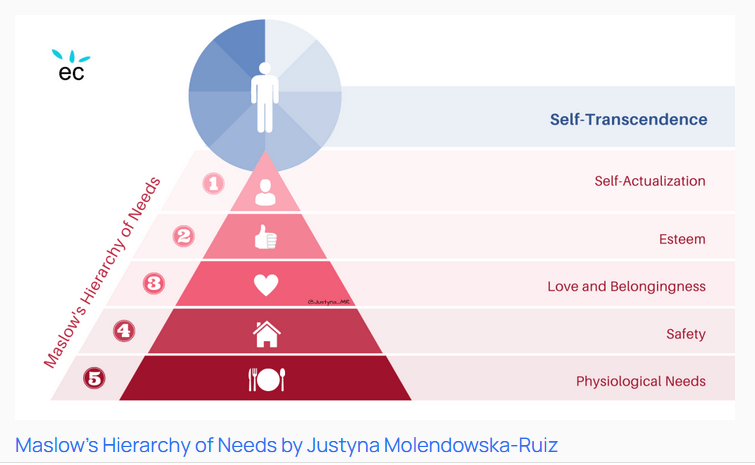
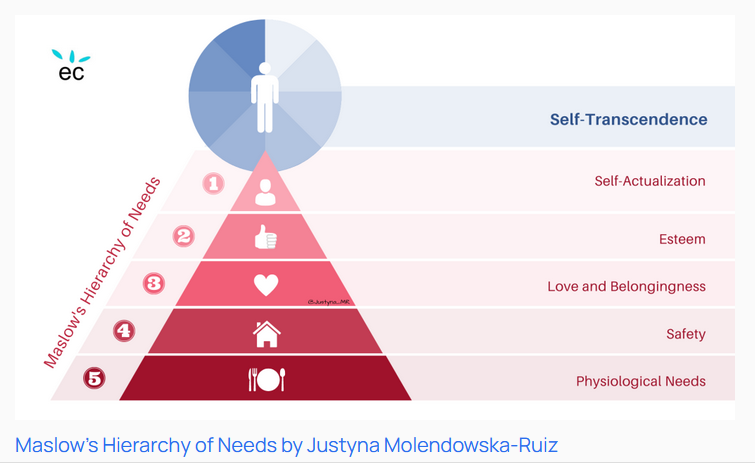
Frankl offered a profound critique of the concept of self-actualization, particularly as presented by Abraham Maslow. While Maslow’s hierarchy of needs positions self-actualization—the realization of one’s full potential—as the pinnacle of human motivation, Frankl contended that this focus on self-fulfillment is misplaced when made an end in itself.
Self-Transcendence Over Self-Actualization
Central to Frankl’s philosophy is the idea that true fulfillment arises not from pursuing self-actualization directly but from self-transcendence: dedicating oneself to a purpose greater than personal gain. He argued that self-actualization is an effect, the effect of meaning fulfillment. In other words, individuals achieve self-actualization as a byproduct of committing to meaningful endeavors beyond themselves. Frankl emphasized that self-actualization, if made an end in itself, contradicts the self-transcendent quality of human existence. Thus, the more one strives for self-actualization directly, the more it eludes them. Instead, by seeking and fulfilling meaningful goals outside oneself, self-actualization naturally ensues.
The Paradox of Intentionality
Frankl highlighted a paradox wherein the pursuit of certain goals, such as happiness or self-actualization, becomes self-defeating when they are the direct aim. He believed that these states are best achieved indirectly, through dedication to meaningful tasks and causes. This perspective suggests that an overemphasis on personal fulfillment can lead to existential frustration, whereas focusing on responsibilities and values beyond oneself fosters genuine self-actualization.
Implications for Psychotherapy and Personal Development
Frankl’s critique has significant implications for therapeutic practices and personal growth strategies. It encourages a shift from introspective self-focus to an outward orientation, where individuals seek purpose through contributions to society, relationships, and causes they deem meaningful. This approach aligns with his development of logotherapy, a therapeutic method centered on helping individuals find meaning in life, especially amidst suffering and adversity.
In summary, Viktor Frankl’s critique of self-actualization challenges the notion of self-fulfillment as a primary objective. He posited that true actualization is a byproduct of transcending oneself in pursuit of meaningful goals, thereby enriching both the individual and their broader community.




 The Glorious Quran and Science
Leave a comment