
Written and collected by Zia H Shah MD, Chief Editor of the Muslim Times
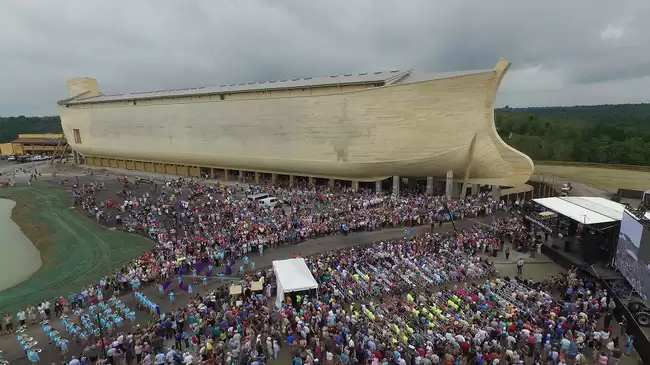
The Ark Encounter is a renowned attraction located in Williamstown, Kentucky, featuring a life-sized replica of Noah’s Ark. Built to biblical specifications, this massive wooden structure spans 510 feet in length, 85 feet in width, and 51 feet in height, making it the largest timber-frame structure in the world. Designed to bring the biblical account of Noah’s Ark to life, the Ark Encounter offers an immersive experience with three decks of exhibits that explore the story of the Great Flood, the animals on the Ark, and the historical and scientific considerations surrounding the biblical narrative.
The story of Noah’s Flood, as detailed in the Bible’s Book of Genesis (chapters 6–9), describes a divine deluge that inundated the entire earth, eradicating all life except for Noah, his family, and the animals aboard the Ark. This narrative has been a cornerstone in Judeo-Christian traditions, symbolizing themes of judgment, redemption, and covenant.
The part most relevant to our examination comes from Genesis 7:
In the six hundredth year of Noah’s life, on the seventeenth day of the second month—on that day all the springs of the great deep burst forth, and the floodgates of the heavens were opened. And rain fell on the earth forty days and forty nights.
On that very day Noah and his sons, Shem, Ham and Japheth, together with his wife and the wives of his three sons, entered the ark. They had with them every wild animal according to its kind, all livestock according to their kinds, every creature that moves along the ground according to its kind and every bird according to its kind, everything with wings. Pairs of all creatures that have the breath of life in them came to Noah and entered the ark. The animals going in were male and female of every living thing, as God had commanded Noah. Then the Lord shut him in.
For forty days the flood kept coming on the earth, and as the waters increased they lifted the ark high above the earth. The waters rose and increased greatly on the earth, and the ark floated on the surface of the water. They rose greatly on the earth, and all the high mountains under the entire heavens were covered. The waters rose and covered the mountains to a depth of more than fifteen cubits. Every living thing that moved on land perished—birds, livestock, wild animals, all the creatures that swarm over the earth, and all mankind. Everything on dry land that had the breath of life in its nostrils died. Every living thing on the face of the earth was wiped out; people and animals and the creatures that move along the ground and the birds were wiped from the earth. Only Noah was left, and those with him in the ark. (Genesis 7:11-23)
Genesis presents a global flood and suggests that the only animals that survived on the planet earth were those on the ark.
Scientific Examination of a Global Flood as Presented in the Bible
From a scientific perspective, the concept of a global flood as described in Genesis presents significant challenges:
- Geological Evidence: Extensive geological studies have found no indications of a worldwide flood occurring within the timeframe suggested by biblical chronology. Stratigraphic records, sediment layers, and fossil distributions do not support the occurrence of a global deluge. David Montgomery, a geomorphologist at the University of Washington, states, “The one thing we know for sure from geology is that a global flood never happened.” livescience.com
- Hydrological Constraints: For water to cover the highest mountains, as described in Genesis 7:19–20, an amount far exceeding the current volume of Earth’s hydrosphere would be required. There is no known source for such vast quantities of water, nor a mechanism for its sudden appearance and subsequent recession.
- Biological Diversity: Housing representatives of all animal species within the Ark presents logistical challenges. The diversity of species, their specific habitat needs, and the requirements for their care over an extended period raise questions about the feasibility of such an endeavor.
The Quranic Description of the Flood
The flood is described in at least four different Surahs, the most descriptive account is in Surah Hud:
It was revealed to Noah, ‘None of your people will believe, other than those who have already done so, so do not be distressed by, what they do. Build the Ark under Our [watchful] eyes and with Our inspiration. Do not plead with Me for those who have done evil–– they will be drowned.’ So he began to build the Ark, and whenever leaders of his people passed by, they laughed at him. He said, ‘You may scorn us now, but we will come to scorn you: you will find out who will receive a humiliating punishment and on whom a lasting suffering will descend.’ When Our command came, and water gushed up out of the earth, We said, ‘Place on board this Ark a pair of each species, and your own family–– except those against whom the sentence has already been passed–– and those who have believed,’ though only a few believed with him. He said, ‘Board the Ark. In the name of God it shall sail and anchor. My God is most forgiving and merciful.’ It sailed with them on waves like mountains, and Noah called out to his son, who stayed behind, ‘Come aboard with us, my son, do not stay with the disbelievers.’ But he replied, ‘I will seek refuge on a mountain to save me from the water.’ Noah said, ‘Today there is no refuge from God’s command, except for those on whom He has mercy.’ The waves cut them off from each other and he was among the drowned. (Al Quran 11:36-43)
The Quran does not talk of a global flood. In Surah Qamar, we again read of a local flood:
We opened the Gates of Heaven with pouring water. And We caused the ground to gush forth springs, so the two waters met according to the decree which had been ordained. (Al Quran 54:11-12)
The Quran talks about two sources of flood water, one severe and continuous rain and the other gushing springs, but, it definitely does not support a global flood.
Historical and Regional Flood Event
While evidence for a global flood is completely lacking, there is support for significant regional flood events that may have inspired such narratives:
- Black Sea Deluge Hypothesis: Approximately 7,500 years ago, rising sea levels are believed to have caused the Mediterranean Sea to breach a land barrier, leading to the rapid flooding of the Black Sea basin. This event would have had catastrophic impacts on surrounding human settlements and could have been preserved in cultural memory as a great flood. smithsonianmag.com
Catastrophism in Modern Geology
Catastrophism is a geological doctrine that explains Earth’s geological features as the result of sudden, short-lived, violent events, often linked to natural disasters such as floods, earthquakes, and volcanic eruptions. This perspective was dominant in early geology and closely associated with religious interpretations of Earth’s history, particularly biblical events like Noah’s Flood. However, as scientific understanding advanced, catastrophism was largely replaced by the principle of uniformitarianism, which argues that geological processes occur gradually over long periods. Despite this shift, elements of catastrophism remain relevant in modern geology, particularly in the study of mass extinctions and sudden climate changes.
Before the 19th century, most geological theories were rooted in religious explanations of Earth’s formation and changes. Catastrophism was championed by early geologists like Georges Cuvier (1769–1832), a French paleontologist and anatomist. Cuvier argued that Earth’s history was shaped by a series of cataclysmic events that led to mass extinctions and the emergence of new species. His studies of fossils supported the idea that life on Earth had undergone multiple drastic changes due to catastrophic events.
Catastrophism aligned well with biblical narratives, particularly the story of Noah’s Flood, which was often cited as an explanation for the distribution of fossils and sedimentary layers. This belief held strong until the late 18th and early 19th centuries when new geological observations began challenging the idea that Earth’s history was shaped solely by sudden, short-term disasters.
The shift away from catastrophism began with the work of James Hutton (1726–1797), who introduced the concept of uniformitarianism—the idea that Earth’s geological features result from continuous and consistent processes, such as erosion, sedimentation, and plate tectonics, occurring over vast timescales. Hutton’s theory was further developed and popularized by Charles Lyell (1797–1875) in his influential book Principles of Geology (1830–1833). Lyell’s work demonstrated that the same slow-moving geological forces observed today—such as river erosion, volcanic activity, and glacial movements—had been shaping the Earth for millions of years.
Uniformitarianism gained widespread acceptance because it provided a more scientific, evidence-based framework for understanding geological formations. It also laid the foundation for Darwin’s theory of evolution, as gradual geological changes allowed for the slow evolution of species over time.
While uniformitarianism became the dominant paradigm, the 20th century saw a partial revival of catastrophism, particularly in explaining mass extinctions and sudden climate shifts. The discovery of the Chicxulub impact crater in the 1980s, linked to the asteroid impact that caused the extinction of the dinosaurs 66 million years ago, reinforced the idea that catastrophic events could play a major role in shaping Earth’s history.
Today, geologists recognize that both gradual and catastrophic processes contribute to the Earth’s geological evolution. Events like supervolcanic eruptions, asteroid impacts, megafloods, and rapid climate shifts are acknowledged as significant forces that have shaped Earth’s history alongside slow-moving geological processes.
The transition from catastrophism to uniformitarianism in the 19th century marked a turning point in geology, moving the field toward a more scientific and evidence-based approach. However, modern geology recognizes that both gradual and catastrophic events have played crucial roles in shaping our planet. By integrating these perspectives, scientists can better understand Earth’s dynamic history and the potential impact of future geological events.
Conclusion
With the time, knowledge, and skills available to him, Noah could not have collected all the thousands of animal species from different continents and remote islands like the Galapagos. Additionally, according to the Bible, Noah and his family spent 371 days in the ark with all those animals. The size of the ark mentioned in the Bible does not allow for enough food and water for all the occupants for more than a year.
Now, I will simply conclude by quoting the conclusion of the chapter, the Flood, of Dr. Maurice Bucaille’s book, the Bible, the Quran and Science:
In conclusion, it is possible to state categorically what major differences exist here between the Biblical and Qur’anic narrations. Some of them escape critical examination because objective data are lacking. When, however, it is possible to check the statements in the Scriptures in the light of the established data, the incompatibility between the Biblical narration-i.e. the information given on its place in time and geographical extent-and the discoveries that have contributed to modern knowledge is all too clear. In contrast to this, the narration contained in the Qur’an is free from anything which might give rise to objective criticism. One might ask if it is possible that, between the time of the Biblical narration and the one contained in the Qur’an, man could have acquired knowledge that shed light on this event. The answer is no, because from the time of the Old Testament to the Qur’an, the only document man possessed on this ancient story was the Bible itself. If human factors are unable to account for the changes in the narrations which affected their meaning with regard to modern knowledge, another explanation has to be accepted, i.e. a Revelation which came after the one contained in the Bible.



 The Glorious Quran and Science
Leave a comment