

Epigraph:
House the wives you are divorcing according to your means, wherever you house yourselves, and do not harass them so as to make their lives difficult. If they are pregnant, maintain them until they are delivered of their babies; if they suckle your infants, pay them for it. Consult together in a good way– if you make difficulties for one another, another woman may suckle the child for the father –– and let the wealthy man spend according to his wealth. But let him whose provision is restricted spend according to what God has given him: God does not burden any soul with more than He has given it– after hardship, God will bring ease. (Al Quran 65:6)

Written and collected by Zia H Shah MD
Prima facie is a Latin term that translates to “at first sight” or “based on the first impression.”
The prima facie reading of the above verses quoted as Epigraph will suggest that the father is in charge of custody issues right from day one. The verses also suggest that if the divorced parents are not getting along reasonably well then the father can choose another woman to suckle the child.
Even though most conservative Muslims read the Quran as prima facia or literally whenever possible, the opinions of the jurists have been divergent about custody issues, despite fairly unambiguous Quranic verses on the subject as quoted above. These verses have often been related to another verse that talks about the duration of breast feeding:
Mothers suckle their children for two whole years, if they wish to complete the term, and clothing and maintenance must be borne by the father in a fair manner. No one should be burdened with more than they can bear: no mother shall be made to suffer harm on account of her child, nor any father on account of his. The same duty is incumbent on the father’s heir. If, by mutual consent and consultation, the couple wish to wean [the child], they will not be blamed, nor will there be any blame if you wish to engage a wet nurse, provided you pay as agreed in a fair manner. Be mindful of God, knowing that He sees everything you do. (Al Quran 2:233)
This verse among other details also prescribes kindness to the mother as well as the father that they are not taken advantage of because of their tender love for their children.
Based on these verses the father is considered to be the child’s natural and legal guardian because upon him is the responsibility of maintenance or nafaqa of his child. Mothers are to suckle them and are the custodians till a particular age after which the custody either reverts to the father or the child is given option by the court to choose between the parents.
There are four different schools of jurisprudence in Sunni Islam. According to Imam Abu Hanifa, custody transfers to the father when the boy reaches the age of 7 years and the girl when she attains puberty. In Imam Malik’s opinion, mother has the right to her son’s custody till he is able to speak clearly and the daughter till her marriage.
According to Imam Shafi’i and Imam Hanbal, mother has the right of custody or upbringing till 7 years of age for both son and daughter. After this age the option will be granted to the children to choose with whom they wish to live. In Shi’a jurisprudence, mother has the right to keep her son in her custody till he is two years old and daughter till she is seven. After this, the right of custody is transferred to the father. The above information about different schools of jurisprudence is from an article by Aayesha Rafiq: Child Custody in Classical Islamic Law and Laws of Contemporary Muslim World (An Analysis). This article is included in the bibliography.
Ahmadi Muslims, generally follow Hanafi school on most issues. On the issue of custody a publication from 1983 suggests that custody will be with the mother for both sons and daughters till age 9 and then will revert to the father.
Today the custody arrangements in the West are as diverse as the families they impact. However, over recent years, a notable trend towards shared physical custody has been observed.
In USA over half of child custody cases, both parents settle that the mother should have custody of the child. However, in only 18% of cases do the parents agree that the father should have custody. 11% of cases result in an agreement for both parents to share custody equally, while in 20% of cases, there is no agreement reached between the parents.
About 40% of US states aim to give equal custody time to both parents. However, joint physical custody is not always feasible or desirable, depending on each case’s circumstances.
That said, the notion of 50/50 child custody arrangements is gaining traction. In these situations, both parents share joint custody and remain actively involved in all decisions regarding their children’s welfare. This approach aims to ensure that children maintain strong relationships with both parents following a divorce.
It is important to note that custody awards can vary greatly across various U.S. states, particularly when viewed through the lens of parental gender.[1]
Several issues are considered by the Western courts in assigning custody, for example:
- Stability. …
- Child care arrangements. …
- Primary Caretaker. …
- Drugs and alcohol. …
- Mental Health of the Parents. …
- Physical health of the parent. …
- Spousal abuse. …
- Abuse, Neglect, Abandonment and Interference with visitation rights.
The family courts in the West have a lot of details and wisdom to offer on the custody issues. The Muslims need not confine their wisdom and learning to only Muslim sources. Just like in matters of science and technology we have borrowed from the best sources, same should be the case in politics and judiciary.
Even fifty years ago in my early childhood there were hardly any families in Pakistan that had mothers as equal or primary bread winners. But, the reality is changing now. The Quranic verses quoted above show that the divine teachings about custody for the seventh century Arabia reflected the economic realities of the time. As these were variously read and put into practice by different Imams of jurisprudence based on what they emphasized, today we need to seriously consider the new economic realities that are changing every where, though more dramatically in the West.
Over the past 50 years, the U.S. economy has been transformed on several dimensions. The manufacturing-based economy has been replaced by an information-based economy. And the presence of women in the workplace has increased dramatically. In 1960, women comprised only 33% of the U.S. labor force. By 2009, women had reached near parity with men (47% of the workforce).
Over that same period, women have made significant gains in educational attainment. In 1960, less than 6% of women had a college degree. By 2008, that share had climbed to 29%. Furthermore, for the past two decades, women have been the majority of new college graduates. As a result, among adults in their 20s and 30s today, more women than men have graduated from college.
These dramatic changes in the economic status of women have had wide-ranging effects on family structure. In the 1950s and 1960s, most married women did not work outside the home, instead relying on their husbands’ income to support the family. In 1960, 32% of wives were in the labor force. By 2008, that share had risen to 61%.7
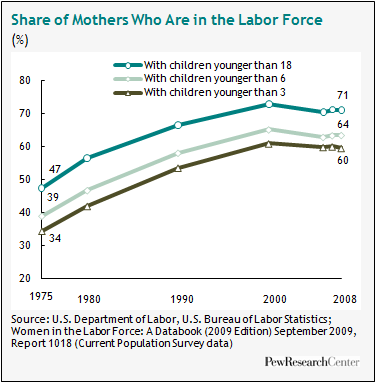
Along with their greater participation in the labor force, women began to delay marriage and have fewer children. In addition, women have been faced with the challenge of balancing marriage, motherhood and work. A large majority of mothers with children younger than 18 (71%) are now in the labor force. In 1975, fewer than half of all mothers were working. Even among mothers of very young children (younger than 3), 60% are in the labor force, up from 34% in 1975.[2]
The new social realities not only demand that we read the Quranic verses about child custody more progressively in a flexible mind set, where literal following does not occasion violation of the essence of the divine message.
It is likely that openness in this domain will gradually spill over in other areas as well, for example, equal inheritance for the daughters. I do want to follow the Quranic injunctions, but, not merely literally, without the essence of its egalitarian message of compassion, equality and justice.
References
- https://www.gauthierlawfirm.com/u-s-divorce-child-custody-statistics-gauthier-law-firm#:~:text=11%25%20of%20cases%20result%20in,custody%20time%20to%20both%20parents.
- https://www.pewresearch.org/social-trends/2010/11/18/ii-overview/




 The Glorious Quran and Science
Leave a comment