
Epigraph:
Allah takes away the souls of human beings at the time of their death; and of those also that are not yet dead, during their sleep. And then He retains those against which He has decreed death, and sends back the others till an appointed term. In that surely are Signs for a people who reflect. (Al Quran 39:42)
Collected and presented by Zia H Shah MD
Closer To Truth, hosted by Robert Lawrence Kuhn and directed by Peter Getzels, presents the world’s greatest thinkers exploring humanity’s deepest questions. It has thousand of videos talking about and discovering fundamental issues of existence. Engages new and diverse ways of thinking. Appreciates intense debates. It helps the audience seek their own answers.
In the above video the first interviewee makes the best arguments for Afterlife, arguing from human psychology and human experience. This is true for majority of thoughtful individuals regardless of faith.
A Pew Research Center survey from 2012 shows that a very large majority of the Muslims believe in Afterlife, heaven and hell.

In South Asia and Southeast Asia, belief in heaven is nearly universal. The conviction that paradise awaits the faithful is nearly as prevalent across the Middle East-North Africa region. In these three regions, belief in heaven ranges from 99% in Thailand and Tunisia to 88% in the Palestinian territories.
Overall, the lowest levels of belief in heaven are found in Southern and Eastern Europe, although even in that region at least half of Muslims surveyed in each country subscribe to the idea of paradise in the afterlife.
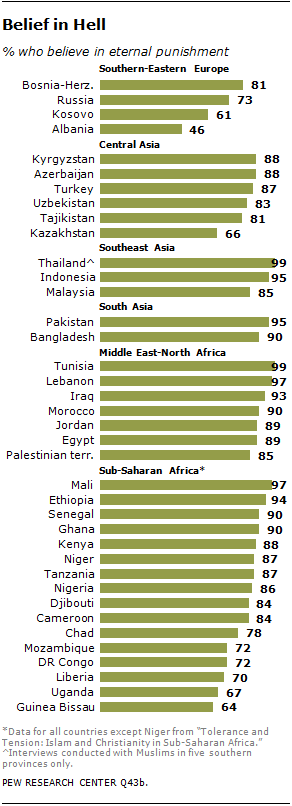
While respondents in some countries are less likely to say they believe in hell than heaven, the difference is especially pronounced in sub-Saharan Africa. In four of the 16 countries surveyed in the region, the percentage that believes in hell is at least 20 points lower than the percentage that says heaven exists: Guinea Bissau (23-point difference), Liberia (23 points), Uganda (23 points) and Mozambique (22 points). In the other sub-Saharan countries surveyed, belief in hell and heaven differs by about 10 points or less.
Muslims who are more religiously committed tend to express higher belief in the existence of both heaven and hell. This is especially true in Southern and Eastern Europe. For example, in Russia, among those who pray several times a day, 79% believe in heaven and 78% in hell. By contrast, among Russian Muslims who pray less frequently, 49% believe in heaven and 46% in hell.
The Quran describes Afterlife in almost every Surah except for the few short ones in the last section. The main argument that the Quran offers for the belief in Afterlife is that God, who is capable of the first creation is indeed capable of recreating us for accountability and the final judgment: Surah Qaf: The First Creation as the Foremost Proof for Afterlife.
The above and other videos of Closer to Truth about this subject talk about human soul and how can it survive physical death of human bodies? When Christians talk about this they tend to go to their belief about resurrection of Jesus, otherwise the Bible does not say a whole lot about human souls. The other important story for the devout Christians is that of Lazarus. It is a story of resuscitation, revival or resurrection, depending on your perspective. It has a whole chapter in Gospel of John devoted to it. It is also a prelude to Jesus being put on the cross according to the Biblical view. Here I quote the whole chapter from the New International Version:
The Death of Lazarus
11 Now a man named Lazarus was sick. He was from Bethany, the village of Mary and her sister Martha. 2 (This Mary, whose brother Lazarus now lay sick, was the same one who poured perfume on the Lord and wiped his feet with her hair.) 3 So the sisters sent word to Jesus, “Lord, the one you love is sick.”
4 When he heard this, Jesus said, “This sickness will not end in death. No, it is for God’s glory so that God’s Son may be glorified through it.” 5 Now Jesus loved Martha and her sister and Lazarus. 6 So when he heard that Lazarus was sick, he stayed where he was two more days, 7 and then he said to his disciples, “Let us go back to Judea.”
8 “But Rabbi,” they said, “a short while ago the Jews there tried to stone you, and yet you are going back?”
9 Jesus answered, “Are there not twelve hours of daylight? Anyone who walks in the daytime will not stumble, for they see by this world’s light. 10 It is when a person walks at night that they stumble, for they have no light.”
11 After he had said this, he went on to tell them, “Our friend Lazarus has fallen asleep; but I am going there to wake him up.”
12 His disciples replied, “Lord, if he sleeps, he will get better.” 13 Jesus had been speaking of his death, but his disciples thought he meant natural sleep.
14 So then he told them plainly, “Lazarus is dead, 15 and for your sake I am glad I was not there, so that you may believe. But let us go to him.”
16 Then Thomas (also known as Didymus[a]) said to the rest of the disciples, “Let us also go, that we may die with him.”
Jesus Comforts the Sisters of Lazarus
17 On his arrival, Jesus found that Lazarus had already been in the tomb for four days. 18 Now Bethany was less than two miles[b] from Jerusalem, 19 and many Jews had come to Martha and Mary to comfort them in the loss of their brother. 20 When Martha heard that Jesus was coming, she went out to meet him, but Mary stayed at home.
21 “Lord,” Martha said to Jesus, “if you had been here, my brother would not have died. 22 But I know that even now God will give you whatever you ask.”
23 Jesus said to her, “Your brother will rise again.”
24 Martha answered, “I know he will rise again in the resurrection at the last day.”
25 Jesus said to her, “I am the resurrection and the life. The one who believes in me will live, even though they die; 26 and whoever lives by believing in me will never die. Do you believe this?”
27 “Yes, Lord,” she replied, “I believe that you are the Messiah, the Son of God, who is to come into the world.”
28 After she had said this, she went back and called her sister Mary aside. “The Teacher is here,” she said, “and is asking for you.” 29 When Mary heard this, she got up quickly and went to him. 30 Now Jesus had not yet entered the village, but was still at the place where Martha had met him. 31 When the Jews who had been with Mary in the house, comforting her, noticed how quickly she got up and went out, they followed her, supposing she was going to the tomb to mourn there.
32 When Mary reached the place where Jesus was and saw him, she fell at his feet and said, “Lord, if you had been here, my brother would not have died.”
33 When Jesus saw her weeping, and the Jews who had come along with her also weeping, he was deeply moved in spirit and troubled. 34 “Where have you laid him?” he asked.
“Come and see, Lord,” they replied.
35 Jesus wept.
36 Then the Jews said, “See how he loved him!”
37 But some of them said, “Could not he who opened the eyes of the blind man have kept this man from dying?”
Jesus Raises Lazarus From the Dead
38 Jesus, once more deeply moved, came to the tomb. It was a cave with a stone laid across the entrance. 39 “Take away the stone,” he said.
“But, Lord,” said Martha, the sister of the dead man, “by this time there is a bad odor, for he has been there four days.”
40 Then Jesus said, “Did I not tell you that if you believe, you will see the glory of God?”
41 So they took away the stone. Then Jesus looked up and said, “Father, I thank you that you have heard me. 42 I knew that you always hear me, but I said this for the benefit of the people standing here, that they may believe that you sent me.”
43 When he had said this, Jesus called in a loud voice, “Lazarus, come out!” 44 The dead man came out, his hands and feet wrapped with strips of linen, and a cloth around his face.
Jesus said to them, “Take off the grave clothes and let him go.”
The Plot to Kill Jesus
45 Therefore many of the Jews who had come to visit Mary, and had seen what Jesus did, believed in him. 46 But some of them went to the Pharisees and told them what Jesus had done. 47 Then the chief priests and the Pharisees called a meeting of the Sanhedrin.
“What are we accomplishing?” they asked. “Here is this man performing many signs. 48 If we let him go on like this, everyone will believe in him, and then the Romans will come and take away both our temple and our nation.”
49 Then one of them, named Caiaphas, who was high priest that year, spoke up, “You know nothing at all! 50 You do not realize that it is better for you that one man die for the people than that the whole nation perish.”
51 He did not say this on his own, but as high priest that year he prophesied that Jesus would die for the Jewish nation, 52 and not only for that nation but also for the scattered children of God, to bring them together and make them one. 53 So from that day on they plotted to take his life.
54 Therefore Jesus no longer moved about publicly among the people of Judea. Instead he withdrew to a region near the wilderness, to a village called Ephraim, where he stayed with his disciples.
55 When it was almost time for the Jewish Passover, many went up from the country to Jerusalem for their ceremonial cleansing before the Passover. 56 They kept looking for Jesus, and as they stood in the temple courts they asked one another, “What do you think? Isn’t he coming to the festival at all?” 57 But the chief priests and the Pharisees had given orders that anyone who found out where Jesus was should report it so that they might arrest him.
According to the Quran, this can be a case a resuscitation but not literally true as most devout Christians understand it to be a case of resurrection from the dead:
The disbelievers of Mecca say: There is only one death for us and we shall not be raised again. Bring back our fathers if you speak the truth. (Al Quran 44:35-36)
Allah does not oblige such challenges by atheists as He has set up a different paradigm for all of humanity, outlined in detail in the following passage:
Allah has created the heavens and the earth in accordance with an eternal law, so that everyone may be requited according to that which he practices; and they shall not be wronged. Hast thou reflected over the case of him who has made his desires his god, and whom Allah has adjudged astray on the basis of His knowledge, and whose ears and whose heart He has sealed up, and on whose eyes He has put a covering? Who will, then, guide him, after Allah has thus condemned him? Will you not then take heed? They assert: There is nothing but our present life; we live and we die and it is the passage of time that kills us.
But they have no real knowledge of the matter; they do nothing but conjecture. When Our manifest Signs are recited to them, their only contention is: Bring back our fathers if you are truthful. Tell them: It is Allah Who gives you life, then causes you to die; then will He gather you together unto the Day of Judgment about which there is no doubt. But most people know it not. (Al Quran 45:22-26)
The holy Quran says that humans have been given but little knowledge about souls:
And they ask you concerning the soul. Say, ‘The soul is by the command of my Lord; and of the knowledge thereof you have been given but a little.’ (Al Quran 17:85)
In trying to explain human souls and Afterlife, the Quran uses the metaphor of sleep. It calls sleep a miracle or Sign of Allah:
And among His Signs is your sleep by night and day, and your seeking of His bounty. In that surely are Signs for a people who hear. (Al Quran 30:23)
Now, we get to the most important verse for this discourse, the metaphor between sleep and death and how to understand Afterlife:
Allah takes away the souls of human beings at the time of their death; and of those also that are not yet dead, during their sleep. And then He retains those against which He has decreed death, and sends back the others till an appointed term. In that surely are Signs for a people who reflect. (Al Quran 39:42)
So, Allah has shown amazing creativity in creation of this universe and He has also provided laws of nature to preserve human souls for our accountability and Afterlife. What mechanisms He uses for this purpose are open to scientific query and we know but little for now. May be the extra dimensions of string theory will shed some more light on our sleep, consciousness and Afterlife: Videos: Would Extra Dimensions, Some Day Explain the Mystery of Consciousness?
further Suggested Reading by Zia H Shah MD, Chief Editor of the Muslim Times about afterlife in Abrahamic faiths
All of David Attenborough’s Work as a Proof for the Hereafter according to the Holy Quran
If Allah Precisely Judges Everyone’s Belief, All End up in Hell
National Geographic: Accountability and Heaven and Hell in Native American Religions
Surah Qaf: The First Creation as the Foremost Proof for Afterlife
A New Commentary of Surah Al Waqi’ah (The Event or the Resurrection)
Surah Yasin’s Lucid Argument About the Afterlife
Michael Shermer with Bart Ehrman — Heaven and Hell: A History of the Afterlife
Is There an Afterlife? – Christopher Hitchens, Sam Harris, David Wolpe, Bradley Artson Shavit
How Can the Jews, the Christians and the Muslims Argue Afterlife
Maulana Tariq Jameel’s Extreme Physical Paradise: Do We Need Better Theology?


 The Glorious Quran and Science
Leave a comment