
Epigraph
Which is harder to create: you people or the sky that He built, raising it high and perfecting it, giving darkness to its night and bringing out its morning brightness, and the earth, too, He spread out, bringing waters and pastures out of it, and setting firm mountains [in it] for you and your animals to enjoy? (Al Quran 79:27-33)
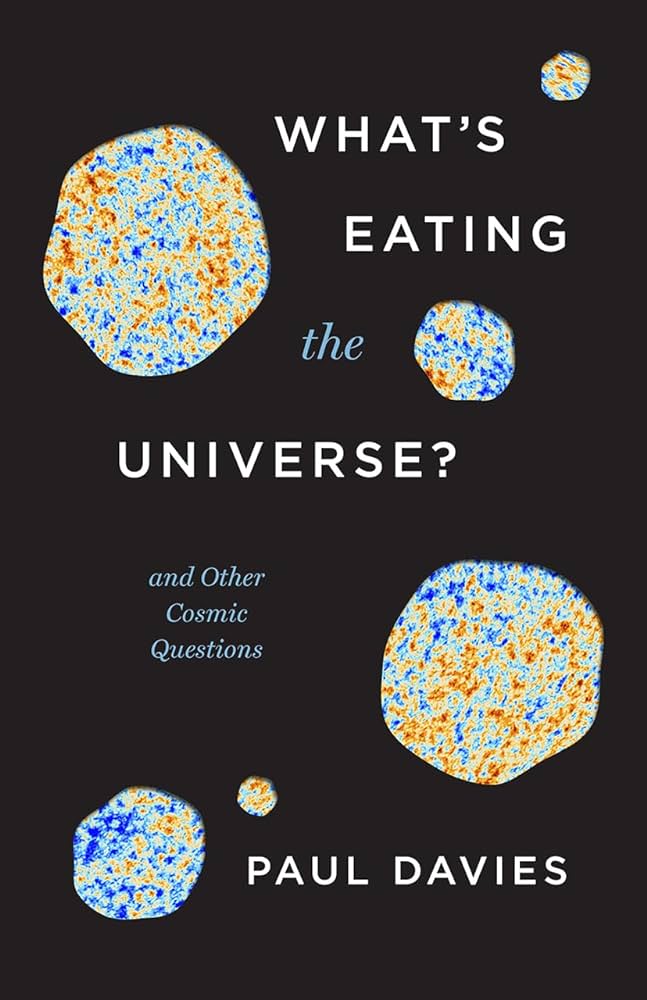
What is Eating the Universe? And Other Cosmic Questions
Book by Paul Davies
Book reviewed by Zia H Shah MD, Chief Editor of the Muslim Times
As a theologian in this book review, I am not going to present ‘God of the gaps,’ which is finding God in areas that contemporary science does not know, rather finding God the Creator, in what we know and finding limits of human knowledge based on the Quranic verses, in review of chapter 18, 20 and 22.
The title of this book is visible in the picture and heading above. This review is meant to relate the best of cosmology by the famous Paul Davies with my understanding of the Quranic cosmology or theology. I have put a provocative label for this post, to get you here and change this book review into a debate between atheism/pantheism versus theism.
Davies is the recipient of many awards: Templeton Prize, Royal Society of London Michael Faraday Prize, Klumpke-Roberts Award, Kelvin Medal. Born in 1946 he has been at the study of cosmology for a long time. He is to my knowledge the best spoken cosmologist, whose writings and videos are most useful to make a case for theism. A case for God of the Abrahamic faiths, Who is transcendent and beyond time, space and matter. He describes his CV as a theoretical physicist, cosmologist and astrobiologist in the preface of this book as:
While my own contributions have been modest, I have rubbed shoulders with some of the giants of physics and astronomy, women and men of sparkling intellect and insatiable curiosity, whose infectious zeal for understanding the world from the perspective of science has been a constant source of inspiration.
He was working along side many great names, the likes of Frederick Hoyle and Stephen Hawking. He seems to me to be closest to theism among the well known contemporary cosmologists. I want to thank him for his book and his videos as I draw on them to explain my theistic metaphysics and theology.
When theists talk or debate with atheists, they often just emphasize their ideology and talk over each other’s head. Davies, on the other hand, respectfully engages both sides, and I want to do the same.
I am going to opine on only some of the chapters of his book that are of more special interest to me.
Please review the shorter videos, less than 10 minutes, as you read the review and leave the longer ones as reference, when you have more leisure time. When you click on the video you get to see its duration:
Among other things in the above video he pins down those who suggest that every thing that can exist does exist, to cop out of the question of explaining the observable universe in terms of the First Cause.
The above video can be reason enough for why you would like to read my review and Davies book. My review is free and for his book you got to pay Amazon.
He also says that laws of physics are real and these need to be explained and not merely as brute fact.
In the video below he talks about the strong bias towards atheism among the contemporary physicists:
In the above video Davies is not giving us God of Judaism, Christianity and Islam. But, I find the video useful and as a good start for me, in as much as he defines the limits for the militant atheists. I think I will find God by the end of my review.
Read on and in the words of Sir Francis Bacon, “Read not to contradict … but to weigh and consider.”
A lot of human activity and interaction, in all fields of human life, is about establishing the peck order. It serves a very useful purpose, for example all of the physics discoveries of the last century can be studied sufficiently, by studying the life and work of the Nobel Prize winners in physics.
But, on the negative side of the struggle for the peck order, scientists compete to embellish and promote their work and sometimes not recognize or diminish the work of others. Davies gives us a snapshot from the twenties and thirties, after Georges Lemaitre made explicit claims in 1927 about our universe coming from a ‘cosmic egg’ billions of years ago, in the fourth chapter of the book:
You might have expected that a declaration of such profound importance would be a scientific, not to mention theological sensation. Yet again, however, the response was muted. Hubble himself doubted Lemaitre’s conclusion. Albert Einstein, by then the world greatest authority on gravitation and cosmology, was himself dismissive. ‘Your calculations are correct,’ he wrote to Lemaitre, ‘but your physics is atrocious.’ Einstein had also shrugged Friedman’s earlier theoretical effort aside, and indeed he only accepted that the universe was actually expanding after visiting Hubble in California in 1931. After that, he did a U-turn and backed Lemaitre’s work. In spite of this illustrious endorsement, speculation about the origin of the universe wasn’t taken very seriously in the 1930s; indeed, cosmology was hardly even a recognized subject.
Perhaps there was an undercurrent of tension between theism versus atheism. The discussions about metaphysics stemming from the discoveries of astronomy and cosmology have taken more of a dogmatic character as decades have passed.
The atheist physicists want us to believe that the reality of the universe is so complex that only the best mathematicians and physicists can understand the theories of relativity and quantum physics, yet one thing they assert with certainty is that it is an accident and the only explanation it requires are those that they are working on.
Chapter 1: Journey from the Edge of Time
Epigraph
We will show them Our Signs in the universe and also among their own selves, until it becomes manifest to them that the Quran is the truth. (Al Quran 41:53)

Davies’ chapter starts as:
On 14 January 1990, the world’s press featured a mottled red and-blue image purporting to show nothing less than the birth of the universe. ‘It was like looking at the face of God,’ proclaimed the project’s lead scientist, George Smoot. In the words of Stephen Hawking, the picture represented ‘one of the greatest scientific discoveries of the century, if not all time’.
The subject of these superlatives was a colour-coded heat map of the sky produced by a satellite called COBE, for Cosmic Background Explorer. COBE had been tasked with surveying the fading afterglow of the Big Bang, a sea of microwaves that suffuses space and travels to us largely undisturbed from a time when the cosmos was a tiny fraction of its current age.
The ideas leading to Big Bang and the mention of the expanding universe in 1930’s brought physics towards theism, otherwise the 19th century physics in time of Laplace had a tendency towards arrogant atheism. Some of this history, I have captured in a previous article: Religion and Science: The Indispensable God-hypothesis.
Chapter 2: The Search for the Key to the Universe
Epigraph
We have created the heavens and the earth and all that is between the two in accordance with the perfect truth and wisdom. (Al Quran 15:85)
Davies writes in the second chapter of his book:
Was there a Prime Mover who set the complex mechanism in motion? A supernatural Creator who conjured order out of chaos? A god who made the universe from nothing? No attempt was made in these early models to link the motion of astronomical objects with the motion of material bodies on Earth. Heaven and Earth, each filled with movement, remained separate domains. This view persisted through much of the Medieval period, until the seventeenth century. Then, suddenly, humankind’s understanding of the universe was transformed. A small band of visionary ‘natural philosophers’ came to realize that the key to the universe was not to be found in divine agency, nor in the geometry of the cosmic architecture itself. Rather, it resides in laws of nature that transcend the physical world and occupy an abstract plane, invisible to the senses but nevertheless within the grasp of human reason. Number and form, beloved of the ancient philosophers, are manifested not just in specific physical objects and systems, but interwoven into the very laws of nature themselves, forming a mosaic of subtle patterns encrypted in a kind of cosmic code. It was a stunning conceptual pivot, marking a transition from mere description of the world to explanation. The quantum leap in comprehension accompanying this transition was poetically expressed by Galileo in 1632: ‘The great book of nature is written in the language of mathematics,’ without which, ‘one wanders in vain through a dark labyrinth.’
To a theist like me the universe following the natural laws does not rule out the Creator, it merely directs us to the creativity, wisdom and subtlety of the Creator. It reminds us of the Quranic verse that is echoed in several places in the holy scripture:
We have created the heavens and the earth and all that is between the two in accordance with the perfect truth and wisdom. (Al Quran 15:85)
Davies embellishes the metaphor from Galileo further by saying:
The key to the universe, said Galileo, lay with mathematical decryption, a sentiment the search for the key to the universe echoed three centuries later by the astronomer Sir James Jeans, who declared ‘The universe appears to have been designed by a pure mathematician!’
If you would want to explore the metaphor presented by Galileo in 1632 and others later in regards to mathematics, may I suggest:
Video: Want to Know Mathematics and Physics: Is God a Mathematician?
Movie: Ramanujan: A Prophet of Mathematics Born in a Hindu Family
Nova Documentary on Mystery of Mathematics
The Unreasonable Effectiveness of Mathematics in the Natural Sciences
Chapter 3: Why is it Dark at Night?
Epigraph
It is He who created night and day, the sun and the moon, each floating in its orbit. (Al Quran 21:33)
It is He who made the night so that you can rest in it and the daylight so that you can see– there truly are signs in this for those who hear. (Al Quran 10:67)

Davies gives beautiful scientific explanation of the fact that the night sky is not dark merely because of the absence of sunlight. Just as the stars are visible at night, theoretically the whole of the sky could be lit by light from distant galaxies.
In the past, when people considered dark night to be merely absence of sunlight the Quranic expression of Allah creating the night, and even mentioning it before the day, may have seemed an awkward expression, but, not any more after the scientific discoveries of physics and astronomy.
With the information, now nicely described by Davies, the expression of the Quran about the creation of the night becomes more profound to any Muslim, who stands in awe of the Quran, as quoted in the epigraph of this section.
Chapter 4: The Big Bang
Epigraph
Are the disbelievers not aware that the heavens and the earth used to be joined together and that We ripped them apart, that We made every living thing from water? Will they not believe? (Al Quran 21:30)
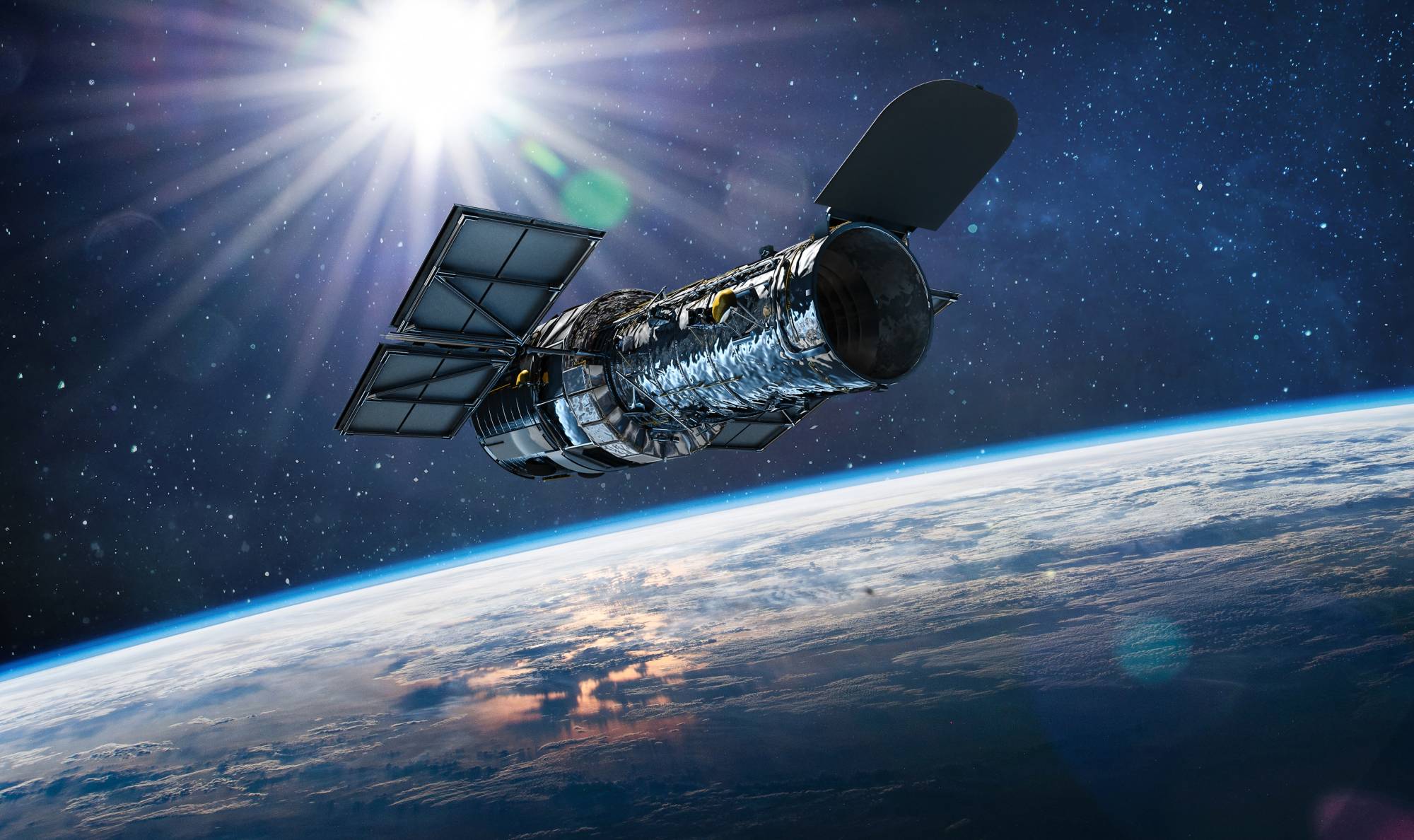
Read Davies’ book for the details of his chapter, in the mean while, it is best to study a brief summary of the Big Bang, at this stage, from Encyclopedia Britannica:
Big-bang model, widely held theory of the evolution of the universe. Its essential feature is the emergence of the universe from a state of extremely high temperature and density—the so-called big bang that occurred 13.8 billion years ago. Although this type of universe was proposed by Russian mathematician Aleksandr Friedmann and Belgian astronomer Georges Lemaître in the 1920s, the modern version was developed by Russian-born American physicist George Gamow and colleagues in the 1940s.
The big-bang model is based on two assumptions. The first is that Albert Einstein’s general theory of relativity correctly describes the gravitational interaction of all matter. The second assumption, called the cosmological principle, states that an observer’s view of the universe depends neither on the direction in which he looks nor on his location. This principle applies only to the large-scale properties of the universe, but it does imply that the universe has no edge, so that the big-bang origin occurred not at a particular point in space but rather throughout space at the same time. These two assumptions make it possible to calculate the history of the cosmos after a certain epoch called the Planck time. Scientists have yet to determine what prevailed before Planck time.
The Quranic verses quoted as epigraph described the Big Bang with amazing specificity. For one who is open to theism it turns out to be an amazing prophecy coming from the seventh century fulfilled by the 20th century physicists, including Edwin Hubble, Alexander Friedman, Georges Lemaitre and also Albert Einstein by playing as an arbiter of the latest scientific discoveries.
Chapter 5: Where is the Center of the Universe?
Epigraph
We have built the heavens as a manifestation of several of Our attributes, and surely We go on expanding the universe. (Al Quran 51:47)
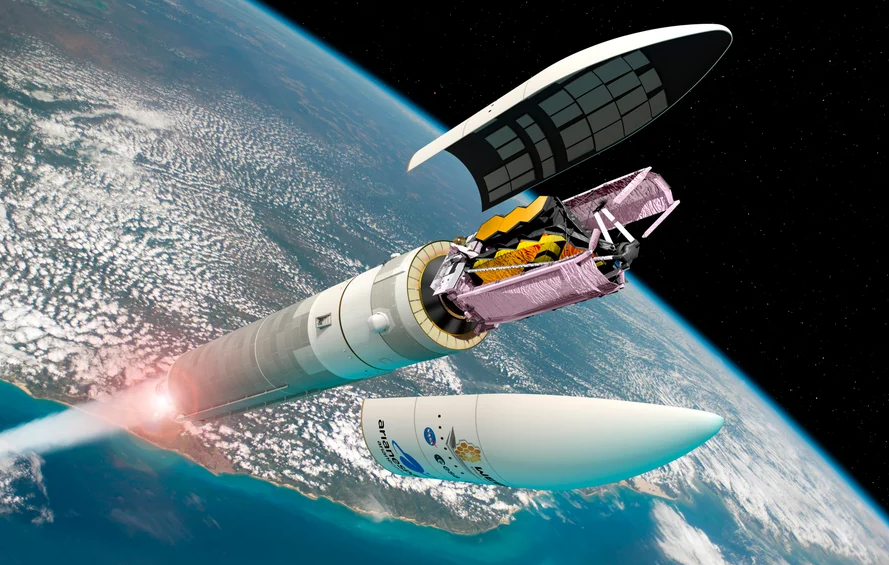
The universe is expanding with a speed greater than the speed of light. Davies tells us that the horizon of the universe is now about 47 light years away.
It is amazing that a text from the seventh century Arabia, where very few could read and write, talks about the expanding universe, ideas that came about only in the last century.
Chapter 9: Explaining the Cosmic Big Fix
Epigraph
He is the Mighty, the Forgiving; Who created the seven heavens, one above the other. You will not see any flaw in what the Lord of Mercy creates. Look again! Can you see any flaw? Look again! And again! Your sight will turn back to you, weak and defeated. (Al Quran 67:2-4)
His chapter opens with the statement:
A trained marksman can hit the bullseye from a thousand meters, but if most of us took a potshot we will be well wide of the mark. The same laws of physics are at work, but the marksman has a sharper aim. To hit a bullseye a thousand meters away requires precision and skill. But hitting the same target a thousand light years away defies imagination. Yet that’s how precisely the cosmos seems to have been set up at the beginning.
No comments at this time.
Chapter 18: A Theory for Everything
Epigraph
Eyes cannot reach Him. He reaches the eyes! (Al Quran 6:103)
In the above video Davies suggests that we may some day be able to understand the universe in totality. However, if God did create it and also revealed Himself to humanity in the Quran, a degree of mystery will always prevail and we may never fully know the very First Cause, except for congratulatory triumphalism by agnostic and atheist physicists and cosmologists.
In physics, string theory is a theory that attempts to merge quantum mechanics with Einstein’s general theory of relativity. Physicists have been working on a theory for every thing that can explain all of reality, but, such ambitions have evaded the scientists, so far.
Two areas will always remain shrouded in mystery, at least to some degree. The First Cause and human consciousness. I am not presenting a God of the gaps, but drawing this conclusion from positive statements from the holy Quran. The First Cause inference is drawn from the epigraph of this section.
Discussion of human consciousness belongs to chapter number 22.
Chapter 20: Can the universe come from nothing
Epigraph:
Have they been created from nothing, or are they their own creators? Have they created the heavens and the earth? In truth they put no faith in anything. (Al Quran 52:35-36)
Getting a pigeon out of an empty hat is magic, but getting a universe or infinite number of universes out of nothing is not a miracle, rather a sheer accident or a brute fact, if we were to believe the militant atheists.

Davies explains the laws of nature and the catch 22 that we are facing in trying to find a theory for everything and source of the laws of nature, in the following words:
‘The Laws of physics were there before the Big Bang!’ But that is not really true since there was no really ‘before’. It is more accurate to say that laws of physics transcend space and time; they exist in a mathematical realm that is not part of the physical universe. Some distinguished scientists do indeed take that position. They argue that in the matter of existence, the set of physical laws are the primary entity and have within them universe-creating capabilities. Others disagree and deny that one can think of laws as ‘things’ that exist independently of the universe. They reason that laws of physics are relationships between physical things that necessary exist only after the origin of the universe. But you cannot have it both ways. Either unexplained laws are ‘out there’ and account for how the physical cosmos (lawfully) appeared spontaneously from nothing, or laws + universe together burst into being ready-made — a joint package of marvels with no explanation whatsoever. It is catch 22.
i
This catch 22 along with what is discussed in the review of chapter 18 and 22, set the limits of human knowledge.
Below is another physicist Victor Stenger with a different emphasis, almost suggesting that we the humans have invented the laws of nature:
Chapter 21: How Many Universes are There
Epigraph
Whatever is in the heavens and the earth glorifies Allah; and He is the Mighty, the Wise. His is the kingdom of the heavens and the earth; He gives life and He causes death; and He has power over all things. He is the First and the Last, and the Manifest and the Hidden, and He knows all things full well. (Al Quran 57:1-3)
Davies says that the number of universes cannot be 153. It has to be 1, 2 or infinity. In the next chapter he has examined the history of this concern with the number of universes that came in the shape of multiverse or M theory to explain our biophilic universe. Actually he concludes the next chapter, as he talks about a universe-creating mechanism – a bubble generator, with this description:
The origin of those laws remains unexplained. You could cook up any number of different multiverse models with different overarching laws and different bubble universe generators. So, the problem is just shifted up a level: instead of ‘Why this universe?’ one can ask, ‘Why this multiverse?’ There may be no end to this ontological paper trail.
At this time we should also examine the age old question, who made God: Who Created God? John Lennox at The Veritas Forum at UCLA.
I have previous also written about the M theory or multiverse in a book review, while reviewing the last book of Stephen Hawking: Ten Raised to Five Hundred Reasons for Our Gracious God.
Chapter 22: The Goldilocks Enigma
Epigraph
He is the Mighty, the Forgiving; Who created the seven heavens, one above the other. You will not see any flaw in what the Lord of Mercy creates. Look again! Can you see any flaw? Look again! And again! Your sight will turn back to you, weak and defeated. (Al Quran 67:2-4)
Davies says, “As the list of propitious coincidences grew, scientists became uneasy. Like in the story of Goldilocks, our universe seems to be ‘just right’ for life.
This short comment reflects the atheistic bias of the present day physicists. In decades to come the scientists may even deny the historic origin of the multiverse. In fact I have seen a short video clip of Richard Dawkins and Steven Weinberg, where they do that.
Frederick Hoyle in 1950s was working on how carbon has come to be. Davies describes:
Hoyle guessed there must exist a happy coincidence in the arrangement of nuclear states that enabled carbon to form from rare simultaneous encounter of three helium nuclei. Experiment prove him right. ‘It seemed as if a super-intellect had been monkeying with the laws of physics,’ he later wrote, nothing that if the strength of the nuclear force were just a bit weaker or stronger, the coincidence would go away and the universe would be devoid of carbon and therefore life.
I have documented this carbon mystery, or whatever word you would like to use, in greater length in a previous article: A challenge for Dawkins: Where did carbon come from?
The greatest enigma or mystery in life on planet earth is the best of life among the 9 million extant species, namely Homo sapiens and in humanity itself the greatest of all mysteries is the human consciousness. Even though Davies does not talk about it in his book, I find it a convenient place to share his recent videos on the subject.
And another video on the same subject:
Based on a Quranic verse about human consciousness or human soul, we have here another area, where human knowledge and investigations have limitations:
And they ask you concerning the soul. Say, ‘The soul is by the command of my Lord; and of the knowledge thereof you have been given but a little.’ (Al Quran 17:85)
To deal with this mystery further, let me share a prior article by me: Commentary of the Quranic verse about human soul.
Chapter 25 and 26 Extraterrestrial Life
Epigraph
Allah is He, Who created seven heavens and of the earth a similar number. (Al Quran 65:12)
And among His Signs is the creation of the heavens and the earth, and whatever living creatures He has spread in both of them and He has the power to gather them together, when He will so please. (Al Quran 42:29)
Davies above video talks extensively about the possibility of extraterrestrial life. the above two verses of the Quran, not only suggest the presence of extraterrestrial life but also allude to a possible meeting. An amazing description and assertion from a text coming from the seventh century Arabia that was not a center of learning before Islam, by any stretch of the imagination.
Incidentally, the number 7, as mentioned in the verse in the epigraph, is used as a symbol for a very large or infinite number.
Epilogue: Chapter 29: Is There Meaning to it All
Epigraph
There truly are signs in the creation of the heavens and earth, and in the alternation of night and day, for those with understanding, who remember God standing, sitting, and lying down, who reflect on the creation of the heavens and earth: ‘Our Lord! You have not created all this without purpose – You are far above that!’ (Al Quran 3:190-191)
Unlike many Christian and Muslim theologians, I agree with Davies that miracles do not violate the laws of nature, not even the miracle of the First Cause and that is what makes our universe comprehensible and cosmology a worth while pursuit.
Unlike Davies, some what militant atheists like Richard Dawkins assume as if all theologians are presenting God of the gaps or committing some other fallacy. A couple of years ago I had a personal exchange with Dawkins in Twitter now named X, however brief: Video: The world’s best known atheist, Richard Dawkins does seem to believe in a Creator God.
‘The rationality of the universe is somehow anchored in God,’ is one of the brief statement made in the above video and I will totally agree with it. Davies is more of an agnostic or pantheist and here I add a historic debate between three well known atheists and three theists: Debate: Does the Universe have a purpose?
As I alluded before, it seems to me from several of Davies videos here that he is a pantheists, who believe that Nature is identical with divinity while not recognizing a distinct personal anthropomorphic god. I am among the theists, who challenge the idea that nature contains all of reality. I do not believe in demons and Jinns, for I see no evidence for them. But, I do believe in the transcendent God of the Abrahamic faiths, Judaism, unitarian Christianity and Islam. According to some theists, including me, natural laws may be viewed as secondary causes of God.
I believe in methodological naturalism but not in metaphysical naturalism, as described below, ignoring this distinction has led to many an unnecessary debates between theists and atheists. I have grounded my belief in the following verses of the Quran among other things.
Whatever is in the heavens and the earth glorifies Allah; and He is the Mighty, the Wise. His is the kingdom of the heavens and the earth; He gives life and He causes death; and He has power over all things. He is the First and the Last, and the Manifest and the Hidden, and He knows all things full well. (Al Quran 57:1-3)
In philosophy, naturalism is the idea that only natural laws and forces (as opposed to supernatural ones) operate in the universe.[1] In its primary sense[2] it is also known as ontological naturalism, metaphysical naturalism, pure naturalism, philosophical naturalism and antisupernaturalism. “Ontological” refers to ontology, the philosophical study of what exists. Philosophers often treat naturalism as equivalent to materialism.
For example, philosopher Paul Kurtz argues that nature is best accounted for by reference to material principles. These principles include mass, energy, and other physical and chemical properties accepted by the scientific community. Further, this sense of naturalism holds that spirits, deities, and ghosts are not real and that there is no “purpose” in nature. This stronger formulation of naturalism is commonly referred to as metaphysical naturalism.[3] On the other hand, the more moderate view that naturalism should be assumed in one’s working methods as the current paradigm, without any further consideration of whether naturalism is true in the robust metaphysical sense, is called methodological naturalism.[4]
In the above short clip Davies is demanding a personal miracle. The God of Islam and the Quran does hear the prayers of the grieved, but otherwise does not offer miracles on demand.
But, we do find miracles mentioned in the Bible and the Quran. I am not apologizing for each and every miracle claimed by the believers from the scriptures or otherwise, however, I do want to share a miracle of cosmological significance from the Quran here that we have briefly alluded to before. Firstly, the verses talking about the Big Bang, life coming from water and some geological significance of mountains and more, in fairly specific terms:
Are the disbelievers not aware that the heavens and the earth used to be joined together and that We ripped them apart, that We made every living thing from water? Will they not believe?
And We put firm mountains on the earth, lest it should sway under them, and set broad paths on it, so that they might follow the right direction, and We made the sky a well-secured canopy–– yet from its wonders they turn away. (Al Quran 21:30-32)
Secondly, the verses about the expanding universe and more:
We have built the heavens as a manifestation of several of Our attributes, and surely We go on expanding the universe. And We spread out the earth – how well We smoothed it out! And of everything We created pairs that you may reflect. (Al Quran 51:47-49)
From cosmology of Davies we know that laws of physics are real and they cannot be denied causation as a brute fact. It is in appreciation of these laws and as the First Cause of them that the sophisticated theologians, see their Creator and the Creator of this universe or multiverse. In chapter 18 we examined the limits of human knowledge in light of a Quranic verse, when it comes to the First Cause and chapter 22, when it comes to human consciousness.
Quantum physics is described as a ‘magic box of wonders,’ by Davies in chapter 20, and would definitely be used by many for their atheistic agenda. In the mean while, I have used it for my theism: Demystifying Quantum Physics: You Need it for Your Faith and If there is freewill, so is Providence: Refuting the best of atheism through the latest science.
Science should not be used to dogmatically exclude theology and it in turn should not be used to shut off the scientific expedition, like once it happened in the Islamic civilization in medieval ages.
I will conclude in the words of Charles Darwin, as he quoted Francis Bacon from his book Advancement of learning, in the later editions of On the Origin of Species, to establish the proper relationship between religion and natural science:
To conclude, therefore, let no man out of weak conceit of sobriety, or an ill-applied moderation, think or maintain, that a man can search too far or be too well-studied in the book of God’s word, or in the book of God’s works; divinity or philosophy; but rather let men endeavor an endless progress or proficiency in both.
If you are not ready to buy the book yet, here is a free alternative:

 The Glorious Quran and Science
Leave a reply to Table of Contents – The Quranic Compassion Cancel reply