
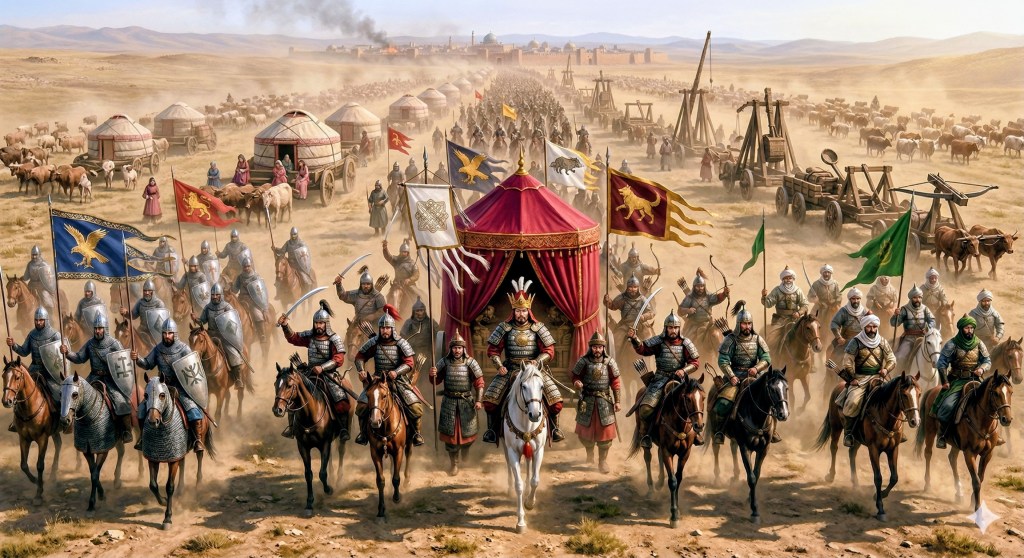
The Zenith of Resistance: The Mongol Incursions, the Mamluk Defense, and the Transformation of Meccan Civil Life
Presented by Zia H Shah MD
Abstract
The thirteenth century stands as a watershed moment in the history of Islamic civilization, characterized by the catastrophic expansion of the Mongol Empire and the subsequent annihilation of the Abbasid Caliphate in 1258. This report provides a comprehensive analysis of the multidimensional impact of the Mongol invasions on the common Muslim life in Mecca, a city that, while never physically occupied by Mongol forces, was profoundly reshaped by the geopolitical and spiritual vacuum created by their conquests. The study investigates the mechanisms of this indirect but pervasive influence, ranging from the disruption of the Hajj pilgrimage and the collapse of traditional religious authority to the demographic shifts caused by a diaspora of scholars fleeing from the East. Central to the narrative is the identification of the military and political forces that halted the Mongol advance, specifically the Mamluk Sultanate of Egypt. Through a detailed examination of the Battle of Ain Jalut (1260) and subsequent engagements, this report elucidates how the Mamluks, under the leadership of Sultans Qutuz and Baybars, established themselves as the “Shield of the Hejaz.” Furthermore, the analysis highlights the critical role of internal Mongol fissures, notably the intervention of Berke Khan of the Golden Horde, whose conversion to Islam created a strategic diversion that ultimately secured the holy cities. The report concludes with a thematic epilogue that reflects on the resilience of Meccan society and the eventual integration of the Mongol Ilkhanids into the Islamic fold, an evolution that transformed a relationship of existential terror into one of diplomatic and cultural patronage.
The Mongol Onslaught: A Prelude to Civilizational Disruption
The Mongol invasions of the thirteenth century were not merely a sequence of military campaigns but a global event that fundamentally altered the demographic, economic, and social fabric of the Islamic world. Under the leadership of Genghis Khan and his successors, the Mongol hordes dismantled established sedentary civilizations with a ferocity that contemporary chroniclers likened to the Day of Judgment. The initial wave of destruction in Central Asia and northeastern Persia led to the depopulation of vast regions, as the Mongols systematically destroyed any city that dared to resist. For the common Muslim in Mecca, situated thousands of miles from the front lines in Transoxania, these events were initially experienced as a series of terrifying reports brought by merchants and fleeing refugees.
The collapse of the Khwarazmian Empire between 1219 and 1221 served as the first major indicator of the vulnerability of the Dar al-Islam. The Mongols used terror as a strategic weapon, often sparing populations that surrendered immediately while massacring those who opposed them, leaving psychological scars that would persist for centuries. This climate of fear sparked a mass migration of scholars, artisans, and commoners toward the safer southern and western reaches of the Islamic world, including the Hejaz.
| Key Mongol Invasions (1217–1260) | Target Region | Outcome |
| Khwarazmian Campaign (1219–1221) | Central Asia/Persia | Total collapse of Khwarazm-Shah; depopulation |
| Battle of Köse Dağ (1243) | Anatolia | Seljuk Sultanate of Rum becomes a client state |
| Siege of Baghdad (1258) | Mesopotamia | End of Abbasid Caliphate; slaughter of 200,000+ |
| Invasion of Syria (1259–1260) | Levant | Fall of Aleppo and Damascus |
By the time Hulegu Khan, the grandson of Genghis Khan, was dispatched westward in 1251, the Mongol intent was clear: the total subjugation of the Islamic heartlands and the elimination of any independent political authority. Hulegu’s forces, estimated between 138,000 and 300,000 men, were augmented by Christian auxiliaries from Armenia and Georgia, as well as Chinese military engineers, creating an unprecedented technological and tactical advantage. The common Muslim in Mecca, watching the horizon of the northern deserts, understood that the survival of the holy cities now depended on the strength of the last remaining organized Islamic power: the Mamluks of Egypt.
The Siege of Baghdad and the Spiritual Crisis in Mecca
The fall of Baghdad in early 1258 represents the most significant civilizational rupture in the history of Sunni Islam. For the Meccan populace, Baghdad was not just a distant capital; it was the seat of the Caliph, the “Commander of the Faithful,” in whose name the Friday sermon (khutba) was recited and who provided the ultimate legitimacy for the guardianship of the Kaaba. The destruction of the city and the execution of Caliph al-Musta’sim created a theological and political crisis of the highest order.
The Mechanics of the Sack
Hulegu Khan’s approach to Baghdad was preceded by the systematic destruction of the Nizari Ismaili state in the Elburz Mountains in 1256, removing a potential threat to his rear. When the Mongols finally invested Baghdad in January 1258, the Caliph’s defenses were woefully inadequate, consisting of only 30,000 troops against Hulegu’s massive host. The subsequent slaughter lasted for a week, resulting in the death of hundreds of thousands of inhabitants and the destruction of the city’s irreplaceable libraries and schools.
The immediate impact on Mecca was both spiritual and physical. For the first time in five centuries, the Islamic world was without a universally recognized Caliph. In Mecca, this led to a period where the Friday prayer, which traditionally included a supplication for the reigning Caliph, became a poignant reminder of the community’s “stateless” condition. Furthermore, it is recorded that no one from Baghdad performed the Hajj for years after the city’s fall, as the traditional pilgrimage routes through Iraq were either blocked or rendered too dangerous by Mongol patrols and Bedouin opportunism.
The End of the Golden Age
The sack of Baghdad effectively ended the “Golden Age” of Islam, shifting the center for education and scientific research to the West and toward non-state actors. In Mecca, common life was directly affected by the cessation of endowments and supplies that had traditionally flowed from the Abbasid court. The city’s dependence on external sources for its survival—most notably for grain and water maintenance—made the threat of a Mongol advance into the Hejaz a matter of imminent starvation as much as military conquest.
The Mamluk Response: The Shield of the Hejaz
The responsibility for stopping the Mongol expansion fell upon the Mamluk Sultanate of Egypt, a state ruled by a military caste of freed slave soldiers. The Mamluks had established their power in 1250 after overthrowing the Ayyubid dynasty, and they viewed themselves as the only capable defenders of the Islamic faith against both the Crusaders and the Mongols.
The Ultimatum and the Defiance of Qutuz
Following the fall of Damascus and Aleppo in early 1260, Hulegu Khan sent a group of envoys to Cairo with a letter demanding the immediate submission of the Mamluk Sultan, al-Muzaffar Sayf al-Din Qutuz. The letter was a masterpiece of psychological warfare, threatening to “shatter the mosques” and “reveal the weakness of your God”. Qutuz, recognizing that surrender would lead to the same annihilation witnessed in Baghdad, responded by executing the Mongol envoys and displaying their heads on the Bab Zuweila gate in Cairo. This decisive act signaled to the entire Muslim world, including the fearful residents of Mecca, that a legitimate resistance was being organized.
The Battle of Ain Jalut (1260)
The confrontation took place on September 3, 1260, at Ain Jalut in the Jezreel Valley. While Hulegu had withdrawn the majority of his army to the East to attend a kurultai following the death of the Great Khan Möngke, he left a formidable force of approximately 10,000 to 20,000 men under his general Kitbuqa. The Mamluk army, led by Qutuz and his general Baybars, utilized their knowledge of the local terrain to trap the Mongol vanguard.
Baybars, who had spent time in the region as a fugitive, devised a strategy centered on a feigned retreat. A small Mamluk force engaged the Mongols and then retreated into the highlands, drawing Kitbuqa’s cavalry into a position where they were surrounded by the bulk of the Mamluk army hidden in the hills. At a critical moment, when the Mongol ferocity threatened to break the Mamluk left wing, Sultan Qutuz famously removed his helmet and shouted “O Islam!” three times, a battle cry that rallied his men for a final, victorious charge.
| Tactical Comparison at Ain Jalut | Mamluk Forces | Mongol Forces |
| Leadership | Sultan Qutuz, General Baybars | Kitbuqa Noyon |
| Core Cavalry | Heavy Mamluk cavalry with superior armor | Light horse archers |
| Innovation | Use of hand cannons (midfa) to frighten horses | Traditional siege and swarm tactics |
| Motivation | Defense of the Holy Cities and Islam | Imperial expansion and terror |
| Outcome | Decisive victory; Kitbuqa killed | First permanent halt to westward advance |
The victory at Ain Jalut was not merely a military success; it was a psychological turning point for the inhabitants of Mecca. It proved that the Mongols were not invincible, and it established the Mamluk Sultanate as the legitimate protector of the Hejaz and the Holy Cities.
Berke Khan and the Internal Mongol Resistance
While the Mamluk victory at Ain Jalut stopped the immediate threat from the north, the long-term safety of Mecca was significantly bolstered by a development within the Mongol Empire itself: the conversion of Berke Khan of the Golden Horde to Islam. Berke, a grandson of Genghis Khan, was deeply offended by Hulegu’s brutal treatment of Baghdad and the execution of the Caliph.
Berke Khan’s intervention transformed the Mongol threat from a monolithic front into a fractured one. He formed a strategic alliance with the Mamluk Sultanate, providing the Mamluks with critical intelligence and attacking the Ilkhanate (Hulegu’s domain) from the north. This forced the Ilkhanids to divert their resources to the Caucasus and Central Asia to defend against their own kin, effectively preventing any major Mongol army from ever reaching the Hejaz. For the common Muslim in Mecca, this meant that the threat of a direct Mongol invasion shifted from an imminent reality to a distant, managed border conflict.
Direct and Indirect Effects on Common Life in Mecca
Although Mongol soldiers never entered Mecca, the city’s common life was fundamentally altered by the “Mongol storm.” These impacts can be categorized into demographic, economic, and socio-religious dimensions.
Demographic Shifts and the Refugee Crisis
The most direct effect on the population of Mecca was the influx of refugees from the East. As the Mongols devastated Transoxania, Khorasan, and Iraq, thousands of survivors sought refuge in the Hejaz, which was perceived as a sanctuary beyond the reach of Mongol horsemen. This included not only commoners but also a significant diaspora of scholars and intellectuals.
Ibn Battuta, who visited the region decades later, noted that cities like Shiraz, which had escaped destruction by submitting to the Mongols, became centers for these refugees. However, Mecca remained the ultimate spiritual destination. This influx of “displaced persons” transformed Mecca from a seasonal pilgrimage site into a more cosmopolitan and intellectually dense urban center. The presence of these scholars ensured that the intellectual traditions of Baghdad and Nishapur were preserved and continued within the madrasas of the Hejaz.
Economic Hardship and the Dependence on Egypt
Mecca’s economy was historically centered on two pillars: the Hajj trade and agricultural imports from Egypt and Yemen. The Mongol invasions severely compromised both. The initial years of the conflict saw a near-total cessation of pilgrimage caravans from the East, leading to a sharp decline in trade revenue for Meccan merchants and the local Sharifian government.
Furthermore, the city’s reliance on Egyptian grain became absolute. As the Mongols disrupted the irrigation systems and agricultural output of Mesopotamia—leading to long-term desertification in those regions—Mecca could no longer count on any support from the East. The Mamluks utilized this economic dependence to solidify their hegemonic hold over Mecca, ruling indirectly through the Sharifs while ensuring the city’s loyalty by controlling its food supply.
| Economic Indicators for the Hejaz (1250–1300) | Pre-Mongol Context | Post-1258 Context |
| Primary Food Supply | Iraq, Egypt, and local oases | Egypt (Exclusive dependence) |
| Hajj Participation | Global representation | Heavily restricted to Mamluk territories |
| Trade Orientation | Overland Silk Road and Sea routes | Red Sea dominance under Mamluks |
| Endowments (Waqf) | Abbasid-funded institutions | Mamluk and local Sharifian funding |
The Psychological Scar and Spiritual Renewal
The common Muslim in Mecca lived in a state of heightened spiritual anxiety during the mid-13th century. The perceived “failure” of the external structures of Islamic power (the Caliphate and the Sultanates of the East) led many to turn inward. This period saw a significant rise in the influence of Sufism and mystical orders in Mecca. When political and military institutions seemed incapable of protecting the faith, the common people sought solace in personal religious experience and the teachings of traveling dervishes who had survived the Mongol massacres. This deepening of spiritual life was a direct psychological response to the trauma of the Mongol conquests.
The Mamluk Reconstruction of the Hajj Infrastructure
To secure the Hejaz and their own legitimacy, the Mamluk Sultans, particularly Baybars and Qalawun, undertook a massive project to fortify the pilgrimage routes. This infrastructure was essential for protecting common pilgrims from both Mongol raids in the north and Bedouin banditry in the desert.
The Fortification of the Egyptian and Syrian Routes
The Mamluks established a sequence of fortified towers, khans, and cisterns along the Darb al-Hajj (Pilgrimage Road). These buildings served as hospitality centers for pilgrims and secure storage facilities for their belongings, while also acting as military outposts to monitor potential Mongol probes into northern Arabia.
| Mamluk Fort/Station | Location/Route | Purpose |
| ‘Ajroud | Egyptian Route (near Suez) | Strategic storage and security |
| Nakhl | Central Sinai | Fortified khan and hospitality |
| ‘Aqaba (Ayla) | Head of the Red Sea | Military monitoring and Hajj hub |
| Al-Aznam | Hijaz coast | Coastal defense and supply |
| Karak Castle | Transjordan | Regional administrative hub and postal center |
Under Sultan Baybars, the Barid (postal service) was revitalized, allowing for rapid communication between Cairo, Damascus, and the Hejaz. This ensured that the Meccan authorities could be alerted to any Mongol movements in a matter of days, providing a layer of security that had been absent during the initial Mongol surge. The “seals of security” issued by Sultan Qalawun further integrated the local Arab tribes into the state’s security apparatus, reducing the frequency of Bedouin raids on the caravans.
The Transformation of Authority: From Caliphs to Sultans
The most profound change in the daily life of Mecca was the redefinition of political and religious authority. Following the victory at Ain Jalut, Baybars invited a relative of the slain Abbasid Caliph to Cairo and formally re-established the Caliphate in 1261. However, this “shadow Caliphate” was purely ceremonial; the real power resided with the Mamluk Sultan.
The Saturday of the Sharifate
In Mecca, the Mamluks ruled through the Sharifs, specifically the Banu Qatada. The Sultan’s name was now read in the Friday khutba alongside the ceremonial Caliph’s, signaling to the common Muslim that their physical safety was guaranteed by the “servant of the Two Holy Mosques” in Cairo. This period saw the “Mamlukization” of the Hijaz, where Meccan judges and administrators were increasingly drawn from or trained by the Cairo-based elite. The Tabari and Shaybani families, who dominated the Meccan judiciary, became key intermediaries in this new administrative hierarchy.
The Competitive Piety of the Ilkhanids
As the 13th century drew to a close, the direct threat from the Mongols evolved into a diplomatic competition for influence over Mecca. Following the conversion of Ghazan Khan in 1295, the Ilkhanid Mongols began to present themselves as legitimate Muslim rulers. Ghazan sent diplomatic missions and expensive gifts to Mecca, attempting to challenge the Mamluk monopoly on the guardianship of the holy city. This era of “competitive piety” actually benefited the common people of Mecca, as both the Mamluks and the Ilkhanids funded restorations of the Kaaba, built new madrasas, and established charitable endowments to support the poor.
The Economic Ramifications: State Capacity and Granaries
The Mongol invasions had a long-term detrimental effect on the overall economic state capacity of the Islamic world, which in turn affected Mecca’s fiscal stability. The destruction of the irrigation systems in Iraq led to a permanent decrease in agricultural productivity, as measured by historical granary storage levels.
| Economic Metric | Pre-Mongol Islamic Empire | Post-Mongol Mamluk/Ilkhanid Era |
| Granary Storage Levels | High (Stabilized by central state) | 18%–56% decrease in affected regions |
| State Capacity (Tax) | Broad land-based taxation | Fragmented; reliance on monopolies |
| Agricultural Security | Managed by central irrigation | Vulnerable to famine and Bedouin raids |
| Trade Revenue | Distributed along Silk Road | Concentrated in Cairo/Mecca/Venice corridor |
For Mecca, this meant that the price of grain and basic commodities became highly volatile. The Mamluk Sultans often had to intervene by providing subsidized grain from Egypt to prevent famines during the Hajj season, a practice that further tied the city to Cairo’s political will. The common merchant in Mecca had to navigate this new landscape by diversifying their trade with the Indian Ocean and the growing European markets, as the overland routes to the East remained unstable for much of the late 13th century.
The Pax Mongolica and the Reconnection of Mecca
By the early 14th century, the era of total war had transitioned into the “Pax Mongolica,” a period of relative stability that allowed for the resumption of global trade and travel. The Mongol conversion to Islam facilitated a renewed connection between Mecca and the far reaches of Asia.
Ilkhanid rulers like Oljeitu (r. 1304–1316) and Abu Sa’id (r. 1316–1335) sent massive caravans to Mecca, and the Ilkhanid court in Tabriz and Sultaniyya became a secondary center for the scholarship that sustained Meccan life. This period saw a “Persian-Mongol fusion” in the arts and literature, which filtered through to Mecca via the pilgrims and diplomatic gifts. The common pilgrim in Mecca would now see beautiful enameled glassware from Cairo and fine textiles from the Ilkhanid East, reflecting a world that had moved past the “Armageddon” of 1258.
Thematic Epilogue: Resilience and the Restoration of the Sacred
The narrative of the Mongol impact on Mecca and the Hejaz is essentially a story of civilizational survival and the enduring power of the sacred. The Mongols, who initially appeared as a cataclysmic force capable of extinguishing the light of Islam, eventually became the very vessels through which the religion expanded into the North and East. The direct affect on the common Muslim in Mecca was one of transition—from the security of a waning universal caliphate to the dynamic, albeit sometimes precarious, protection of a military stratocracy in Egypt.
The forces that stopped the Mongol invasion—the Mamluks in the field and the Golden Horde in the north—did more than just win a series of battles; they preserved the physical and spiritual continuity of the pilgrimage. The Hajj, the central ritual of the faith, survived the collapse of its traditional sponsors because the common believers and the new military elite recognized its role as the unifying anchor of the community. Mecca emerged from the 13th century not as a ruin, like Baghdad or Merv, but as a rejuvenated center of learning and piety, bolstered by the diaspora of the scholars it had sheltered.
In the final analysis, the Mongol storm forced the Islamic world to reinvent its institutions. The move toward personal spirituality through Sufism, the professionalization of the military through the Mamluk system, and the integration of diverse cultures under the Pax Mongolica created a more resilient and geographically broader Islamic civilization. Mecca remained the heart of this world, a city that had faced the horizon of total destruction and emerged as the prized protectorate of a new age, proving that the spiritual core of a community can often survive the disintegration of its temporal structures.



 The Glorious Quran and Science
Leave a comment