
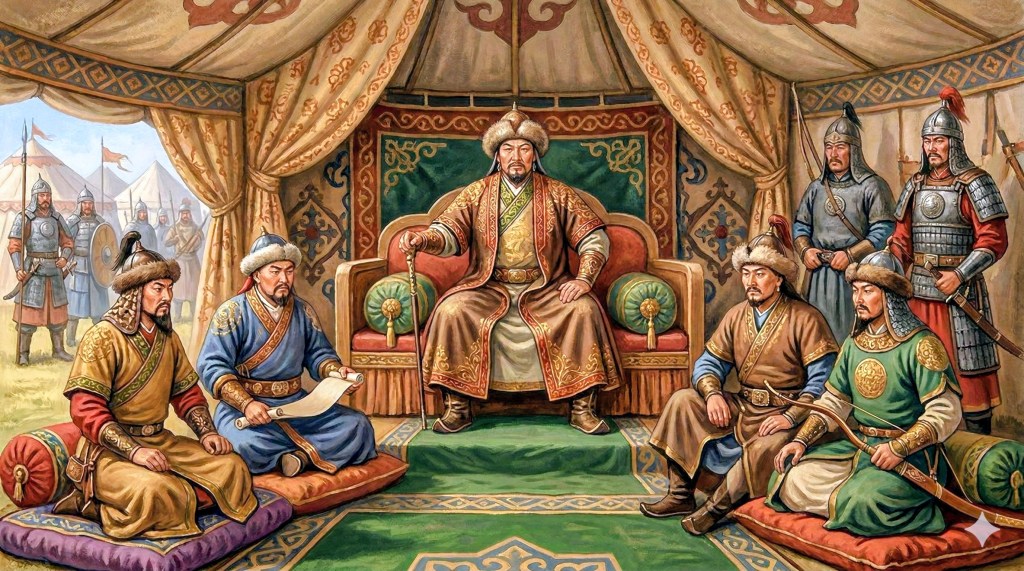
Audio teaser: How Berke Khan’s faith shattered the Mongols
The Shield of the Crescent: A Comprehensive Historical and Geopolitical Analysis of Berke Khan and the Islamization of the Golden Horde
Abstract
The mid-thirteenth century represents one of the most transformative eras in the history of Eurasia, defined by the collision of the Mongol imperial juggernaut and the established order of the Islamic world. At the heart of this historical pivot stands Berke Khan (r. 1257–1266), a grandson of Genghis Khan and the first Mongol monarch to officially embrace Islam. This report provides an exhaustive biographical reconstruction of Berke Khan, tracing his trajectory from a primary military commander in the Mongol conquest of the West to the sovereign of the Golden Horde. It analyzes his spiritual conversion in 1252 at Bukhara, identifying the critical influences of Sufi mysticism and the ethical conduct of Muslim merchant networks. Furthermore, the report explores the profound geopolitical ramifications of his conversion, most notably the initiation of the Berke-Hulagu War. By prioritizing religious solidarity over Chinggisid kinship, Berke forged a landmark alliance with the Mamluk Sultanate of Egypt, effectively arresting the Ilkhanate’s westward advance and preserving the remaining holy sites of the Hijaz. The study also examines his domestic reforms—the institutionalization of Sharia, the abolition of the Yasa in specific jurisdictions, and the patronage of Islamic urbanism at Sarai Berke—which facilitated the long-term Turkification and Islamization of the northern steppe. The report concludes with a thematic epilogue on the enduring legacy of Berke Khan as the primary architect of a Mongol-Islamic synthesis that reshaped the demographic and religious landscape of Eastern Europe and Central Asia for centuries.
The Chinggisid Inheritance and the Early Military Career
The origins of Berke Khan are inextricably linked to the early fragmentation and territorial endowments of the Mongol Empire as envisioned by its founder, Genghis Khan. Berke was born into the Borjigin clan, the third son of Jochi, who was the eldest son of Genghis Khan. The circumstances of his birth are subject to scholarly debate, particularly concerning the identity of his mother. While some sources suggest he was born in the Caucasus region during his father’s early military expeditions , historian Jean Richard argues that his mother was Sultan Khatun, the captured daughter of the Khwarazmian Sultan Muhammad II, which would place his birth no earlier than 1221. However, Mamluk ambassadors visiting his court in 1264 estimated his age at 56, suggesting a birth date between 1207 and 1209. Regardless of the exact date, Berke was raised within a family that traditionally practiced shamanism and idol-worship, yet he was positioned from youth as a central figure in the military-diplomatic apparatus of the Mongol elite.
Following the death of Jochi in 1227, the western portion of the empire—the Ulus of Jochi—was bequeathed to his sons. While Orda was the eldest, Batu Khan emerged as the pre-eminent leader of the lineage, establishing the foundation of what would become the Golden Horde. Berke served as a loyal and capable lieutenant to Batu, participating in the Great Western Campaign of 1236. This campaign, comprising approximately 150,000 soldiers, aimed to subdue the Volga Bulgars, the Kipchaks, and the Rus’ principalities. Berke was personally entrusted with the conquest of the Kipchaks north of the Caucasus and the Merkits in the winter of 1238–39. His military contributions were pivotal during the subsequent invasion of Europe, where he fought alongside Batu and the legendary general Subutai at the Battle of Mohi in 1241. In this engagement, the Mongol forces decimated the Hungarian royal army of King Béla IV, a victory that marked the westernmost extent of their effective military reach.
Chronology of Early Life and Military Engagement
| Period | Event | Strategic Outcome |
| c. 1207–1221 | Birth of Berke Khan | Integration into the Borjigin elite. |
| 1227–1229 | Death of Jochi and Ögedei’s Inauguration | Consolidation of Jochid power in the western steppes. |
| 1236–1237 | Invasion of Volga Bulgaria | Subjugation of early Muslim communities on the Volga. |
| 1237–1238 | Conquest of Ryazan and Suzdal | Devastation of major Rus’ urban centers. |
| 1238–1239 | Campaign against the Kipchaks | Capture of Merkit and Kipchak leaders; stabilization of the Caspian region. |
| 1241 | Battle of Mohi | Decimation of the Hungarian army; entry into Central Europe. |
| 1242 | Withdrawal from Europe | Return to the Volga following the death of Ögedei Khan. |
The withdrawal from Europe in 1242 did not signal a retreat from power but rather a redirection of focus toward internal Mongol politics. Berke remained a crucial diplomatic actor, representing Batu at the kurultai of 1251 that enthroned Möngke Khan as the Great Khan. During this period, the Jochid ulus functioned almost as a sovereign entity, with Batu serving as the senior prince (aqa) of the empire. It was within this context of immense political power and expanding cultural horizons that Berke’s personal transformation began to take shape.
The Spiritual Journey: Conversion at Bukhara
The conversion of Berke Khan to Islam in 1252 is one of the most consequential events in the history of the Mongol Empire, signaling the first crack in the traditional religious pluralism of the Chinggisid dynasty. This conversion was not a sudden political maneuver but the result of sustained contact with the sophisticated urban and spiritual culture of Central Asia. While stationed at Saray-Jük, Berke encountered a merchant caravan from Bukhara. His questioning of these travelers about their faith revealed an initial attraction to the ethical clarity and monotheistic rigor of Islam, which contrasted with the polytheistic and shamanistic traditions of the Mongolian steppe.
The catalyst for his formal conversion was the Sufi Sheikh Saif-ud-Din Bakharzi (d. 1261), a prominent disciple of Najm ad-Din Kubra, the founder of the Kubrawiyya order. Bakharzi had been sent on a proselytizing mission to Bukhara and had attained such prestige that he safely survived the Mongol invasion, maintaining authority over both the local population and the new Mongol elite. Historical tradition emphasizes Berke’s humility during this encounter; despite being a grandson of the “Conqueror of the Universe,” he is said to have waited for three days at the gate of the Sheikh in Bukhara before being granted an audience. Following a thorough explanation of Islamic tenets, specifically the concept of Tawhid (the oneness of God), Berke embraced the faith and took the Muslim titles Abu al-Ma’ali Nasir al-Din and Hisam al-Din.
Primary Drivers of Conversion
The conversion was facilitated by a combination of intellectual, ethical, and socio-economic factors that resonated with Berke’s experience as a ruler of a diverse empire.
- Theological Clarity: Islam offered a straightforward path to the divine that avoided the worship of human-hybrid deities or statues, appealing to a leader seeking a unified moral framework.
- The “Kipchak Connection”: The Golden Horde’s territory was populated largely by Turkic Kipchaks and Volga Bulgars, many of whom were already Muslim. Adopting Islam provided Berke with a shared identity with his subjects.
- Economic and Legal Ethics: The Islamic prohibition of usury and the mandatory nature of zakat (charity) presented a workable economic system that promoted the circulation of wealth and social welfare, which was highly attractive to a stabilizing state.
- Sufi Influence: The Kubrawiyya and other Sufi orders provided a decentralized, resilient network of traveling preachers who could interact with nomads on the steppe, making the religion accessible beyond urban centers.
Berke’s conversion was a catalyst for a broader religious shift within his family and court. He successfully persuaded his brother Tukh-timur to adopt Islam, and several of his wives and children followed suit. This internal Islamization of the Jochid elite ensured that the Golden Horde would eventually become a predominantly Muslim state, even as animists and Buddhists remained within the population.
The Ascent to Sovereignty and Islamic Governance
Following the death of Batu Khan in 1255 and the brief reigns of his successors Sartaq and Ulaghchi, Berke assumed the throne of the Golden Horde in 1257. His ascension marked the beginning of a deliberate effort to institutionalize Islam within the khanate’s administrative and legal structures. Unlike previous Mongol rulers who maintained the Yasa as the sole legal authority, Berke introduced the Sharia as a parallel and, in many cases, superior legal system.
Berke’s domestic policies were characterized by a commitment to Islamic urbanism and education. He initiated the construction of numerous mosques and madrasas (religious schools) throughout his domain, particularly in the heart of the Golden Horde along the Volga River. He actively recruited scholars, jurists (fuqaha’), and Sufi sheikhs from the wider Islamic world, inviting them to settle in his capital and providing them with patronage. To enforce Islamic social norms, he banned the consumption of liquor and pork within the primary urban centers of his colony.
The Evolution of Sarai Berke
A central pillar of Berke’s reforms was the development of Sarai Berke (New Sarai), which replaced Sarai Batu as the administrative and cultural hub of the khanate. Located further north on the Akhtuba River, the city was designed to reflect the prestige of an Islamic empire. Archaeological excavations have revealed a metropolis of significant sophistication, housing up to 600,000 residents at its peak.
| Feature of Sarai Berke | Description and Significance |
| Infrastructure | Developed system of water reservoirs, ceramic water pipes, and sewers. |
| Religious Sites | Numerous mosques and minarets characterized by Central Asian and Iranian architectural styles. |
| Economic Hub | Markets and bazaars organized by ethnic quarters (Alans, Russians, Greeks, Kipchaks); center of the Silk Road trade. |
| Intellectual Life | Presence of astrolabes for astronomical study; patronage of poets like Hisām Kātib and Sayf-i Sarāy. |
| Artisanal Quarters | Large-scale production of glazed pottery, glass, metalsmithing, and jewelry. |
This urban flourishing demonstrated that the Golden Horde had transitioned from a purely predatory nomadic state to a complex agrarian and mercantile society. The “Turkification” and “Islamization” of the Horde were mutually reinforcing processes; as the Mongol aristocracy assimilated into the Turkic-Kipchak linguistic and cultural milieu, Islam provided the unifying ideological framework for this new identity.
The Breach with the Ilkhanate: The Crisis of 1258
While Berke was consolidating his Islamic state in the north, his cousin Hulagu Khan was leading a massive Mongol campaign in the south. Hulagu, a grandson of Genghis Khan through his son Tolui, was dispatched by Great Khan Möngke to secure Persia and Mesopotamia. This campaign initially had the support of all Mongol branches, including the Jochids, who provided troops to Hulagu’s army as part of their imperial obligation.
However, tensions began to surface as Hulagu’s campaign targeted the heartlands of Islamic civilization. Berke, already a devout Muslim, was deeply troubled by the threat to the Abbasid Caliphate. He reportedly complained to his brother Batu, “We helped Möngke to enthrone. But he forgot who the enemy is or friend is. Now, he is starving the lands of our friend Caliph. It is abject”. Despite these protests, Hulagu proceeded with the Siege of Baghdad in 1258.
The sack of Baghdad and the subsequent execution of Caliph al-Musta’sim marked the definitive break between the Golden Horde and the Ilkhanate. Hulagu’s forces massacred hundreds of thousands of Muslims, destroyed the House of Wisdom, and decimated the irrigation systems of Mesopotamia. While Hulagu spared the Christian population at the intercession of his Nestorian wife, Doquz Khatun, his actions were seen by Berke as a personal and religious affront.
Second-Order Insights: Geopolitical vs. Religious Motivations
The subsequent Berke-Hulagu War was driven by a complex intersection of personal faith and imperial power struggles. While Berke’s Islamic identity provided the moral justification for war, several geopolitical and economic factors were equally influential:
- Territorial Disputes: Berke claimed Azerbaijan and the Caucasus as Jochid territory, arguing that his soldiers had participated in the conquest of Iran and should be rewarded with its most fertile pastures.
- Economic Chokeholds: Hulagu demanded that the Golden Horde cease the sale of Cuman-Kipchak slaves to the Mamluks of Egypt, which was a vital source of revenue and military manpower for the Mamluks.
- Imperial Factionalism: The conflict occurred concurrently with the Toluid Civil War. Berke supported Ariq Böke, while Hulagu allied with Kublai Khan. This divided the empire into two hostile camps: the Jochid-Ariq Böke faction and the Ilkhanid-Kublai faction.
Berke famously declared, “He (Hulagu) has sacked all the cities of the Muslims, and has brought about the death of the Caliph. With the help of God I will call him to account for so much innocent blood”. By 1262, the situation escalated into the first major civil war in Mongol history, signifying the end of the unified Mongol Empire.
The Mamluk-Jochid Alliance and the Shield of Islam
The most significant diplomatic consequence of Berke’s conversion was the formation of an alliance with the Mamluk Sultanate of Egypt. Following their victory at the Battle of Ain Jalut in 1260, the Mamluks, led by Sultan Qutuz and later Sultan Baybars, realized they could not withstand a second, full-scale Mongol invasion alone. Baybars, a Turkic Kipchak himself, recognized Berke as a natural ally who could strike the Ilkhanate from the north.
In 1261, Baybars sent a “cautious” letter to Berke through Alan merchants, urging him to wage war against Hulagu based on their shared Muslim faith. Berke responded immediately, ordering his soldiers in Iran to defect to the Mamluks or return home. On November 2, 1262, a group of 100 Golden Horde soldiers arrived in Egypt, where they were treated with high honors and granted status as emirs in the Mamluk army.
The Mechanics of Diplomatic Exchange
The alliance was sustained through sophisticated embassies and symbolic gift-giving that emphasized the religious bond between the two powers.
- The 1263 Jochid Embassy: Berke sent a delegation including Emir Jalaleddin ibn Qadi and Sheikh Nureddin Ali, specifically chosen for their knowledge of Islamic customs. In his letter, Berke confirmed his conversion and expressed joy at Baybars’ re-establishment of the Abbasid Caliphate in Cairo.
- The 70-Page Letter: Baybars sent a 70-page official letter to Berke, encouraging him to engage in jihad against Hulagu and highlighting the Mamluk commitment to protecting the holy sites.
- Symbolic Gifts: The Mamluks sent Berke a Qur’an written in the script of Uthman ibn Affan, along with valuable weapons, horses, and exotic African animals like giraffes and elephants.
- The Byzantine Link: The alliance was facilitated by Michael VIII of Byzantium, who permitted Mamluk embassies to pass through his territory to the Golden Horde despite pressure from the Ilkhanate.
This alliance was not merely symbolic; it had immediate military implications. The threat of a Golden Horde invasion from the north forced Hulagu to divert the bulk of his army to the Caucasus, preventing him from launching a retaliatory campaign against Egypt to avenge the defeat at Ain Jalut.
Military Confrontation: The Battle of the Terek River
The open war between Berke and Hulagu reached its climax at the Battle of the Terek River in January 1263. Hulagu had marched north through the Derbent pass with a massive army, seeking to seize the Jochid lands. He was met by a Golden Horde force commanded by Berke’s nephew, the capable general Nogai Khan.
The engagement resulted in a decisive defeat for the Ilkhanate. A critical detail of the battle was the collapse of the frozen Terek River; as Hulagu’s heavy cavalry attempted to retreat across the ice, it gave way, leading to thousands of soldiers drowning in the frigid waters. Hulagu was forced to retreat to Azerbaijan, having lost a significant portion of his military strength and prestige.
Long-Term Impact of the War
The Berke-Hulagu War represented a macro-historical turning point with several enduring consequences:
| Impact Area | Consequences of the Conflict |
| Mongol Unity | Permanent fragmentation of the Mongol Empire into four independent khanates. |
| Islamic World | Preservation of the Mamluk Sultanate and the holy cities (Mecca, Medina) from Mongol conquest. |
| Economic Shifts | Halt of trade between the Golden Horde and the Ilkhanate; reorientation of Jochid trade toward the Mediterranean and Egypt. |
| Military Science | The conflict “tied down” Ilkhanid troops in the Caucasus, creating a perpetual two-front war for the Ilkhans. |
| Territorial Stability | The Kura River became the established border between the Golden Horde and the Ilkhanate for the next sixty years. |
Berke continued to undermine the Ilkhanate through diverse strategies, including supporting rebellions in the Georgian Kingdom and Anatolia. Although he was unable to fully annex Azerbaijan, his campaigns “insured the survival of Muslim territories in the Middle East” by ensuring the Ilkhanate could never achieve regional hegemony.
Socio-Cultural Impact on the Russian Principalities
While Berke was oriented toward the Islamic world, his reign also had profound consequences for the Russian principalities under the “Mongol-Tatar Yoke.” Berke’s governance was characterized by a pragmatic relationship with the Russian Orthodox Church, which he utilized as a stabilizing force within his tributary system.
In 1261, a bishopric was established at Sarai to minister to the Christian population and facilitate diplomacy between the Mongols and the Russian princes. Berke granted the Orthodox Church extraordinary privileges, including total exemption from taxes, tribute, and military conscription. In exchange, the Church was required to pray for the well-being of the “Mongol Tsar” in its liturgy. This arrangement allowed the Church to accumulate vast wealth and lands, becoming a “prosperous temple in the midst of a desolate country”.
The Role of Orthodoxy in National Identity
Scholarly debates within the “Eurasian school” suggest that the Mongol rule, paradoxically, strengthened the founding pillars of the Russian state:
- Political Centralization: The khans’ requirement for Russian princes to travel to Sarai to receive their “yarlik” (charter of authority) fostered a culture of centralized political homage that was later adopted by the Tsars of Muscovy.
- Protection from Catholic Influence: By isolating Russia from Western Europe, the Mongol rule shielded it from the influence of the Catholic Church during the Crusades, allowing the Russian Orthodox identity to crystallize.
- Administrative Innovation: The Russians adopted Mongol systems of census-taking, taxation, and the “yam” (postal network), which laid the foundation for the Muscovite military-fiscal state.
Thus, Berke’s reign did not merely bring destruction to Russia but introduced a stable administrative framework that permitted the Orthodox Church to flourish as a national institution, even as the state religion of the Golden Horde shifted toward Islam.
The Mongol-Islamic Synthesis and the Conversion of Later Khans
Berke Khan’s death in 1266, while attempting to cross the Kura River to attack Hulagu’s son Abaqa, marked the end of an era, but his influence was self-perpetuating. While his immediate successor, Mengu-Timur, was not a Muslim, the diplomatic and cultural foundations laid by Berke remained intact. The Mamluk alliance continued to be a pillar of Jochid foreign policy, and the process of “Kipchakization”—the assimilation of Mongols into Turkic-Muslim culture—proceeded unchecked.
The full realization of Berke’s vision occurred under Öz Beg Khan (r. 1312–1341), the Golden Horde’s greatest ruler, who officially adopted Islam and completed the Islamization of the khanate. Under Öz Beg, Sarai Al-Jedid (New Sarai) reached its zenith as a global center of Islamic scholarship, hosting thinkers like at-Taftazani and al-Bazzazi. This cultural trajectory eventually influenced other Mongol successor states. The Ilkhanate under Mahmud Ghazan officially declared Islam its state religion in 1295, and the Chagatai Khanate followed suit under Tarmashirin Khan in the 1330s.
Religious Demographics of Mongol Successor States
| Khanate | Official Conversion | Key Figure of Conversion | Impact on Region |
| Golden Horde | 1252 (Individual) / 1312 (State) | Berke Khan / Öz Beg Khan | Turkification of Russia/Central Asia. |
| Ilkhanate | 1295 | Mahmud Ghazan | Synthesis of Mongol rule with Persian-Islamic bureaucracy. |
| Chagatai Khanate | 1330s | Tarmashirin Khan | Islamization of Transoxania. |
| Yuan Dynasty | N/A (Remained Buddhist) | Kublai Khan | Assimilation into Chinese culture; loss of contact with Muslim West. |
Berke’s legacy as a “Falcon of Islam” is substantiated by the fact that of all the Genghisid lineages, the Jochids were the first to find a way to reconcile the Mongol imperial ethos with the universalist claims of Islam. This synthesis provided a model for future Turko-Mongol empires, including the Timurids and eventually the Ottomans, who both claimed the dual heritage of the Chinggisid bloodline and the Islamic faith.
Thematic Epilogue: Faith as the Architect of History
The biography of Berke Khan serves as a profound case study in how individual spiritual conviction can intersect with imperial geopolitics to alter the course of a civilization. Prior to his conversion, the Mongol Empire appeared as an indiscriminate force of nature, a “Scourge of God” that threatened to extinguish the intellectual and religious core of the Dar al-Islam. Berke’s decision to prioritize his identity as a Muslim over his kinship with fellow Mongols represented a revolutionary departure from the traditional Mongol code of ethnic and dynastic solidarity.
His historical significance lies in three distinct spheres. First, in the geopolitical arena, he was the primary agent of the Mongol Empire’s fragmentation. By initiating the first major internal war, he shattered the aura of Mongol invincibility and created the “pincer” that protected the Levant and the Hijaz. Without Berke’s distraction of Hulagu, it is highly probable that the Mamluks would have faced the full, undivided force of the Mongol armies, leading to the potential destruction of Mecca and Jerusalem.
Second, in the socio-cultural sphere, Berke pioneered the “Mongol-Islamic synthesis.” He proved that the military and administrative efficiency of the Mongols could be integrated with the ethics, law, and urban sophistication of Islam. His patronage of Sarai Berke transformed the northern steppes from a transit zone for nomadic warriors into a stable agrarian and mercantile heartland. This shift facilitated the long-term Turkification of the Golden Horde, ensuring that the legacy of Genghis Khan in Eastern Europe would eventually manifest as an Islamic civilization.
Third, Berke redefined the concept of sovereignty within the Mongol world. By adopting the title of Sultan and establishing relations with the Mamluk-held Caliphate, he legitimized the idea that a Mongol Khan could be a “Protector of the Faith.” This ideological shift ensured that as the Mongol Empire faded, it left behind a series of Muslim-ruled states that preserved the core tenets of Islamic culture and science through the centuries of “ruin” that followed the initial conquests.
Berke Khan was the “Falcon” who flew between two worlds, harnessing the power of the steppe to defend the sanctity of the mosque. His conversion was not merely a private spiritual event but a public act of historical preservation. Through his alliance with Sultan Baybars and his military defiance of the Ilkhanate, Berke Khan became the shield that allowed the Islamic world to survive its most existential crisis, ultimately birthing a new Eurasian synthesis that defined the religious and political borders of the modern world.


 The Glorious Quran and Science
Leave a comment