
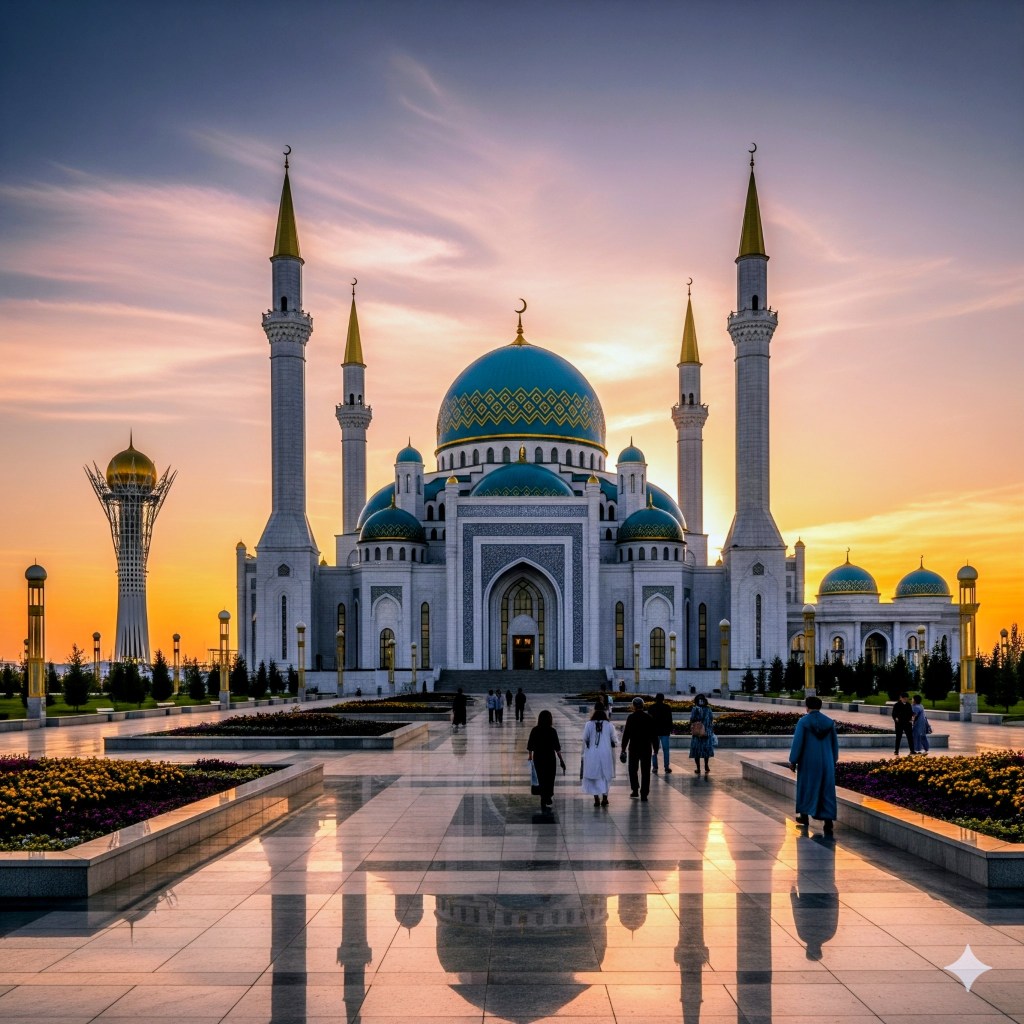
The mosque designed by Charles Hadife an architect based in Beirut Lebanon is located at the left riverbank in the city of Astana, construction first started in March 2005. The mosque was a gift in accordance with the agreement of the Kazakhstan President, Nursultan Nazarbayev and the Emir of Qatar, Hamad bin Khalifa.
The Sacred Steppe: A Comprehensive History of Islamization in Kazakhstan from the Arab Conquest to the Jochid Zenith (1282–1341)
Presented by Zia H Shah MD
Audio teaser: How the Golden Horde Became Islamic
Abstract
The historical trajectory of Islam in Kazakhstan represents a sophisticated synthesis of military conquest, trans-continental trade, and the profound spiritual influence of Sufi mysticism within the nomadic environment of the Eurasian steppe. While the initial introduction of Islamic thought dates back to the eighth-century Arab-Chinese confrontation at the Battle of Talas, the definitive transformation of the region into a cornerstone of the Islamic world occurred during the era of the Golden Horde (Jochid Ulus). This report meticulously analyzes the evolutionary process of Islamization, focusing on the critical period between 1282 and 1341. It explores the pivotal roles played by the Jochid khans—Berke, Mengu-Timur, Töde Möngke, and Uzbeg Khan—in shifting the state’s orientation from a shamanistic, pluralistic Mongol appanage to a centralized Islamic power. By examining the interplay between the Mongol legal code (Yassa), Islamic Sharia, and local customary law (Adat), this analysis demonstrates how the conversion of the ruling elite facilitated the permanent integration of the Turkic-Kipchak tribes into the broader Dar al-Islam. The report concludes that the institutionalization of Islam under Uzbeg Khan provided the cultural and legal bedrock for the subsequent emergence of the Kazakh Khanate, ensuring that Islam became an inseparable component of the Kazakh national and spiritual identity.
The Primordial Encounter: 7th to 10th Centuries
The history of Islam on the territory of modern Kazakhstan is not a singular event but a multi-century process of cultural assimilation and social restructuring. The first contact between the inhabitants of the Central Asian steppes and the Islamic faith occurred in the late seventh century, specifically during the 670s, as the first Arab missionaries began to penetrate the fringes of the Transoxiana region. This initial phase was characterized by sporadic encounters along the southern trade routes, where the sophisticated urban culture of the Caliphate met the diverse religious landscape of the Turkic tribes, which at the time included adherents of Tengrism, Shamanism, Nestorian Christianity, and Buddhism.
The decisive geopolitical shift that favored Islamic expansion was the Battle of Talas (or Atlaha) in 751 AD. In this confrontation near the city of Taraz, the Arab army under Ziyad ibn Salikh defeated the Tang Chinese forces commanded by Gao Syanzhi. The victory was made possible by the defection of the Karluk tribes to the Arab side, a move that reflected the strategic alliances between local Turkic leaders and the Islamic vanguard. This event was a civilizational watershed; it effectively halted Chinese westward expansion and created a secure environment for the dissemination of Islamic teachings throughout the Syr Darya and Zhetysu regions.
Following the Battle of Talas, Islamization proceeded through the mechanism of state adoption. The Karakhanid Dynasty, which emerged in the tenth century, became the first Turkic polity to officially embrace Islam. In 960 AD, the founder of the dynasty, Satuq Bogra Khan, along with his son Haroon Musa, declared Islam the state religion. This state-level conversion facilitated the urbanization of the faith, as mosques and madrasas were established in key centers like Balasagun and Kashgar. However, the Islam of this era was primarily concentrated in sedentary and semi-sedentary urban pockets, while the vast nomadic populations of the northern steppes continued to practice traditional Tengrism, albeit with an increasing awareness of Islamic monotheism.
The Mongol Cataclysm and Religious Pluralism
The early thirteenth century brought a profound disruption to the nascent Islamic infrastructure of Central Asia. The Mongol invasions led by Genghis Khan devastated the Khwarazmian Empire and the city-states of the Syr Darya. Prosperous centers of Islamic learning were plundered, and many religious institutions were dismantled. Despite this initial destruction, the Mongol administration introduced a unique paradigm of religious tolerance codified in the Great Yassa. The Mongol rulers prioritized civil order and loyalty to the Great Khan over religious uniformity, allowing Muslims, Christians, and Buddhists to practice their faiths provided they remained tax-compliant and politically submissive.
When the Mongol Empire was divided into four primary uluses (appanages), the westernmost territories fell to Jochi, the eldest son of Genghis Khan. Jochi’s son, Batu Khan, established the Golden Horde (also known as the Jochid Ulus or the Blue Horde in its western wing), which encompassed the Desht-i Kipchak—the Great Steppe of the Kipchaks. The demographic composition of the Golden Horde was predominantly Turkic, with the Mongol elite forming a minority ruling class. This demographic reality, combined with the presence of established Muslim communities in the Volga Bulgaria and Crimea regions, created a fertile ground for the re-emergence of Islam as a social force.
| Khan of the Golden Horde | Reign Period | Religious Stance / Impact |
|---|---|---|
| Batu Khan | 1242–1255 | Traditional Mongol (Tengrist); established the Ulus of Jochi. |
| Berke Khan | 1257–1266 | First Muslim convert; aligned with Mamluks against the Ilkhanate. |
| Mengu-Timur | 1266–1280 | Pluralistic; emphasized sovereignty and tax exemptions for clergy. |
| Töde Möngke | 1280–1287 | Pious Muslim convert; influenced by Sufis; abdicated in 1287. |
| Uzbeg Khan | 1313–1341 | Proclaimed Islam as state religion; centralized power; built 70 cities. |
Berke Khan: The Vanguard of Jochid Islamization
The conversion of Berke Khan (1257–1266) represents the first systemic crack in the traditional Mongol religious worldview. Berke’s spiritual journey was facilitated by his interactions with Muslim merchant caravans from Bukhara during his tenure at Saray-Jük. Impressed by the monotheistic rigor and ethical clarity of Islam, Berke converted in 1252, several years before ascending the throne. His conversion was not a clandestine affair; sources suggest he openly displayed his Muslim identity at court and encouraged his family members, including his brother Tukh-timur and several of his wives, to follow suit.
Berke Khan’s reign was defined by the prioritization of religious solidarity over Chinggisid kinship, a radical departure from Mongol tradition. The most dramatic manifestation of this shift was the Berke-Hulagu War. When the Ilkhanate ruler Hulagu (Berke’s cousin) sacked Baghdad and executed the Abbasid Caliph Al-Musta’sim in 1258, Berke was reportedly incensed. He declared a religious obligation to call Hulagu to account for “so much innocent blood,” subsequently forming a strategic alliance with the Mamluk Sultanate of Egypt. This alliance was critical for the survival of the remaining Islamic holy sites in the Hejaz and established a permanent cultural and diplomatic link between the Golden Horde and the centers of Islamic jurisprudence in Cairo and Damascus.
Domestically, Berke initiated the institutionalization of Islamic practices. He encouraged the construction of mosques and religious schools (madrasas) along the Volga River and invited Sufi sheikhs and Islamic jurists (fuqaha) to settle in his capital. While Berke did not formally abolish the Mongol Yassa, he introduced Sharia as a parallel legal system, particularly for personal and religious matters among his Muslim subjects. His reign provided the first model of a “Chinggisid-Islamic” state, where the prestige of the Mongol lineage was harnessed to support the expansion of the faith.
Sovereignty and Fiscal Tolerance under Mengu-Timur
Following the death of Berke, the throne was occupied by Mengu-Timur (1266–1280), a grandson of Batu Khan. Although Mengu-Timur was not a Muslim, his reign was crucial for the long-term stabilization of the Jochid Ulus as an independent entity. Under his leadership, the Golden Horde became virtually independent of the Great Khan Kublai in Beijing, a status that allowed the local rulers to tailor religious and economic policies to the specific needs of the Eurasian steppe.
Mengu-Timur continued the Mongol policy of religious tolerance, but he formalized it through the granting of yarliks (decrees) that provided extensive tax exemptions to religious institutions. This policy significantly benefited the Russian Orthodox Church in the western Slavic territories, but it also allowed Muslim communities in the southern and eastern wings of the Horde to flourish economically. By exempting religious lands and personnel from Mongol taxation and labor obligations, Mengu-Timur inadvertently created a financial and social environment where religious organizations—both Christian and Muslim—could accumulate wealth and exert social influence independently of the central military apparatus. This period of “fiscal tolerance” laid the groundwork for the more aggressive Islamization that would follow in the fourteenth century.
Töde Möngke: The Ascetic Khan and the Sufi Influence
The accession of Töde Möngke (1280–1287) marked a return to Muslim leadership in the Golden Horde. Unlike Berke, whose Islam was characterized by geopolitical assertiveness, Töde Möngke’s faith was defined by deep mysticism and Sufi asceticism. He converted to Islam in 1283 and became known for his disinterestedness in the traditional Mongol pursuits of military conquest and territorial expansion. Contemporary accounts by historians like Rashid al-Din emphasize that Töde Möngke was more comfortable in the company of dervishes and sheikhs than among the military elite.
During his reign, the influence of the powerful general Nogai Khan grew substantially, as Töde Möngke’s focus on religious contemplation created a power vacuum. However, the cultural impact of his reign was significant. The presence of Sufi mentors at court became a standardized feature of royal life, and the Atalyk system—where royal princes were raised and educated by Sufi elders—began to take root. This period demonstrated that Islam had permeated the highest echelons of the Jochid aristocracy to the extent that a khan could prioritize spiritual devotion over imperial governance. Ultimately, his perceived weakness led to a palace coup orchestrated by Nogai Khan, forcing Töde Möngke to abdicate in favor of his nephew Tole Buqa in 1287.
Uzbeg Khan: The Architect of the Islamic State (1313–1341)
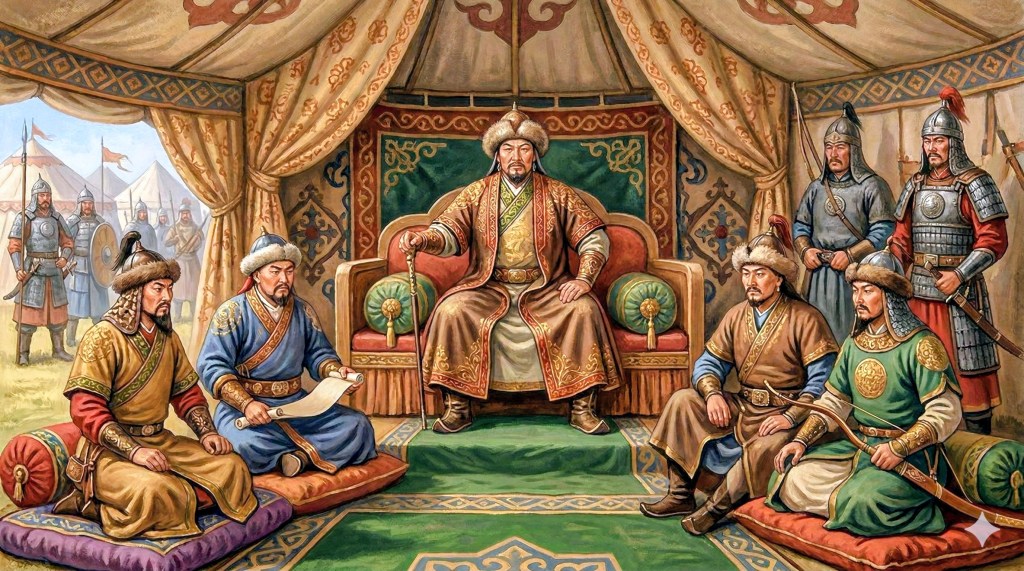
The reign of Uzbeg Khan (1312–1341) is the definitive epoch of Islamization in the history of the Golden Horde and the broader Kazakh steppe. Uzbeg ascended to the throne in 1313 through a coup backed by the Muslim nobility and the urban elites of Sarai, assassinating the legitimate heir Ikhsar. Upon taking power, Uzbeg made the historic decision to proclaim Islam as the official state religion of the Golden Horde.
Uzbeg’s religious policy was far more proactive and institutionalized than that of Berke or Töde Möngke. He recognized that for the Golden Horde to transition from a collection of loosely affiliated tribes into a centralized state, a unifying ideology was necessary. He famously faced down the traditionalist Tengrist aristocracy, who argued that abandoning the laws of Chinggis Khan for the “religion of the Arabs” was a betrayal of their heritage. Uzbeg’s response was uncompromising: he reportedly executed 120 Chinggisid princes and Buddhist lamas who resisted his religious reforms, effectively purging the opposition and making Islamic identity a prerequisite for political participation within the Jochid state.
| Policy Category | Reform under Uzbeg Khan | Long-term Impact on the Region |
|---|---|---|
| Legal | Proclamation of Islam as State Religion (1313/1321) | Transition from Yassa-dominant to Sharia-integrated law. |
| Urbanization | Construction of ~70 new cities with Islamic infrastructure | Created sedentary centers of faith in a nomadic landscape. |
| Economic | Monetary reform; security for Silk Road trade | Integrated the steppe into the global Islamic trade network. |
| Social | Integration of Sufi Tariqas into governance | Established the Atalyk and Khoja classes as social pillars. |
Uzbeg Khan’s era was characterized by unprecedented urban growth. He oversaw the construction of over 70 cities, transforming the Volga-Ural and Syr Darya regions into a landscape of urban Islamic civilization. In the capital of Saray, Ibn Battuta observed thirteen mosques and a sophisticated administrative apparatus where Muslim scholars, jurists, and administrators held the most important positions. This urbanization was critical for the dissemination of “canonical” Islam, as madrasas provided the necessary educational infrastructure for training a local clergy and bureaucracy.
Furthermore, Uzbeg maintained the alliance with the Mamluks, sending his daughter Tulunbay to marry the Sultan of Egypt, and re-opened friendly relations with the Yuan Dynasty in China, ensuring that the Golden Horde remained the primary trade conduit between the East and the West. By the time of his death in 1341, Uzbeg had successfully synthesized the Mongol imperial structure with Islamic civilization, creating a stable, prosperous state that would serve as the foundational model for all subsequent Turkic-Islamic polities in the region, including the Kazakh Khanate.
The White Horde (Ak Orda) and the Ancestry of Kazakhstan
To understand the specific impact of Jochid Islamization on modern Kazakhstan, one must examine the role of the White Horde (Ak Orda), the eastern wing of the Jochid Ulus. Formed around 1225 and bequeathed to Jochi’s eldest son, Orda Khan, the White Horde encompassed the territories between Lake Balkhash and the Volga, specifically the Syr Darya region. While the Blue Horde (western wing) under Batu and Berke was more involved in European and Middle Eastern affairs, the White Horde focused on the administration of the Turkic-Kipchak tribes that would eventually constitute the Kazakh ethnic core.
The Islamization of the White Horde proceeded in parallel with the central government in Saray. By the mid-fourteenth century, cities like Sygnaq, Otrar, and Yasi (Turkestan) had become the spiritual and political centers of the Ak Orda. These cities served as the burial sites for the White Horde khans, such as Urus Khan and Barak Khan, reinforcing the connection between the Islamic faith and the ruling dynasties of the steppe. The White Horde eventually gained independence from the central Jochid authority and, after a period of fragmentation following the death of Barak Khan in 1428, gave birth to the Kazakh Khanate.
The Sufi Tariqas: Social Glue and Cultural Mediators
While the khans provided the political and legal framework for Islamization, the actual conversion of the nomadic populace was the work of the Sufi orders, primarily the Yasawiyya, Kubrawiyya, and Qalandariyya. Sufism’s emphasis on mysticism and the inner spiritual path made it uniquely compatible with the pre-Islamic worldviews of the Turkic nomads.
The Yasawiyya Order and “Steppe Islam”
Founded by Khoja Ahmed Yasawi (d. 1166) in the city of Yasi, the Yasawiyya order became the most influential spiritual force in the region. Yasawi’s poetry, the Divan-i Hikmet, was written in the Turkic language, making complex theological concepts accessible to non-literate nomads. The Yasawiyya practiced a form of Islam that integrated local traditions, such as the veneration of Aruahs (spirits of ancestors), and utilized ritualistic zikr (remembrance) that mirrored traditional shamanistic ceremonies. This “folk Islam” allowed the Kazakh tribes to adopt the faith without undergoing a traumatic loss of their ancestral cultural markers.
The Kubrawiyya and Qalandariyya: Influencing the Elite
In contrast to the mass appeal of the Yasawiyya, orders like the Kubrawiyya and the Qalandariyya often operated within the royal courts and urban centers. The Qalandars, originally from Anatolia, were particularly successful in converting the Mongol elite, often acting as clandestine missionaries who focused their appeals directly on the rulers. These sheikhs served as the intellectual and spiritual mentors to the khans, ensuring that the administrative and legal reforms of rulers like Uzbeg were grounded in Islamic philosophy.
| Sufi Order | Primary Focus | Key Mechanism of Influence |
|---|---|---|
| Yasawiyya | Nomadic populations of the steppe | Turkic-language poetry; integration of ancestor worship. |
| Kubrawiyya | Urban elite and central administration | Intellectual and theological guidance for the ruling class. |
| Qalandariyya | The Chinggisid royal family | Direct mentorship (Atalyk system); clandestine missions. |
| Naqshbandiyya | Religious and legal institutions | Oversight of mosques and legal ceremonies; educational influence. |
The Legal Synthesis: Yassa, Sharia, and the Kazakh Codes
The Islamization process initiated by the Jochid khans left a permanent mark on the legal structure of the Kazakh steppe. Kazakh statehood, which began with the formation of the Kazakh Khanate in 1465, was built upon a synthesis of the Mongol Yassa, Islamic Sharia, and local Adat (customary law). This synthesis allowed the Kazakhs to maintain the social organization necessary for nomadic life while adhering to the ethical and religious standards of the Islamic world.
As the Kazakh Khanate matured, its leaders codified this synthesis into major legal documents:
- Kassym Khannyn Kaska Zholy (The Bright Path of Kassym Khan): Introduced in the early sixteenth century, this code was based on the legal practices inherited from the Golden Horde and the White Horde. It regulated property, criminal law, and military service, integrating Islamic concepts of justice with tribal compensation systems.
- Yesim Khannyn Yeski Zholy (The Ancient Path of Yesim Khan): Refined the political system by elevating the role of the Biys (judges) over the traditional Tore (aristocratic) elite, a move that emphasized judicial wisdom and religious knowledge as sources of authority.
- Zheti Zhargy (The Seven Charters): Approved by Tauke Khan (1680–1718), this code represented the pinnacle of the Sharia-Adat synthesis. It explicitly recognized state support for the Muslim religion and utilized Sharia principles for administrative, criminal, and civil law.
In the Zheti Zhargy, the dominant position was held by the Ak-suyek (aristocratic class), which included the Tore (descendants of Genghis Khan) and the Khoja (descendants of the Prophet Muhammad’s companions or early missionaries). The inclusion of the Khoja class in the highest social stratum signifies the complete integration of Islamic lineage into the traditional Turkic-Mongol social hierarchy.
Turkestan: The Spiritual and Political Capital
The city of Turkestan (formerly Yasi) serves as the quintessential symbol of the Islamic legacy of the Golden Horde and the Kazakh Khanate. The Mausoleum of Khoja Ahmed Yasawi, commissioned by Tamerlane (Timur) between 1389 and 1405, was designed to honor the Sufi saint and to demonstrate Timur’s commitment to the dissemination of Islam in the Syr Darya steppes. As the largest and most impressive structure of its kind in Central Asia, the mausoleum became a “Second Mecca” for the nomadic tribes, a site of pilgrimage that unified the disparate clans under a shared religious umbrella.
Under the Kazakh Khanate, Turkestan became the capital city. The mausoleum functioned as a multifunctional center—a mosque, a library, and a political hub where ceremonies for the elevation of khans took place. By choosing Turkestan as their burial site, the Kazakh khans, sultans, and prominent leaders from across the Three Zhuzes (tribal unions) reinforced the religious and political unity of the young state. This concentration of political and spiritual power in a single site ensured that the Yasawiyya tradition remained at the heart of the Kazakh national identity.
The Atalyk System: Education and the Transmission of Faith
The survival and growth of Islam among the nomadic elite were facilitated by the Atalyk system, an institution of mentorship that existed in the Golden Horde and continued through the Kazakh Khanate. The Atalyk was typically a trusted advisor or a Sufi sheikh appointed to raise and educate the heirs to the throne. This system ensured that royal children were literate in Turkic and Persian and were deeply grounded in Islamic theology and the traditions of their ancestors.
Evidence suggests that rulers like Tauekel Khan were not only literate but also engaged in poetry and maintained extensive correspondence with Sufi scholars and other regional rulers. This literacy among the aristocrats was a direct result of the Jochid-era policy of inviting Muslim scholars to the court, creating a “scholarly-aristocratic” culture that bridged the gap between the nomadic life of the steppe and the intellectual traditions of the Islamic world.
Thematic Epilogue: The Steppe as Dar al-Islam
The transformation of the Eurasian steppe from a shamanistic frontier into a vibrant province of the Islamic world was the result of a deliberate, multi-generational project led by the khans of the Golden Horde. The period from 1282 to 1341, spanning the reigns of Töde Möngke and Uzbeg Khan, was the pivotal era where Islam moved from being the personal faith of a few rulers to the institutionalized religion of the state and its people.
The legacy of this period is threefold. First, the Jochid khans provided the political and economic security necessary for Islamic civilization to flourish in a nomadic environment. By securing the Silk Road and building dozens of cities, Uzbeg Khan created the infrastructure for a sedentary religious culture to coexist with the nomadic pastoralism of the steppes. Second, the integration of Sufi tariqas into the social fabric allowed for a “local contextualization” of Islam. This “Steppe Islam” was resilient because it did not require the nomads to abandon their tribal identities; instead, it sanctified their traditions, genealogies, and customary laws through an Islamic lens. Third, the legal evolution from the Yassa to the Zheti Zhargy created a unique model of legal pluralism that remains relevant to understanding Kazakh identity today.
When the Kazakh Khanate emerged from the fragments of the Golden Horde, it did so as a self-consciously Muslim state. The “Muslimness” of the Kazakhs, as expressed through their life-cycle rituals, their veneration of saints in Turkestan, and their adherence to the Hanafi school of Sunni Islam, is the direct inheritance of the Jochid era. The decisions made by Berke, Mengu-Timur, Töde Möngke, and Uzbeg Khan ensured that the Crescent would remain the enduring symbol over the steppe, defining the spiritual and cultural horizons of the Kazakh people for centuries to come.


 The Glorious Quran and Science
Leave a comment