
Presented by Zia H Shah MD
Abstract
This essay examines whether the Mongol invasions of the thirteenth century directly affected the daily life of Muslims in Mecca, and identifies the forces that prevented the Mongol war machine from reaching Islam’s holiest cities. The central argument is twofold. First, Mecca was never directly threatened, besieged, or occupied by Mongol armies. The holy city lay roughly 860 miles south of the Syrian frontlines, shielded by vast desert and, more decisively, by the military power of the Mamluk Sultanate of Egypt. The Mamluks halted the Mongol advance at the Battle of Ayn Jalut in 1260 Encyclopedia Britannica +3 and decisively repelled a full-scale invasion at the Second Battle of Homs in 1281, MilitaryHistoryNow.comWikipedia establishing themselves as the protectors of the Hijaz and the Two Holy Sanctuaries. Second, while Mecca escaped the physical devastation visited upon Baghdad, Aleppo, and Damascus, the Mongol cataclysm sent profound indirect tremors through the holy city. The destruction of the Abbasid Caliphate in 1258 ResearchGateUantwerpen severed one of the three great pilgrimage arteries to Mecca, redirected trade patterns toward the Red Sea, reshaped the political landscape of Islamic sovereignty, and elevated Mecca’s symbolic importance as the paramount site of legitimacy for Muslim rulers. Religious life and the Hajj pilgrimage continued without interruption in Mecca throughout the Mongol period, and the city’s economy may have ultimately benefited from the redirection of maritime commerce through its port of Jeddah. The essay concludes by tracing the eventual conversion of the Mongol khanates to Islam, which transformed the destroyers of the caliphate into patrons of the faith and brought the existential crisis to a remarkable resolution.
The cataclysm that reshaped Islam’s political geography
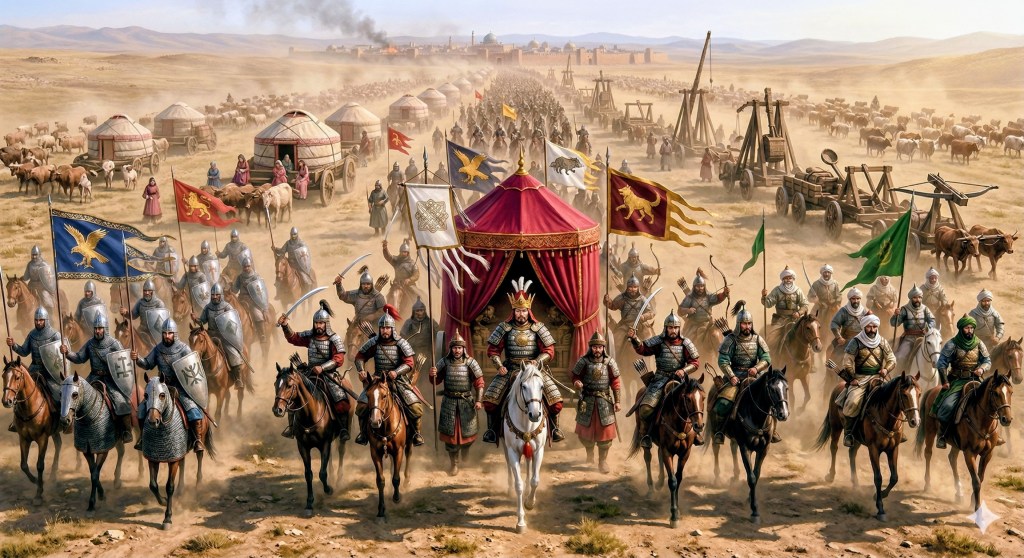
On a February morning in 1258, the army of Hulagu Khan breached the eastern walls of Baghdad and ended five centuries of Abbasid rule in a single, catastrophic week of slaughter. Hulagu had been dispatched westward by his brother, the Great Khan Möngke, with roughly one-fifth of the entire Mongol Empire’s military manpower — a force estimated between 138,000 and 300,000 men, Wikipedia augmented by Armenian, Georgian, and Chinese engineering corps. His mission was explicit: destroy the Nizari Ismaili Assassins, then compel the submission of Caliph al-Musta’sim or annihilate him. Wikipedia +3
The caliph chose defiance. His reply to Hulagu’s ultimatum called the Mongol prince “young and ignorant” and boasted of summoning armies from across Islam — armies that never materialized. Wikipedia By January 1258, Mongol columns converged on Baghdad from three directions. On January 17, a sortie of 20,000 Abbasid troops was routed when Mongol engineers broke the dykes of the Dujayl Canal, drowning the celebrating army in the flooded plain. WikipediaWikipedia The formal siege began on January 29; Substack within six days, the eastern wall was breached. On February 10, al-Musta’sim surrendered. Wikipedia Three days later, the sacking began. WikipediaWikipedia
The destruction was staggering. Libraries accumulated over half a millennium were hurled into the Tigris, which reportedly ran black with ink King Saud UniversityHistory of Information and red with blood. Substack +2 The House of Wisdom, the crown jewel of Islamic intellectual civilization, was obliterated. WikipediaMedium Hulagu’s own estimate placed the dead at 200,000; later Muslim chroniclers claimed figures many times higher. Wikipedia +2 The stench of decomposing bodies forced Hulagu to move his camp upwind of the city. Wondrium Al-Musta’sim himself was rolled in a carpet and trampled to death by horses GT health — a concession to the Mongol taboo against spilling royal blood on open earth.
The fall of Baghdad was not merely a military event. It was a civilizational rupture. The 508-year-old Abbasid dynasty, the nominal spiritual center of Sunni Islam, ceased to exist. ResearchGate The poet Ibn al-Sa’i captured the mood of the age: the destruction shook Muslim consciousness about the vulnerability of their civilization itself. Yet amid this catastrophe, a city 860 miles to the south Distance Calculator — Mecca, the spiritual heart of Islam — remained untouched. Understanding why requires tracing the military barrier that stood between the Mongol advance and the Arabian Peninsula.
Ayn Jalut and Homs: the Mamluk shield that saved the holy cities
After Baghdad, Hulagu’s armies swept westward with terrifying momentum. Aleppo fell in January 1260 after a devastating siege. Damascus surrendered without a fight in March. Fandom +2 By spring of 1260, Mongol patrols had reached Gaza Cambridge Core — the southernmost point of the Mediterranean coast — and the stated aim was to continue into Egypt. The entire Levant lay prostrate. Nothing, it seemed, could prevent the Mongols from rolling south through the Hijaz.
Then two things happened: the Great Khan Möngke died in 1259, Seven Swords pulling Hulagu eastward with the bulk of his army to attend the succession crisis, Wikipedia and the Mamluk Sultanate of Egypt chose to fight. Sultan Qutuz, a Kipchak Turk who had seized power in Cairo just months earlier, assembled his forces and marched north. WikipediaWikipedia His vanguard commander was the brilliant and ruthless Baybars, Encyclopedia Britannica a veteran of the elite Bahriyya regiment who knew the Palestinian terrain intimately from his years as a fugitive. Encyclopedia Britannica
On September 3, 1260, at the spring of Ayn Jalut in the Jezreel Valley of Galilee, the Mamluks engaged the Mongol garrison force of roughly 10,000 to 20,000 men under the Nestorian Christian general Kitbuqa. Wikipedia Baybars employed the Mongols’ own signature tactic against them — a feigned retreat that lured Kitbuqa’s cavalry into a prepared ambush. Encyclopedia Britannica When the Mongol charge broke the Mamluk left wing, Encyclopedia Britannica Qutuz threw down his helmet Encyclopedia Britannica to be recognized by his troops and personally led his reserve into the breach, Wikipedia crying “Wa Islamah!” — “O Islam!” Encyclopedia Britannica Kitbuqa was killed. His army was annihilated. Encyclopedia BritannicaWikipedia
Scholars have debated whether Ayn Jalut deserves its reputation as a world-historical turning point. J.M. Smith Jr., writing in the Harvard Journal of Asiatic Studies in 1984, argued that the Mamluks defeated only a garrison, not a full Mongol army, and that the real constraints on Mongol expansion were internal — the civil war with the Golden Horde, insufficient pastureland in Syria, and the succession crisis in Mongolia. Medievalists Yet even Smith acknowledged the battle’s symbolic and strategic significance: it was the first time the Mongols were permanently prevented from expanding in a particular direction. JW.ORGMilitaryHistoryNow.com
The true test came two decades later. On October 29, 1281, the Ilkhan Abaqa Khan dispatched the largest invasion force ever sent against the Mamluks — an army of 40,000 to 50,000 men MilitaryHistoryNow.com under his brother Möngke Temur, reinforced by Armenian, Georgian, and Hospitaller contingents. They met Sultan Qalawun’s smaller Mamluk army south of Homs in western Syria. The Mongol right wing routed the entire Mamluk left flank, and for a moment total Mongol victory seemed imminent. But Qalawun held his nerve. He personally led the Mamluk right and center in a devastating assault on the Mongol core, shattering their formation. MilitaryHistoryNow.com Möngke Temur was wounded and fled. The pursuit continued for hundreds of miles until the survivors crossed the Euphrates. MilitaryHistoryNow.com
The historian David Ayalon wrote that although Qalawun won at Homs, “the real architect of the victory was undoubtedly Sultan Baybars, who, in the seventeen years of his rule, built a war-machine which proved strong enough to beat one of the mightiest armies the Mongol Ilkhans ever put into the field.” Cambridge Core Historian Nicholas Morton has argued that Wikipedia Homs, not Ayn Jalut, was the truly decisive clash, because it was the first time the Mamluks defeated a full-strength Mongol invasion army rather than a mere garrison force. MilitaryHistoryNow.com
Between 1260 and 1303, the Mamluks fought six major engagements against Mongol incursions into Syria, Wikipedia losing only one — the Battle of Wadi al-Khazandar in 1299, Medievalists a Pyrrhic Mongol victory that led to a brief, unsustainable occupation of Damascus. WikipediaWorld History Encyclopedia The final decisive encounter came at the Battle of Marj al-Saffar in April 1303, which ended Mongol attempts to conquer Syria permanently. WikipediaThe Historian’s Hut Throughout this half-century of continuous resistance, the Mamluk military cordon ensured that Mongol forces never penetrated further south than Gaza Wikipedia — still hundreds of miles and an ocean of desert away from Mecca.
Life behind the shield: Mecca in the age of the Mongols
While empires burned to the north, Mecca continued its ancient rhythms. The city was governed by the Sharifs, hereditary rulers descended from the Prophet Muhammad Wikipedia through his grandson Hasan ibn Ali. Grokipedia The Banu Qatadah dynasty, founded by Qatadah ibn Idris around 1200, administered the holy city WikipediaScribd in a semi-autonomous arrangement FandomWikipedia — first under Ayyubid suzerainty, then increasingly under Mamluk oversight after 1260.
Mecca’s economy was overwhelmingly built on the Hajj. Revenue flowed from pilgrim services, customs duties on merchants, stipends from the Mamluk sultans, and the transit trade passing through the port of Jeddah. Grokipedia The city was never a political capital; Wikipedia it was a city of devotion and scholarship, Encyclopedia.com its permanent population likely numbering between 20,000 and 50,000 residents, swelling dramatically each year when Hajj caravans bearing tens of thousands of pilgrims arrived from Cairo, Damascus, and beyond. WikipediaWikipedia
The traveler Ibn Jubayr, who spent nine months in Mecca in 1183–1184, described the rituals of circumambulation, the Black Stone, the Zamzam well, Grokipedia and the bustling markets that served the pilgrim economy in meticulous detail. When Ibn Battuta arrived in 1326, he found a cosmopolitan city still functioning as the spiritual center of a vast civilization — despite everything that had occurred in the intervening century. A study of Mecca’s merchant community during the Mamluk period reveals its remarkably international character: of 201 recorded merchants, only 14 percent were native Meccans, while nearly a quarter came from Iran, another quarter from Syria, and 17 percent from Egypt. Ashmolean
Religious life in Mecca continued without interruption throughout the Mongol period. The Hajj pilgrimage persisted. Wikipedia Scholars from across the Muslim world visited and settled. The re-establishment of the Abbasid Caliphate in Cairo in 1261 WikipediaWikipedia — a shadow institution, but one that maintained the formal structures of Sunni Islamic authority — ensured continuity of religious legitimacy. Encyclopedia BritannicaHistory Sphere No Mongol army ever appeared on the horizon. No siege engines were raised against the Kaaba. The daily call to prayer echoed over the same valleys it had echoed over for six centuries, unbroken.
Indirect tremors: how the Mongol storm reached Mecca without an army
Yet to say Mecca was untouched would be to mistake the absence of armies for the absence of consequences. The Mongol cataclysm sent shockwaves through the holy city along four distinct channels: the disruption of pilgrimage routes, the redirection of trade, the spiritual crisis of the caliphate’s fall, and the transformation of Mecca into a contested arena of political legitimacy.
The most immediate impact was the collapse of the Iraqi Hajj route. The Darb Zubaydah, the 1,300-kilometer pilgrimage highway from Kufa to Mecca, had been one of the three great arteries feeding the holy city. UNESCO Its final organized pilgrimage occurred in 1243, even before the fall of Baghdad, as Mongol pressure made the route increasingly dangerous. After 1258, it was effectively abandoned. Richard Wilding No one from Baghdad performed the Hajj for more than a decade. Smithsonian MagazineWondrium Pilgrims from Iraq, Khurasan, Persia, and the eastern Islamic world were forced to travel first to Damascus to join the Syrian caravan SmarthistorySubstack — a significant detour that reduced overall pilgrim numbers from the east and diminished one of Mecca’s traditional revenue streams.
The disruption of overland trade routes had a more complex effect. Baghdad had been a central commercial hub connecting East and West; Wikipedia its destruction dismantled established trade patterns. Fiveable But the consequence for Mecca was paradoxical. As overland routes through Iraq and Central Asia became unsafe, merchants increasingly turned to maritime channels through the Red Sea. Jeddah, Mecca’s port, grew in importance. Wikipedia The spice trade between the Indian Ocean and the Mediterranean — which became vital to the Mamluk economy — flowed through Jeddah in ever-greater volumes. Internecine conflict between rival Mongol khanates further encouraged maritime trade. WikipediaStanford In the medium term, Mecca’s economy may have actually benefited from the commercial redirection that the Mongol invasions set in motion.
The spiritual impact was perhaps the deepest. The destruction of the Abbasid Caliphate — the institution that had served as the nominal center of Sunni Islam for over five centuries — created a profound vacuum. Islamic History With the caliphal seat in Baghdad annihilated, Mecca gained enhanced significance as the paramount site where Muslim rulers could claim legitimacy. Uantwerpen The pilgrimage became the primary stage on which rival powers performed their claims to sovereignty before the gathered community of believers. Uantwerpen The Sharifs of Mecca, who bestowed recognition upon visiting rulers, Wikipedia became kingmakers in a newly multipolar Islamic world. Grokipedia Scholars from the University of Antwerp have noted that after 1258, nascent dynasties “expend[ed] substantial efforts” in the Hijaz “to impose themselves as supreme representatives of the Muslim community.”
This dynamic was visible in concrete acts of patronage. Sultan Baybars sent the first Mamluk kiswa — the ceremonial covering of the Kaaba — from Egypt to Mecca Historystudies in 1263, WikipediaAcademia.edu along with the mahmal, a ceremonial palanquin carried on camelback. Historystudies In 1264, a sermon was delivered in Baybars’ name in Mecca, and his secretary received the key of the Kaaba. Taylor & Francis OnlineTaylor & Francis Online In 1269, Baybars personally performed the Hajj, distributing charity, MDPI abolishing excise taxes on pilgrims, and arranging 20,000 dirhams per year in payments to the Sharifs. Taylor & Francis OnlineMDPI These were not merely acts of piety. They were declarations of sovereignty in a post-caliphal world — sovereignty made possible, and made necessary, by the Mongol destruction of Baghdad.
The Mamluks as guardians of the Two Holy Sanctuaries
The Mamluk claim to protect Mecca and Medina was built on three pillars: military victory over the Mongols, expulsion of the Crusaders, and institutional control of the Hajj infrastructure. Together, these gave former slave soldiers — men of Kipchak Turkic origin with no dynastic lineage and no Arab ancestry — the religious legitimacy to rule the most powerful Islamic state of the later Middle Ages. Encyclopedia Britannica
The relationship between Cairo and Mecca operated through a carefully managed suzerain-vassal arrangement with the Sharifs. Sultan Qalawun formalized this relationship in a 1282 treaty with Sharif Abu Numayy, which sanctioned the Mamluk prerogative to send the kiswa and established the political framework that would endure for over two centuries. BrillUantwerpen The Mamluks maintained a political agent and a cavalry garrison in Mecca, played rival Sharifian factions against one another, Academia.eduWikipedia and compensated the Sharifs with annual allocations of money and grain. Wikipedia In return, the Sharifs administered local affairs and managed the complex tribal politics of the Hijaz.
The installation of a shadow Abbasid caliphate in Cairo in 1261 was another critical element. Sultan Baybars invited a surviving member of the Abbasid family, al-Mustansir, to Cairo and invested him as caliph. Wikipedia Al-Mustansir in turn confirmed Baybars’ authority over Egypt, Syria, the Jazira, the Hijaz, and Yemen. Wikipedia The institution persisted through seventeen caliphs until the Ottoman conquest of 1517. Ghent University Library Though these caliphs were largely powerless — as the scholar Mustafa Banister has written, “the caliphs as individuals were largely disposable and powerless, [but] the office they held retained importance” — the institution provided the Mamluks with a crucial link to Islamic legitimacy and attracted recognition from Muslim rulers as distant as Delhi and the Ottoman court. Wikipedia
Control of the Hajj routes completed the architecture of legitimacy. The Mamluks organized and protected the two principal pilgrimage caravans MDPI — the Egyptian Darb al-Misri from Cairo and the Syrian route from Damascus — appointing prestigious military commanders as amir al-hajj WikipediaAcademia.edu and investing heavily in cisterns, caravanserais, and fortifications along the way. Know-your-history By 1266, Baybars had reopened the Egyptian route via Aqaba, Taylor & Francis restoring a pilgrimage artery that had been disrupted in the final years of Ayyubid rule. Taylor & Francis As the Metropolitan Museum of Art’s authoritative chronology summarizes: “Within a short period of time, the Mamluks created the greatest Islamic empire of the later Middle Ages, which included control of the holy cities Mecca and Medina.” The Metropolitan Museum of ArtThe Metropolitan Museum of Art
From destroyers to believers: the Mongol conversion to Islam
Perhaps the most remarkable chapter in this story is its ending. The Mongol khanates that had threatened to extinguish Islamic civilization converted, one by one, to the faith of their conquered subjects. Encyclopedia.com
Berke Khan of the Golden Horde became the first Mongol ruler to embrace Islam, Wikipedia converting around 1252 after encountering a Sufi sheikh from Khorazm. Wikipedia His fury at Hulagu’s destruction of Baghdad — “He has sacked all the cities of the Muslims and has brought about the death of the Caliph,” Berke reportedly declared. Wikipedia “With the help of God, I will call him to account for so much innocent blood” WikipediaWikipedia — drove the first open war between Mongol khanates Wikipedia and created a Muslim alliance between the Golden Horde and the Mamluk Sultanate that fundamentally constrained the Ilkhanate’s strategic options. Under Özbeg Khan (r. 1313–1341), Islam became the Golden Horde’s official religion. Sacred FootstepsEncyclopedia.com
The Ilkhanate’s conversion was more dramatic. Tekuder, Hulagu’s son, briefly adopted Islam in 1282 but was overthrown. Wikipedia +2 The pivotal moment came on June 16, 1295, when Ghazan Khan formally converted to Sunni Islam Encyclopedia.com and declared it the Ilkhanate’s state religion. Sacred FootstepsWikipedia His coins bore the legend “Emperor of Islam.” World History Encyclopedia Ghazan’s conversion was partly political — a condition for the military support of the amir Nawruz Wikipedia — but it set in motion a cultural transformation. Under Ghazan and his successors, the Ilkhanate became a patron of Islamic learning, RANGE: Journal of Undergraduate Research supporting scholars like the historian Rashid al-Din Hamadani, Encyclopedia Britannica whose Jami’ al-Tawarikh became one of the great works of Persian historiography.
Strikingly, conversion did not immediately end the Mamluk-Ilkhanid conflict. Ghazan invaded Syria in 1299 and again in 1303, even as a Muslim ruler. Wikipedia +2 But it did transform the nature of the rivalry. By the early fourteenth century, the contest was no longer between Islam and an existential external threat, but between rival Muslim powers competing for supremacy within the Islamic framework — including competition over influence in Mecca itself. In 1325, the Ilkhanid general Chupan performed the Hajj and sponsored repairs to Mecca’s water supply and construction projects in Medina. Wikipedia In 1330, the Ilkhan Abu Sa’id sent his ceremonial mahmal to Mecca on the back of an elephant — a spectacular gesture of one-upmanship that prompted the Mamluk sultan al-Nasir Muhammad to respond with a military expedition and his own Hajj pilgrimage. Brill
The Chagatai Khanate in Central Asia underwent the most gradual conversion, with Islam gaining a permanent hold under Tughlugh Timur Khan (r. 1347–1363), who reportedly converted along with some 160,000 Chagatai Mongols. Sacred Footsteps By the mid-fourteenth century, three of the four major Mongol successor states were Muslim. Wikipedia As Peter Jackson concluded in his landmark 2017 study The Mongols and the Islamic World, the Mongols’ “conversion proved a landmark in the history of the faith” Yale University Press — Islam not only survived the Mongol onslaught but spread throughout the empire into regions where it had never previously penetrated. Yale University Press
Epilogue: the city that endured
The question of whether the Mongols affected common Muslim life in Mecca admits a layered answer that illuminates something important about the nature of historical causation itself. In the most immediate, tangible sense, the answer is no. No Mongol soldier set foot in the Hijaz. No siege engine was raised against the walls of the holy city. The daily rhythms of prayer, pilgrimage, scholarship, and commerce continued in Mecca throughout the darkest decades of the thirteenth century, sustained by the Mamluk military shield and the vast buffer of the Arabian desert.
Yet the Mongol cataclysm reshaped the world around Mecca in ways that the holy city could not escape. The destruction of Baghdad severed ancient pilgrimage routes, redirected the arteries of commerce, and demolished the institution that had served as the symbolic center of Sunni Islam for half a millennium. EgyptTodayFiveable In the vacuum left by the Abbasid Caliphate’s destruction, Mecca’s significance was paradoxically amplified. The holy city became the indispensable stage on which Muslim rulers — Mamluk sultans, Ilkhanid converts, Rasulid princes of Yemen — performed their claims to legitimacy before the assembled umma. Brill The Mamluks’ transformation from slave soldiers into guardians of Islam’s holiest sites was itself a product of the Mongol crisis, as was the shadow caliphate they installed in Cairo, and the elaborate Hajj infrastructure they built to demonstrate their worthiness as rulers.
The broader historical significance extends further still. The Mongol invasions demonstrated that a civilization’s spiritual center can endure even when its political center is annihilated — provided that defenders arise to shield it. The Mamluks, themselves products of the slave trade and military displacement that characterized the medieval Islamic world, became those defenders. Brainly Their victory was not inevitable. Had Kitbuqa prevailed at Ayn Jalut, had Qalawun’s nerve broken at Homs, the Mongol advance might have swept through Egypt and into the Hijaz, with consequences beyond calculation. MilitaryHistoryNow.comIndiaFacts That it did not owes much to the contingencies of battle, the death of a Great Khan at an opportune moment, and the extraordinary military system that Baybars built over seventeen years of relentless preparation.
And then there is the conversion — the ultimate irony of this story. The grandsons of the men who destroyed the caliphate became Muslims. EgyptToday They performed the Hajj. They sent the kiswa to cover the Kaaba. They competed with the Mamluks for the privilege of patronizing Mecca’s shrines. The faith that the Mongols had nearly extinguished absorbed them. ResearchGateIslamic History In this, the story of Mecca and the Mongols offers a meditation on resilience that extends beyond the military: it is the story of a spiritual tradition that outlasted the most devastating military force the medieval world had ever seen, not merely by surviving behind a shield of swords, but by eventually converting the swordsmen themselves.




 The Glorious Quran and Science
Leave a comment