
Presented by Zia H Shah MD
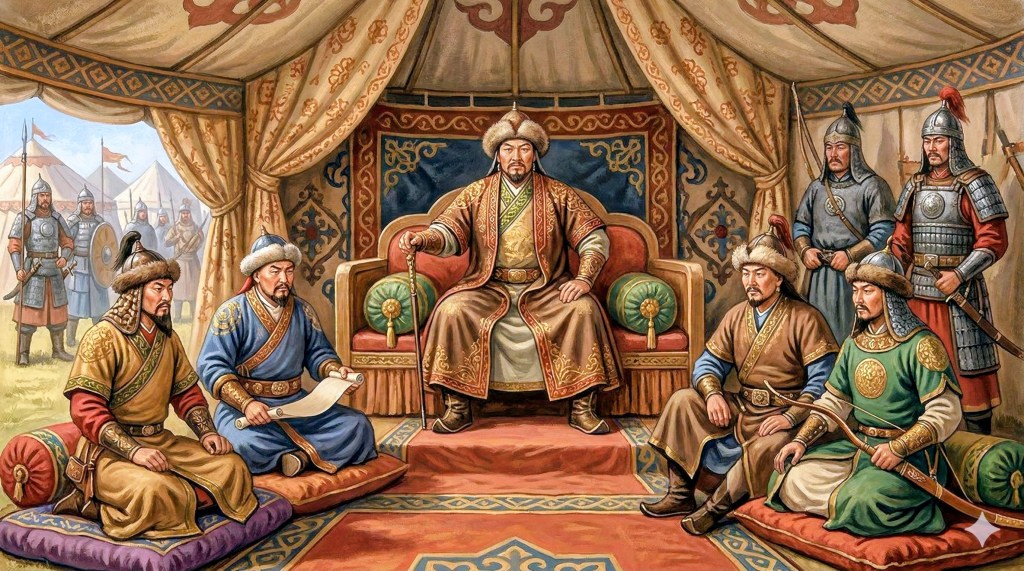
Berke Khan, grandson of Genghis Khan and the first Mongol ruler to embrace Islam, reshaped the 13th-century world by turning the vast military power of the Golden Horde into a shield for the Muslim civilization his ancestors had nearly destroyed. His conversion around 1252, Wikipedia his war against his cousin Hulagu Khan after the catastrophic sack of Baghdad in 1258, Wikipedia and his unprecedented alliance with the Mamluk Sultanate of Egypt Wikipedia collectively prevented the annihilation of Islam’s heartlands, fractured the Mongol Empire beyond repair, and set in motion the Islamization of the Eurasian steppe — a process that would ultimately bring three of the four great Mongol khanates into the fold of Islam. Wikipedia Though he ruled the Golden Horde for barely a decade (c. 1257–1266), WikipediaFandom Berke Khan’s decisions rank among the most consequential in medieval world history, bridging the Mongol and Islamic civilizations and ensuring the survival of Muslim political and spiritual institutions at their most vulnerable moment.
A prince born between two worlds
Berke was born into the most powerful dynasty on earth. His father, Jochi (c. 1182–1225), was the eldest and most controversial son of Genghis Khan — his legitimacy clouded by the abduction of his mother Börte by the Merkit tribe shortly before his birth. Wikipedia Despite this stigma, Jochi received the largest territorial inheritance of any Genghisid prince: Wikipedia the western lands stretching from the Irtysh River to “as far as the hooves of Mongol horses had trodden,” encompassing the Kipchak Steppe, much of Central Asia, and territories yet to be conquered in Eastern Europe.
Berke’s exact birth year remains debated. Mamluk ambassadors who visited his court in 1264–1265 described him as fifty-six years old, qawwam placing his birth between 1207 and 1209. The Persian chronicler Minhaj al-Siraj Juzjani, however, claims Berke was born during the Mongol conquest of Khwarezmia (1219–1221), Wikipedia which would make him significantly younger. WikipediaWikipedia The discrepancy hinges partly on the identity of his mother. Historian Jean Richard argued that Berke’s mother was Sultan Khatun (Khan-Sultan), the captured daughter of Sultan Muhammad II of Khwarazm qawwam +2 and sister of the celebrated warrior-prince Jalal al-Din Mingburnu. If correct, this Khwarazmian Muslim princess could not have married Jochi before 1220, making a birth before 1221 impossible. Wikipedia However, as Anne Broadbridge has cautioned, “Berke’s mother’s identity has never been solidly confirmed.” Scholarly Publications What is clear is that if Sultan Khatun was indeed his mother, Berke grew up in a household where Islam was not entirely foreign — a detail that may illuminate his later spiritual journey.
Jochi fathered at least fourteen sons by various wives. Wikipedia Berke’s most prominent brothers included Orda Khan, who would rule the eastern White Horde; Batu Khan, the brilliant military commander who would forge the Golden Horde into a continental power; and Shiban, ancestor of the later Shaybanid dynasty. After Jochi’s death around 1225, Batu emerged as the senior Jochid prince, and Berke grew up under his older brother’s expanding authority.
Berke’s early military career was forged in the great western campaign of 1236–1242, the largest Mongol military operation since Genghis Khan’s conquests. Commanding a force of approximately 150,000 soldiers, Batu and the legendary general Subutai swept across the Kipchak Steppe, Russia, Poland, and Hungary. Wikipedia Batu assigned Berke specifically to subdue the Kipchak Turks of the North Caucasus. During the winter of 1238–1239, Berke defeated the Kipchaks and conquered the steppe territories along the Kuma and Terek rivers WikipediaWikipedia — lands that would later become the very battlefield of his war against Hulagu. In April 1241, Berke fought at the Battle of Mohi in Hungary, where coordinated Mongol tactics annihilated King Béla IV’s army WikipediaWikipedia in one of medieval Europe’s most devastating defeats.
The conversion that would reshape an empire
Berke Khan holds a singular distinction in world history: he was the first Mongol ruler to convert to Islam. Encyclopedia Britannica This fact is affirmed by virtually every scholarly authority, from the Encyclopædia Britannica Encyclopedia Britannica to specialist works by Devin DeWeese, István Vásáry, and Peter Jackson. The circumstances and timing of his conversion have been the subject of extensive historical inquiry, blending hagiographic legend with verifiable evidence from independent sources.
The most commonly accepted account places Berke’s conversion around 1252, in or near the great Central Asian city of Bukhara QuoraWikipedia — a city the Mongols had devastated just three decades earlier. According to this tradition, while at Saray-Jük in far western Kazakhstan, Berke encountered a caravan from Bukhara. He questioned the travelers about their faith, was deeply impressed by Islamic beliefs, and embraced Islam. He also persuaded his brother Tukh-Timur to convert. WikipediaWikipedia
The figure most prominently credited with Berke’s conversion is Sayf al-Din Bakharzi (1190–1261), a towering Sufi sheikh of the Kubrawiyya order. Bakharzi was a direct disciple of Najm al-Din Kubra, the order’s founder Uzbek TravelWikipedia who had died fighting the Mongols during the siege of Urgench in 1221. Dolores Travel Sent by his master to Bukhara, Bakharzi established Encyclopaedia Iranica the renowned Fathabad khanaqah (Sufi lodge) and earned the honorary title “Shaykh al-‘Alam” — Sheikh of the World. Wikipedia Remarkably, he survived the Mongol devastation of Bukhara and lived some forty years under Mongol rule, gaining what scholars describe as “incontestable authority over the ruling elite.” Uzbek Travel Later hagiographic traditions embellished the conversion with miraculous elements — visions and spiritual demonstrations — but as Vásáry cautioned, these “appear in later Sufi traditions but lack corroboration in contemporary chronicles” and “likely served to glorify Kubrawi lineages.” Grokipedia
Yet the historical kernel is robust. Vásáry’s landmark study, “‘History and Legend’ in Berke Khan’s Conversion to Islam” (1990), concluded definitively: “Sayf ad-Din Bakharzi’s influence on Berke must have been very strong. Disregarding the legendary elements of these narratives and their strong Islamic bias, their historical kernel must be true. Berke’s conversion to Islam was a personal and religious decision; he did not act from political motifs, but the consequences of this deed were not at all personal.” Taylor & Francis
Independent contemporary evidence confirms the conversion’s early date. The Franciscan friar William of Rubruck, who traveled through Jochid territories in 1253, recorded that Berke was already a Muslim and had forbidden the consumption of pork in his camp. Libsyn The Persian historian Ata-Malik Juvaini noted that at Great Khan Möngke’s enthronement feast in 1251, meat was slaughtered in halal fashion specifically out of deference to Berke. Libsyn Together, these two independent non-Muslim witnesses — one Latin Christian, one Persian administrator — confirm that Berke was a practicing Muslim before he became Khan, making his conversion a matter of personal conviction rather than political calculation.
Berke’s devotion was conspicuous. Wikipedia His camp hosted muezzins, imams, and Sufi shaykhs. He established mobile schools where children learned the Quran. delanceyplaceResearchGate He attended to visiting scholars and fuqaha’ (Islamic jurists). HRMARSKwpublications And when he assumed power, his coins bore Islamic inscriptions, including the shahada — the declaration of faith. Grokipedia
Seizing the throne of the Golden Horde
Berke’s path to power was paved with political cunning and, quite possibly, ruthlessness. When Batu Khan died in 1255, Podgorski the Golden Horde passed to Batu’s eldest son, Sartaq Khan Wikipedia — a Nestorian Christian Wikipedia and loyal ally of Great Khan Möngke. But Sartaq died within months of returning from Karakorum, where Möngke had confirmed his succession. ScribdGrokipedia Armenian sources, notably the historian Kirakos, directly accused Berke of poisoning Sartaq, and modern historians consider this plausible. Grokipedia
Möngke then appointed Ulaghchi — either Sartaq’s young son or his younger brother — as ruler, Wikipedia with Batu’s widow Boraqchin Khatun serving as regent. Wikipedia +2 This was a deliberate attempt to block Berke’s rise. But Ulaghchi died after only a few months, WikipediaWikipedia in late 1257. When Boraqchin allegedly turned to Hulagu Khan for protection, Berke accused her of treason and had her executed. WikipediaWikipedia Many historians suspect Berke orchestrated Ulaghchi’s death as well. By 1257 or early 1258, with Möngke consumed by his campaign against the Song Dynasty in distant China, Berke had maneuvered himself onto the throne of the Golden Horde — the most powerful Mongol state west of Mongolia.
As khan, Berke proved an able administrator. Wikipedia He suppressed the rebellion of Daniel of Galicia against Mongol suzerainty, launched a devastating raid into Poland and Lithuania in 1259, Wikipedia and managed a tax revolt in Suzdal with a mixture of firmness and clemency — relenting after Alexander Nevsky personally pleaded for his Russian subjects. Fandom He also demonstrated diplomatic sophistication, forging relationships with the Byzantine Empire, the Seljuqs of Rum, and — most momentously — the Mamluk Sultanate of Egypt.
“He has sacked all the cities of the Muslims”
The event that transformed Berke from a regional ruler into a pivotal figure in Islamic history was the Mongol sack of Baghdad on February 10, 1258 — arguably the single most traumatic event in medieval Muslim civilization.
Hulagu Khan, Berke’s cousin and the founder of the Ilkhanate, had been dispatched westward by Möngke with an enormous army to consolidate Mongol dominion over western Asia. WikipediaHRMARS After destroying the Ismaili Assassins’ fortress at Alamut in 1256, Hulagu turned on Baghdad Encyclopedia.comMVSLIM — seat of the Abbasid Caliphate, the spiritual and political center of Sunni Islam for over five centuries. Caliph al-Musta’sim, the thirty-seventh and last Abbasid caliph, Wikipedia refused to surrender. Encyclopedia.comWikipedia The siege lasted barely two weeks. The Mongols breached the fortifications, and the massacre began. Libraries, mosques, and the famed House of Wisdom were destroyed. Scribd The Tigris was said to have run black with ink from ruined manuscripts and red with the blood of the slain. Al-Musta’sim himself was wrapped in a carpet and trampled to death by horses Political Periscope — in accordance with a Mongol taboo against spilling royal blood on bare earth. Encyclopedia.comWar History Online For the first time in its history, the Islamic world was left without a caliph. Encyclopedia Britannica
Berke was enraged. The Persian historian Rashid al-Din Hamadani recorded Berke’s protest, sent as a message to Möngke Khan: “He [Hulagu] has sacked all the cities of the Muslims, and has brought about the death of the Caliph. With the help of God I will call him to account for so much innocent blood.” En AcademicWikipedia Even before his formal accession, Berke had reportedly complained to Batu: “We helped Möngke to enthrone. But he forgot who the enemy is or friend is. Now, he is starving the lands of our friend Caliph. It is abject.” WikipediaWikipedia
Yet open war did not erupt immediately. Four years separated the sack of Baghdad from the outbreak of hostilities Libsyn — a gap explained by Berke’s need to first secure his own throne Libsyn and by the accumulation of multiple grievances beyond religion alone. The causes of the Berke-Hulagu War were layered:
- Religious fury: Berke’s genuine outrage as a Muslim over the destruction of the caliphate and the massacre of Muslim populations WikipediaWikipedia
- Territorial seizure: Genghis Khan had originally granted Azerbaijan — its rich pastures and lucrative trade cities — to Jochi’s line. After Möngke’s death in 1259, Hulagu unilaterally incorporated these Jochid territories into his new Ilkhanate without any central authority’s mandate FandomLiquiSearch
- Murder of Jochid princes: Three Jochid princes — Balaghai, Tutar, and Quli — who had served in Hulagu’s army were executed on his orders by 1261, reportedly on charges of sorcery. Wikipedia Berke had expected mild punishment at most Libsyn
- Economic warfare: Hulagu hoarded war booty from Baghdad that was owed to Berke, and both sides slaughtered each other’s ortogh (trading-partner) merchants WikipediaWikipedia
- Personal animosity: At Möngke’s enthronement in 1251, Berke had bossed Hulagu around with constant demands, and Hulagu found him “burdensome and overbearing”
The combined weight of these grievances led Berke to take a step unprecedented in Mongol history: he declared jihad against a fellow Chinggisid ruler. The bitter irony was not lost on him. The contemporary Mamluk author Ibn Wasil recorded Berke’s anguished reflection: “Mongols are killed by Mongol swords. If we were united, then we would have conquered all of the world.” Wikipedia +2
The war that split the Mongol Empire
The Berke-Hulagu War (1262–1266) was the first major armed conflict between Mongol khanates Wikipedia and a watershed moment in the dissolution of the Mongol Empire. Wikipedia Berke mobilized approximately 30,000 men and placed his grand-nephew Nogai Khan — whose own father Tutar had been among the Jochid princes executed by Hulagu — as commander-in-chief. Podtail
In the spring of 1262, Berke’s forces pushed south, capturing the strategic fortress of Derbent, which guarded one of the primary passes through the Caucasus Mountains. PodtailFoundae Initial engagements in the pastures of Azerbaijan produced mixed results — Berke’s forces won some skirmishes but Nogai was forced to retreat in others. Podtail By late November, Hulagu drove the Jochids back past Derbent and his son Abaqa pursued them into the lowlands north of the Caucasus. Libsyn
What followed was a masterpiece of steppe warfare. Around January 10, 1263, Abaqa’s forces discovered an abandoned Jochid camp on the north bank of the frozen Terek River — tents, herds, treasures, and families left behind, but Berke’s army nowhere to be seen. Libsyn It was a trap. Nogai’s forces launched a devastating surprise attack. Abaqa ordered a panicked retreat across the frozen river, and the weight of fleeing men and horses broke the ice. Hundreds or thousands of Ilkhanate soldiers and horses plunged into the freezing waters and drowned. WikipediaWikipedia Abaqa barely escaped with his life. Libsyn The Battle of the Terek River became one of the most dramatic engagements in Mongol military history. Wikipedia
The war continued in a grinding stalemate until both protagonists died — Hulagu on February 8, 1265, Encyclopedia.comWikipedia and Berke in 1266, the latter falling ill while marching to cross the Kura River near Tiflis to press the campaign against Hulagu’s successor Abaqa. Wikipedia +3
The war’s strategic consequences were immense. When Hulagu returned from Syria in 1262, he had fully intended to avenge the Mamluk victory at Ain Jalut and launch a devastating campaign against Egypt. Political Periscope Berke’s invasion drew Hulagu north with the bulk of his forces, completely preventing this campaign. Fandom +3 As the Encyclopaedia Iranica confirms: “Understanding early on that his preoccupations with the Golden Horde would prevent him from devoting himself to avenging the defeat at Ayn Jalut, in 1262 Hülegü sent out a mission to Europe to seek assistance in the war against the Mamluks.” Encyclopaedia Iranica Hulagu never again mounted a serious campaign against Egypt or Syria. Multiple historians argue that Berke’s intervention effectively saved the Islamic holy cities of Mecca, Medina, and Jerusalem from potential destruction. Fandom +2
An alliance that redrew the map of the medieval world
In late 1261, Sultan Baybars of Egypt Libsyn — himself a Kipchak Turk from the very steppes the Golden Horde controlled — dispatched a letter to Berke War History via Alan merchants, qawwam congratulating him on his conversion and urging him to fight Hulagu. CyberLeninka This cautious opening, written by the celebrated scribe Qadi Muhyiddin ibn Abd al-Zahir, initiated what would become one of the most consequential diplomatic alliances of the medieval period. qawwam
The alliance was wholly unprecedented: a Mongol ruler joining forces with a Muslim state against another Mongol ruler, on the basis of shared Islamic faith. Simple Book Publishing Its architecture was elaborate. Baybars sent official embassies with letters that incited Berke to war, informed him about Muslim territories, announced the re-establishment of the Abbasid Caliphate in Cairo, and included a golden genealogy chart of the new Caliph’s lineage. QAWWAMqawwam Berke reciprocated with his own delegations, and the two rulers exchanged gifts — Baybars sent Berke a valuable Qur’an that reportedly deeply impressed the khan’s court. QAWWAM
The personal bond between the two rulers was remarkable. Baybars included Berke’s name in the Friday prayers at Mecca, Medina, and Jerusalem — an extraordinary honor. War History Berke reportedly married his daughter to Baybars as a sign of friendship. Foundae Baybars even named his eldest son “Berke” in tribute to the Mongol khan. UM Online Journal The historian Masudul Hasan poetically described their closeness as “the water of the Volga river flowing into the Nile.” Foundae
Beyond diplomacy and sentiment, the alliance created a devastating two-front dilemma for the Ilkhanate. Forced to guard against the Golden Horde in the north and the Mamluks in the south simultaneously, the Ilkhanate could never concentrate its full military power in either direction. This strategic geometry persisted long after both Berke and Baybars died — the alliance endured for nearly two centuries (c. 1260–c. 1440), CyberLeninka with approximately eighty diplomatic missions exchanged between the two powers. CyberLeninka
The economic dimension was equally vital. The Mamluk military system depended on continuous importation of Kipchak Turkish military slaves from the Golden Horde’s territories, CyberLeninkaWikipedia purchased through Genoese intermediaries in Crimean ports like Caffa. War HistoryKiddle The Golden Horde needed the revenue; the Mamluks needed the warriors. ResearchGate This slave trade — the very mechanism that had produced Baybars himself — bound the two states in mutual economic dependence. Broader trade in furs, silk, spices, and luxury textiles flowed through Golden Horde territory, connecting Muslim lands from Egypt through Central Asia and beyond. World History Edu Arabic-Mongol and Persian-Mongol dictionaries were compiled in the fourteenth century specifically for Mamluk chancelleries, Wikipedia testifying to the sustained intensity of cross-cultural exchange. WorldpossiblePodgorski
The geopolitical realignment was profound. It created a durable axis — Golden Horde plus Mamluks versus Ilkhanate plus Crusader states — that defined Middle Eastern power politics for generations. It established the Mamluk Sultanate as the preeminent Muslim power and allowed Egypt to become the unrivaled political, economic, and cultural center of the Arabic-speaking Muslim world. Encyclopedia Britannica
How Berke’s faith transformed the fortunes of Islam
Berke Khan’s conversion and subsequent policies benefited the Muslim world in ways both immediate and enduring, operating across military, institutional, diplomatic, and cultural dimensions.
Military protection was the most dramatic benefit. By waging war against Hulagu and forcing the Ilkhanate into a permanent two-front confrontation, Berke neutralized the existential threat that had loomed over the remaining Muslim lands after Baghdad’s destruction. While the Battle of Ain Jalut in September 1260 checked the Mongol advance tactically, it was fought against a reduced Mongol force — Hulagu himself was absent, having withdrawn most of his troops eastward. Wikipedia +2 Had Berke not drawn Hulagu into civil war, the full weight of Ilkhanate military power would almost certainly have been directed against Egypt and Syria. Political Periscope Berke’s intervention made the Ain Jalut victory permanent.
Institutional patronage within the Golden Horde itself was substantial. Berke built mosques and madrasas throughout his territories, Kaznu welcomed Muslim scholars and jurists to his court, banned the consumption of pork and alcohol, Kwpublications and employed Muslim administrators and tax collectors. HRMARSKwpublications His capital at Sarai on the lower Volga Fandom developed Islamic infrastructure that would expand dramatically under his successors. Worldpossible The Franciscan friar William of Rubruck’s observation that Berke enforced Islamic dietary laws in his camp confirms that these were not merely symbolic gestures but enforceable policies. Libsyn
Diplomatic legitimation of the post-Baghdad Islamic order was another critical contribution. When Baybars re-established the Abbasid Caliphate in Cairo in 1261, Hizb-australia Berke’s recognition of this move — from the most powerful Mongol Muslim ruler — lent it vital legitimacy. By declaring jihad against the Ilkhanate, Berke reframed the intra-Mongol conflict in explicitly Islamic terms, GrokipediaWorld History Edu mobilizing religious solidarity across the Muslim world and demonstrating that a Chinggisid prince could be a champion rather than a destroyer of Islam.
Trade facilitation across the vast Golden Horde territories connected Muslim commercial networks from the Mediterranean to Central Asia and beyond. Under Berke’s policies, cities like Sarai and Crimean ports flourished as trade hubs, World History Edu and the alliance with the Mamluks created protected corridors for Muslim commerce. Podgorski
Perhaps most significantly, Berke’s conversion inaugurated missionary Islam within the Mongol political sphere. As scholar Uli Schamiloglu has noted, “it is already possible to speak of a missionary Islam propagated by Sufi orders in the territories of the Golden Horde in the time of Berke Khan.” Nu The Kubrawiyya and other Sufi networks, operating under Berke’s patronage, established nodes of Islamic religious life across the steppe GrokipediaOpenStax — a process that would accelerate under his successors and transform the religious landscape of Inner Asia.
The long arc of Islamization after Berke
Berke’s conversion was a seed, not a harvest. The full Islamization of the Golden Horde was a gradual process spanning decades, but Berke’s pioneering example set an irreversible trajectory.
His immediate successor, Mengu-Timur (r. 1266–1280), continued the Mamluk alliance and Ilkhanate containment En Academic +3 but was not prominently associated with further Islamization. Töde-Möngke (r. 1282–1287) Sacred Footsteps converted to Islam QalamWikipedia in 1283 and reportedly became so devoted to religion that he neglected state affairs. The transformative figure was Özbeg Khan (r. 1313–1341), who upon taking power proclaimed Islam the official state religion of the Golden Horde. KiddleWikipedia When Tengrist Mongol nobles organized a plot to resist, Özbeg executed 120 nobles, including many Chinggisids who refused to convert. Wikipedia Under Özbeg, the Golden Horde reached its territorial and political zenith Wikipedia — the longest reign of any Golden Horde khan Libsyn at twenty-eight years. Wikipedia All subsequent rulers were Muslims. The Uzbek people and modern Uzbekistan take their name from him.
Berke’s example cascaded across the Mongol world. The Ilkhanate — the very dynasty of Hulagu who had destroyed Baghdad — saw its ruler Mahmud Ghazan Khan convert to Islam in 1295 and declare it the state religion. Sacred Footsteps The Chagatai Khanate followed when Tughlugh Timur Khan made Islam permanent in the 1340s–1360s, reportedly converting 120,000 Chagataid Mongols alongside him. Sacred Footsteps By the mid-fourteenth century, three of the four great Mongol khanates had embraced Islam Sacred FootstepsSimple Book Publishing — a transformation that began with one prince’s encounter with a Sufi sheikh in Bukhara.
The broader civilizational impact was immense. Berke’s policies nurtured a fusion of Turko-Mongol political traditions with Islamic governance that would define Central Asian civilization for centuries. This synthesis fed into the great successor empires — the Timurid, Ottoman, Safavid, and Mughal dynasties all drew, in various ways, on the model of Chinggisid political legitimacy coexisting with Islamic religious identity that Berke pioneered.
Death on campaign and an enduring legacy
Berke Khan died in late 1266 or early 1267, succumbing to illness while marching to cross the Kura River Fandom near Tiflis Wikipedia (modern Tbilisi) to press his military campaign against the Ilkhanate’s new ruler, Abaqa Khan. Wikipedia He died as he had ruled — in the field, pursuing the conflict that defined his reign. His entire army withdrew to New Sarai. Aljamiah He left no sons; the throne passed to his grandnephew Mengu-Timur, FandomWikipedia Batu Khan’s grandson, WikipediaMuslim Memo nominated by the distant Great Khan Kublai. Wikipedia
Berke Khan remains, as several scholars have noted, an under-recognized figure in general world history despite his outsized significance. Goodreads Islamic historical tradition remembers him as a champion and defender of the faith — some sources call him “the savior of Muslim civilization,” though this characterization carries hagiographic overtones. Persian historiography, particularly Rashid al-Din, offers a more politically nuanced portrait, documenting both the religious conviction and the hard-edged territorial calculus that drove his decisions. Western and modern scholarship, exemplified by Peter Jackson’s observation that “it is fruitless to write off a conversion of this kind as ‘partial’ or ‘insincere,’ since we occupy no vantage point that enables us to judge the wholeheartedness of Mongol rulers who accepted Islam,” has moved toward treating Berke’s faith as genuine while analyzing its political ramifications with analytical rigor. Sacred Footsteps
His significance spans multiple domains of history simultaneously. In religious history, he was the pioneer of Mongol Islamization, Wikipedia setting a precedent Wikipedia that brought three of four khanates to Islam. Sacred Footsteps In military and political history, he initiated the first inter-khanate war, precipitating the permanent fragmentation of the Mongol Empire. Wikipedia +2 In diplomatic history, he created the first alliance between a Mongol state and an external Muslim power based on religious solidarity. Encyclopedia Britannica In geopolitical history, his actions preserved the Mamluk Sultanate and shielded Islam’s heartlands from further devastation. MediumPolitical Periscope And in cultural history, he began the Turko-Mongol Islamic synthesis that shaped Central Asian civilization for centuries to come.
Conclusion
Berke Khan’s life illuminates one of history’s most dramatic ironies: a grandson of the man who unleashed the most destructive force the Islamic world had ever faced became its most consequential protector. IslamiCity His conversion was personal, driven by spiritual conviction rather than political expediency Taylor & Francis — yet its consequences reshaped the geopolitical architecture of Eurasia. By turning the Golden Horde’s military power against the Ilkhanate, forging an alliance with the Mamluks, and patronizing Islamic institutions across the steppe, Berke ensured that the Mongol catastrophe became, paradoxically, a vehicle for Islam’s expansion into new territories and populations. The Kipchak Steppe, the Volga basin, and vast stretches of Central Asia became Muslim lands in significant part because of decisions made by one prince in the 1250s and 1260s. In the long sweep of history, the faith that Genghis Khan’s armies nearly extinguished was carried forward by Genghis Khan’s own descendants — and Berke Khan was the first and most decisive link in that extraordinary chain.


 The Glorious Quran and Science
Leave a comment