
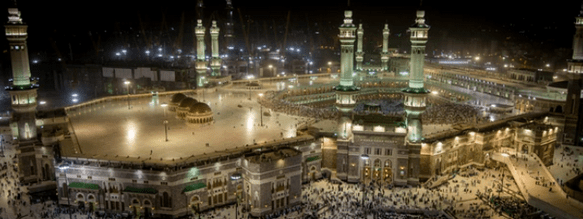
The Sacred City and Its Lord: A Comprehensive Commentary on Quran 27:91
Presented by Zia H Shah MD
Abstract
This commentary undertakes a detailed historical, theological, and intertextual study of Quran 27:91, the commanding verse in which the Prophet Muhammad is instructed to declare his devotion to “the Lord of this city” — Mecca — “Who has made it inviolable.” Drawing upon the classical tafsir tradition of Ibn Kathir, al-Tabari, al-Qurtubi, al-Jalalayn, and al-Sa’di, alongside the contemporary exegesis of Maududi, Sayyid Qutb, Muhammad Asad, and Mufti Muhammad Shafi, this study situates the verse within the broader Quranic theology of sacred space. The commentary weaves together every major Quranic passage concerning the Kaaba, Mecca, and Becca — from Abraham’s founding prayers in Surah al-Baqarah (2:125–129) and Surah Ibrahim (14:35–37), to the designation of the first House of worship in Surah Ale Imran (3:96–97), the change of qibla (2:144–150), the rites of Hajj (2:158, 2:196–197, 22:26–29), the divine protection narrated in Surah al-Fil (105:1–5), the gratitude demanded in Surah Quraish (106:1–4), and God’s solemn oath by the city in Surah al-Balad (90:1–4). Each verse cluster is presented with its Arabic text and the English translation of M.A.S. Abdel Haleem (Oxford University Press). The commentary is further enriched with insights from the published articles of Zia H Shah MD, whose research on the Kaaba’s historical resilience, fulfilled Abrahamic prophecy, and divine preservation provides a contemporary lens through which to appreciate the living reality of Mecca’s sanctity — a sanctity proclaimed in scripture and confirmed by the annual convergence of millions of pilgrims from every corner of the earth. A thematic epilogue draws the threads together, arguing that Quran 27:91 functions as a theological axis connecting the particular and the universal, the Abrahamic past and the eschatological future, and the material sanctuary with the spiritual sovereignty of God over all creation.
I. The central verse: “I am commanded to serve the Lord of this city”
The Arabic text and translation
إِنَّمَآ أُمِرْتُ أَنْ أَعْبُدَ رَبَّ هَـٰذِهِ ٱلْبَلْدَةِ ٱلَّذِى حَرَّمَهَا وَلَهُۥ كُلُّ شَىْءٍۢ ۖ وَأُمِرْتُ أَنْ أَكُونَ مِنَ ٱلْمُسْلِمِينَ
“[Say, Prophet], ‘I have only been commanded to worship the Lord of this city, who made it inviolable. Everything belongs to Him. I am commanded to be one of those devoted to Him.’” My Islam — Quran 27:91, trans. M.A.S. Abdel Haleem My Islam
This verse appears near the close of Surah al-Naml (The Ants), a Meccan chapter WikipediaMy Islam revealed approximately five years before the Hijra, during the most intense period of Qurayshi persecution. The Prophet stands in the very city whose leaders seek to silence him and declares that his sole obligation is to worship the Lord of this city — the demonstrative pronoun hādhihi pointing directly at Mecca, the ground beneath his feet. The verse contains three interlocking theological claims: God alone made Mecca sacred (ḥarramahā); God’s sovereignty extends over everything (walahu kullu shay’); and the Prophet’s response to this reality is total submission (an akūna min al-muslimīn).
The classical commentators speak
Imam al-Tabari (d. 310 AH / 923 CE), the dean of Quranic exegesis, records through Qatadah that “this city” means Mecca without dispute. Al-Tabari then provides the crucial insight into why God specified Mecca when He is Lord of all cities: “He intended to make the polytheists of the Prophet’s people, the inhabitants of Mecca, aware of His blessing upon them and His goodness toward them — that the One they should worship is He who made their city sacred, thereby protecting them from others, while in all other lands people devour one another and kill one another — not those idols who have bestowed no favor upon them and who can neither benefit nor harm them.” Islamweb The verse is thus a pointed argument from divine beneficence: the Quraysh owed their security, their commerce, and their prestige entirely to God, yet they worshipped powerless stones.
Imam al-Qurtubi (d. 671 AH / 1273 CE) in his al-Jāmiʿ li-Aḥkām al-Qur’ān defines the meaning of ḥarramahā: “He made it a secure sanctuary in which no blood is shed, no one is wronged, no prey is hunted, and no trees are cut.” Al-Qurtubi also preserves an important qirā’āt (variant reading) from Ibn Abbas, who read allatī ḥarramahā (with the feminine relative pronoun) rather than the majority reading alladhī ḥarramahā (masculine). In the majority reading, “Who made it sacred” describes God; in Ibn Abbas’s reading, it describes the city itself — “which He made sacred.” Both readings arrive at the same theological destination but illuminate different facets of the relationship between the Creator and His sanctuary.
Ibn Kathir (d. 774 AH / 1373 CE) offers perhaps the most comprehensive treatment. He draws an explicit intertextual link between “the Lord of this city” (27:91) and “the Lord of this House” in Surah Quraish (106:3), noting that connecting the divine title Rabb (Lord) to a specific place “is a sign of honor and divine care for that city.” QuranXquranx He then cites the Prophet’s hadith from the conquest of Mecca (recorded in both al-Bukhari and Muslim): “Verily, this city was made sacred by God the day He created the heavens and the earth, so it is sacred by the sanctity of God until the Day of Resurrection. Its thorny bushes should not be cut, its game should not be chased, and its lost property should not be picked up except by one who would announce it publicly.” My Islamquranx This hadith pushes the sanctity of Mecca back to the very moment of creation — a primordial holiness that no human decree could establish or revoke.
On the phrase “to Him belongs everything,” Ibn Kathir identifies the rhetorical device of ʿaṭf al-ʿāmm ʿalā al-khāṣṣ — “a statement of general application following a specific statement.” God is Lord of Mecca, and Lord of all things; the specific does not limit the universal. QuranXquranx Al-Sa’di (d. 1376 AH / 1956 CE) echoes this: “He mentioned this lest one suppose His lordship is restricted to the House alone.” Quran.com
Tafsir al-Jalalayn (al-Mahalli and al-Suyuti, 15th century) amplifies the practical dimensions of Mecca’s sanctity: it is “a secure Sanctuary, one in which no human blood may be shed, no person may be wronged, none of its prey may be hunted and [a sanctuary] which is never deserted. Such were the graces bestowed by God upon its inhabitants, the tribe of Quraysh, graces whereby God has spared their land the suffering and civil strife common to all the other lands of the Arabs.” QuranXquranx
Contemporary exegetes and the argument against polytheism
Sayyid Abul A’la Maududi (d. 1979) in Tafhīm al-Qur’ān provides the sharpest contemporary reading of the verse’s polemical force: My IslamQuranX “This was meant to warn the disbelievers of Makkah, as if to say: You may if you so like prove thankless to that God Who has done you the great favor of making this City of yours a haven of peace in the strife-ridden land of Arabia, and Who by His grace has made it the center of spiritual affiliation for the whole of Arabia, but I have been commanded to be grateful to Him and bow down before Him. Surah Quran None of your deities had the power to make this City a sanctuary and make the quarrelsome and plundering tribes of Arabia have respect for it.” QuranXquranx
Sayyid Qutb (d. 1966) in Fī Ẓilāl al-Qur’ān highlights the irony at the verse’s heart: “The Arab idolaters used to believe in the sanctity of Makkah and the Sacred House. Indeed they based their supremacy in Arabia on belief in the sanctity of this House. Yet they did not believe in the oneness of God who made it sacred and also made it the focus of their lives.” Qur’an Wiki Qutb reads the movement from “Lord of this city” to “to Him belongs everything” as a distillation of tawḥīd — the doctrine of divine oneness that is the Quran’s central message. Qur’an Wiki
Yusuf Ali (d. 1953) places the verse in its historical moment: “This was spoken in Makkah say about the 5th year before the Hijrat, when the holy Prophet and his adherents were being persecuted as enemies to the cult of Makkah. So far from being against the true spirit of the holy City of Makkah, it was actually in furtherance of that spirit, which had been overlaid by the idolatries and abominations of the Pagan Quraish.” Alim Muhammad Asad (d. 1992) notably translates Rabb as “Sustainer” rather than “Lord,” capturing the dimension of ongoing divine care that sustains the city’s sacred character.
Mufti Muhammad Shafi Usmani in Ma’ārif al-Qur’ān explains that “the particular mention of Makkah here is to show its revered splendor, and its respect and honour in the sight of Allah,” and that the word ḥaram (sacred/inviolable) encompasses both complete veneration and specific religious prohibitions: “Whoever takes refuge in the Haram is secured. It is not allowed to kill or take revenge from anyone in the Haram. Even hunting of animals and cutting of trees is not permitted in the precincts of Haram.” quranQuran.com
II. Abraham raises the foundations: the Kaaba’s origin story in Surah al-Baqarah
The theological claim made in 27:91 — that God “made this city inviolable” — does not stand alone. The Quran traces Mecca’s sanctity to the patriarch Abraham, whose story unfolds across multiple surahs. The most sustained Quranic narrative of the Kaaba’s founding appears in Surah al-Baqarah.
وَإِذْ جَعَلْنَا ٱلْبَيْتَ مَثَابَةً لِّلنَّاسِ وَأَمْنًا وَٱتَّخِذُوا۟ مِن مَّقَامِ إِبْرَٰهِـۧمَ مُصَلًّى ۖ وَعَهِدْنَآ إِلَىٰٓ إِبْرَٰهِـۧمَ وَإِسْمَـٰعِيلَ أَن طَهِّرَا بَيْتِىَ لِلطَّآئِفِينَ وَٱلْعَـٰكِفِينَ وَٱلرُّكَّعِ ٱلسُّجُودِ
“We made the House a resort and a sanctuary for people, saying, ‘Take the spot where Abraham stood as your place of prayer.’ We commanded Abraham and Ishmael: ‘Purify My House for those who walk round it, those who stay there, and those who bow and prostrate themselves in worship.’” My IslamIslamAwakened — Quran 2:125 My Islam
وَإِذْ قَالَ إِبْرَٰهِـۧمُ رَبِّ ٱجْعَلْ هَـٰذَا بَلَدًا ءَامِنًا وَٱرْزُقْ أَهْلَهُۥ مِنَ ٱلثَّمَرَٰتِ مَنْ ءَامَنَ مِنْهُم بِٱللَّهِ وَٱلْيَوْمِ ٱلْءَاخِرِ
“Abraham said, ‘My Lord, make this land secure and provide with produce those of its people who believe in God and the Last Day.’ God said, ‘As for those who disbelieve, I will grant them enjoyment for a short while and then subject them to the torment of the Fire — an evil destination.’” My Islam — Quran 2:126 My Islam
وَإِذْ يَرْفَعُ إِبْرَٰهِـۧمُ ٱلْقَوَاعِدَ مِنَ ٱلْبَيْتِ وَإِسْمَـٰعِيلُ رَبَّنَا تَقَبَّلْ مِنَّآ ۖ إِنَّكَ أَنتَ ٱلسَّمِيعُ ٱلْعَلِيمُ
“As Abraham and Ishmael built up the foundations of the House [they prayed], ‘Our Lord, accept [this] from us. You are the All Hearing, the All Knowing.’” My Islam — Quran 2:127 Imam Ghazali InstituteMy Islam
رَبَّنَا وَٱجْعَلْنَا مُسْلِمَيْنِ لَكَ وَمِن ذُرِّيَّتِنَآ أُمَّةً مُّسْلِمَةً لَّكَ وَأَرِنَا مَنَاسِكَنَا وَتُبْ عَلَيْنَآ ۖ إِنَّكَ أَنتَ ٱلتَّوَّابُ ٱلرَّحِيمُ
“‘Our Lord, make us devoted to You; make our descendants into a community devoted to You. Show us how to worship and accept our repentance, for You are the Ever Relenting, the Most Merciful.’” My Islam — Quran 2:128 My Islam
رَبَّنَا وَٱبْعَثْ فِيهِمْ رَسُولًا مِّنْهُمْ يَتْلُوا۟ عَلَيْهِمْ ءَايَـٰتِكَ وَيُعَلِّمُهُمُ ٱلْكِتَـٰبَ وَٱلْحِكْمَةَ وَيُزَكِّيهِمْ ۚ إِنَّكَ أَنتَ ٱلْعَزِيزُ ٱلْحَكِيمُ
“‘Our Lord, make a messenger of their own rise up from among them, to recite Your revelations to them, teach them the Scripture and wisdom, and purify them: You are the Mighty, the Wise.’” My Islam — Quran 2:129 IslamAwakenedMy Islam
These five verses form a single dramatic unit. Abraham and Ishmael do not merely construct a building; they establish a covenantal architecture — a House purified for worship, surrounded by prayers for security, sustenance, devotion, and prophetic guidance. The phrase “Purify My House” (ṭahhirā baytiya) in 2:125 carries layers of meaning: physical cleanliness, removal of idols, and the spiritual purification of maintaining sincere monotheistic worship. Islamic Studies +3 The command anticipates precisely the corruption that would later overtake Mecca’s idol-filled Kaaba and the restoration that Muhammad would accomplish.
Abraham’s prayer in 2:129 — “raise up from among them a messenger” — is understood by classical commentators as a direct prophecy of Muhammad himself. Ibn Kathir records the hadith in which the Prophet said: “I am the supplication of my father Abraham, the good news of Jesus the son of Mary.” My Islam The verse thus draws a line from Abraham raising stones in a barren valley to the Prophet standing in that same city declaring “I am commanded to worship the Lord of this city” (27:91). The prayer and its answer span some four thousand years.
Abraham’s prayer in Surah Ibrahim
The Abrahamic theme resurfaces with even greater pathos in Surah Ibrahim:
وَإِذْ قَالَ إِبْرَاهِيمُ رَبِّ ٱجْعَلْ هَـٰذَا ٱلْبَلَدَ ءَامِنًا وَٱجْنُبْنِى وَبَنِىَّ أَن نَّعْبُدَ ٱلْأَصْنَامَ
“Remember when Abraham said, ‘Lord, make this town safe! Preserve me and my offspring from idolatry.’” My Islam — Quran 14:35
رَّبَّنَآ إِنِّىٓ أَسْكَنتُ مِن ذُرِّيَّتِى بِوَادٍ غَيْرِ ذِى زَرْعٍ عِندَ بَيْتِكَ ٱلْمُحَرَّمِ رَبَّنَا لِيُقِيمُوا۟ ٱلصَّلَوٰةَ فَٱجْعَلْ أَفْـِٔدَةً مِّنَ ٱلنَّاسِ تَهْوِىٓ إِلَيْهِمْ وَٱرْزُقْهُم مِّنَ ٱلثَّمَرَٰتِ لَعَلَّهُمْ يَشْكُرُونَ
“Our Lord, I have established some of my offspring in an uncultivated valley, close to Your Sacred House, Lord, so that they may keep up the prayer. Make people’s hearts incline towards them, and provide them with produce, so that they may be thankful.” My Islam — Quran 14:37
The phrase baytika al-muḥarram (“Your Sacred House”) in 14:37 uses the same root ḥ-r-m that appears in 27:91’s ḥarramahā (“He made it inviolable”). Wikipedia Abraham prays for the hearts of humanity to “incline toward” (tahwī ilā) his offspring settled near the Sacred House. Zia H Shah MD, in his article “Monotheism and Success of Hajj Prophesied Some 4000 Years Ago,” reads this prayer as a prophecy fulfilled every Hajj season: “What was once a barren valley now becomes, during Hajj, the scene of one of the greatest human gatherings on earth, united by faith.” thequran Indeed, over 54 million pilgrims have performed Hajj in the past quarter-century alone, with approximately 35.8 million Umrah performers visiting Mecca in the single year of 2024. thequran
The divine commission in Surah al-Hajj
وَإِذْ بَوَّأْنَا لِإِبْرَٰهِـۧمَ مَكَانَ ٱلْبَيْتِ أَن لَّا تُشْرِكْ بِى شَيْـًٔا وَطَهِّرْ بَيْتِىَ لِلطَّآئِفِينَ وَٱلْقَآئِمِينَ وَٱلرُّكَّعِ ٱلسُّجُودِ
“We showed Abraham the site of the House, saying, ‘Do not assign partners to Me. Purify My House for those who circle around it, those who stand to pray, and those who bow and prostrate themselves.’” — Quran 22:26 My IslamIslam Awakened
وَأَذِّن فِى ٱلنَّاسِ بِٱلْحَجِّ يَأْتُوكَ رِجَالًا وَعَلَىٰ كُلِّ ضَامِرٍ يَأْتِينَ مِن كُلِّ فَجٍّ عَمِيقٍ
“Proclaim the Pilgrimage to all people. They will come to you on foot and on every kind of swift mount, emerging from every deep mountain pass.” — Quran 22:27 ThequranIslam Awakened
ثُمَّ لْيَقْضُوا۟ تَفَثَهُمْ وَلْيُوفُوا۟ نُذُورَهُمْ وَلْيَطَّوَّفُوا۟ بِٱلْبَيْتِ ٱلْعَتِيقِ
“So let the pilgrims perform their acts of cleansing, fulfil their vows, and circle around the Ancient House.” — Quran 22:29 My IslamIslam Awakened
The phrase al-Bayt al-ʿAtīq (“the Ancient House”) in 22:29 is significant. Classical lexicographers note that ʿatīq can mean both “ancient” (pointing to the House’s primordial origin) and “emancipated/free” (pointing to its liberation from human ownership — it belongs to God alone). Shah observes in his historical study of the Kaaba that the Quran “shows Abraham the site of the House” rather than instructing him to choose a location, implying that the site possessed pre-existing sanctity. thequran Many exegetical traditions associate the original Kaaba with Adam, destroyed in the Flood and rebuilt by Abraham on the same foundational traces Sacred SitesWikipedia — traditions that, as Shah notes, are “primarily matters of later exegetical and devotional tradition, not archaeologically verifiable history.” Thequran
III. The first House established for humanity: Becca unveiled
إِنَّ أَوَّلَ بَيْتٍ وُضِعَ لِلنَّاسِ لَلَّذِى بِبَكَّةَ مُبَارَكًا وَهُدًى لِّلْعَـٰلَمِينَ
“The first House [of worship] to be established for people was the one at Mecca. It is a blessed place; a source of guidance for all people;” My Islam — Quran 3:96 Thequran
فِيهِ ءَايَـٰتٌۢ بَيِّنَـٰتٌ مَّقَامُ إِبْرَٰهِـۧمَ ۖ وَمَن دَخَلَهُۥ كَانَ ءَامِنًا ۗ وَلِلَّهِ عَلَى ٱلنَّاسِ حِجُّ ٱلْبَيْتِ مَنِ ٱسْتَطَاعَ إِلَيْهِ سَبِيلًا ۚ وَمَن كَفَرَ فَإِنَّ ٱللَّهَ غَنِىٌّ عَنِ ٱلْعَـٰلَمِينَ
“There are clear signs in it; it is the place where Abraham stood to pray; whoever enters it is safe. Pilgrimage to the House is a duty owed to God by people who are able to undertake it. Those who reject this [should know that] God has no need of anyone.” My IslamMy Islam — Quran 3:97
These two verses make three extraordinary claims. First, the Kaaba is the first House of worship established for all humanity Wikipedia — not merely for Arabs or for Muslims, but lil-nās (“for people”) and as guidance lil-ʿālamīn (“for all the worlds”). Second, the House contains “clear signs” (āyāt bayyināt), chief among them the Station of Abraham (Maqām Ibrāhīm). Third, whoever enters the sanctuary is āminā — safe, secure.
The name “Becca” (Bakka) is used in 3:96 rather than “Mecca” (Makka). Abdel Haleem translates it directly as “Mecca,” though the classical commentators debated the distinction. Some held that “Bakka” refers specifically to the site of the Kaaba while “Makka” refers to the wider city; others suggested the two names are dialectical variants. Wikipedia The connection to the biblical “Valley of Baca” (Psalm 84:6) has been noted by both Muslim and non-Muslim scholars, though the identification remains debated.
The safety promise — “whoever enters it is safe” — echoes 27:91’s ḥarramahā (“He made it inviolable”). The sanctuary’s security is not contingent on human enforcement but on divine decree, a theme that runs through every verse about Mecca. Shah writes in his article on the Kaaba’s history: “Abraham’s ‘standing place’ is linked to prayer and security — entering the House is tied to security, an ethic that becomes central to later Muslim imagination of the sanctuary as a protected zone.” Thequran
The concluding phrase of 3:97 — “God has no need of anyone” (inna Allāha ghaniyyun ʿan al-ʿālamīn) — is striking. The pilgrimage obligation is not for God’s benefit but for humanity’s. The Kaaba stands as an invitation, not a divine necessity. Those who reject it impoverish only themselves.
IV. Turning toward the Sacred Mosque: the qibla as theological compass
The most dramatic liturgical consequence of Mecca’s sanctity is the change of prayer direction (qibla) from Jerusalem to the Sacred Mosque, narrated in Surah al-Baqarah:
قَدْ نَرَىٰ تَقَلُّبَ وَجْهِكَ فِى ٱلسَّمَآءِ ۖ فَلَنُوَلِّيَنَّكَ قِبْلَةً تَرْضَىٰهَا ۚ فَوَلِّ وَجْهَكَ شَطْرَ ٱلْمَسْجِدِ ٱلْحَرَامِ ۚ وَحَيْثُ مَا كُنتُمْ فَوَلُّوا۟ وُجُوهَكُمْ شَطْرَهُۥ
“Many a time We have seen you [Prophet] turn your face towards Heaven, so We are turning you towards a prayer direction that pleases you. Turn your face in the direction of the Sacred Mosque: wherever you [believers] may be, turn your faces to it. Those who were given the Scripture know with certainty that this is the Truth from their Lord: God is not unaware of what they do.” My Islam — Quran 2:144 My IslamIslam Awakened
وَمِنْ حَيْثُ خَرَجْتَ فَوَلِّ وَجْهَكَ شَطْرَ ٱلْمَسْجِدِ ٱلْحَرَامِ ۖ وَإِنَّهُۥ لَلْحَقُّ مِن رَّبِّكَ ۗ وَمَا ٱللَّهُ بِغَـٰفِلٍ عَمَّا تَعْمَلُونَ
“[Prophet], wherever you may have started out, turn your face in the direction of the Sacred Mosque — this is the truth from your Lord: He is not unaware of what you do.” My Islam — Quran 2:149 My IslamIslam Awakened
وَمِنْ حَيْثُ خَرَجْتَ فَوَلِّ وَجْهَكَ شَطْرَ ٱلْمَسْجِدِ ٱلْحَرَامِ ۚ وَحَيْثُ مَا كُنتُمْ فَوَلُّوا۟ وُجُوهَكُمْ شَطْرَهُۥ
“Wherever you may have started out, turn your face in the direction of the Sacred Mosque: wherever you may be, turn your faces to it.” — Quran 2:150 Islam Awakened
The triple repetition of the command to face the Sacred Mosque (in 2:144, 2:149, and 2:150) is unprecedented in the Quran and signals the qibla‘s supreme importance. Ibn Kathir records that when the Prophet migrated to Medina, he initially prayed toward Jerusalem for approximately sixteen or seventeen months before this revelation turned the Muslim community toward Mecca. Wikipedia +2 The change was so dramatic that congregations shifted direction mid-prayer upon hearing the announcement. Islamic Studies
Shah’s historical analysis frames the qibla transformation as “the Quran’s way of weaving continuity with Abraham into an emerging community’s ritual life, while sharply distinguishing monotheistic worship from the pre-Islamic shrine-culture.” Thequran The Sacred Mosque is not merely a geographic coordinate but a theological anchor — every Muslim prayer, five times daily, in every corner of the earth, converges upon the same point. This convergence is the liturgical expression of the tawḥīd (divine oneness) proclaimed in 27:91.
V. Sacred rites around the House: Safa, Marwa, and the Hajj
إِنَّ ٱلصَّفَا وَٱلْمَرْوَةَ مِن شَعَآئِرِ ٱللَّهِ ۖ فَمَنْ حَجَّ ٱلْبَيْتَ أَوِ ٱعْتَمَرَ فَلَا جُنَاحَ عَلَيْهِ أَن يَطَّوَّفَ بِهِمَا
“Safa and Marwa are among the rites of God, so for those who make major or minor pilgrimage to the House it is no offence to circulate between the two. Anyone who does good of his own accord will be rewarded, for God rewards good deeds, and knows everything.” — Quran 2:158
وَأَتِمُّوا۟ ٱلْحَجَّ وَٱلْعُمْرَةَ لِلَّهِ
“Complete the Hajj and the Umrah for God.” — Quran 2:196 (opening)
ٱلْحَجُّ أَشْهُرٌ مَّعْلُومَـٰتٌ ۚ فَمَن فَرَضَ فِيهِنَّ ٱلْحَجَّ فَلَا رَفَثَ وَلَا فُسُوقَ وَلَا جِدَالَ فِى ٱلْحَجِّ
“The Pilgrimage takes place during the prescribed months. There should be no indecent speech, misbehaviour, or quarrelling for anyone who undertakes the Pilgrimage.” Islamic Studies — Quran 2:197 (opening)
The Saʿī (ritual walking) between Safa and Marwa commemorates Hagar’s desperate search for water after Abraham left her and infant Ishmael in the barren valley of Mecca. Classical commentators, including al-Razi (as cited in Abdel Haleem’s notes), explain that this verse was revealed because early Muslims hesitated to perform the Saʿī, fearing it was a pagan innovation since idols named Isaf and Na’ilah had been placed atop the two hills. The Quran clarifies that the rite predates the idols — it belongs to the original Abrahamic worship. This reclamation parallels the broader project of 27:91: distinguishing the authentic Abrahamic heritage of Mecca from the pagan accretions.
جَعَلَ ٱللَّهُ ٱلْكَعْبَةَ ٱلْبَيْتَ ٱلْحَرَامَ قِيَـٰمًا لِّلنَّاسِ وَٱلشَّهْرَ ٱلْحَرَامَ وَٱلْهَدْىَ وَٱلْقَلَـٰٓئِدَ
“God has made the Ka’ba — the Sacred House — a means of support for people, and the Sacred Months, the animals for sacrifice and their garlands: all this so that you may know that God has knowledge of all that is in the heavens and earth and that He is fully aware of all things.” — Quran 5:97
The word qiyāman (“a means of support / an upright pillar”) in 5:97 is remarkable. The Kaaba is not merely a building but a civilizational support structure — economically, spiritually, and socially sustaining the people around it. This directly connects to 27:91’s logic: the Lord who made Mecca sacred is also the one “to whom belongs everything,” the Sustainer whose sanctuary sustains human life.
VI. When God destroyed the army of the elephant
أَلَمْ تَرَ كَيْفَ فَعَلَ رَبُّكَ بِأَصْحَـٰبِ ٱلْفِيلِ ﴿١﴾ أَلَمْ يَجْعَلْ كَيْدَهُمْ فِى تَضْلِيلٍ ﴿٢﴾ وَأَرْسَلَ عَلَيْهِمْ طَيْرًا أَبَابِيلَ ﴿٣﴾ تَرْمِيهِم بِحِجَارَةٍ مِّن سِجِّيلٍ ﴿٤﴾ فَجَعَلَهُمْ كَعَصْفٍ مَّأْكُولٍ ﴿٥﴾
“Do you [Prophet] not see how your Lord dealt with the army of the elephant? Did He not utterly confound their plans? He sent ranks of birds against them, pelting them with pellets of hard-baked clay: He made them [like] cropped stubble.” My Islam — Quran 105:1–5
Surah al-Fil recalls the failed expedition of Abraha al-Ashram, the Christian ruler of Yemen, who marched with war elephants to destroy the Kaaba around 570 CE — the very year of the Prophet Muhammad’s birth. Ibn Kathir narrates that Abraha’s lead elephant, named Mahmud, refused to advance upon the sanctuary despite all efforts by its handlers, while the mysterious birds (ṭayran abābīl) rained down pellets of baked clay that annihilated the invading army. My Islam Shah’s article on divine preservation notes: “God preserved the Kaaba — the focal point of worship — just before the arrival of Islam’s final Prophet, thereby paving the way for the new religion to flourish.”
The connection to 27:91 is direct and potent. When God says He “made [Mecca] inviolable” (ḥarramahā), Surah al-Fil provides the historical evidence. The sanctity of Mecca is not abstract theology — it is demonstrated history. The very ground that the Quraysh polytheists walked upon had been defended by divine intervention within living memory. Islamic Studies
لِإِيلَـٰفِ قُرَيْشٍ ﴿١﴾ إِيلَـٰفِهِمْ رِحْلَةَ ٱلشِّتَآءِ وَٱلصَّيْفِ ﴿٢﴾ فَلْيَعْبُدُوا۟ رَبَّ هَـٰذَا ٱلْبَيْتِ ﴿٣﴾ ٱلَّذِىٓ أَطْعَمَهُم مِّن جُوعٍ وَءَامَنَهُم مِّنْ خَوْفٍ ﴿٤﴾
“[He did this] to make the Quraysh feel secure, secure in their winter and summer journeys. So let My Islam them worship the Lord of this House: who provides them with food to ward off hunger, safety to ward off fear.” — Quran 106:1–4
Surah Quraish is traditionally read as a continuation of Surah al-Fil. The destruction of Abraha’s army secured the Quraysh’s custodianship of the Kaaba, which in turn guaranteed their trade caravans safe passage — south to Yemen in winter, north to Syria in summer. The phrase “the Lord of this House” (Rabb hādhā al-Bayt) in 106:3 is the direct twin of “the Lord of this city” (Rabb hādhihi al-baldah) in 27:91. Ibn Kathir explicitly connects these two verses, noting that both use the grammatical device of iḍāfa (possessive construction) to link divine lordship with a sacred place — a mark of honor and intimacy.
The logic is devastating to polytheism: the same God who destroyed the elephant army and secured Qurayshi prosperity is the only God deserving of worship. The idols of the Kaaba did nothing; God did everything. This is precisely the argument that 27:91 distills into a single, crystalline declaration.
VII. God swears by the city: Surah al-Balad
لَآ أُقْسِمُ بِهَـٰذَا ٱلْبَلَدِ ﴿١﴾ وَأَنتَ حِلٌّۢ بِهَـٰذَا ٱلْبَلَدِ ﴿٢﴾ وَوَالِدٍ وَمَا وَلَدَ ﴿٣﴾ لَقَدْ خَلَقْنَا ٱلْإِنسَـٰنَ فِى كَبَدٍ ﴿٤﴾
“I swear by this city — and you [Prophet] are an inhabitant of this city — [I swear] by parent and offspring, that We have created man for toil and trial.” — Quran 90:1–4
When God swears an oath in the Quran, the object of the oath is always something of immense significance. Here, God swears by Mecca itself. The parenthetical phrase “and you [Prophet] are an inhabitant of this city” adds a second layer: the city is honored because the Prophet is in it. The word ḥill (translated as “inhabitant” or “one who is free/lawful within”) can also mean that the Prophet is “permitted” to act freely in this city — a foreshadowing of the conquest of Mecca, when the sanctuary’s inviolability was temporarily lifted for the Prophet alone.
The pairing of “parent and offspring” (wālidin wa mā walad) in 90:3 resonates with the Abraham-Ishmael narrative. The parent who built the Kaaba and the offspring who inherited its custodianship are invoked alongside the city itself, creating a triad: sacred place, sacred lineage, sacred purpose.
The phrase “this city” (hādhā al-balad) in 90:1 uses almost the identical Arabic expression as 27:91’s hādhihi al-baldah — differing only in the gendered form of the demonstrative pronoun. The two verses are linguistic siblings. Where 27:91 declares worship of the city’s Lord, 90:1 has God Himself swearing by the city — the highest possible validation of its sanctity.
VIII. The Kaaba through the lens of contemporary scholarship: insights from Zia H Shah MD
Zia H Shah MD, in a series of detailed articles published on The Glorious Quran and Science, brings a contemporary historical and analytical lens to the Kaaba’s significance that illuminates the theology of 27:91 in fresh ways.
The “double reading” of sacred and material history
In his comprehensive study “A History of the Kaaba Across Time, Prophetic History, and the Modern Pilgrimage Age” (2026), Shah proposes what he calls a “double reading” of the Kaaba — two histories braided together. One is the sacred narrative: “a House tied to Abraham and Ishmael, set apart as a place of guidance and return.” The other is the material narrative: “a stone-and-marble structure repeatedly repaired after shocks” — floods, fires, the seizure of the Black Stone by the Qarmatians in 930 CE, and multiple reconstructions under Umayyad, Abbasid, and Ottoman rule.
Shah’s crucial insight is that “the Kaaba’s ‘success’ is not merely survival. It is persistence of a unifying ritual grammar across centuries, even when empires rise and fall.” The physical vulnerability of the structure does not translate into institutional collapse, “because the House’s meaning is sustained by a wider religious and political ecology that repeatedly reconstitutes the sanctuary.” This observation gives empirical depth to 27:91’s claim of divine sanctification: the ḥarramahā (“He made it inviolable”) operates not through miraculous imperviousness to damage but through a sustained pattern of restoration and renewal — what Shah calls “sacred meaning sustained through practical stewardship.”
Fulfilled prophecy and the modern Hajj
In “Monotheism and Success of Hajj Prophesied Some 4000 Years Ago” (2025), Shah reads Quran 22:27 — “They will come to you on foot and on every kind of swift mount, emerging from every deep mountain pass” — as a living prophecy fulfilled anew each year. He documents the staggering scale of modern pilgrimage: 2,489,406 Hajj pilgrims in 2019 (the pre-pandemic baseline), drawn from virtually every nation on earth; approximately 35.8 million Umrah performers in 2024 alone; and a cumulative total exceeding 54 million Hajj pilgrims over the past 25 years.
Shah quotes Malcolm X’s famous letter from Hajj: “There were tens of thousands of pilgrims, from all over the world. They were of all colors — from blue-eyed blonds to black-skinned Africans — but we were all participating in the same ritual, displaying a spirit of unity and brotherhood.” This lived experience of universal gathering confirms what 27:91 declares theologically: the Lord of Mecca is the Lord of “everything” — His sovereignty and His sanctuary are not tribal but cosmic.
Twin pillars of divine preservation
In “Divine Preservation in Islam: Quranic Integrity, Sacred Protection, and a Bright Future for Humanity” (2025), Shah argues that Islam rests on twin pillars of divine preservation: the textual integrity of the Quran and the physical protection of the Kaaba. The destruction of Abraha’s army (Surah al-Fil) demonstrated that God guards the sanctuary; the meticulous oral and written transmission of the Quran demonstrated that God guards the message. Shah cites al-Razi’s observation that the preservation of the Quran is one of its “greatest miracles” — a divine promise that had “stood the test of time for six centuries” by al-Razi’s era, and now for fourteen. The Birmingham Quran manuscript, dated to the 7th century, is noted as being “identical to present-day Quran copies,” providing material evidence of this claim.
Shah observes that these twin preservations are not coincidental but theologically complementary: “Together they suggest that Islam is meant to endure.” The Kaaba “standing to this day and being the destination of millions of pilgrims is a living testament to the idea that what is sacred to God will be upheld.” This is the contemporary echo of 27:91: the God who made Mecca inviolable millennia ago continues to sustain it today.
The Kaaba as civilizational center
Shah frames the Kaaba as “an axis where ritual, geography, and sacred time converge.” The modern Mecca complex — including the Abraj al-Bait tower reaching 1,972 feet, the King Salman Gate project adding roughly 900,000 prayer spaces, and sophisticated health and crowd-management systems — represents what Shah calls “a modern fusion of theology, bureaucracy, security policy, and health governance.” The COVID-era Hajj of 2020, reduced to approximately 1,000 pilgrims with zero confirmed cases, demonstrated that even pandemic could not extinguish the pilgrimage but only temporarily compress it. By 2024, numbers had rebounded to over 1.8 million.
Shah writes with a phrase that captures the essence of 27:91: “The House remains a place where millions, speaking hundreds of languages, attempt — at least for a few days — to become one congregation.” For believers, he concludes, “it is the lived sign that the House remains what the Quran calls it: a center of return and safety.“
Thematic epilogue: from the particular to the universal
The Quranic theology of Mecca, surveyed across more than thirty verses and illuminated by fourteen centuries of commentary, reveals a consistent and powerful architecture of meaning. At its center stands Quran 27:91 — a verse of deceptive simplicity that condenses the entire edifice into a single declaration.
The movement from particular to universal is the verse’s defining theological gesture. “The Lord of this city” — specific, local, demonstrative — expands immediately into “to Him belongs everything” — cosmic, absolute, boundless. This is not a contradiction but a disclosure: the particular reveals the universal. The Kaaba is not God’s cage but God’s sign. It is precisely because God’s sovereignty is unlimited that His choice to sanctify one specific city carries such weight. Mecca matters not because God is confined to it but because God, who owns all creation, has designated it as the focal point of human worship.
Abraham’s prayers and their answers span the entire Quranic narrative. He prayed for security (2:126, 14:35) — and Mecca became the ḥaram, the inviolable sanctuary. He prayed for hearts to incline toward his offspring (14:37) — and billions of hearts across forty centuries have turned toward the Kaaba in prayer. He prayed for a messenger to rise from among his descendants (2:129) — and Muhammad stood in that same city, declaring the words of 27:91. The verse is thus not only a command but the consummation of Abrahamic history.
The theme of divine protection runs like a golden thread from the destruction of the elephant army (105:1–5) through the Qurayshi trade security (106:1–4) to the modern Hajj infrastructure that sustains millions of pilgrims annually. The ḥarramahā of 27:91 is not a one-time act but a continuing reality — what Shah calls “persistence of a unifying ritual grammar.” The Kaaba has been damaged, besieged, and even desecrated by sectarian violence, yet it has been rebuilt every time. Its “physical vulnerability does not translate into institutional collapse,” because the divine will that sanctified it also sustains it through human stewardship.
The call to submission (wa-umirtu an akūna min al-muslimīn) that closes 27:91 places the Prophet in an ancient lineage of devotees. Abraham, who “was not a polytheist” (3:67), submitted. Ishmael, who helped raise the foundations, submitted. The verse’s final word — al-muslimīn — is not a sectarian label but a description of a spiritual posture: those who surrender themselves to the one God. When Muhammad declares himself “one of those devoted to Him,” he stands at the end of a chain that extends back through every prophet to the very foundations of the House.
The Quran thus presents the Kaaba not as an ordinary building but as a theological argument made material — a structure that embodies tawḥīd (the oneness of God), amn (security and peace), ʿibādah (worship), and ummah (universal community). Every verse examined in this commentary contributes a facet of this argument: the Kaaba as first House for humanity (3:96), as resort and sanctuary (2:125), as qibla that unites a global community (2:144), as site of purifying rites (2:158, 22:26), as divine trust sustained against all threats (105:1–5), as object of God’s own oath (90:1), and as the institutional support of civilized life (5:97).
At the axis of it all stands the quiet, resolute declaration of 27:91: I am commanded to worship the Lord of this city. Not the idols in it. Not the tribe around it. Not the commerce through it. The Lord — who made it sacred, who owns everything, and who demands nothing less than total devotion. In an age when over two billion Muslims turn toward Mecca in prayer and millions traverse the globe to circle the Ancient House each year, the verse’s ancient claim has become the most visible religious reality on earth: a barren valley transformed by divine decree into the spiritual center of humanity.

 The Glorious Quran and Science
Leave a comment