
Epigraph
أَوَلَمْ يَرَوْا۟ إِلَى ٱلْأَرْضِ كَمْ أَنۢبَتْنَا فِيهَا مِن كُلِّ زَوْجٍۢ كَرِيمٍ
Al Quran 26:7
Presented by Zia H Shah MD with help of Claude
Quran 26:7 poses a deceptively simple question — do they not look at the earth and its plant life? — that gains staggering force when read against modern botanical science. What seventh-century Arabs understood as perhaps a few hundred familiar species turns out to be a kingdom of nearly 400,000 known species, with tens of thousands still undiscovered, each one a variation on the verse’s theme of zawj karīm — a noble kind. This commentary brings together the verse’s Arabic text, classical tafsīr, global biodiversity data, the extreme endemism of Hawaiian flora, and philosophical reflection to argue that 26:7 functions as an open-ended invitation whose power scales with human knowledge itself. The more we learn about the plant kingdom, the more resonant the verse becomes.
The verse and its botanical constellation in the Quran
Quran 26:7 (Surah al-Shuʿarāʾ):
أَوَلَمْ يَرَوْا۟ إِلَى ٱلْأَرْضِ كَمْ أَنۢبَتْنَا فِيهَا مِن كُلِّ زَوْجٍۢ كَرِيمٍ
“Do they not see the earth, and what noble kinds of thing We grow in it?” — M.A.S. Abdel Haleem My Islam (Oxford University Press)
The verse sits near the opening of a surah that addresses the disbelievers’ rejection of prophetic signs. My IslamWikipedia Its rhetorical structure — an interrogative that redirects attention from theological argument to empirical observation — is characteristic of the Quran’s broader epistemology of nature. Five companion verses form a botanical constellation across the text:
Quran 20:53 — ٱلَّذِى جَعَلَ لَكُمُ ٱلْأَرْضَ مَهْدًۭا وَسَلَكَ لَكُمْ فِيهَا سُبُلًۭا وَأَنزَلَ مِنَ ٱلسَّمَآءِ مَآءًۭ فَأَخْرَجْنَا بِهِۦٓ أَزْوَٰجًۭا مِّن نَّبَاتٍۢ شَتَّىٰ — “It was He who spread out the earth for you and traced routes in it. He sent down water from the sky. With that water We bring forth every kind of plant.” Thequran +2
Quran 31:10 — وَأَنزَلْنَا مِنَ ٱلسَّمَآءِ مَآءً فَأَنۢبَتْنَا فِيهَا مِن كُلِّ زَوْجٍ كَرِيمٍ — “We sent down water from the sky, with which We made every kind of good plant grow on earth.” ThequranMy Islam
Quran 36:36 — سُبْحَـٰنَ ٱلَّذِى خَلَقَ ٱلْأَزْوَٰجَ كُلَّهَا مِمَّا تُنۢبِتُ ٱلْأَرْضُ وَمِنْ أَنفُسِهِمْ وَمِمَّا لَا يَعْلَمُونَ — “Glory be to Him who created all the pairs of things that the earth produces, as well as themselves and other things they do not know about.” ThequranMy Islam
Quran 22:5 — وَتَرَى ٱلْأَرْضَ هَامِدَةً فَإِذَآ أَنزَلْنَا عَلَيْهَا ٱلْمَآءَ ٱهْتَزَّتْ وَرَبَتْ وَأَنۢبَتَتْ مِن كُلِّ زَوْجٍۭ بَهِيجٍ — “You sometimes see the earth lifeless, yet when We send down water it stirs and swells and produces every kind of joyous growth.” ThequranIslam Awakened
Quran 50:7 — وَٱلْأَرْضَ مَدَدْنَـٰهَا وَأَلْقَيْنَا فِيهَا رَوَٰسِىَ وَأَنۢبَتْنَا فِيهَا مِن كُلِّ زَوْجٍۭ بَهِيجٍ — “How We spread out the earth and put solid mountains on it, and caused every kind of joyous plant to grow in it.” IslamAwakened
Across these six verses, two key phrases recur: zawj karīm (زَوْجٍ كَرِيمٍ — “noble kind”) in 26:7 and 31:10, and zawj bahīj (زَوْجٍ بَهِيجٍ — “joyous/beautiful kind”) in 22:5 and 50:7. Meanwhile, 20:53 uses azwājan min nabātin shattā (“diverse kinds of plants”), and 36:36 extends the concept beyond botany entirely: pairs “of things they do not know about.” Amplify Islam +2 Together these verses construct a Quranic theology of biodiversity — one that is both empirical and aesthetic, directing the human gaze toward the earth’s surface and asking it to register not merely variety but nobility and beauty in that variety.
What the classical scholars understood by zawj karīm
The Arabic word zawj (زَوْج) is a semantic hinge on which much of the verse’s meaning turns. In classical Arabic it carries at least three senses: pair or mate (as in spouse), kind or type (as in species or category), and counterpart (something that exists in complementary relation to another). Quran.com The classical mufassirūn were aware of all three and exploited their interplay.
Al-Ṭabarī (d. 923), the foundational exegete, Alsadiqin favored an interpretation rooted in divine power. Following the reading of Mujāhid ibn Jabr, he argued that God’s creation of zawj — contrasting and complementary pairs in all things — demonstrates a perfection unique to the Creator. His reasoning was that any entity capable of producing only one type of action (like fire, which heats but cannot cool) is limited; only an omnipotent being creates “things that are different or similar” at will. Islam Question & Answer For al-Ṭabarī, plant diversity was one instance of a universal principle of creative omnipotence.
Al-Qurṭubī (d. 1273) interpreted zawj broadly to encompass both gender pairs and contrasting categories. Alsadiqin On the parallel verse 13:3, he catalogued the types of pairs plants exhibit — “sweet and sour, fresh and dry, white and black, small and large” Islam Question & Answer — an early recognition that plant diversity operates along multiple axes of variation simultaneously. His approach was empirical in spirit: he observed actual differences among plants and understood the Quran as directing attention toward them.
Ibn Kathīr (d. 1373) held both meanings of zawj in productive tension. Alsadiqin Commenting on 50:7, he glossed zawj bahīj as “all crops, fruits, plants and types.” Islam Question & Answer On 51:49, he extended the principle of pairing to the entire cosmos — heaven and earth, night and day, faith and disbelief — and explicitly included plants in this list, concluding that the purpose of recognizing pairs is to recognize that “the Creator is one, with no partner.” Islam Question & Answer For Ibn Kathīr, botanical diversity was a theological argument compressed into a single word.
Fakhr al-Dīn al-Rāzī (d. 1210), the great philosophical exegete, characteristically emphasized how natural phenomena serve as dalāʾil — rational proofs for God’s existence and unity. Though his specific commentary on 26:7 remains largely inaccessible in English (his 32-volume Mafātīḥ al-Ghayb awaits full translation), Internet ArchiveWikipedia his well-documented method would have treated the verse’s botanical argument as part of the surah’s broader rhetorical structure: the disbelievers reject signs, and yet the most obvious sign — the earth’s proliferating plant life — lies beneath their feet. SifatuSafwa
The word karīm adds a qualitative dimension that the classical scholars did not overlook. Muftī Muḥammad Shafīʿ, author of Maʿārif al-Qurʾān, glossed it as “a nice and favourite thing.” Quran.com The Academy for Learning Islam, drawing on Tafsīr-e Namūneh and Tafsīr al-Mīzān, expanded this: karīm “refers to plants that are pleasant and add beauty to the world as well as plants that have nutritional and medicinal value. Every plant that grows on the face of the earth has some benefit for human beings, animals, and other creation.” academyofislamThe Academy for Learning Islam The word thus collapses beauty and utility into a single term — the “noble” kind is simultaneously the beautiful, the generous, and the useful.
One further linguistic detail deserves attention. The preposition ilā (إِلَى) in awalam yaraw ilā al-arḍ (“do they not look toward the earth”) signals, as commentators note, that this is not passive sight (baṣar) but directed, contemplative observation — looking at something with intellectual engagement. “Had it been mere physical sight,” the Academy for Learning Islam observes, “there would be no need for that preposition.” academyofislamThe Academy for Learning Islam The verse does not say “do they not see the earth” but “do they not look toward the earth” — a grammatical nuance that turns the verse from a rhetorical question into a methodological imperative: observe carefully.
The plant kingdom by the numbers: 374,000 species and counting
The scope of what that imperative now encompasses would have been unimaginable to its first audience. Modern taxonomy has documented approximately 374,000 to 391,000 known plant species on Earth, depending on whether one counts strictly accepted names or broader taxonomic treatments. The most authoritative recent figure comes from Kew’s World Checklist of Vascular Plants (completed in 2021 after 35 years of work by Rafaël Govaerts), which catalogues 350,386 vascular plant species Mongabay — a figure that excludes bryophytes (mosses, liverworts, and hornworts), which add roughly 22,000 more.
The breakdown reveals an empire dominated by flowering plants. Angiosperms account for approximately 295,000–370,000 species (depending on the source and date), representing roughly 85–90% of all plant life. Within this group, eudicots (~210,000 species) vastly outnumber monocots (~74,000). The remaining plant groups are smaller but ecologically critical: ferns and lycopods contribute roughly 11,800 species, gymnosperms (conifers, cycads, ginkgo) a mere ~1,079, Biodiversity Heritage Library and bryophytes approximately 21,900. The five largest flowering plant families alone — Asteraceae (daisies, ~33,000 species), Orchidaceae (orchids, ~28,000), Fabaceae (legumes, ~20,000), Rubiaceae (~13,000), and Poaceae (grasses, ~12,000) — contain over 100,000 species, roughly a third of all flowering plants. North Carolina Botanical Garden
These numbers continue to grow. Approximately 2,000 to 2,500 new plant species are described every year. Kew reported that over 8,600 new plant species were named between 2020 and 2023 alone. Kew A landmark 2019 study by Enquist et al., published in Science Advances, compiled 20 million observational records over a decade and estimated the total number of land plant species on Earth at roughly 435,000 University of Leeds — meaning tens of thousands remain undiscovered, many in tropical forests facing rapid deforestation.
That same study produced a finding of particular relevance to the Quranic verse’s emphasis on generosity and abundance: 36.5% of all land plant species are “exceedingly rare” — observed and recorded fewer than five times in the entire history of botanical science. ScienceDaily That is approximately 158,000 species so uncommon that science has barely glimpsed them. Mongabay These rare species cluster in biodiversity hotspots — the Northern Andes, Costa Rica, South Africa, Madagascar, Southeast Asia — regions that remained climatically stable since the last ice age but now face accelerating human disruption. EurekAlert!
Conservation data adds urgency. Of plant species formally assessed by the IUCN, approximately 21% are threatened with extinction. But most plants have never been assessed. When Kew scientists applied predictive models across nearly 400,000 flowering species in 2024, they estimated that 45% may be threatened — and that three in four undescribed species are likely already at risk. Mongabay The first Global Tree Assessment (October 2024) found 38% of the world’s 47,282 tree species facing extinction. The noble kinds are vanishing even as we continue to discover them.
Hawaii’s flora: an island laboratory of noble kinds
No place on Earth illustrates both the creative profligacy and the fragility of zawj karīm more vividly than the Hawaiian archipelago. Separated from the nearest continent by 3,900 kilometers of open Pacific — the most isolated island chain on the planet Wikipedia — Hawaii’s native flora arrived through extraordinarily improbable events. On average, only one plant species successfully colonized Hawaii naturally every 98,000 years. Manoaheritagecenter Yet from these vanishingly rare arrivals, evolution built a native flora of approximately 1,400 vascular plant taxa, of which 89–90% are endemic — found absolutely nowhere else on Earth. Department of Land and Natural ResourcesDepartment of Land and Natural Resources Roughly 1,100 to 1,260 species exist only in Hawaii. Another ~109 are indigenous (native but also occurring elsewhere), and some 23–24 “canoe plants” — including taro, breadfruit, coconut, and sugarcane — were carried by Polynesian settlers a millennium ago. Department of Land and Natural ResourcesBiology LibreTexts
The mechanism behind this extraordinary endemism is adaptive radiation: a handful of ancestral colonizers diversifying rapidly to fill empty ecological niches across Hawaii’s remarkably varied habitats, which span 8 of the world’s 13 major climate zones, from tropical rainforest to alpine desert. The most celebrated example is the silversword alliance — approximately 28–30 species in three genera (Argyroxiphium, Dubautia, Wilkesia), all descended from a single California tarweed ancestor Wikipedia whose seeds likely arrived on a bird’s feathers more than 5.1 million years ago. Wikipedia From that single colonist, evolution produced trees, shrubs, mat-plants, cushion plants, rosette plants, and vines occupying environments from dripping cloud forests to barren volcanic cinder fields. PNAS Botanist Peter Raven called it “the best example of adaptive radiation in plants.” Wikipedia
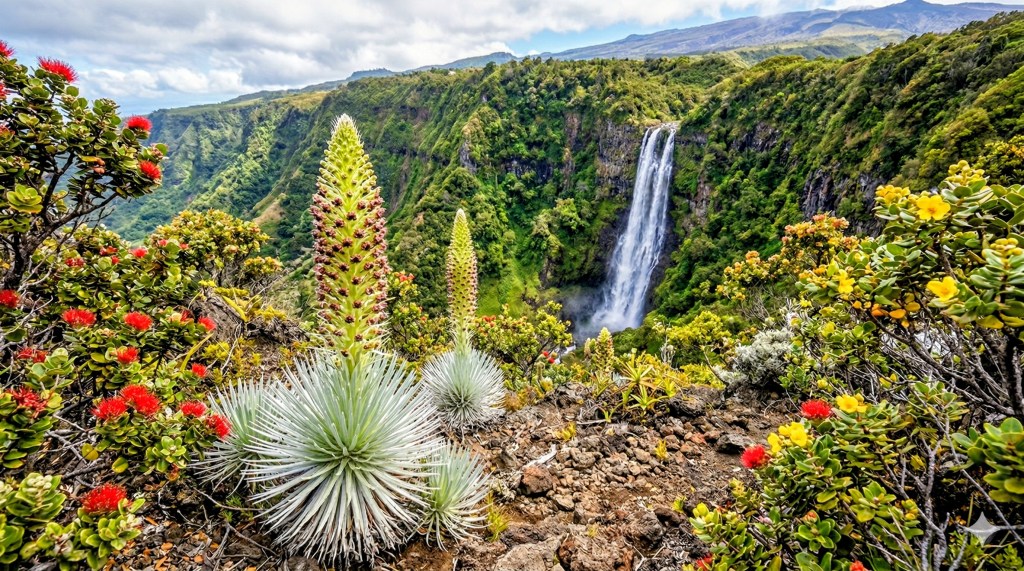
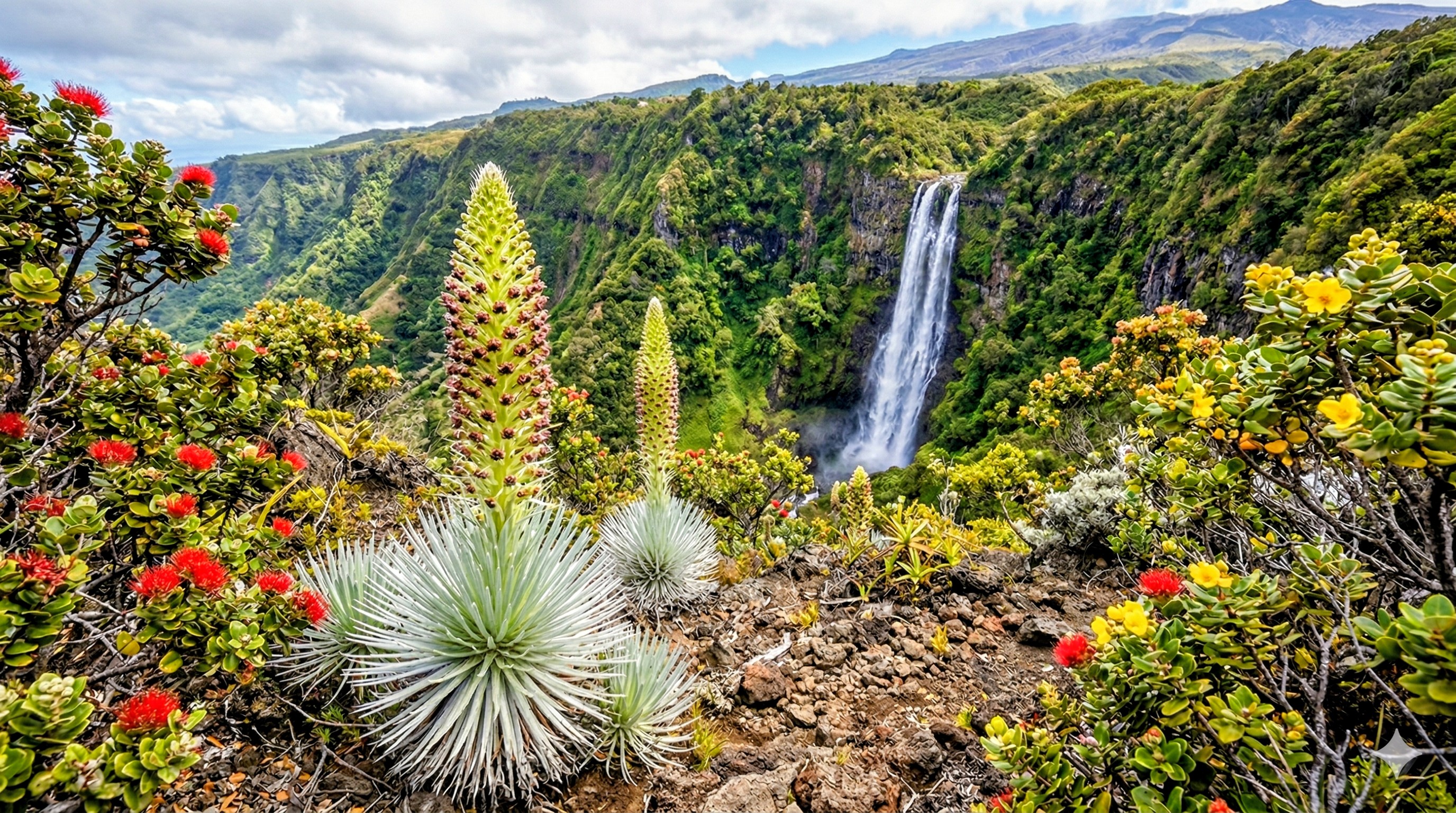
The Haleakalā silversword (Argyroxiphium sandwicense subsp. macrocephalum) — known in Hawaiian as ʻāhinahina, “very gray” — is the alliance’s most iconic member. It grows only on the cinder slopes of Haleakalā crater on Maui, above 2,100 meters. Wikipedia A monocarpic species, it lives for decades — sometimes up to 90 years — before sending up a single flower stalk as tall as two meters, bearing hundreds of maroon flowers, and dying. Its silvery trichomes break wind, prevent desiccation, and harvest moisture from passing clouds. National Parks Conservation Association It cannot self-pollinate; it depends on endemic Hawaiian yellow-faced bees. nps It is, in every sense of the term, a zawj karīm — a noble kind, singular and irreplaceable.
But Hawaii is also the “Endangered Species Capital of the World.” Over 100 native plant taxa have already gone extinct — roughly 10% of the native flora. More than 200 species survive with fewer than 50 individuals remaining. Some 366 Hawaiian plant taxa are federally listed as Endangered or Threatened, comprising 44% of all U.S. endangered plant species despite Hawaii representing less than 1% of the nation’s land mass. Department of Land and Natural Resources Invasive species, habitat loss, climate change, and wildfire (including the devastating 2023 Maui fires) have shattered ecosystems that evolved in the absence of continental pressures — no native land mammals except one bat species, no native ants, no native terrestrial reptiles. The silversword itself, which rebounded from ~4,000 individuals in the 1920s to over 90,000 by mid-century after protections, has declined again since the 1990s as climate change reduces the fog and drizzle days on which it depends. National Parks Conservation Associationnps The Mauna Kea silversword subspecies survives as roughly 40 naturally occurring individuals. Wikipedia
From the Hijaz to Haleakalā: the expanding horizon of kam
The verse’s rhetorical power lies partly in the word kam (كَمْ) — “how many.” It does not say “see the three kinds” or “see the hundred kinds.” It poses an open question. And the distance between the original audience’s answer and ours measures the verse’s escalating resonance.
A seventh-century inhabitant of the Hijaz — the western Arabian region where the Quran was revealed — would have personally known perhaps 100 to 200 plant species: date palms, acacias, tamarisks, Salvadora persica (the toothbrush tree), Calotropis procera, and cultivated crops such as olives, grapes, pomegranates, figs, barley, and wheat. The Quran itself names approximately 19 to 30 plant species. Scialert The entire Arabian Peninsula hosts between 3,500 and 4,000 species CmepPubMed Central — a respectable regional flora, concentrated in the southwestern mountains PubMed Central of Yemen and Dhofar, PubMed Central but representing less than 1% of global plant diversity. The Arabs had practical botanical knowledge — they knew, for instance, that date palms required the transfer of pollen from male to female trees — but no systematic taxonomy, no awareness of tropical rainforests where a single hectare may contain 300 tree species, no concept of the orchid family’s 28,000 variations on a theme.
For such an audience, the verse’s kam pointed to the familiar landscape and asked them to see it with fresh eyes — to notice that even the arid earth around them produced an impressive variety of species, each one karīm, each one noble and useful. The argument was local: look at what is already here.
For a modern reader — one who has walked through the systematic beds of Kew Gardens, or stood before a Haleakalā silversword blazing against volcanic cinder, or scrolled through the 350,000 entries of the World Checklist of Vascular Plants — the same kam detonates with entirely different force. “How many noble kinds have We caused to grow in it?” The answer is not hundreds but hundreds of thousands, with 36.5% so rare they have been seen fewer than five times, ScienceDaily with 2,000 more being discovered every year, Biodiversity Heritage Library with entire radiations — like the silversword alliance — spinning out from single seeds over millions of years into forms no human mind could have predicted. The verse’s question has not changed. The scale of its answer has expanded by three orders of magnitude.
This is what makes 26:7 philosophically distinctive among arguments from nature. Unlike a specific factual claim that can be confirmed or falsified, the verse issues a methodological imperative — look — paired with a quantitative question — how many? — that rewards every advance in knowledge. It is, in the language of contemporary philosophy, an open-ended invitation to thaumazein, the wonder that Aristotle called the beginning of philosophy. But where Aristotle’s wonder was primarily intellectual, the Quranic formulation is simultaneously empirical, aesthetic, and theological: look at the earth, count its noble kinds, and recognize in their abundance a sign (āyah) of creative power.
The Islamic tradition developed a rich vocabulary for this practice. Tafakkur (تَفَكُّر) — deliberate contemplation — is repeatedly commanded in the Quran and elevated in hadith literature: “One hour of contemplation is better than a thousand works of charity.” Al-IslamAl-Islam Ibn al-Qayyim described tafakkur as the faculty that “connects knowledge structures together.” The Quran deploys multiple cognitive verbs — tafakkur (contemplation), tadhakkur (remembrance), iʿtibār (drawing lessons), tadabbur (deliberation) Yaqeen Institute for Islamic Research — suggesting a layered epistemological process: one observes, reflects, connects, and finally arrives at recognition. The botanical verses constitute the input to this process; the theological conclusion — that such abundance implies a Creator — is its output. Crucially, the process is empirical at its foundation: it begins with looking.
This epistemological structure had historical consequences. The Quranic imperative to observe nature helped motivate the great tradition of Islamic natural philosophy. Al-Dīnawarī (815–896) produced the six-volume Kitāb al-Nabāt (Book of Plants), describing several thousand species. Wikipedia Ibn ʿAwwām (12th century) catalogued over 500 plants in his Kitāb al-Filāḥah. Al-Islam The Qurʾānic Botanic Garden in Qatar today documents 60 plant species mentioned in the Quran and prophetic traditions. Qbg Shahīna Ghazanfar’s Plants of the Qurʾān (Kew Publishing, 2023) represents the first comprehensive modern botanical study of Quranic flora, Kew Shop tracing Arabic plant names through Akkadian, Sumerian, Hebrew, and Aramaic texts to identify species precisely. Middle East Eye
Noble kinds, joyous growth, and the garden beyond
The Quran’s botanical vocabulary is not merely taxonomic but aesthetic and moral. The adjective karīm in zawj karīm connects plant diversity to a broader semantic field of nobility, generosity, and beauty. It is cognate with God’s own name al-Karīm (the Generous). The parallel adjective bahīj in 22:5 and 50:7 — rendered by Abdel Haleem as “joyous” — adds an affective dimension: plants do not merely exist; they rejoice, and they cause rejoicing. As one Islamic commentator writes of bahīj: “This one word means something which becomes extremely beautiful, bright and pleasing to the eye. It makes you smile.” Understand Al Quran Academy
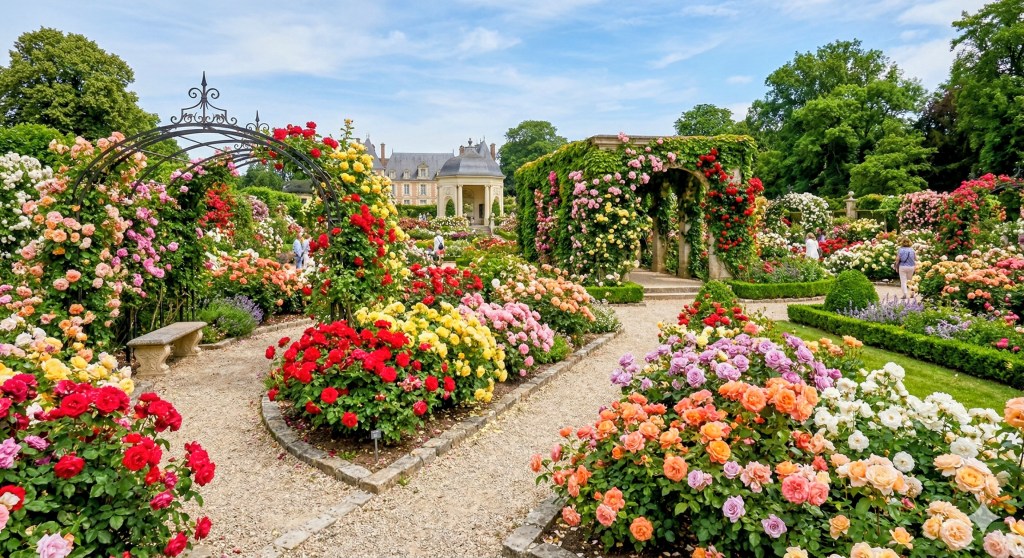
This aesthetic theology reaches its culmination in the Quranic concept of jannah (جَنَّة) — the word for paradise, which literally means “garden.” It appears 147 times in the Quran. Quran Gallery App The earthly botanical verses and the eschatological garden descriptions form a theological circuit: the diversity and beauty of earthly plants invite contemplation, contemplation leads to recognition of the Creator, and that recognition orients the believer toward paradise — which is itself described as the ultimate garden, with rivers of water, milk, honey, and wine flowing beneath shade trees that bear fruit without end. Wikipedia The earthly garden mirrors the heavenly one. Emma Clark, writing on the Islamic garden tradition, notes that “all Islamic gardens on earth are, to a certain extent, both a foretaste and a mirror of the Paradise gardens as described in the Qurʾān.” Aga Khan Centre The Persian word pairidaeza — from which English derives “paradise” — means, simply, an enclosed garden. Aga Khan Centre
Quran 36:36 stretches the concept further still, declaring that God created pairs “of things they do not know about” (mimmā lā yaʿlamūn). ThequranMy Islam This clause is remarkable for its epistemic humility — or rather, the epistemic humility it imposes on its audience. There exist noble kinds the reader has never seen and categories of pairing the reader has never imagined. Amplify Islam In the seventh century, this might have pointed to distant lands and unknown species. In the twenty-first century, it might point to Questions on Islam the 36.5% of plant species so rare they have scarcely been observed, UConn Today or to the estimated tens of thousands of species not yet described by science, or to the molecular mechanisms of plant reproduction that were not understood until Camerarius’s experiments in 1694 Patheos — more than a millennium after the verse was revealed. Thequran
Conclusion
Quran 26:7 operates at the intersection of the empirical and the numinous. It does not make a falsifiable scientific claim; it issues an imperative to observe and a question about magnitude. The classical mufassirūn understood this well: al-Ṭabarī saw divine omnipotence in the proliferation of contrasting kinds, Islam Question & Answer al-Qurṭubī catalogued the axes of variation (sweet and sour, large and small), Islam Question & Answer and Ibn Kathīr traced the principle of pairing through the entire cosmos. Islam Question & Answer What they could not have known — what gives the verse its peculiar twenty-first-century force — is the sheer scale of the answer. Nearly 400,000 known species. Two thousand new ones every year. An entire silversword alliance radiating from a single tarweed seed across five million years of volcanic islands. Oxford Academic Over a third of all species so rare they are barely known to exist. New York Botanical Garden
The verse’s genius is structural: by asking how many rather than stating a number, it transforms every botanical discovery into additional evidence for its own argument. The Haleakalā silversword — monocarpic, silver-haired, dependent on endemic bees, growing nowhere else in the universe National Parks Conservation Association — is a zawj karīm the verse’s first audience could never have conceived. And yet the verse anticipated it, not by naming it, but by posing the question that would eventually lead a contemplative observer to stand before it on a volcanic crater and wonder.


 The Glorious Quran and Science
Leave a comment