
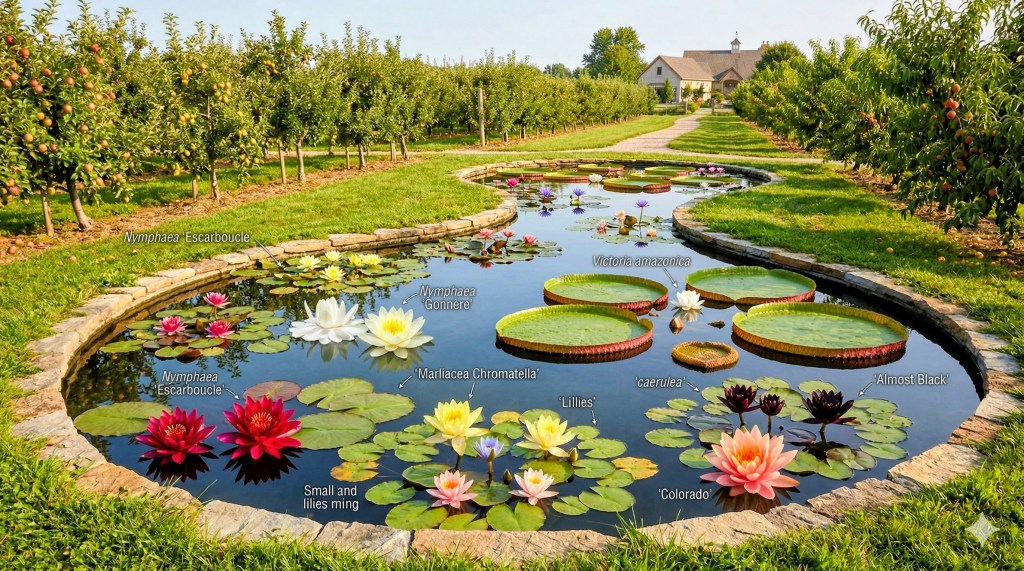
Signs in the soil: Quranic botany, divine pairs, and the problem of human heedlessness
Presented by Zia H Shah with the help of Claude
The Quran’s botanical verses — spanning Surahs Ash-Shu’ara, Al-An’am, Ya-Sin, Taha, Qaf, Ar-Ra’d, and An-Nahl — form a unified theological argument: the diversity and sexual pairing of plant life constitutes an unmistakable sign (āyah) of divine creative power, yet most people pass through life heedless of it. This report compiles the exact Arabic text and M.A.S. Abdel Haleem translations (Oxford University Press) for each requested verse, then examines classical exegesis, botanical science, and the philosophical dimensions of these passages.
The opening of Surah Ash-Shu’ara: Quran 26:1–9
The nine opening verses of Surah 26 establish the surah’s central tension — revelation is clear, signs are everywhere, yet disbelief persists. Below is each verse with its Arabic text and the Abdel Haleem rendering, cross-verified across multiple sources including islamawakened.com and myislam.org.
26:1 Arabic: طسم Abdel Haleem: Ta Sin Mim
26:2 Arabic: تِلْكَ آيَاتُ الْكِتَابِ الْمُبِينِ Abdel Haleem: These are the verses of the Scripture that makes things clear: My Islam
26:3 Arabic: لَعَلَّكَ بَاخِعٌ نَّفْسَكَ أَلَّا يَكُونُوا مُؤْمِنِينَ Abdel Haleem: [Prophet], are you going to worry yourself to death because they will not believe? My Islam
26:4 Arabic: إِن نَّشَأْ نُنَزِّلْ عَلَيْهِم مِّنَ السَّمَاءِ آيَةً فَظَلَّتْ أَعْنَاقُهُمْ لَهَا خَاضِعِينَ Abdel Haleem: If We had wished, We could have sent them down a sign from heaven, at which their necks would stay bowed in utter humility. My Islam
26:5 Arabic: وَمَا يَأْتِيهِم مِّن ذِكْرٍ مِّنَ الرَّحْمَٰنِ مُحْدَثٍ إِلَّا كَانُوا عَنْهُ مُعْرِضِينَ Abdel Haleem: Whenever they are brought a new revelation from the Lord of Mercy, they turn away: My Islam
26:6 Arabic: فَقَدْ كَذَّبُوا فَسَيَأْتِيهِمْ أَنبَاءُ مَا كَانُوا بِهِ يَسْتَهْزِئُونَ Abdel Haleem: they deny it, but the truth of what they scorned will soon hit them. My Islam
26:7 Arabic: أَوَلَمْ يَرَوْا إِلَى الْأَرْضِ كَمْ أَنبَتْنَا فِيهَا مِن كُلِّ زَوْجٍ كَرِيمٍ Abdel Haleem: Do they not see the earth, and what noble kinds of thing We grow in it? Islam Awakened
26:8 Arabic: إِنَّ فِي ذَٰلِكَ لَآيَةً ۖ وَمَا كَانَ أَكْثَرُهُم مُّؤْمِنِينَ Abdel Haleem: There truly is a sign in this, though most of them do not believe: My Islam
26:9 Arabic: وَإِنَّ رَبَّكَ لَهُوَ الْعَزِيزُ الرَّحِيمُ Abdel Haleem: your Lord alone is the Almighty, the Merciful. My Islam
Note that Abdel Haleem’s translation is distinctive for its modern, flowing English prose, Virtual Mosque use of “Scripture” rather than “Book” for al-Kitāb, “Lord of Mercy” for al-Raḥmān, and bracketed contextual insertions like “[Prophet].” His rendering of the pivotal 26:7 — “what noble kinds of thing We grow in it” Islam Awakened — translates zawj karīm as “noble kinds,” capturing both the botanical diversity and the dignity implied by karīm.
Botanical signs across the Quran: the remaining verses
Quran 6:95 — God splits the seed
Arabic: إِنَّ ٱللَّهَ فَالِقُ ٱلْحَبِّ وَٱلنَّوَىٰ ۖ يُخْرِجُ ٱلْحَىَّ مِنَ ٱلْمَيِّتِ وَمُخْرِجُ ٱلْمَيِّتِ مِنَ ٱلْحَىِّ ۚ ذَٰلِكُمُ ٱللَّهُ ۖ فَأَنَّىٰ تُؤْفَكُونَ
Abdel Haleem: It is God who splits open the seed and the fruit stone: He brings out the living from the dead and the dead from the living — that is God — so how can you turn away from the truth? IslamAwakened
Quran 6:99 — From rain to clustered grain
Arabic: وَهُوَ ٱلَّذِىٓ أَنزَلَ مِنَ ٱلسَّمَآءِ مَآءً فَأَخْرَجْنَا بِهِۦ نَبَاتَ كُلِّ شَىْءٍ فَأَخْرَجْنَا مِنْهُ خَضِرًا نُّخْرِجُ مِنْهُ حَبًّا مُّتَرَاكِبًا وَمِنَ ٱلنَّخْلِ مِن طَلْعِهَا قِنْوَانٌ دَانِيَةٌ وَجَنَّـٰتٍ مِّنْ أَعْنَـٰبٍ وَٱلزَّيْتُونَ وَٱلرُّمَّانَ مُشْتَبِهًا وَغَيْرَ مُتَشَـٰبِهٍ ۗ ٱنظُرُوٓا۟ إِلَىٰ ثَمَرِهِۦٓ إِذَآ أَثْمَرَ وَيَنْعِهِۦٓ ۚ إِنَّ فِى ذَٰلِكُمْ لَـَٔايَـٰتٍ لِّقَوْمٍ يُؤْمِنُونَ
Abdel Haleem: It is He who sends down water from the sky. With it We produce the shoots of each plant, then bring greenery from it, and from that We bring out grains, one riding on the other in close-packed rows. From the date palm come clusters of low-hanging dates, and there are gardens of vines, olives, and pomegranates, alike yet different. Watch their fruits as they grow and ripen! In all this there are signs for those who would believe. My Islam
Quran 13:4 — Same water, different fruits
Arabic: وَفِى ٱلْأَرْضِ قِطَعٌ مُّتَجَـٰوِرَٰتٌ وَجَنَّـٰتٌ مِّنْ أَعْنَـٰبٍ وَزَرْعٌ وَنَخِيلٌ صِنْوَانٌ وَغَيْرُ صِنْوَانٍ يُسْقَىٰ بِمَآءٍ وَٰحِدٍ وَنُفَضِّلُ بَعْضَهَا عَلَىٰ بَعْضٍ فِى ٱلْأُكُلِ ۚ إِنَّ فِى ذَٰلِكَ لَـَٔايَـٰتٍ لِّقَوْمٍ يَعْقِلُونَ
Abdel Haleem: There are, in the land, neighbouring plots, gardens of vineyards, cornfields, palm trees in clusters or otherwise, all watered with the same water, yet We make some of them taste better than others: there truly are signs in this for people who reason. My Islam
Quran 16:11 — Crops, olives, palms, and vines
Arabic: يُنۢبِتُ لَكُم بِهِ ٱلزَّرْعَ وَٱلزَّيْتُونَ وَٱلنَّخِيلَ وَٱلْأَعْنَـٰبَ وَمِن كُلِّ ٱلثَّمَرَٰتِ ۗ إِنَّ فِى ذَٰلِكَ لَـَٔايَةً لِّقَوْمٍ يَتَفَكَّرُونَ
Abdel Haleem: With it He grows for you grain, olives, palms, vines, and all kinds of other crops. There truly is a sign in this for those who reflect. Islam Awakened
Quran 20:53 — The earth spread out for every kind of plant
Arabic: ٱلَّذِى جَعَلَ لَكُمُ ٱلْأَرْضَ مَهْدًا وَسَلَكَ لَكُمْ فِيهَا سُبُلًا وَأَنزَلَ مِنَ ٱلسَّمَآءِ مَآءً فَأَخْرَجْنَا بِهِۦٓ أَزْوَٰجًا مِّن نَّبَاتٍ شَتَّىٰ
Abdel Haleem: It was He who spread out the earth for you and traced routes in it. He sent down water from the sky. With that water We bring forth every kind of plant, My Islam
Quran 36:33–36 — From dead earth to the praise of the Creator of all pairs
36:33 — Arabic: وَءَايَةٌ لَّهُمُ ٱلْأَرْضُ ٱلْمَيْتَةُ أَحْيَيْنَـٰهَا وَأَخْرَجْنَا مِنْهَا حَبًّا فَمِنْهُ يَأْكُلُونَ Abdel Haleem: There is a sign for them in the lifeless earth: We give it life and We produce grain from it for them to eat; Islam AwakenedMy Islam
36:34 — Arabic: وَجَعَلْنَا فِيهَا جَنَّـٰتٍ مِّن نَّخِيلٍ وَأَعْنَـٰبٍ وَفَجَّرْنَا فِيهَا مِنَ ٱلْعُيُونِ Abdel Haleem: We have put gardens of date palms and grapes in the earth, and We have made springs of water gush out of it My Islam
36:35 — Arabic: لِيَأْكُلُوا۟ مِن ثَمَرِهِۦ وَمَا عَمِلَتْهُ أَيْدِيهِمْ ۖ أَفَلَا يَشْكُرُونَ Abdel Haleem: so that they could eat its fruit. It was not their own hands that made all this. How can they not give thanks? Islam Awakenedqurano
36:36 — Arabic: سُبْحَـٰنَ ٱلَّذِى خَلَقَ ٱلْأَزْوَٰجَ كُلَّهَا مِمَّا تُنۢبِتُ ٱلْأَرْضُ وَمِنْ أَنفُسِهِمْ وَمِمَّا لَا يَعْلَمُونَ Abdel Haleem: Glory be to Him who created all the pairs of things that the earth produces, as well as themselves and other things they do not know about. Islam AwakenedMy Islam
Quran 50:7 — Every joyous pair
Arabic: وَٱلْأَرْضَ مَدَدْنَـٰهَا وَأَلْقَيْنَا فِيهَا رَوَٰسِىَ وَأَنۢبَتْنَا فِيهَا مِن كُلِّ زَوْجٍۭ بَهِيجٍ Abdel Haleem: how We spread out the earth and put solid mountains on it, and caused every kind of joyous plant to grow in it, My Islam
What classical exegetes said about “every noble pair” in 26:7–8
The phrase مِن كُلِّ زَوْجٍ كَرِيمٍ (min kulli zawjin karīm — “every noble pair/kind”) in verse 26:7 has generated rich exegetical discussion, particularly around the Arabic word zawj.
Ibn Kathir interprets zawj broadly as denoting types and kinds of vegetation. In his commentary on the near-identical phrase in 50:7 (zawjin bahīj), he writes: “That is, of all crops, fruits, plants and types.” Surah Quranislamqa On the more universal statement in 51:49 (“of everything We have created pairs”), Ibn Kathir expands the principle beyond botany: “All things are created in pairs — heaven and earth, night and day, sun and moon, land and sea, light and darkness, faith and disbelief, death and life, misery and happiness, Paradise and Hell, and even animate beings… and plants.” For Ibn Kathir, the botanical pairing participates in a cosmic principle of duality that points toward the oneness of the Creator.
Al-Qurtubi offers a complementary reading. On the word zawjayn (“two pairs”) in related verses, he reports: “Abu ‘Ubaydah said the word zawj may refer to one or two. What is meant by zawjayn is two types, such as sweet and sour, fresh and dry, white and black, small and large.” islamqa Al-Qurtubi also records the view of Mujahid (a prominent student of Ibn ‘Abbas) that pairs encompass “male and female, heaven and earth, sun and moon, night and day, light and darkness, plains and mountains, jinn and humans, good and evil” Islam Question & Answer — a list that extends the pairing concept well beyond sexuality into all forms of complementary duality. Al-Qurtubi emphasizes the apologetic function: plant diversity demonstrates divine power and foreshadows resurrection.
Fakhr al-Din al-Razi, known for his encyclopedic rational-theological approach in Mafātīḥ al-Ghayb, reportedly catalogued approximately twenty different opinions on related exegetical questions. IPFSWikiIslam His general method highlights botanical arguments as rational proofs (dalā’il) for God’s existence and wisdom. Al-Razi stresses how the absence of inconsistency in the cosmos — including the ordered diversity of plant life — manifests underlying design. Amazon
The word karīm (“noble” or “generous”) applied to plants carries layered meaning. Al-Sa’di interprets it as “every kind of plant that is pleasant to the eye and brings delight and joy to the observer, as food for the sons of Adam and their livestock.” islamqa The Ma’ārif al-Qur’ān defines it as “a nice and favourite thing.” Quran.com The Tafsīr-e Namūneh extends this to “useful or beneficial — plants that are pleasant and add beauty to the world as well as plants that have nutritional and medicinal value.” The Academy for Learning Islam The word karīm thus implies beauty, usefulness, generosity in producing sustenance, and nobility — all reflecting divine beneficence.
A crucial linguistic note: the Academy for Learning Islam observes that the preposition إِلَى (ilā, “toward”) in “Do they not look toward the earth” signals more than physical seeing. Had the verse meant mere visual perception, no preposition would be required. The use of ilā indicates contemplative observation (tafakkur) — sight accompanied by thought. The Academy for Learning Islam
Botanical science and the Quran’s anticipation of plant sexuality
The Quranic insistence that plants grow in “pairs” (azwāj) is remarkable given the timeline of Western scientific discovery. Rudolph Jacob Camerarius (1665–1721), a German botanist at the University of Tübingen, was the first to experimentally prove plant sexual reproduction in his 1694 work De sexu plantarum epistola. Oxford ReferenceEncyclopedia.com By surgically removing parts of castor oil plants, maize, spinach, and dog’s mercury, he demonstrated that pollen from stamens (male organs) is indispensable for producing viable seeds. Sharpgiving This was roughly a thousand years after the Quran’s revelation (610–632 CE).
Modern botany classifies plant reproductive strategies into several categories. Dioecious species — where male and female organs exist on entirely separate individual plants — include date palms (Phoenix dactylifera), willows, ginkgo trees, kiwi fruit, hemp, and spinach. Iqra Quran Monoecious species carry both male and female flowers on the same plant, as in corn, squashes, and birches. Most flowering plants (~70%) are hermaphroditic, with both stamens and pistils in the same flower. Approximately 5% of flowering plants are dioecious and about 7% are monoecious with separate unisexual flowers. Answering Islam
The semantic question is whether zawj in these verses means strictly “sexual pair” or more broadly “kind/type.” Classical exegetes favored the broader meaning, but some — including Ibn ‘Atiyyah — acknowledged both: “Zawj in this verse refers to type or kind… It may be said that of every fruit there is male and female.” islamqa Muhammad Asad’s commentary is more pointed: he notes that whenever the dual form zawjān is followed by the additional numerical ithnān (“two”), it invariably signifies “a pair comprising both sexes.” IslamiCity He gives examples: male and female organs coexisting in one flower (cotton), placed in separate flowers on the same plant (cucurbitaceae), or in entirely separate unisexual plants (date palms).
The pre-Islamic world did possess limited practical knowledge of date palm pollination — Assyrian reliefs from ~1500 BCE depict figures holding male inflorescences over female ones. Springer But this was craft knowledge about a single species, not a generalized understanding of plant sexuality as a universal principle. The Quranic verses, by contrast, speak universally: “all the pairs of things that the earth produces” Islam Awakened (36:36), “every kind of joyous plant” (50:7), “every noble kind” (26:7). Islam Awakened Whether one reads zawj as “sexual pair” or “complementary type,” the scope is strikingly comprehensive. The Academy for Learning Islam
Ghafla and the paradox of ignored signs
The rhetorical architecture of 26:1–9 builds toward a devastating conclusion: signs are everywhere, yet “most of them do not believe” (26:8). This is the Quranic diagnosis of ghafla (غفلة) — heedlessness, the spiritual condition of being surrounded by evidence and failing to perceive it.
The concept appears repeatedly in the Quran. 7:179 delivers its harshest expression: “They have hearts with which they do not understand, eyes with which they do not see, ears with which they do not hear. They are like cattle, nay even more astray. It is they who are the heedless ones (ghāfilūn).” 50:22 addresses the soul on Judgment Day: “You were heedless of this; now We have removed your covering, and sharp is your sight this Day.”
Classical and modern scholars have analyzed ghafla from multiple angles. Al-Ghazali categorized it as a primary sickness of the soul, stemming from excessive attachment to the world (Iḥyā’ ‘Ulūm al-Dīn). Ibn al-Qayyim distinguished ghafla from simple forgetfulness (nisyān): heedlessness is a choice, and therefore one is morally accountable for it. Allama Tabataba’i (in Tafsīr al-Mīzān) clarifies that one can only be told “you were heedless of this” if the thing in question is right before them — ghafla is not ignorance of the absent but blindness to the present. Al-Islam.org
Abdel Hakim Murad offers a contemporary philosophical reading: the world “also obscures God” because “we are marinated from birth in the world through our sense perceptions, and distracted by the sheer brilliance of it — of the signs in it, but not aware of their origin.” The mental error is presuming the material world is self-explanatory; the spiritual error is the atrophy of inward perception. WordPress The Quran’s response is to deploy the very phenomena of daily experience — rain, grain, fruit, the splitting of seeds — as arguments, precisely because their ordinariness should make the divine origin more obvious, not less. Islamic Studies
Maududi’s commentary on 26:7 crystallizes this: “The seeker after truth does not have to look far for a sign. If only he sees with open eyes the phenomena of vegetation around him, he will be able to judge whether the reality about the system of the world presented by the Prophets is true.” My Islam The harmony between earth, sun, air, water, and the needs of living beings is, in this view, evidence enough. Islamicstudies.info God deliberately withholds coercive miracles (26:4) because belief under compulsion is not what is sought Quranopedia — what is sought is voluntary recognition through reflection. honey for the heartIslamic Studies
Āyāt: when verses and signs are the same word
The Arabic word āyah (آية, plural āyāt) performs extraordinary double duty: it means both “sign” and “verse.” Quora Every verse of the Quran is a sign; every natural phenomenon is a verse in the cosmic book of creation. This is not accidental polysemy — it is, in the Islamic intellectual tradition, a deliberate reflection of the structure of reality.
Seyyed Hossein Nasr articulates this most forcefully: “Viewed as a text, Nature is a fabric of symbols, which must be read according to their meaning. The Quran is the counterpart of that text in human words; its verses are called āyāt (‘signs’), just as are the phenomena of Nature.” Islam-science Nasr warns that if the tradition of symbolic interpretation were to disappear, “the ‘cosmic text’ would become unintelligible. The phenomena of Nature would lose any connection with the higher orders of reality… they would become mere ‘facts.’” Islam-science The 13th-century Sufi ‘Azīz al-Dīn Nasafī formalized this as a distinction between the Qur’ān-e tadwīnī (the written scripture) and the Qur’ān-e takwīnī (the Quran of creation): “Each day destiny and the passage of time set this book [Nature] before you, chapter by chapter, verse by verse, letter by letter.” Resurgence
Toshihiko Izutsu, in his pioneering semantic analysis God and Man in the Qur’ān, demonstrates how the Quran transformed pre-Islamic Arabic vocabulary by charging existing words with new religious depth. ResearchGate The word āyah in pre-Quranic Arabic simply meant “sign” or “mark.” The Quran elevated it into a term simultaneously denoting scripture, miracle, proof, and natural phenomenon Quora — creating what Izutsu calls a new Weltanschauung (worldview) embedded in language itself.
Quran 41:53 is often cited as the definitive formulation: “We shall show them Our signs (āyāt) on the horizons and within themselves until it becomes clear to them that this is the Truth.” Thequran The three domains of signs — scripture, cosmos, and self — form a triangle of revelation. Resurgence The botanical verses compiled in this report operate squarely in the cosmic domain, using the observable fact of plant growth, diversity, and pairing to argue that the natural order testifies to its own Author.
What “Ṭā Sīn Mīm” might mean
The three letters طسم (Ṭā Sīn Mīm) opening Surah 26 belong to the ḥurūf muqaṭṭa’āt — the “disconnected letters” that begin 29 of the Quran’s 114 surahs. Wikipedia Ṭā Sīn Mīm specifically opens two surahs (26 and 28), Amazon while the related Ṭā Sīn (without Mīm) opens Surah 27, SeekersGuidanceWikiIslam creating a thematic cluster across three consecutive chapters.
Classical scholars offered at least six major interpretations. The view attributed to the four Rightly Guided Caliphs and Ibn Mas’ud holds that these letters are a divine mystery — their knowledge is reserved for God alone. My Islam Ibn Kathir endorses this humility but also strongly supports what became the dominant scholarly position: the letters serve as a testimony to the Quran’s miraculous nature (i’jāz). The logic is elegant — the Quran is composed of the same Arabic letters that all humans use daily, yet no one can produce anything like it, proving its divine authorship. SeekersGuidance This interpretation was endorsed by al-Qurtubi, al-Razi, al-Zamakhshari, and Ibn Taymiyyah. My Islam
Other views include that the letters are names for the surahs they introduce (supported by a hadith in which the Prophet referred to a surah by its opening letters); SeekersGuidance that they are abbreviations for divine attributes (Ibn ‘Abbas reportedly linked individual letters to names like al-Laṭīf, al-Samī’, al-Majīd); IPFSWikiIslam and that they functioned as attention-getters in an oral culture where opponents tried to drown out Quranic recitation. Quora Al-Tabari records the simpler view that they are just letters of the Arabic alphabet, cited in part as one might recite “A, B, C…” to invoke the whole. Alim
What is striking is the pattern: in all but three of the 29 cases, the disconnected letters are immediately followed by mention of the Quranic revelation itself. Wikipedia Surah 26 follows this pattern exactly — Ṭā Sīn Mīm (26:1) is followed immediately by “These are the verses of the Scripture that makes things clear” (26:2) Islamic StudiesMy Islam — binding the mysterious letters to the theme of clarifying revelation.
Conclusion
These verses and their scholarly traditions converge on a single architectonic idea: creation is legible. The Quran treats the natural world not as inert matter but as a text composed of signs (āyāt) — the same word it uses for its own verses. IslamiCity The botanical details are precise and varied: God splits seeds (6:95), IslamAwakened sends rain to produce layered grain and clustered dates (6:99), Quranic Arabic Corpus grows olives and palms and vines (16:11), Islam Awakened spreads neighboring plots watered by the same water yet yielding different fruits (13:4), Quran.com revives dead earth (36:33), My Islam and causes “every noble kind” to grow (26:7). The word zawj (“pair/kind”) anticipates what Western botany did not confirm until Camerarius’s experiments in 1694 Oxford Reference — that plants possess sexual characteristics — though classical exegetes primarily read it as denoting diversity of types rather than strictly sexual pairing. Quran.comThequran
The theological engine driving all these passages is the contrast between sign and heedlessness. The disconnected letters Ṭā Sīn Mīm open Surah 26 with mystery; the first verses establish that the Scripture is clear; My Islam then comes the pivotal turn at 26:7 — look at the earth, see what grows — followed by the lament of 26:8 that most people simply do not believe. Islamic Studies In the Islamic philosophical tradition, this is not God’s failure to communicate but humanity’s failure to read. The cure the Quran prescribes is tafakkur — the contemplative gaze that sees through phenomena to their origin. As Nasr puts it, without that gaze, the phenomena of nature become “mere facts,” Islam-science and the cosmic Quran falls silent.




 The Glorious Quran and Science
Leave a comment