
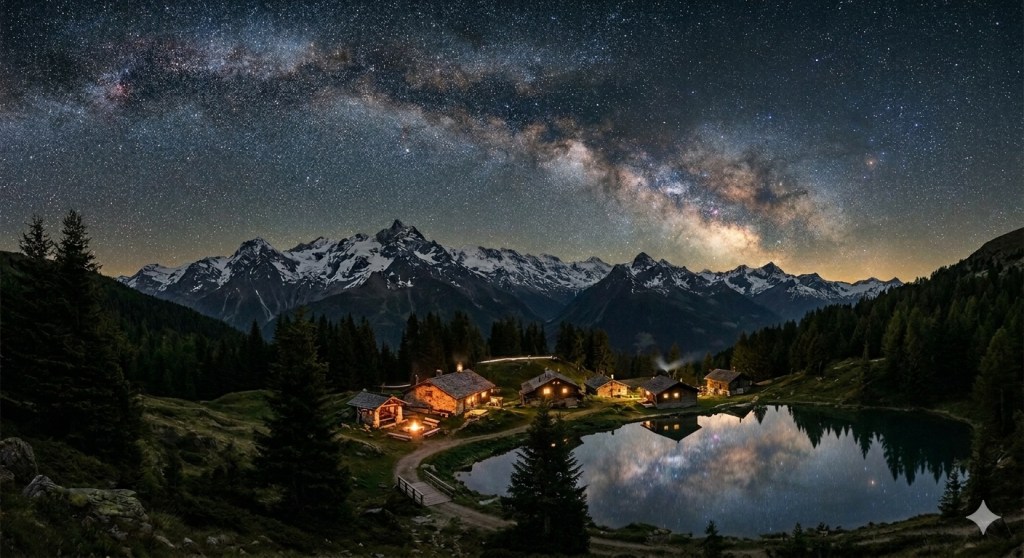
The Night God Made: A Scientific, Philosophical, and Theological Commentary on Quran 6:96 and Its Supporting Verses
Presented by Zia H Shah MD
Abstract
The Quran repeatedly asserts that God created the night — not as a mere absence of sunlight, but as a deliberate, purposeful act of divine making. This commentary examines Quran 6:96 (fāliqu al-iṣbāḥ wa ja’ala al-layla sakanan) alongside eight supporting verses that either explicitly attribute the creation of night to God (21:33, 25:47, 17:12, 40:61) or describe the alternation and merging of night and day as cosmic signs of divine sovereignty (39:5, 36:37, 28:71, 35:13). The central thesis is this: the ordinary intuition that night is simply what happens when the sun goes down — a passive default, a mere privation — is challenged both by the Quran’s insistent use of active creation verbs (ja’ala, khalaqa) and, remarkably, by modern cosmology. Olbers’ Paradox demonstrates that in a static, infinite universe, the sky should blaze with light in every direction; the fact that the night sky is dark is a positive cosmological datum, Encyclopedia Britannica a consequence of the universe’s finite age, its accelerating expansion, and the redshift of ancient light. WikipediaThequran Night, it turns out, is not nothing — it is a signature of the cosmos’s deepest architecture. This commentary weaves three strands of analysis: a scientific investigation drawing on Olbers’ Paradox, the cosmic Dark Ages, and dark energy; a philosophical examination of darkness as ontologically significant rather than mere privation; and a theological exploration grounded in classical tafsīr (Quranic exegesis) from scholars including al-Ṭabarī, al-Rāzī, Ibn Kathīr, and al-Qurṭubī. Together, these perspectives converge on a single, striking conclusion: the dark night sky is not emptiness but eloquence — a created sign (āyah) encoding both cosmic history and divine intent.
I. The primary verse: Quran 6:96
فَالِقُ الْإِصْبَاحِ وَجَعَلَ اللَّيْلَ سَكَنًا وَالشَّمْسَ وَالْقَمَرَ حُسْبَانًا ۚ ذَٰلِكَ تَقْدِيرُ الْعَزِيزِ الْعَلِيمِ
“He makes the dawn break; He makes the night for rest; and He made the sun and the moon to a precise measure. That is the design of the Almighty, the All Knowing.” — M.A.S. Abdel Haleem
This verse stands at the heart of the Quran’s cosmological theology. Three acts of divine agency unfold in a single breath: the cleaving of dawn, the fashioning of night as rest, and the calibration of the sun and moon to an exact reckoning (ḥusbānan). My Islam The verb ja’ala — “He made” — is not incidental. Classical Arabic distinguishes ja’ala (to establish or assign a function) from khalaqa (to bring into existence from nothing). When the Quran says God made the night sakanan — a place of stillness, peace, and rest — it does not describe a passive phenomenon. It describes a purposeful act of design. Quran.com
The word sakanan (سكنًا) derives from the root s-k-n, which carries meanings of dwelling, tranquility, and repose. The same root gives us maskan (home) Quran.com and sakīnah (divine tranquility). The Ma’arif al-Qur’an commentary develops this extensively: night is “a time of peace and comfort for every living being,” quran and the fact that all creatures on Earth are compelled to rest simultaneously at nightfall demonstrates “the irresistibly subjugating power of Allah.” quran No international agreement, the tafsīr notes with vivid rhetoric, could achieve what night achieves — the universal synchronization of rest across all living things. quran
The verse concludes with a phrase of supreme theological weight: dhālika taqdīru al-‘azīzi al-‘alīm — “That is the design of the Almighty, the All-Knowing.” The word taqdīr (تقدير), from the root q-d-r meaning to measure and determine, elevates the night-day cycle from a natural phenomenon to a precise divine decree. quran Night is not what happens in the absence of a plan; night is the plan.
II. Verses affirming the creation and making of night
Quran 21:33 — Night and day as co-equal creations
وَهُوَ الَّذِي خَلَقَ اللَّيْلَ وَالنَّهَارَ وَالشَّمْسَ وَالْقَمَرَ ۖ كُلٌّ فِي فَلَكٍ يَسْبَحُونَ
“It is He who created night and day, the sun and the moon, each floating in its orbit.” — M.A.S. Abdel Haleem
This is arguably the most explicit verse in the Quran on the ontological status of night. The verb used here is khalaqa (خلق) — creation ex nihilo, the strongest possible claim of origination. Quran.com Night is listed alongside the sun and the moon as something created, not as a mere shadow cast by the sun’s departure. The four items — night, day, sun, moon — stand in grammatical parallel, each equally a product of divine creative power. The closing image of celestial bodies “floating” (yasbaḥūn) in orbits further embeds night within a dynamic, designed cosmic system rather than treating it as an inert backdrop. Surah QuranIslamic Studies
Ibn Kathīr connects this verse directly to 6:96, treating both as part of a unified Quranic cosmological theology: “Allah often mentions the creation of the night, the day, the sun and the moon and then ends His Speech by mentioning His attributes of power and knowledge.” Quranopedia The theological implication is clear: the alternation of light and darkness belongs to the same category of deliberate creation as the existence of celestial bodies themselves.
Quran 25:47 — Night as a garment
وَهُوَ الَّذِي جَعَلَ لَكُمُ اللَّيْلَ لِبَاسًا وَالنَّوْمَ سُبَاتًا وَجَعَلَ النَّهَارَ نُشُورًا
“It is He who made the night a garment for you, and sleep a rest, and made the day like a resurrection.” Islam Awakened — M.A.S. Abdel Haleem
The metaphor of night as libās (لباس) — a garment, a covering — is among the Quran’s most beautiful. A garment is not an absence; it is a crafted thing, woven and fitted to the body. Night wraps the world the way clothing wraps the person: protecting, concealing, comforting. Quran.com The triple progression — night as garment, sleep as cessation of toil, day as resurrection — recapitulates the cycle of death and rebirth in miniature, making every dusk a small death and every dawn a rehearsal for the afterlife.
Al-Jalālayn glosses the verse: “He made for you the night as a garment, veiling you like a garment, and sleep for repose, rest for bodies through the temporary cessation of labour.” Quran O The Shi’a commentator Makārem Shīrāzī adds that night “falls over the world like a piece of clothing that keeps away light and energy so that all of creation can relax and recuperate.” The Academy for Learning Islam The verb ja’ala appears twice in this verse, each time ascribing active, purposeful making to God. Night is not the universe’s default; it is something God fashioned for you — lakum — with human benefit as the explicit aim.
Quran 17:12 — Night and day as two signs
وَجَعَلْنَا اللَّيْلَ وَالنَّهَارَ آيَتَيْنِ ۖ فَمَحَوْنَا آيَةَ اللَّيْلِ وَجَعَلْنَا آيَةَ النَّهَارِ مُبْصِرَةً لِتَبْتَغُوا فَضْلًا مِّن رَّبِّكُمْ وَلِتَعْلَمُوا عَدَدَ السِّنِينَ وَالْحِسَابَ ۚ وَكُلَّ شَيْءٍ فَصَّلْنَاهُ تَفْصِيلًا
“We made the night and the day as two signs, then darkened the night and made the daylight for seeing, for you to seek your Lord’s bounty and to know how to count the years and calculate. We have explained everything in detail.” IslamAwakened — M.A.S. Abdel Haleem
This verse introduces a remarkable concept: night and day are both āyatayn (آيتين) — two signs. Night is not merely the canvas on which the sign of day is displayed; night itself is a sign. The phrase fa-maḥawnā āyata al-layl — “We darkened the sign of the night” — has generated rich exegetical discussion. Mujāhid, as recorded by Ibn Kathīr, interprets the “darkening” as a reference to the moon’s dark patches, which distinguish it from the blazing sun. Quranglobal But the verse’s deeper logic is that God first establishes night and day as twin signs, then differentiates their characters: night is darkened (for rest and reflection), day is illuminated (for commerce and calculation). Both are purposefully designed, and both communicate divine intent.
The closing declaration — wa kulla shay’in faṣṣalnāhu tafṣīlā — “We have explained everything in detail” — suggests that the very contrast between night and day is a form of divine exposition, an articulation of meaning through the alternation of opposites.
Quran 40:61 — Night as divine grace
اللَّهُ الَّذِي جَعَلَ لَكُمُ اللَّيْلَ لِتَسْكُنُوا فِيهِ وَالنَّهَارَ مُبْصِرًا ۚ إِنَّ اللَّهَ لَذُو فَضْلٍ عَلَى النَّاسِ وَلَٰكِنَّ أَكْثَرَ النَّاسِ لَا يَشْكُرُونَ
“It is God who has given you the night in which to rest and the day in which to see. God is truly bountiful to people, but most people do not give thanks.” My Islam — M.A.S. Abdel Haleem
Here, night is characterized as an expression of faḍl (فضل) — divine grace, bounty, generosity. The construction ja’ala lakum (“made for you”) recurs, reinforcing the Quran’s consistent framing of night as a benefaction rather than a deficit. The verse closes with a poignant reproach: wa lākinna akthara al-nāsi lā yashkurūn — “but most people do not give thanks.” Clear Quran The implication is that the very ordinariness of night blinds people to its nature as a gift. We take the darkness for granted precisely because it arrives so faithfully — and in so doing, we miss its character as a sign of divine care.
III. Verses on the alternation and merging of night and day
Quran 39:5 — Night wrapping around day
خَلَقَ السَّمَاوَاتِ وَالْأَرْضَ بِالْحَقِّ ۖ يُكَوِّرُ اللَّيْلَ عَلَى النَّهَارِ وَيُكَوِّرُ النَّهَارَ عَلَى اللَّيْلِ ۖ وَسَخَّرَ الشَّمْسَ وَالْقَمَرَ ۖ كُلٌّ يَجْرِي لِأَجَلٍ مُّسَمًّى ۗ أَلَا هُوَ الْعَزِيزُ الْغَفَّارُ
“He created the heavens and earth for a true purpose; He wraps the night around the day and the day around the night; He has subjected the sun and moon to run their courses for an appointed time; He is truly the Mighty, the Forgiving.” My Islam — M.A.S. Abdel Haleem
The verb yukawwiru (يكوِّر), from the root k-w-r meaning to coil or wind, evokes the image of a turban being wound around the head. Night is wound around day, and day wound around night — a mutual, reciprocal action suggesting that neither is subordinate to the other. Both are active participants in a cosmic choreography. Many modern commentators have noted that this image is strikingly consistent with the spherical Earth’s terminator line — the boundary between the sunlit and shadowed hemispheres — which continuously wraps one into the other as the planet rotates.
Quran 36:37 — The stripping of daylight from night
وَآيَةٌ لَّهُمُ اللَّيْلُ نَسْلَخُ مِنْهُ النَّهَارَ فَإِذَا هُم مُّظْلِمُونَ
“The night is also a sign for them: We strip the daylight from it, and— lo and behold!— they are in darkness.” My Islam — M.A.S. Abdel Haleem
This verse deploys one of the Quran’s most dramatic verbs: naslakhu (نسلخ) — to strip, peel, or flay. Daylight is peeled away from night like a skin from an animal, revealing the darkness beneath. The image inverts the common assumption: it is not that darkness descends upon day, but that day is stripped away to reveal the night that was there all along. Night, in this astonishing metaphor, is the underlying reality; day is the covering laid over it. When the covering is removed, “lo and behold — they are in darkness.” The Sufi exegete Maybudi, in his Kashf al-Asrār, draws a spiritual lesson: “Night is more excellent than day, because at night all is ease and comfort… Night is the time of seclusion for friends, the time of meeting for seekers of peace, the solace of the yearners.” quranx
Quran 28:71 — The hypothetical of perpetual night
قُلْ أَرَأَيْتُمْ إِن جَعَلَ اللَّهُ عَلَيْكُمُ اللَّيْلَ سَرْمَدًا إِلَىٰ يَوْمِ الْقِيَامَةِ مَنْ إِلَٰهٌ غَيْرُ اللَّهِ يَأْتِيكُم بِضِيَاءٍ ۖ أَفَلَا تَسْمَعُونَ
“Say [Prophet], ‘Just think, if God were to cast perpetual night over you until the Day of Resurrection, what god other than He could bring you light? Do you not listen?’” — M.A.S. Abdel Haleem My Islam
This verse’s rhetorical strategy is to make people imagine what they take for granted. Perpetual night — sarmadan (سرمدًا), meaning eternal, unbroken — would be a devastating reality, and only God could lift it. Islamic Studies The hypothetical reveals night’s full theological weight: it is something God could impose permanently, which means its daily lifting at dawn is an act of ongoing mercy, not an automatic process. The closing question — afalā tasma’ūn, “Do you not listen?” — employs the verb of hearing rather than seeing, subtly matching the sensory mode appropriate to darkness: in the night, it is the ear, not the eye, that guides. quranQuran.com
Quran 35:13 — Night merging into day
يُولِجُ اللَّيْلَ فِي النَّهَارِ وَيُولِجُ النَّهَارَ فِي اللَّيْلِ وَسَخَّرَ الشَّمْسَ وَالْقَمَرَ ۖ كُلٌّ يَجْرِي لِأَجَلٍ مُّسَمًّى ۚ ذَٰلِكُمُ اللَّهُ رَبُّكُمْ لَهُ الْمُلْكُ ۚ وَالَّذِينَ تَدْعُونَ مِن دُونِهِ مَا يَمْلِكُونَ مِن قِطْمِيرٍ
“He makes the night merge into the day and the day into the night; He has subjected the sun and the moon — each runs for an appointed term. Such is God your Lord: all control belongs to Him. My Islam Those you invoke beside Him do not possess so much as the skin of a date stone.” — M.A.S. Abdel Haleem
The verb yūliju (يولج) — to cause one thing to enter into another — paints night and day as interpenetrating substances, not mere boundaries. Night enters day as twilight lengthens, and day enters night at dawn. The gradual transition between the two — the luminous spectrum of dusk and dawn — becomes evidence that both are real, substantial, and actively managed by God. Quran-Islam.org The verse’s closing contrast is sharp: God, to whom all sovereignty (mulk) belongs, versus false deities who do not possess “so much as the skin of a date stone” (qiṭmīr). Surah Quran The cosmic management of night and day serves as the supreme proof of divine kingship.
IV. The cosmological case: why the dark sky is a creation, not a void
Olbers’ Paradox and the eloquence of darkness
In 1823, the German astronomer Heinrich Wilhelm Olbers published a deceptively simple question: if the universe is infinite and uniformly filled with stars, why is the night sky dark? University of Western Australia In such a universe, every line of sight should terminate at the surface of a star, and the entire sky should blaze as bright as the sun. Encyclopedia Britannica +2 The fact that space between the stars is dark constitutes a paradox. Though named for Olbers, the puzzle traces back to Thomas Digges (1576) and was explicitly raised by Johannes Kepler in 1610, who used it as an argument against an infinite cosmos. Wikipedia
The resolution of Olbers’ Paradox reveals something profound about the nature of night. Darkness is not a failure of the universe to fill itself with light. It is a consequence of three fundamental features of the cosmos:
- The universe has a finite age (~13.8 billion years). Light from stars beyond the observable horizon has not yet had time to reach us. Encyclopedia Britannica +2 This was the key insight identified by Lord Kelvin in 1901 The Conversation and formalized by Edward Harrison in 1964. The Conversation
- The universe is expanding. Cosmic expansion stretches light waves, redshifting photons from distant galaxies out of the visible spectrum and into infrared and microwave wavelengths invisible to the human eye. Science News Today +2 The expansion also increases the spacing between photons, further dimming distant sources.
- Stars have finite lifetimes. The universe has not been populated with luminous stars for eternity; stellar energy is finite and eventually exhausted. University of Western AustraliaScientific American
Remarkably, Edgar Allan Poe anticipated this resolution in 1848, Big Think writing in his cosmological prose poem Eureka: “Were the succession of stars endless, then the background of the sky would present us a uniform luminosity… The only mode… we could comprehend the voids… would be by supposing the distance of the invisible background so immense that no ray from it has yet been able to reach us at all.” WikipediaAeon Astronomer Edward Harrison credited Poe with the first plausible solution — over half a century before Lord Kelvin’s formalization. Explorethecosmos
The cosmological significance cannot be overstated. The darkness of the night sky is not emptiness; it is information. It tells us the universe had a beginning, is expanding, and is dynamically evolving. Science News Today +2 As Peter Scheuer argued in 1963, the darkness of the night sky is one of the foundational “facts” of cosmology The Conversation — a datum as fundamental as Hubble’s observation that galaxies are receding.
The cosmic Dark Ages and the primordial night
Modern astrophysics has confirmed a literal period of cosmic darkness. Thequran After the Big Bang, the universe was initially an opaque plasma of extraordinary heat. Approximately 380,000 years after the Big Bang, the plasma cooled enough for atoms to form, releasing light as the cosmic microwave background (CMB) thequranThequran — measured at 2.725 K by the COBE and Planck satellites. Grokipedia But once this “afterglow” decoupled, the universe entered an era known as the cosmic Dark Ages: no stars existed, no galaxies shone, and the cosmos was, as NASA describes it, “a very dark place.” Thequran This primordial night lasted for roughly 200–400 million years until gravity ignited the first stars, bringing the “cosmic dawn.” thequran
The parallel with the Quran’s language is striking. Fakhr al-Dīn al-Rāzī, the 12th-century exegete, commented on the Quranic precedence of darkness over light (as in 6:1 and 79:29) by noting that “darkness is non-existence and light is existence… non-existence precedes existence, indicating the origin of things.” thequranThequran Cosmology now confirms this exact sequence: a primordial cosmic night preceded the birth of the first stars. The Quran’s assertion that God “dimmed its night and brought forth its daylight” (79:29) maps onto the cosmological timeline with uncanny resonance. Thequran
Dark energy and the deepening of night
The discovery in 1998 by the High-Z Supernova Search Team and the Supernova Cosmology Project that the universe’s expansion is accelerating added another dimension to the cosmology of darkness. Wikipedia Dark energy, constituting approximately 68% of the universe’s total mass-energy content, drives galaxies apart at ever-increasing rates. The Muslim Vibe +2 This acceleration increases the cosmological redshift of distant sources, pushing their light further into invisibility. Eventually, galaxies near the cosmological event horizon will recede faster than light can travel, disappearing from the observable universe entirely. Wikipedia The night sky, already dark, will grow darker still over cosmic time Scientific American — not from absence, but from the positive action of dark energy stretching the fabric of spacetime.
The Quran’s framing resonates here. Night is not a deficit in the cosmic ledger; it is actively sustained by the deepest forces in the universe. The 96% of the cosmos that is non-luminous — dark matter and dark energy — ensures that the sky remains dark. QuranandscienceWikipedia In a sense, the universe is mostly night, with luminous matter constituting a mere 5% of its content. The dark sky is the cosmos’s dominant state, and the Quran’s insistence that God made it begins to look less like a quaint attribution and more like an insight into the universe’s fundamental architecture.
As Zia H. Shah noted in his reflections on Quranic cosmology, “The darkness of the night sky is not merely a backdrop but a powerful scientific statement about the origins and evolution of the universe.” The fact that Olbers’ Paradox is resolved by the finite age and expansion of the universe — rather than by dust absorption or any trivial explanation — confirms that cosmic darkness is a positive feature of creation, woven into the very structure of spacetime. Science News Today +2 The Quran, in attributing this darkness to divine agency, anticipates a truth that modern science took centuries to articulate: the night sky is not a void but a revelation.
V. The philosophical case: darkness as ontologically real
Beyond privation — the challenge to Aristotle
Western philosophy has long treated darkness as mere privation (sterēsis). Aristotle, in De Anima, defined darkness as “the privation of [the actualized state] in the transparent medium” — the absence of light, ontologically empty. Augustine of Hippo extended this logic through his doctrine of privatio boni: just as darkness is the absence of light, evil is the absence of good. Allan Snodgrass Thomas Aquinas systematized this further, Wikipedia treating darkness and evil alike as lacking positive ontological status. For over two millennia, the dominant Western tradition has held that darkness is nothing.
Yet this view has never gone unchallenged. Goethe explicitly rejected Newton’s treatment of darkness as mere absence, ResearchGate insisting that “light and darkness relate to each other like the north and south pole of a magnet” — as polar, interacting forces, not as being and nothingness. The Philosophy Forum More recently, philosopher Roy Sorensen argued in Seeing Dark Things (2008) that we genuinely perceive darkness — it is not a failure of perception but a positive perceptual experience. Taylor & Francis Online Greek cosmological traditions treated darkness not as absence but as “a distinct and active force,” with the underworld as an ontologically real domain. Wikipedia
The Quran’s position aligns with those who reject the privation thesis. When God says He created the night (21:33) or made it (6:96, 25:47), the language forecloses the possibility that night is mere absence. You cannot create a nothing. The act of creation implies the production of something real, something with properties and purposes. The Quran assigns night at least six positive attributes: sakan (stillness, 6:96), libās (garment, 25:47), subāt (repose, 25:47), raḥma (mercy, 28:73), āyah (sign, 36:37, 17:12), and faḍl (grace, 40:61). Quran.com This is not the vocabulary of nothingness.
The phenomenology of night
Maurice Merleau-Ponty, in Phenomenology of Perception (1945), offered a description of night that breaks decisively with the privation tradition. Bookey Night, for Merleau-Ponty, is not the removal of objects from view but a transformation of the entire perceptual field. Darkness does not simply subtract; it restructures. The body’s relationship to space changes; hearing and touch assume primacy; the self is enveloped rather than oriented. His famous observation — “The darkness of the theater is required for the clarity of the performance” — captures the idea that darkness is a condition of possibility, not a deficiency. Course Hero
This insight finds its cosmological counterpart: the darkness of the night sky is what makes astronomical observation possible. Without it, we could not see distant stars, resolve galaxies, or detect the cosmic microwave background. Thequran The dark sky is, quite literally, the theater in which the universe’s story becomes legible. Just as Merleau-Ponty’s darkness enables the performance, cosmic darkness enables the performance of science itself. The Quran’s description of night as an āyah — a sign — resonates with this: darkness is not the absence of meaning but the medium through which meaning is communicated. ThequranQuran Gallery App
Heidegger’s thought adds another dimension. His critique of the “metaphysics of presence” — the Western philosophical tendency to privilege light, clarity, and visibility — implicitly revalues concealment and darkness. Springer His concept of aletheia (truth as unconcealment) presupposes a prior state of concealment from which truth emerges. Darkness, in this framework, is the ground of truth, not its enemy. Steven Burik’s synthesis of Heidegger, Derrida, and Daoist philosophy concludes that “classical Daoism offers a thinking that does not favor the light metaphor over its opposite. Daoists have the good sense to acknowledge darkness as a positive contribution to human life, at the very least on par with light.” Springer
The Quran, centuries before these philosophical developments, had already placed night on equal footing with day — as co-equal creations (21:33), as twin signs (17:12), as mutually wrapping forces (39:5). The philosophical recovery of darkness as ontologically real is, in this light, a belated convergence with a Quranic insight.
VI. The theological case: night as mercy, sign, and sovereignty
The distinction between ja’ala and khalaqa
Classical tafsīr draws a theologically significant distinction between the two verbs the Quran uses for divine origination. The Ma’arif al-Qur’an commentary on 6:1 notes: “The origination of the heavens and the earth has been expressed through the word khalaqa (created) while that of darkness and light with the word ja’ala (made). The hint implied is that darkness and light are not independent and self-existent like the heavens and the earth; instead, they are contingents and attributes.” Quran.comQuran.com Yet when the Quran does use khalaqa for night (as in 21:33), it affirms night’s ontological reality as a genuine creation from nothing. The alternation between ja’ala and khalaqa across the corpus suggests a layered theology: night is both an ontological creation (khalaqa) and a purposeful assignment of function (ja’ala).
Night as primordial — Ibn ‘Abbās’s testimony
A striking report preserved in Ibn Kathīr’s tafsīr records that when Ibn ‘Abbās was asked whether night or day came first, he replied: “Do you think that when the heavens and the earth were joined together, there was anything between them except darkness? Thus you may know that the night came before the day.” QuranX This gives night a kind of primordial priority — it is the original condition of creation, the default state of the cosmos before light was introduced. Modern cosmology, with its account of the cosmic Dark Ages, confirms precisely this sequence. Thequran
The Ma’arif al-Qur’an reinforces the point: “ẓulumāt (darkness) has been given precedence over nūr (light) perhaps because darkness Quran.com is basic to this world while light is associated with particulars — when they are there, there is light; and when they are not there, there is darkness.” This is not a devaluation of darkness but an acknowledgment of its fundamental status. Darkness is the canvas; light is the brushstroke. But canvases are not nothings — they are the precondition of all art.
The refutation of dualism
The Ma’arif al-Qur’an on 6:1 explicitly notes that these verses refute Zoroastrian dualism — the doctrine that light and darkness are governed by two opposing divine principles (Yazdān and Ahriman). By attributing both darkness and light to a single Creator, the Quran collapses the dualist framework. Night is not the domain of an evil counter-deity; it is as much a product of divine mercy as the dawn. This anti-dualist theology finds its strongest expression in the verse that frames both darkness and light as created: “Praise be to God, Who created the heavens and earth and made the darknesses and the light” (6:1). The plural ẓulumāt (darknesses) and the singular nūr (light) may suggest, as al-Rāzī observes, that the varieties of darkness — cosmic, atmospheric, oceanic, subterranean — are multiple, while the light of God’s guidance is singular.
The Sufi dimension — night as the lover’s hour
The mystical tradition adds a dimension that complements the scientific and philosophical analyses. The Kashf al-Asrār of Maybudi describes night as “the portion of the self-purifiers… the time of seclusion for friends, the time of meeting for seekers of peace, the solace of the yearners, the moment for the mystery of lovers.” In the Sufi understanding, night is not a time of deprivation but of intimacy — when the distractions of the visible world fall away and the soul can commune directly with the Divine. The Quran itself affirms this in its exhortation to night prayer (tahajjud): “Keep vigil for part of the night as an additional prayer for you. It may well be that your Lord will raise you to a praised position” (17:79). Night, far from being empty, is the hour when the soul is most full.
VII. Synthesis: three lines of evidence, one conclusion
The convergence of science, philosophy, and theology on this question is remarkable. Cosmology tells us that the dark night sky is a positive datum — a consequence of the universe’s finite age, its expansion, and the physics of light — not a mere absence. Philosophy tells us that darkness possesses its own phenomenological reality, structuring perception and enabling forms of knowledge inaccessible in the light. Theology tells us that the Quran consistently treats night as a deliberate creation, endowed with purpose, beauty, and mercy.
These three lines of evidence converge on a single conclusion: the ordinary intuition that night is “nothing” is wrong. Night is a creation. It is a sign. It encodes the deepest truths about the cosmos — its origin, its age, its expansion, its future. The Quran’s insistence, fourteen centuries ago, that God made the night and created it was not a naïve attribution of agency to a passive phenomenon. It was a recognition — confirmed by modern science and enriched by philosophical reflection — that darkness is as much a feature of the universe’s design as light itself.
The darkness between the stars is not empty space waiting to be filled. It is the signature of a finite, dynamic, purposefully structured cosmos. Every dark patch in the night sky testifies to the Big Bang, to cosmic expansion, to the finite speed of light, and to the ongoing stretching of spacetime by dark energy. The Quran, in calling this darkness a sign (āyah), invites the reader to decode its message. And the message, when decoded, is this: the universe was made — with its light and its darkness, its days and its nights, its suns and its silences — by a power that measures all things with precision. Dhālika taqdīru al-‘azīzi al-‘alīm.
Thematic Epilogue
This commentary has traced a single thread through cosmology, philosophy, and Quranic exegesis: the rehabilitation of night. We began with the Quran’s unambiguous assertion that God made the night — ja’ala al-layla sakanan — and found this claim supported by nine verses that variously describe night as created (khalaqa, 21:33), fashioned as a garment (libās, 25:47), established as a sign (āyah, 17:12, 36:37), given as grace (faḍl, 40:61), wound around day (yukawwiru, 39:5), merged into day (yūliju, 35:13), and wielded as a hypothetical of divine power (sarmadan, 28:71).
We then turned to modern cosmology and discovered that Olbers’ Paradox — why the sky is dark at night — is resolved not by trivial explanations but by the most fundamental properties of the universe: its finite age, its expansion, and the finite speed of light. The cosmic Dark Ages, that primordial epoch of starless blackness after the Big Bang, mirror the Quranic sequence of darkness before light. Dark energy, constituting 68% of the cosmos, ensures that night deepens across cosmic time. The universe is, by mass-energy content, overwhelmingly dark — and this darkness is not a deficit but a feature, encoding the story of creation itself.
Philosophy offered a parallel recovery. Against the dominant Aristotelian tradition of treating darkness as privation, thinkers from Goethe to Merleau-Ponty to Heidegger have recognized darkness as phenomenologically real, perceptually positive, and epistemically generative. The dark theater enables the performance; the dark sky enables the science.
And theology — from Ibn ‘Abbās declaring that darkness preceded light in creation, to al-Rāzī explaining that non-existence (symbolized by darkness) logically precedes existence (symbolized by light), to the Sufi mystics who found in night the hour of divine intimacy — has always understood what modern science is only now confirming: that night is not nothing.
The Quran does not merely describe the physical world; it interprets it. It insists that every natural phenomenon is an āyah — a sign pointing beyond itself to the One who made it. Night, in this Quranic hermeneutic, is perhaps the most eloquent sign of all: it speaks of divine power (only God could impose or lift it), divine mercy (it brings rest to every living creature), divine wisdom (it enables observation of the cosmos), and divine sovereignty (its alternation with day testifies to a single, purposeful Governor of all things). To look up at the dark sky and see nothing is to miss the message. To look up and see a sign — a created, purposeful, information-rich reality testifying to the finite age, the expansion, and the fine-tuned architecture of the universe — is to begin to hear what the Quran has been saying all along:
That is the design of the Almighty, the All Knowing.
 The Glorious Quran and Science
Leave a comment