
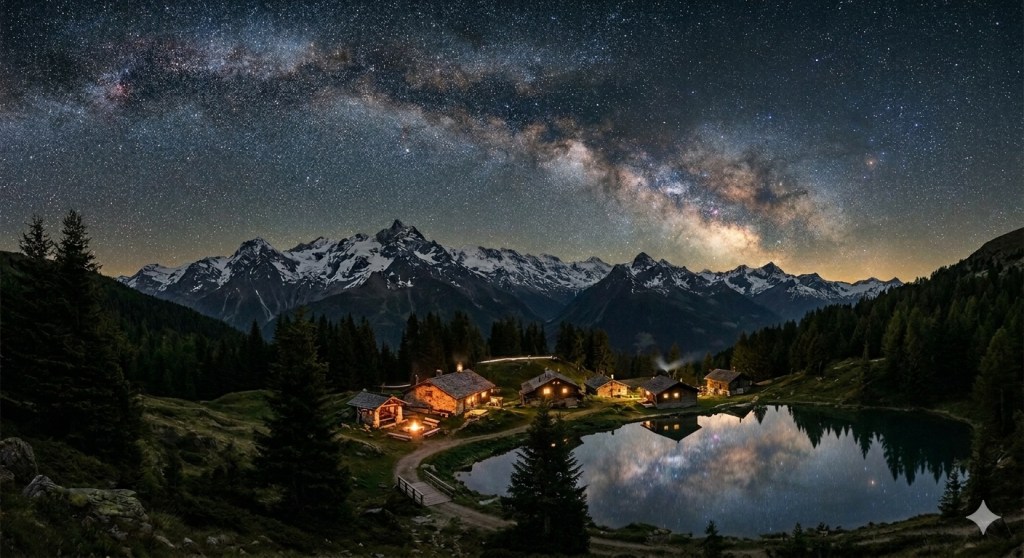
Presented by Zia H Shah MD with the help of ChatGPT
Abstract
Quran 6:96 (Al-Anʿām) presents the night not merely as “what happens when the Sun is absent,” but as something made with discernible function: sakan—a settledness in which living beings find rest—joined to the dawn’s breaking and the Sun–Moon system’s regularity for calculation. From a scientific standpoint, “night” is indeed the shadowed phase of a rotating Earth, yet it is also a real physical regime with measurable properties (illumination, thermal balance, atmospheric optics, and ecological/biological timing). From a cosmological standpoint, the darkness of the night sky is itself an information-rich datum: the classic “dark night sky” puzzle (Olbers’ paradox) points away from an eternal static cosmos and toward a universe with finite age and evolving structure. Philosophically, the verse invites reflection on whether “absence” can still be meaningfully spoken of as “made” when it is a patterned state grounded in created relations and sustained regularities—a theme that resonates with privation analyses in metaphysics and with Islamic theological accounts of divine agency sustaining the world’s temporally renewed states.
Textual focus and supporting verses
Note on translations. The Arabic is quoted in full. The English is from M. A. S. Abdel Haleem (Oxford World’s Classics, published by Oxford University Press). To keep the focus on “night” language and to avoid lengthy quotation, translations are given as targeted excerpts (with ellipses where needed).
Q 6:96 (Al-Anʿām)
Arabic: فَالِقُ ٱلْإِصْبَاحِ وَجَعَلَ ٱلَّيْلَ سَكَنًۭا وَٱلشَّمْسَ وَٱلْقَمَرَ حُسْبَانًۭا ۚ ذَٰلِكَ تَقْدِيرُ ٱلْعَزِيزِ ٱلْعَلِيمِ
Abdel Haleem (excerpt): “He makes the dawn break; He makes the night for rest …”
Q 21:33 (Al-Anbiyāʾ)
Arabic: وَهُوَ ٱلَّذِى خَلَقَ ٱلَّيْلَ وَٱلنَّهَارَ وَٱلشَّمْسَ وَٱلْقَمَرَ ۖ كُلٌّۭ فِى فَلَكٍۢ يَسْبَحُونَ
Abdel Haleem: “He created the day and the night, the sun and the moon—each travelling in an orbit.”
Q 25:47 (Al-Furqān)
Arabic: وَهُوَ ٱلَّذِى جَعَلَ لَكُمُ ٱلَّيْلَ لِبَاسًۭا وَٱلنَّوْمَ سُبَاتًۭا وَجَعَلَ ٱلنَّهَارَ نُشُورًۭا
Abdel Haleem: “He made the night a garment for you … and made the day like a resurrection.”
Q 17:12 (Al-Isrāʾ)
Arabic: وَجَعَلْنَا ٱلَّيْلَ وَٱلنَّهَارَ ءَايَتَيْنِ ۖ فَمَحَوْنَآ ءَايَةَ ٱلَّيْلِ … وَجَعَلْنَآ ءَايَةَ ٱلنَّهَارِ مُبْصِرَةًۭ …
Abdel Haleem (excerpt): “We made the night and the day as two signs …”
Q 40:61 (Ghāfir)
Arabic: ٱللَّهُ ٱلَّذِى جَعَلَ لَكُمُ ٱلَّيْلَ لِتَسْكُنُوا۟ فِيهِ وَٱلنَّهَارَ مُبْصِرًا …
Abdel Haleem (excerpt): “God … made the night so that you may rest in it, and the day so that you may see …”
Q 39:5 (Az-Zumar)
Arabic: … يُكَوِّرُ ٱلَّيْلَ عَلَى ٱلنَّهَارِ وَيُكَوِّرُ ٱلنَّهَارَ عَلَى ٱلَّيْلِ …
Abdel Haleem (excerpt): “He wraps the night around the day and the day around the night …”
Q 36:37 (Yā-Sīn)
Arabic: وَءَايَةٌۭ لَّهُمُ ٱلَّيْلُ نَسْلَخُ مِنْهُ ٱلنَّهَارَ فَإِذَا هُم مُّظْلِمُونَ
Abdel Haleem: “The night is also a sign for them: We strip the daylight from it … they are in darkness.”
Q 28:71 (Al-Qaṣaṣ)
Arabic: قُلْ أَرَءَيْتُمْ إِن جَعَلَ ٱللَّهُ عَلَيْكُمُ ٱلَّيْلَ سَرْمَدًا … مَنْ إِلَـٰهٌ غَيْرُ ٱللَّهِ يَأْتِيكُم بِضِيَآءٍ …
Abdel Haleem (excerpt): “… if God were to cast perpetual night over you … what god other than He could bring you light?”
Q 35:13 (Fāṭir)
Arabic: يُولِجُ ٱلَّيْلَ فِى ٱلنَّهَارِ وَيُولِجُ ٱلنَّهَارَ فِى ٱلَّيْلِ …
Abdel Haleem (excerpt): “He makes the night merge into the day and the day into the night …”
Q 79:29 (An-Nāziʿāt)
Arabic: وَأَغْطَشَ لَيۡلَهَا وَأَخۡرَجَ ضُحَىٰهَا
Abdel Haleem (excerpt): “giving darkness to its night and bringing out its morning brightness …”
Taken together, these passages attribute to God (i) the existence of night/day as a created pair (21:33), (ii) their purpose (rest; “garment”; timekeeping), and (iii) their dynamic alternation (“wrap,” “strip,” “merge,” or threaten “perpetual night” as a counterfactual).
Scientific commentary on night as regime and sign
Night is not an independent “thing” in the way a rock is; scientifically, it is best described as a state of a place on Earth relative to the Sun. As NASA puts it in educational terms, when your location faces the Sun it is day, and Earth’s rotation carries you away into night. This immediately reframes the philosophical objection (“night is mere absence”) into a more precise claim: night is a shadowed configuration produced by the geometry of a rotating sphere under localized irradiation.
The dawn language in 6:96—fāliq al-iṣbāḥ (“cleaving the morning/dawn”)—corresponds to a physically crisp transition zone where scattered sunlight returns before sunrise. In atmospheric optics, daytime brightness and the blue sky arise because shorter-wavelength light is scattered more efficiently by molecules and particles; when the Sun sinks far enough below the horizon, this illumination collapses and the “night regime” takes over. Meteorologically and astronomically, even “night” has grades: civil/nautical/astronomical twilight depend on solar depression angles (6°, 12°, 18°), underscoring that night is not a binary void but a continuum of diminishing solar contribution.


The three recent essays from The Glorious Quran and Science (April 6, 2026) accentuate an even deeper layer: the darkness of the night sky (the blackness between stars) is scientifically nontrivial. That puzzle is formalized as Olbers’ paradox: if the universe were infinite, eternal, static, and uniformly filled with stars, the sky should be bright in all directions; observation contradicts this. Modern cosmology resolves the paradox not by a single trick but by a conjunction of facts: the universe has a finite age, it has expanded, and luminous structure evolves, so there has not been infinite time (nor an unredshifted visible band) to fill every line of sight with stellar surface brightness.
Here the essays’ “worked example” is pedagogically powerful: compare the Sun with Sirius (the brightest night-time star). Their apparent magnitudes differ by about 25 magnitudes, which corresponds to a brightness ratio on the order of 10^10 (≈ 10–13 billion), making vivid the inverse-square penalty of distance. As the essays argue, scaling this reasoning up to a hypothetically infinite, static cosmos yields the paradoxical conclusion of a blazing sky; the fact that we instead see darkness is one observational handle on cosmic finitude and history.
One especially important scientific refinement is that the “missing brightness” is not simply absent from physics; much of the universe’s background glow is outside unaided human vision. A central example is the cosmic microwave background, measured to be extremely close to a blackbody spectrum with temperature around 2.726 K (COBE/FIRAS). The Planck mission’s cosmological parameter fits place the age of the universe at about 13.8 billion years (e.g., ~13.797 ± 0.023 Gyr in Planck 2018 results), anchoring the “finite age” part of the explanation quantitatively.
Night’s “purpose” in the Quranic cluster (rest, shelter) also has strong biological resonance. Human circadian timing is tightly modulated by light exposure; modern reviews summarize how changes in intensity and spectrum of light shape sleep timing, circadian phase, and mood. The ecological extension is now a major research and conservation topic: many organisms rely on Earth’s light–dark cycle for reproduction, feeding, and navigation, and artificial light at night is documented as disruptive. These scientific points do not “prove” theological claims, but they do strengthen a key interpretive insight: night is a structured regime with system-level consequences, not a mere semantic negation.
Philosophical commentary on absence, privation, and “making”
Your motivating conceptual tension is classical: if darkness is merely the absence of light, how can it be “created”? Philosophically, this is the domain of privation—the analysis of some features as “lacks” rather than positive substances. In Neoplatonic and Augustinian traditions, privation theory is often invoked in the problem of evil: evil is treated as a lack of due goodness rather than a created positive entity (a strategy meant to relieve pressure on classical monotheism). Even when one does not endorse the full ethical application, the metaphysical point generalizes: privations are not “things that float free”; they are states of concrete subjects (a body is blind; a room is dark) that depend upon the underlying being and its normative/functional profile.
This suggests a philosophically careful reconciliation: to say “night is made” need not mean “a new substance called Night was manufactured.” It can mean that the world is ordered so that a recurring relational state—Earth’s shadowed half, with its physical and biological consequences—comes to be. In ordinary language we already speak this way: we “create shade” by placing an object between a light and a surface; the created item is a configuration with predictable behavior. The Quranic idiom of “wrapping,” “stripping,” and “merging” fits precisely this kind of configuration talk: it describes boundary processes (daylight receding, darkness advancing) that are not substances but are nonetheless real and describable.
The conceptual link to the three April 6 essays is instructive. They highlight what Richard Dawkins called the “anaesthetic of familiarity”: the thought that habituation can hide genuine explanatory depth in everyday phenomena. Philosophically, this is a reminder that “it’s just absence” can be less an argument than a perceptual shrug: it may conceal the layered structure of explanation (geometry of rotation; atmospheric optics; biological entrainment; cosmological finitude).
Theological commentary on 6:96 and the night’s purposes
Quran 6:96 is densely layered: (i) dawn’s breaking (fāliq al-iṣbāḥ), (ii) the night as sakan (settledness/rest), and (iii) Sun and Moon as ḥusbān (calculation/reckoning), concluding with divine taqdīr (determination/measure). What is often missed in quick readings is the verse’s rhetorical structure: the night is not singled out in isolation, but placed within a time-architecture—rest, work, and measurement—suggesting teleology (order toward ends) rather than mere description of an optical deficit.
A notable linguistic detail is that 6:96 uses jaʿala (“made/appointed”) rather than khalaqa (“created”) for the night: wa jaʿala al-layla sakanan. In the supporting constellation, both verbs appear: 21:33 explicitly says God created night and day (khalaqa al-layl wa al-nahār), while 25:47, 40:61, and 17:12 repeatedly say God made the night for specific ends (garment, rest, sign). The difference is theologically and philosophically important: “made” naturally accommodates “assignment of role within an already created order,” which neatly addresses the “privation” worry without forcing night to be a standalone entity.
Classical-leaning exegesis reinforces this functional reading. The Maʿārif al-Qurʾān tafsīr glosses the phrase about night as indicating that God made the night a time of peace and comfort (sakan) for living beings, explicitly connecting darkness with the facilitation of sleep and rest. This harmonizes with the verse cluster: 25:47’s “night as clothing” is explained as the way night covers things like a garment covers the body, while “sleep as subāt” is linked to the “cutting off” of activity (a partial cessation).
The alternation metaphors are also exegetically rich. In 39:5, the verb yukawwiru (from root k-w-r) is associated in Arabic lexicography with wrapping/rolling, as one wraps a turban; the Quranic Arabic Corpus and Lane’s lexicon both foreground this “wrap” sense. Maʿārif al-Qurʾān adds a phenomenological analogy: night’s arrival is like a curtain cast over daylight, and day’s arrival like darkness receding behind a veil—language of succession and covering rather than of substance. Likewise, 36:37’s “stripping” (naslakh) pictures daylight as something peeled away, leaving darkness exposed; the verse presents this as an āyah (sign), i.e., an invitation to read the natural world as meaningful.
Finally, Islamic theology supplies a more expansive metaphysical grammar for why “night” can be meaningfully predicated of divine action even if conceived as a privation. In many kalām frameworks, the world is analyzed as substances and “accidents,” and divine action is understood as sustaining or recreating the world’s states moment by moment. The Stanford Encyclopedia of Philosophy notes that (with some exceptions) Islamic theologians often held that God recreates atoms and their accidents at every moment, making God the immediate cause of change. Likewise, contemporary articulations of Sunni creed describe createdness as “preceded by non-existence” and analyze the world as substances and accidents (qualities like color, life, motion). Within such a view, “night” is not merely a lexical negative; it is a temporally real regime—an ordered cluster of accidents and relations—continually dependent upon God’s sustaining action.
Integrative reading of “created night” in 6:96
If a modern reader says, “Night is just an absence,” the most charitable reply is: yes—at one explanatory level. Locally, night is the absence of direct solar illumination because a rotating Earth turns a region away from the Sun. But the Quranic language in 6:96 is operating at a different (though compatible) level: it is describing the world-system in which (a) dawn reliably “cleaves” the darkness, (b) night reliably affords sakan, and (c) Sun and Moon reliably serve as calculative measures (ḥusbān), culminating in the claim that this is taqdīr—determined measure and intelligible order.
The scientific analysis does not dissolve this reading; it thickens it. “Night” is a regime with distinct atmospheric optics, temperature dynamics, biology, and ecology; and at cosmic scale, the night sky’s darkness is a signature of a universe with a finite history rather than an eternally luminous static field. In that light, the Quranic insistence that night is an āyah (17:12; 36:37) is not a scientific claim in the narrow sense, but it is scientifically resonant as a methodological posture: treat the familiar as intelligible and worthy of explanation—precisely what the three April 6 essays emphasize through the “anesthesia of familiarity” lens.
Theologically, the move from “absence” to “made” is therefore coherent on multiple models of divine action. On a “design of order” model, God creates the heavens and the Earth (21:33) and thereby creates the lawful relations that entail alternation of light and darkness. On a kalām “continuous dependence” model, the succession of states—day and night—does not merely happen; it is sustained, such that the language of “making night” is not a category mistake but a concise theological description of dependence.
Epilogue
Quran 6:96 reads the night as made—not because it posits a separate physical substance called “Night,” but because it asks the reader to see the world’s temporal architecture as purposeful, measurable, and sign-bearing: dawn breaks, night settles, and the Sun–Moon system enables reckoning, all under a determination that is both powerful and knowing. Modern science, far from reducing night to a trivial negation, reveals layered depths: a rotating planet with a moving terminator and graded twilight; an atmosphere whose scattering produces day’s brightness and whose diminishing illumination unveils the stars; biological clocks that key life to darkness and light; and a cosmos whose dark sky encodes finitude, expansion, and a background radiation beyond our eyes. The Quranic night, then, can be read as a convergence point: a daily mercy for rest (25:47; 40:61), a boundary phenomenon “wrapped” and “stripped” in alternation (39:5; 36:37), and—at the largest scale—an invitation to look into darkness and find not nothingness, but intelligible order.
For references, please go to Microsoft Word file:
 The Glorious Quran and Science
Leave a comment