
Epigraph:
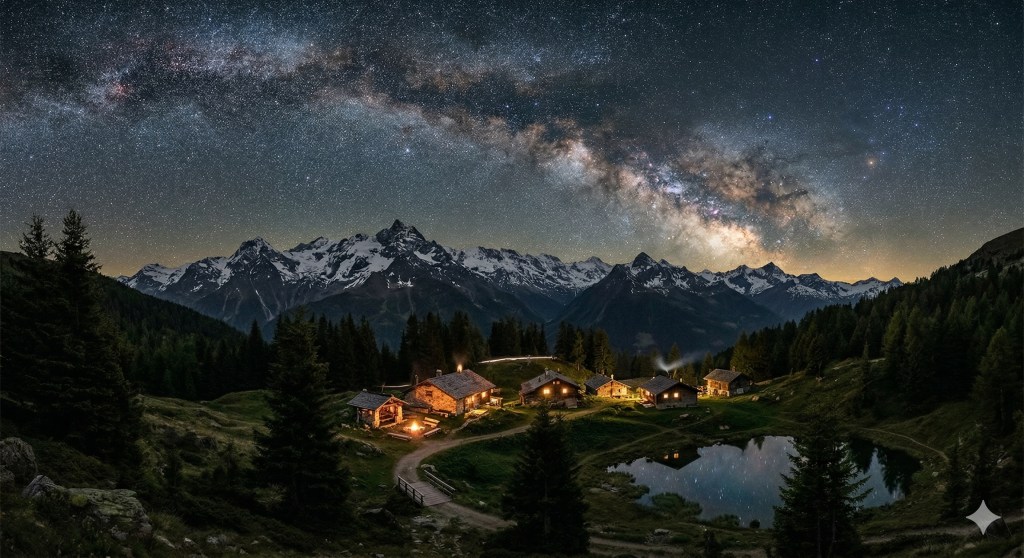
أَأَنتُمْ أَشَدُّ خَلْقًا أَمِ السَّمَاءُ ۚ بَنَاهَا
رَفَعَ سَمْكَهَا فَسَوَّاهَا
وَأَغْطَشَ لَيْلَهَا وَأَخْرَجَ ضُحَاهَا
Al Quran 79:27-29
Why the Night Sky Is Dark
Presented by Zia H Shah MD
Abstract
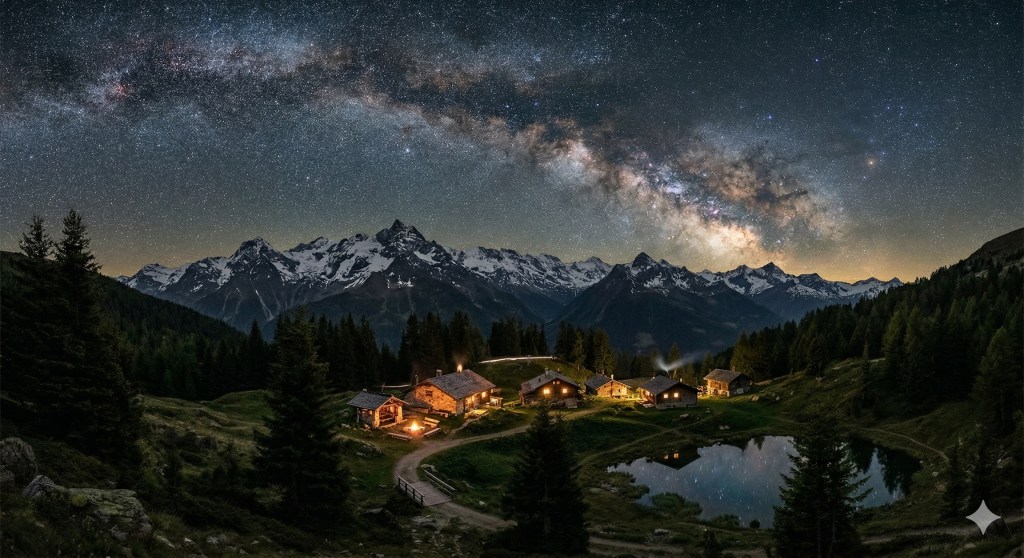
The darkness of the night sky is so ordinary that it can become, for many people, an “anesthesia of familiarity”—a background fact rarely interrogated until a child asks, or a philosopher lingers, or an astronomer runs the numbers. Yet the darkness is not trivial. In a universe that were infinite in age, static, and uniformly filled with stars, the sky should not be mostly dark; it should be bright nearly everywhere—a classic puzzle known as Olbers’ paradox.
Modern cosmology explains the darkness as the combined consequence of a finite cosmic age, cosmic expansion (which redshifts and dilutes light), and the fact that luminous structures (stars and galaxies) have finite lifetimes and an evolving history—so there has not been infinite time for light from infinitely distant sources to reach us, nor does that light remain in the visible band when it does. The “missing brightness” has not vanished; a large part of the universe’s background glow is simply outside human vision, most famously in the cosmic microwave background.
This report traces the cosmological logic, the historical path of ideas that clarified it, and a concrete brightness comparison between Sirius and the Sun. It then offers a scientific, philosophical, and theological commentary on Quran 79:27–29 (with a constellation of other relevant verses), reading the Qur’anic imagery of night and day as an invitation to reflect on order, finitude, dependence, and meaning.
The puzzle behind a familiar darkness
On Earth, “night” begins in the simplest way: the Sun sets for your location, and the scattering that makes daytime sky-blue largely ceases to illuminate your hemisphere. But the deeper question is not why your local horizon is dark; it is why the celestial sphere—the whole dome of directions above you—contains so much blackness between stars. If space is filled with galaxies (as modern telescopes demonstrate), why doesn’t the background blaze with their light?
Olbers’ paradox frames that question with uncomfortable clarity. In an idealized universe that is (i) infinite in extent, (ii) infinite in age, (iii) static (not expanding), and (iv) uniformly filled with luminous stars, every line of sight should eventually hit a star’s surface. Under those assumptions, there should be essentially no “empty” dark directions: the sky’s average surface brightness should be comparable to the surface brightness of a typical star, rather than mostly black.
A common early attempt to escape the paradox was to propose that dust absorbs distant starlight. But in a universe that has existed forever, dust that continuously absorbs radiation should heat up and re-radiate; the energy budget doesn’t disappear. Dust can change the spectrum of the background light, but it cannot make the long-run background energy vanish in an eternally illuminated cosmos.
Even so, “dark” does not mean “nothing.” From a truly dark site on Earth, the night sky contains natural light from sources such as airglow (upper-atmospheric emission) and zodiacal light (sunlight scattered by interplanetary dust), in addition to starlight and diffuse galactic light. These components are part of what astronomers model as the natural night-sky brightness.
Cosmological reasons the sky is dark
The resolution of Olbers’ paradox is not a single trick but a converging set of facts about the universe we actually inhabit.
The most direct break in Olbers’ assumptions is that the universe has a finite age. A standard modern description places the origin of the hot Big Bang around 13.8 billion years ago; that finitude implies a horizon-like limit on how much time light has had to travel and how much luminous history can contribute to what we see now. In other words, the observable universe is not “the whole infinite universe” (if such a thing exists) but the portion whose signals can reach us within cosmic time.
Cosmic expansion deepens the darkness through redshift. As space expands, light waves are stretched to longer wavelengths; radiation emitted in the visible can arrive as infrared, and sufficiently distant/early light can be shifted beyond the visible altogether. In an expanding universe, this redshifting is not cosmetic: it reduces each photon’s energy and spreads the arrival of photons over time, diminishing observed brightness compared with what a static universe would predict.
The phrase “the light is missing” is misleading. A central piece of evidence that the universe is not an eternal, steady-state starfield is the cosmic microwave background (CMB): a pervasive, nearly uniform glow that fills the sky in microwave wavelengths. Its measured temperature is about 2.725 K, and it represents relic radiation from the early universe—far outside the visible band for human eyes, but very real in the universe’s energy accounting.
Historically, the decisive observational settling of “eternal static” versus “evolving expanding” was strongly linked to the mid-20th-century recognition and interpretation of the CMB. The discovery is associated with Arno Allan Penzias and Robert Woodrow Wilson, whose measurement of the background radiation became Nobel-recognized evidence supporting a hot Big Bang cosmology over steady-state rivals.
A further, often underappreciated piece is cosmic history: there were eras before stars and galaxies lit up the sky. Modern reconstructions of the cosmic star-formation rate indicate a rise to a peak (often summarized as around redshift z ≈ 2, a few billion years after the Big Bang) and a decline thereafter. The universe has not been producing starlight at a constant rate for infinite time; it has an evolving luminous budget.
Finally, it helps to remember that Earth-bound observers see a night sky that is brighter than deep interstellar space would be, because our atmosphere and solar system add their own faint glow. Even the popular-level history of Olbers’ riddle emphasizes that far from stars—and without atmospheric contributions—space would be darker still than a pristine, moonless terrestrial sky.
How we got here: a historical chain of ideas
The “dark night” problem is old because it sits at the intersection of everyday perception and cosmic scale. A long-view history of the riddle (and the many false starts) is often told as a four-century conversation involving philosophers and astronomers—from ancient atomists through early modern debates about infinity, to modern relativistic cosmology.
In the early modern period, Johannes Kepler is often cited as an early figure who pressed the darkness into service as an argument against an infinite, uniformly star-filled universe (circa 1610). The key move was conceptual: a dark sky is not an incidental aesthetic; it is evidence that at least one “infinite and uniform and eternal” assumption is wrong.
By the 18th century, the riddle matured into more quantitative thought experiments. Edmund Halley and Jean-Philippe Loys de Chéseaux are among those associated with shell arguments and early forms of the “forest of stars” intuition: in an infinite uniform distribution, every direction should eventually encounter a luminous surface.
In the 19th century, Heinrich Wilhelm Olbers discussed the paradox in 1823 and helped cement it as a named problem—hence “Olbers’ paradox.” One proposed resolution was absorption by interstellar material, but thermodynamic reasoning undermined that as a final answer in an eternal universe: absorbers must eventually radiate.
The 20th century supplied the decisive conceptual shift: a dynamical universe. Albert Einstein’s general relativity opened the door to non-static cosmological solutions, and observational astronomy soon transformed “nebulae” into external galaxies and motion into expansion. Popular astronomical outreach summaries explicitly connect the settling of Olbers’ paradox to the recognition of cosmic expansion and to the later discovery of the CMB.
Two observational milestones are especially relevant. First, Henrietta Swan Leavitt’s Cepheid period–luminosity relation (“Leavitt’s law”) helped build the distance ladder needed to measure cosmic-scale distances, enabling expansion to become a testable hypothesis rather than a metaphysical speculation.
Second, Edwin Hubble provided pivotal observational evidence for expansion. His 1929 paper reported a correlation between distances and radial velocities among extra-galactic nebulae, foundational to what became known as Hubble’s law.
With expansion established as a feature of the cosmos, the dark night ceased to be paradoxical. The night sky is dark because the universe is not an infinitely old, static, uniformly shining sea of stars. It is a time-evolving cosmos with horizons, redshifts, and a hot early phase whose “afterglow” now lives mostly outside our visible senses.
Worked example: why the Sun outshines Sirius
A layperson’s intuition often underestimates how brutally distance suppresses brightness. The contrast between Sirius and the Sun is a clean demonstration.
Sirius is the brightest star in the night sky as seen from Earth, with apparent visual magnitude around −1.46, and its bright component is about 25.4 times as luminous as the Sun. Its distance from the solar system is about 8.6 light-years.
By everyday units, a light-year is about 9.46 trillion kilometers. Multiplying, 8.6 light-years corresponds to roughly 8.1 × 10^13 km—i.e., over 80 trillion kilometers, matching the scale in the prompt. By contrast, the astronomical unit (Earth–Sun distance) is defined as exactly 149,597,870,700 meters, about 150 million kilometers.
Apparent brightness (flux) follows an inverse-square law: for the same intrinsic luminosity, doubling distance makes a source four times fainter. If one object is intrinsically brighter by a factor of (L) but farther by a factor of (D), the apparent-brightness ratio scales like (D^2 / L). Using (D \approx (8.6 \text{ ly})/(1 \text{ au})) and (L \approx 25.4), the Sun’s apparent brightness comes out on the order of (10^{10}) times Sirius’s—tens of billions divided by a few dozen—yielding a value in the neighborhood of ~10–13 billion depending on whether you use rounded or band-specific quantities.
Astronomers often express the same idea through the magnitude system. A five-magnitude difference is defined as a factor of 100 in brightness (Pogson’s ratio), so brightness ratios grow exponentially with magnitude gaps. With the Sun around −26.7 apparent magnitude and Sirius around −1.46, the magnitude gap is about 25 magnitudes, corresponding to a brightness ratio of roughly (10^{0.4 \times 25} \sim 10^{10}), i.e., about 10–13 billion—consistent with the “13 billion” figure in the prompt.
This is not just a curiosity about a bright star. It is the same mathematical tension at the heart of Olbers’ paradox: distance makes individual stars faint, but an infinite, uniform, eternal cosmos supplies infinitely many shells of stars. In that idealized setup the total does not stay faint—it accumulates until the sky ceases to have darkness at all.
Night and darkness in the Qur’an: 79:27–29 and a wider constellation of verses
Quran 79:27–29 appears in a passage that challenges human doubt about resurrection by directing attention to the scale and order of creation: “Which is harder to create: you or the sky? He built it… He dimmed its night, and brought forth its daylight/morning brightness” (renderings differ slightly by translator). Classical tafsir commonly reads the rhetorical question as a rebuke to those who deny re-creation: if the greater structure (the heavens/sky) is within divine power, then re-creating humans is not “hard.”
A particularly clarifying point is how classical commentators handled the phrase “its night.” In Tafsir al-Tabari, the night is explicitly attached to the sky: “He darkened the night of the sky,” with an explanation that night is associated with the sun’s setting/rising “in it,” hence the idafa (“night of it”) linguistically. This matters because modern readers sometimes over-literalize the phrase into a claim that the entire cosmos has day/night the way Earth does, whereas the classical move is to treat the sky as the theater in which day/night appears to human observers. The verse’s language is phenomenological (about what is manifest in the sky) while still theological (pointing beyond the phenomenon to agency and order).
A scientific commentary can respect that genre. The Qur’an is not written as a physics textbook, but it recurrently directs attention to regularities that science also studies: alternation, periodicity, measure, and dependence. In modern terms, Earth’s day/night cycle is a consequence of a rotating sphere illuminated by a nearby star; the “darkening” of night is literally the withdrawal of direct sunlight from a hemisphere. The Qur’anic phrasing “We strip from [the night] the day” (36:37) is strikingly compatible with this observational reality: daylight is treated as something removed, revealing darkness beneath—an image that resonates with the physical fact that “night” is the absence of direct solar illumination rather than a substance poured into the world.
Cosmology adds a second layer: even if you removed Earth entirely and placed an observer in intergalactic space, the heavens would still be dark in the visible because the universe is finite in age and expanding, and because much of the cosmic background glow lies outside the visible spectrum (for example in the CMB). The darkness, then, is not merely “the Sun has set,” but “the cosmos has a history, a horizon, and a redshift.” Seen this way, 79:27–29 can be read as an invitation to contemplate scale: the sky’s architecture, and within it the patterned alternation of darkness and brightness, are signs that humble human pretensions about what is “hard.”
Philosophically, night does two things at once. It conceals, and it reveals. It conceals the overwhelming glare of day and the practical preoccupations that come with it; it reveals the deeper frame—stars, vastness, finitude—within which the human story takes place. Many people live as though the true default is illumination (the day) and darkness is a defect. But physics and biology both resist that assumption: cycles of light and dark are part of what makes stable life and stable meaning possible. The “anesthesia of familiarity” is precisely that we forget how contingent these conditions are until a thought experiment (perpetual day, perpetual night) reawakens gratitude and conceptual shock. Quran 28:71–73 explicitly leverages that thought experiment, asking what “god other than Allah” could restore night or day if one were made perpetual, and then grounding the alternation in mercy and gratitude.
The Qur’an repeatedly returns to “night” (al-layl), “darkness” (often via covering and veiling verbs), and the interpenetration of night and day as signs (ayat). A non-exhaustive but thematically dense cluster includes:
In cosmic-oath passages: 91:4 (“By the night as it conceals [it]”) and 92:1 (“By the night when it covers”), which frame night’s covering power as rhetorically weighty—something capable of bearing moral and metaphysical argument.
In “sign” passages: 36:37 (“We strip from it the day—then they are in darkness”), which treats night as a demonstrative sign rather than mere absence.
In alternation/wrapping imagery: 39:5 (“He wraps the night around the day, and wraps the day around the night”) and 57:6 (“He merges the night into day and the day into night”), which emphasize continuity and lawful transition rather than abrupt dualism.
In merciful function: 10:67 and 40:61, each stating that night is made for rest and day for seeing/working—explicitly moralizing the ordinary cycle into a gift that many ignore.
In night-as-garment metaphors: 78:10–11 (“night as a cover/garment; day for livelihood”) and 25:47 (“night as clothing/cover; sleep as rest; day for rising”), where night is not framed as terror but as protection and renewal.
In the “two signs” scheme: 17:12 (“We made the day and night as two signs… [and] made the sign of the night devoid of light”), linking the cycle to timekeeping and human reckoning, not only to mood or poetry.
Each set of verses can support multiple readings at once. A scientific reading notes the empirical regularity: the alternation is stable enough to calibrate calendars and livelihoods. A philosophical reading notes the existential pedagogy: night breaks the illusion that human projects are self-grounding; it forces dependence (on time, on rest, on cycles not authored by us). A theological reading situates both under divine agency and mercy: night is not a rival force to be conquered but a created condition with a purpose (sakan—tranquility; libas—covering; nushur—rising).
Against that background, Quran 79:27–29 functions like a hinge. It moves from macrocosmic structure (“the sky He built… raised… proportioned”) to the intimate phenomenology that every person knows (“darkened its night… brought out its morning brightness”). Classical commentators read this as a chain of evidence meant to reframe human incredulity about resurrection: the one who orders the greater order can surely restore the lesser. The commentary tradition also explicitly ties the verse to life-functions: light for sustenance and perception; darkness for tranquility.
If one brings cosmology into dialogue (carefully), an additional resonance appears: the visible darkness of the cosmic night is itself a sign of a universe with a beginning and a dynamic history—precisely the kind of universe in which “creation” is not merely a one-time past act but an intelligible order unfolding in time. In that sense, the Qur’anic invitation to attend to night is not only devotional; it is epistemic. Night is when the sky becomes legible.
Epilogue: the dark is not empty
The night sky’s darkness is not a blank; it is a structured silence. In cosmology it speaks of finitude (a universe not infinitely old), of dynamism (expansion and redshift), and of hidden abundance (background radiation largely outside visible perception). In human life it speaks of limits and mercy: you cannot labor perpetually; you must rest; you are embedded in rhythms you did not invent, yet depend upon.
Sirius, brilliant by stellar standards, still loses to the Sun by ten billionfold because nearness governs experience. The same is true of meaning: what is closest—time, breath, night, morning—can be so familiar that it vanishes from attention. The Qur’an’s repeated return to night, covering, and the gradual interweaving of darkness and light can be read as a remedy for that invisibility: a call to notice the ordinary as a sign, and the sign as a doorway.
For references, please go to the Microsoft Word file:


 The Glorious Quran and Science
Leave a comment