
Epigraph:
أَأَنتُمْ أَشَدُّ خَلْقًا أَمِ السَّمَاءُ ۚ بَنَاهَا
رَفَعَ سَمْكَهَا فَسَوَّاهَا
وَأَغْطَشَ لَيْلَهَا وَأَخْرَجَ ضُحَاهَا
Al Quran 79:27-29
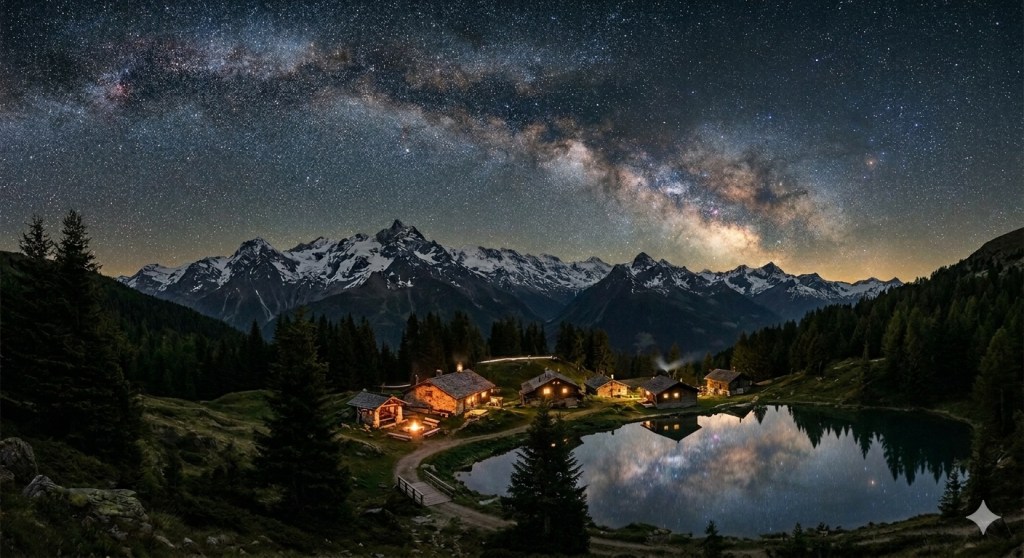
The darkness that reveals the universe
Presented by Zia H Shah MD with the help of Claude
Abstract
The darkness of the night sky — a phenomenon so familiar it rarely provokes wonder — encodes some of the most profound truths in all of science. This article presents a comprehensive interdisciplinary exploration of why the night sky is dark, weaving together cosmology, the history of science, physics, philosophy, and Quranic theology. We trace the intellectual history of this question from Kepler’s 1610 argument for a finite cosmos, through Halley, Chéseaux, and Olbers’s famous paradox, to Edgar Allan Poe’s remarkably prescient 1848 solution in Eureka, Lord Kelvin’s quantitative resolution, and the modern cosmological framework grounded in the Big Bang theory. The resolution rests on the finite age of the universe (~13.8 billion years), its ongoing expansion, the finite speed of light, and the limited lifetimes of stars. We examine the inverse square law through the dramatic comparison of Sirius and the Sun — two stars differing in apparent brightness by a factor of thirteen billion despite Sirius being intrinsically 25 times more luminous. We explore Richard Dawkins’s concept of the “anaesthetic of familiarity” as an explanation for why this extraordinary phenomenon goes unquestioned. Finally, we offer scientific, philosophical, and theological commentary on Quran 79:27–29 — “And He darkened its night and extracted its brightness” — alongside other Quranic verses about night and darkness (91:4, 92:1, 93:2, 36:37, 78:10–11, 25:47, 39:5), drawing on classical tafsīr from Ibn Kathīr, al-Ṭabarī, al-Qurṭubī, and modern scholars. The convergence of scientific understanding and scriptural reflection reveals that the darkness of night is not emptiness but a cosmological signature — a sign written across the sky in the language of physics and, for the believing mind, in the language of divine creation.
Why the sky is dark: a question that decodes the cosmos
The darkness of the night sky is not a trivial fact — it is direct evidence that the universe had a beginning. Every time a person steps outside after sunset and gazes upward at a dark expanse punctuated by scattered stars, they are witnessing the consequences of the Big Bang, the expansion of space, and the finite speed of light. The resolution of this seemingly simple observation required centuries of intellectual struggle and stands as one of cosmology’s most elegant achievements.
The single most important factor is the finite age of the universe. Precision measurements from the Planck satellite place the age at 13.797 ± 0.023 billion years. University of Nevada, Las Vegas Because the universe is not infinitely old, only light from objects within a finite volume — the observable universe, University of Nevada, Las Vegas with a comoving radius of approximately 46.5 billion light-years WikipediaVerse and Dimensions Wikia — has had time to reach us. The radius exceeds 13.8 billion light-years because space itself has expanded during the photons’ journey, Astronoo but the fundamental point holds: there exists a cosmic horizon beyond which no information can yet arrive. The density of stars within this finite volume is far too low for every random line of sight to terminate on a stellar surface. Explorethecosmos In a hypothetical static universe with the same stellar density, it would take approximately 10²³ years — ten trillion times the current age of the cosmos — for space to fill with radiation matching stellar surface temperatures. Wikipedia
The expansion of the universe, confirmed observationally by Edwin Hubble in 1929, compounds this effect. As space stretches, photons traveling through it have their wavelengths elongated — a phenomenon called cosmological redshift. Light from the most distant observable sources has been redshifted BRETT HALL by a factor of roughly 1,100. Visible light becomes infrared, then microwave radiation, then radio waves — all invisible to the human eye. BRETT HALL A redshifted photon also carries proportionally less energy, further diminishing the visible brightness contribution from distant sources.
Stars also have finite lifetimes. They are born from collapsing clouds of gas, burn nuclear fuel for millions to billions of years, and die. ETV Bharat The universe’s total energy budget for starlight is inherently limited. Scientific American The observable universe contains an estimated two trillion galaxies and perhaps 10²⁴ stars, but this vast number is still finite, and these stars are scattered across an incomprehensibly large volume of roughly 4 × 10⁸⁰ cubic meters.
Yet the sky is not perfectly dark. It is suffused with the Cosmic Microwave Background (CMB) — the afterglow of the Big Bang itself. Approximately 380,000 years after the universe began, the primordial plasma cooled to roughly 3,000 Kelvin, allowing electrons to combine with protons into neutral hydrogen. The universe became transparent for the first time, releasing a flood of photons. ESA These photons have been traveling ever since, stretched by cosmic expansion from their original near-infrared wavelengths to a peak wavelength of approximately one millimeter — deep in the microwave spectrum. Openspaceproject The CMB now has a near-perfect blackbody temperature of 2.725 K, just above absolute zero. Wikipedia Approximately 411 CMB photons occupy every cubic centimeter of space. Accidentally discovered in 1964 by Arno Penzias and Robert Wilson at Bell Labs — earning them the 1978 Nobel Prize MicrowavesHub — and mapped with exquisite precision by the COBE, WMAP, and Planck satellites, the CMB represents a sky that is, in fact, glowing in every direction. It is glowing with the light of creation itself, but at wavelengths our eyes cannot detect.
The darkness of night, then, is the product of a specific cosmological architecture: a universe that began, that expands, that contains stars with finite fuel, and whose ancient light has been stretched beyond visibility. The sky is approximately 500 billion times darker in total radiation density than it would be if the cosmos had reached thermodynamic equilibrium with its stellar output. Wikipedia
Olbers’s paradox: the question that took four centuries to answer
In an infinite, static, eternal universe uniformly filled with luminous stars, the night sky should not be dark — it should blaze with the brightness of a stellar surface in every direction. Wikipedia This is the essence of Olbers’s paradox, one of the most important gedanken experiments in the history of cosmology. The paradox is named for the German astronomer Heinrich Wilhelm Olbers, who published his formulation in 1823, Encyclopedia BritannicaWikipedia though — as we shall see — the question had been posed by earlier thinkers for over two centuries. Wikipedia
The geometric argument is rigorous and devastating. Divide the universe into thin concentric spherical shells centered on an observer. A shell at distance r with thickness dr has a volume proportional to 4πr²dr. In a homogeneous universe, the number of stars in this shell therefore increases as r². However, the apparent brightness of each individual star decreases as 1/r² according to the inverse square law. These two effects cancel exactly: Wikipedia the total flux contributed by each shell equals nLdr, where n is the stellar number density and L is the average stellar luminosity — a constant independent of distance. University of Birmingham In an infinite universe, the sum over infinitely many shells diverges. Wikipedia More precisely, every line of sight must eventually intersect a stellar surface, Encyclopedia Britannica just as every line of sight in an infinite forest eventually hits a tree trunk. The entire sky should glow at roughly 5,800 K — the surface temperature of a Sun-like star.
The most commonly proposed historical resolution — that interstellar dust absorbs distant starlight — fails on thermodynamic grounds. As John Herschel demonstrated in 1848, any absorbing medium would heat up from the absorbed radiation and eventually re-radiate that energy, reaching thermal equilibrium with the stellar radiation field. Gale Dust can change the wavelength of re-emitted light, but it cannot destroy energy. Explorethecosmos As the physicist Phil Plait memorably noted: “You haven’t solved the problem by adding nebulas; you’ve just delayed it by a bit. And an infinite universe is patient.” Scientific AmericanScientific American
The modern resolution rests on breaking the paradox’s founding assumptions. The universe is not infinitely old — it is 13.8 billion years old. Wikipedia It is not static — it is expanding. And stars have finite lifetimes. The most important of these is the finite age: historian Edward Harrison demonstrated that even in a hypothetical non-expanding universe of the same age, the sky would still be dark, because there simply has not been enough time for starlight to fill the cosmic volume. The expansion provides an additional dimming mechanism through redshift but is secondary to the age constraint. In the line-of-sight version of the paradox, every direction does terminate on a luminous surface — the surface of last scattering, where the CMB was emitted — but this surface has been redshifted from approximately 3,000 K to just 2.7 K, rendering it invisible. Wikipedia
Four centuries of wondering: from Kepler to the Big Bang
The intellectual history of this question is one of science’s most fascinating narratives, spanning four centuries and featuring an improbable cast that includes astronomers, physicists, a poet, and — most surprisingly — the author of “The Raven.”
Thomas Digges was the first to brush against the problem. WikipediaExplorethecosmos In 1576, he published A Perfit Description of the Coelestiall Orbes, the first English exposition of the Copernican system, in which he postulated an infinite universe filled with infinitely many stars. WikipediaAstronoo He simply assumed distant stars were too faint to matter, missing the mathematical insight that would expose the paradox. Jim Al-Khalili
Johannes Kepler confronted the problem directly in 1610, Encyclopedia Britannica in his Dissertatio cum Nuncio Sidereo (Conversation with the Starry Messenger), written in response to Galileo’s telescopic discoveries. arxivGale Kepler’s reasoning was sharp and consequential: “The more they are, and more crowded they are, the stronger becomes my argument against the infinity of the universe.” arxiv For Kepler, the darkness between stars was the “dark outer wall” enclosing a finite cosmos. The dark sky was not a puzzle to be explained away — it was proof that the universe of stars had boundaries.
Edmond Halley brought the problem before the Royal Society in March 1721, with Newton himself in the presidential chair. In two short papers published in the Philosophical Transactions, Halley developed the concentric-shell argument mathematically, Gale showing that the r² increase in star count cancels the 1/r² decrease in individual brightness. He called this a “Metaphysical Paradox” Gale but proposed an unconvincing solution: that the inverse square law somehow breaks down at extreme distances.
The Swiss astronomer Jean-Philippe Loys de Chéseaux Linda Hall Library independently formulated the paradox with full mathematical rigor in 1744, in an appendix to his Traité de la Comète. Astronoo His proposed solution — absorption by an interstellar medium — would later be shown to violate thermodynamic principles. Gale
Heinrich Wilhelm Olbers published his famous paper “Über die Durchsichtigkeit des Weltraumes” (On the Transparency of Space) in 1823, Scientific Americangeorgeszpiro restating the paradox and proposing the same absorption solution as Chéseaux. Harrison later observed that “Olbers was far from the first to pose the problem, nor was his thinking about it particularly valuable.” Wikipedia Yet his name stuck, popularized by Hermann Bondi in the 1950s, and the paradox has been “Olbers’s” ever since.
Edgar Allan Poe’s astonishing intuition in Eureka
The most extraordinary chapter in this story belongs to Edgar Allan Poe. On a stormy evening in February 1848, Poe delivered a lecture titled “On The Cosmography of the Universe” at the Society Library in New York to an audience of roughly sixty bewildered listeners. arxivPhys.org He expanded the lecture into Eureka: A Prose Poem, published in March 1848 by George Putnam in a print run of only 500 copies. arxiv Putnam paid Poe fourteen dollars. Poe told his publisher that “Newton’s discovery of gravitation was a mere incident compared to the discoveries revealed in this book” arxiv and wrote to a friend: “I have no desire to live since I have done Eureka.”
Buried within this strange, visionary text is the first correct qualitative solution to the dark sky paradox. Poe stated the problem with perfect clarity: “Were the succession of stars endless, then the background of the sky would present us an uniform luminosity, like that displayed by the Galaxy — since there could be absolutely no point, in all that background, at which would not exist a star.” WikipediaMedium His solution was revolutionary:
“The only mode, therefore, in which, under such a state of affairs, we could comprehend the voids which our telescopes find in innumerable directions, would be by supposing the distance of the invisible background so immense that no ray from it has yet been able to reach us at all.” WikipediaRaptis Rare Books
Poe grasped three principles — the finite speed of light, the vastness of space, and the implication that the universe is not infinitely old — and synthesized them into an answer that would not be quantitatively confirmed for over a century. Medium As physicist Paul Halpern wrote: “Put together the notions of a finite speed of light, large gaps in space, and a finite age of stars, and one finds in Eureka an elegant solution to Olbers’s paradox.” Beyond the dark sky question, Poe also anticipated a universe originating from a single “primordial particle” (resembling the Big Bang singularity), cyclic expansion and collapse, and the extragalactic nature of nebulae. arxiv Intriguingly, Alexander Friedmann — who first derived expanding-universe solutions from Einstein’s equations — was reportedly an avid reader of Poe.
Lord Kelvin (William Thomson) published the first correct quantitative resolution Wikipedia in 1901, in a paper titled “On Ether and Gravitational Matter through Infinite Space.” NaturePhysics Forums Kelvin calculated that the Milky Way contained insufficient stars to cover the sky, and that even extending stars to infinity, their finite energy resources combined with the finite speed of light meant that light from distant stars could not yet have reached us. ADSEl Tamiz His was a thermodynamic argument: the universe has not reached thermal equilibrium because stars have not had enough time to heat up the radiation field of space. University of Nevada, Las Vegas Harrison called Kelvin’s analysis the first “satisfactory quantitative resolution” and lamented that it had been largely forgotten. NatureWikipedia
The final pieces fell into place with Edwin Hubble’s 1929 discovery of cosmic expansion, building on the theoretical work of Georges Lemaître (1927) and Alexander Friedmann (1922). Lemaître’s 1931 “Primeval Atom” hypothesis evolved into the Big Bang theory El Tamiz through the work of George Gamow, Ralph Alpher, and Robert Herman, who predicted the existence of a relic background radiation. When Penzias and Wilson detected the CMB in 1965, the framework was complete. WordPressCosmoquest Edward Harrison’s magisterial 1987 book Darkness at Night: A Riddle of the Universe provided the definitive historical synthesis, Harvard University Press crediting Kelvin with the quantitative solution and Poe with its qualitative anticipation. WikipediaPhys.org
Thirteen billion times brighter: Sirius, the Sun, and the tyranny of distance
The inverse square law of light offers perhaps the most visceral demonstration of why the night sky is dark. Consider Sirius, the brightest star in Earth’s night sky, and our own Sun. Sirius is intrinsically 25.4 times more luminous than the Sun — a blue-white stellar furnace with a surface temperature of approximately 9,940 K Encyclopedia Britannica compared to the Sun’s 5,778 K. Yet as seen from Earth, the Sun outshines Sirius by a factor of approximately 13 billion.
The explanation is distance, amplified by geometry. The Sun sits at 1 AU — roughly 150 million kilometers, or 8.3 light-minutes away. Sirius lies at 8.6 light-years, Encyclopedia Britannica which translates to approximately 81.4 trillion kilometers or 544,000 AU. The inverse square law dictates that light intensity diminishes as the square of the distance: a source twice as far appears four times dimmer; ten times as far, one hundred times dimmer. The calculation is straightforward but staggering:
If Sirius had the same luminosity as the Sun, it would appear (544,000)² ≈ 2.96 × 10¹¹ times dimmer — nearly 300 billion times fainter. Correcting for Sirius’s 25.4-fold greater luminosity: 2.96 × 10¹¹ ÷ 25.4 ≈ 1.2 × 10¹⁰ — roughly 12 billion times fainter than the Sun. The magnitude system confirms this independently: the Sun’s apparent magnitude is −26.74, Sirius’s is −1.46, a difference of 25.28 magnitudes corresponding to a brightness ratio of 10^(25.28/2.5) ≈ 1.3 × 10¹⁰ — about 13 billion.
| Property | Sun | Sirius A |
|---|---|---|
| Apparent magnitude | −26.74 | −1.46 |
| Luminosity (solar units) | 1 | 25.4 |
| Distance from Earth | 1 AU (150 million km) | 544,000 AU (8.6 light-years) |
| Surface temperature | 5,778 K | ~9,940 K |
The geometric reason is elegant: light radiates uniformly in all directions from a source, spreading over the surface of an expanding sphere whose area equals 4πr². Double the distance and the same energy is spread over four times the area. At Sirius’s distance, the Sun’s light would be diluted across a sphere with an area 296 billion times larger than at Earth’s orbit. Even Sirius’s substantially greater intrinsic power barely dents this geometric penalty.
This inverse square law connects directly to Olbers’s paradox. In the shell argument, the r² growth in star numbers per shell precisely cancels the 1/r² dimming of individual stars, making each shell equally bright. ExplorethecosmosUnrevealed Files The inverse square law alone cannot save the sky from blazing uniformity — only the finite age and expansion of the universe can.
The anaesthetic of familiarity: why we stopped wondering
Why does no one ask why the night sky is dark? The answer lies in a phenomenon that Richard Dawkins named “the anaesthetic of familiarity” in the opening chapter of his 1998 book Unweaving the Rainbow: Science, Delusion and the Appetite for Wonder. Dawkins wrote:
“There is an anaesthetic of familiarity, a sedative of ordinariness which dulls the senses and hides the wonder of existence. For those of us not gifted in poetry, it is at least worth while from time to time making an effort to shake off the anaesthetic.” Goodreadsgoodreads
The concept describes how constant exposure to extraordinary phenomena renders them invisible to the inquiring mind. We habituate. From infancy, we encounter gravity, light, the dark sky, consciousness, the color of leaves — and gradually these marvels become background noise. The dark night sky is perhaps the supreme example. Every human being who has ever lived has seen it. It seems so obviously, so boringly, so inevitably dark that the question “why?” feels almost absurd. Yet as we have seen, this darkness is not inevitable at all. It required specific cosmological conditions — a universe with a beginning, an expanding fabric of space, stars with finite fuel — and its explanation connects to the deepest questions about the origin, age, and fate of the cosmos. Scientific American
Dawkins’s broader argument in Unweaving the Rainbow was that science does not strip the world of wonder — it deepens it. The title references Keats’s accusation that Newton had destroyed the poetry of the rainbow by reducing it to prismatic colors. Wikipedia Dawkins countered that understanding the physics of refraction reveals a far richer, more awe-inspiring reality than naive enchantment ever could. The same is true of the dark sky: knowing why it is dark transforms it from a backdrop into a window onto creation.
The dark night sky is, in this sense, a nightly cosmology lecture that the entire human species has been sleeping through.
“He darkened its night”: Quran 79:27–29 in science, philosophy, and theology
Three verses in Surah An-Nāziʿāt present the creation of the heavens in language that resonates with extraordinary depth across scientific, philosophical, and theological registers:
79:27 A-antum ashaddu khalqan ami al-samāʾu? Banāhā. “Are you a more difficult creation, or is the heaven? He constructed it.”
79:28 Rafaʿa samkahā fa-sawwāhā. “He raised its ceiling and proportioned it.”
79:29 Wa aghṭasha laylahā wa akhraja ḍuḥāhā. “And He darkened its night and extracted its brightness.”
The science of cosmic darkness as an active phenomenon
The Arabic verb أَغْطَشَ (aghṭasha) is in the causative Form IV, meaning “He made it dark” or “He caused it to become dark.” The root غ-ط-ش carries connotations of intense, enveloping, blinding darkness — Lisān al-ʿArab defines ghaṭash as dimness of vision approaching blindness and describes a laylah aghṭash as a night of total, impenetrable darkness. This is not passive absence; it is active creation.
This linguistic framing aligns remarkably with modern cosmological understanding. The darkness of the night sky is not a default state — it is a produced condition requiring explanation. Science News Today As Olbers’s paradox demonstrates, the “natural” expectation in a naive infinite universe would be a sky of uniform stellar brightness. Explorethecosmos The actual darkness we observe is the consequence of specific physical conditions: the finite age of the cosmos, the expansion of space stretching ancient light beyond visibility, and the limited energy budgets of stars. Explorethecosmos The verse’s treatment of darkness as something God actively did to the heavens — rather than a mere absence of light — mirrors the scientific reality that darkness is a cosmological outcome, not a cosmological given.
The paired expression wa akhraja ḍuḥāhā — “and He brought forth its brightness” — uses the verb أَخْرَجَ (akhraja, “to extract, bring out, produce”) for daylight. Together, the two acts form a complementary cosmic pair: darkness is imposed; light is extracted. Neither is the default. Both are products of active cosmic processes — an insight that resonates with the physics of nuclear fusion (which produces starlight) and the thermodynamic history of the universe (which produces cosmic darkness).
The possessive pronoun in laylahā (“its night”) attributes the darkness to the heaven itself, not merely to the Earth. As al-Jalālayn explains: “Night has been annexed to it because it represents its shade.” QuranXWikiIslam This cosmic attribution is scientifically apt — the darkness of space is indeed a property of the cosmos as a whole.
Philosophical dimensions of cosmic darkness
The question “Why is it dark at night?” may be the simplest question in science that leads to the most profound answer. It connects directly to the origin, age, structure, and fate of the universe. The verse’s rhetorical opening — “Are you a more difficult creation, or is the heaven?” — invites a philosophical posture of humility. The Quran states elsewhere: “The creation of the heavens and the earth is greater than the creation of mankind, but most people do not know” (40:57). This cosmological humility resonates with modern awareness of the universe’s staggering scale.
The pairing of darkness and light in verse 29 reflects a deeper philosophical complementarity. Darkness is not merely the absence of light but a positive cosmological feature with its own causes, its own structure, and its own meaning. Science News Today The CMB reveals that “dark” space is actually suffused with ancient radiation — the universe glows faintly with the relic light of its own birth. Darkness, properly understood, is not emptiness. It is information.
What the scholars of tafsīr say
Ibn Kathīr (d. 1373 CE), in his widely referenced tafsīr, interprets: “He made its night dark and extremely black, and its day bright, luminous, shining and clear.” He cites Ibn ʿAbbās, who explained aghṭasha simply as “He made it dark,” confirmed by Mujāhid, ʿIkrimah, and Saʿīd bin Jubayr. Quran.comquranx The primary theological context is eschatological: the grandeur of cosmic creation is invoked to argue that resurrection is easily within God’s power — if God constructed something as vast and complex as the heavens, recreating human beings is trivially achievable. QuranX +2
Al-Jalālayn (al-Maḥallī and al-Suyūṭī) annotate that night is “the heaven’s shade” and daylight is “its sun’s light” QuranXquranx — a theological framing that locates both darkness and illumination as intrinsic properties of the cosmic structure.
On verse 28, Ibn Kathīr interprets rafaʿa samkahā (“He raised its ceiling”) as making the heaven “a lofty structure, vast in its space, with equal sides, adorned with stars.” The word سَمْك (samk) denotes measured height or elevation, evoking a cosmic architecture of immense, deliberate altitude. The verb فَسَوَّاهَا (fa-sawwāhā, “and proportioned it”) implies order, balance, and intentional design free from defect — echoing Quran 67:3: “You do not see in the creation of the Most Merciful any inconsistency.”
Maududi (Tafhīm al-Qurʾān) emphasizes that “the balance that exists between countless stars and planets and galaxies in the heavens testifies that all this has not happened haphazardly but there is a well thought-out plan working behind it.” quranx He attributes night and day to the heaven itself, noting that “the night falls when the sun of the heavens sets and the day dawns when it rises.” QuranX
The overarching theological function of these verses is to employ a cosmological argument for eschatology: by directing attention to the sky and earth — the most commonly observed elements of creation — the text uses cosmic phenomena as evidence for God’s power to resurrect the dead. The darkness of night and the brightness of day become āyāt (signs) pointing simultaneously to the Creator and to the reality of the hereafter.
A Quranic vocabulary of night: seven verses, seven dimensions
The Quran employs a remarkably varied vocabulary to describe night and darkness, each term illuminating a different facet of the phenomenon. Taken together, these verses construct a multidimensional portrait of night as covering, garment, stillness, and cosmic sign.
The night that covers: Quran 91:4 and 92:1
91:4 (Wal-layli idhā yaghshāhā) — “By the night when it covers it [the sun].” The verb يَغْشَاهَا (yaghshāhā), from the root غ-ش-ي, means to cover, conceal, or overwhelm. The pronoun refers back to the sun (al-shams), and the imperfect tense indicates an ongoing, repeated process. Ibn Kathīr explains: “When it covers the sun, which takes place when the sun disappears and the horizons become dark.” quranxQuranX Scientifically, the Earth’s rotation carries a given location out of the sun’s illumination; the night literally “covers” the sun’s light from observers on the dark hemisphere. The thin atmospheric layer that scatters sunlight during the day ceases to do so after sunset, and the darkness of space becomes visible.
92:1 (Wal-layli idhā yaghshā) — “By the night when it covers.” The same root verb appears here without a pronoun, leaving the object unspecified — a deliberate rhetorical openness (ījāz) inviting broader contemplation. The night covers not just the sun but everything: the earth, people, their deeds, their moral states. Sayyid Quṭb Wikipedia reads the contrast of night and day in this surah as a mirror of the two divergent paths of human moral striving described in 92:4: “Indeed, your efforts are diverse.”
The night that is still: Quran 93:2
93:2 (Wal-layli idhā sajā) — “And by the night when it is still.” The verb سَجَى (sajā) uniquely combines darkness and tranquility in a single word — it evokes a sea becoming calm, a world settling into peace. Maududi explains: “The word sajā does not only signify the spreading of darkness but also contains the meaning of stillness and peace.” Islamic Studies This verse was revealed to comfort the Prophet Muḥammad ﷺ during the distressing pause in divine revelation (fatrat al-waḥy). Quran411 Just as the stillness of night does not mean the sun has been extinguished, the silence in revelation did not mean God had forsaken His messenger. The scientific dimension is real: darkness triggers melatonin production, atmospheric convective activity subsides, temperatures fall, and biological systems enter restorative modes. Night is literally, physiologically, still.
The night that strips away light: Quran 36:37
36:37 (Wa āyatun lahumu al-laylu naslakhu minhu al-nahāra fa-idhā hum muẓlimūn) — “And a sign for them is the night. We strip from it the day, so they are left in darkness.” Islam AwakenedQuran.com The verb نَسْلَخُ (naslakhu), from the root س-ل-خ, means to skin, flay, or peel — the same word used for removing an animal’s hide. Daylight is depicted as a thin skin draped over the underlying darkness; when God peels it away, the darkness that was always underneath is revealed.
This is scientifically extraordinary. Modern astronomy confirms that darkness is the default state of the cosmos. Space is overwhelmingly dark. Daylight on Earth is a localized atmospheric phenomenon — a razor-thin band of illuminated air only about 100 kilometers thick, visible from space as a fragile bright line over the sunlit hemisphere. The metaphor of “stripping” light to reveal darkness captures precisely the scientific reality: when sunlight is removed by Earth’s rotation, the pre-existing cosmic darkness becomes manifest. As Mufti Shafi’s Maʿārif al-Qurʾān explains: “The real element in this world is darkness. Light is transitory.” Quran.com
The night as garment: Quran 78:10–11 and 25:47
78:10–11 (Wa jaʿalnā al-layla libāsā, wa jaʿalnā al-nahāra maʿāshā) — “And We made the night as a garment, and made the day for livelihood.” The word لِبَاسًا (libāsā) means garment or clothing — the same term used for human dress throughout the Quran. Night covers the earth and its inhabitants as a garment covers a body: protecting, concealing, creating conditions for rest. Quran.com
25:47 enriches this with three additional terms: night as لِبَاسًا (garment), sleep as سُبَاتًا (subātan, “cutting off” — from the root meaning to sever, related to the word Sabbath), and day as نُشُورًا (nushūrā, “resurrection”). The daily cycle of sleeping and waking becomes a microcosm of death and resurrection. The Prophet ﷺ himself would say upon waking: “Al-ḥamdu lillāhi alladhī aḥyānā baʿda The Academy for Learning Islam mā amātanā wa ilayhi al-nushūr” — “All praise is for Allah who gave us life after death, and to Him is the return.”
The night that wraps: Quran 39:5
39:5 (Yukawwiru al-layla ʿalā al-nahāri wa yukawwiru al-nahāra ʿalā al-layli) — “He wraps the night over the day and wraps the day over the night.” The verb يُكَوِّرُ (yukawwiru), from the root ك-و-ر, means to coil or wind — the same word used for wrapping a turban around the head. This coiling imagery implies wrapping around a curved surface, a description frequently noted for its compatibility with the understanding of a spherical Earth. From space, the day-night terminator sweeps continuously around the globe as the Earth rotates — night and day literally wrapping around each other on a curved surface.
A summary of Quranic night vocabulary
| Arabic term | Root | Meaning | Verse |
|---|---|---|---|
| أَغْطَشَ (aghṭasha) | غ-ط-ش | Made pitch-dark (causative) | 79:29 |
| يَغْشَى / يَغْشَاهَا (yaghshā) | غ-ش-ي | Covers, envelops, overwhelms | 91:4, 92:1 |
| سَجَى (sajā) | س-ج-و | Became still, settled into darkness | 93:2 |
| نَسْلَخُ (naslakhu) | س-ل-خ | Strips, skins, peels away | 36:37 |
| لِبَاسًا (libāsā) | ل-ب-س | Garment, clothing | 78:10, 25:47 |
| يُكَوِّرُ (yukawwiru) | ك-و-ر | Wraps, coils (like a turban) | 39:5 |
Each term captures a different dimension of night: its intensity, its concealing nature, its tranquility, its revelatory character (stripping away the transient to expose the fundamental), its protective function, and its geometry on a spherical world. Taken together, they form a vocabulary of remarkable range and precision.
Epilogue: what the darkness teaches
Stand outside on a clear night. Look up. The sky is dark.
This is not obvious. It is not inevitable. It is not empty. The darkness above you is a message written in the physics of light and time, and it says: the universe had a beginning. Every dark patch between the stars is a testament to the finite age of the cosmos — 13.8 billion years, not infinity. Every invisible photon of the Cosmic Microwave Background, stretched a thousandfold by the expansion of space, whispers of a moment when the entire universe was a glowing fog of plasma at three thousand degrees. The darkness is the silence after creation’s first shout, still echoing in microwaves.
It took humanity four centuries to understand this. Kepler saw it as a wall. Halley called it a metaphysical paradox. Chéseaux and Olbers blamed dust. Edgar Allan Poe — impoverished, grief-stricken, fourteen months from his death — saw farthest of all, writing in Eureka that the voids between stars existed because light from the most distant reaches of the cosmos had simply not yet arrived. He was right. Lord Kelvin proved it with equations. Hubble proved it with a telescope. Penzias and Wilson proved it with an antenna pointed at nothing and hearing everything.
Richard Dawkins called our blindness to everyday wonders the “anaesthetic of familiarity.” We see the dark sky so often that we forget to ask why. But the Quran does not forget. “And He darkened its night and extracted its brightness” — فَأَغْطَشَ لَيْلَهَا وَأَخْرَجَ ضُحَاهَا. The verb is causative, active, deliberate. Darkness is not what happens when nothing happens. It is something that was done. The Quran frames it as an act of creation no less purposeful than raising the heaven’s ceiling or proportioning its structure — and modern cosmology, in its own language, agrees. The darkness is not absence. It is architecture.
The night sky is a sign — an āyah in the Quranic sense, and a data point in the scientific sense. It tells us that we live in a young universe, still filling with light, still expanding, still incomplete. The darkness between the stars is not void but vintage: it is the look of a cosmos whose story is still being told, whose most distant light is still on its way. To gaze at the dark sky with understanding is to see, simultaneously, the finitude of time, the geometry of light, the expansion of space, the birth of atoms, and — for the reflecting mind — the signature of something beyond all of these.
The next time the night falls and the sky goes dark, do not look away. You are seeing the edge of everything we know.


 The Glorious Quran and Science
Leave a comment