
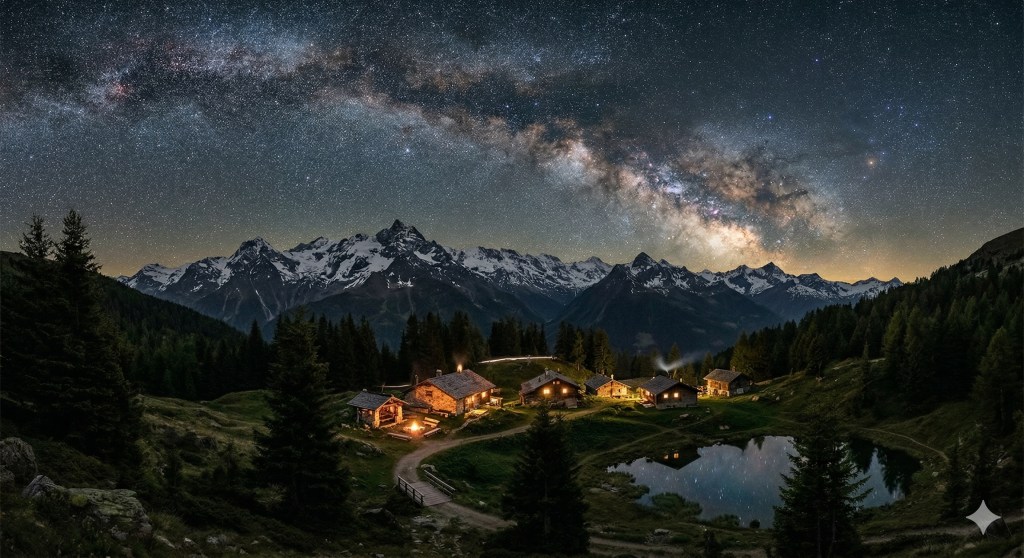
The Architecture of Darkness: A Multidisciplinary Analysis of Quranic Oaths by the Night
Presented by Zia H Shah MD with help of Gemini
Abstract
The phenomenon of the dark night sky, while frequently relegated to the realm of the mundane through the “anesthesia of familiarity,” serves as a profound ontological and cosmological witness within the Quranic discourse. By invoking the night as a solemn oath (qasam), the Quranic text bridges the observable world (Alam al-Shahadah) and the unseen realities (Alam al-Ghayb), utilizing natural regularity as a signature of divine volition and an anchor for eschatological certainty. This research report provides a comprehensive scientific, philosophical, and theological commentary on the seventy-five oaths in the Quran, with a focused exegesis of the specific verses sworn by the night. Through the resolution of Olbers’ Paradox and the exploration of circadian biology, atmospheric science, and occasionalist metaphysics, the night is revealed not as a mere absence of light, but as a deliberate, “enshrouding” mechanism that protects biological life and testifies to the finitude of a universe designed with intentionality. By synthesizing classical exegesis with modern astrophysics, this analysis demonstrates that Quranic oaths function as “prophetic signatures” that harmonize the “Book of Nature” with the “Book of Scripture”.
The Nomological Fabric of Quranic Oaths: The Seventy-Five Pledges of the Creator
In the cultural and linguistic milieu of seventh-century Arabia, the oath (qasam) was an established rhetorical instrument used to validate claims of supreme importance and to capture the immediate attention of the listener. While Islamic tradition strictly forbids humans from swearing by anything other than the Creator, the Quran presents a unique theological paradigm where God swears by various aspects of His own creation. There are approximately seventy-five such oaths recorded in the Quran, encompassing a vast array of natural and metaphysical phenomena. These oaths are not mere ornaments of speech; they are structural components of the Makkan Surahs, designed to “weight” the message and establish a cosmic backdrop for the moral and spiritual lessons that follow.
The seventy-five oaths can be categorized into four primary thematic clusters, each serving a distinct theological objective. The frequency and diversity of these oaths suggest that the entire universe is a “summons to attention,” directing the human intellect toward the harmony of the natural order as proof of Tawhid (monotheism).
Classification of the 75 Quranic Oaths
| Category | Primary Focus | Representative Oaths | Theological Objective |
|---|---|---|---|
| Cosmological | Order, Scale, and Fine-Tuning | Sun, Moon, Stars, Heavens, Orbits | Proof of Divine Governance and the Singularity of the Creator |
| Temporal | Regularity, Change, and Cycles | Day, Night, Dawn, Twilight, Time (Al-Asr) | Proof of the Hereafter, Resurrection, and the Inevitability of Judgment |
| Biological | Complexity, Duality, and Information | Male/Female, Human Soul, Body, Progeny | Proof of Divine Volition, Ethics, and the “Perfect Design” of Life |
| Metaphysical | The Unseen and Revelation | Seen/Unseen, Pen, Written Record, Angels | Proof of the Divine Origin of the Quran and Information Conservation |
Theologically, these oaths function as “evidence exhibits” in a divine court of law, where the created order is called to testify to the truth of the message of monotheism and accountability. Philosophically, they suggest a duality and purposeful pairing inherent in the universe—light and darkness, male and female, sky and earth—implying that the cosmos is not chaotic but follows intentional rhythms and laws that are accessible to a “rational person” (dhi hijr).
The transition between these categories often highlights the relationship between the macrocosm (the universe) and the microcosm (the human soul). For instance, oaths by the sun and moon in Surah Ash-Shams are immediately followed by an oath by the human soul, suggesting that the same power that governs the celestial furnace is responsible for the moral intuition of the human being. This integration serves to sacralize the natural world, transforming scientific observation into an act of Tasbih (glorification).
The Rhetoric of the Night: Darkness as a Witness to Truth
Within the corpus of seventy-five oaths, the night (Al-Lail) holds a position of particular prominence. It is frequently invoked to emphasize spiritual truths, moral contrasts, or the certainty of revelation. These oaths typically appear in the short, rhythmic chapters near the end of the Quran, where the urgent tone of the Makkan period reflects the initial challenge to pagan Arabian society.
The polarity of night and day is used as a rhetorical framework for three primary claims: the singularity of divine governance (Tawhid), the certainty of the afterlife (Akhirah), and the integrity of prophetic revelation (Wahy). Unlike the day, which represents clarity and manifest activity, the night represents the “unseen” aspects of existence—the Ghaib. Oaths by the night challenge the listener to consider the reality beyond sensory perception, suggesting that just as the night hides the world but reveals the stars, the “darkness” of the current life may be a veil that will eventually be lifted to reveal the greater reality of the hereafter.
| Surah and Verse | Key Arabic Terminology | Functional Metaphor |
|---|---|---|
| 92:1 (Al-Lail) | Yaghsha (Enshrouding) | The Protective Veil of Rest and Order |
| 91:4 (Ash-Shams) | Yaghshaha (Veiling the Sun) | The Localized Nature of Light and Finitude |
| 89:4 (Al-Fajr) | Yasri (Passing/Receding) | The Transience of Darkness and Trial |
| 93:2 (Ad-Duha) | Saja (Stillness/Calm) | Sanctuary, Reassurance, and Recovery |
| 81:17 (At-Takwir) | ‘As’asa (Closing in/Departing) | The Dynamics of Transition and Revelation |
| 84:17 (Al-Inshiqaq) | Wasaqa (Enveloping/Gathering) | Eschatological Collection and Accountability |
| 74:33 (Al-Muddaththir) | Adbara (Retreating) | The Inevitable Yielding of Ignorance to Light |
Surah Al-Lail (92:1): The Enveloping Mechanism and Thermal Regulation
Arabic Text: وَٱلَّيْلِ إِذَا يَغْشَىٰ English Translation: By the night when it covers.
Linguistic and Theological Commentary
In the opening of Surah Al-Lail, the term yaghsha (from the triliteral root Gh−Sh−Y) conveys the action of covering, enveloping, or enshrouding something completely. In classical exegesis, this is understood as the night spreading its darkness over the earth, effectively “hiding” the light of the sun. Theologically, this oath establishes a parallel between the purposeful order found in nature and the moral order of human existence. Just as the night and day follow a strict and beneficial cycle, human efforts follow a diverse path (sa’yakum lashatta) that leads either to ease and happiness or to hardship and ruin.
The Surah contrasts two moral archetypes: the generous, God-conscious soul who “gives and fears Allah” and the selfish, heedless soul who “withholds and considers himself free of need”. The “night” here serves as a metaphor for the period of concealment—the current life where deeds are often hidden—while the “day” symbolizes the ultimate exposure of these deeds in the hereafter.
Scientific Commentary: The Planetary Thermal Blanket
From a scientific perspective, the “enshrouding” described by yaghsha relates to the Earth’s rotation and the subsequent onset of night, which acts as a vital thermal regulator. The Earth’s atmosphere and the daily cycle of darkness are prerequisites for life on a planetary scale.
- Thermal Blanket Effect: The night prevents the rapid loss of heat into the vacuum of space. Without the regular “covering” of the earth by the atmosphere’s darkness, the side of the planet facing away from the sun would experience extreme drops in temperature, while the sun-facing side would be incinerated.
- Planetary Rotation: The oath highlights the regularity of Earth’s rotation on its axis. The precision of this 24-hour cycle is what allows for moderate temperature distributions necessary for a liquid-water-based biosphere.
- Biological Synchronization: The “covering” of the night is essential for the circadian rhythms of almost all terrestrial organisms. Light and darkness serve as the primary “Zeitgebers” (time-givers) that reset the biological clocks of plants, animals, and humans.
Philosophical Insight: Occasionalism and Divine Habit
The commentary on Surah Al-Lail often integrates the theological doctrine of occasionalism, as advocated by Abu Hamid al-Ghazali. This doctrine posits that natural laws—such as the rising of the sun or the onset of night—possess no inherent, independent causal power. Instead, God creates the effect (night) at the moment of the cause (rotation). In this view, the “laws of physics” are actually “Divine Habits” (Sunnat Allah). The reliability of the night is not a brute fact of matter but a continuous act of divine volition that allows humans to navigate the world with predictability.
Surah Ash-Shams (91:4): The Veiling of the Solar Furnace
Arabic Text: وَٱلَّيْلِ إِذَا يَغْشَىٰهَا English Translation: And the night when it draws a veil over it.
Linguistic and Scientific Commentary: The Localized Shadow
In Surah Ash-Shams, the feminine pronoun ha in yaghshaha refers specifically to the sun (ash-shams). While the day “exposes” or “reveals” the sun, the night “veils” it. This linguistic distinction points toward a sophisticated cosmological reality: the “night” is not an object in itself but is the Earth’s own shadow moving through the persistent light of space.
- The Vacuum of Space: Cosmologically, this verse acknowledges that the “heavens” are inherently dark. As noted in Surah An-Nazi’at (79:29), the night of the heavens was “darkened” (aghtasha laylaha). Daylight is a localized phenomenon produced only where a nearby star’s light interacts with an atmosphere. The “night” veils the sun only from the perspective of an observer on a rotating planet.
- Solar Physics: The oath by the sun and its brightness (duhahaha) refers to the sun as a “blazing lamp” (siraˉj wahhaˉj). Modern astrophysics identifies the sun as a G2V yellow dwarf star—a nuclear furnace where hydrogen nuclei fuse into helium at 15 million °C. The sun converts approximately 4.26 million tons of mass into energy every second (E=mc2).
- Fine-Tuning: The stability of this nuclear process for billions of years is governed by the “fine-tuning” of physical constants. If the strong nuclear force or the gravitational constant varied by even a fraction of a percent, stars would either explode or fail to ignite. The oath by the night “veiling” this immense power reminds humanity of the “perfect design” that allows such a furnace to exist without destroying the life it sustains.
Philosophical Commentary: The Anesthesia of Familiarity
The darkness of the night sky serves a teleological purpose by preventing the “anesthesia of familiarity”—a psychological state where the repetition of natural phenomena prevents observers from recognizing their cosmic significance. By “veiling” the sun, the night allows humanity to see the distant stars and galaxies that are hidden during the day by the sun’s glare. The night is thus a “veil” that reveals a deeper reality, shifting human focus from the local (the sun) to the universal (the cosmos).
Surah Al-Fajr (89:2 & 89:4): Sacred Rhythms and the Passing of Empires
Arabic Text (89:2): وَلَيَالٍ عَشْرٍ English Translation: And [by] ten nights.
Arabic Text (89:4): وَٱلَّيْلِ إِذَا يَسْرِ English Translation: And [by] the night when it passes.
Theological and Historical Commentary: The Vigilance of Time
The oaths in Surah Al-Fajr point toward specific temporal durations and the transience of trial. The “ten nights” are traditionally interpreted as the final nights of Ramadan or the first ten nights of Dhu al-Hijjah, signifying “sacred rhythms” within human timekeeping. These nights represent periods of heightened spiritual awareness where the boundary between the seen and unseen is perceived to be thinner.
The oath by the night “when it passes” or “recedes” (yasri) serves as an analogical evidence for the temporary nature of human oppression. The Surah immediately transitions into a historical account of the people of ‘Aad, Thamud, and Pharaoh—mighty civilizations that “transgressed throughout the land” but were eventually swept away by the “scourge of punishment”. The passing of the night is a “sign” (ayah) that the darkness of tyranny must inevitably yield to the dawn of divine justice.
Scientific Insight: The Cosmological Redshift
From a multidisciplinary perspective, the concept of the night “passing” or “moving” (yasri comes from the root S−R−Y, meaning to travel by night) resonates with the dynamic nature of the universe.
- Cosmic Expansion: Modern cosmology, as mentioned in Surah Adh-Dhariyat (51:47), confirms that the universe is not static but is expanding.
- Redshift: As galaxies move away from us, the light they emit is “stretched” toward the red end of the spectrum. Distant light eventually moves out of the visible range entirely into the infrared, contributing to the darkness of the night. In this sense, the light “passes” into the invisible, a physical manifestation of the night “travelling” or receding.
- Temporal Finitude: The fact that the night sky is dark is a proof that the universe is not infinite and eternal (Olbers’ Paradox). If it were, the night would never “pass”; it would be eternally bright with the flux of infinite stars.
Surah Ad-Duha (93:2): The Stillness of Sanctuary and Chronobiology
Arabic Text: وَٱلَّيْلِ إِذَا سَجَىٰ English Translation: And [by] the night when it settles [or becomes still].
Theological Commentary: Reassurance and the Prophet’s Heart
Surah Ad-Duha was revealed during a period when prophetic revelation (Wahy) had temporarily ceased, causing the Prophet Muhammad (peace be upon him) distress and inviting the mockery of his enemies who claimed God had “abandoned” him. The oath by the “morning brightness” (Ad-Duha) followed by the “night when it settles” (saja) serves as a divine reassurance. Just as the stillness of the night is a necessary pause before the brightness of the morning, the pause in revelation was a necessary period of rest and preparation for the greater tasks ahead.
Scientific Commentary: The Biology of Rest
The term saja implies a profound stillness and calm. This “stillness” of the night is not merely a social convention but a biological necessity rooted in human and animal physiology.
- Melatonin and the Pineal Gland: Darkness is the physiological trigger for the pineal gland to release melatonin. This hormone is essential for initiating sleep and regulating the body’s “quiet clock”.
- Cellular Repair and Immunity: During the “stillness” of night, the body undergoes critical metabolic repair. Growth hormones are released, and the immune system is bolstered. The Quranic oath by the night’s stillness finds a modern parallel in the discovery that a lack of biological “night” (sleep deprivation) leads to profound cognitive and physical breakdown.
- The Architecture of the Night: Research into chronobiology suggests that the night serves as a foundational matrix for “moral, spiritual, and psychological individuation”. The stillness provides the sanctuary required for the consolidation of memory and the processing of emotion—a biological echo of the prophetic “pause” for reflection.
Surah At-Takwir (81:17): The Liminal Transition and Atmospheric Breathing
Arabic Text: وَٱلَّيْلِ إِذَا عَسْعَسَ English Translation: And [by] the night as it closes in [or departs].
Linguistic Commentary: The Contronym (Didd)
The term ‘as’asa is a rare Arabic contronym, a word that possesses two opposite meanings: it can refer to the night as it approaches (closes in) or as it departs (fades away). This dual meaning is scientifically and poetically significant, as it captures the “transition regime” of the atmosphere—the twilight and dawn where light and darkness are in flux.
Scientific Commentary: The Breathing Biosphere
The oath by the night ‘as’asa is immediately followed by verse 81:18: “And by the dawn when it breathes” (wa-al-subhi idha tanaffasa).
- Photosynthesis: The term tanaffasa (breathing) provides a striking alignment with the carbon-oxygen exchange of the biosphere. At dawn, as the night “departs,” plants begin the process of photosynthesis, utilizing sunlight to convert CO2 into oxygen. The world literally begins to “breathe” out oxygen as the first rays of light strike the leaves.
- Atmospheric Pressure: The “closing in” of the night also relates to the cooling of the atmosphere, which leads to changes in air pressure and the “breathing” of wind patterns. The subjection (taskhir) of these patterns is cited as a sign of divine governance.
- Transition of Revelation: Theologically, this transition from the uncertainty of the “closing” night to the “breathing” dawn mirrors the transition from spiritual ignorance to the clarity of the Quranic message. The revelation is presented as a “noble” word that brings life to a dead world, just as the dawn brings oxygen to the biosphere.
Surah Al-Inshiqaq (84:17): The Enveloping of the Collected
Arabic Text: وَٱلَّيْلِ وَمَا وَسَقَ English Translation: And [by] the night and what it envelops [or gathers].
Theological and Scientific Commentary: The Invisible Gathering
The term wasaqa means to gather, collect, or drive together. Traditionally, this refers to the gathering of animals to their shelters and humans to their homes as the night falls.
- Microbial Dark Matter: From a modern multidisciplinary perspective, the “unseen” things that the night gathers include “Microbial Dark Matter”—the 99% of microbial species on Earth that cannot be cultured in labs and remained hidden until the advent of metagenomics. These organisms govern global ecosystems but were unknown at the time of the Quranic revelation. The oath by the night and “what it gathers” encompasses these hidden dimensions of life.
- Information Conservation: The “gathering” of the night is a metaphor for the total recording of existence. As explored in the multidisciplinary research on the “Physics of Recorded Deeds,” no informational state is ever truly lost. Just as the night gathers the activities of the day into a “collected” state of rest, the divine record (Lawh Mahfuz) preserves the totality of human history.
- Eschatological Shock: The gathering of the night serves as a tangible analogy for the “Resurrection” and the “Day of Judgment” (Akhirah). The “awakening of the world” at dawn after the “gathering” of the night provides a daily witness to the possibility of life being restored after death.
Surah Al-Muddaththir (74:33): The Retreating Veil of Ignorance
Arabic Text: وَٱلَّيْلِ إِذَا أَدْبَرَ English Translation: And [by] the night when it departs.
Theological Commentary: The Final Departure
In Surah Al-Muddaththir, the oath by the “retreating” night (adbara) occurs in the context of a powerful warning regarding the “great” reality of the hereafter. The retreating night symbolizes the end of the period of testing—the current life—where the truth was often obscured by the darkness of doubt and denial.
- The Inevitability of Light: Just as the rotation of the Earth makes the departure of the night an astronomical certainty, the Quran argues that the Day of Judgment is a mathematical and moral inevitability.
- The “Great One” (Al-Kubra): The surah describes the judgment as “one of the greatest” things (innaha la-ihda al-kubar). The retreating night acts as the final veil being pulled back to reveal the ultimate ontological reality.
Cosmological Deep Dive: Olbers’ Paradox and the “Darkened” Night
The darkness of the night sky, while seemingly intuitive, represents one of the most profound observational constraints in the history of physical cosmology. Known as Olbers’ Paradox, the question of why the night is not as bright as the surface of the sun challenges the assumptions of an infinite, static, and eternal universe.
The Mathematical Problem
If the universe were infinite in extent and populated by an infinite number of stars distributed uniformly, every line of sight from an observer on Earth would eventually terminate on the surface of a star. Mathematically, the flux of light from a shell of stars at distance r would be:
F=4πr2L×(n⋅4πr2dr)=L⋅n⋅dr
where L is the average stellar luminosity and n is the density of stars. Integrating this from zero to infinity leads to an infinite brightness, or at least a night sky as bright as the surface of the sun.
The Scientific Resolution
The modern resolution of this paradox, synthesized with the Quranic narrative of the “darkened night” (aghtasha laylaha in 79:29), provides evidence for a created and dynamic universe.
- The Big Bang and Finite Age: The universe has a beginning (approximately 13.8 billion years ago). Because the speed of light (c) is finite, we can only see light from stars within our “cosmic horizon.” Light from more distant stars has simply not had enough time to reach us. This aligns with the Quranic concept of a “creation” (khalaqa) that initiated in time.
- The Expansion of the Universe: As galaxies move away from us (Hubble expansion), their light is redshifted. The energy of the photons is reduced, and they move from the visible spectrum into the infrared. This “darkens” the contribution of distant stars to the night sky.
- Finite Stellar Lifetimes: Lord Kelvin noted that even if the universe were infinite, stars do not have enough fuel to shine forever. They eventually exhaust their nuclear fuel and “die,” contributing to the darkness.
- The Inverse-Square Law: The disparity in apparent brightness between the local sun and distant stars is immense. The sun outshines Sirius, the brightest star in the night sky, by over 13 billion times purely due to the inverse-square law of light.
The Quranic Synthesis
The Quran’s use of the term aghtasha in Surah An-Nazi’at (79:27-29) is linguistically precise. It refers to making something “extremely dark.” Modern science confirms that the “heavens” are indeed extremely dark; the “light” we see during the day is a localized scattering effect of our atmosphere. The darkness of the night sky is a cosmological “signal” that the universe is finite, has a beginning, and is expanding—truths that the Quran invoked through the mechanism of the oath 1,400 years ago.
Philosophy of the Seen and the Unseen: The Plenitude of Being
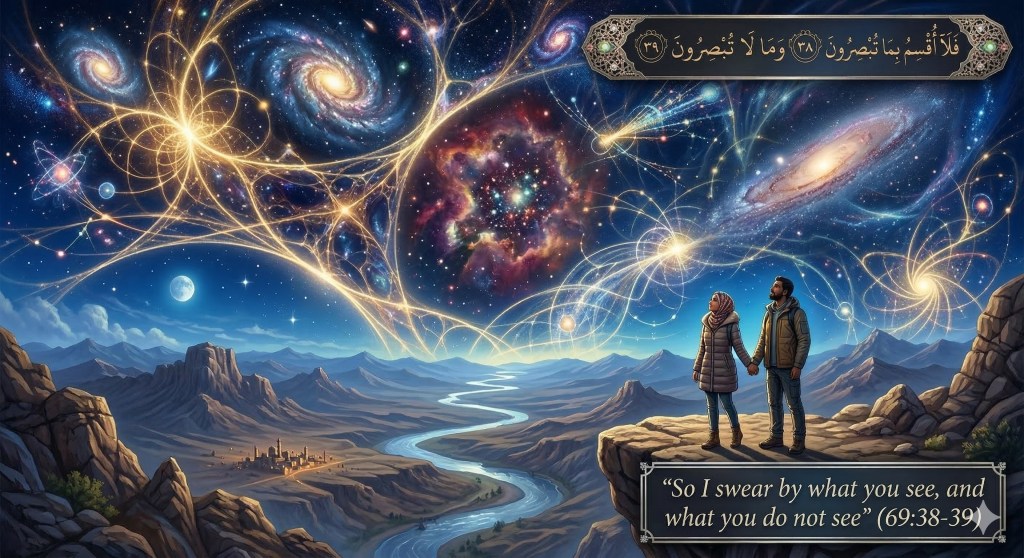
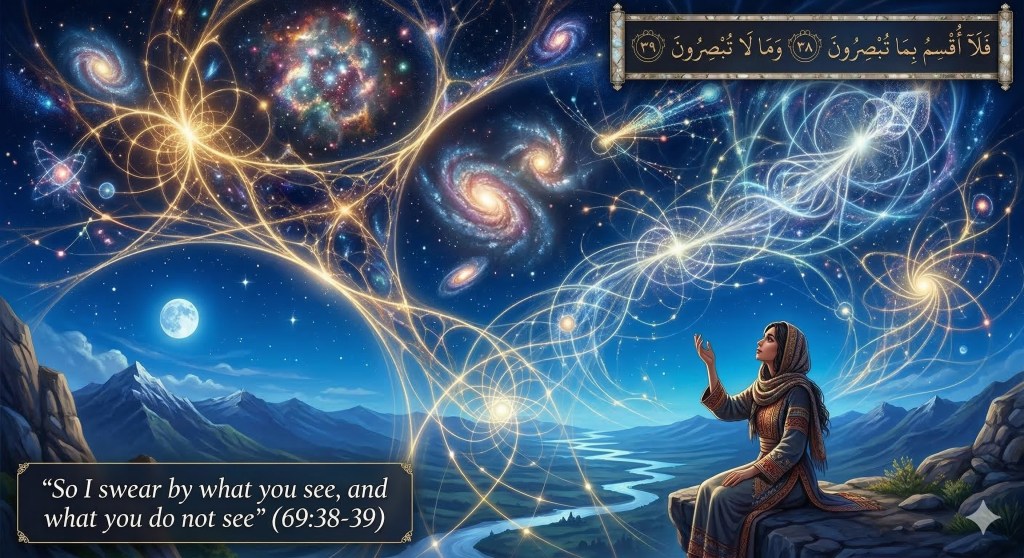
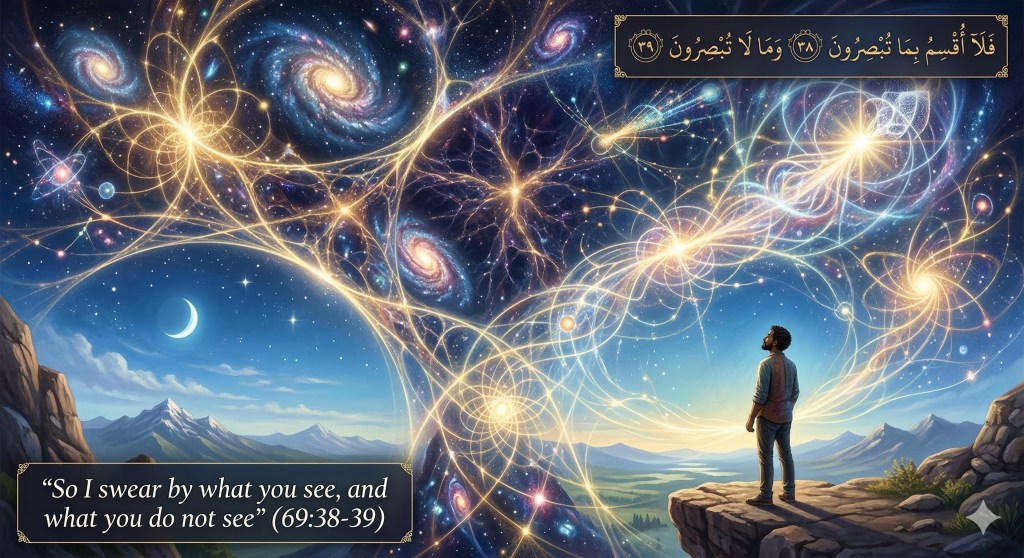
The Quranic oaths often converge on the formula: “So I swear by what you see and what you do not see” (69:38-39). This oath encompasses the entirety of creation, asserting that the hidden reality is a “plenitude of being” far vaster than the perceivable world.
Scientific Dimensions of the Unseen
Zia H. Shah MD argues that the category of “what you do not see” has expanded exponentially with modern scientific discovery.
- Dark Matter and Dark Energy: Approximately 25-27% of the universe is composed of dark matter, and 68-71% is dark energy. These entities do not interact with electromagnetic radiation and are literally “that which you do not see,” yet they provide the gravitational scaffolding and expansionary force of the entire cosmos.
- Subatomic Realities: Neutrinos, quarks, and the quantum vacuum are invisible to the naked eye and even to most sensors, yet trillions of neutrinos pass through the human body every second.
- The Electromagnetic Spectrum: Humans perceive only a tiny sliver of light (∼400−700 nm). The “unseen” includes radio waves, microwaves, infrared, ultraviolet, X-rays, and gamma rays, which facilitate modern technology and biological processes.
Philosophical Lineage
The oath on the seen and unseen resonates with several foundational philosophical traditions:
- Plato’s Allegory of the Cave: Suggests that the “seen” world is a mere shadow of the “unseen” intelligible realm of Forms.
- Kant’s Noumenal World: Distinguishes between phenomena (things as they appear) and noumena (things-in-themselves), acknowledging that the most important realities lie beyond empirical intuition.
- Al-Ghazālī’s Hierarchy: Places revealed and mystical knowledge above sensory perception, noting that the senses can be deceived (e.g., a star appearing as a small point of light when it is actually a massive sun).
The night sky serves as the ultimate bridge between these realms. By “veiling” the sun, the night reveals the distant cosmos, allowing the human mind to transition from the immediate, visible world to the contemplation of the infinite and the unseen.
The Physics of Accountability: Information Theory and the Night
The multidisciplinary research of Zia H. Shah MD extends the theological concept of accountability into the realm of modern physics and information theory. The Quranic “oaths by the night” often serve as a preamble to verses about the preservation of deeds and the ultimate rendering of justice.
The Quantum Register of Deeds
| Quranic Concept | Information-Theoretic Parallel | Functional Description |
|---|---|---|
| Al-Lawh al-Mahfuz | Holographic Boundary | A secure source where all 3D history is encoded and preserved. |
| Mithqala Dharrah | Quantization | Accountability at the fundamental Planck-scale limit; no detail is too small. |
| La Yakhfawn | No-Hiding Theorem | In quantum mechanics, information cannot be destroyed; privacy is a “classical illusion”. |
| Kiraman Katibin | Environmental Decoherence | The act of “living” is the act of “writing” into the history of the universe through particle interaction. |
The night is presented as the time of “collection” (wasaqa) and “stillness” (saja), providing the ideal conditions for the human soul to reflect on its own informational weight. The “darkness” of the night serves as a metaphor for the period of “storage” before the “retrieval” and “rendering” of forgotten informational states on the Day of Resurrection.
Thematic Epilogue: The Unity of the Two Books
The seventy-five oaths in the Quran, with their profound focus on the night, constitute a “prophetic signature” for the modern age. These ancient scriptural pledges invite a rigorous investigation of natural phenomena that align with scientific realities—from the “breathing” of the dawn to the expansion of the universe and the dark matter of the heavens—which were only verified centuries later through modern technology.
The night is revealed not as a chaotic void or a simple absence of light, but as a sophisticated, calibrated architecture designed for biological rest, planetary temperature regulation, and cosmological revelation. By swearing by the night, the Creator directs the human soul from the visible regularity of the spinning earth toward the invisible truths of monotheism, the hereafter, and the divine origin of the revelation.
The synthesis of these oaths with modern astrophysics, philosophy, and theology leads to a unified worldview where scientific discovery is transformed into an act of Tasbih. Recognition of the “Architecture of Darkness” allows the modern observer to move from the “how” of physical mechanisms—such as Earth’s rotation or solar fusion—to the “why” of divine volition. In the silence of the dark night, the universe “speaks of its own finitude” and the power of the One who “wraps the night over the day” and maintains the flawless rhythm of existence. The night sky stands as a permanent challenge to human arrogance, reminding the reader that there will always be a dimension of reality—the Ghaib—that remains within the Knowledge of the Creator, fostering a sense of awe, humility, and accountability in the age of quantum physics and cosmology.

 The Glorious Quran and Science
Leave a comment