
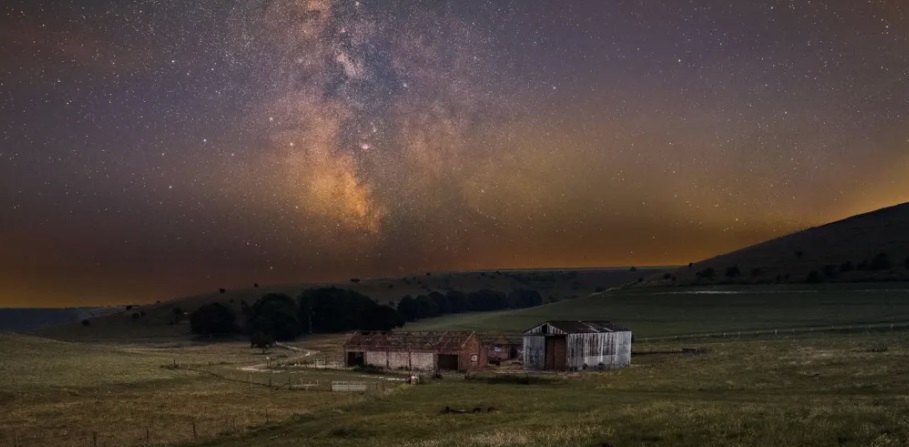
Night as Divine Oath in the Quran
Presented by Zia H Shah MD
Abstract
Among the Qur’an’s most concentrated rhetorical devices is the qasam—the divine oath—where familiar realities (night, dawn, sun, stars) are summoned as “testimony” for invisible but decisive truths: God’s oneness, the credibility of revelation, moral accountability, resurrection, and judgment. The cluster of oaths by the night occurs prominently in late Meccan-style passages whose rapid cadence and cosmic imagery are designed to arrest attention and re-frame ordinary experiences as signs (āyāt). This commentary examines all eight Qur’anic oath-occurrences that explicitly swear by “night” or “nights,” integrating classical exegetical anchors, philosophical analysis of oath-logic, and modern cosmological reflection—especially the question why the night sky is dark, a fact that became historically famous as “Olbers’ paradox.”
Corpus of the night oaths
The Qur’an contains eight specific oath-occurrences that explicitly invoke night (including plural “nights”): 92:1, 91:4, 89:2, 89:4, 93:2, 81:17, 84:17, 74:33. In each case, the night is not a decorative backdrop; it is placed as a witness whose physical properties (covering, stillness, passage, retreat) are meaningfully aligned with what the passage is trying to secure as truth (jawāb al-qasam, “answer to the oath”).
The same set also forms a coherent thematic arc: (i) moral contrast (92:1), (ii) ethical purification (91:4), (iii) sacred time and historical memory (89:2), (iv) transience and accountability (89:4), (v) prophetic reassurance (93:2), (vi) revelation’s credibility (81:17), (vii) human life as stages (84:17), and (viii) eschatological warning (74:33).
Oaths in the Quran as scientific, philosophical, and theological speech
What a Qur’anic oath is doing
In classical Arabic rhetoric, an oath is a recognized emphatic structure: an oath marker introduces an “object sworn by” (muqsam bihi), and then arrives at the “answer” or claim being underscored (jawāb al-qasam). As summarized in the scholarly discussion of Qur’anic oaths associated with Mustansir Mir, classical theorists (e.g., al-Zarkashī and al-Suyūṭī) characterize the oath as speech that confirms and intensifies a truth-claim; the object sworn by functions to weight the claim with seriousness and attention.
Why humans may not swear by creation—yet God does
A crucial theological asymmetry frames Qur’anic oaths: people are instructed not to swear by created things (ancestors, places, objects), but to swear by God—or remain silent. The well-known report in Sahih al-Bukhari forbids swearing by forefathers and directs the oath-taker to swear by God or be quiet. Likewise, Jami` at-Tirmidhi transmits the warning that swearing by other than God courts shirk (associating partners with God).
By contrast, the Creator’s oath by created phenomena is framed—both in classical and contemporary reflections—as a way to (a) assert sovereignty over creation and (b) elevate the sworn objects as signs that point beyond themselves. This is also why modern commentaries from The Glorious Quran and Science repeatedly describe Qur’anic oaths as a “summons to attention” that pushes from visible order to invisible truth, while cautioning that scripture is not a science textbook.
A note on “75 oaths”
A widely-circulated reflection by Adele Arbi in The Crescent (hosted on Medium) describes pausing at Qur’anic oaths as a practice that changes perception, and it claims to provide “a list of 75” oaths organized by “the seen and the unseen.” However, the article is marked “member-only,” and the accessible view does not expose the full list for verification here. Accordingly, what follows does not reproduce that inaccessible catalog; instead, it offers seventy-five distilled insights about Qur’anic oath-logic—anchored in accessible sources and classical/academic discussions—so that the conceptual payoff of “75” is delivered as interpretive understanding rather than as an unverifiable enumeration.
Seventy-five distilled insights on Qur’anic oaths
Method note: These insights synthesize the rhetorical framework described in the night/day testimony essays, the broader “nature’s testimony” thesis, and classical discussions of how the object sworn by relates to the claim sworn to (including the critique that older commentary sometimes overemphasized the object’s “excellence” without explaining its logical tie to the claim).
- A divine oath is a pedagogical shock: it forces attention onto what is normally ignored.
- The oath’s object is selected for relevance to the ensuing claim, not ornament.
- Qur’anic oaths treat nature as “courtroom testimony” for revelation.
- The oath bridges the visible (shahāda) and unseen (ghayb) without collapsing them.
- Oath-clusters compress a worldview into a few lines: cosmos → conscience → accountability.
- The jawāb al-qasam is the interpretive “center of gravity,” not the oath-object alone.
- Many Qur’anic oaths are “argumentative”: the sworn object is evidence, not merely venerated.
- “By X” often means: consider X carefully; it already contains a lesson.
- Oaths relocate certainty from social convention to cosmic intelligibility.
- The Qur’an’s oath-language “naturalizes” metaphysics: unseen truths are argued through seen order.
- Humans swear to borrow authority; God swears to display authority.
- Humans are restricted from swearing by creation to block veneration of creatures.
- God’s swearing by creation does not “license creature-worship,” but reframes creatures as signs.
- Repeated cosmic oaths cultivate an ethic of attention and gratitude rather than distraction.
- Oaths are a rhetoric of seriousness: they mark the following claim as existentially weighty.
- Night/day polarity functions as a moral grammar (concealment/disclosure; loss/salvation).
- The alternation of night and day is used as an argument for governance and providence.
- Night is frequently paired with day or dawn to embed contrast and reversibility.
- Oaths make recurring cycles (dawn after night) into analogies for resurrection.
- Oaths by “time” activate a theology of accountability: life is not an undirected flow.
- “Seen/unseen” oaths train epistemic humility: reality exceeds immediate perception.
- They also train epistemic confidence: the unseen can be rationally inferred from lawful effects.
- Modern science (microscope/telescope) provides an analogy for this Qur’anic epistemology.
- Oaths invite “reading the world” as intelligible, not random.
- They oppose both superstition and cynicism: nature is meaningful without being divine.
- Many oath-objects are mundane (night, dust, wind), teaching that meaning is not confined to the rare.
- The oath-object’s “familiarity” is part of its power: it can be personally verified by anyone.
- Oaths democratize evidence: you don’t need elite status to contemplate night and know it is real.
- Yet oaths also scale upward: the same night opens into astronomy and cosmology.
- This scaling models unity of truth: Creator of nature, Sender of revelation.
- Oaths are a rhetorical inheritance of Arabic oratory transformed toward monotheism.
- That transformation is philosophical: a known technique is turned into a moral-metaphysical summons.
- The Qur’an often clusters multiple oaths to create cumulative pressure on the listener.
- The cluster’s ordering often moves from cosmic → terrestrial → human interior.
- This ordering implies a hierarchy of signs culminating in moral responsibility.
- Some oaths rebut specific accusations (poetry, soothsaying) by invoking cosmic witnesses.
- Some oaths comfort the Prophet during social or psychological crisis.
- Some oaths anchor sacred time, tying worship to cosmic rhythm.
- Some oaths function as warning sirens before eschatological description.
- Some oaths function as “meta-oaths,” declaring the oath itself tremendous (e.g., by star-positions).
- Night-oaths are especially suited to inwardness: night reduces distraction and magnifies reflection.
- Night also symbolizes concealment: what is real may be present yet hidden.
- The sun’s concealment at night models that absence-from-view is not nonexistence.
- Night’s “stillness” models that silence can be part of providence, not abandonment.
- Night’s “passing” models time’s irreversibility—hence urgency of moral choice.
- Oaths tie theology to creation without reducing theology to physics.
- They cultivate a contemplative habit: pause, look, infer.
- They insist that moral truths are not “irrational add-ons” but cohere with cosmic order.
- They implicitly critique nihilism: a universe suitable for meaning is a universe suitable for accountability.
- They also critique idolatry: cosmic order points to governance, not to worship of the governed.
- The night sky’s darkness can be read as cosmological evidence against an eternal static cosmos.
- That cosmological “signal” aligns with the Qur’an’s use of creation as evidence that demands interpretation.
- The existence of a cosmic background (CMB) means “dark” is not “empty.”
- Hence night, in a scientific age, becomes doubly pedagogical: local darkness + cosmic history.
- Oaths thereby remain expandable: the same verse speaks to shepherd and astrophysicist differently.
- “Ten nights” integrates worship with calendrical time, forming communal moral memory.
- Such sacred nights show that time is not homogeneous; it can be morally “thick.”
- Oath-structures thereby sacralize attention, not mere chronology.
- The Qur’an can swear by derivatives of time (dawn, forenoon, night) to break “temporal numbness.”
- The oath’s purpose is not God acquiring certainty, but humans being jolted into certainty.
- In a philosophical register, oaths operate like phenomenological “restarts”: the world is re-seen.
- They expose “anesthesia of familiarity”: what is always present is least noticed.
- They transform metaphysics into ethics: if order is real, then responsibility is real.
- They also transform ethics into worship: gratitude is a rational response to provision.
- Oaths construct a bridge between intellect and devotion: thinking becomes a form of reverence.
- Night-oaths often precede claims about revelation, implying: the same God who orders night orders speech.
- Some night-oaths precede claims about judgment, implying: the same God who ends night ends history.
- Some night-oaths precede claims about moral divergence, implying: difference is written into both cosmos and conscience.
- Thus “night” can function as both mercy (rest) and warning (concealment), depending on context.
- Qur’anic oaths treat nature as an interpretive text—calling for tafsīr of the world.
- The Qur’an’s oath-technique implies coherence: truth is not confined to private feeling.
- Yet it also implies interiority: the “soul” can be sworn by as part of the evidence-chain.
- Oaths therefore address full humanity: senses, reason, imagination, conscience.
- The credibility of the Prophet is argued through cosmic signs rather than tribal power.
- Ultimately, Qur’anic oaths are not “extra decoration,” but a disciplined technology of awakening.
Commentary on every Qur’anic oath by the night
What follows treats each night-oath as a three-layer structure: text, rhetorical function (jawāb and linkage), and scientific/philosophical/theological expansion—including (where relevant) the cosmological meaning of darkness.
92:1
Arabic: وَٱلَّيْلِ إِذَا يَغْشَىٰ
English (Quran.com): “By the night when it covers,”
Immediate “answer to the oath” (jawāb):
Arabic: إِنَّ سَعْيَكُمْ لَشَتَّىٰ
English (Quran.com): “Surely the ends you strive for are diverse.”
Theologically, “covering” (yaghshā) is not simply darkness; it is the sign of a governance that wraps the world in alternating states. That alternation becomes moral argument: just as night and day are not the same, human striving is not morally uniform—some efforts open toward ease, others toward constriction (a contrast developed immediately after 92:4).
Philosophically, the verse turns a daily certainty into an epistemic template: the most reliable truths are often the ones so regular we stop noticing them. Here the oath functions as a deliberate de-familiarization: it re-introduces “night” as something significant enough to be sworn by, forcing the listener to ask what night is for and what it means.
Scientifically, the word “covers” resonates on two scales. Locally, night “covers” the land through Earth’s rotation, producing the dark interval that structures biological rest and timekeeping—an interpretive point modern essays explicitly connect to circadian order as part of providential design. Cosmologically, “covering” invites the deeper question: why is the vast sky itself mostly dark? The existence of darkness between stars is one of the classic arguments against an infinite, static, eternal universe (the core of Olbers’ paradox). In this way, the oath-object “night” can be read as a gateway from moral contrast to cosmological contingency: darkness is not merely a mood; it encodes the universe’s history.
91:4
Arabic: وَٱلَّيْلِ إِذَا يَغْشَىٰهَا
English (Quran.com): “and the night as it conceals it!”
Here night “conceals” the sun (the pronoun in context), emphasizing a subtle metaphysical lesson: concealment is not annihilation. The sun is not destroyed when it is hidden; it remains real, governing another horizon. That phenomenology becomes theological grammar: the unseen is not unreal simply because it is unseen—a principle made explicit in the Qur’anic oath of “seen and unseen,” which recruits all reality as testimony for revelation.
The moral “answer” of Sūrat al-Shams is not about astronomy but about the soul:
Arabic: قَدْ أَفْلَحَ مَن زَكَّىٰهَا
English (Quran.com): “Successful indeed is the one who purifies their soul,”
The linkage is not arbitrary. Classical and modern discussions of oath-logic insist that the object sworn by and the claim secured are “intimately connected.” Night conceals; day reveals; the soul likewise can be obscured by moral corrosion or clarified by purification. The oath thus creates a cosmic analogy for inner ethics: the way light is veiled yet recoverable models the way moral clarity can be veiled yet restored.
Scientifically, the verse also resonates with modern epistemology: invisibility does not imply nonexistence—radio waves, microbes, gravitational lensing, and cosmic background radiation are real though not directly perceived. That is why the “seen and unseen” oath is described as philosophically fertile for modern readers living after the telescope and modern physics.
89:2
Arabic: وَلَيَالٍ عَشْرٍۢ
English (Quran.com): “and the ten nights,”
Unlike the other night-oaths, this is plural and calendrical: it points to a marked span of sacred time rather than the nightly phenomenon in general. Classical tafsīr traditions (as represented in Maʿāriful-Qurʾān) commonly identify these as the first ten nights/days of Dhū al-Ḥijjah, associated with intensified worship and remembrance; multiple early authorities are named in that discussion, and supporting reports are mentioned in that exegetical tradition.
Philosophically, “ten nights” indicates that time is not only measurable but meaningful. Sacred time is “thickened time”: not that physics changes, but that value and orientation change. The oath therefore trains a theology of time: history is not indifferent; certain intervals are explicitly framed as moral and devotional opportunities.
Scientifically, there is a quiet invitation here as well: the reliable recurrence of lunar months and the visibility of night skies were essential for early calendrical life, navigation, and communal coordination. It is significant that many Qur’anic oaths involve precisely those repeatable patterns—because repeatability is what makes reality legible and thus usable as “testimony.”
89:4
Arabic: وَٱلَّيْلِ إِذَا يَسْرِ
English (Quran.com): “and the night when it passes!”
This oath emphasizes motion: night is not a static substance but a phase that travels on. Classical reports (as represented in Qur’an-commentary transmissions) gloss it as night “going away,” with one part removing another—an image of time’s irreversible flow.
The “answer” is framed as a rhetorical question:
Arabic: هَلْ فِى ذَٰلِكَ قَسَمٌ لِّذِى حِجْرٍ
English (Quran.com): “Is all this ˹not˺ a sufficient oath for those who have sense?”
The force here is epistemic and ethical: if a person has ḥijr (restraining intelligence), the mere observation of dawn, counted nights, and the passing of night should be sufficient to infer accountability. That is, the oath does not only persuade emotionally; it appeals to disciplined reason.
Scientific expansion of “passing” includes both daily and cosmic timescales. Daily: Earth’s rotation imposes a universal clock. Cosmic: the fact that the night sky is not ablaze with uniform starlight is evidence that the universe has a finite age and dynamic history, rather than being an eternally steady, infinite distribution of stars. In this perspective, “night passing” becomes an emblem for temporality itself—created time, not self-existent eternity.
93:2
Arabic: وَٱلَّيْلِ إِذَا سَجَىٰ
English (Quran.com): “and the night when it falls still!”
The oath’s keyword is not mainly darkness but stillness (sajā). In the surah’s lived context (as preserved in Islamic interpretive tradition), the passage is widely read as reassurance: apparent “silence” (including the experience of a pause) does not mean abandonment. The oath thus dignifies the quiet interval itself: silence is not empty; it can be mercy.
The “answer” makes that explicit:
Arabic: مَا وَدَّعَكَ رَبُّكَ وَمَا قَلَىٰ
English (Quran.com): “Your Lord ˹O Prophet˺ has not abandoned you, nor has He become hateful ˹of you˺.”
Philosophically, this is a theology of delay. Night’s stillness functions as a model for how meaning can be present even when it is not noisy. That is consistent with a broader Qur’anic oath-logic: the oath-object is carefully chosen because it contains, in itself, the structure of the claim being affirmed.
Scientific expansion can be offered without collapsing the verse into biology: stillness is also what makes night a privileged observational window. It is in quiet darkness that the sky becomes readable—yet even this “readability” includes the astonishing fact of darkness itself, which points to cosmic finitude rather than an eternal static cosmos. In that sense, night’s stillness becomes both psychological mercy and cosmological clue.
81:17
Arabic: وَٱلَّيْلِ إِذَا عَسْعَسَ
English (Quran.com): “and the night as it falls”
This oath appears within a cluster that explicitly aims to secure the credibility of revelation:
Arabic: إِنَّهُۥ لَقَوْلُ رَسُولٍ كَرِيمٍ
English (Quran.com): “Indeed, this ˹Quran˺ is the Word of ˹Allah delivered by Gabriel,˺ a noble messenger-angel,”
The logic is courtroom-like: cosmic regularities are recruited as witnesses for the claim that the Qur’an is not fabricated speech. The night here is portrayed dynamically (“as it falls”), aligned with the passage’s broader movement from visible signs (stars, night, dawn) to the invisible reality of revelation’s source.
Scientific reflection deepens the symbolism. “Night falling” evokes the onset of darkness, but modern physics adds: the universe’s darkness is not merely the sun’s absence. The classic argument insists that if the universe were infinite, static, and eternal, the night sky should be uniformly bright. The observed darkness functions as evidence for a universe with a beginning and an evolving history. If so, the oath by night participates—at least analogically—in a larger epistemology: nature bears witness to truths not immediately visible (origins, history, destination).
Cosmology of darkness and the night sky
Olbers’ paradox and what “darkness” means
Encyclopaedia Britannica explains Olbers’ paradox in its classic form: in an endless, uniformly populated universe, every line of sight should end on a star, so the night sky should have no dark gaps—contrary to observation. The conceptual sting is that darkness is not simply “absence”; it is an observational constraint on cosmological models.
Modern cosmology resolves this tension primarily through (i) the universe’s finite age and (ii) cosmic expansion/redshift, which shifts much ancient light out of visible wavelengths. The measured age in the standard cosmological model is ~13.8 billion years, and the Planck collaboration’s parameter tables quantify it near 13.797 ± 0.023 Gyr in a baseline ΛCDM fit (with model/likelihood variations).
Darkness is therefore “structured”: the night sky is not a blank void but contains a faint, nearly-uniform cosmic microwave background. NASA’s documentation of COBE/FIRAS describes the CMB spectrum as an almost perfect blackbody with temperature about 2.725 K, a key observational pillar of the hot Big Bang model. That means: the universe is not dark because nothing exists; it is “dark” to the eye because much cosmic radiation is outside visible range, and because finite time limits how much starlight can reach us.
Why this matters for Qur’anic night oaths
The essays on “dark nights” argue that the darkness people take for granted can be read as a cosmological signal: if the universe were infinitely old and static, night would not look like this. Philosophically, this modern insight resonates with the Qur’an’s oath-logic: ordinary phenomena are re-presented as evidence that should break habituation and re-open wonder. The night-oaths thus become, for a modern reader, invitations to two layers of contemplation simultaneously:
- Local phenomenology: night covers, stills, passes, retreats—structuring life, perception, and moral rhythm.
- Cosmic history: darkness and faint background radiation encode a universe with a history and a horizon, not an eternally steady scene.
Importantly, the most careful modern multidisciplinary readings insist that this does not reduce revelation to physics; rather, it expands the oath’s “summons to attention” by showing that deeper layers of meaning can emerge as knowledge grows.
Thematic epilogue
The Qur’anic oath by the night is best read as a disciplined spiritual philosophy of attention. Night is the world’s daily reminder that reality comes in phases: concealment and disclosure, rest and striving, silence and speech, warning and mercy. When the Qur’an swears by night, it teaches that the visible world is already saturated with intelligible signs—and that intelligence itself (the capacity to infer unseen governance from seen order) is part of what makes humans morally accountable.
Modern cosmology adds a further, unintended but fitting resonance: the darkness of the night sky is not a trivial absence but a deep clue to cosmic finitude and history. In that sense, night becomes a convergence point of the Qur’an’s three great emphases in oath passages—tawḥīd (a single governance), resurrection/judgment (history has an end and meaning), and revelation (truth is not a human improvisation but a claim placed under the witness of the cosmos).



 The Glorious Quran and Science
Leave a comment