
Presented by Zia H Shah MD
Abstract
Surah Al-Imran, verse 154, serves as a profound metaphysical anchor in the aftermath of the Battle of Uhud. It addresses the psychological and spiritual state of the believers and the hypocrites, distinguishing between those who found peace in divine providence and those consumed by self-interest and doubt. Theologically, the verse asserts the absolute sovereignty of God’s decree (Qadar), suggesting that while human agency exists, it is nested within a broader, immutable divine framework. Philosophically, it challenges the notion of “what if” by positing that life and death are governed by a supreme governance that transcends physical location or tactical choice. This commentary explores the verse through the lens of Occasionalism and the interplay between human will and divine predestination.
The Arabic Text
ثُمَّ أَنزَلَ عَلَيْكُم مِّن بَعْدِ الْغَمِّ أَمَنَةً نُّعَاسًا يَغْشَىٰ طَائِفَةً مِّنكُمْ ۖ وَطَائِفَةٌ قَدْ أَهَمَّتْهُمْ أَنفُسُهُمْ يَظُنُّونَ بِاللَّهِ غَيْرَ الْحَقِّ ظَنَّ الْجَاهِلِيَّةِ ۖ يَقُولُونَ هَل لَّنَا مِنَ الْأَمْرِ مِن شَيْءٍ ۗ قُلْ إِنَّ الْأَمْرَ كُلَّهُ لِلَّهِ ۗ يُخْفُونَ فِي أَنفُسِهِم مَّا لَا يُبْدُونَ لَكَ ۖ يَقُولُونَ لَوْ كَانَ لَنَا مِنَ الْأَمْرِ شَيْءٌ مَّا قُتِلْنَا هَاهُنَا ۗ قُل لَّوْ كُنتُمْ فِي بُيُوتِكُمْ لَبَرَزَ الَّذِينَ كُتِبَ عَلَيْهِمُ الْقَتْلُ إِلَىٰ مَضَاجِعِهِمْ ۖ وَلِيَبْتَلِيَ اللَّهُ مَا فِي صُدُورِكُمْ وَلِيُمَحِّصَ مَا فِي قُلُوبِكُمْ ۗ وَاللَّهُ عَلِيمٌ بِذَاتِ الصُّدُورِ
Translations
MAS Abdel Haleem: “Then, after the distress, He sent down calm on you, a sleep that overtook some of you. Others, however, were anxious about themselves, thinking thoughts about God that were untrue—the thoughts of ignorance—saying, ‘Is any of this in our hands?’ Say, ‘Everything is in the hands of God.’ They hide in their hearts what they do not reveal to you, saying, ‘If we had had any say in this, we would not have been killed here.’ Say, ‘Even if you had stayed in your homes, those for whom death was ordained would have gone out to the place where they were to die.’ This was so that God might test what is in your chests and purge what is in your hearts. God knows exactly what is in people’s hearts.”
Pickthall: “Then, after grief, He sent down security for you. As slumber did it overcome a party of you, while (another) party, who were anxious on their own account, thought wrongly of Allah, the thought of ignorance, and said: Have we any part in the cause? Say (O Muhammad): The cause belongeth wholly to Allah. They hide within themselves that which they reveal not unto thee, and say: If we had had any part in the cause we should not have been slain here. Say: Even though ye had been in your houses, those unto whom killing was appointed would have gone forth to the places where they were slain, that Allah might try what is in your breasts and prove what is in your hearts. Allah is Aware of what is in the breasts (of men).”
Yusuf Ali: “After (the excitement) of the grief, He sent down calm on a band of you overcome with slumber, while another band was stirred to anxiety by their own selves, moved by wrong suspicions of Allah-suspicions due to ignorance. They said: ‘Have we any hand in the affair?’ Say thou: ‘Indeed, this affair is wholly Allah’s.’ They hide in their minds what they dare not reveal to thee. They say (to themselves): ‘If we had had anything to do with this affair, we should not have been in the slaughter here.’ Say: ‘Even if you had remained in your homes, those for whom death was decreed would certainly have gone forth to the place of their death’; that Allah might test what is in your breasts and purge what is in your hearts. For Allah knoweth well the secrets of your hearts.”
Personal Translation (Zia H Shah MD): “Then, after the sorrow, He sent down peace of mind upon you in the shape of a slumber that overcame a party of you. But there was another party who were anxious only concerning their own selves, they entertained false notions concerning Allah like the notions of the days of Ignorance. They muttered: Have we any say in matters of administration Tell them: All governance belongs to Allah. They conceal that in their minds which they disclose not to thee. They say: Had we any say in matters of administration, we would not have been slaughtered here. Say to them: Had you remained in your homes, surely those on whom fighting had been enjoined would have issued forth to the stations where they were to die. Thus would Allah’s decree have been carried out. Allah desired to test your secret thoughts and to purge that which was in your minds. Allah knows well that which passes through your minds.”
Philosophical and Theological Commentary
The Supremacy of Divine Decree over Human Agency
The verse highlights a pivotal moment in the Battle of Uhud. Following the initial setback and the ensuing chaos, the believers experienced a supernatural “slumber” or peace—a sign of divine reassurance. In contrast, those with weak faith were preoccupied with self-preservation, questioning the strategic decisions and harboring resentment.
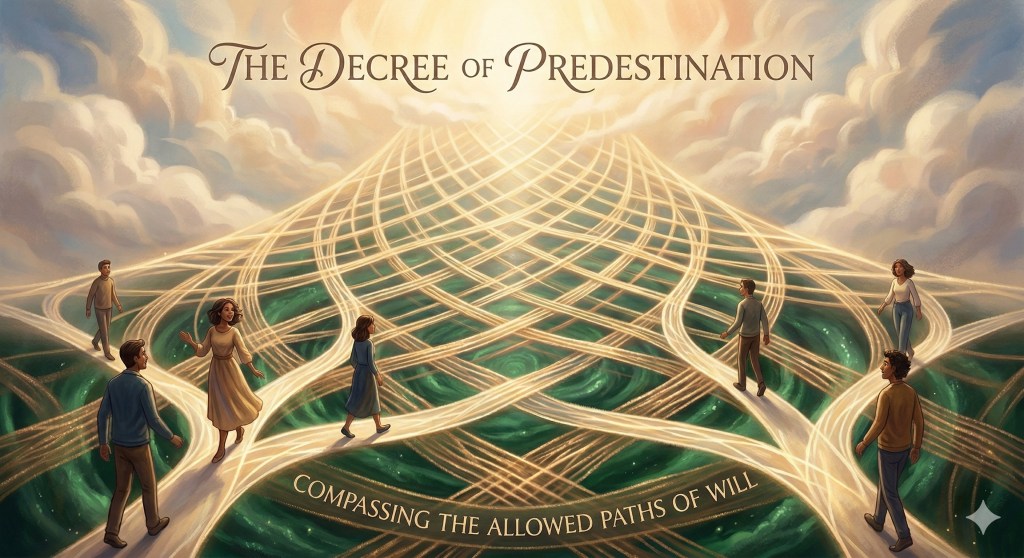
The core theological challenge presented here is the relationship between the human “say” (al-amr) and the Divine Governance. The dissenters argued that if they had been given a “say” in the administration of the battle, the tragedy could have been averted. The Quranic response is categorical: “All governance belongs to Allah.” This does not negate the existence of human will, but it establishes that human will is only meaningful within the domain of God’s decree. Free will acts as a psychological and moral testing ground, but it cannot override the ultimate outcomes ordained by God. The verse explicitly states that even if these individuals had stayed in their homes, the decree of death would have compelled those “on whom fighting had been enjoined” to go forth to their appointed end. This suggests that the ultimate milestones of human life—specifically death and the broader “administration” of universal events—are under the direct management of the Creator.
Testing and Purging the Soul
The purpose of this intersection between decree and agency is described as a “test” (ibtila) and a “purging” (tamhis). By allowing a situation where humans feel their agency is in conflict with reality, God exposes the contents of the heart. The “false notions of Ignorance” refer to the belief that human strategy is the primary cause of success or failure, independent of God. True faith acknowledges that while we must act with responsibility, the result is exclusively God’s domain.
Occasionalism and the Divine Governance
In the context of modern philosophy and science, this verse resonates deeply with the doctrine of Occasionalism. This school of thought, historically associated with the Ash’arites and later discussed in Western philosophy, posits that created substances (like humans or physical forces) are not the “efficient causes” of events. Instead, all events are caused directly by God.
As explored in the thequran.love, Occasionalism provides a bridge between classical theology and modern scientific understanding. In this framework, the laws of nature are not independent powers but are the “habits” or “sunnah” of God.
When the verse states, “All governance belongs to Allah,” it aligns with the Occasionalist view that there is no secondary causality that can act against the Divine Will. The “governance” mentioned is not just political or tactical; it is ontological. If God is the only true Cause, then human “free will” is the internal experience of making a choice, but the external realization of that choice is entirely dependent on God’s continuous creative act.
Science, therefore, becomes a source of commentary on the Quran. By studying the precision of physical laws, we are studying the consistency of God’s “governance.” The exponential growth in our understanding through AI and quantum physics further reveals that what we perceive as “chance” or “human error” is often part of a vast, complex web of Divine Decree that ensures the ultimate “test” of the soul is carried out.
Thematic Epilogue: The Harmony of Submission
The message of Quran 3:154 is ultimately one of liberating submission. By acknowledging that “all governance belongs to Allah,” the believer is freed from the paralyzing anxiety of “what if.” The tragedy of Uhud was not a failure of God’s plan, but a necessary crucible to refine the believers.
The supremacy of the Divine Decree does not render human effort useless; rather, it provides human effort with its true purpose: to serve as a witness to the state of one’s heart. When we realize that our free will is a gift exercised within the invincible domain of God’s sovereignty, we find the “peace of mind” mentioned in the verse. This realization bridges the gap between the material struggles of history and the eternal peace of the Divine Presence, ensuring that even in the face of slaughter or sorrow, the underlying reality is one of divine wisdom and mercy.



 The Glorious Quran and Science
Leave a comment