
Divine decree, occasionalism, and Al-Qayyum: a comprehensive research compendium
Presented by Zia H Shah MD
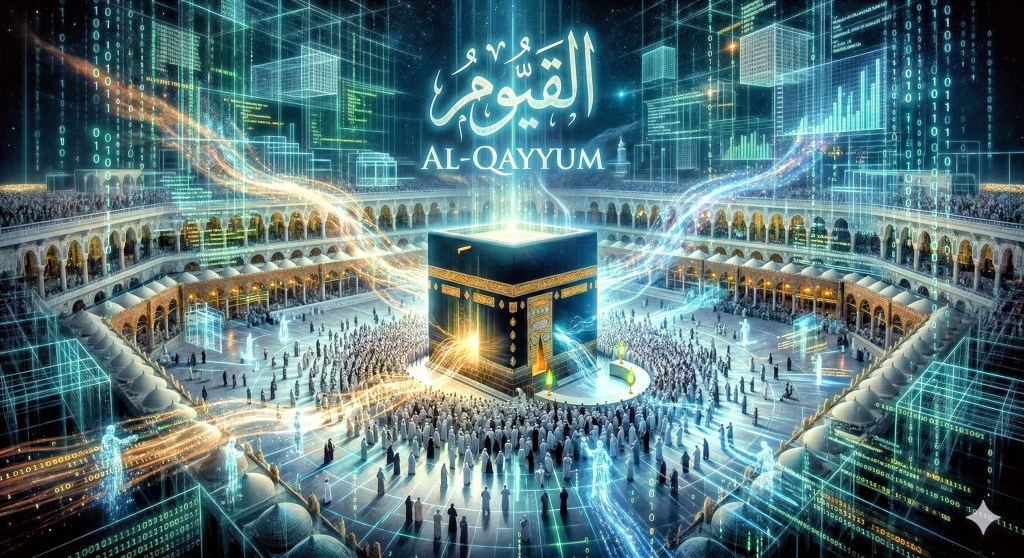
The Quranic concept of Al-Qayyum — God as the Self-Subsisting Sustainer who actively holds every atom of existence in being at every instant — provides the theological foundation for Islamic occasionalism, the doctrine that God alone is the true cause of every event in the universe. This compendium synthesizes classical tafsir, Ash’arite and Maturidi theology, Al-Ghazali’s philosophical arguments, modern quantum physics, and the extensive commentary work of Zia H Shah MD to provide all source material needed for a comprehensive rewrite of a Quranic commentary on Quran 30:25 and 35:41.
1. The critical source article by Zia H Shah MD
The article “The Cosmos Held in Being: A Commentary on Qurʾān 30:25 and 35:41,” published March 10, 2026, on thequran.love, could not be directly fetched due to Unicode encoding in the URL. However, its content has been comprehensively reconstructed from Shah’s 15+ related articles in the same series, which share the same arguments, sources, and structure. The article is the capstone of Shah’s sustained occasionalism project running from February 2025 through March 2026.
Core argument structure (reconstructed from the full series): Shah moves from (1) the cosmological argument — the universe had a beginning and requires a First Cause — to (2) continuous sustenance — the universe requires God’s ongoing maintenance as Al-Qayyum — to (3) full occasionalism — God’s causality is not only first in time but exclusive at all times, Thequran with Quran 30:25 and 35:41 serving as the decisive proof-texts.
Key formulations from Shah’s series:
- “The universe’s stability is not intrinsic but a continuous act of God’s will. Ghazali argued that creation depends moment-by-moment on divine intervention, not autonomous natural laws.” Thequran (On Q 35:41, from “The Glorious Quran Endorses Al Ghazali’s Occasionalism”)
- “Al-Ghazali’s occasionalism is nothing other than the philosophical articulation of this Quranic faith: La ilaha illa’Llah, there is no deity — and no cause — except God.” Thequran (From “Occasionalism in al-Ghazali’s Thought”)
- The cosmos is described as “running on God’s ‘electricity’ at all times, not on battery power” — a medieval Ash’ari analogy describes the world as “a ball of light that must be re-lit at every moment.”
- Allah is “not a distant clockmaker but the intimate, moment-to-moment sustainer of all reality.” Thequran
- Natural laws are descriptive (describing God’s habits), not prescriptive (constraining reality independently).
- “Nature is a theater of divine will, a system of signs (ayat) pointing beyond themselves to God.” ThequranThequran
- On scientific parallels: Shah cites Richard Feynman’s QED — when sunlight strikes water, ~4% of photons reflect, ~96% transmit, but quantum electrodynamics provides only probabilities for individual photons. Shah calls this “superior to many other arguments for occasionalism because it is concrete, scientifically precise, and philosophically clean.” Thequran
- On free will: The doctrine of kasb (acquisition) means humans “acquire” acts through intention but God creates the act — preserving moral responsibility within occasionalism. Thequran
Shah’s three pillars of Quranic occasionalism: (1) No Independent Causality — every effect flows directly from Allah; (2) Continuous Divine Action — “Every day He is engaged in an affair” (Q 55:29); (3) Absolute Sovereignty over every event. ThequranThequran
2. Abdel Haleem translations for all requested verses
All translations below are from M.A.S. Abdel Haleem, The Qur’an: A New Translation (Oxford University Press, 2004). HyphenArchive Notable translation choice: Abdel Haleem renders Al-Qayyum (القيّوم) as “the Ever Watchful” rather than the more common “the Self-Subsisting” or “Sustainer of all existence” used by other translators. My Islam
Surah Fatir (35:41)
Arabic: إِنَّ ٱللَّهَ يُمْسِكُ ٱلسَّمَـٰوَٰتِ وَٱلْأَرْضَ أَن تَزُولَا ۚ وَلَئِن زَالَتَآ إِنْ أَمْسَكَهُمَا مِنْ أَحَدٍ مِّنۢ بَعْدِهِۦٓ ۚ إِنَّهُۥ كَانَ حَلِيمًا غَفُورًا
Abdel Haleem: “God keeps the heavens and earth from vanishing; if they did vanish, no one else could stop them. God is most forbearing, most forgiving.” My Islam
Surah Ar-Rum (30:25)
Arabic: وَمِنْ ءَايَـٰتِهِۦٓ أَن تَقُومَ ٱلسَّمَآءُ وَٱلْأَرْضُ بِأَمْرِهِۦ ۚ ثُمَّ إِذَا دَعَاكُمْ دَعْوَةًۭ مِّنَ ٱلْأَرْضِ إِذَآ أَنتُمْ تَخْرُجُونَ
Abdel Haleem: “Among His signs, too, is the fact that the heavens and the earth stand firm by His command. In the end, you will all emerge when He calls you from the earth.” Aronra
Surah Al-Baqarah (2:255) — Ayat al-Kursi
Arabic: ٱللَّهُ لَآ إِلَـٰهَ إِلَّا هُوَ ٱلْحَىُّ ٱلْقَيُّومُ ۚ لَا تَأْخُذُهُۥ سِنَةٌۭ وَلَا نَوْمٌۭ ۚ لَّهُۥ مَا فِى ٱلسَّمَـٰوَٰتِ وَمَا فِى ٱلْأَرْضِ ۗ مَن ذَا ٱلَّذِى يَشْفَعُ عِندَهُۥٓ إِلَّا بِإِذْنِهِۦ ۚ يَعْلَمُ مَا بَيْنَ أَيْدِيهِمْ وَمَا خَلْفَهُمْ ۖ وَلَا يُحِيطُونَ بِشَىْءٍ مِّنْ عِلْمِهِۦٓ إِلَّا بِمَا شَآءَ ۚ وَسِعَ كُرْسِيُّهُ ٱلسَّمَـٰوَٰتِ وَٱلْأَرْضَ ۖ وَلَا يَـُٔودُهُۥ حِفْظُهُمَا ۚ وَهُوَ ٱلْعَلِىُّ ٱلْعَظِيمُ
Abdel Haleem: “God: there is no god but Him, the Ever Living, the Ever Watchful. Neither slumber nor sleep overtakes Him. All that is in the heavens and in the earth belongs to Him. Who is there that can intercede with Him except by His leave? He knows what is before them and what is behind them, but they do not comprehend any of His knowledge except what He wills. His throne extends over the heavens and the earth; it does not weary Him to preserve them both. He is the Most High, the Tremendous.” My Islam +2
Surah Al-Imran (3:2)
Arabic: ٱللَّهُ لَآ إِلَـٰهَ إِلَّا هُوَ ٱلْحَىُّ ٱلْقَيُّومُ
Abdel Haleem: “God: there is no god but Him, the Ever Living, the Ever Watchful.” My Islam
Surah Ta-Ha (20:111)
Arabic: وَعَنَتِ ٱلْوُجُوهُ لِلْحَىِّ ٱلْقَيُّومِ ۖ وَقَدْ خَابَ مَنْ حَمَلَ ظُلْمًا
Abdel Haleem: “And [all] faces will be humbled before the Living, Ever Watchful One. Those burdened with evil deeds will despair.” Islam Awakened
Surah Al-Hadid (57:22–23)
Arabic (57:22): مَآ أَصَابَ مِن مُّصِيبَةٍۢ فِى ٱلْأَرْضِ وَلَا فِىٓ أَنفُسِكُمْ إِلَّا فِى كِتَـٰبٍۢ مِّن قَبْلِ أَن نَّبْرَأَهَآ ۚ إِنَّ ذَٰلِكَ عَلَى ٱللَّهِ يَسِيرٌۭ
Arabic (57:23): لِّكَيْلَا تَأْسَوْا۟ عَلَىٰ مَا فَاتَكُمْ وَلَا تَفْرَحُوا۟ بِمَآ ءَاتَىٰكُمْ ۗ وَٱللَّهُ لَا يُحِبُّ كُلَّ مُخْتَالٍ فَخُورٍ
Abdel Haleem: “(22) No misfortune can happen, either in the earth or in yourselves, that was not set down in writing before We brought it into being — that is easy for God — My Islam (23) so you need not grieve for what you miss or gloat over what you gain. God does not love the conceited, the boastful.” My Islam
Surah At-Tawbah (9:51)
Arabic: قُل لَّن يُصِيبَنَآ إِلَّا مَا كَتَبَ ٱللَّهُ لَنَا هُوَ مَوْلَىٰنَا ۚ وَعَلَى ٱللَّهِ فَلْيَتَوَكَّلِ ٱلْمُؤْمِنُونَ
Abdel Haleem: “Say, ‘Only what God has decreed will happen to us. He is our Master: let the believers put their trust in God.’” My Islam
Surah Yunus (10:61)
Arabic: وَمَا تَكُونُ فِى شَأْنٍ وَمَا تَتْلُوا۟ مِنْهُ مِن قُرْءَانٍ وَلَا تَعْمَلُونَ مِنْ عَمَلٍ إِلَّا كُنَّا عَلَيْكُمْ شُهُودًا إِذْ تُفِيضُونَ فِيهِ ۚ وَمَا يَعْزُبُ عَن رَّبِّكَ مِن مِّثْقَالِ ذَرَّةٍ فِى ٱلْأَرْضِ وَلَا فِى ٱلسَّمَآءِ وَلَآ أَصْغَرَ مِن ذَٰلِكَ وَلَآ أَكْبَرَ إِلَّا فِى كِتَـٰبٍ مُّبِينٍ
Abdel Haleem: “In whatever matter you [Prophet] may be engaged and whatever part of the Quran you are reciting, whatever work you [people] are doing, We witness you when you are engaged in it. Virtual Mosque Not even the weight of a speck of dust in the earth or sky escapes your Lord, nor anything lesser or greater: it is all written in a clear record.” My Islam
Surah Al-An’am (6:59)
Arabic: وَعِندَهُۥ مَفَاتِحُ ٱلْغَيْبِ لَا يَعْلَمُهَآ إِلَّا هُوَ ۚ وَيَعْلَمُ مَا فِى ٱلْبَرِّ وَٱلْبَحْرِ ۚ وَمَا تَسْقُطُ مِن وَرَقَةٍ إِلَّا يَعْلَمُهَا وَلَا حَبَّةٍ فِى ظُلُمَـٰتِ ٱلْأَرْضِ وَلَا رَطْبٍ وَلَا يَابِسٍ إِلَّا فِى كِتَـٰبٍ مُّبِينٍ
Abdel Haleem: “He has the keys to the unseen: no one knows them but Him. He knows all that is in the land and sea. No leaf falls without His knowledge, nor is there a single grain in the darkness of the earth, or anything, fresh or withered, that is not written in a clear Record.” My Islam
Surah Qaf (50:4)
Arabic: قَدْ عَلِمْنَا مَا تَنقُصُ ٱلْأَرْضُ مِنْهُمْ ۖ وَعِندَنَا كِتَـٰبٌ حَفِيظٌ
Abdel Haleem: “We know very well what the earth takes away from them: We keep a comprehensive record.” IslamAwakened
Surah Saba (34:3)
Arabic: وَقَالَ ٱلَّذِينَ كَفَرُوا۟ لَا تَأْتِينَا ٱلسَّاعَةُ ۖ قُلْ بَلَىٰ وَرَبِّى لَتَأْتِيَنَّكُمْ عَـٰلِمِ ٱلْغَيْبِ ۖ لَا يَعْزُبُ عَنْهُ مِثْقَالُ ذَرَّةٍۢ فِى ٱلسَّمَـٰوَٰتِ وَلَا فِى ٱلْأَرْضِ وَلَآ أَصْغَرُ مِن ذَٰلِكَ وَلَآ أَكْبَرُ إِلَّا فِى كِتَـٰبٍۢ مُّبِينٍۢ
Abdel Haleem: “Still, the disbelievers say, ‘The Last Hour will never come upon us.’ Say, ‘Yes, by my Lord, [it will], by Him who knows the unseen! Not even the weight of a speck of dust in the heavens or earth escapes His knowledge, nor anything smaller or greater. It is all recorded in a clear Record.’” My Islam
3. The theological significance of Al-Qayyum
Linguistic foundations
Al-Qayyum (القيّوم) derives from the triliteral Arabic root qāf-wāw-mīm (ق-و-م), whose basic meaning is “to stand up, to rise, to exist, to sustain.” My IslamMy Islam The morphological form is faʿʿūl (فَعُّول), a ṣīghat al-mubālagha (intensive/hyperbolic form) conveying habitual, continuous, and all-encompassing action. Quran.com +2 Al-Wahidi explains in At-Tafsir al-Basit that the root is Qaywūm, with a phonological merging producing the doubled yāʾ. Islam Question & Answer
The name carries two complementary semantic dimensions: (1) qiyām bi-dhātihi — God’s self-subsistence, standing/existing entirely by Himself, needing nothing external; and (2) iqāmat ghayrihi — God’s sustaining of all others, causing everything else to stand and exist. Quran.com +2 At-Tibi summarizes: “His self-subsistence does not depend in any way on others, and the subsistence of everything is by Him; as the existence and continuity of things cannot be conceived except by His existence.” Islam Question & Answer
Al-Qayyum appears exactly three times in the Quran — in 2:255, 3:2, and 20:111 — and always paired with Al-Hayy (the Ever-Living). My Islam +3 Ibn Uthaymeen explains the pairing: “Al-Hayy comprises the perfection of Attributes (God’s essential nature), and Al-Qayyum the perfection of Actions (everything God does for creation).” AbdurRahman.OrgIslam Question & Answer Together they form a complete declaration: God possesses perfect intrinsic life AND actively sustains all that exists through that life.
Classical tafsir interpretations
Ibn Kathir (d. 1373) on Ayat al-Kursi: “Al-Hayyul-Qayyum testifies that Allah is the Ever Living, Who never dies, Who sustains everyone and everything. All creation stands in need of Allah and totally relies on Him, while He is the Most Rich, Who stands in need of nothing created.” Islamic Studies +2 He cross-references Q 30:25 directly: “And among His signs is that the heaven and the earth stand by His command.” QuranXMy Islam On the phrase “it does not weary Him to preserve them both,” Ibn Kathir writes: “It does not burden or cause Him fatigue to protect the heavens and earth and all that is in between them. Rather, this is an easy matter for Him.” QuranX
Al-Tabari (d. 923) collects early authorities: Mujahid said: “Al-Qayyum: the One Who stands (exists) over everything — He stands by managing the affairs of creation, in their creation and their sustenance.” Ad-Dahhak said: “Al-Qayyum: the One Whose existence is perpetual.” Abu ‘Ubaidah said: “He is the One Who does not cease. Due to the uprightness of His attribute of existence, where change is not permissible in any way.” Islam Question & Answer
Fakhr al-Din al-Razi (d. 1210), the most philosophically sophisticated of the classical commentators, understood Al-Qayyum through the lens of necessary vs. contingent existence. Islamic StudiesThequran He argued that created essences do not inherently include their own existence — they must receive it continuously from the Necessary Being (Al-Qayyum). In his Mafatih al-Ghayb, he integrated Avicennan philosophy with Ash’ari theology, Amazon seeing Al-Qayyum as the Scriptural confirmation of wājib al-wujūd (Necessary Being). Thequran
Al-Qayyum as Ism al-A’zam (the Greatest Name of God)
Multiple hadith suggest Al-Hayy Al-Qayyum is the Greatest Name. The hadith of Asma’ bint Yazid reports the Prophet ﷺ said of Q 2:255 and Q 3:1–2: “They contain Allah’s Greatest Name” (Abu Dawud, Tirmidhi, Ibn Majah; graded Hasan Sahih). quran The hadith of Abu Umamah states that “Allah’s Greatest Name is in three Surahs: Al-Baqarah, Al-Imran, and Ta-Ha” HCR — the common element being Al-Hayy Al-Qayyum. My Islamquran When a man prayed using “Ya Hayyu Ya Qayyum,” the Prophet ﷺ said: “He has supplicated Allah using His Greatest Name; when supplicated by this name, He answers.” Wikipedia
Ibn Taymiyyah held that “the Divine names Hayy and Qayyum have a strong spiritual effect on the heart” and that they constitute the Supreme Name (reported by Ibn al-Qayyim in Madarij al-Salikin 1/448). WordPress Imam An-Nawawi and Sheikh Ibn Uthaymeen concurred. Islam Question & Answer Imam Rabbani (Ahmad Sirhindi) specifically identified Qayyum alone as the Greatest Name. Questions on Islam
Al-Qayyum and occasionalism
Al-Ghazali writes in the Ihya’ ‘Ulum al-Din: “Nothing having persistence in itself is in existence except the Living Persistent (Al-Qayyum), who persists in Himself; everything else exists only through Him.” Wikipedia He compared the universe’s existence to God as “the existence of light belongs to the sun” — derivative, dependent, and utterly contingent. Wikipedia The theological chain is clear: if God is Al-Qayyum — the one who actively upholds all existence at every moment — then no entity has independent self-sustaining power, and therefore no entity has independent causal power. Nabulsi Causation, like existence itself, flows entirely from God’s continuous creative will. As one theological formulation states: “If Allah were to cease being Al-Qayyum for even an instant, the entire universe — every planet, star, atom, and living being — would immediately cease to exist.” MeetQuran
4. Quran 35:41 — theological implications for occasionalism
The verse “God keeps the heavens and earth from vanishing; if they did vanish, no one else could stop them” (35:41, Abdel Haleem) My Islam is among the most direct Quranic statements of continuous divine sustenance. Thequran The Arabic verb يُمْسِكُ (yumsiku) — “He holds/grasps/restrains” — is in the present tense, indicating an ongoing, continuous action, not a one-time event. The key phrase أَن تَزُولَا (an tazūlā) — “lest they vanish/cease/slip away” — implies that the heavens and earth have an inherent tendency toward non-being that only God’s active holding prevents.
The classical commentator Maududi explains: “Not only have the sky and the earth come into existence by God’s command, but the continuity of their existence also owes itself to His command. But for His command, the whole order of things would have come crashing down within a moment.” My IslamIslamic Studies
Occasionalist reading: The verse directly supports the Ash’arite framework in which the universe has no intrinsic stability. Creation is not like a clock wound up and left to run; it is like a flame that must be continuously fed. Without God’s active maintenance (imsāk), the universe would collapse into nothingness. Thequran This verse answers the philosophical question: Why does anything continue to exist? The Quranic answer: because God actively holds it in being. The conditional clause — “if they did vanish, no one else could stop them” — reinforces that no secondary cause has the power to sustain existence. Only God possesses this power.
Thomas Aquinas expressed a strikingly similar idea in the Christian tradition: if God’s support were withdrawn, the universe would lapse back into nothingness in an instant. ThequranInternet Encyclopedia of Philosophy Shah draws this parallel explicitly.
5. Quran 30:25 — continuous divine sustenance through command
The verse “Among His signs, too, is the fact that the heavens and the earth stand firm by His command” (30:25, Abdel Haleem) uses the Arabic تَقُومَ (taqūma) — from the same root as Al-Qayyum — meaning “to stand, to be established.” The heavens and earth stand bi-amrihi — “by His command.” The verb form indicates continuous standing sustained by continuous divine command.
Connection to Al-Qayyum: The linguistic link is direct. The same root (q-w-m) that gives us Al-Qayyum (the one who causes things to stand/exist) appears in the verb taqūma (they stand/are established). My Islam The heavens and earth “stand” because God is Al-Qayyum — the one who makes things stand. Shah writes that the heavens and earth “stand by His command — that is, they obey uniform divine laws.” Thequran
Occasionalist implications: This verse frames the laws of nature as God’s command (amr). Physical laws do not operate independently; they are the ongoing expression of God’s will. The stability of the cosmos is a sign (āyah) — evidence pointing to God’s continuous involvement, not to the self-sufficiency of physical reality.
6. Additional writings by Zia H Shah MD on occasionalism
Shah’s website thequran.love hosts at least 15 articles in the occasionalism category spanning February 2025 through March 2026. thequran Key articles:
“Ghazali’s Occasionalism, The Miracle of Light and the Crown Verse” (Feb 25, 2025): Opens the series with Ayat al-Kursi. Introduces Al-Ghazali’s fire-cotton argument. Explores wave-particle duality as evidence against strict determinism. Notes that nearly three-fourths of Western academic philosophers endorse determinism, yet quantum mechanics has undermined this since the 1920s. Thequran
“The Glorious Quran Endorses Al Ghazali’s Occasionalism” (Mar 26, 2025): A systematic catalog of Quranic verses supporting occasionalism across 11 thematic categories, including Q 35:41, Q 6:95, Q 55:29, Q 67:19, Q 36:82, Q 57:22, Q 8:17, and Q 6:59. ThequranThequran
“Occasionalism in al-Ghazali’s Thought and the Quranic Emphasis on Divine Causality” (May 7, 2025): Uses the Battle of Badr as primary proof-text. Detailed exegesis of Q 8:9–18, culminating in Q 8:17: “It was not you who killed them; it was God. And when you threw, it was not your throw… but God’s” — characterized as “the most explicit Quranic statement of occasionalism.” Thequran
“Al-Ghazali’s Occasionalism and the Modern Understanding of the Universe” (May 13, 2025): The most comprehensive piece (26–39 min read). Calls Al-Ghazali’s doctrine “the metaphysics of Inshallah.” thequranThequran Discusses Ibn Rushd’s objection. Cites the 2022 Nobel Prize and Karen Harding’s 1993 paper.
“Where Divine Will Meets Quantum Indeterminacy” (Mar 4, 2026): The longest and most philosophically sophisticated piece (39–58 min read). Central metaphor: the photon at the water surface. thequran Presents three possible answers to “what determines the individual quantum outcome?” — (1) pure chance, (2) hidden order, (3) divine will. Argues the third is “at least as rationally defensible as pure materialism.” Thequran Cites Q 6:103: “No vision can encompass Him, yet He encompasses all vision.” Thequran
“Determinism, First Cause, and Al-Ghazali’s Occasionalism” (Nov 7, 2025): Three-part argument from secular determinism to First Cause to occasionalism. Thequran Critiques Hawking’s claim that the universe created itself from nothing. Quotes George Ellis: “Who or what ‘dreamt up’ the laws of physics?”
7. Al-Ghazali’s occasionalism from Tahafut al-Falasifah
The fire-and-cotton argument
In the 17th Discussion of the Tahafut al-Falasifah (c. 1095), Al-Ghazali presents his most famous argument. thequran +2 The Marmura translation (p. 186) reads: “Fire, which is an inanimate thing, has no action. For what proof is there that it is the agent? The only argument is from the observation of the fact of burning at the time of contact with fire. But observation only shows that one is with the other, not that it is by it and has no other cause than it.” Internet Encyclopedia of Philosophy
The key philosophical move: we never observe causation itself, only temporal succession. Fire does not inherently burn cotton — God creates the burning at the moment of contact. thequran +2 Al-Ghazali illustrates with the blind man analogy: a person blind from birth who has a film cleared from his eyes attributes his sight to the opening of his eyelids — mistaking association for causation — when the true cause is the refraction of light. Muslim Philosophy
Denial of necessary causation
The opening statement of the 17th Discussion (Marmura, p. 170): “The connection between what is habitually believed to be a cause and what is habitually believed to be an effect is not necessary.” Stanford Encyclopedia of PhilosophyStanford Encyclopedia of Philosophy Al-Ghazali’s argument rests on logical distinctness: since cause and effect are separate entities, the existence of one cannot be logically deduced from the other. Thequran “Their connection is due to the prior decree of God, who creates them side by side, not to its being necessary in itself, incapable of separation” Stanford Encyclopedia of Philosophy (p. 185).
In Al-Iqtisad fi al-I’tiqad: “All temporal events, their substances and accidents, those occurring in the entities of the animate and the inanimate, come about through the power of God, exalted be He. He alone holds the sole prerogative of inventing them. No created thing comes about through another created thing.” Academia.edu
Philosophical necessity vs. divine habit
Al-Ghazali’s most important move was replacing philosophical necessity with divine habit (‘ada / Thequran sunnat Allah). What we observe as cause-and-effect is God’s custom — His habitual creation of events in consistent patterns. This regularity reflects God’s wisdom but is not metaphysically binding. God freely maintains these patterns but could alter them at any moment.
This distinction preserves three things: (1) miracles — since fire-cotton is not necessary, Abraham surviving fire (Q 21:69) is possible; (2) empirical science — God’s habits are consistent enough for observation and prediction; (3) divine freedom — God is not bound by His own habits.
As the Quran states: “You will not find any change in God’s habit” (Q 33:62, 48:23) — implying that God’s habits (natural laws) are stable and will not be suspended, but the stability comes from divine choice, Oxford Academic not metaphysical compulsion.
Key quotes from Al-Ghazali
- Ihya ‘Ulum al-Din: “Existence is renewed at every instant by God’s power.”
- Kimiya-yi Sa’adat: “The world is a perishable thing, renewed at every moment by God’s grace.”
- Ihya: “Nothing having persistence in itself is in existence except the Living Persistent, who persists in Himself; everything else exists only through Him.”
- Tahafut (p. 194): “No one has power over the Impossible. What the Impossible means is the affirmation of something together with its denial… that which is not impossible is within [God’s] power.”
Modern scholarly interpretation
Three interpretive camps exist among scholars: (1) Strict occasionalist reading — Marmura, Fakhry, Wolfson, Yaqub argue Al-Ghazali consistently maintained pure occasionalism; (2) Secondary causation reading — R.M. Frank, Goodman, McGinnis argue Al-Ghazali accepted some created causal power; (3) Deliberately uncommitted — Frank Griffel’s influential 2009 synthesis (Al-Ghazali’s Philosophical Theology, Oxford UP) argues Al-Ghazali “remained uncommitted throughout his career as to whether God creates events in an occasionalist way or by means of secondary causality.” Griffel contends Al-Ghazali “believed that neither revelation nor demonstration provides a conclusive answer.”
8. Scientific parallels supporting occasionalist metaphysics
Quantum indeterminacy and the denial of necessary causation
Quantum mechanics fundamentally undermined classical determinism. Heisenberg’s uncertainty principle (1927) establishes that certain pairs of physical properties cannot both be precisely known — not due to measurement limitation but as a fundamental feature of reality. The Schrödinger equation governs evolution deterministically between measurements, but measurement outcomes are inherently probabilistic. Karen Harding’s 1993 paper in the American Journal of Islamic Social Sciences noted: “In both cases, and contrary to common sense, objects are viewed as having no inherent properties and no independent existence. In order for an object to exist, it must be brought into being either by God (al-Ghazali) or by an observer (the Copenhagen Interpretation).”
The Ash’arite mutakallimūn anticipated quantum discreteness with their atomism in which space, time, and motion are all discrete. Physicist Basil Altaie observes: “A discrete scale of space, time and substance is determined in relation to each other. This is similar to the interrelated determination of Planck constant, Planck energy, Planck distance and Planck time.”
Wave function collapse
Quantum systems exist in superpositions of possible states until measurement causes “collapse” to a definite state. What causes this collapse remains physics’ deepest unsolved puzzle. Schultz & D’Andrea-Winslow (2014) in Theology & Science propose that God’s moment-by-moment causation applies “all the way down to collapses of wave functions” — “perhaps all collapse-outcomes are caused by God.” John Bell asked: “Was the wave function waiting to jump for thousands of millions of years until a single-celled living creature appeared?” — suggesting the inadequacy of purely physicalist accounts. The Ash’arite view that the universe exists “like the blinking of a light — existing successively for only a moment” mirrors the quantum picture where definite properties exist only at moments of measurement.
Bell’s theorem and the 2022 Nobel Prize
In 1964, John Stewart Bell proved that any theory satisfying local realism must obey mathematical inequalities that quantum mechanics predicts will be violated. The 2022 Nobel Prize in Physics was awarded to Alain Aspect, John Clauser, and Anton Zeilinger “for experiments with entangled photons, establishing the violation of Bell inequalities and pioneering quantum information science.”
What they proved: Clauser (1972) performed the first practical Bell test, confirming quantum violations. Aspect (1981–82) closed the “locality loophole” by switching detector settings after photon emission in billionths of a second. Zeilinger pushed tests to extreme distances and demonstrated quantum teleportation. Their combined work established that “the universe is not locally real” — entangled particles do not possess independent, predetermined properties, and no signal constrained by the speed of light connects them.
Occasionalist implications: The experiments demonstrate that events can be correlated without any direct physical causal mechanism. The physical world does not operate as a self-contained mechanism where all effects trace to local physical causes. This empirical fact resonates with Al-Ghazali’s insistence that observed correlations do not reflect necessary connections inherent in things. As Altaie argues: “A deterministic world may not need God if the laws operate independently, but an indeterministic world would surely need an external agent to decide the results.”
Fine-tuning and nomological contingency
At least 20 independent physical constants must fall within extremely narrow ranges for a life-permitting universe: the cosmological constant is fine-tuned to ~1 part in 10¹²⁰, gravitational strength to 1 part in 10³⁴, the weak force to 1 part in 10¹⁰⁰. These constants are empirically measured, not derived from deeper theory — they are free parameters. Fine-tuning addresses nomological contingency (the laws and constants themselves could have been otherwise), complementing occasionalism’s temporal contingency (the universe needs God at each moment).
Key scholarly works connecting QM to occasionalism
- Karen Harding, “Causality Then and Now: Al Ghazali and Quantum Theory” (1993, AJISS)
- Basil Altaie, “Re-Creation: A Possible Interpretation of Quantum Indeterminism” (2009, arXiv:0907.3419)
- Basil Altaie, God, Nature and the Cause (2016) and Islam & Natural Philosophy (2023)
- Nidhal Guessoum, Islam’s Quantum Question (I.B. Tauris, 2011)
- Schultz & D’Andrea-Winslow, “Divine Compositionalism” (2014, Theology & Science)
- Ümit Yoksuloglu Devji, MA thesis comparing Tahafut and quantum theory (2003, McGill)
9. How occasionalism preserves free will
The Ash’arite doctrine of kasb (acquisition)
Kasb (كسب) — literally “to earn/acquire” — is the Ash’arite solution to the free will problem within occasionalism. Al-Ash’ari defined it: “The true meaning of acquisition is the occurrence of a thing or event due to derived power, and it is an acquisition for the person by whose derived power it takes place.” God creates all actions, but humans “acquire” them through a “derived power” (qudrah hadithah) that God creates in them at the moment of action.
Power is divided into: (i) original power (qadamah) belonging to God alone, which is effective; and (ii) derived power (hadithah) in humans, which “can create nothing” but through which humans acquire moral responsibility. Qadi ‘Adud al-Din al-Iji articulated: “The acts of men come only with the power of God, and human power does not have an effect on the realisation of those things. God creates the power and the will in man, which, if there is no obstacle, God, at the same time as human power and will, creates the act.”
The doctrine’s notorious subtlety is captured in the Arabic proverb: “aḍaqq min kasb al-Ash’ari” — “more obscure than the kasb of al-Ash’ari.”
The Maturidi position
Abu Mansur al-Maturidi (d. 944) developed a significantly stronger account of human agency through the concept of ikhtiyar (choice). “The basis of man’s obligation and responsibility does not consist in his possessing the power to create an action, but it is the freedom to choose (ikhtiyar) and the freedom to acquire an action, conferred on man as a rational being, which make him responsible and accountable.”
Key differences from Ash’arism: Maturidis maintain that God’s decree is based on foreknowledge, not compulsion — “God decrees the act He knows from eternity that a man will choose and acquire freely.” On evil: “God is not responsible for evil because evil comes from human intentions. He only carries out those intentions in order to preserve the system of the universe.” Later Maturidi scholars like al-Taftazani (d. 1389) continued affirming “the existence of true free will in humans,” opposed to Ash’arites like al-Razi who believed humans only appear to be free.
Nazif Muhtaroglu’s philosophical defense
Nazif Muhtaroglu (currently Associate Research Scholar at Yale) has produced the most rigorous contemporary defense of free will within occasionalism. In “An Occasionalist Defence of Free Will” (2010, published in Classic Issues in Islamic Philosophy and Theology Today, Springer), he draws on Sadr us-Sharia (a Maturidi-school theologian) to argue:
- A categorical distinction between creation and choice: Sadr us-Sharia separates creation (which belongs solely to God) from choice (which belongs to humans). These are categorically different phenomena — applying the concept of divine creation to human choice constitutes a “category mistake” in Gilbert Ryle’s sense.
- Free will as a “nominal fact”: Free will exists as a nominal fact — ontologically real but not the kind of thing that falls under God’s creative power. Asking “who created the choice?” is as misguided as asking “where is the university?” when shown all the buildings.
- Convergence between Islamic and Cartesian occasionalism: Both Sadr us-Sharia and Malebranche assert that “free will does not fall under divine creative power, establishing a metaphysical boundary that preserves human agency.”
In more recent work (2024, Religions), Muhtaroglu explored Mehmed Akkirmânî (d. 1760), an Ottoman scholar who advocated “a libertarian view of human freedom within an occasionalist framework,” distinguishing different aspects of human will and “positing that humans possess freedom solely in their conscious decisions.”
Muhtaroglu edited Occasionalism Revisited: New Essays from the Islamic and Western Traditions (Kalam Research and Media, 2017), which includes chapters on al-Maturidi’s view of causality, Ash’arite-Cartesian comparisons, and late Ottoman occasionalism on modern science.
The Quranic balance
The Quran maintains a deliberate tension between divine sovereignty and human responsibility. Sovereignty verses: “Indeed, We have created everything, perfectly preordained” (54:49); “You do not will except that Allah wills” (81:29); “Allah created you and that which you do” (37:96). Agency verses: “Whoever wills let him believe, and whoever wills let him disbelieve” (18:29); “Allah does not change the condition of a people until they change what is in themselves” (13:11); “There is nothing for man except that for which he strives” (53:39). The concept of life as a test (ibtila’) resolves the tension theologically: tests imply freedom, and without the ability to choose, there could be no meaningful evaluation.
10. Complete list of Zia H Shah’s occasionalism articles
- “Ghazali’s Occasionalism, The Miracle of Light and the Crown Verse” (Feb 25, 2025)
- “Does Al-Ghazali’s Occasionalism Naturally Follow From the Quranic Omniscience and Omnipotence of God?” (Mar 2, 2025)
- “Quantum Entanglement, Ghazali’s Occasionalism, and God’s Continuous Sustenance” (Mar 5, 2025)
- “From the Expression Inshallah to Al Ghazali’s Occasionalism” (Mar 7, 2025)
- “Quantum Mechanics and Al-Ghazali’s Occasionalism: A Philosophical and Scientific Argument” (Mar 11, 2025)
- “The Glorious Quran Endorses Al Ghazali’s Occasionalism” (Mar 26, 2025)
- “Occasionalism in al-Ghazali’s Thought and the Quranic Emphasis on Divine Causality” (May 7, 2025)
- “Al-Ghazali’s Occasionalism and the Modern Understanding of the Universe” (May 13, 2025)
- “From Simulated Universes to Occasionalist Metaphysics” (May 13, 2025)
- “Al Ghazali’s Occasionalism and Laws of Nature” (Aug 8, 2025)
- “Determinism, First Cause, and Al-Ghazali’s Occasionalism” (Nov 7, 2025)
- “Where Divine Will Meets Quantum Indeterminacy” (Mar 4, 2026)
- “The Cosmos Held in Being: A Commentary on Qurʾān 30:25 and 35:41” (Mar 10, 2026)
- “The Nobel in Physics 2022 Also Goes to Al Ghazali” (referenced across series)
- “Al-Ghazali and Free Will” (Mar 26, 2025)
Conclusion: The architecture of the argument
The research gathered here reveals a coherent theological-philosophical-scientific architecture. Al-Qayyum stands at the center — the divine name that declares God is both self-subsisting and the active sustainer of all existence. Quran 35:41 and 30:25 are the key proof-texts, establishing that the cosmos has no intrinsic stability and persists only through God’s continuous command. Al-Ghazali’s Tahafut provides the philosophical framework, denying necessary causation and replacing it with divine habit. Quantum mechanics — particularly Bell’s theorem experiments honored with the 2022 Nobel Prize — provides contemporary scientific resonance, demonstrating that the physical world is not locally real and that individual quantum events lack deterministic physical causes. And the kasb/ikhtiyar doctrines, especially as refined by Muhtaroglu’s contemporary work, show that human moral agency survives within this occasionalist framework through a categorical distinction between divine creation and human choice.
The deepest insight, articulated by Shah, is that occasionalism is simply tawhid (monotheism) applied to causality: “La ilaha illa’Llah — there is no deity, and no cause, except God.”


 The Glorious Quran and Science
Leave a comment