
Caliph Umar’s conquest of Jerusalem: how a humble arrival reshaped the Holy City
Presented by Zia H Shah MD
When Caliph Umar ibn al-Khattab entered Jerusalem around 637–638 CE, he inaugurated one of the most consequential and unusually peaceful transfers of power in the history of the ancient world. Without a single recorded massacre, without the destruction of a single church, and with an explicit guarantee of religious freedom for Christians, the second caliph of Islam took possession of Christianity’s holiest city — and then did something no conqueror had done in five centuries: he invited Jews to return. The conquest reversed half a millennium of Jewish exile from Jerusalem, protected Christian sacred sites through a written covenant, and established a model of pluralistic governance Alhakam that scholars from Karen Armstrong to Moshe Gil have judged remarkable by the standards of any era, let alone the seventh century. The event’s significance extends far beyond a single military campaign; it became a foundational reference point for interfaith coexistence, invoked by Saladin in 1187 and debated by constitutional scholars today.
The collapse of Byzantine Syria after Yarmouk
The road to Jerusalem ran through the catastrophic Byzantine defeat at the Battle of Yarmouk. Fought over six days in August 636 CE along the Yarmouk River (modern Syria-Jordan border), World History Encyclopedia the engagement pitted an estimated 40,000–100,000 Byzantine troops under the Armenian general Vahan against roughly 20,000–25,000 Muslim forces under the nominal command of Abu Ubayda ibn al-Jarrah, with the tactical genius Khalid ibn al-Walid directing battlefield operations. worldhistory On the decisive sixth day, Khalid executed a flanking maneuver that seized the only bridge over the Wadi Ruqqad, trapping the Byzantine army on three sides. World History Encyclopedia The result was annihilation: Byzantine losses reached an estimated 40,000 killed, while Muslim casualties numbered approximately 4,000–5,000. X Emperor Heraclius, watching from Antioch, reportedly declared, “Farewell, O Syria,” and withdrew to defend Anatolia. Wikipedia
The aftermath opened Palestine like an unlatched gate. Muslim armies swept south, IslamiCity and by late 636, Abu Ubayda had marched on Jerusalem. The city — re-fortified by Heraclius after its reconquest from the Persians in 628–630 — found itself entirely cut off from Byzantine relief. Wikipedia Patriarch Sophronius of Jerusalem, a formidable Chalcedonian theologian who had already shipped the True Cross to Constantinople for safekeeping, Catholic CultureHiba Magazine organized the defenses but recognized the situation was hopeless. The siege lasted approximately four to six months, conducted as a deliberate blockade rather than a storming assault. WikipediaWikipedia The Muslim strategy sought a bloodless capitulation, and they got one — but on an extraordinary condition.
Sophronius refused to surrender to any general. He insisted that only the Caliph himself could receive the keys to the Holy City. IslamiCity +2 Multiple motivations have been proposed for this demand: Sophronius sought the highest possible guarantee that surrender terms would be honored; he understood that only the supreme Muslim authority could make binding commitments regarding Jerusalem’s incomparable sacred sites; and, according to some Islamic traditions, the Patriarch had heard descriptions of the prophesied conqueror — “a man in patched garments with high ethics.” Hiba Magazine An initial attempt to send Khalid ibn al-Walid disguised as Umar failed when Christian Arabs who had visited Medina identified the deception. Wikipedia Abu Ubayda then wrote directly to the Caliph, Wikipedia who — after consulting with Uthman ibn Affan and Ali ibn Abi Talib — set out from Medina for Jerusalem. Hiba Magazine
A caliph in patched robes arrives at the gates
The story of Umar’s arrival has become one of the most celebrated episodes in Islamic historiography. He reportedly traveled with a single servant and one camel, the two men alternating between riding and walking. Forgotten Ummah When they neared Jerusalem, it was the servant’s turn to ride. Umar’s commanders urged him to switch places for the sake of appearances; he refused, insisting that justice mattered more than spectacle. Alhakam He wore simple, patched, travel-worn garments, making him indistinguishable from his companion. IslamiCity When Patriarch Sophronius — in ceremonial red robes — asked which man was the Caliph, the rider pointed to the man on foot. DailySunnahAbout Islam
The Byzantine chronicler Theophanes the Confessor (d. 818) corroborates the humble dress from a hostile perspective, recording that “Oumaros” entered the Holy City “dressed in filthy garments of camel-hair,” luc which Theophanes interpreted as “devilish pretence.” Luc Theophanes adds that Sophronius, seeing Umar seek out the Temple site, wept and declared: “Verily, this is the abomination of desolation standing in a holy place, as has been spoken through the prophet Daniel.” luc +2 This passage, while reflecting Byzantine antagonism toward Islam, independently confirms both Umar’s personal visit and his immediate interest in the Temple Mount.
A critical caveat applies to these narratives: the detailed Muslim accounts come primarily from writers working 200–300 years after the events — al-Tabari (d. 923), al-Baladhuri (d. 892), and others drawing on the contested authority of Sayf ibn Umar (d. c. 800). No strictly contemporary source records the specific details of Umar’s humble arrival. En Academic However, the core facts — Umar’s personal journey, the peaceful surrender, and the treaty — are attested across both Muslim and Christian traditions, and the broad historicity is accepted by mainstream scholarship.
The Assurance of Safety: what the Pact actually promised
Upon arriving, Umar signed what is known as Wikipedia al-ʿUhda al-ʿUmariyya (Umar’s Assurance), a written covenant addressed to the people of Aelia (Jerusalem’s Roman name). Wikipedia The most complete surviving version appears in al-Tabari’s Ta’rikh al-Rusul wa’l-Muluk (Vol. 12 of the SUNY translation, pp. 191–192), transmitted via Sayf ibn Umar: The Caliphate
“In the name of God, the Merciful, the Compassionate. This is the assurance of safety which the servant of God, Umar, the Commander of the Faithful, has given to the people of Aelia. He has given them an assurance of safety for themselves, for their property, their churches, their crosses, the sick and healthy of the city and for all the rituals which belong to their religion. Their churches will not be inhabited by Muslims and will not be destroyed. Neither they, nor the land on which they stand, nor their cross, nor their property will be damaged. They will not be forcibly converted. Wikipedia … If they pay their taxes according to their obligations, then the conditions laid out in this letter are under the covenant of God, are the responsibility of His Prophet, of the caliphs and of the faithful.” WikipediaEgyptToday
The treaty was witnessed by Khalid ibn al-Walid, Amr ibn al-As, Abd al-Rahman ibn Awf, and Mu’awiya ibn Abi Sufyan. WikipediaZiyara Tours Its provisions required payment of the jizya (poll tax), expulsion of Byzantine officials and criminals, and granted those wishing to depart with the Byzantines safe passage with their possessions. Nothing was to be taken from anyone before the harvest was reaped. EgyptToday
A crucial scholarly distinction must be drawn between this document and a separate, far more restrictive text also called the “Pact of Umar” (al-Shurut al-ʿUmariyya), which lists sumptuary laws for non-Muslims — prohibitions on building new churches, restrictions on dress and public worship, bans on riding horses with saddles, and other discriminatory measures. Grokipedia Scholar Milka Levy-Rubin of Cambridge has demonstrated conclusively that this restrictive document “was formalized under the early Abbasids, in the first half of the ninth century” Barnes & Noble and is “in its final form a much later product.” Taylor & Francis Prof. Abd al-Fattah El-Awaisi has argued it was “falsely attributed” to Umar I, Answering Christianity while Bernard Lewis noted it “can hardly be authentic” in its present form. Abraham P. Bloch maintained that “Umar was a tolerant ruler, unlikely to impose humiliating conditions upon non-Muslims… His name has been erroneously associated with the restrictive Covenant of Omar.” Thomas Walker Arnold similarly held that the Assurance was “in harmony with [Umar’s] kindly consideration for his subjects of another faith.” Wikipedia
Moshe Gil of Tel Aviv University assessed al-Tabari’s version of the Jerusalem Assurance favorably: “The language of the covenant and its details appear authentic and reliable and in keeping with what is known of Jerusalem at the time.” Wikipedia Other versions preserved by al-Ya’qubi (d. 897), al-Baladhuri, and the Christian chronicler Eutychius of Alexandria provide shorter renderings Wikipedia that agree on the core guarantees while lacking the controversial Jewish exclusion clause found only in al-Tabari’s version — a clause most scholars consider a later interpolation, given that Umar demonstrably permitted Jews to resettle in the city. IslamiCity +2
Why Umar refused to pray inside the Church of the Holy Sepulchre
After signing the treaty, Patriarch Sophronius guided Umar through Jerusalem’s sacred sites. The most remarkable episode occurred at the Church of the Holy Sepulchre (Church of the Resurrection), Christianity’s holiest shrine. When the time for prayer arrived, Sophronius invited Umar to pray inside the church. IslamiCity The fullest account comes from Christian History Institute Eutychius of Alexandria (Sa’id ibn Batriq, d. 940), the Melkite Patriarch of Alexandria, Wikipedia writing in Arabic: Christian History Institute
“When it was time for prayer, he said to the patriarch Sophronius: ‘I would like to pray.’ The patriarch replied: ‘O prince of believers, pray where you are.’ ‘I will not pray here,’ said Umar. Then the patriarch introduced him to the Church of Constantine and commanded a mat to be spread in the middle of the church. But Umar said: ‘No, I will not pray here either.’” Christian History Instituteroger-pearse
Umar’s reason was strikingly prophetic: “If I had prayed in the church, you would have been removed and you would have lost possession, because on my departure the Muslims would have taken it saying, ‘Here Umar prayed.’” Christian History Instituteroger-pearse He then walked outside and prayed alone on the eastern steps of the church. IslamiCityWikipedia According to several traditions, he additionally wrote a decree forbidding Muslims from gathering for congregational prayer at that location Holy Jerusalem Tours or calling the adhan (call to prayer) there Islam Question & Answer — layering legal safeguards atop his personal example.
The Mosque of Umar (Masjid Umar) that now stands opposite the southern courtyard of the Church of the Holy Sepulchre was built in 1193 CE by al-Afdal ibn Salah ad-Din (Saladin’s son), not during Umar’s lifetime. IslamicLandmarks Its 15-meter minaret was added during the Mamluk period. The mosque remains active for Muslim worship today, a physical monument to an act of restraint that protected the Church for nearly fourteen centuries. The gesture proved prophetically justified: when the Fatimid Caliph al-Hakim ordered the Church of the Holy Sepulchre destroyed in 1009, the precedent of Umar’s refusal could not prevent a ruler determined on destruction Muslim Ink — but it had maintained the church’s integrity for over 370 years.
A further legacy of Umar’s visit is the custodianship of the Church’s keys. Tradition holds that Umar entrusted the keys to a Muslim family — the Joudeh/Nusseibeh families — who have served as neutral custodians mediating between competing Christian denominations (Greek Orthodox, Catholic, Armenian) for approximately 1,400 years. Craigconsidinetcd
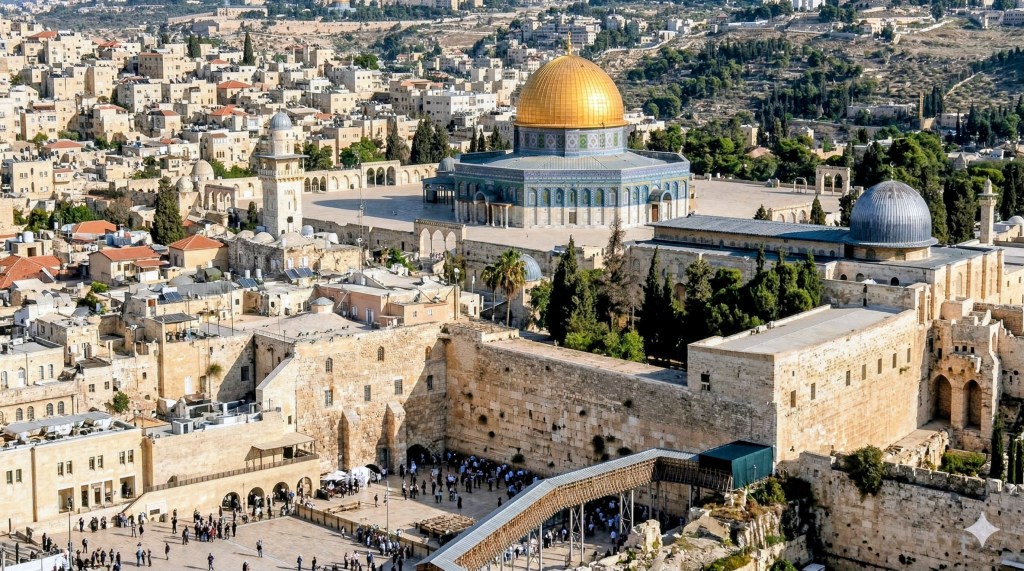
Cleaning the Temple Mount and reconsecrating the sacred rock
The condition of the Temple Mount (Haram al-Sharif) shocked Umar. The Byzantines had deliberately converted it into a garbage dump Alhakam — a theological act of contempt. IslamiCity Since the Roman destruction of the Second Temple in 70 CE, Christians had interpreted the site’s desolation as fulfillment of Jesus’ prophecy that “not one stone shall be left upon another” (Matthew 24:2). Empress Helena (4th century) reportedly ordered refuse deposited on the rock, and Byzantine authorities maintained the site as a ruin for centuries, treating its degradation as proof that Judaism had been superseded by Christianity. Christian History Institute Ibn Kathir (d. 1373) recorded: “Hilaneh [Helena] then ordered that all the town’s refuse and its garbage be placed on the rock which is the Qibla of the Jews. This continued until Umar ibn al-Khattab conquered Bayt al-Maqdis.” Institute for Palestine Studies
Umar’s reaction was visceral. Multiple traditions describe him kneeling down and clearing debris with his own hands, carrying dirt in his cloak and throwing it into the Valley of Gehenna. When his soldiers saw the Caliph laboring, they joined in. lucDailySunnah Eutychius records that Sophronius led Umar to the site, describing it as “the rock where God spoke to Jacob… which the children of Israel called the Holy of Holies.” luc +3 A Cairo Geniza document provides a Jewish perspective on the same event: “As the ruins were slowly exposed, he would ask the Jewish elders concerning the stone — that is, the Foundation Stone — and one of the elders would point out the outline of the area until it was finally exposed.” Rabbi Richmanrabbirichman
The figure of Ka’b al-Ahbar — a Yemenite Jewish rabbi who converted to Islam Wikipedia during Umar’s caliphate — plays a prominent role in the Islamic sources. Ka’b accompanied Umar from Medina and helped identify the location of the Foundation Stone (Even HaShetiya / al-Sakhra), buried under accumulated refuse. En Academic When Ka’b suggested building the mosque north of the rock so worshippers facing Mecca would simultaneously face the stone — essentially fusing Jewish and Islamic prayer orientations — Umar sharply rejected the idea. WikipediaRabbi Richman Al-Tabari records his response: “O Ka’b, you are following after Judaism. I saw you take off your sandals [following Jewish practice]… We were not commanded concerning the Rock, but we were commanded concerning the Ka’ba.” Middle East Forum Umar built the prayer structure to the south of the rock, oriented solely toward Mecca lucWikipedia — a deliberate theological disengagement of Islam from Judaism.
The structure Umar built was intentionally modest: a rectangular wooden house of prayer constructed from beams and planks raised over ancient ruins. The earliest eyewitness description comes from Arculf, a Frankish bishop who visited Jerusalem around 670 CE. WikipediaWikipedia His account, recorded by Adomnán in De Locis Sanctis, Wikipedia describes: “On this spot where the Temple once stood, near the eastern wall, the Saracens have now erected a square house of prayer, in a rough manner, by raising beams and planks upon some remains of old ruins; this is their place of worship, and it is said it will hold some three thousand men.” Center for Online Judaic Studiescojs This crude wooden structure would be transformed half a century later when Caliph Abd al-Malik built the magnificent Dome of the Rock (691–692 CE) over the Foundation Stone, WikipediaThe Times of Israel and the congregational mosque (al-Aqsa) was expanded on the southern end of the platform. Wikipedia
The Temple Mount’s significance in Islam is anchored in the Isra and Mi’raj — the Night Journey and Ascension of Prophet Muhammad. IslamiCity The Quran (17:1) states: “Exalted is He who took His Servant by night from al-Masjid al-Haram to al-Masjid al-Aqsa, whose surroundings We have blessed.” Islamic tradition identifies al-Masjid al-Aqsa with the Temple Mount, Wikipedia where Muhammad is believed to have led all previous prophets in prayer before ascending through the seven heavens from the Foundation Stone. Christian History Institute This makes the site the third holiest in Islam after Mecca and Medina. WikipediaWikipedia
Five hundred years of exile ended: the return of Jews to Jerusalem
Perhaps the most transformative consequence of Umar’s conquest was a decision that receives less attention than it deserves: the readmission of Jews to Jerusalem after approximately 500 years of enforced exile. Wikipedia The ban originated with Emperor Hadrian, who, after crushing the Bar Kokhba revolt in 135 CE, expelled all Jews from Jerusalem, Wikipedia renamed the city Aelia Capitolina, and rebuilt it as a Roman colony dedicated to Jupiter. Jews were forbidden to enter on pain of death. The Times of Israel Over the following centuries, the prohibition was maintained by successive Roman and Byzantine administrations, relaxed only to permit Jews to visit one day per year — on Tisha B’Av, the anniversary of the Temple’s destruction Wikipedia — not as an act of compassion but as a theological demonstration of Christianity’s triumph. The Times of Israel
The exceptions to the ban were vanishingly brief. Emperor Julian “the Apostate” (361–363 CE) allowed Jews to return and even begin rebuilding the Temple, Israelintheirland but his death in battle ended the project. Empress Eudocia (438 CE) temporarily lifted the ban, prompting thousands of Jews to migrate to Jerusalem, only for Christian monks to violently attack the pilgrims Wikipedia — reportedly stoning and stabbing them — after which the ban was reinstated. Jewish Currents During the Persian conquest of 614 CE, a combined Persian-Jewish force took the city, Wikipedia and the Jewish leader Nehemiah ben Hushiel briefly governed Jerusalem Wikipedia and began preparations for a Third Temple. Middle East Forum By 617, however, the Persians reversed course under Christian pressure, Wikipedia expelled the Jews again, Wikipedia and demolished a synagogue on the Temple Mount. WikipediaWikipedia When Heraclius reconquered the city in 629–630, Unamsanctamcatholicam he ordered massacres, forced conversions, and expelled Jews from a three-mile radius of Jerusalem. In 634, he decreed empire-wide forced baptism of all Jews. Wikipedia
Into this context of centuries of persecution arrived Umar. According to a Cairo Geniza document analyzed by scholar Simha Assaf, Jews initially requested permission for 200 families to settle in Jerusalem. Encyclopedia.com Patriarch Sophronius vehemently opposed this. Umar compromised on 70 Jewish families from Tiberias The Times of IsraelEncyclopedia.com — the city that had served as the center of Jewish intellectual life in Palestine since the destruction of Jerusalem. The families were settled in the southern part of the city, near the Temple Mount, Encyclopedia.com and established a synagogue adjacent to one of the Mount’s gates. The Geniza document records: “When the Arabs conquered Jerusalem, there were people from the Nation of Israel among them who showed them the place of the Temple, and they have dwelled in their midst ever since.” rabbirichmanIsraelintheirland
Jewish reactions to the conquest were remarkably positive. The “Secrets of Rabbi Simon ben Yohai” (Nistarot de-Rabbi Shimon bar Yohai), an 8th-century Jewish apocalyptic text whose core traditions likely date to the mid-7th century, presents the Arab conquest as divinely ordained deliverance from Byzantine oppression: “The Holy One, blessed be He, only brings the kingdom of Ishmael in order to save you from this wickedness.” Wikipedia The Doctrina Jacobi (c. 634), one of the earliest external references to Islam, records a Jewish merchant reporting that “we Jews were overjoyed” at the defeat of Byzantine forces. fayez thezealotWikipedia The Karaite writer Solomon ben Jeroham later noted that Jews who returned to Jerusalem after the conquest were initially given access to “the Courts of the House of the Lord” — the Temple Mount itself — for the first time since 135 CE.
Over subsequent decades, Jewish life in Jerusalem stabilized. Ten Jewish servants (later growing to 20) were employed to maintain the Dome of the Rock after its construction, exempted from the jizya tax in exchange for their service. Jcfa The Yeshiva of Jerusalem was re-established and maintained correspondence with diaspora communities. A Geniza document known as Tefillat ha-She’arim (“Prayers at the Gates”) describes specific prayers Jews recited at each gate of the Temple Mount — evidence of sustained Jewish devotion to the site under Muslim rule.
How Umar’s Jerusalem compared to every other conquest of the city
The most powerful way to assess Umar’s governance is through comparison. Jerusalem has been conquered dozens of times across three millennia, and the pattern of bloodshed makes Umar’s peaceful takeover starkly exceptional:
- 70 CE (Roman): Titus destroyed the Second Temple and systematically razed the city. Josephus claims over a million dead; modern estimates suggest 150,000–300,000 killed and 97,000 enslaved.
- 135 CE (Roman): Hadrian crushed the Bar Kokhba revolt, Wikipedia killed an estimated 580,000 Jews (Cassius Dio), renamed the city, and banned Jews entirely.
- 614 CE (Persian): Shahrbaraz’s army killed an estimated 17,000–60,000 Christians, Wikipedia destroyed the Church of the Holy Sepulchre, deported 35,000 people, and carried off the True Cross. Wikipedia +2
- 637/638 CE (Muslim/Umar): No massacre. No destruction. Churches protected by treaty. Jews invited to return.
- 1099 CE (Crusader): The First Crusade’s capture produced one of the medieval world’s worst atrocities. IslamiCityAbout Islam Raymond of Aguilers wrote that Crusaders waded through blood “up to their knees and bridle reins.” Wikipedia Jews who sheltered in their synagogue were burned alive Wikipedia while Crusaders reportedly sang hymns. Death estimates range from several thousand to 40,000, depending on the source. The Wolf Age Ibn al-Qalanisi recorded: “The Jews assembled in their synagogue, and the Franks burned it over their heads.”
When Saladin reconquered Jerusalem in 1187, he consciously modeled his conduct on Umar’s example. Al Mujtama Magazine His advisers were split on whether to destroy the Church of the Holy Sepulchre; most “reminded him of the Caliph Umar, who allowed the Church to remain in Christian hands after conquering the city.” Saladin spared the Church, permitted Christian pilgrimage, Wikipedia and allowed native Eastern Christians to remain for a jizya payment World History Encyclopedia — a direct echo of the ʿUhda al-ʿUmariyya.
The dhimmi system that Umar’s governance exemplified was not equality in the modern sense. Non-Muslims paid the jizya, were subject to certain social restrictions Encyclopedia Britannica (which grew more elaborate in later centuries), and occupied a formally subordinate status. WikipediaSephardicheritagemuseum Yet the scholarly consensus is clear that this system represented a significant improvement over Byzantine governance for most religious minorities. Bernard Lewis wrote that “the change from Byzantine to Arab rule was welcomed by many among the subject peoples, who found the new yoke far lighter than the old.” Montgomery Watt argued that “the Christians were probably better off as dhimmis under Muslim-Arab rulers than they had been under the Byzantine Greeks.” Wikipedia W. Cleveland and M. Bunton characterized dhimmi status as “an unusually tolerant attitude for the era” that “stood in marked contrast to the practices of the Byzantine Empire.” Wikipedia The jizya itself was often lighter than Byzantine taxation; Hanafi jurists exempted women, children, the elderly, the sick, the poor, monks, and anyone unable to pay. Wikipedia
What the scholars have concluded
Karen Armstrong, in Jerusalem: One City, Three Faiths, offered perhaps the most widely cited assessment: “On two occasions in the past, it was an Islamic conquest of Jerusalem that made it possible for Jews to return to their holy city. Umar and Saladin both invited Jews to settle in Jerusalem when they replaced Christian rulers there.” GoodreadsDergipark She concluded: “The Israelis have not been the worst conquerors of Jerusalem: they have not slaughtered their predecessors, as the Crusaders did, nor have they permanently excluded them, as the Byzantines banned the Jews from the city. On the other hand, they have not reached the same high standards as Caliph Umar.” Goodreads In an interview, Armstrong stated flatly: “Under Muslim rule, the three religions were able to coexist in relative harmony.” PenguinRandomhouse.com
Hugh Kennedy of SOAS, in The Great Arab Conquests, emphasizes the non-violent character of the Jerusalem takeover, noting that “under the terms of the surrender Caliph Umar promised to tolerate the Christians of Jerusalem and not to turn churches into mosques.” Wikipedia Fred Donner of the University of Chicago has argued that Muhammad’s movement was originally an ecumenical “Believers’ movement” that included Jews and Christians, and that the tolerance extended by early Muslim conquerors may preserve “vestigial evidence of the earlier phase of peaceful coexistence among the different religious groups.” Stanford University Moshe Gil, writing as an Israeli historian from Tel Aviv University Wikipedia and drawing on over 1,000 Cairo Geniza documents, presents a less romanticized picture — documenting “almost unceasing warfare” during the period Amazon — but confirms the essential facts of Jewish readmission and the relatively favorable terms of the conquest.
The cautious historian must note what is uncertain. The source limitations are real: the earliest detailed accounts date from two to three centuries after the events. No contemporary 7th-century source records the specific details of Umar’s refusal to pray in the Church, the cleaning of the Temple Mount, or the exact terms of the treaty. The stories may have been shaped by later theological and political concerns. En Academic Herbert Busse has written extensively on the historicity of the Umar traditions, and scholars like Patricia Crone have critiqued overly optimistic readings of early Islamic pluralism. Sophronius’s own surviving writings describe the Muslim conquerors in notably hostile terms, complicating the irenic picture the tradition assumes. En Academic Mark R. Cohen observed that “no text of the document can be dated earlier than the tenth or eleventh century.” Wikipedia
Yet the remarkable consistency of the narrative across both Muslim and Christian sources — from al-Tabari and al-Baladhuri to Eutychius and Theophanes — and its corroboration by Jewish Geniza documents suggests a solid historical core. The broad outlines are beyond reasonable dispute: Umar came, the city surrendered peacefully, Christians were protected, Jews were readmitted, and the Temple Mount was cleared and reconsecrated. Whether every detail of the humble arrival or the church-step prayer occurred exactly as described matters less than the fact that the tradition itself — and the governance model it encoded — shaped centuries of subsequent history.
Conclusion: a precedent that outlived its author
Umar ibn al-Khattab was assassinated in 644 CE, just six years after accepting Jerusalem’s surrender, stabbed by a Persian slave named Abu Lu’lu’a while leading dawn prayers in Medina. Wikipedia But the model he established in Jerusalem proved more durable than any single life. His Assurance of Safety became the template for Muslim governance of conquered cities; IslamiCity his refusal to pray in the Church of the Holy Sepulchre preserved that building through fourteen centuries of turbulent history; his readmission of Jews reversed one of antiquity’s longest-running acts of religious persecution; and his personal labor in clearing the Temple Mount reconsecrated a site sacred to three faiths.
The story’s enduring power lies not in its details — many of which remain debated — but in what it reveals about the possibilities of conquest. In a century when the Crusaders would later wade through blood in the same streets, and when the Persians had sacked the same churches just twenty-three years earlier, About Islam a conqueror chose restraint. That restraint was not passive tolerance but active governance: treaty-writing, site-protection, demographic reversal, and symbolic gestures calibrated for the long term. IslamiCity Modern scholars assess Umar’s Jerusalem neither as a paradise of equality — the dhimmi system was hierarchical by design — nor as mere propaganda. It was something rarer and more interesting: a conquest in which the conqueror understood that preserving what he found was more powerful than destroying it. As Armstrong concluded, “the societies that have lasted the longest in the holy city have, generally, been the ones that were prepared for some kind of tolerance and coexistence.” Goodreads Umar’s Jerusalem lasted, and its precedent echoes still.


 The Glorious Quran and Science
Leave a comment