
The Divine Paradox: A Theological Commentary on the Encounter Between Moses and Khidr (Quran 18:71-82)
Presented by Zia H Shah MD
The narrative of the encounter between the Prophet Moses and the enigmatic figure traditionally identified as al-Khidr, as articulated in Surah al-Kahf (18:71-82), constitutes a seminal text for Islamic epistemology, theodicy, and the philosophy of law. This report provides an exhaustive theological commentary on these verses, utilizing the translation of M.A.S. Abdel Haleem as a primary linguistic frame. The analysis integrates classical exegetical traditions, notably those of Ibn Kathir and al-Qurtubi, with contemporary intellectual perspectives from scholars such as Muhammad Asad, Nouman Ali Khan, and Hamza Yusuf. The report examines the fundamental tension between the perceived reality governed by revealed law (Shariah) and the hidden, cosmic reality governed by divine wisdom (Haqiqah). By scrutinizing the linguistic shifts within the text—such as the transition from “strange” (imra) to “horrible” (nukra) and the sophisticated changes in personal agency within the final explanation—this study reveals a worldview where even the most tragic events are woven into an intricate tapestry of ultimate mercy and justice. The commentary explores the nature of ladunni knowledge, the limits of human perception, and the pedagogical requirements of the master-disciple relationship, ultimately offering a framework for understanding the “Problem of Evil” within a theistic paradigm.
Socio-Historical Foundations and the Quest for Knowledge
The narrative of Moses and his unnamed mentor is situated at the heart of Surah al-Kahf, a chapter revealed during the third period of the Prophet Muhammad’s Makkan life. During this era, the early Muslim community faced systemic persecution and psychological warfare from the Quraysh leadership. To challenge the Prophet’s legitimacy, the Quraysh dispatched emissaries to the Jewish rabbis of Madinah, seeking questions that only a true recipient of revelation could answer. The rabbis proposed three inquiries: the account of the youths in the cave, the story of the great traveler (Dhul-Qarnayn), and the nature of the soul. While the stories of the Cave and Dhul-Qarnayn address the trials of faith and power, the account of Moses serves as the definitive trial of knowledge.
The immediate catalyst for the journey was an event where Moses, arguably the most learned and powerful prophet of his time, was asked if anyone on earth possessed more knowledge than he did. Upon answering “No,” he was divine admonished for not attributing absolute knowledge to God. This prompted the quest for a “servant” located at the “junction of the two seas”—a geographical and metaphysical boundary representing the convergence of worldly knowledge and spiritual insight.
| Element of the Journey | Theological Symbolism |
| The Prophet Moses | Representing Shariah (Exoteric Law) and human prophetic excellence. |
| Al-Khidr | Representing Haqiqah (Esoteric Reality) and direct divine inspiration (Ladunni). |
| The Junction of Two Seas | The meeting point of the material and spiritual realms; the limit of human intellect. |
| The Roasted Fish | The symbol of life emerging from death; the sign of reaching the destination. |
The journey is a pedagogical masterclass in humility. Moses, the law-giver of the Israelites, is placed in the role of a novice, required to follow a mentor whose actions will systematically violate his moral and legal training. Khidr’s initial hesitation—”You certainly cannot be patient with me… and how can you be patient with what is beyond your realm of knowledge?”—sets the stage for an inquiry into the limits of causality.
The First Episode: The Ethics of Property and Hidden Protection (18:71-73)
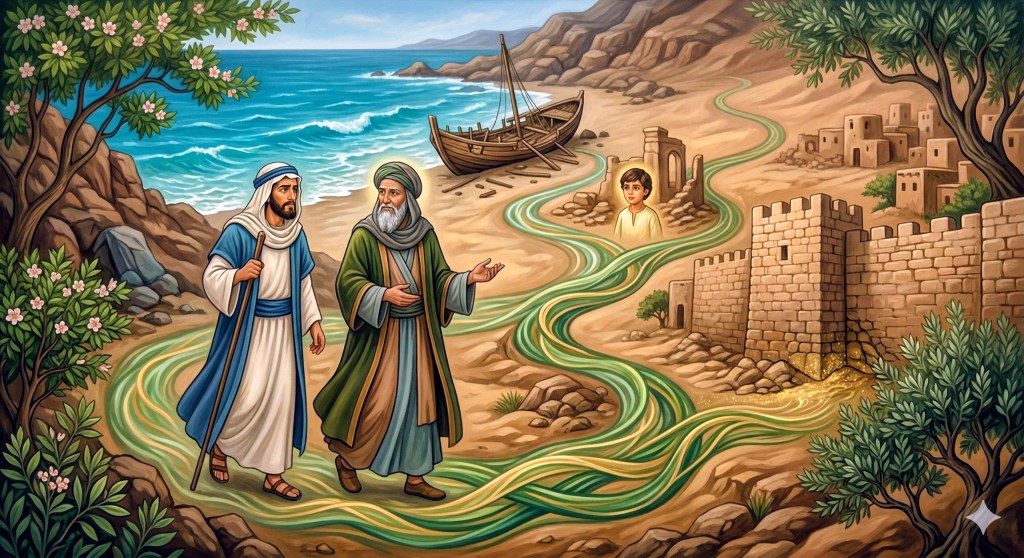
The journey commences as Moses and Khidr embark on a vessel. The Abdel Haleem translation of verse 71 captures the immediate shock of the encounter: “Then the two went forth until, when they embarked on the boat, he made a hole in it, whereupon Moses exclaimed: ‘Have you made a hole in it so as to drown the people in the boat? You have certainly done an awful thing’”.
The Violation of Reciprocity and Law
The theological gravity of this act is amplified by its context. Classical traditions, including those cited by Ibn Kathir, note that the boat’s crew recognized Khidr and, out of respect for his righteousness, allowed both men to board for free. Khidr’s response—tearing out a plank or “scuttling” the ship—appears to be a flagrant betrayal of hospitality and a reckless endangerment of the very lives that had just shown them kindness.
Moses’ reaction is not merely emotional; it is a legal imperative. As a messenger tasked with upholding justice, he cannot remain silent while witnessing property damage that threatens innocent lives. Moses characterizes the act as imra—a term Abdel Haleem renders as “awful,” but which carries the connotation of being strange, grave, or monstrously out of place. In this moment, Moses represents the zahir (apparent) reality: damaging a vessel is an objective evil.
The Rebuking of Linear Logic
Khidr’s response in verse 72 is the foundational recurring motif of the narrative: “Did I not tell you that you will not be able to patiently bear with me?”. This is more than a reminder of their agreement; it is an epistemological critique of the human mind’s tendency to judge events based on immediate sensory data. Moses’ apology in verse 73—”Do not take me to task at my forgetfulness”—is interpreted by classical scholars as a sincere lapse. However, contemporary insights, particularly from Hamza Yusuf, suggest that this “forgetfulness” is an inherent feature of being human; we are “moment-to-moment” creatures who struggle to maintain a perspective of eternity when faced with immediate crisis.
| Linguistic Term | Meaning/Context in 18:71 | Scholarship Insight |
| Kharaqaha | “He made a hole in it” or “tore it open” | Implies a deliberate act of sabotage. |
| Litughriqa | “So as to drown” | Suggests the consequence was the primary concern of Moses. |
| Imra | “Awful,” “Grave,” “Strange” | A term for a social or moral anomaly. |
This first trial introduces the believer to the concept that a “calamity” (damage to property) can be a mechanism of mercy. In a world of predators, a defect can be a savior.
The Second Episode: The Sanctity of Life and the Problem of Evil (18:74-76)
The narrative intensifies in verse 74: “Then the two went forth until they met a lad whom he slew, whereupon Moses exclaimed: ‘What! Have you slain an innocent person without his having slain anyone? Surely you have done a horrible thing’”.
From “Imra” to “Nukra”
If the first act was an offense against property, the second is the ultimate offense against the sanctity of life. Moses’ terminology shifts from imra to nukra (horrible, wicked, or deplorable). Scholars like al-Alusi and Shafi emphasize that nukra is a significantly stronger term of condemnation. From the perspective of any revealed law—be it Mosaic or Muhammadan—killing an innocent child who has committed no crime is the definition of the forbidden (haram).
The text specifies the victim was a ghulam (a young boy or lad). While some traditions suggest he was a rebellious teenager, Hamka and others emphasize his status as a “pure soul” (nafsan zakiyyah). Moses’ outrage is a manifestation of the highest prophetic virtue: the refusal to tolerate injustice.
Theodicy and Divine Wisdom
This episode directly confronts the “Problem of Evil.” How can an all-powerful, all-knowing, and all-good God permit the death of a child?. Theological traditions, particularly the Maturidi school, posit that God’s actions are never arbitrary but are always grounded in hikmah (wisdom). Wisdom is defined as “placing things in their proper place”.
Khidr’s second reprimand (verse 75) is identical to the first, yet carries the weight of a life lost. Moses, recognizing his failure to remain silent in the face of such a “monstrous” act, sets his own ultimatum in verse 76: “If I ever question you about anything after this, then do not keep me in your company; you will then be fully justified”. This establishes the boundary between human judgment and divine operation; even a Prophet cannot be a companion to the direct execution of cosmic destiny if he remains bound by the exoteric law.
The Third Episode: Social Justice and Unseen Legacies (18:77-78)
The travelers arrive at a town where they seek the most basic of human necessities: food. Verse 77 records: “Then the two went forth until when they came to a town, they asked its people for food, but they refused to play host to them. They found in that town a wall that was on the verge of tumbling down, and he buttressed it…”.
The Rejection of Hospitality
In the ethical world of the Quran, refusing hospitality to a hungry traveler is a mark of profound moral degradation. The people of this town represent a society that has lost its sense of social responsibility. Despite this, Khidr performs an act of uncompensated labor by “buttressing” or repairing a collapsing wall.
Moses’ reaction here is different; it is not moral horror but pragmatic frustration. He suggests: “If you had wished, you could have received payment for it”. This reveals Moses’ concern for social equity and self-preservation. Why should they work for free for a people who refused them bread?. This third test proves that the “logic of the unseen” is as much about proactive kindness as it is about reactive protection.
The Parting of Ways
In verse 78, Khidr declares: “This brings me and you to a parting of ways. Now I shall explain to you the true meaning of things about which you could not remain patient”. This “parting” is not a failure on Moses’ part but an acknowledgment of different functional roles. Moses is the guardian of the Law (Shariah), which must remain the baseline for human society; Khidr is an agent of the Reality (Haqiqah), which manages the underlying currents of existence.
The Grand Interpretation: Unveiling the Ghayb (18:79-82)
The concluding section (18:79-82) provides the ta’wil (interpretation) that transforms these seemingly random or cruel acts into a cohesive narrative of mercy.
The Boat: Protecting Livelihood (18:79)
The boat belonged to “poor people who worked on the river.” Khidr explains: “I desired to damage it for beyond them lay the dominion of a king who was wont to seize every boat by force”. By making the boat “defective” (‘ayaba), Khidr saved it. A perfect boat would have been seized, leaving the poor men destitute. A damaged boat remains in their possession, requiring only a simple repair. This demonstrates a destiny where an apparent evil (damage to property) is the only means of averting a catastrophic loss.
The Youth: The Mercy of Substitution (18:80-81)
Regarding the slain lad, Khidr reveals that his parents were “people of faith.” Divine knowledge indicated that the boy would grow up to “plague them with transgression and disbelief”. Khidr states: “we desired that their Lord should grant them another in his place, a son more upright and more tender hearted”.
Theology here grapples with “pre-emptive justice.” Muhammad Asad suggests an allegorical reading: the boy represents the potential for corruption within even the most faithful families. From a traditionalist view, the death of the child is a “lesser evil” that preserves the faith of the parents and grants them a “better” child in the Hereafter or as a subsequent replacement. It reframes death not as an end, but as a repositioning within a larger spiritual economy.
The Wall: The Intergenerational Blessing of Righteousness (18:82)
The wall belonged to two “orphan boys,” and beneath it lay a treasure. Their father had been a “righteous man” (salihan). God “intended that they should come of age and then bring forth their treasure as a mercy from your Lord”. Khidr concludes with the definitive disclaimer: “I did not do this of my own bidding”.
| Episode | Apparent Act | Hidden Reality | Theological Theme |
| The Boat | Sabotage | Preservation | Protecting the Livelihood of the Poor |
| The Youth | Homicide | Substitution | Preservation of Faith (Iman) |
| The Wall | Free Labor | Inheritance | The Reward of Ancestral Virtue |
Linguistic Agency and the “Etiquette” of Divine Action
One of the most subtle theological insights found in the explanation (18:79-82) is the shifting use of personal agency in Khidr’s language. Classical commentators like al-Qurtubi and contemporary scholars like Shafi` note a sophisticated hierarchy of intent.
- “I intended” (Aradtu): When discussing the damage to the boat—an act that appears “vicious” or “flawed”—Khidr attributes the intention to himself: “I desired to damage it”.
- “We intended” (Aradna): When discussing the replacement of the child—an act involving both the “evil” of death and the “good” of a better child—the plural form is used: “So we desired that their Lord give them in exchange…”.
- “Your Lord intended” (Arada Rabbuka): When discussing the protection of the orphans and the restoration of the wall—acts that are pure mercy and kindness—the intent is attributed solely to God: “So your Lord intended that they should come of age…”.
This linguistic etiquette teaches the believer that while God is the ultimate cause of all things, human speech should attribute flaws and harshness to the self/intermediary and beauty and mercy to the Creator.
Theological Synthesis: Shariah, Haqiqah, and Ladunni Knowledge
The encounter raises a critical question: how can a servant of God violate the established Law (Shariah)? Traditional scholarship offers three primary resolutions.
The Cosmic vs. The Imperative Law
Commentators such as those in Tafheem-ul-Quran and Ma’arif-ul-Quran argue that Khidr was acting under the “laws of nature” or “cosmic laws” (Takwin). These are the laws by which God allows sickness, storms, and death to occur. Khidr was an instrument of this direct creative will, while Moses was the guardian of the “imperative law” (Tashri) given to humans for their governance. In this view, Khidr’s acts are similar to an earthquake or a fire—they are events of destiny that are not subject to human legal adjudication.
The Identity of Khidr
The nature of Khidr’s identity remains a point of scholarly debate. Ibn Kathir mentions a view that Khidr might be an angel or a different species not bound by human Shariah. However, most classical authorities prefer the view that he was a human prophet or a Wali (saint) endowed with ilm al-ladunni—knowledge directly from the Presence of God. This knowledge allows the possessor to see the “ends” while the rest of humanity sees only the “means”.
The Sufi Master-Disciple Archetype
In the mystical tradition, the relationship between Moses and Khidr is the primordial model for the relationship between the murid (disciple) and the murshid (mentor). The journey emphasizes that the path to truth often involves “unlearning” superficial judgments. As Ruzbihan Baqli notes, Khidr represents the station of “essential union” where the mediator and the mediated are one. Moses’ mistake was to apply the standards of “discursive knowledge” (ta’lim) to a process of “inspired mentorship” (suhba).
Contemporary Reinterpretations and Modernist Critiques
Modernist scholars have attempted to reconcile the “scandalous” nature of the narrative with rational principles and contemporary sensibilities.
Muhammad Asad: The Rationalist Allegory
Muhammad Asad, influenced by the Manar school of Muhammad Abduh, emphasizes a purely allegorical explanation. For Asad, the story illustrates that human reason can only operate on “perceptions previously experienced,” and thus it cannot grasp the metaphysical “how” of divine governance. He views the “killing of the boy” not as a literal historical event to be emulated, but as a morality lesson on the hidden corruptions that God averts from the faithful. Asad argues that to take every Quranic passage literally without considering allegory is to “offend against the very spirit of the divine writ”.
Nouman Ali Khan: The Pedagogy of Fate
Nouman Ali Khan provides a practical framework for the modern believer by categorizing the three episodes into “three types of fate” :
- Visible Mercy (The Boat): When something appears bad, but God reveals its goodness shortly thereafter.
- Delayed Understanding (The Boy): When a tragedy occurs whose goodness may only be understood in the Hereafter.
- Hidden Protection (The Wall): When God averts evil from us or grants us a blessing that we are never even aware of.
This categorization helps the contemporary mind move past the “Problem of Evil” by recognizing that our perspective is structurally limited.
Hamza Yusuf: The Critique of Modern Time
Hamza Yusuf uses the narrative to critique the modern mechanization of time. He argues that the modern world, governed by the “inexorable ticking of the clock” (seconds and minutes), has disassociated time from human events and weakened the sense of God’s supremacy. Moses, in his struggle for immediate answers, represents the human trapped in “moment-to-moment” linear time. Khidr represents the “sage” (hakim) who lives in “God’s conception” of time—a continuous present where the past, present, and future are a single reality.
Jurisprudential Limits: Shariah vs. Private Inspiration
A significant danger in interpreting these verses is the potential for “ignorant Sufis” or antinomians to claim that they are no longer bound by the Law if they receive a “private inspiration” (ilham).
The Supremacy of the Law
Classical scholars like al-Qurtubi and contemporary authorities like Shafi` and al-Alusi are unanimous: no person can violate the Shariah based on private inspiration. The basic principles of the Quran and earlier Scriptures—such as the prohibition of killing the innocent—are “inviolable”. Khidr’s acts were permissible only because they were based on Wahy (direct revelation), which ceased after the Prophet Muhammad.
| Concept | Status in Islamic Law | Context in 18:71-82 |
| Wahy (Revelation) | Direct, infallible divine command. | The basis for Khidr’s actions. |
| Ilham (Inspiration) | Private, subjective spiritual insight. | Cannot be used to violate Shariah. |
| Shariah (Law) | The binding external code for man. | Moses’ correct and necessary baseline. |
| Haqiqah (Reality) | The hidden truth known to God. | The “interpretation” provided by Khidr. |
As al-Alusi points out, Tariqah (the spiritual path) always remains subjected to Shariah; they are not two different realities but different depths of the same truth.
Thematic Epilogue: Trusting the Hidden Kindness
The narrative of Quran 18:71-82 concludes not with a legal victory for Moses, but with an epistemological surrender to the mercy of God. The Abdel Haleem translation of verse 82 ends with the poignant phrase: “a mercy from your Lord… This is the interpretation of that about which you could not remain patient”.
The thematic core of this encounter is the concept of Rahmah (Mercy). Every “evil” act performed by Khidr was, in its hidden dimension, a profound act of compassion. The damaging of the boat was a mercy to the poor; the killing of the boy was a mercy to the parents; the building of the wall was a mercy to the orphans. This teaches the believer that God does not create evil for its own sake; rather, what we perceive as “evil” is often the “forerunner of good”.
For the early Muslims in Makkah, this story was a revolutionary statement of hope. It suggested that their own “scuttled boat” (the loss of property) and their “slain youth” (the martyrdom of loved ones) were not signs of divine abandonment but were parts of a meticulous plan designed for a higher success. The story of Moses and Khidr remains an eternal reminder to “seek refuge in God’s hidden kindness” and to trust that, regardless of the apparent tragedy, the final destination is “entirely good”. It invites humanity to look past the “seconds and minutes” of our pain and into the “mercy from your Lord” that sustains the universe.


 The Glorious Quran and Science
Leave a comment