
The Architecture of Divine Volition: A Philosophical and Theological Commentary on Quran 18:23-24 through the Lens of Ghazalian Occasionalism and Quantum Metaphysics
Presented by Zia H Shah MD
Audio teaser:
Abstract
This report provides an exhaustive investigation into the ontological and epistemological dimensions of Quran 18:23-24, situating the mandate of the “Insha’Allah” (God willing) clause within the broader framework of Islamic and Western occasionalism. Centered on the seminal work of Abu Hamid al-Ghazali and the contemporary scientific synthesis of Dr. Zia H. Shah MD, the analysis challenges the classical Aristotelian paradigm of necessary causation. By examining the 17th discussion of The Incoherence of the Philosophers, the report elucidates the transition from inherent causal powers to divine habitual customs (‘āda). This theological stance is further enriched by a comparative study of Christian occasionalists, including Nicolas Malebranche, George Berkeley, and Jonathan Edwards, illustrating a cross-cultural consensus on the total dependence of creation upon the Divine Will. The study integrates modern scientific paradigms—specifically quantum indeterminacy, Bell’s Theorem (corroborated by the 2022 Nobel Prize in Physics), and the simulation hypothesis—to argue that the universe is not a deterministic machine but a frame-by-frame rendering sustained by a non-local Agency. The report concludes that Quran 18:23-24 is not merely a linguistic etiquette but a metaphysical assertion of radical contingency, framing reality as a perpetual miracle and offering a resolution to the “Hard Problem of Consciousness” and the “Problem of Induction” through the lens of a sustaining Creator.
The Revelation of Al-Kahf: Historical Context and the Delay of the Word
The eighteenth chapter of the Quran, Surah Al-Kahf (The Cave), serves as a pivotal metaphysical bridge in the Islamic revelation, particularly through its address of human intent and the unseen. The specific revelation of verses 23 and 24 occurred during a period of intense ideological conflict in Mecca. Seeking to discredit the Prophet Muhammad, the pagan Quraysh consulted the Jewish rabbis of Medina, who suggested posing three questions to test his prophetic claim: one concerning the youth who disappeared in a cave, one concerning a great traveler (Dhul-Qarnayn), and one regarding the nature of the soul. When these questions were presented, the Prophet, confident in the forthcoming revelation, replied that he would provide the answer “tomorrow,” but crucially omitted the qualifier “if Allah wills” (Insha’Allah).
The consequence of this omission was a fifteen-day cessation of revelation, a period of profound psychological trial for the Prophet and a source of mockery for his detractors. This delay was not a mere administrative pause but a divine corrective intended to establish a fundamental principle of Islamic ontology: the radical contingency of the future. When the revelation finally descended, it contained not only the narrative of the Men of the Cave but also a parenthetical instruction that would become the foundation for Islamic occasionalist thought.
Philological Analysis of the Arabic Text and the Haleem Translation
The linguistic structure of the verses is imperative, establishing a normative ethical and metaphysical standard for all discourse concerning the future.
وَلَا تَقُوۡلَنَّ لِشَاىۡءٍ اِنِّىۡ فَاعِلٌ ذٰ لِكَ غَدًا ۙ ﴿18:23﴾ اِلَّاۤ اَنۡ يَّشَآءَ اللّٰهُ وَاذۡكُرْ رَّبَّكَ اِذَا نَسِيۡتَ وَقُلۡ عَسٰٓى اَنۡ يَّهۡدِيَنِ رَبِّىۡ لِاَقۡرَبَ مِنۡ هٰذَا رَشَدًا ﴿18:24﴾
Using the translation of M.A.S. Abdel Haleem, the text reads:
(18:23) “And never say about anything: ‘I shall certainly do this tomorrow’” (18:24) “without adding, ‘if God so wills!’ But if you forget, then remember your Lord, and say, ‘I trust my Lord will guide me to what is more right than this.’”.
The prohibition wa-lā taqūlanna (And never say) is strengthened by the nūn al-tawkīd (the n-sound of emphasis), indicating that this is a non-negotiable principle of speech. The term ghadan (tomorrow) is a synecdoche for any future duration, signifying that the bridge between current intention and future realization is not a path one walks alone, but one that must be continuously paved by Divine Volition.
| Linguistic Component | Literal/Contextual Meaning | Ontological Implication |
| Lā taqūlanna | Never say (emphatic prohibition) | Human words lack inherent creative power. |
| Insha’Allah | If God wills | The future is a domain of Divine Sovereignty. |
| Idhā nasīta | When you forget | Human fallibility vs. Divine Permanence. |
| Rashadan | Rectitude/Right Way | Divine Guidance is the true end of all action. |
The Philosophy of Necessity: Al-Ghazali’s Critique of Causality
The scriptural mandate of “Insha’Allah” found its most rigorous philosophical articulation in the work of Abu Hamid al-Ghazali (1058–1111). At the heart of Al-Ghazali’s project was the defense of divine omnipotence against the Aristotelian and Neoplatonic falāsifa, primarily Al-Farabi and Ibn Sina. The philosophers maintained that the universe is governed by necessary causal connections—intrinsic powers within objects that force a specific outcome. For instance, they argued that fire possesses a nature that necessitates the burning of cotton upon contact.
Al-Ghazali perceived a grave theological danger in this “causal necessity”. If nature possessed autonomous necessitating powers, then God’s role would be reduced to a distant “First Cause” who could no longer intervene in His own creation. Miracles—such as the Prophet Ibrahim being unharmed by fire or the splitting of the moon—would become logically impossible because they would violate the “nature” of the objects involved.
The 17th Discussion and the Humean Anticipation
In the 17th discussion of Tahāfut al-Falāsifa (The Incoherence of the Philosophers), Al-Ghazali deconstructs the concept of necessary connection using a skeptical, epistemological approach that anticipates David Hume by seven centuries. He argues that the link between what we call a “cause” and what we call an “effect” is not a logical necessity.
His argument rests on the observation that cause and effect are two distinct entities: “This is not That; nor can That be This”. Because they are logically distinct, it is possible to conceive of one existing without the other. For Al-Ghazali, observation only proves “conjunction” (ma’ahu – with it), never “connection” or “causation” (bihi – by it). We see fire touch cotton, and we see the cotton burn, but we do not see the “necessity” that binds them.
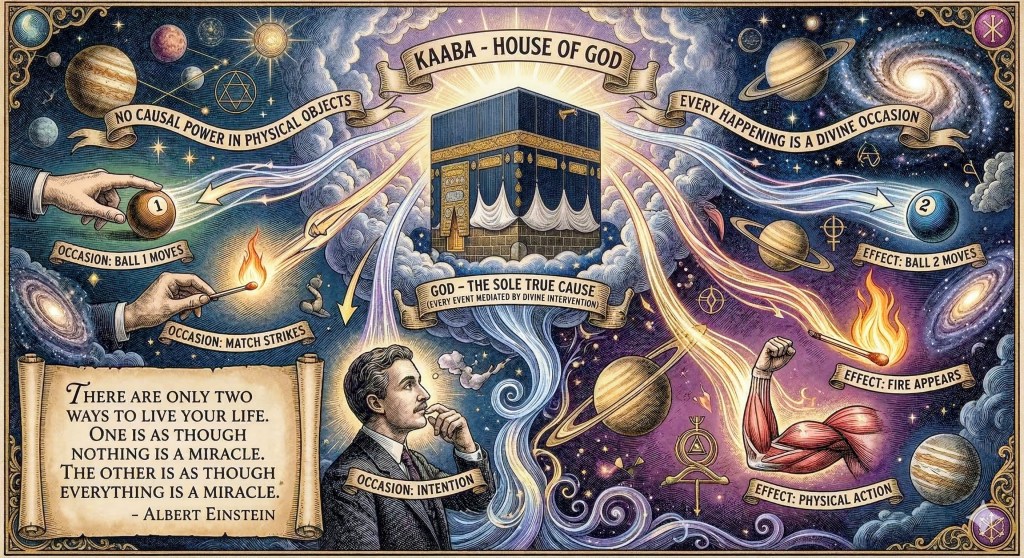
To resolve this, Al-Ghazali proposes the doctrine of “Divine Habit” (‘āda). The regularity we see in the world is not due to any inherent power in the objects themselves, but due to God’s consistent choice to act in the same way repeatedly. Fire does not burn by its own power; rather, God creates the burning whenever fire meets cotton. This allows for both the predictability of science (as God is rational and consistent) and the possibility of miracles (as God is free to alter His habit at any moment).
Metaphysical Atomism: The Discrete Nature of Time and Substance
Underpinning Ghazalian occasionalism is the Ash’arite doctrine of metaphysical atomism. In this framework, the universe consists of indivisible atoms (jawāhir) and their accidents (a’rād), such as color, motion, or life. Crucially, Ash’arite theology holds that “no accident can last for two successive instances of time”.
This implies that the world is not a static object that persists through time by itself. Instead, it is being perpetually recreated by God at every discrete moment. This “continuous creation” (tajdīd al-khalq) means that an object exists in moment T1 only because God willed it, and it exists in T2 only because God created it anew. This metaphysical reality is the literal fulfillment of the “Insha’Allah” command in Quran 18:23-24: every transition from one moment to the next is a new act of Divine Volition.
Cross-Cultural Occasionalism: Christian and Modern Philosophers
The intuition that God is the sole true cause is not exclusive to Islamic thought. Various Christian philosophers arrived at similar conclusions, often driven by different metaphysical problems, yet converging on the same theological outcome of total dependence.
Nicolas Malebranche and the Cartesian Dilemma
In the 17th century, the French Catholic priest Nicolas Malebranche (1638–1715) developed a global occasionalism to solve the problem of mind-body dualism. René Descartes had argued that the mind (immaterial) and the body (material) were two entirely different substances, leading to the question of how they could interact. Malebranche’s solution was to deny all creaturely causation.
He argued that there is only one “true cause” because there is only one God. For Malebranche, a true cause must have a necessary connection to its effect, and the only volition that carries such necessity is the Will of an omnipotent Being. When a human wills to move their arm, that volition is merely an “occasional cause”—a signal for God to enact the physical movement. This mirrors Al-Ghazali’s “fire and cotton” logic: the finite being provides the occasion, but the Infinite Being provides the power.
George Berkeley: The Immaterialist Vision
George Berkeley (1685–1753) used occasionalist principles to support his doctrine of immaterialism. Berkeley agreed with Al-Ghazali and Malebranche that material objects (which he called “ideas”) are passive and inert, possessing no inherent power to cause anything. However, Berkeley diverged by maintaining that finite spirits (human minds) are genuine causes of their own internal volitions. For Berkeley, the regularities of the natural world are the “active expressions of God as he acts on us” according to fixed laws, which we perceive as the “laws of nature”. This view aligns with the Quranic concept of Ayat (Signs), where every natural phenomenon is a direct communication from the Divine Mind.
Jonathan Edwards and Continuous Creationism
The American theologian Jonathan Edwards (1703–1758) formulated a version of occasionalism rooted in the doctrine of divine conservation. Edwards argued that God does not merely “uphold” the universe as a finished product; rather, God’s sustaining act is “altogether equivalent to an immediate production out of nothing, at each moment”. This leads to the conclusion that there are no persisting objects in the world, only a “succession of fleeting objects created successively by God,” which appear to us as stable things. This radical vision of a “frame-by-frame” universe is exactly what Zia H. Shah MD links to modern quantum physics and the simulation hypothesis.
| Philosophical School | Core Doctrine | View of Causality | Primary Motivation |
| Ash’arite (Al-Ghazali) | Divine Habit (‘āda) | Denies necessity in nature; God is the only agent. | Safeguarding miracles and omnipotence. |
| Malebranchean | Occasional Causes | Creatures provide occasions; God enacts all effects. | Resolving Cartesian mind-body dualism. |
| Berkeleyan | Immaterialism | Material objects are inert; only Spirit acts. | Refuting materialism and atheism. |
| Edwardsean | Continuous Creation | God creates the world anew from nothing at every instant. | Affirming total divine sovereignty. |
Zia H. Shah MD: The Convergence of Quantum Physics and Occasionalism
In the 21st century, the discourse on occasionalism has been revitalized by the work of Dr. Zia H. Shah MD, who argues that modern physics has provided the empirical verification for Al-Ghazali’s theological intuitions. Shah posits that the classical, deterministic Newtonian universe has been replaced by a quantum world characterized by contingency, non-locality, and a radical “looseness at the joints”.
Quantum Indeterminacy and the Sovereign Choice
In classical physics, it was believed that if one knew the position and momentum of every particle, the future would be entirely predictable. This “Strong Determinism” seemed to leave no room for Divine Will or for the “Insha’Allah” of 18:23-24. However, quantum mechanics has revealed that individual events at the subatomic level are non-deterministic.
Shah focuses on the phenomenon of light striking a water surface. Physics can predict that 4% of photons will be reflected and 96% transmitted, but it cannot determine the fate of any individual photon. For Shah, what the materialist calls “brute randomness,” the occasionalist identifies as the “Sovereign Choice of God”. God determines the specific outcome of each quantum event in accordance with His wisdom, thereby sustaining the macroscopic laws of nature through His discrete, moment-by-moment volitions.
The 2022 Nobel Prize and the Death of Local Realism
A cornerstone of Shah’s argument is the 2022 Nobel Prize in Physics, awarded to Alain Aspect, John Clauser, and Anton Zeilinger for their work on quantum entanglement and the violation of Bell’s inequalities. Their experiments proved that “local realism”—the idea that objects have definite properties independent of observation and that they only influence each other through local signals—is false.
Shah interprets this violation of local causality as a “striking parallel” to Al-Ghazali’s denial of inherent causal powers. If entangled particles across vast distances exhibit instantaneous correlations that defy classical explanation, it suggests that the “causal” links are not in the particles, but are imposed by a non-local Agency. ThisAgency “holds” the heavens and the earth, ensuring the coherence of the cosmos from outside the material system.
Quantum Tunneling and the Breakdown of Determinism
Shah further highlights “quantum tunneling” as evidence for occasionalist causality. In classical physics, a particle cannot cross a barrier without sufficient energy. In quantum physics, a particle can “tunnel” through based on probability. This demonstrates that physical laws do not rigidly necessitate outcomes but describe a range of possibilities. This mirrors Al-Ghazali’s 17th discussion argument: the physical object (the particle) does not bring about the effect (crossing the barrier) by its own power, but by the permission of the Lawmaker.
The Universe as a Constantly Rendered Scene: The Simulation Hypothesis
To bridge the gap between 11th-century theology and 21st-century science, Zia Shah employs the “Simulation Hypothesis” as a robust explanatory model for occasionalism. In a modern digital simulation, reality is not a static substance; it is an image rendered “frame-by-frame” by a processor.
Frame-by-Frame Sustenance and Al-Qayyum
Shah maps this computational process onto the Quranic name Al-Qayyum (The Self-Subsisting Sustainer). In Quran 35:41, Allah is described as “holding” the heavens and the earth lest they “cease”. Shah argues that this “holding” is synonymous with “continuous creation”. Just as a programmer must refresh every pixel to maintain the virtual world, God recreates every atom at each discrete moment.
| Simulation Concept | Quranic/Occasionalist Concept | Mechanism |
| Source Code | Amr (Command) / Laws of Nature | The underlying “habit” that ensures consistency. |
| Refresh Rate | Tajdīd al-khalq (Continuous Creation) | The universe being “re-rendered” at every instant. |
| Central Processor | Al-Qayyum (The Sustainer) | The non-local Agency that prevents reality from vanishing. |
| Program Updates | Miracles / Prophecy | Shifts in the Divine Habit that appear unusual to inhabitants. |
This “frame-by-frame” model provides a revolutionary understanding of Quran 18:23-24. When the verse instructs us to say “Insha’Allah,” it is reminding us that we do not exist across a continuous duration by our own power. We only exist in the “next frame” of reality if the Divine Programmer chooses to render us again. The phrase is thus a profound acknowledgement of our ontological fragility and our moment-by-moment dependence on the Sustainer.
The Hard Problem of Consciousness and Divine Proximity
Zia Shah extends occasionalism to address the “Hard Problem of Consciousness”—the question of how subjective experience (qualia) arises from the mere collision of atoms in the brain. Materialist science attempts to reduce the mind to neural firing, but it cannot explain the experience of being.
The “Meeting Point” of the Divine and the Human
Shah proposes an occasionalist solution: consciousness is not generated by the brain but is a “direct gift” and a “signature” of the Divine Mind. He cites Quran 50:16 (“We are closer to him than his jugular vein”) and Quran 8:24 (“Allah intervenes between a man and his heart”) to suggest that God is the immediate cause of our mental states.
Just as God creates “burning” as the occasion for fire meeting cotton, He creates “thought” or “feeling” as the occasion for neural activity. This provides a unified account of physical and mental reality without reducing one to the other. It also offers a scientific interpretation for the instruction in 18:24 to “remember your Lord when you forget”. Forgetfulness is a neural lapse, but “remembrance” is a spiritual realignment with the true source of awareness.
Information Theory and the Preserved Tablet
The Quranic discourse on causality is intimately linked to the concept of the Lauh al-Mahfuz (The Preserved Tablet), which Zia Shah interprets through the lens of modern information theory.
Data Recovery and the Unitary Universe
In quantum information theory, the principle of unitarity suggests that information is never truly destroyed. Shah draws on Landauer’s Principle—that every logical erasure of information has a thermodynamic cost—to argue that every “word” and “deed” is recorded in the fabric of the universe. The fulfillment of Joseph’s dreams in Surah Yusuf is presented as the “retrieval” and “rendering” of information from the Divine Record into the human sensorium.
This gives a new dimension to the mandate of 18:23-24. Our future plans are not just vague ideas; they are informational seeds that will either be “rendered” into reality by the Divine Will or remain as latent possibilities in the Record. The “Insha’Allah” is a recognition that only God has the authority to translate information from the “Unseen” ledger into the “Seen” world.
Human Volition and the Doctrine of Kasb (Acquisition)
A major critique of occasionalism is that it appears to lead to fatalism: if God is the only cause, why should humans strive?. The Ash’arite school responded with the doctrine of kasb (acquisition), which Zia Shah modernizes into a “compatibilist” model of free will.
The Interface of Intent and Act
Under kasb, God is the sole Creator of the action, but the human is the Acquirer. God creates the capacity for choice and the action itself, but He does so on the “occasion” of the human’s intention. Quran 18:23-24 perfectly captures this duality. The human says “I will do this,” which is the exercise of intention; but adding “if Allah wills” acknowledges that the ontological power to execute that intention remains with God.
Zia Shah uses the “radio receiver” analogy: the brain is like a receiver that captures the signal (consciousness/will) from the Divine Broadcaster. While the radio doesn’t generate the music, it must be tuned correctly to play it. Similarly, human beings are responsible for “tuning” their hearts through intention, while God remains the source of the “music” of action.
Chaos Theory and the Butterfly Effect of Providence
The contingency of 18:23-24 finds a further scientific parallel in Chaos Theory’s “Butterfly Effect”. In complex, non-linear systems, a tiny input can lead to enormous, unpredictable outcomes. Shah draws a parallel between this and the “Night of Glory” (Laylat al-Qadr), where a few verses revealed in a cave transformed world history.
In an occasionalist universe, what science calls “sensitivity to initial conditions” is what theology calls “Divine Providence”. Nothing is truly random; even the flap of a butterfly’s wings—or the choice to utter “Insha’Allah”—is a divinely guided moment that shapes the course of history. This reinforces the lesson of Al-Kahf: human knowledge of the future is minuscule, and we must therefore refer all our outcomes to the One who manages the cascading consequences of every event.
| Scientific Principle | Theological Integration | Significance for 18:23-24 |
| Quantum Indeterminacy | Sovereign Choice of God. | The future is not pre-set; God decides each outcome. |
| Bell’s Theorem | Non-Local Sustenance. | Causality is external to the objects; God “holds” the system. |
| Landauer’s Principle | The Preserved Tablet. | Every intention and act is an eternal informational event. |
| Butterfly Effect | Divine Providence. | Small gestures (like “Insha’Allah”) have vast spiritual weight. |
The Problem of Induction and the Rationality of Habit
One of the most profound implications of Ghazalian occasionalism is its solution to the “Problem of Induction”. How can we know that the sun will rise tomorrow just because it has risen in the past?. If there are no necessary connections in nature, scientific prediction seems impossible.
Al-Ghazali’s response was that God creates in us a “habit of knowledge” (‘ilm bi-al-’āda) that allows us to recognize the patterns of His action. We can rely on science because God is consistent and “rational,” not arbitrary. However, the “Insha’Allah” remains a necessary cognitive anchor: it reminds us that our induction is based on a “custom” of the Divine Will, not on an autonomous, mechanical necessity. Science becomes the study of “God’s Habits,” making the researcher a student of the Divine Character.
Thematic Epilogue: The Unity of the Two Books
The investigation of Quran 18:23-24 through the prisms of classical theology, Western philosophy, and modern physics reveals a remarkably cohesive worldview. This is the “Two Books” paradigm championed by Zia H. Shah MD: the “Book of Nature” (Science) and the “Book of Revelation” (the Quran) are two mirrors reflecting the same singular Reality.
The “Insha’Allah” command is not merely a linguistic habit or a social piety; it is a profound ontological declaration. It asserts that the universe is a radical gift, “re-rendered” and “re-authorized” in every discrete moment of time. By deconstructing the illusion of autonomous causality, occasionalism refocuses the human heart on the immediate, intimate presence of the Creator.
As demonstrated through the synthesis of Al-Ghazali and modern quantum mechanics, the “looseness at the joints” of the physical world is the space where Divine Will operates. Science reveals the map of God’s habits, while the Quran provides the meaning behind those habits. Quran 18:23-24, therefore, serves as the ultimate bridge between intent and outcome, teaching the believer to act with purpose while surrendering the results to the One who “holds the heavens and the earth lest they cease”.
In this framework, every “tomorrow” is a new creation, every intention is a dialogue with the Divine, and every “Insha’Allah” is a recognition that we live and move only within the loving, unceasing sustainment of a Sovereign Agency. The future is not a path to be conquered, but a grace to be received, one frame at a time.


 The Glorious Quran and Science
Leave a comment