
The Primordial Paradigm: Abraham as the Universal Archetype of Monotheism and Quranic Role Model
Presented by Zia H Shah MD
Audio teaser: How Abraham prevents personality cults
Abstract
The theological architecture of the Glorious Quran establishes a unique framework of human excellence by presenting a plurality of role models, most notably the Prophet Abraham (Ibrahim) alongside the Prophet Muhammad. This dual emphasis serves as a critical safeguard for the doctrine of Tawhid (the absolute Oneness of God), shifting the focus of the believer from the personhood of the teacher to the enduring nature of the message. By designating Abraham as an Uswatun Hasanah (Excellent Example) and an Ummah (a nation or model in himself), the Quranic text delineates a “primordial monotheism” (Millat Ibrahim) that transcends ethnic, sectarian, and temporal boundaries. This research report provides an exhaustive investigation into the specific verses declaring Abraham’s role-model status—spanning Surah Al-Mumtahanah, Surah An-Nahl, Surah Al-Baqarah, and Surah Al-An’am—to demonstrate how his life exemplifies unwavering obedience, rational inquiry, and absolute submission. Furthermore, the analysis contrasts this Quranic model of decentralized prophetic authority, represented by the paradigm of 124,000 prophets, with the person-centric devotions found in other traditions. It specifically critiques the deification of Jesus in Christianity, the doctrine of infallible Imamate in Twelver Shiism, the hereditary focus of Ismaili Muslims, and the messianic institutionalization within the Ahmadiyya community. The synthesis demonstrates that the Quranic Abraham stands as a corrective to sectarian obsession, anchoring faith in a direct, unmediated relationship between the Creator and the created, where the message of accountability remains paramount over the historical identity of the messenger.
The Theological Necessity of Multiple Role Models: The 124,000 Prophet Paradigm
The Islamic worldview is predicated on the continuity of divine guidance, asserting that God did not leave any civilization or era without a spiritual warner. While the Quran mentions only twenty-five prophets by name, Islamic tradition, supported by various hadith narrations, suggests a staggering figure of 124,000 prophets sent throughout history. Although some scholars highlight the relative weakness of the specific numerical reports in the hadith corpus, the underlying sentiment is treated as a core Quranic truth: “And for every community there is a messenger” (10:47) and “We certainly sent into every nation a messenger” (16:36). This paradigm of decentralized prophethood serves several vital functions in preserving the integrity of Tawhid.
First, the sheer number of prophets prevents the crystallization of a personality cult around any single individual. When guidance is understood as a global, multi-millennial phenomenon involving thousands of diverse figures across all races and tribes, the focus naturally shifts from the biological or historical particularity of the teacher to the universality of the message. The Quranic insistence that “We make no distinction between any of His messengers” (2:285) acts as a theological leveling mechanism. It ensures that while prophets are respected as moral exemplars, they are never elevated to the status of divinity or semi-divinity, as they are all seen as equal servants of the same Sovereign.
Second, the diversity of role models provides a comprehensive curriculum of human experience. Different prophets were tested with different trials: poverty, power, family betrayal, physical illness, and political persecution. By presenting Abraham alongside Muhammad, the Quran offers two distinct but harmonious archetypes of the “Perfect Man.” While Muhammad serves as the model for the finalized legal and social order, Abraham provides the model for the rational seeker, the immigrant for faith, and the father of the monotheistic covenant. This prevents the faith from becoming a “closed system” focused only on a 7th-century Arabian context and instead frames Islam as the “religion of Abraham”—a primordial, natural disposition (Fitra) that preceded all modern sectarian labels.
Comparison of Universal Prophetic Paradigm vs. Personality-Centered Models
| Feature | Quranic Universal Paradigm | Personality-Centered Models (Sectarian/Other) |
| Primary Focus | The Message (Tawhid and Accountability). | The Personhood of the Teacher/Intercessor. |
| Number of Models | 124,000 prophets spanning all of humanity. | Single infallible leader or exclusive lineage. |
| Role of the Leader | A “warner” and “bringer of good news”. | A divinely protected, often infallible intermediary. |
| Accountability | Individual and direct to God. | Allegiance to the leader as a guarantor of salvation. |
| Succession | Ended with the Seal of Prophets; knowledge inherited by fallible scholars. | Continuous through hereditary Imams or divinely guided Khulafa. |
Commentary on Surah Al-Mumtahanah 60:4-6: The Archetype of Dissociation and Sincerity
Surah Al-Mumtahanah, meaning “The Woman to be Examined,” was revealed in a period of intense conflict and complex social negotiations in Medina, specifically following the Treaty of Hudaybiyyah. The chapter opens with a stern warning against taking the enemies of God as secret allies, a context rooted in the incident of Hatib bin Abi Balta’a, who attempted to send a warning to the Meccans out of concern for his family. It is within this specific context of conflicting loyalties that the Quran invokes the Prophet Abraham as the “Excellent Example” (Uswatun Hasanah).
The Command of Total Dissociation (60:4)
Verse 4 declares: “You already have an excellent example in Abraham and those with him, when they said to their people, ‘We totally dissociate ourselves from you and shun whatever idols you worship besides Allah. We reject you, and there has arisen between us and you enmity and hatred forever until you believe in Allah alone’”. The use of the phrase “and those with him” is significant; it indicates that the role-model status is not just for Abraham as an isolated individual but for the entire first generation of monotheists who stood by him in a polytheistic society.
The commentary on this verse emphasizes that Abraham’s “enmity and hatred” were not based on personal animosity or racial prejudice, but were a “total break” necessitated by the violation of Tawhid. This serves as a psychological anchor for believers who feel lonely or marginalized for their faith. The Quranic narrative suggests that a believer should never feel isolated because they are walking the same path as Abraham—a path where the bond of faith is the supreme tie, surpassing even the most intimate biological or tribal connections. This is a direct critique of the “family obsession” seen in later sectarian developments, where biological descent from the Prophet Muhammad’s family is elevated to a status of spiritual necessity.
The Nuance of Intercession and Prophetic Humility
A critical second-order insight in Surah Al-Mumtahanah is the explicit exception provided in the same verse: “except the saying of Abraham to his father, ‘I will surely ask forgiveness for you’”. The Quran clarifies that this specific action of Abraham—praying for his polytheistic father—is not part of the Uswah (example) to be followed blindly. Abraham made this promise before it became clear that his father was an unyielding enemy of God. Once the truth was manifest, he dissociated himself even from this promise.
This prevents the deification of the prophet; the Quran presents Abraham as a human being who is subject to divine correction and whose intercessory power is limited by the will of God. It reinforces the principle of individual accountability: no prophet can save a person who has committed themselves to the rejection of the Truth. This stands in sharp contrast to the Christian view of Jesus as a vicarious redeemer or the Shiite and Ismaili views of the Imams as mandatory intercessors whose pleasure is synonymous with God’s pleasure.
The Prayer for Protection from Becoming a “Trial” (60:5)
In verse 5, the Quran records Abraham’s humble supplication: “Our Lord! Make us not a trial for the disbelievers, and forgive us, Our Lord! Verily, You, only You, are the Almighty, the All-Wise”. This prayer provides a nuanced understanding of the prophetic character. Abraham does not pray for the destruction of his enemies out of spite; rather, he prays that the suffering of the believers does not become a Fitnah (trial) that makes the disbelievers believe they are right. It reveals a role model who is deeply concerned with the “certainty of faith” and the perception of Truth in the world, rather than his own personal vindication.
The Repetition of the Paradigm (60:6)
The designation is repeated in verse 6: “Certainly, there has been in them an excellent example for you to follow—for those who look forward to the meeting with Allah and the Last Day”. This repetition serves as a “final nail” in the argument for Abrahamic emulation. It specifies that this example is only beneficial for those who prioritize the afterlife and divine accountability. The verse concludes by stating that God is Al-Ghani (Self-Sufficient) and Al-Hamid (Worthy of all Praise), reminding the community that their adherence to these role models does not add anything to God’s sovereignty but is purely for their own spiritual benefit.
Abraham as a Comprehensive Institution: Analysis of Surah An-Nahl 16:120-123
While Surah Al-Mumtahanah focuses on Abraham’s social dissociation, Surah An-Nahl provides a comprehensive metaphysical description of his character, declaring him to be an Ummah in himself—a term usually reserved for entire nations or communities.
The Meaning of Ummah in 16:120
Verse 120 states: “Indeed, Abraham was an Ummah, obedient to Allah, a Hanif, and he was not of those who associate others with Allah”. Exegetes such as Ibn Taymiyyah and Maududi interpret Ummah here as an “ideal personality” or a “leader who comprises all good traits”.
The theological implication is profound: Abraham stood alone in his monotheism when the entire world was in a state of polytheism. By calling him an Ummah, the Quran suggests that he was a “one-man institution” who upheld the banner of Islam single-handedly. This serves to empower individual believers, suggesting that one person, when aligned with the Truth, carries the weight and legitimacy of an entire nation. It is a rejection of the idea that Truth is found in numbers or in a centralized hierarchy; rather, Truth resides in the individual’s submission to the One God.
Semantic Analysis: Qanit, Hanif, and Thankful
Abraham is further characterized by three specific qualities in this passage:
- Qanit: This refers to one who is “constantly submissive and obedient”. It implies a state of perpetual devotion that does not waver during times of trial or ease.
- Hanif: A term almost synonymous with Abraham in the Quran, Hanif denotes an “upright” person who “deliberately steers clear of Shirk in favor of Tawhid”. It signifies a non-deviant monotheism that rejects all cultural and man-made idols.
- Grateful: Verse 121 mentions that he was “thankful for His favors”. This highlights that the Abrahamic model is not one of grim asceticism, but of joyful gratitude for God’s blessings, which led to his being “chosen” and guided to the “straight path”.
The Mandate to the Final Messenger (16:123)
The section culminates in verse 123: “Then We revealed to you, [O Muhammad], ‘Follow the religion of Abraham, inclining toward truth; and he was not of those who associate with Allah’”. This is a pivotal verse for understanding the Quranic concept of role models. By commanding the Prophet Muhammad to follow the Millah (creed/religion) of Abraham, the Quran emphasizes that Muhammad is not starting a new religion or a personal cult. He is a restorer and a finalizer of the original Abrahamic faith.
This command serves as a critical safeguard against the “innovation” of deifying Muhammad or any subsequent leader. If the “Seal of the Prophets” himself is a follower of Abraham’s creed, then the focus of the community must remain on that creed—Tawhid—rather than on the personality of Muhammad himself. It establishes a “Universal Code of values” (ad-Deen) that is accessible to all, independent of the particular messenger delivering it.
Rational Monotheism and the Folly of Rejection: Surah Al-Baqarah 2:130-135
Surah Al-Baqarah provides an intellectual and historical justification for why Abraham is the supreme role model, framing his path as the only rational choice for humanity and dismissing those who turn away as “fools”.
The Intellectual Necessity of the Abrahamic Path (2:130)
Verse 130 asks: “And who but a fool would turn away from the faith of Abraham? For it is We Who chose Abraham for Our mission in this world, and surely in the World to Come he shall be reckoned among the righteous”. The use of the word Safiha (fool) indicates that the “religion of Abraham” is so deeply rooted in the Fitra (natural disposition) and so clearly validated by reason that to reject it is an act of intellectual suicide.
This verse acts as a “theological boundary,” asserting that Abraham cannot be defined by the later “legalistic or ethnic frameworks” of Judaism or Christianity because he preceded them. It rejects the Jewish claim of being the “chosen nation” based on biological descent from Abraham, reminding them that biological ties hold no value without adherence to Abraham’s creed.
The “Instantaneous” Submission (2:131)
Verse 131 describes the core of Abraham’s character: “When his Lord said to him, ‘Submit!’ he said, ‘I have submitted myself to the Lord of the Universe’”. This dialogue, known as the Aslim-Aslamtu exchange, demonstrates that Abraham’s submission was immediate, unhesitating, and absolute.
This is a key differentiator from the Biblical Abraham, who is sometimes portrayed as arguing with God or being “bullied” by his wife Sarah. The Quranic Abraham, by contrast, is the archetype of Islam (submission) in its purest, most primordial form. He does not demand “reasons” or “proofs” once the divine command is recognized; he simply “submits himself as a Muslim to the Lord of the worlds”.
The Trans-generational Legacy (2:132-135)
The Quran emphasizes that this role-model status was something Abraham consciously passed down to his descendants: “And Abraham enjoined the same upon his children, and so did Jacob: ‘My children! Behold, Allah has chosen this religion for you. Remain till death in submission’”.
This highlights the role model as a “community builder” and a “father of the faithful”. However, verse 134 provides a vital corrective: “That was a nation who has passed away. They shall receive the reward of what they earned and you of what you earn. And you will not be asked of what they used to do”. This verse is a direct strike against “personality-centric” or “ancestry-centric” devotion. It states that the righteousness of Abraham and his immediate family does not “rub off” on their descendants through blood alone; each individual and each generation is strictly accountable for their own beliefs and actions.
The Architect of Worship: Abraham and the Sanctity of the Ka’bah (2:125-128)
The Quranic presentation of Abraham as a role model is not limited to abstract creed; it extends to the physical and ritual center of monotheistic worship—the Ka’bah in Mecca.
The Maqam Ibrahim as a Permanent Station of Prayer (2:125)
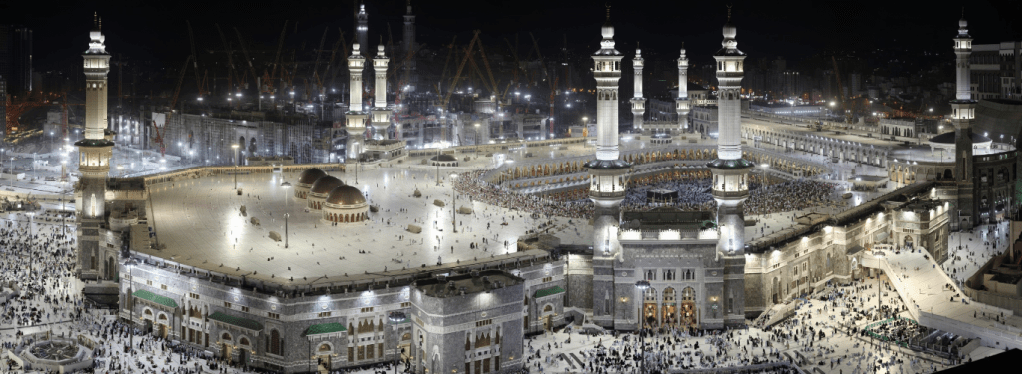
Verse 125 states: “And remember when We made the Sacred House a centre and a sanctuary for the people, saying, ‘You may take the standing-place of Abraham (Maqam Ibrahim) as a site of prayer’”. The Maqam Ibrahim is the specific rock upon which Abraham stood while raising the foundations of the Ka’bah with his son Ishmael.
The theological significance of the Maqam is that God chose to honor a physical “footprint” of Abraham’s labor to remind all future believers of his “love and dedication”. It is taught that Abraham stood on this rock to reach higher than his own height, signifying a desire to perform worship “at the highest level” and “to carry it to perfection”. This makes Abraham a role model in Ihsan (excellence/perfection) in worship. It emphasizes that the Ka’bah is not an object of worship itself, but a “landmark” that guides the believer to the “exclusive devotion” of Abraham’s God.
The Task of Purification (2:125)
In the same verse, God says: “And We entrusted Abraham and Ishmael to purify My House for those who circle it, who meditate in it, and who bow and prostrate themselves”. The “purification” of the House is not merely the removal of physical dirt, but the removal of “internal filth”—namely, Shirk (polytheism) and the “personality cults” that often arise around sacred sites.
This duty of “purification” is a perpetual role-model mandate for all religious leaders. It suggests that the primary duty of any “teacher” in Islam is to keep the “House of God” (the heart and the place of worship) free from any partner being associated with Him. This is a direct critique of later sectarian developments where sacred sites became centers for the “veneration of icons” or “personality-centered shrines”.
The Supplication for a “Submissive Nation” (2:128)
Abraham and Ishmael’s prayer—”Our Lord! Accept this from us… and make of us both Muslims to You, and of our offspring a Muslim nation”—is a model of humility. Even while performing the greatest service of their lives, they remain in a state of fear and hope, asking God for “acceptance”. This is a sharp contrast to later “infallibility” doctrines, where leaders are seen as naturally deserving of divine favor without the need for such humble pleading.
Rational Discovery and the Cosmic Turn: Surah Al-An’am 6:75-79
Surah Al-An’am provides perhaps the most “philosophical” account of Abraham’s role-model status, detailing his intellectual journey from celestial observation to “imageless monotheism”.
The Critique of Celestial Bodies (6:75-78)
The narrative depicts Abraham observing a star, the moon, and the sun, each of which he rhetorically calls “my Lord” to engage his people’s polytheistic mindset. However, as each one “sets” and disappears, he concludes that they are mere “creatures” subject to the laws of their Creator.
| Celestial Body Observed | Abraham’s Rational Conclusion | Theological Insight |
| The Star (6:76) | “I love not those that set.” | Divinity must be permanent and unchanging. |
| The Moon (6:77) | “Unless my Lord guides me, I will be misguided.” | Human reason needs divine guidance to avoid error. |
| The Sun (6:78) | “This is greater… but I am free from what you associate.” | Size and brightness do not equal divinity; creation implies a Creator. |
This “rational monotheism” demonstrates that the Abrahamic path is not based on “blind following” (Taqlid) but on “observation and reason”. He is the role model for the “independent thinker” who uses the “gift of reason” to dismantle the “man-made traditions” of his society.
The “Turning of the Face” (6:79)
The journey culminates in verse 79: “Indeed, I have turned my face toward He who created the heavens and the earth, inclining toward truth (Hanifa), and I am not of those who associate others with Allah”. The “turning of the face” (Wajjahtu Wajhiya) is a powerful metaphor for the “exclusive devotion” of the entire self to the Unseen God.
This verse is recited by millions of Muslims every day as they begin their prayers, serving as a constant renewal of the Abrahamic commitment to Tawhid. It defines the role model as one who finds God not through “icons or intermediaries,” but through a direct orientation toward the “Originated of the heavens and the earth”. It is a rejection of the “personality cult” in its most fundamental form, asserting that the human face must be turned away from all created things (including prophets and leaders) and toward the Creator alone.
The Critique of “Personality-Centered” Devotion: Sectarian Comparisons
The Quranic emphasis on Abraham as a “Universal Role Model” and the “Paradigm of 124,000 Prophets” provides a sharp critique of several “personality-centered” theological developments across history and contemporary Islam.
The Christian Deification of Jesus
The primary Quranic critique of Christianity is that it “misunderstood and misrepresented” the nature of its messenger, transforming Jesus from a “servant and prophet” into the “Son of God” or a “partner in the Trinity”. By making the teacher the object of worship, Christians violated the “Millat Ibrahim,” which insistently teaches that the messenger is only a “tool and a medium” for delivering the message of God. The Quranic Abraham, who “was not a Jew nor a Christian” (3:67), serves as a “theological judge” of this error, reminding humanity that the original path was one of “pure submission” to the One, not the many.
Twelver Shiism and the Infallible Imams
Mainstream Sunni critique of Twelver Shiism centers on the “doctrine of infallible Imamate”. Sunnis argue that by claiming the Imams are “divinely protected from error” and that “mandatory allegiance” to them is a guarantor of salvation, the movement has created a “rigid clerical hierarchy” that lacks a scriptural basis. They argue that the Quranic model—as seen in the 124,000 prophets—is one of “personal accountability” where no human leader possesses a “blank check of obedience”. The elevation of the Ahl al-Bayt (the Prophet’s family) to a status of “semi-divinity” or “superhuman intermediaries” is seen as a deviation from the “unmediated relationship” between the believer and God that Abraham modeled.
Ismaili Muslims and the Hereditary Lineage
Ismaili Muslims emphasize a “particular lineage” through a “hereditary spiritual leadership” called the Imamat, currently led by the Aga Khan. In Ismaili theology, the Imam is the “bearer of the Nur (light) of divine guidance” and is responsible for the “spiritual interpretation of Islam in each age”.
The Sunni critique of this model is that it “infringes on divine sovereignty” by giving absolute authority to a “living leader” over the written Scripture. While Ismailis argue this allows the faith to remain a “living tradition,” critics argue it “veils the seeker from God” by elevating a “hereditary gatekeeper” to a status that the Quran reserves only for God and His final, completed message. The “Millat Ibrahim” is a “creed” (a set of beliefs), not a “lineage” (a set of people).
The Ahmadiyya Community and the Promised Messiah
The Ahmadiyya community is centered on the recognition of Mirza Ghulam Ahmad as a “subordinate prophet,” “Messiah,” and “Mahdi”. They follow a system of Khilafat (Caliphate) which they believe is “divinely ordained” and provides “everlasting continuity” to the work of the Promised Messiah.
| Movement Component | Ahmadiyya Perspective | Mainstream/Abrahamic Critique |
| Prophethood | Subordinate prophet (Zilli Nabi) is possible after Muhammad. | “Khatamun-Nabiyyin” means the absolute closure of all forms of prophethood. |
| Leadership | Caliph is “divinely guided” and “appointed by Allah”. | All leaders are human, fallible, and should be verified against the Quran. |
| Devotion | “Love and loyalty to Khilafat” is a hallmark of identity. | Devotion should be to the Message and Tawhid, avoiding “personality worship”. |
| Authority | The Caliph’s directives are heeded as “divine inspiration”. | No teacher has the right to “legislate” beyond what God has authorized in the Quran (42:21). |
Mainstream scholars critique this “Ahmadiyya emphasis on their Promised Messiah and their Khulafa” as a form of “personality cult” that “tarnishes the basic principles of Islam”. They argue that the “Millat Ibrahim” is a “rational monotheism” that does not require “new prophets” or “special reformers” endowed with “prophetic responsibility”. The “system of Islam” was completed during the lifetime of Muhammad (5:3), and the 124,000-prophet paradigm ensures that the “Teacher” is always secondary to the “Truth”.
The Role of the Teacher in Islam: Guide vs. Intercessor
The Quranic and Prophetic tradition does not “treat the roles of teachers lightly”; rather, it links teaching with the “legacy of the Prophets”. However, there is a sharp theological distinction between a “Teacher” who transmits knowledge and an “Intercessor” or “Divine Leader” who demands ontological devotion.
The Prophet as a Teacher (62:2, 3:164)
The Quran identifies the Prophet Muhammad’s primary roles as: “reciting revelations, purifying hearts, and teaching the Book and wisdom” (62:2). This “teaching” is a “transformative mission,” but it is also “technical” in that it involves making the text clear to the people.
A key insight from the commentary on Surah Al-Nahl 16:44 is that the messenger “can only make things clear to the people by means of what has been sent down to them (Quran)”. The teacher “cannot guide” in the sense of implanting belief into the heart; that remains the sole domain of God (72:21). This reinforces the idea that the “Role Model” is an exemplar to be followed in behavior and character, not a “god” or “semi-god” to be worshipped.
The Warning Against “Lords Besides Allah” (3:79)
The Quran provides a definitive check on the authority of any religious leader or teacher in Surah Ali Imran 3:79: “It is not for any human being to whom God had given the Scripture and wisdom and prophethood that he should afterwards have said to mankind: ‘Be slaves of me instead of God’; but (what he said was): ‘Be worshippers of the Lord by virtue of your constant teaching of the Scripture’”.
This verse acts as the “Final Nail” in the coffin of “personality worship”. It explicitly states that no prophet—including Abraham, Jesus, or Muhammad—has the right to demand that their followers become “slaves” to their own person. The only legitimate command a prophet can give is for the people to become “worshippers of the Lord” through the study and teaching of the Scripture. This is the essence of the “Millat Ibrahim”—a creed where the “Human Teacher” is always pointing away from himself and toward the Divine.
Thematic Epilogue: Reclaiming the Unmediated Faith
The Glorious Quran’s presentation of Prophet Abraham as the “Supreme Role Model” (Uswatun Hasanah) alongside Prophet Muhammad is a strategic theological masterstroke designed to preserve the “absolute transcendence” of God. By constantly refocusing the believer on the “religion of Abraham”—a primordial, rational, and unsectarian path of submission—the Quran prevents the “ossification of faith” into a cult of personality.
The paradigm of 124,000 prophets serves as the ultimate “decentralizer.” It teaches that the Truth is universal, global, and timeless, and that the “Teacher” is a servant of that Truth, not its owner. This prevents the “supremacy complexes” and “religious intolerance” that arise when a community believes it has the only teacher or the only divinely protected lineage.
Abraham stands at the heart of this “unmediated relationship.” He is the man who looked at the stars and moon and moon and said, “I love not those that set”. He is the man who told his own father and his own people, “I am innocent of what you worship”. He is the man who built the House of God and prayed that his work be “accepted,” fearing the trials of the soul.
In contrast to the “personality-centered” devotions of:
- The Christians, who “make Jesus God,” thereby confusing the messenger with the Sender.
- The Shiites, who emphasize “the family of the prophet” and “infallible Imams” as mandatory intermediaries.
- The Ismaili Muslims, who prioritize a “particular lineage” and the “absolute authority” of a living Imam.
- The Ahmadiyya Community, with their “emphasis on their Promised Messiah and their Khulafa” as divinely guided protectors of the community.
The Quranic Abrahamic model offers a “Pure Submission” (Millah) that is based on:
- Monotheism: A direct, “face-turning” orientation to the Creator without partners.
- Accountability: A realization that “every soul is responsible for what it earned” and that “ancestry provides no escape” from divine judgment.
- Rational Conviction: A faith that is “grounded in reason and reflection” upon the heavens and the earth, rather than “blind imitation” of ancestors or leaders.
To follow Abraham is to reject the “obsession with the teacher” and to embrace the “majesty of the Message.” It is to recognize that the greatest role model is the one who most completely effaces their own ego in the presence of the Divine Will. As the Prophet Muhammad was told, so too is every believer reminded: “Follow the religion of Abraham, inclining toward truth; and he was not of those who associate partners with God” (16:123). This is the “Excellent Example” that remains relevant until the Last Day, a fortress of faith built with the materials of “prophetic example, clear principles, and the ultimate goal of pleasing Allah”.



 The Glorious Quran and Science
Leave a comment