
Abraham as Islam’s universal exemplar: the Quran’s case for teachings over personality
Presented by Zia H Shah MD
The Quran designates Prophet Abraham (Ibrahim) as an “excellent example” (uswatun hasanah) — the same title given to Prophet Muhammad — making him one of only two figures in scripture explicitly called a role model for all believers. This designation, found in Surah Al-Mumtahanah 60:4-6, carries profound theological implications: Islam’s final Prophet was himself commanded to “follow the religion of Abraham” (16:123), Alim +2 establishing that the divine message transcends any single messenger. The Quran deploys Abraham as a structural safeguard against personality-centered devotion, presenting faith as rooted in eternal monotheistic principles rather than allegiance to any individual. This framework stands in deliberate contrast to traditions — both within and outside Islam — that have elevated specific personalities or lineages to near-divine status.
The Quran’s two “excellent examples”: Abraham alongside Muhammad
The Arabic phrase أُسْوَةٌ حَسَنَةٌ (uswatun hasanah) appears in only two contexts in the entire Quran. Most Muslims know the first: Surah Al-Ahzab 33:21 applies it to Prophet Muhammad. Far fewer recognize that the same phrase appears — twice — for Abraham in Surah Al-Mumtahanah.
Verse 60:4 declares: “Qad kaanat lakum uswatun hasanatun feee Ibraaheema wallazeena ma’ahoo iz qaaloo liqawmihim innaa bura’aaa’u minkum wa mimmaa ta’budoona min doonil laahi kafarnaa bikum wa badaa bainanaa wa bainakumul ‘adaawatu wal baghdaaa’u abadan hattaa tu’minoo billaahi wahdahoo…”
Translation (Sahih International): “There has already been for you an excellent pattern in Abraham and those with him, when they said to their people, ‘Indeed, we are disassociated from you and from whatever you worship other than Allah. We have denied you, and there has appeared between us and you animosity and hatred forever until you believe in Allah alone’ — except for the saying of Abraham to his father, ‘I will surely ask forgiveness for you, but I have not [power to do] for you anything against Allah.’ My Islam [The believers prayed:] ‘Our Lord, in You we trust, and to You we turn, and to You is the final return.’” My IslamThe Muslim Vibe
Verse 60:5 continues the prayer: “Rabbanaa laa taj’alnaa fitnatal lillazeena kafaroo waghfir lanaa rabbanaa innaka antal ‘azeezul hakeem.” (“Our Lord, make us not objects of trial for the disbelievers and forgive us, our Lord. Indeed, it is You who is the Exalted in Might, the Wise.”) Quran.comQuran411
Verse 60:6 then reiterates the designation: “Laqad kaana lakum feehim uswatun hasanatul liman kaana yarjul laaha wal yawmal aakhir; wa many yatawalla fa innal laaha huwal ghaniyyul hameed.” (“There has certainly been for you in them an excellent pattern for anyone whose hope is in Allah and the Last Day. And whoever turns away — then indeed, Allah is the Free of need, the Praiseworthy.”) My Islam
Ibn Kathir explains that Allah “addresses His faithful servants, commanding them to disown disbelievers,” and presents Abraham as the definitive model for this. quran The classical exegete Al-Jalalayn defines uswatun hasanah as qudwa — a pattern to follow “in terms of sayings and deeds.” Surah Quran Critically, the one exception noted is Abraham’s promise to pray for his idolatrous father, which the Quran explicitly excludes from the model, teaching that even prophetic compassion cannot extend to seeking forgiveness for those who die in polytheism Quran.com (cross-referenced with 9:113-114). Quran.com
Maududi draws out the deeper principle: the “inevitable demand of faith in Allah is denial of taghut (false deities),” QuranX and Abraham embodied this by “expressing disapproval of his pagan people and breaking off all connections with them.” My Islam The qualities highlighted are not biographical details but theological principles — Tawhid (pure monotheism), Bara’a (disavowal of falsehood), and Tawakkul (complete trust in God).
Abraham as “a nation unto himself”: Surah An-Nahl’s remarkable portrait
Surah An-Nahl 16:120-123 contains one of the Quran’s most distinctive descriptions of any human being — and culminates in the extraordinary command to Muhammad himself.
Verse 16:120: “Inna Ibraaheema kaana ummatan qaanital lillaahi Haneefanw wa lam yaku minal mushrikeen.” (“Indeed, Abraham was a [comprehensive] leader, devoutly obedient to Allah, inclining toward truth, and he was not of those who associate others with Allah.”) My IslamAlquran english
Verse 16:121: “Shaakiral li an’umih; ijtabaahu wa hadaahu ilaa Siraatim Mustaqeem.” (“He was grateful for His favors. He [Allah] chose him and guided him to a straight path.”) AlimMy Islam
Verse 16:122: “Wa aatainaahu fid dunyaa hasanah; wa innahoo fil Aakhirati laminas saaliheen.” (“And We gave him good in this world, and indeed he, in the Hereafter, will be among the righteous.”) AlimNoble Quran
Verse 16:123: “Thumma awhainaa ilaika anit tabi’ Millata Ibraaheema haneefaa; wa maa kaana minal mushrikeen.” (“Then We revealed to you, [O Muhammad], to follow the religion of Abraham, inclining toward truth; and he was not of those who associate with Allah.”) Tafsirq +3
The word ummah (أمة) in verse 120 is extraordinary. While typically translated as “nation” or “community,” here it describes a single individual. Maududi explains: “Abraham was a whole community by himself, for at that time he was the only Muslim in the whole world who was upholding the banner of Islam, while the rest of the world was upholding the banner of unbelief. As that servant of Allah performed the mission which is ordinarily carried out by a whole community, he was not one person but an institution in himself.” My Islam
Ibn Kathir adds that the word signifies Abraham “was given all good and righteous qualities” Surah Quran — that he embodied the completeness of virtue that normally requires an entire nation to collectively express. Alim The verse also calls him Hanif (حنيف), meaning one who is upright in pure monotheism, inclining away from all falsehood toward truth. This term appears 12 times in the Quran, and nearly always in connection with Abraham. Quran Gallery AppMuslimWiki
Verse 123 is theologically pivotal. Ibn Kathir writes: “Because of his perfection, greatness, and the soundness of his Tawhid and his way, We revealed to you, O Seal of the Messengers and Leader of the Prophets: ‘Follow the religion of Ibrahim.’” AlimSurah Quran Al-Zamakhshari calls this command “a special tribute” to the Friend of God — honoring Abraham by making him the model for the final prophet. Quran.com This verse demolishes any notion that Islam centers exclusively on one personality: the Prophet Muhammad is himself directed to follow a predecessor’s creed.
The Millah of Abraham: only a fool turns away
The concept of Millah Ibrahim (ملة إبراهيم) — the creed or religion of Abraham — is among the most significant theological constructs in the Quran. The word millah derives from the Arabic root م-ل-ل, meaning “to dictate” or “to prescribe,” carrying the connotation of divinely dictated instruction. The expression Millat Ibrahim appears in approximately eight verses, WikipediaQuran Talk Blog and in virtually every instance, it is immediately followed by “hanifan wa ma kana min al-mushrikin” — “inclining toward truth, and he was not of the polytheists.” This deliberate pairing defines Abraham’s creed as pure Tawhid and rejection of shirk.
Surah Al-Baqarah 2:130 opens with a rhetorical challenge: “Wa may yarghabu ‘am Millati Ibraaheema illaa man safiha nafsah…” (“And who would be averse to the religion of Abraham except one who makes a fool of himself. And We had chosen him in this world, and indeed he, in the Hereafter, will be among the righteous.”) My IslamAlquran english
The passage continues through verse 131, where Abraham’s response to God’s command to submit is immediate and total — “Qaala aslamtu li Rabbil ‘aalameen” (“I have submitted to the Lord of the worlds”) — and through verse 132, where he instructs his sons: “O my sons, indeed Allah has chosen for you this religion, so do not die except while you are Muslims.” Islamic Studies Verse 133 records Jacob on his deathbed asking his sons what they will worship, and their reply: “We will worship your God and the God of your fathers, Abraham and Ishmael and Isaac — one God. And we are Muslims in submission to Him.” Islamic Studies
Verse 2:135 delivers the definitive declaration: “Wa qaaloo koonoo hoodan aw nasaaraa tahtadoo; qul bal Millata Ibraaheema haneefanw wa maa kaana minal mushrikeen.” (“They say, ‘Be Jews or Christians [so] you will be guided.’ Say, ‘Rather, [we follow] the religion of Abraham, inclining toward truth, and he was not of the polytheists.’”) My IslamQuranhadits
Maududi’s commentary on this passage is incisive: “If man’s guidance depends on following Judaism or Christianity, how can Abraham and other Prophets and righteous people who are accepted as having been rightly-guided even by the Jews and Christians be considered so when they were born several centuries before the birth of Judaism and Christianity?” Islamic Studies The argument is that Abraham’s monotheism preceded and transcends all sectarian labels — neither “Jewish” nor “Christian” but simply Muslim (one who submits to God).
The complete list of Quranic references to Millah Ibrahim includes: 2:130, 2:135, 3:95, 4:125, 6:161, 12:37-38, 16:123, and 22:78. Additionally, Quran 3:67 makes the most explicit claim: “Abraham was neither a Jew nor a Christian, but he was a Hanif, a Muslim, and he was not of the polytheists.” Quran Gallery App And Quran 22:78 states: “It is the religion of your father, Ibrahim. He named you ‘Muslims’ before” — tracing the very name of the Muslim community to Abraham.
Abu Ja’far al-Tabari identifies two reasons why Hanifiyyah is specifically called the religion of Abraham: first, the people of Mecca knew Abraham, claimed descent from him, and claimed to follow his religion — so they should follow his actual Tawhid rather than their corrupted version; second, Allah made Abraham a leader of all prophets after him, commanding them to emulate him — a distinction uniquely his.
Abraham builds the Ka’bah and declares God’s oneness
Two additional verse sets complete the portrait of Abraham as Islam’s archetypal monotheist.
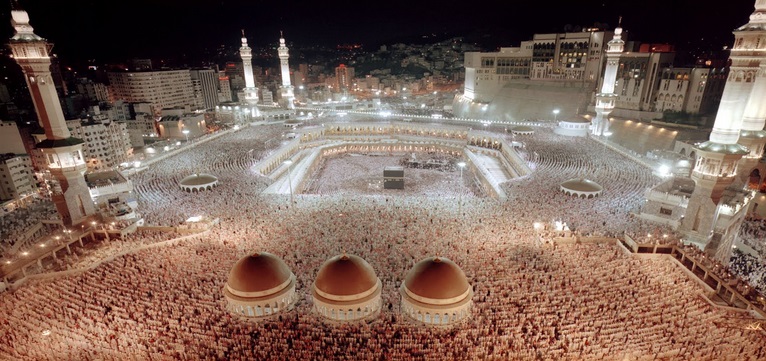
Surah Al-Baqarah 2:125-128 records Abraham and Ishmael establishing the Ka’bah — the physical center of Islamic worship:
Verse 127: “Wa iz yarfa’u Ibraaheemul qawaa’ida minal Baiti wa Ismaa’eelu Rabbanaa taqabbal minnaa innaka Antas Samee’ul ‘Aleem.” (“And when Abraham was raising the foundations of the House and [with him] Ishmael, [saying], ‘Our Lord, accept [this] from us. Indeed, You are the Hearing, the Knowing.’”) Submission
Verse 128: “Rabbanaa waj’alnaa muslimaini laka wa min zurriyyatinaaa ummatam muslimatal laka wa arinaa manaasikanaa wa tub ‘alainaa; innaka antat Tawwaabur Raheem.” (“Our Lord, and make us Muslims in submission to You and from our descendants a Muslim nation in submission to You. And show us our rites and accept our repentance. Indeed, You are the Accepting of Repentance, the Merciful.”) Submission
Maududi highlights that purifying God’s House “does not merely mean keeping it clean of dirt and filth. The real purity and cleanliness of the House of God rests in the fact that in it the name of God alone should be glorified.” My Islam The Quraysh, who boasted of being Abraham’s inheritors, were in fact “trampling over” his legacy through their polytheism. My Islam
Surah Al-An’am 6:79 records Abraham’s climactic declaration of monotheism, the culmination of his intellectual journey through observing the stars, moon, and sun (6:76-78):
“Innee wajjahtu wajhiya lillazee fataras samaawaati wal arda haneefanw wa maaa ana minal mushrikeen.” The Muslim Vibe (“Indeed, I have turned my face toward He who created the heavens and the earth, inclining toward truth, and I am not of those who associate others with Allah.”) My IslamNoble Quran
The phrase “wajjahtu wajhiya” (“I have turned my face”) is, as one commentary notes, “a powerful metaphor for reorienting one’s entire existence — intellect, will, and emotion — toward a single, ultimate reality.” Quran Gallery App Maududi explains that Abraham’s declaration was “arrived at through careful observation and serious reflection,” representing monotheism born of reason, not blind faith. Islamic StudiesIslamic Studies This rational pathway to God makes Abraham’s example universally accessible — his faith was not based on miracles witnessed or inherited tradition but on intellectual conviction.
Additional Quranic passages reinforce Abraham’s exemplary status. Surah Al-Anbiya 21:51-73 narrates his destruction of idols and miraculous survival when cast into fire. Islamicstudies.info Surah Ibrahim 14:35-41 records his prayer for Mecca and his descendants. JomAlQuranIslamicstudies.info Surah Ash-Shu’ara 26:78-82 contains his profound personal testimony: “Who created me, and He guides me. Who feeds me and gives me drink. When I am ill, He cures me. Who will cause me to die and then bring me to life.” Surah Az-Zukhruf 43:26-28 states he “left behind this word to endure among his posterity” — the word of pure monotheism. Islamic Studies
124,000 prophets and the principle of no distinction
Islam’s prophetic paradigm is fundamentally pluralistic. The widely cited hadith of Abu Dharr al-Ghifari, recorded in Musnad Ahmad and Al-Tabarani, states that Prophet Muhammad identified 124,000 prophets sent throughout history, of whom 313 were messengers (rusul). RiwayaPejabat Mufti Wilayah Persekutuan While scholars debate the hadith’s authenticity — Imam al-Syaukani classified the chain as hassan (acceptable) while Ibn Taymiyah expressed reservations Islamhelpline — the underlying Quranic principle is unambiguous.
Quran 16:36 declares: “And We certainly sent into every nation a messenger, [saying], ‘Worship Allah and avoid false deities.’” OnePath Network +2 Quran 35:24 affirms: “There never was a nation but a warner had passed among them.” Quran 40:78 acknowledges prophets beyond those named in scripture: “We did aforetime send prophets before you; of them there are some whose story We have related to you, and some whose story We have not related to you.” Islamhelpline
The Quran names approximately 25 prophets, Wikipedia each embodying particular virtues: Why Islam Noah exemplifies steadfastness (he preached for 950 years); Edarabia Moses represents courage against tyranny; Joseph demonstrates chastity and forgiveness; Job personifies patience in suffering; David models grateful worship; Jesus embodies miraculous servanthood. This diversity serves a deliberate theological function — no single personality monopolizes the concept of righteousness.
Among these, five are designated Ulul ‘Azm (أُولُو الْعَزْمِ) — Prophets of Strong Will: Noah, Abraham, Moses, Jesus, and Muhammad. IslamOnline Quran 33:7 specifically names these five as receiving a “solemn covenant” (mithaqan ghalithan) from God. Islamic Guru Quran 42:13 links them in a single chain: “He has ordained for you the same religion which He ordained for Noah, and that which We have revealed to you, and that which We ordained for Abraham, Moses, and Jesus — commanding: ‘Establish the religion and make no divisions therein.’” Wikipedia
The command to make “no divisions” strikes at the heart of personality-centered devotion. Quran 2:285 makes this explicit: “They all believe in Allah, His angels, His Books, and His messengers. They proclaim, ‘We make no distinction between any of His messengers.’” Quran.comAmericanislamicoutreach The Tafsir Jalalayn notes this directly opposes “the manner of the Jews and the Christians” who “believe in some and disbelieve in others.” Quran O Quran 4:150-152 condemns those who “say, ‘We believe in some but reject others,’ and wish to adopt a way in between — those are the disbelievers, truly.”
The Prophet Muhammad himself reinforced this unity in a hadith recorded in Sahih al-Bukhari: “The prophets are paternal brothers; their mothers are different, but their religion is one.” IQRA Network The “different mothers” — different times, peoples, circumstances — are secondary to the shared religion of Tawhid.
Message over messenger: the Quran’s structural argument
The Quran builds a systematic case that the divine message takes primacy over any individual messenger. This principle operates at multiple levels.
At the theological level, the core message of every prophet is identical. Quran 21:25 states: “And We sent not before you any messenger except that We revealed to him that, ‘There is no deity except Me, so worship Me.’” My IslamIQRA Network Every prophetic story in the Quran ultimately illustrates the same truth — the oneness of God and human accountability before Him. The messengers vary; the message does not.
At the personal level, the Quran repeatedly humanizes prophets and limits their status. Muhammad is told: “Say, ‘I am only a man like you, to whom it has been revealed that your god is one God’” (18:110). He is instructed: “Say, ‘I do not tell you that I have the depositories of Allah or that I know the unseen, nor do I tell you that I am an angel. I only follow what is revealed to me’” (6:50). And crucially: “Say, ‘I hold not for myself the power of benefit or harm, except what Allah has willed’” (7:188).
At the structural level, the definitive verse is Surah Al-Imran 3:144: “Muhammad is no more than a messenger; other messengers have gone before him. If he were to die or to be killed, would you regress into disbelief? Those who do so will not harm Allah whatsoever.” Quran.comQuran.com Revealed after the Battle of Uhud (625 CE), when rumors of Muhammad’s death caused panic, this verse served as a corrective that resonated through history. Quran.comIslamic Studies When Muhammad actually died, Abu Bakr recited this verse and declared: “If anyone was worshiping Muhammad, surely Muhammad is dead. If anyone was worshiping God, surely God is the Living who does not die.” QuranX Maududi comments: “If their devotion to the truth is wholly bound up with the person of Muhammad, and if their submission to God is so lukewarm that his demise would cause them to plunge back into disbelief, then they should bear in mind the fact that Islam does not need them.” Islamic Studies
Quran 3:79-80 explicitly prohibits prophets from becoming objects of worship: “It is not appropriate for someone whom Allah has blessed with the Scripture, wisdom, and prophethood to say to people, ‘Worship me instead of Allah.’ Rather, he would say, ‘Be devoted to the worship of your Lord alone.’ Quran.com Nor could he order you to take the angels and prophets as lords.” Quran
The command to Muhammad to follow Abraham (16:123) is the capstone of this architecture. Alim As the Yaqeen Institute observes: “Prophet Muhammad himself was called to follow the role model of earlier prophets, in particular our father Abraham… The essence of prophetic character, we learn, is timeless.” Yaqeen Institute for Islamic Research If the final Prophet follows a previous prophet’s creed, then the creed itself — not any personality — is supreme.
How personality-centered devotion diverges from the Quranic model
The Quran’s teaching-centered framework becomes sharpest when contrasted with traditions that have elevated specific personalities or lineages to central positions of spiritual authority.
Christianity’s Christological trajectory illustrates the pattern most dramatically. The elevation of Jesus from prophet to divine co-equal with the Father occurred through centuries of theological development. Paul’s letters (c. 50s CE) already positioned Jesus within the divine identity. Canon Fodder Ignatius of Antioch (d. ~115 CE) referred to Jesus as theos approximately 14 times. Faith Pulpit The Council of Nicaea (325 CE) formalized the doctrine that Christ was “begotten, not made” and “of the same substance (homoousios) as the Father,” Encyclopedia Britannica and the Council of Chalcedon (451 CE) affirmed him as “fully human and fully divine.” Academia.edu The Quran directly addresses this escalation. Surah An-Nisa 4:171 warns: “O People of the Book! Do not go to extremes regarding your faith… The Messiah, Jesus, son of Mary, was no more than a messenger of Allah… So believe in Allah and His messengers and do not say ‘Trinity.’ Stop!” Quran.com In a dramatic Judgment Day scene (5:116-117), Jesus himself denies any claim to divinity: “Never did I say to them except what You commanded me: ‘Worship Allah, my Lord and your Lord.’” Noble Quran +2
Within Islam itself, certain traditions have developed personality-centered emphases that diverge from the Quran’s pluralistic prophetic framework. Twelver Shia theology centers religious authority in the Ahl al-Bayt (the Prophet’s family) through the doctrine of the Imamate — twelve divinely appointed, infallible (ma’sum) Imams who serve as the authoritative interpreters of Islam. Wikipedia The Hadith al-Thaqalayn (“I am leaving among you two weighty things: the Book of Allah and my family, Ahl al-Bayt”) serves as the foundational text. Wikishia While the Quran expresses high regard for the Prophet’s household (33:33), it does not establish an institutional doctrine of hereditary infallible spiritual authority. The Quran instead emphasizes individual accountability — “No bearer of burdens shall bear the burden of another” (6:164) Surah Anam — and distributes its role models across multiple prophetic lineages.
Nizari Ismaili Islam takes the lineage concept further with the institution of the living Hazar Imam (Present Imam). Following the death of Aga Khan IV (Prince Shah Karim al-Hussaini) on February 4, 2025, his son Aga Khan V (Prince Shah Rahim al-Hussaini) became the 50th Imam. Wikipedia Ismaili theology holds that the Imam is the “bearer of divine light (Noor)” passed through the lineage from Ali, and the authoritative interpreter of both the exoteric and esoteric meanings of the Quran. Ismailimail Scholar Farhad Daftary explains that “the central theological doctrine of the Ismailis is based on the belief in the permanent need for humankind for a divinely inspired Imam.” Ismailimail This concentrates spiritual authority in a single living person — a contrast with the Quran’s model of 25 named prophets across centuries as collective exemplars of the same message. Wikipedia
The Ahmadiyya Muslim Community, founded by Mirza Ghulam Ahmad (1835-1908), makes acceptance of their founder as the “Promised Messiah and Mahdi” a condition of membership. Wikipedia Their system of Khilafat — currently led by Mirza Masroor Ahmad as the fifth Khalifatul Masih — creates a structural parallel to the personality-centered devotion the Quran critiques. Ahmadiyya Three of the five caliphs have been direct descendants of the founder. WikipediaWikipedia Mainstream Muslim scholars and organizations reject Ahmadiyya claims primarily because they appear to contravene the Quranic principle that Muhammad is the “Seal of the Prophets” (33:40). AlmasjidUASV Bible
The pattern across these traditions is consistent: devotion gravitates from the universal message toward a particular personality or lineage, and the teaching risks being overshadowed by the teacher. The Quran’s architecture — multiple prophets, the same message, no distinction between messengers, and even Muhammad following Abraham — functions as a deliberate structural safeguard against precisely this tendency.
Conclusion: Abraham as the Quran’s argument for principle over personality
The Quran’s presentation of Abraham is not merely biographical — it is a theological argument. By bestowing upon Abraham the same title of uswatun hasanah given to Muhammad, by calling him an ummah (a nation unto himself), by designating his creed (Millah Ibrahim) as the essence of true religion, and by commanding the final Prophet to follow his way, the Quran makes an unmistakable case: faith belongs to God’s eternal message, not to any human messenger.
Abraham’s unique suitability for this role rests on several factors. He arrived at monotheism through reason (6:76-79), not inherited tradition. Wikipedia +2 He physically destroyed idols (21:57-67) as active rejection of falsehood. JomAlQuranIslamicstudies.info He was willing to sacrifice his son in absolute obedience (37:102-107). He built the Ka’bah (2:127) as the permanent center of monotheistic worship. Quran For kidsWikipedia And he predates all sectarian divisions — he was, as the Quran insists, “neither a Jew nor a Christian, but a Hanif, a Muslim” (3:67). Quran Gallery AppExplore Islam His example cannot be claimed exclusively by any sect, community, or lineage.
The Quran’s ultimate insight is that the diversity of prophetic role models — from Adam’s humility to Noah’s perseverance, from Moses’ courage to Jesus’ servanthood, from Abraham’s intellectual monotheism to Muhammad’s comprehensive mercy — points away from any single personality and toward the One God they all served. When the religion itself is named after the act of submission (Islam) rather than after any prophet, when the creed is traced to Abraham rather than contained by any one era, and when even the final Prophet is told to follow a predecessor, the message is clear: worship belongs to God alone, and the greatest honor paid to any messenger is to follow what he taught.



 The Glorious Quran and Science
Leave a comment