
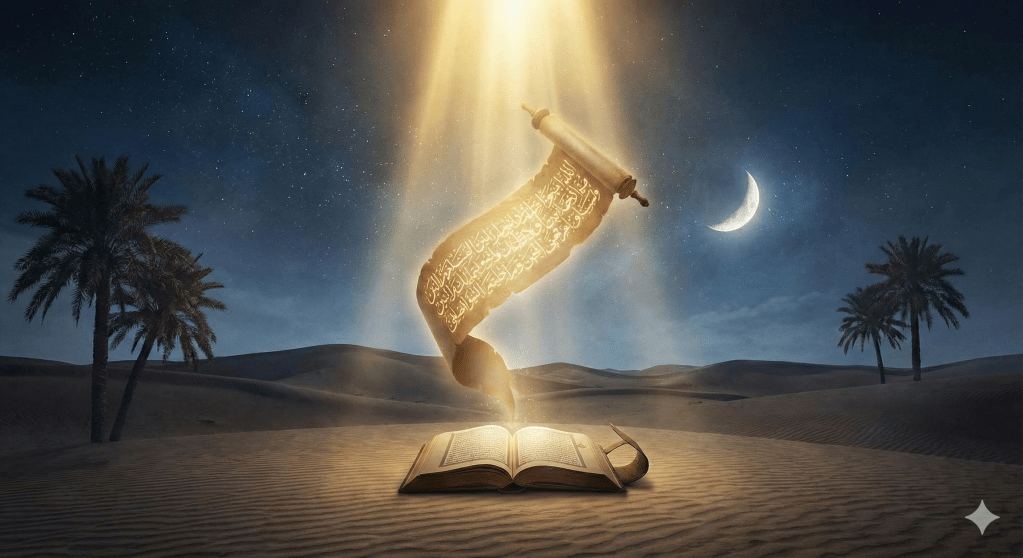
Epigraph
وَعَلَّمَ آدَمَ الْأَسْمَاءَ كُلَّهَا ثُمَّ عَرَضَهُمْ عَلَى الْمَلَائِكَةِ فَقَالَ أَنبِئُونِي بِأَسْمَاءِ هَٰؤُلَاءِ إِن كُنتُمْ صَادِقِينَ
Al Quran 2:31
الرَّحْمَٰنُ
عَلَّمَ الْقُرْآنَ
خَلَقَ الْإِنسَانَ
عَلَّمَهُ الْبَيَانَ
Al Quran 55:1-4

Language as the fingerprint of a divine teacher: a commentary on Quran 2:30–33 and 55:3–4
Presented by Zia H Shah MD
Abstract
This commentary advances the thesis that human language — and specifically the Arabic language in its Quranic expression — constitutes one of the most compelling evidences for guided evolution and a prior divine consciousness. Drawing on Quran 2:30–33, where God teaches Adam “the names of all things” (al-asmāʾ kullahā), and Quran 55:3–4, where God creates humanity and endows it with articulate expression (al-bayān), we argue that these verses describe a divine pedagogy: the incremental, purposeful revelation of language to the first human community. The Arabic triliteral root system — with its approximately 1,642 roots generating a corpus of 77,429 word tokens in the Quran through systematic non-concatenative morphological patterns Thequranthequran — exhibits a degree of organization, semantic coherence, and mathematical elegance that resists explanation by random, blind processes. This linguistic architecture became fully visible only after the Quran’s revelation catalyzed the formal study of Arabic grammar Grokipedia by scholars such as Abu al-Aswad al-Du’ali, Al-Khalil ibn Ahmad, and Sibawayh, who discovered rather than invented the deep structure already latent in the language. Modern computational analysis shows that just 26 prolific root families account for roughly 8,000 of the Quran’s approximately 77,000 words, with the single root q-w-m (“to stand/establish”) yielding 22 derived forms across 660 occurrences. The classical Islamic debate between tawqīf (divine institution of language) and iṣṭilāḥ (human convention) Thequran is here revisited through the lens of modern linguistics, philosophy of mind, and information theory. Noam Chomsky’s Universal Grammar, WikipediaAeon Steven Pinker’s “language instinct,” American ScientistSteven Pinker the unsolved “hard problem” of language origins, and the Linguistic Society of Paris’s century-long ban on the topic LinkedIn +2 all converge on a single admission: no currently accepted naturalistic paradigm adequately explains how language arose. We propose that the Quran’s silence on the precise timeframe of this divine teaching is theologically deliberate, allowing compatibility with extended evolutionary timescales while affirming that the process was guided rather than accidental. The commentary concludes that the Arabic language, in the systematic richness of its root architecture and the inimitable eloquence of the Quran it carries, constitutes what Zia H Shah has called a “semantic lattice” Thequran — a structure too organized, too information-dense, and too purposeful to be the product of chance, and therefore a sign pointing toward the All-Knowing Teacher (al-ʿAlīm) who, as the Quran declares, taught humanity what it did not know.
The Quranic foundation: God as the first teacher of language
The argument begins where the Quran begins its account of human distinction — in the dramatic exchange between God and the angels in Surah Al-Baqarah. When God announces His intention to place a khalīfah (vicegerent) on earth, the angels protest: “Will You place therein one who causes corruption and sheds blood, while we declare Your praise and sanctify You?” Islamicstudies.info God’s reply is terse and decisive: “Indeed, I know that which you do not know” (2:30). What follows is the definitive act that establishes human supremacy over all other creation: “And He taught Adam the names — all of them” (2:31). IslamAwakenedMy Islam
The Arabic of this verse is striking in its totality. The word kullahā (“all of them”) leaves no room for a partial endowment. God then presents these named realities to the angels and challenges them: “Inform Me of the names of these, if you are truthful.” IslamAwakened The angels confess their utter dependence: “Exalted are You; we have no knowledge except what You have taught us. Indeed, it is You who is the Knowing, the Wise” (2:32). quranx Adam then names what the angels could not, and God concludes: “Did I not tell you that I know the unseen of the heavens and the earth, and I know what you reveal and what you conceal?” Quran.com (2:33). My IslamQuran.com
This passage is complemented by the opening of Surah Ar-Rahman, which structures divine mercy itself around the act of linguistic endowment. The sequence is deliberate: “The Most Merciful — taught the Quran — created man — taught him al-bayān” (55:1–4). AlimIslamic Studies The teaching of the Quran precedes the creation of man in the rhetorical order, suggesting that divine speech is ontologically prior to human existence. Then, immediately after creating humanity, God’s first act of mercy is not sustenance or shelter but al-bayān — the capacity for articulate, meaningful expression.
The great exegetes differed on the precise referent of “the names” and al-bayān, but their disagreements reveal a unified deeper conviction: language is not an accident of evolution but a divine gift. Ibn Kathir reported Ibn Abbas’s sweeping definition — that the names included “human, animal, sky, earth, land, sea, horse, donkey,” and even mundane objects like plates and pots. quranx +2 Fakhr al-Din al-Razi offered the most expansive interpretation: God taught Adam the names of all creations “in all different languages spoken by the descendants of Adam today — Arabic, Persian, Roman, and others.” Thebrpi Al-Tustari, the great Sufi exegete, interpreted al-bayān as encompassing “speech of the spiritual self, understanding of the intellect, discernment of the heart, natural intuition, and knowledge of the natural self.” quranx Mufti Muhammad Shafi explicitly linked the two passages: “The word bayān comprehends all the means of communication created by Allah — speech, writing, and all means of communication in all languages and dialects. All these are the practical interpretation or application of the verse ‘He taught Adam the names, all of them’ (2:31).” Islamicstudies.info
The theological import is unmistakable. Language is not merely a survival tool that emerged from random neural mutations. It is the defining gift that made human vicegerency possible, Learningquranacademy that distinguished Adam from the angels, and that constitutes one of God’s first acts of mercy toward the creature He fashioned for His earth.
The Arabic root system as an architectural marvel
To grasp why Arabic is uniquely suited to serve as evidence for a divine teacher, one must understand the extraordinary system upon which it is built. Arabic belongs to the Semitic family of languages, and its morphology operates on a principle radically different from that of Indo-European languages. Where English builds words by concatenating prefixes and suffixes onto a linear stem (un-break-able), Arabic employs non-concatenative, templatic morphology: a skeleton of (usually three) consonants — the root — is interwoven with vowel patterns, prefixes, infixes, and suffixes to generate entire families of semantically related words. Thequranthequran
Consider the root k-t-b (ك-ت-ب), which encodes the abstract concept of “writing.” From this single triliteral root, Arabic derives: kataba (he wrote), kātib (writer), maktūb (written, a letter), kitāb (book), Thequran kutub (books), maktaba (library), maktab (office/desk), kuttāb (writers; Quranic school), kitāba (the act of writing), mukātaba (correspondence), iktitāb (subscription), and istiktāb (dictation). Thequran Every word in this family is immediately recognizable as related to the others, and every derivation follows a predictable pattern.
This is not an isolated example. The Quranic Arabic Corpus (compiled at the University of Leeds by Kais Dukes) Grokipedia has identified 1,642 distinct root tags across the Quran’s 77,429 word tokens. Thequran Of these, 49,967 tokens (approximately 64.5%) are root-bearing stems, while the remaining 35.5% are function particles. The distribution follows a striking power law: the top 100 roots account for roughly 60% of all root-bearing tokens. thequran The five most frequent roots in the Quran are: أ-ل-ه (Alh, the God-family, 2,851 occurrences), ق-و-ل (qwl, to say, 1,722), ك-و-ن (kwn, to be, 1,390), ر-ب-ب (rbb, Lord, 980), and أ-م-ن (Amn, faith, 879). As Zia H Shah has documented in his comprehensive philological analyses, these high-frequency roots “cluster around themes of faith, justice, knowledge, and divine authority,” suggesting that the Quran’s morphological richness directly mirrors its theological priorities.
The system’s generative power operates through ten primary verb forms (awzān), each carrying a systematic semantic modification of the root meaning. Talkpal Form I (faʿala) gives the basic meaning; The Arabiker Form II (faʿʿala) intensifies or causes it; Form III (fāʿala) makes it reciprocal; Form IV (ʾafʿala) causes it through a different mechanism; Form V (tafaʿʿala) reflexivizes Form II; Form VI (tafāʿala) reflexivizes Form III; Form VII (infaʿala) creates a passive or reflexive; Form VIII (iftaʿala) generates another reflexive shade; Form IX (ifʿalla) describes colors and physical traits; and Form X (istafʿala) expresses seeking or considering. desert-sky The systematic pairing — Forms II and V as causative and its reflexive, Forms III and VI as reciprocal and its reflexive — reveals an architectural logic that early Arab grammarians used the template root f-ʿ-l (فعل, “to do”) to describe abstractly, much as a mathematician uses variables.
What Zia H Shah has called the “morphological architecture of the Quranic lexicon” goes beyond mere productivity. His extensive mapping of over 500 Quranic nouns to their triliteral roots reveals, in his words, “a linguistic ecosystem of unparalleled semantic unity.” Thequran The root system functions as a safeguard for semantic integrity: “because every noun is anchored to a three-letter core, the primary essence of a concept remains visible regardless of its morphological transformation.” When a reader encounters the noun masjid (mosque), the root {s-j-d} immediately invokes prostration and submission. Thequran When one reads raḥmah (mercy), the root {r-ḥ-m} simultaneously recalls raḥīm (womb), and thus the very name for the organ of motherhood is linked to God’s attribute of mercy — a connection the Prophet Muhammad explicitly affirmed: “I am al-Raḥmān and created the raḥim — and derived its name from My Name.” Thequran
This creates what Shah describes as a “hyperlinked” reading experience, where “every word recalls its root cousins” Thequran and the Quran functions as “a cohesive and self-referential” discourse. The effect is not merely pedagogical. It is ontological: the language mirrors the unity of the reality it describes.
26 root families and the statistical signature of design
The most striking quantitative evidence emerges from Shah’s analysis of morphological productivity in the Quran. His systematic alphabetical survey of every root in the Quranic Arabic Corpus identified 26 Arabic roots that generate more than 10 derived forms within the Quranic text. These 26 root families collectively account for roughly 8,000 of the Quran’s approximately 77,000 words — meaning that a remarkably small genetic core of the lexicon produces an outsized proportion of the text.
The single most productive root, ق-و-م (q-w-m, “to stand/establish”), generates an extraordinary 22 derived forms spanning 660 occurrences, yielding words as diverse as qawm (“people,” literally “those who stand together”), qiyāmah (“resurrection,” the great standing), mustaqīm (“straight,” as in the straight path), maqām (“station”), and qāʾim (“one who stands”). That a single three-consonant skeleton can carry meanings ranging from communal identity to eschatological judgment to moral rectitude to physical location — all through systematic morphological derivation — is a phenomenon that demands explanation.
The data reveals that the most productive roots cluster with remarkable precision around the Quran’s core theological concerns: faith and divine authority (أ-ل-ه, ر-ب-ب, أ-م-ن), knowledge and speech (ع-ل-م, ق-و-ل), moral agency (ع-م-ل, ك-ف-ر), and existential structure (ك-و-ن, ق-و-م). This is not a random distribution. A language engineered to carry a divine message about monotheism, moral accountability, and the structure of reality has its deepest morphological wells precisely at the semantic fields that matter most.
As Shah observes, the roots originally describing physical actions — “binding a camel” ({ʿ-q-l}), “plowing a field” ({b-q-r}), “digging a tunnel” ({n-f-q}) — are transformed into abstract concepts like reason (ʿaql), social regulation (baqar, the cow, symbolic of communal sustenance), and hypocrisy (nifāq). “This linguistic mechanism suggests that the spiritual life is not a separate realm but is deeply embedded in the realities of the natural world, reinforcing the Quranic claim that the universe itself is a ‘book’ of signs to be read.” Thequran
When the hidden grammar became visible: the Quran and the birth of Arabic linguistics
One of the most remarkable features of Arabic’s organizational structure is that it existed long before anyone formalized it. Pre-Islamic Arabs spoke Arabic with astonishing eloquence — their poetry was the pride of their civilization, hung on the walls of the Kaaba — yet they had no formal grammar. The deep architecture of roots, patterns, verb forms, and case endings operated beneath the surface of their speech like the laws of physics beneath the motion of planets: real, precise, and invisible.
It was the Quran’s revelation that forced this hidden structure into the light. Academia.edu As Islam spread rapidly across non-Arab territories, millions of new converts needed to recite the Quran correctly. Pronunciation errors (laḥn) in Quranic recitation became a serious concern, because in Arabic, even small vowel changes can alter meaning — confusing a nominative case ending with an accusative can change a sentence’s entire theology. The urgency of preserving God’s word drove the formalization of the grammar that had always been there.
Abu al-Aswad al-Du’ali (c. 603–688 CE), Arabic for Nerds reportedly instructed by Ali ibn Abi Talib himself, is credited as the father of Arabic grammar (naḥw). He invented the diacritical dot system to mark short vowels, ensuring correct recitation. But the true revolution came with Al-Khalil ibn Ahmad al-Farahidi (718–786 CE), who authored Kitab al-ʿAyn — the first Arabic dictionary and one of the earliest known dictionaries in any language. Wikipedia Al-Khalil’s approach was revolutionary: he arranged letters by phonetic place of articulation (from the deepest pharyngeal sounds to the lips) and used mathematical permutations to exhaustively enumerate all possible Arabic words, pioneering a combinatorial approach to lexicography Wikipedia that presaged modern computational linguistics by a millennium.
Al-Khalil’s greatest student, Sibawayh (c. 760–796 CE), a Persian from Shiraz, WikipediaWikipedia produced the foundational masterwork of Arabic linguistics: Al-Kitab (“The Book”), a five-volume, approximately 900-page comprehensive treatment of Arabic syntax, morphology, and phonology. Scholars have noted that “there are no precedents for it in Syriac, Greek, or Latin.” Sibawayh — himself a non-native speaker — systematized what native speakers had always practiced intuitively but never articulated. The encyclopedia assessment remains striking: “After Sibawayh, Arabic was for centuries the most thoroughly analyzed and elucidated of languages from a grammatical point of view — a claim that may still hold true today.” Encyclopedia.com
The schools of Basra and Kufa that emerged afterward — with Basra’s empirical rigor and Kufa’s analogical flexibility Grokipedia — further refined the science of Arabic grammar. But their work was fundamentally descriptive, not prescriptive. They did not invent the ten verb forms or the case system or the root-pattern architecture. They discovered it, the way astronomers discover the orbits of planets. The grammar was already there, embedded in the language, waiting for the Quran to provide the occasion and the motive for its excavation.
This chronology is theologically significant. The argument is not that the Quran created Arabic’s structure, but that the Quran revealed it — in the double sense of making it known and providing the impetus for its study. The extraordinary systematicity that Al-Khalil and Sibawayh uncovered was already present in the speech of Bedouins who could not read or write. Where did it come from? A language spoken by an unlettered desert people, with no grammarians, no academies, no linguistic institutes, possessed a mathematical architecture so rigorous that when it was finally described, it became the most thoroughly analyzed grammar in human history. The Quran’s own challenge — “If you are in doubt of what We have revealed to Our messenger, then produce one chapter like it” (2:23) Sapience Institute — extends implicitly to the language itself: produce a language with this degree of internal coherence from random processes alone.
The hard problem of language and the failure of naturalistic explanations
The thesis that Arabic’s structure points to a divine teacher gains strength from a remarkable admission by modern science: no currently accepted theoretical paradigm can explain the origin of human language. This is not the claim of theologians alone. The Linguistic Society of Paris formally banned all papers on the origin of language in 1866, LinkedIn +2 and the London Philological Society followed in 1872. American Scientist The ban persisted for over a century, effectively suppressing serious research until the 1990s. American ScientistEn Academic The reason was not disinterest but despair: every proposed explanation collapsed under scrutiny.
Noam Chomsky, the most influential linguist of the twentieth century, American Scientist proposed that humans possess an innate “Universal Grammar” — a biologically encoded language organ containing the structural principles common to all human languages. tasc-creationscience +2 Children, he argued, acquire grammar far beyond what their limited, imperfect input could teach them (the “poverty of the stimulus”), suggesting pre-existing neural architecture for language. tasc-creationscience +2 In a landmark 2002 paper with Hauser and Fitch, Chomsky proposed that the uniquely human component of language may be just recursion — the ability to embed phrases within phrases, generating infinite expressions from finite means. FrontiersWikipedia Yet Chomsky himself has acknowledged that “the relatively sudden origin of language poses difficulties that may be called ‘Darwin’s problem.’” Reasons to Believe He has suggested language may have emerged “in an instant and in perfect form” through a single genetic mutation — an admission that the standard gradualist evolutionary account cannot explain language’s appearance. Wikipedia
Steven Pinker, in The Language Instinct (1994), argued that language is a “complex, specialized skill” that “develops in the child spontaneously, without conscious effort or formal instruction” — an instinct, Edge.org comparable to web-spinning in spiders or sonar in bats. tasc-creationscienceHarvard Yet even Pinker, an atheist, conceded that language is “not a cultural invention” but “a distinct piece of the biological makeup of our brains.” tasc-creationscience +2 The irony was noted by design proponents: if language is an innate biological endowment so complex that it defies explanation by learning alone, the question of who or what endowed it becomes unavoidable. tasc-creationscience
The FOXP2 gene, identified in 1998 as the first gene directly linked to language ability, initially excited researchers who hoped it would provide the naturalistic key. A 2002 Nature paper showed that human FOXP2 has two amino acid changes distinguishing it from chimpanzees, with patterns suggesting recent positive selection. Nature But a 2018 study in Cell challenged this narrative entirely, finding no evidence of recent human-specific selection when analyzing more diverse genomes. ScienceDaily The “language gene” turned out to be a transcription factor regulating hundreds of other genes, involved in motor learning and vocal imitation across vertebrates including birds and bats. WikipediaWikipedia Language is not reducible to a single gene — its origin requires changes in cortical connectivity of a scope that genetics alone cannot yet explain.
The anthropologist Chris Knight surveyed the three most prominent theoretical frameworks — Chomsky’s, Amotz Zahavi’s handicap principle, and Dan Sperber’s relevance theory — and reached a devastating conclusion: “Language exists, but for reasons which no currently accepted theoretical paradigm can explain.” Reasons to Believe The three frameworks converge on an impossibility: Chomsky argues there are no intermediate steps between bounded and infinite expression; Reasons to Believe Zahavi argues that cheap signals (which is what words are — mere sounds) should not be evolutionarily stable; Sperber argues that recipients should not trust signals that are free of cost. Language should not exist, yet it does. The gap between animal signaling and human language — with its recursion, displacement, double articulation, and infinite generativity — remains, as scholars have called it, “the hardest problem in science.” LinkedIn
Consciousness, information, and the argument from semantic architecture
The problem deepens when we consider what language actually is. Language is not merely a system of sounds or symbols. It is a semantic architecture — a structure of meaning. Words do not simply exist as physical phenomena (sound waves, ink marks); they refer, they signify, they carry intentional content. The word “mercy” is not a mere sequence of phonemes but a pointer to a rich concept involving compassion, forbearance, and kindness. This semantic dimension presupposes consciousness: there must be a mind that grasps the meaning, that bridges the gap between physical signal and conceptual content.
The philosopher Jordan Zlatev formalized this insight in his “Semiotic Hierarchy,” which proposes four levels of meaning: life → consciousness → sign function → language. Critically, each level rests on the previous one. ResearchGate Consciousness is a precondition for language, because language requires subjects who can experience meaning. ResearchGate But consciousness itself remains, in David Chalmers’s famous formulation, the “hard problem” of philosophy — no purely physicalist account has explained why subjective experience accompanies neural processes. Internet Encyclopedia of Philosophy
The convergence is powerful. If language presupposes consciousness, and consciousness resists materialist explanation, then the existence of language — particularly a language of extraordinary systematic richness like Arabic — points beyond the material. Information theory strengthens this argument. Claude Shannon’s 1948 framework showed that information can be quantified as reduction of uncertainty. WikipediaFrontiers Human language operates as an optimized information system, mapping signals to meanings with extraordinary efficiency. Cognitive Science Society But information systems, in all human experience, require encoding and decoding — which requires intelligence. The grammar of any human language, measured in information-theoretic terms, represents an enormous quantity of specified complex information: highly complex (an enormous combinatorial possibility space) and highly specified (following strict, organized rules rather than random distribution). Frontiers
Arabic’s root system is arguably the paradigmatic example of this specified complexity. Substack The fact that three consonants — say, r-ḥ-m — can generate an entire semantic universe (mercy, womb, compassion, the attribute of God, kinship) through predictable morphological patterns is not a feature that random processes produce. Thequran Random processes produce noise. What the Arabic root system produces is a signal — organized, meaningful, information-dense, and semantically coherent across thousands of derivations.
The tawqīf-iṣṭilāḥ debate: classical Islam anticipated modern questions
Islam’s intellectual tradition grappled with the origin of language centuries before modern linguistics existed, producing a debate of remarkable sophistication. The question — was language divinely taught (tawqīf) or humanly invented (iṣṭilāḥ)? Humanrightscolumbia — was directly conditioned by Quran 2:31 Academia.eduThequran and became, as the SOAS scholar Mustafa Shah has documented, one of the most famous pages of Islamic “theolinguistics.” Academia.edu
Ibn Faris (d. 1004 CE), the most ardent advocate of the tawqīf position, declared in his al-Ṣāḥibī: “I say: the language of the Arabs is a tawqīf” — meaning it was divinely fixed and revealed. He maintained that “the Arabic language was revealed all at once by God to Adam” and that “its origins are therefore a matter of divine inspiration rather than human convention and coinage.” Brill Abu al-Hasan al-Ash’ari, the founder of Ash’arism, also held this position, Humanrightscolumbia as did al-Baqillani. WordPress Their argument was straightforward: the Quran uses the active verb ʿallama (“He taught”) with God as the subject and Adam as the object. Teaching is a deliberate, intelligent act. What God taught was al-asmāʾ kullahā — “all the names.” This implies a complete, conscious transmission of linguistic knowledge.
The opposing camp, primarily the Mu’tazilites, argued for iṣṭilāḥ — human convention. ResearchGateAcademia.edu God gave Adam the capacity for language, not specific vocabulary. Languages arose through social agreement and consensus.
The most intellectually honest position may have been that of Ibn Jinni (d. 1002 CE), the brilliant Mu’tazilite grammarian, who famously “hesitated” between the two positions. Academia.eduAcademia.edu He did not exclude even the naturalistic hypothesis Academia.edu that early humans imitated sounds of nature, Thebrpi yet he could not dismiss the force of the Quranic text. His teacher Abu Ali al-Farisi had held firmly to divine origin, citing Quran 2:31. IJFMR
Perhaps the most productive resolution was offered by Ibn ʿAqil, who identified four means of language origination: divine legislation, inspiration, analogical reasoning, and human convention. This integrative, dynamic model linked the concepts of tajaddud (renewal) and ittisāʿ (expansion) Academia.edu — initial divine endowment followed by ongoing human development. Academia.edu This is precisely the model that best accommodates both the Quranic text and the observable facts of linguistic change.
Incremental revelation and the Quran’s deliberate silence on timeframes
A critical feature of the Quranic account is what it does not say. Quran 2:31 states that God “taught Adam the names — all of them,” but it specifies neither the mechanism nor the duration of this teaching. Was it instantaneous? Was it gradual? Did it unfold over years, centuries, or millennia? The Quran is silent — and this silence is theologically significant.
The Quran itself demonstrates that the Arabic word yawm (يوم, “day”) can refer to vastly different temporal scales. “A day in the sight of your Lord is like a thousand years of your reckoning” (22:47). “The angels and the Spirit ascend unto Him in a day the measure whereof is as fifty thousand years” (70:4). “He has created you in diverse stages” (71:14). Classical scholars including Ibn Abbas recognized the non-literal nature of yawm in creation contexts. The six ayyām (days/periods) of creation mentioned in the Quran have been interpreted by Muslim scholars across centuries — long before modern science — as epochs or eons, not 24-hour solar days. Learn Religions
This interpretive flexibility applies directly to the divine teaching of language. The thesis of this commentary is that God revealed language piecemeal — incrementally, to the first human community, over a timeframe that the Quran deliberately leaves unspecified. This model is consistent with both the tawqīf affirmation (God is the source and teacher) and the observable facts of language development and diversification. It is also strikingly consistent with what we know about language acquisition in children: the capacity for language unfolds in universal developmental stages — babbling, single words, two-word combinations, complex grammar — suggesting an innate architecture that activates incrementally through exposure and interaction with the environment. WikipediaASHA
The argument is not that God dictated a vocabulary list in a single sitting. It is that God endowed the first humans with the cognitive and neurological architecture for language — what Chomsky calls the Language Acquisition Device, Structural Learning what Pinker calls the language instinct Aeon — and then guided the development of that capacity through inspiration (ilhām), instruction, and the unfolding of innate potential in interaction with the world. The “teaching of the names” was real, but it was a process, not an event. The Quran, true to its nature, communicates the theological essence (God taught) without constraining the scientific details (how long it took).
This is the genius of the Quranic formulation. By affirming divine agency without specifying temporal mechanics, it remains compatible with any timeline — from instantaneous creation to the extended evolutionary development of Homo sapiens over hundreds of thousands of years. What it excludes — and this is the theological core — is the idea that the process was random and unguided. The verb ʿallama (“He taught”) is incompatible with accident. Teaching requires a teacher who knows, who intends, who designs the lesson. The Quran attributes this act to al-ʿAlīm al-Ḥakīm — the Knowing, the Wise.
The Quran as the ultimate demonstration of its own thesis
If Arabic’s structure is evidence for a divine teacher, then the Quran is the exhibit par excellence. The doctrine of iʿjāz al-Qurʾān — the inimitability of the Quran — has been central to Islamic theology since the earliest generations. Wikipedia The Quran issues an explicit, graduated challenge: produce something like the entire Quran (17:88), then ten chapters (11:13), then a single chapter (2:23). Wikipedia Fourteen centuries later, the challenge stands unmet.
The linguistic dimension of this inimitability is what concerns us here. ʿAbd al-Qāhir al-Jurjānī (d. 1078 CE), in his masterwork Dalāʾil al-Iʿjāz (“The Proofs of Inimitability”), argued that the Quran’s inimitability is fundamentally a linguistic phenomenon — the Quran achieves “a degree of excellence unachievable by human beings” in its arrangement of words, not merely in its content. Wikipedia Al-Bāqillānī made the historical observation that the most eloquent Arabs of the Prophet’s time — poets who could compose sophisticated odes — chose war over literary competition when challenged by the Quran: “Failed by their words, they felt compelled to reach for their swords.”
Modern analysis quantifies what classical scholars intuited. The Quran’s shortest chapter, Al-Kawthar (just three verses, ten words), has been shown to contain at least 27 distinct rhetorical devices and literary features — a density of literary construction unparalleled in any known human text of comparable length. Professor Martin Zammit of the University of Malta, in his Comparative Lexical Study of Qurʾanic Arabic, concluded: “Notwithstanding the literary excellence of some of the long pre-Islamic poems, the Qur’an is definitely on a level of its own as the most eminent written manifestation of the Arabic language.”
The argument extends beyond the Quran’s own text to the language it employs. If Arabic possesses a morphological architecture of extraordinary systematicity — and the Quran exploits this architecture to its fullest potential, producing a text that the greatest linguists of Arab civilization could not replicate — then the language and the Book are mutually reinforcing evidences. The Quran demonstrates what Arabic can do at its peak; Arabic’s structure demonstrates that the Quran’s linguistic achievement is not a human accident but the natural expression of a divinely designed linguistic system meeting its divinely intended purpose. As al-Rāfiʿī observed, when the Arabs encountered the Quran, “they found no difference between its terminology and the terminology they use. However, the way these terms were put together and even the way the letters comprising these terms were joined, were all novel to them.” The vocabulary was theirs; the deployment was beyond them. The instrument was familiar; the music was from elsewhere.
A language too organized for chance: the cumulative case
The cumulative argument can now be stated with precision. It proceeds through five interlocking premises:
First, human language is a phenomenon that no currently accepted naturalistic paradigm can adequately explain. The “hard problem” of language origin remains unsolved after more than a century of modern scientific investigation. Chomsky acknowledges that language’s “sudden” appearance poses “Darwin’s problem.” The Linguistic Society of Paris banned the topic for over a century due to the intractability of proposed solutions. The convergence of Chomsky’s, Zahavi’s, and Sperber’s theoretical frameworks yields the conclusion that language “should not exist” by the logic of natural selection alone.
Second, Arabic is among the most systematically organized languages ever documented. Its non-concatenative root-and-pattern morphology creates a generative architecture in which approximately 1,642 triliteral roots combine with predictable morphological templates to produce an entire lexicon of interconnected semantic fields. The ten verb forms constitute a derivational system of mathematical regularity. The relationship between form and meaning is transparent, systematic, and information-dense. As Shah documents, over 500 Quranic nouns, when mapped to their roots, reveal “a linguistic ecosystem of unparalleled semantic unity.”
Third, this organizational structure was not invented by grammarians but discovered by them, centuries after it had been in use by an illiterate desert population with no formal linguistics, no writing academies, and no grammatical tradition. The Quran’s revelation catalyzed the study; the Quran did not create the structure. Al-Khalil’s mathematical enumeration of root possibilities, Sibawayh’s 900-page systematic description — these were acts of discovery, not creation. The grammar preceded its formalization by centuries or millennia.
Fourth, the Quran — which claims to be the speech of the God who taught Adam the names — exploits this linguistic architecture to produce a text that the native masters of Arabic could not replicate, despite being challenged to do so repeatedly. The Quran’s inimitability is primarily a linguistic achievement, demonstrating that the language’s full potential can only be realized by the intelligence that designed it.
Fifth, the Quran attributes the origin of language explicitly to divine teaching (2:31, 55:4), leaves the timeframe deliberately unspecified, and uses a verb (ʿallama, “He taught”) that logically requires a conscious, knowing agent. The Quran does not describe a random process. It describes pedagogy — intentional, purposeful, intelligent transmission of knowledge from a teacher who is al-ʿAlīm (the All-Knowing) and al-Ḥakīm (the All-Wise).
The conclusion follows with cumulative force: the Arabic language, in the systematic richness of its root architecture and the inimitable eloquence of the Quran it carries, constitutes a powerful evidence for a prior divine consciousness that designed, taught, and guided the development of human language. A “semantic lattice” of this coherence, this information density, this architectural elegance — arising among an unlettered people, operating beneath their conscious awareness, and only fully revealed when the Quran provided the occasion for its excavation — is best explained not as the product of random mutation and natural selection, but as the work of an All-Knowing Teacher who revealed it piecemeal to the first human community, exactly as the Quran describes.
Thematic epilogue: the names, the teacher, and the unfinished lesson
The story of Adam and the names is, at its deepest level, the story of what it means to be human. The angels were created to worship. They glorify God ceaselessly, without error, without rebellion. Yet when God announced His intention to place a khalīfah on earth, the angels could not name what was placed before them. They could worship, but they could not know. They could praise, but they could not articulate.
Adam could. In naming what the angels could not name, Adam demonstrated the quality that justified his vicegerency: the capacity for bayān — for articulate, meaningful, conscious expression. This is not merely the ability to produce sounds. As Maududi argued, behind speech operate “the faculties of reasoning and intellect, understanding and discernment, will and judgment, and other mental powers without which man’s power of speech could not operate at all.” Al-bayān is language as the operating system of consciousness — the medium through which humans apprehend, categorize, communicate, and transmit knowledge of reality.
The Arabic language, with its triliteral root system, is a living embodiment of this gift. Every root is a compressed file of meaning; every derivation is an unpacking of that compression; every morphological pattern is a key that unlocks a specific semantic dimension. The root r-ḥ-m unlocks mercy and the womb; the root ʿ-l-m unlocks knowledge and the world; the root q-w-m unlocks standing, community, resurrection, and moral rectitude. The entire language functions as what Shah calls a “grand, unified design” in which “every letter is a building block.”
That this architecture was hidden — operating for centuries in the speech of people who could not read, formalized only after a divine Book demanded its preservation — is itself a sign. The hidden order in Arabic is analogous to the hidden order in nature that science progressively uncovers. Just as the mathematical laws of physics governed the universe long before Newton and Einstein described them, the morphological laws of Arabic governed the language long before Al-Khalil and Sibawayh described them. In both cases, the discovery of pre-existing order points beyond the discoverer to an orderer.
The Quran does not tell us how long the teaching took. It does not tell us whether it was instantaneous or gradual, whether it was completed with Adam alone or unfolded across generations, whether it was delivered as propositional knowledge or as cognitive capacity or as inspired intuition. This silence is not a deficiency; it is an invitation. It invites the reader to contemplate the fact of divine teaching without being constrained by a specific mechanism, just as the Quran’s cosmological verses invite contemplation of divine creation without specifying the physics.
What the Quran does tell us — unambiguously, repeatedly, with the rhetorical force of a civilization’s most eloquent text — is that language came from God. “He taught Adam the names — all of them.” “He created man. He taught him al-bayān.” The verb is active. The subject is divine. The object is human. The gift is language. And the evidence for this gift is the language itself: a structure so organized that it took the greatest minds of Arab civilization to describe it, so productive that three consonants can generate an entire universe of meaning, so information-dense that modern computational analysis continues to reveal new layers of its architecture, and so perfectly suited to carry a divine message that when that message arrived, the masters of the language fell silent before it.
The lesson, it seems, is not finished. Every generation of Muslims that studies Arabic discovers new dimensions of the system. Every computational analysis of the Quranic corpus reveals new patterns. Every child who learns the language re-enacts, in microcosm, the original gift — the capacity for bayān unfolding in stages, moving from babbled sounds to articulate speech to the comprehension of meaning to the grasp of the divine names. The teacher who began the lesson has not stopped teaching. The names are still being learned. The bayān continues to unfold. And the language itself — in its roots and patterns, its semantic lattices and morphological architectures, its ancient hidden order and its ever-new revelations of structure — remains what it has always been: one of the clearest signs (āyāt) that the All-Knowing (al-ʿAlīm) is real, and that He teaches humanity what it does not know.
“Read, in the name of your Lord who created — created man from a clinging substance. Read, and your Lord is the Most Generous — who taught by the pen — taught man that which he knew not.” (Quran 96:1–5)
To read the article in PDF file, please go to:

 The Glorious Quran and Science
Leave a comment