
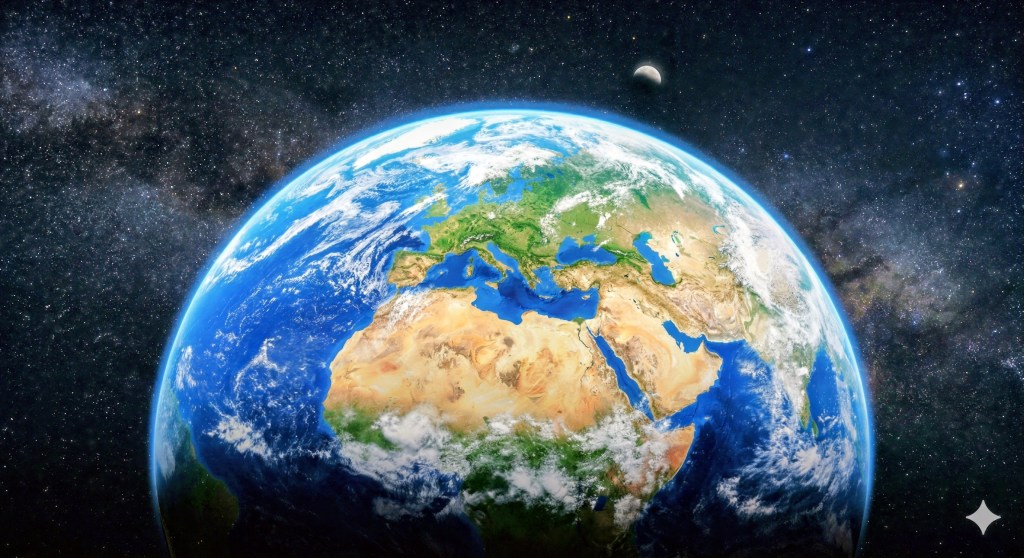
The Terrestrial Canvas: A Multidisciplinary Research Report on the Quranic Earth and its Cosmological, Scientific, and Philosophical Systems
Presented by Zia H Shah MD
Audio teaser:
Abstract
The Quranic discourse on the Earth (al-arḍ) is characterized by its remarkable frequency—appearing 461 times—and its integration into a comprehensive worldview that bridges the physical and the metaphysical. This research report provides an exhaustive analysis of these verses, categorizing them into functional systems: Cosmological Genesis, Ontological Sovereignty, Geophysical Architecture, Hydrological Vitality, Epistemic Omniscience, and Eschatological Transformation. By synthesizing traditional exegesis with the contemporary multidisciplinary frameworks of Dr. Zia H. Shah MD, the report explores the nuanced scientific and philosophical implications of over 100 specific verses. Central to this analysis is the “Two Books” theory, which posits that the Book of Nature and the Book of Scripture are harmonious manifestations of a single Divine Truth. The report highlights the Quranic anticipation of the Big Bang singularity and cosmic expansion in verse 21:30, the geological stabilizing function of mountain roots as “pegs” in 78:6-7, and the sophisticated “Aqueous Design” of terrestrial life. Philosophically, the text investigates the doctrine of “Continuous Creation” and “Occasionalism,” suggesting that what science identifies as immutable laws are ontologically “Divine Habits.” This study concludes that the Quranic Earth is presented not as a random byproduct of material forces, but as a meticulously calibrated “cradle” designed to host moral agency and lead the human intellect toward the recognition of a purposeful Creator..
The Quranic Earth: A Lexical and Categorical Analysis
The term Arḍ (the Earth) serves as a foundational scaffolding for the Quranic worldview. While the term for “heavens” (al-samāwāt) frequently appears in the plural, Arḍ remains singular throughout the 461 instances, emphasizing the unique status of the terrestrial realm as the immediate, tangible environment of humanity. The following table provides a systemic categorization of the 461 mentions, grouping them by their primary functional and theological context.
| System Category | Conceptual Scope | Primary Function | Total Occurrences (Approx.) |
| Cosmological Genesis | The formation of the planet, the “splitting asunder,” and the six days of creation. | Establishes the Creator’s power and the universe’s temporal beginning. | 55 |
| Ontological Sovereignty | Divine ownership (Mulk), control of the heavens and earth, and the “between” motif. | Affirms the Unity of Lordship (Tawhid) and the totality of Divine control. | 112 |
| Geophysical Architecture | Mountains as pegs, the spreading of the crust, and atmospheric protection. | Describes the Earth as a habitable “cradle” and a site of stability. | 78 |
| Hydrological/Biological Systems | The water cycle, the revival of dead land, vegetation, and the origin of life. | Highlights the maintenance of biological life as a sign of Divine mercy. | 94 |
| Epistemic Omniscience | God’s knowledge of every grain, every seed, and the “keys of the unseen.” | Establishes the “Total Record” of reality and human accountability. | 63 |
| Eschatological Horizon | The final quaking, the changing of the Earth, and the report of its news. | Describes the end of the world and the transition to the afterlife. | 59 |
The Quranic Earth is never presented in isolation; it is almost always coupled with the heavens or the intermediary space to denote the “tripartite structure” of reality. This structure is inherently anti-nihilistic, asserting that the Earth was created “in truth” (bi-l-ḥaqq) and not as a product of “play” or “vanity”.
System 1: Cosmological Genesis and Universal Genesis
The Quranic account of the Earth’s origin is embedded in a broader cosmogony that emphasizes a common origin for all matter. Verse 2:117 introduces Allah as the “Originator of the heavens and the earth” (Badīʿu al-samāwāti wa-l-arḍ). This term, Badīʿ, signifies an inventor who creates without a prior model, providing a scriptural basis for creation ex nihilo. Philosophically, this establishes God as the “Necessary Being” (Al-Dhat al-Wajib) whose essence is the Ultimate Reality.
The Singularity and Expansion: 21:30 and 41:9-12
Perhaps the most scientifically prescient verse regarding the Earth’s origin is 21:30: “Do the disbelievers not realize that the heavens and the earth were once one mass (ratq) then We split them apart (fataq)? And We created from water every living thing. Will they not then believe?”. Dr. Zia H. Shah MD interprets the term ratq (a closed-up, solid mass) as the initial singularity of infinite density and zero volume that existed prior to the Big Bang. The subsequent fataq (splitting apart/cleaving) corresponds to the inflation and expansion of the universe. This verse remarkably links the origin of the cosmos to the origin of life from water—two pillars of modern physics and biology—within a single rhetorical frame.
The temporal scale of this creation is further elaborated in 41:9-12. Verse 41:9 asks: “Do you indeed disbelieve in Him who created the earth in two days?”. Verse 41:10 adds that He “placed on it firm mountains towering above it, and blessed it, and decreed for it its foods in four days.”. While a literal reading might suggest an eight-day creation, commentators interpret the “four days” as including the initial “two days” of the Earth’s formation, totaling six days (ayyām) of creation—a consistent formula found in 7:54, 10:3, 11:7, 25:59, 32:4, 50:38, and 57:4. Scientifically, these “days” are understood as distinct epochs or divine phases of cosmic evolution. The ratio of the Earth’s formation (2 days) to the total creation period (6 days) roughly mirrors the modern scientific estimate that the Earth is 4.5 billion years old, approximately one-third the age of the 13.8-billion-year-old universe.
The Phase of Cosmic Smoke: 41:11
Verse 41:11 describes a specific state of the early universe: “Then He turned to the heaven while it was all smoke (dukhān). He said to the heaven and the earth: ‘Come (into being), willingly or unwillingly.’ They said: ‘Here we come in willing obeisance.’”. Dr. Shah notes that the term “smoke” (dukhān) is physically more accurate than “gas” or “dust,” as it implies a suspension of particles and heat that created an opaque, plasma-like state in the early universe before light decoupled from matter during the Recombination Era. This transition from a formless, opaque state to a structured cosmos is a central theme in Quranic cosmogony.
System 2: Ontological Sovereignty and Divine Ownership
The Earth in the Quran is defined by its relationship to its Owner. The attribute of Mulk (Sovereignty or Kingdom) is repeatedly invoked to establish God’s absolute authority. Verse 2:255, the Ayat al-Kursi, declares: “Allah – there is no deity except Him, the Ever-Living, the Sustainer of all existence. Neither drowsiness overtakes Him nor sleep. To Him belongs whatever is in the heavens and whatever is on the earth.”. This verse highlights the attribute of Al-Qayyum (The Self-Subsisting Sustainer), suggesting that the Earth requires the active, unceasing vigilance of its Creator to remain in being.
The Dominion Verses: 2:284, 3:189, and 5:17
Ownership is further solidified in verses like 2:284: “To Allah belongs whatever is in the heavens and whatever is in the earth. Whether you show what is within yourselves or conceal it, Allah will bring you to account for it.”. This links ontological ownership to moral accountability. Other verses emphasizing this sovereignty include:
- 3:189: “To Allah belongs the kingdom of the heavens and the earth. And Allah is Most Capable of everything.”.
- 5:17: “Control of the heavens and earth and all that is between them belongs to God: He creates whatever He will.”.
- 5:120: “To Allah belongs the sovereignty of the heavens and the earth and whatever is within them, and He is over all things competent.”.
The inclusion of the “between” motif (mā baynahumā) in verses like 5:17 and 5:18 functions as a “theological deterrent” against local divinities or semi-divine intermediaries. As Dr. Shah notes, by claiming ownership over the “middle zone,” the Quran ensures that no aspect of reality—be it celestial mechanics, atmospheric processes, or spiritual forces—is seen as autonomous from the Creator.
Universal Prostration: 13:15 and 22:18
The Earth is portrayed as a sentient participant in Divine praise. Verse 13:15 states: “To Allah prostrates whoever is in the heavens and the earth, willingly or by compulsion.”. Verse 22:18 similarly notes that “whoever is in the heavens and whoever is on the earth, and the sun, the moon, the stars, the mountains, the trees, and the moving creatures” all prostrate to God. Philosophically, this “prostration” (sujūd) is interpreted by scholars like Al-Razi and Zia Shah as the inherent obedience of creation to natural laws. The steadfast uniformity of gravity and electromagnetism is nature’s way of “singing” God’s glory. This is a form of “silent worship” where nature has no independent will but fulfills the teleological end for which it was designed.
System 3: Geophysical Architecture: The Stability of the Cradle
The Quran describes the Earth as a hospitable environment meticulously engineered for human settlement. Terms like mahd (cradle), fīrāsh (bed), and bisāṭ (carpet) are used to characterize the terrestrial surface. Verse 2:22 describes Him as the One “who made for you the earth a bed spread out and the sky a ceiling.”. Verse 20:53 reiterates: “He who has made for you the earth like a cradle (mahdan) and inserted roads into it for you.”. These metaphors emphasize the Earth’s suitability for travel, habitation, and the development of civilization.
Mountains as Pegs and Shock Absorbers: 16:15, 31:10, and 78:6-7
A recurring theme in Quranic geology is the stabilizing function of mountains. Verse 78:6-7 asks: “Have We not made the earth a resting place? And the mountains as pegs (awtād)?”. Verses 16:15 and 31:10 state that God “placed firm mountains on the earth, lest it should shake with you.”. Modern geophysics confirms that mountains are formed through tectonic collisions (orogeny), leading to crustal thickening where the thickened crust extends deep into the mantle to form “roots”. For example, the roots of the Himalayas extend down about 155 miles (250 km) into the mantle. These roots provide isostatic balance, anchoring the continental landmasses much like a ship’s keel or a tent peg (watad). Dr. Shah describes mountains as “natural shock absorbers” that dissipate tectonic energy, redistribute stress, and safeguard the biosphere from catastrophic seismic events.
The Spreading and Shaping of the Earth: 13:3, 79:30, and 88:20
The Quran describes the Earth’s surface using terms like madda (extended/spread), ṭaḥā (spread), and daḥā (shaped/spread).
- 13:3: “And He is the One who spread out the earth (madda al-arḍa) and placed firm mountains and rivers upon it.”.
- 79:30: “And after that He spread/shaped the earth (al-arḍa daḥāha).”.
- 88:20: “And to the earth, how it was spread out (sutiḥat)?”. While traditional translations of daḥāha render it as “spread out,” modern linguistic analysis of the root d-h-w notes that it can mean “to make egg-shaped,” specifically referring to the place where an ostrich lays its egg (udḥiya). This subtle linguistic hint aligns with the Earth’s oblate spheroid shape, a fact that would have been unknown in 7th-century Arabia. Furthermore, verse 39:5 states that He “wraps (yukawwiru) the night over the day,” using a verb that describes the coiling of a turban around a spherical head, further suggesting a rotating, curved planet.
Atmospheric Shielding: 2:22 and 21:32
The Earth’s architecture includes its protective “ceiling.” Verse 21:32 states: “And We made the sky a protected ceiling (saqfan mahfūẓan); yet they turn away from its signs.”. Scientifically, this “protected ceiling” encompasses several layers: the magnetosphere (which deflects solar wind), the Van Allen radiation belts (which capture cosmic rays), and the ozone layer (which filters 99% of lethal UV radiation). This defensive architecture is essential for maintaining the biosphere and protecting terrestrial life from high-velocity meteoric impacts and radiation.
System 4: Hydrological Vitality and the Ecology of Resurrection
The Quran places water at the center of its terrestrial cosmology, treating it as the primary medium of creation and mercy. Verse 21:30’s declaration—“We made from water every living thing”—is now recognized as a fundamental biological truth: cytoplasm, the basic substance of the cell, is 80% water, and liquid water is the essential solvent for all biochemical reactions.
The Water Cycle: 10:24, 23:18, and 30:24
The hydrological cycle is described with remarkable accuracy in the Quran, moving beyond the “Reciprocating Earth” myths (the idea that springs came from secret ocean passages) prevalent in ancient times.
- 10:24: “The example of this worldly life is but like rain which We have sent down from the sky that the plants of the earth absorb… until the earth has taken on its adornment and is beautified.”.
- 23:18: “We sent down water from the sky in measure (bi-qadarin) and We caused it to stay in the earth.”.
- 30:24: “He sends down water from the sky, and therewith revives the earth after its death.”. Dr. Shah identifies this as “Aqueous Design,” noting that the amount of water on Earth is unique in the solar system. The phrase “in measure” implies a fine-tuning of the planetary water budget, where too much water would lead to a global flood and too little would result in a dead, lunar-like planet.
The Metaphor of Resurrection: 22:5, 30:50, and 41:39
The Quran uses the Earth’s hydrological systems to provide a logical proof for life after death.
- 22:5: “And you see the earth barren (hāmidah), but when We send down water upon it, it quivers (ihtazzat) and swells (rabat) and grows every kind of beautiful growth.”.
- 30:50: “Look then at the effects of Allah’s mercy, how He gives life to the earth after its death; surely He is the One who will give life to the dead.”.
- 41:39: “And among His signs is that you see the earth humble (khāshiʿah), but when We send down water upon it, it shakes and grows.”. Scientifically, the “swelling” and “shaking” refer to the rehydration of soil particles and the awakening of dormant seeds. Philosophically, this transforms the study of hydrology into a spiritual exercise; observing a blooming desert becomes a confirmation of the eschatological promise that the human essence (the “seed” of the self) is preserved by the same God who revives the barren land.
Agricultural Biodiversity: 13:4 and 26:7
Verse 13:4 describes the Earth’s diversity: “In the earth are neighboring tracts, gardens of grapevines, crops, and date-palms… watered with one water, yet We make some taste better than others. Surely in this are signs for people who understand.”. This highlights the “aesthetic surplus” of creation, where biological diversity exceeds what is strictly necessary for survival, pointing to an Artist who loves beauty. Verse 26:7 adds: “Do they not look at the earth—how many noble pairs We have produced therein?”. This recognition of “pairs” (zawjayn) across the plant and animal kingdoms is a foundational insight into sexual reproduction and genetic diversity.
System 5: Epistemology of Signs and Divine Omniscience
The Quranic Earth functions as a “Total Record,” where every grain of matter is accounted for in the Divine Knowledge. Verse 6:59 states: “With Him are the keys of the unseen; no one knows them except Him. He knows whatever is on land and in the sea; not a leaf falls but He knows it, nor a grain in the darkness of the earth… but it is in a clear record.”.
The Atom’s Weight: 10:61, 31:16, and 34:3
The granularity of this omniscience is emphasized through the “mustard seed” and “atom” motifs.
- 10:61: “And not even the weight of an atom escapes your Lord on the earth or in the heaven.”.
- 31:16: “O my son! If there be but the weight of a grain of mustard seed and it were in a rock or anywhere in the heavens or on earth, Allah will bring it forth.”.
- 34:3: “Not an atom’s weight escapes Him in the heavens or the earth, nor anything smaller than that or larger, but is in a clear record.”. Philosophically, these verses establish a doctrine of “Total Record,” suggesting that the physical environment preserves information of every act. Dr. Shah connects this to Physical Information Theory, which posits that information is a fundamental constituent of reality and can never be truly lost. The Earth acts as a physical witness, recording impressions on atmospheric particles and cosmic waves that will be revealed during the final reckoning.
The Unending Words: 31:27
Verse 31:27 uses a striking hyperbole to describe the depth of Divine knowledge: “And if all the trees on earth were pens and the ocean were ink, replenished by seven more oceans, the Words of Allah would not be exhausted. Surely Allah is Almighty, All-Wise.”. This metaphor underscores the infinitude of the Creator in contrast to the finitude of creation. Even if one were to attempt to write down the biology of a single leaf or the history of a single grain of sand, the complexity and purpose behind it would branch out endlessly into the Divine Wisdom.
The Five Keys: 31:34
Surah Luqman concludes in verse 31:34 by enumerating five “keys of the unseen” (mafātīḥ al-ghayb) known only to God: (1) the Hour of Judgment, (2) the timing of rain, (3) what lies in the wombs, (4) what a person will earn tomorrow, and (5) in which land a person will die. This verse highlights human limitations despite scientific advancement. While we can predict weather patterns or use ultrasound to see into the womb, the absolute and unseen essence of these events remains the domain of the Almighty.
System 6: Eschatological Transformation and Global Metamorphosis
The Quran predicts a final, catastrophic transformation of the Earth’s systems. Verse 14:48 declares: “The Day when the earth will be changed to another earth, and the heavens as well.”. This signals the end of the Earth as a site of trial and its transition into a new ontological state.
The Final Shaking: 99:1-2 and 73:14
Surah Al-Zalzalah (99:1-2) describes the onset of this transformation: “When the earth is shaken with its final earthquake (zilzālahā), and the earth casts out its burdens (athqālahā).”.
- Literal Meaning: The Earth will expel the dead from their graves for resurrection, as if “unburdening” itself.
- Symbolic Meaning: The Earth will “report its news,” revealing every sin, footprint, and unspoken truth it has witnessed. Verse 73:14 describes the physical intensity: “On the Day when the earth and the mountains will shake, and the mountains will become a heap of sand flowing down.”. This depicts the reversal of the orogenic forces that stabilized the planet, as the “pegs” are removed and the topography is flattened.
The Folding and Spread: 39:67 and 84:3
Verse 39:67 provides a cosmic perspective: “The whole earth will be in His grip on the Day of Resurrection, and the heavens will be folded in His right hand.”. Verse 84:3 adds: “And when the earth is spread out (muddat).”. This “folding” and “spreading” mirror scientific scenarios like the “Big Crunch,” where the expansion of the universe reverses and space-time collapses back into a tiny mass, or the “Big Rip,” where the fabric of reality is torn asunder. The Earth, which began as a “closed-up mass” (ratq) that was “split apart” (fataq), completes its journey by being “rolled up” like a scroll.
The Radiant Record: 39:69
The transformation concludes with the Earth manifesting Divine Light. Verse 39:69 states: “And the earth will shine with the light of its Lord, and the Record will be placed, and the prophets and the witnesses will be brought.”. This “shining” implies that the Earth’s material veil will be lifted, revealing the “Total Record” of history in the presence of the Creator.
Philosophical Deep-Dive: Zia H. Shah’s Interdisciplinary Theses
The multidisciplinary research of Dr. Zia H. Shah MD provides three essential philosophical lenses for understanding the Quranic Earth: Occasionalism, Fine-Tuning, and the “Two Books” Theory.
1. Occasionalism and Continuous Creation
Shah revitalizes the Ash’arite doctrine of Tajdid al-khalq (renewal of creation), arguing that the Earth is not an independent substance that exists over time. Instead, based on verse 35:41 (“Allah holds the heavens and the earth, lest they vanish”), he posits that the universe is a series of discrete events that vanish the instant they are created and must be re-created by God in every subsequent moment.
- Quantum Error Correction: Shah maps this “holding” onto modern concepts like quantum error correction and entropy resistance. The structured “standing” of the Earth (verse 30:25) is a violation of the natural thermodynamic trend toward maximum disorder, suggesting a “Conscious Mind” maintaining reality frame-by-frame, much like a computer processor refreshing pixels on a screen.
- Divine Habits: In this framework, “laws of nature” are ontologically viewed as “Divine Habits” (Sunnat Allah). These regularities are habitual and voluntary on the part of God rather than inherent metaphysical compulsions.
2. Fine-Tuning and Aesthetic Surplus
Shah addresses the “Fine-Tuning” argument, citing the precision of physical constants as evidence of the Divine Command.
- Gravity and Expansion: If the gravitational force were slightly stronger, stars would burn out too quickly for life to develop on Earth; if weaker, they would never ignite.
- Aesthetic Argument: Beyond utility, the Earth exhibits “aesthetic surplus”—beauty in firefly bioluminescence or the symmetry of spiral galaxies—that exceeds survival needs. Shah argues that “utility and splendor walk hand in hand,” suggesting an “Artist who loves beauty” rather than blind evolutionary chance.
3. The “Two Books” Theory and Guided Evolution
Shah rejects the segregation of science and religion, championing an “Unified Field Theory of Knowledge”.
- Terminological Identity: He points out that the Quran uses the same term—Ayah (sign)—for a verse of scripture and for a phenomenon of nature (like the alternation of night and day in 2:164). This implies a shared ontological status; studying the Earth is an act of “worship” and “exegesis”.
- Guided Evolution: Shah reconciles the “creation from clay” (verse 23:12) with common ancestry by reinterpreting clay as inorganic matter (abiogenesis) and Adam as a spiritual milestone where an evolving lineage became “human”—capable of receiving revelation and bearing moral responsibility.
Detailed Thematic Epilogue: A Unified Worldview
The integration of 461 Quranic verses and the multidisciplinary insights of Zia H. Shah MD reveals the Earth as a dynamic, purpose-driven system calibrated with extreme precision. The Quranic Earth is not a passive backdrop to human history, but an active “Āyah” (Sign) that directs the human mind from the observation of physical complexity to the realization of a Sustainer.
| Key Thematic Pillars | Summary of Evidence |
| The Cradle of Trial | The geophysical stability of mountains (awtād) and the “protected ceiling” (saqf mahfūẓ) of the atmosphere create a hospitable environment for moral agency. |
| The Aqueous Medium | Water acts as the master key of biological existence and the primary metaphor for the theological miracle of resurrection. |
| The Total Ledger | Divine omniscience extends to every “grain” and “atom,” transforming the planet into a physical record of human conduct that will “report its news” eschatologically. |
| The Contingent Reality | The Earth is held in being by the “Divine Grip,” re-created in every instant through the unceasing volition of Al-Qayyum. |
Ultimately, the Quran presents a “Unitary Truth” where reason is the “closest friend of revelation”. The scientific facts embedded in the text—from the Big Bang singularity and the expansion of space to the oblate spheroid shape of the Earth and the isostatic balance of mountain roots—do not exist to replace faith, but to fortify it through rational scrutiny. The Earth remains a “Living Eulogy” for its Creator, whose wisdom is as inexhaustible as the “seven seas” of ink, and whose “words” are inscribed in the very fabric of the cosmos. As humanity journeys through the “resting place” of the Earth, the text invites us to go beyond mere observation and embark on a rational quest for the Reality that sustains every grain in the “darkness of the land.”.


 The Glorious Quran and Science
Leave a comment