
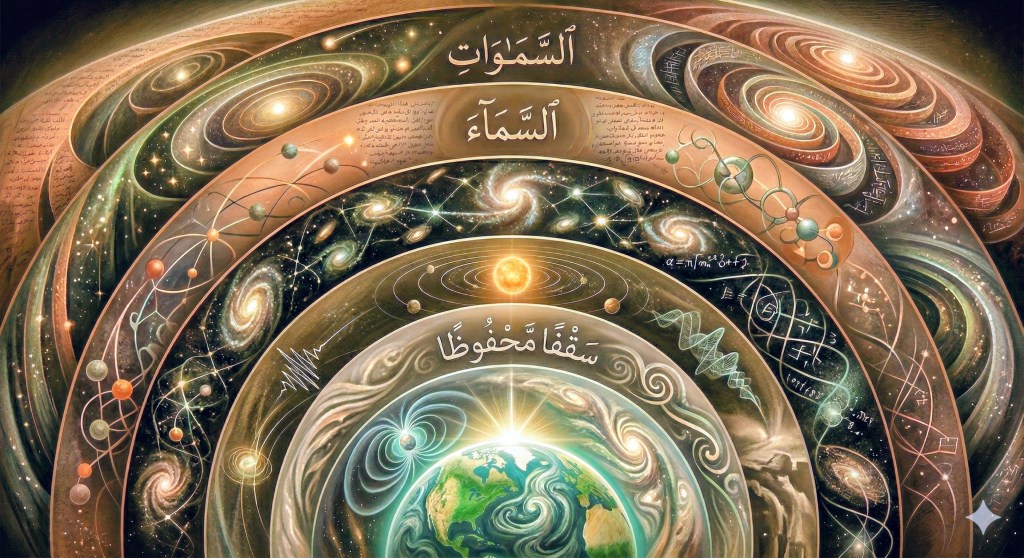
The Quranic Cosmography: A Multidisciplinary Research Report on the Heavens, Fine-Tuning, and the Architecture of the Universe
Presented by Zia H Shah MD
Audio teaser:
The Quranic text exhibits a profound and persistent engagement with the celestial realm, featuring at least 310 specific mentions of “heaven” or “heavens” (al-sama’ or al-samawat) in both singular and plural forms. This frequency is not merely a linguistic artifact but serves as the foundational scaffolding for an integrated worldview that bridges ancient scripture with contemporary scientific inquiry. Through a rigorous categorization of these 310 mentions, it becomes evident that the heavens in the Quran are presented not as a passive backdrop, but as a dynamic, functional, and highly calibrated architecture that testifies to the existence of a purposeful Creator. The work of Zia H. Shah MD, particularly his synthesis of cosmology, physics, and Islamic theology, provides an essential contemporary lens through which these verses can be understood, arguing that the “Book of Nature” and the “Book of Scripture” are two harmonious manifestations of a singular divine truth. This report examines the categorical distribution of these mentions and embellishes the findings with the philosophical and scientific dimensions of the cosmological argument, fine-tuning, cosmic expansion, and the protective mechanisms of the planetary shield.
Categorical Analysis of the 310 Quranic Mentions of Heavens
The analysis of the provided data set reveals seven primary thematic categories into which the 310 mentions of the heavens can be grouped. This categorization is vital for understanding the pedagogical role of the heavens in Quranic discourse, moving from physical observation to metaphysical deduction.
I. Sovereignty, Ownership, and the Divine Kingdom (Mulk)
A significant portion of the mentions establishes the heavens as the ultimate evidence of God’s authority. The Quranic term Mulk (Sovereignty or Kingdom) is repeatedly coupled with “the heavens and the earth” to deny any partners in the governance of reality.
| Surah:Verse | Arabic Text Segment | MAS Abdel Haleem Translation Snippet | Mentions Reference |
| 2:107 | أَلَمْ تَعْلَمْ أَنَّ اللَّهَ لَهُ مُلْكُ السَّمَاوَاتِ وَالْأَرْضِ | “Do you not know that control of the heavens and the earth belongs to God?” | (2:107:7) |
| 3:189 | وَلِلَّهِ مُلْكُ السَّمَاوَاتِ وَالْأَرْضِ | “Control of the heavens and earth belongs to God; God has power over everything.” | (3:189:3) |
| 5:120 | لِلَّهِ مُلْكُ السَّمَاوَاتِ وَالْأَرْضِ | “Control of the heavens and the earth and everything in them belongs to God…” | (5:120:3) |
| 24:42 | وَلِلَّهِ مُلْكُ السَّمَاوَاتِ وَالْأَرْضِ | “Control of the heavens and the earth belongs to God; and to God is the final return.” | (24:42:3) |
| 48:14 | وَلِلَّهِ مُلْكُ السَّمَاوَاتِ وَالْأَرْضِ | “Control of the heavens and the earth belongs to God. He forgives whoever He will…” | (48:14:3) |
This category functions as a theological deterrent against partitioning reality into divine and non-divine zones. As Zia H. Shah notes, by claiming ownership over “the heavens, the earth, and whatever is between them,” the Quran ensures that no “middle zone”—whether it be celestial mechanics, fate, or spirits—is seen as an autonomous domain independent of the Creator.
II. Creation, Origination, and Temporal Beginning
These mentions focus on the act of bringing the heavens into existence, often utilizing terms like Khalaqa (Created) or Badi’ (Originator). This category provides the scriptural basis for the cosmological argument and the doctrine of creation ex nihilo.
| Surah:Verse | Arabic Text Segment | MAS Abdel Haleem Translation Snippet | Mentions Reference |
| 2:117 | بَدِيعُ السَّمَاوَاتِ وَالْأَرْضِ | “[He is] the Originator of the heavens and the earth…” | (2:117:2) |
| 6:1 | الْحَمْدُ لِلَّهِ الَّذِي خَلَقَ السَّمَاوَاتِ وَالْأَرْضَ | “Praise belongs to God, who created the heavens and the earth…” | (6:1:5) |
| 7:54 | إِنَّ رَبَّكُمُ اللَّهُ الَّذِي خَلَقَ السَّمَاوَاتِ وَالْأَرْضَ | “Your Lord is God, who created the heavens and earth in six days…” | (7:54:6) |
| 25:59 | الَّذِي خَلَقَ السَّمَاوَاتِ وَالْأَرْضَ | “He who created the heavens and the earth and everything between them in six days…” | (25:59:3) |
| 32:4 | اللَّهُ الَّذِي خَلَقَ السَّمَاوَاتِ وَالْأَرْضَ | “It is God who created the heavens and the earth and everything between them…” | (32:4:4) |
The mention of “six days” in several of these verses is interpreted by contemporary scholars not as literal 24-hour periods, but as distinct divine phases or epochs, mirroring the stages of cosmic evolution identified by modern astrophysics.
III. Provisions and Biological Life (The Rain-Sama Connection)
The heavens are frequently cited as the source of water (ma’), which is presented as the essential precursor to life. This category bridges the cosmic and the biological, highlighting God’s attribute as Al-Razzaq (The Provider).
| Surah:Verse | Arabic Text Segment | MAS Abdel Haleem Translation Snippet | Mentions Reference |
| 2:22 | وَأَنْزَلَ مِنَ السَّمَاءِ مَاءً | “…and sent water down from the sky and with it brought forth fruits as provision…” | (2:22:10) |
| 6:99 | وَهُوَ الَّذِي أَنْزَلَ مِنَ السَّمَاءِ مَاءً | “It is He who sends down water from the sky. With it We produce the shoots…” | (6:99:5) |
| 13:17 | أَنْزَلَ مِنَ السَّمَاءِ مَاءً | “He sends water down from the sky, and riverbeds flow according to their measure…” | (13:17:3) |
| 35:27 | أَلَمْ تَرَ أَنَّ اللَّهَ أَنْزَلَ مِنَ السَّمَاءِ مَاءً | “Do you not see that God sends water down from the sky? With it We produce fruits…” | (35:27:7) |
| 50:9 | وَنَزَّلْنَا مِنَ السَّمَاءِ مَاءً مُبَارَكًا | “We sent down blessed water from the sky and with it We made gardens grow…” | (50:9:3) |
Zia H. Shah links these verses to the “Aqueous Design” of the universe, arguing that the physico-chemical properties of water (such as its polarity and expansion upon freezing) are precisely calibrated to support terrestrial life, fulfilling the Quranic promise: “We made from water every living thing” (21:30).
IV. Mathematical Order, Consistency, and Laws of Physics
This category includes mentions of the heavens in the context of orbits (falak), precise calculations (husban), and the absence of flaws or inconsistencies (tafawut). These verses are foundational to the “Fine-Tuning” argument.
| Surah:Verse | Arabic Text Segment | MAS Abdel Haleem Translation Snippet | Mentions Reference |
| 13:2 | اللَّهُ الَّذِي رَفَعَ السَّمَاوَاتِ بِغَيْرِ عَمَدٍ | “It is God who raised the heavens without visible pillars, then established Himself…” | (13:2:4) |
| 21:33 | وَهُوَ الَّذِي خَلَقَ… كُلٌّ فِي فَلَكٍ يَسْبَحُونَ | “…each [sun and moon] swimming in its own orbit.” | (21:33) |
| 55:7 | وَالسَّمَاءَ رَفَعَهَا وَوَضَعَ الْمِيزَانَ | “He raised the heaven and established the balance…” | (55:7:1) |
| 67:3 | الَّذِي خَلَقَ سَبْعَ سَمَاوَاتٍ طِبَاقًا | “[He] who created the seven heavens, one above the other. You will not see any flaw…” | (67:3:4) |
| 86:11 | وَالسَّمَاءِ ذَاتِ الرَّجْعِ | “By the sky with its returning [cycle]…” | (86:11:1) |
The “invisible pillars” mentioned in 13:2 and 31:10 are interpreted as the invisible forces of gravity and electromagnetism that hold celestial bodies in their courses, a concept Zia H. Shah aligns with the “Habit of God” (‘Adah) that ensures cosmic regularity.
V. Protection and Atmospheric Shielding
Mentions in this category describe the heavens as a functional roof (saqf) or a guarded canopy (mahfuz). This imagery correlates directly with modern understandings of the atmosphere and magnetosphere.
| Surah:Verse | Arabic Text Segment | MAS Abdel Haleem Translation Snippet | Mentions Reference |
| 2:22 | وَالسَّمَاءَ بِنَاءً | “…and the sky a canopy…” | (2:22:6) |
| 21:32 | وَجَعَلْنَا السَّمَاءَ سَقْفًا مَّحْفُوظًا | “We made the sky a protected ceiling, yet still they turn away from Our signs.” | (21:32:2) |
| 41:12 | وَزَيَّنَّا السَّمَاءَ الدُّنْيَا بِمَصَابِيحَ وَحِفْظًا | “…We adorned the lowest heaven with lamps and a guard.” | (41:12:12) |
| 52:9 | يَوْمَ تَمُورُ السَّمَاءُ مَوْرًا | “On the day when the heaven will shake violently…” | (52:9:3) |
| 72:8 | وَأَنَّا لَمَسْنَا السَّمَاءَ فَوَجَدْنَاهَا مُلِئَتْ حَرَسًا | “We reached for the sky and found it filled with strong guards and sparks of fire.” | (72:8:3) |
The term mahfuzan (protected) is crucial; it implies that the sky is not self-protecting but is actively maintained to safeguard the biosphere from high-velocity meteoric impacts and lethal solar radiation.
VI. The Architecture of the Seven Heavens
The repeated mention of “Seven Heavens” (Sab’a Samawat) suggests a layered or multi-dimensional cosmic structure.
| Surah:Verse | Arabic Text Segment | MAS Abdel Haleem Translation Snippet | Mentions Reference |
| 2:29 | فَسَوَّاهُنَّ سَبْعَ سَمَاوَاتٍ | “…and fashioned them into seven heavens. He has full knowledge of all things.” | (2:29:15) |
| 17:44 | تُسَبِّحُ لَهُ السَّمَاوَاتُ السَّبْعُ | “The seven heavens and the earth and everyone in them glorify Him…” | (17:44:3) |
| 23:86 | قُلْ مَنْ رَبُّ السَّمَاوَاتِ السَّبْعِ | “Say: ‘Who is the Lord of the seven heavens and the Lord of the Mighty Throne?’” | (23:86:4) |
| 65:12 | اللَّهُ الَّذِي خَلَقَ سَبْعَ سَمَاوَاتٍ | “It is God who created seven heavens and a similar number of earths…” | (65:12:5) |
| 71:15 | كَيْفَ خَلَقَ اللَّهُ سَبْعَ سَمَاوَاتٍ طِبَاقًا | “Do you not see how God created seven heavens, one above the other…” | (71:15:7) |
Zia H. Shah explores these verses in the context of M-theory and string theory, which posit extra dimensions beyond the observable four-dimensional space-time. He suggests that the “Seven Heavens” could represent these hidden dimensions where Paradise might reside beyond human perceptual reach.
VII. Eschatology and Cosmic Termination
The final category involves mentions of the heavens in the context of the end of the universe, describing a transition from order to dissolution.
| Surah:Verse | Arabic Text Segment | MAS Abdel Haleem Translation Snippet | Mentions Reference |
| 14:48 | يَوْمَ تُبَدَّلُ الْأَرْضُ… وَالسَّمَاوَاتُ | “On the Day the earth is replaced by another earth, and the heavens too…” | (14:48:6) |
| 21:104 | يَوْمَ نَطْوِي السَّمَاءَ كَطَيِّ السِّجِلِّ | “On that Day We shall roll up the skies as a writer rolls up his scrolls.” | (21:104:3) |
| 55:37 | فَإِذَا انْشَقَّتِ السَّمَاءُ فَكَانَتْ وَرْدَةً | “When the sky is torn apart and turns red like a rose, like [burning] oil.” | (55:37:3) |
| 73:18 | السَّمَاءُ مُنْفَطِرٌ بِهِ | “Even the sky will be torn asunder then. His promise will be fulfilled.” | (73:18:1) |
| 82:1 | إِذَا السَّمَاءُ انْفَطَرَتْ | “When the sky is torn apart…” | (82:1:2) |
These eschatological descriptions mirror modern cosmological scenarios like the “Big Crunch” or “Big Rip,” where the expansion of space either reverses or becomes so violent that it tears apart all structures.
Cosmological Argument and Creation Ex Nihilo
The 310 mentions of the heavens form a cumulative philosophical case for God’s existence known as the Kalam cosmological argument. This argument is predicated on the idea that the universe has a definitive beginning and, therefore, requires a transcendent, uncaused Creator.
The Mechanism of Origination (Badi’)
The Quran uses the term Badi’ (Originator) specifically in relation to the heavens (2:117, 6:101). Zia H. Shah emphasizes that this term signifies creatio ex nihilo—the initiation of existence without any pre-existing substrate, matter, or laws.
بَدِيعُ السَّمَاوَاتِ وَالْأَرْضِ ۖ وَإِذَا قَضَىٰ أَمْرًا فَإِنَّمَا يَقُولُ لَهُ كُن فَيَكُونُ
“He is the Originator of the heavens and the earth. When He decrees a matter, He only says to it, ‘Be,’ and it is.” (Quran 2:117)
Unlike human creation, which involves reshaping existing materials, divine creation as described in this verse is an act of pure volition. Shah notes that even if there were “prior Big Bangs” or a multiverse, the truth of this verse remains, as it terminates the chain of contingency in an “Ultimate Necessity”. This aligns with Premise 1 of the Kalam argument: “Whatever begins to exist has a cause”.
The Singularity and the “Splitting Asunder”
Modern astrophysics identifies the origin of the heavens as the Big Bang singularity. The Quranic verse 21:30 is often cited as a theological echo of this event:
أَوَلَمْ يَرَ الَّذِينَ كَفَرُوا أَنَّ السَّمَاوَاتِ وَالْأَرْضِ كَانَتَا رَتْقًا فَفَتَقْنَاهُمَا
“Are the disbelievers not aware that the heavens and the earth were a joined entity and that We separated them?” (Quran 21:30)
Shah interprets ratq (closed-up mass) as the primordial singularity of infinite density and zero volume, and fatq (splitting apart) as the rapid expansion of the universe. He argues that describing the early universe as “smoke” (dukhan in 41:11) is physically more accurate than “gas” or “dust,” as smoke implies an opaque suspension of particles and heat, perfectly describing the universe before the “Recombination Era” when light first decoupled from matter.
Fine-Tuning: The Precise Calibration of the Heavens
The “pervasive beauty” and “clockwork regularity” of the heavens cited in the Quran (32:7, 59:24) are central to the “Fine-Tuning” argument. Zia H. Shah argues that the physical constants of our cosmos fall within breathtakingly narrow ranges, a phenomenon he calls being “rigged for life”.
The Aesthetic Argument and Al-Mizan
Shah focuses on the Quranic term Al-Mizan (The Balance) as the scriptural parallel to fine-tuning. In Surah Ar-Rahman (55:7), the establishment of this balance in the heavens is tied to the preservation of life.
وَالسَّمَاءَ رَفَعَهَا وَوَضَعَ الْمِيزَانَ
“He raised the heaven and established the balance.” (Quran 55:7)
If there were even a slight imbalance in universal forces, the biological “tracts of life” would become extinct. Shah identifies several examples of this calibration:
| Constant | Precision | Consequence of Deviation |
| Cosmological Constant ($\Lambda$) | 1 part in $10^{120}$ | Larger: rapid expansion prevents galaxy formation. Smaller/Negative: rapid collapse |
| Strong Nuclear Force | Highly sensitive | Stronger: all hydrogen fuses to helium, no stars/water. Weaker: atomic nuclei fail to hold, no carbon/oxygen |
| Gravitational Force | $10^{36}$ times weaker than electromagnetism | Stronger: stars burn out too quickly. Weaker: stars fail to ignite, remaining as diffuse gas |
| Initial Entropy | 1 part in $10^{10^{123}}$ | Lower: chaotic, unstructured universe. Higher: uniform heat death immediately |
The “Magical Jacket” and the Multiverse
Shah addresses the atheistic counter-argument of the Multiverse—the idea that infinite universes exist, making our life-permitting universe a statistical certainty. He employs the analogy of a “Magical Jacket” found in a store that fits a person perfectly. The atheist argues there must be millions of jackets in a “back room” (multiverse) to explain the fit. Shah contends that without evidence of the back room, the “perfect fit” implies a Tailor. Furthermore, the “meta-laws” required to generate a multiverse would themselves require precise calibration, merely pushing the need for a Fine-Tuner back one step.
The Expanding Universe: 7th Century Revelation and 20th Century Science
Among the 310 mentions, the description of the heavens in Surah Adh-Dhariyat (51:47) stands as perhaps the most strikingly prescient in scientific terms.
وَالسَّمَاءَ بَنَيْنَاهَا بِأَيْدٍ وَإِنَّا لَمُوسِعُونَ
“We built the heavens with Our power and made them vast,” or “We built the universe with great might, and We are certainly expanding it.” (Quran 51:47)
From Firmament to Vastness
Zia H. Shah provides a historical contrast to this verse, noting that the ancient Hebrews and Near Eastern cultures believed the sky was a solid dome or “firmament” (Genesis 1:6-8). Aristotelian philosophy required “perfect” and fixed solid spheres. It was not until Hubble’s 1929 observations and the later developments in General Relativity that a dynamic, expanding space became a cornerstone of cosmology.
Shah highlights that modern estimates of the scale of the cosmos have grown exponentially. In 2016, the estimate was two trillion galaxies; however, data from the James Webb Space Telescope (JWST) suggests there may be between 6 and 20 trillion galaxies. The Arabic phrase wa inna la-musi’un (and indeed We are its expander) captures this ongoing process, which is no longer seen as a finished work but a continuous divine act.
Implications for Paradise
The Quran describes Paradise as being “as vast as the heavens and the earth” (3:133, 57:21). Shah interprets this immensity through the lens of the expanding universe. If the observable universe spans 93 billion light-years and contains trillions of galaxies, then the spiritual reality of Paradise must be inconceivably large. He posits that Paradise might reside in extra dimensions where “width” and “length” transcend our 3D perception.
The Protected Ceiling: Magnetosphere and Atmosphere as a Shield
The Quranic description of the sky as a “protected ceiling” (saqfan mahfuzan) in 21:32 is a central theme in Shah’s work, providing a multidisciplinary nexus where revelation meets advanced heliophysics.
Multi-Layered Defense Systems
Modern science confirms that the Earth’s “sky” functions as a sophisticated defensive architecture through several overlapping mechanisms:
- The Magnetosphere: This “giant magnetic bubble” is generated by the convective motion of Earth’s liquid iron-nickel outer core. It deflects the solar wind—charged electrons and protons traveling at millions of miles per hour—shielding the planet from potentially lethal particles.
- The Van Allen Radiation Belts: These doughnut-shaped belts capture and store energetic particles and cosmic rays, preventing them from reaching the surface.
- The Stratosphere and Ozone Layer: This layer acts as a selective filter, absorbing approximately $99\%$ of the Sun’s UV-C and UV-B radiation. Zia Shah notes that this precise filtering allows life-sustaining energy (visible light for photosynthesis) while blocking the lethal energy that would destroy DNA.
- The Mesosphere (Meteoric Barrier): Every day, millions of rocky fragments from space hurtle toward Earth. Most burn up upon hitting the atmosphere (atmospheric ablation), appearing as harmless “shooting stars” rather than destructive projectiles.
The Lessons from Mars
Shah uses Mars as a “cautionary tale” to emphasize that this protection is a specific sign of divine sustenance. Mars lost its global magnetic field approximately 4 billion years ago, which allowed solar winds to strip away its atmosphere, turning it into a barren desert. The existence of Earth’s magnetosphere, sustained over billions of years, is thus a manifestation of Rahma (Grace) intended to facilitate human existence.
Occasionalism: The Continuous Sustenance of the Heavens
Beyond the initial creation, the Quran emphasizes that the heavens are held in place by divine command:
إِنَّ اللَّهَ يُمْسِكُ السَّمَاوَاتِ وَالْأَرْضَ أَن تَزُولَا
“Indeed, God holds the heavens and the earth, lest they cease.” (Quran 35:41)
The Habit of God (‘Adah)
Zia H. Shah integrates this with Al-Ghazali’s doctrine of “Occasionalism,” which posits that God is the sole true cause of every event at every instant. Shah likens the universe to a lightbulb that needs a steady current of electricity (divine power) to keep shining. Natural laws are not “necessary truths” but are descriptions of God’s “habitual course” of action (’Adah).
Quantum Indeterminacy as the Interface
Shah proposes that quantum indeterminacy—the probabilistic nature of subatomic events—serves as the “interface” for divine volition. While physics can predict the probability of a quantum outcome, it cannot determine the specific result. Shah suggests that what science calls “randomness” is the moment of divine choice, through which God sustains and guides reality without violating the observable laws of physics at the macroscopic level.
Synthesis and Conclusion
The 310+ mentions of the heavens in the Quran, when analyzed through the lens of modern science and the multidisciplinary insights of Zia H. Shah MD, construct a robust and coherent argument for the existence of an All-Knowing Creator.
Key Takeaways from the Research
- Unity of Origin and Law: The universal consistency of physical constants (like the gravitational constant operating across 93 billion light-years) points to a single, unified intelligence (Tawhid) rather than a chaotic plurality of causes.
- Teleology over Randomness: The precise calibration of the Big Bang’s expansion rate and the “protected ceiling” of the atmosphere indicate that the universe was not created “for sport” or by blind accident.
- The Heavens as a Witness: The Quranic invitation to “look again and yet again” (67:3-4) at the heavens anticipates the scientific method, promising that deeper inquiry will only reveal further coherence and awe-inspiring complexity.
- A Dynamic and Open Reality: The description of the heavens as “expanding” (51:47) and “rolled up” (21:104) aligns with the dynamic nature of space-time, positioning the Quran as a text that remains relevant across scientific epochs.
In conclusion, the heavens in the Quran serve as the ultimate “Sign” (Ayah). From the initial singularity (Ratq) and subsequent expansion (Fatq) to the mathematical fine-tuning of universal forces and the multi-layered planetary shield, the celestial realm is presented as a majestic commentary on the power, wisdom, and mercy of the Sustainer. By synthesizing ancient scripture with contemporary astrophysics, the Quranic discourse offers a robust, holistic argument that invites humanity to move beyond superficial observation and recognize the divine signature embedded in the very fabric of the universe.


 The Glorious Quran and Science
Leave a comment