
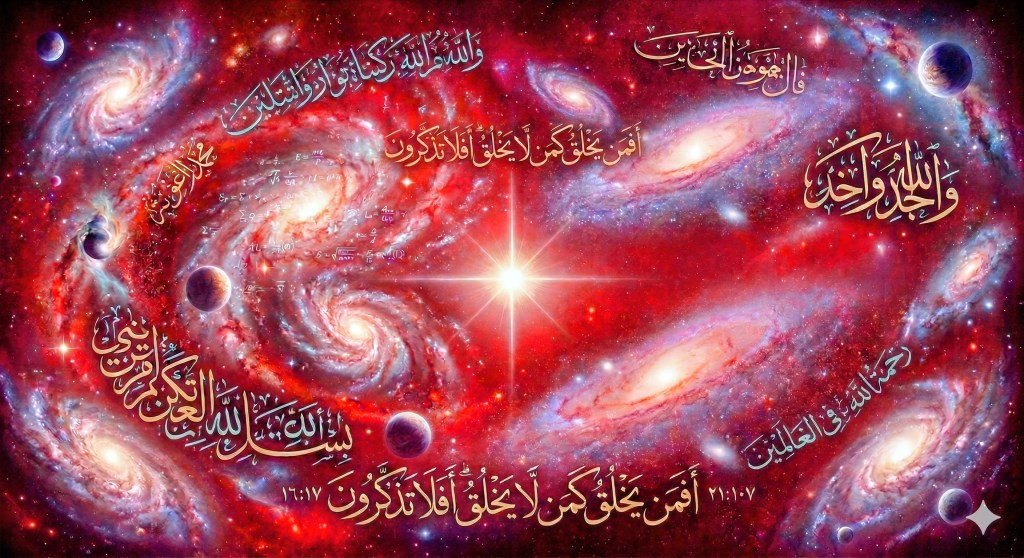
The Architecture of Divine Volition: A Scientific, Philosophical, and Theological Commentary on Quran 16:10-23
Presented by Zia H Shah MD
Audio teaser:
Abstract
This research report provides an exhaustive multidisciplinary analysis of Surah An-Nahl (The Bee), verses 10 through 23, with a particular focus on the ontological challenge posed in verse 17. By synthesizing classical Islamic exegesis with contemporary developments in theoretical physics, molecular biology, and the philosophy of contingency, this analysis explores the “Two Books” paradigm—the harmony between the written Word of God and the created Work of God. Central to this investigation is the distinction between a Necessary Being and contingent reality. The report argues that the intelligibility and fine-tuning of the cosmos, the ex nihilo origin of the universe, and the singularity of biological life forms serve as empirical witnesses to a singular, uncaused Creator. Furthermore, it deconstructs the naturalist’s reliance on “brute facts” as a psychological byproduct of the denial of accountability, as highlighted in verse 22. Through the lens of Quranic epistemology established in verse 3:7, the report distinguishes between foundational truths and allegorical complexities, asserting that the recognition of the Creator is the fundamental prerequisite for a coherent understanding of existence, purpose, and the human condition.
The Epistemological Foundation: Distinguishing the Precise from the Allegorical
Before engaging with the specific cosmological and biological proofs presented in Surah An-Nahl, it is necessary to establish the hermeneutical framework through which the Quran invites its readers to perceive reality. This framework is explicitly defined in Surah Ali ‘Imran, verse 7, which serves as a gateway for the “people of understanding” to approach the divine text and the natural world.
Text and Translation of Quran 3:7
هُوَ ٱلَّذِىٓ أَنزَلَ عَلَيْكَ ٱلْكِتَٰبَ مِنْهُ ءَايَٰتٌ مُّحْكَمَٰتٌ هُنَّ أُمُّ ٱلْكِتَٰبِ وَأُخَرُ مُتَشَٰبِهَٰتٌ ۖ فَأَمَّا ٱلَّذِينَ فِى قُلُوبِهِمْ زَيْغٌ فَيَتَّبِعُونَ مَا تَشَٰبَهَ مِنْهُ ٱبْتِغَآءَ ٱلْفِتْنَةِ وَٱبْتِغَآءَ تَأْوِيلِهِۦ ۗ وَمَا يَعْلَمُ تَأْوِيلَهُۥٓ إِلَّا ٱللَّهُ ۗ وَٱلرَّٰسِخُونَ فِى ٱلْعِلْمِ يَقُولُونَ ءَامَنَّا بِهِۦ كُلٌّ مِّنْ عِندِ رَبِّنَا ۗ وَمَا يَذَّكَّرُ إِلَّآ أُو۟لُوا۟ ٱلْأَلْبَٰبِ
Translation (M.A.S. Abdel Haleem):
It is He who has sent down to you the Book: in it are verses that are precise—they are the foundation of the Book—and others unspecific. As for those in whose hearts is deviation, they will follow that which is unspecific, seeking discord and seeking an interpretation [suitable to them]. And no one knows its [true] interpretation except Allah. But those firm in knowledge say, ‘We believe in it. All [of it] is from our Lord.’ And no one will be reminded except those of understanding.
The verse identifies two categories of signs (ayat): the muhkamat, which are clear, precise, and form the “mother” or foundation of the Book, and the mutashabihat, which are allegorical or multi-layered. In the context of the cosmological argument, the foundational truth is the existence of the Creator and the ontological divide between the uncaused Cause and the caused effect. Those who “get their fundamentals right” recognize that the complexity of the universe is a sign pointing to a singular Mind. Deviation occurs when one prioritizes the “unspecific”—such as the specific mathematical mechanisms of a physical law—to the exclusion of the fundamental reality that laws themselves require a Lawmaker. The “people of understanding” (ulu al-albab) are those who use their cognitive faculties to synthesize these precise truths into a unified worldview, avoiding the pitfalls of reductionism that characterize the “brute fact” paradigm of modern naturalism.
The Narrative of Providence: Exegesis of Quran 16:10-16
The sequence of verses in Surah An-Nahl (16:10-16) constructs a detailed argument from providence (dalil al-inayah), moving from the terrestrial to the celestial to demonstrate the intentionality behind the environmental conditions that permit human flourishing.
Text and Translation of Quran 16:10-16
هُوَ ٱلَّذِىٓ أَنزَلَ مِنَ ٱلسَّمَآءِ مَآءً ۖ لَّكُم مِّنْهُ شَرَابٌ وَمِنْهُ شَجَرٌ فِيهِ تُسِيمُونَ (١٠) يُنۢبِتُ لَكُم بِهِ ٱلزَّرْعَ وَٱلزَّيْتُونَ وَٱلنَّخِيلَ وَٱلْأَعْنَٰبَ وَمِن كُلِّ ٱلثَّمَرَٰتِ ۗ إِنَّ فِى ذَٰلِكَ لَءَايَةً لِّقَوْمٍ يَتَفَكَّرُونَ (١١) وَسَخَّرَ لَكُمُ ٱلَّيْلَ وَٱلنَّهَارَ وَٱلشَّمْسَ وَٱلْقَمَرَ ۖ وَٱلنُّجُومُ مُسَخَّرَٰتٌۢ بِأَمْرِهِۦٓ ۗ إِنَّ فِى ذَٰلِكَ لَءَايَٰتٍ لِّقَوْمٍ يَعْقِلُونَ (١٢) وَمَا ذَرَأَ لَكُمْ فِى ٱلْأَرْضِ مُخْتَلِفًا أَلْوَٰنُهُۥٓ ۗ إِنَّ فِى ذَٰلِكَ لَءَايَةً لِّقَوْمٍ يَذَّكَّرُونَ (١٣) وَهُوَ ٱلَّذِى سَخَّرَ ٱلْبَحْرَ لِتَأْكُلُوا۟ مِنْهُ لَحْمًا طَرِيًّا وَتَسْتَخْرِجُوا۟ مِنْهُ حِلْيَةً تَلْبَسُونَهَا وَتَرَى ٱلْفُلْكَ مَوَاخِرَ فِيهِ وَلِتَبْتَغُوا۟ مِن فَضْلِهِۦ وَلَعَلَّكُمْ تَشْكُرُونَ (١٤) وَأَلْقَىٰ فِى ٱلْأَرْضِ رَوَٰسِىَ أَن تَمِيدَ بِكُمْ وَأَنْهَٰرًا وَسُبُلًا لَّعَلَّكُمْ تَهْتَدُونَ (١٥) وَعَلَٰمَٰتٍ ۚ وَبِٱلنَّجْمِ هُمْ يَهْتَدُونَ (١٦)
Translation (M.A.S. Abdel Haleem):
(10) It is He who sends down rain from the sky; from it is drink and from it is foliage in which you pasture [animals]. (11) He causes to grow for you thereby the crops, olives, palm trees, grapevines, and from all the fruits. Indeed in that is a sign for a people who give thought. (12) And He has subjected for you the night and day and the sun and moon, and the stars are subjected by His command. Indeed in that are signs for a people who reason. (13) And [He has subjected] whatever He multiplied for you on the earth of varying colors. Indeed in that is a sign for a people who remember. (14) And it is He who subjected the sea for you to eat from it tender meat and to extract from it ornaments which you wear. And you see the ships plowing through it, and [He subjected it] that you may seek of His bounty; and perhaps you will be grateful. (15) And He has cast into the earth firmly set mountains, lest it shift with you, and [made] rivers and roads, that you may be guided, (16) And landmarks. And by the stars they are [also] guided.
Hydrological and Biological Signs (Verses 10-11)
The analysis begins with the descent of water, the primary solvent of life. The Quranic text links the physical process of rain to the teleological end of human and animal sustenance. Scientifically, the hydrological cycle requires a precise balance of atmospheric pressure, temperature gradients, and the unique thermodynamic properties of the water molecule. Water’s high specific heat capacity and its anomalous expansion upon freezing are not merely “facts” but are conditions that facilitate the regulation of global climates and the survival of aquatic life.
Verse 11 enumerates specific botanical outputs: “crops, olives, palm trees, grapevines.” This biological diversity, arising from the same fundamental inputs of water and soil, points to the sophisticated information-processing capability of the “digital” genetic code. Each plant represents a different “program” executed by the same molecular machinery, a phenomenon that Zia Shah MD identifies as an empirical witness to a single Designer. The transition from the “tangible” fruit to the “intangible” recognition of wisdom is the cognitive journey the Quran demands from “a people who give thought”.
Cosmic and Earthly Regulation (Verses 12-13)
The “subjection” (taskhir) of the sun, moon, and stars in verse 12 alludes to the nomological necessity of the universe. These celestial bodies do not move by chance but follow “precise calculation” (bi-husban). The regularity of the day and night cycle is a prerequisite for biological circadian rhythms and the possibility of scientific prediction itself. If the laws of physics were inconstant or chaotic, the “people who reason” would have no stable foundation upon which to build knowledge or technology.
Verse 13 mentions the “varying colors” of things multiplied on the earth. This refers not only to the aesthetic beauty of the biosphere but also to the geological and mineralogical diversity that enables human civilization. From a philosophical standpoint, the existence of such a rich, varied reality contradicts the expectation of a minimalist or “barren” universe that might result from unguided, random processes. The diversity of the earth is a sign for “a people who remember” their dependence on the Originator.
The Sea and the Mountains: Navigation and Stability (Verses 14-16)
The subjection of the sea (verse 14) involves the laws of buoyancy and the abundance of resources within the marine environment. The phrase “ships plowing through it” emphasizes the use of fluid dynamics for human commerce and bounty. Verses 15 and 16 shift to geological stability and navigation. The “firmly set mountains” are described as acting to stabilize the earth’s crust (an tamida bikum), a function that resonates with modern concepts of isostasy and the role of mountain roots in planetary crustal dynamics.
The mention of “landmarks” and “stars” for guidance (verse 16) reinforces the theme of a “user-friendly” universe. The cosmos is not only habitable but intelligible. The stars provide a stable reference frame for navigation across both land and sea, implying a coordination between the cosmic order and the human need for orientation.
The Ontological Pivot: The Creator and the Non-Creator
Verse 16:17 represents the climax of the preceding rhetorical build-up. It poses a question that serves as the ultimate test of metaphysical coherence.
Text and Translation of Quran 16:17
أَفَمَن يَخْلُقُ كَمَن لَّا يَخْلُقُ ۗ أَفَلَا تَذَكَّرُونَ
Translation (M.A.S. Abdel Haleem):
Then is He who creates like one who does not create? So will you not be reminded?
This verse establishes an absolute divide between the Category of the Creator and the Category of the Created. In the philosophical framework of Zia Shah MD and classical theologians, khalq (creation) is defined as the planning, determination, and initiation of existence from nothing. All other entities, no matter how powerful, are “non-creators” because they are themselves “created” (16:20). They are contingent beings that depend on pre-existing laws, matter, and energy to function.
| Entity | Creative Status | Ontological Grounding |
| The Creator (Allah) | Originator (Badi’) | Necessary Being; Uncaused Cause |
| Nature / Laws | Non-Creator (Effects) | Contingent; Dependent on Divine Will |
| False Deities | Non-Creator (Created) | Dead, not alive; no agency |
| Humans | Formers / Rearrangers | Contingent; dependent on biological substrate |
The verse “So will you not be reminded?” suggests that the recognition of this distinction is an innate, primordial intuition (fitra) that has been obscured by the complexities of worldly life or the arrogance of self-sufficiency.
Metaphysics of Contingency and the Necessary Being
To deeply understand the Quranic challenge in 16:17, one must engage with the philosophy of contingency. Contingency refers to things that could have been otherwise or might not have existed at all.
The Argument from Contingency
The universe is a collection of contingent entities. Every star, every atom, and every law of physics is contingent because:
- It has a beginning in time (The Big Bang).
- It depends on external factors to exist.
- Its properties (the constants of nature) could have been different.
Philosophers such as Avicenna, Aquinas, and Leibniz argued that a series of contingent causes cannot regress infinitely. There must be a “Necessary Being” whose essence is existence and who provides the “Sufficient Reason” for everything else. Avicenna’s Burhan al-Siddiqin (Proof of the Truthful) demonstrates that even if we imagine an infinite collection of contingent things, that collection itself would still be contingent and require a cause outside of itself. This Cause must be Necessary—the “Uncaused Cause” that the Quran identifies as God.
Brute Facts vs. Sufficient Reason
Atheist naturalists, such as Sean Carroll, often retreat to the claim that the universe and its laws are “brute facts”—things that exist without any explanation or reason. The research suggests that this is a “fatal internal contradiction” in the atheist worldview. Science is built on the Principle of Sufficient Reason—the assumption that things have explanations. To suddenly abandon this principle at the most fundamental level (the origin of the universe) is an act of intellectual desperation.
Fine-Tuning: The Scientific Fingerprint of Al-Khaliq
The “signs for a people who reason” mentioned in Surah An-Nahl are corroborated by the modern discovery of the “fine-tuning” of the universe. This refers to the fact that the fundamental constants of physics fall within extremely narrow, life-permitting ranges.
Critical Constants and Their Precision
Zia Shah MD emphasizes that fine-tuning is not a “God of the gaps” argument but is based on “positive knowledge” of the physical requirements for life.
| Physical Constant | Degree of Precision | Consequence of Slight Variation |
| Cosmological Constant ($\Lambda$) | 1 part in $10^{120}$ | Universe expands too fast or recollapses instantly |
| Initial Entropy (Penrose) | 1 part in $10^{10^{123}}$ | No structure or galaxies could form |
| Strong Nuclear Force | $\pm$ 0.5% | No carbon or oxygen formation in stars |
| Electromagnetic Force | ~1/137 | Atoms would not be stable; no DNA |
| Proton-to-Electron Mass Ratio | 1,836.15 | Molecular bonds would not form |
The discrepancy between the predicted and observed value of the cosmological constant is often called the “worst prediction in physics,” yet its actual value is exactly what is needed for life. This convergence of evidence leads even secular scientists like Martin Rees and Paul Davies to speak of a “miraculous concurrence” or a cosmic “recipe”. For the “people of understanding,” these are the ayat (signs) of Al-Khaliq—the one who planned and determined the parameters of existence before bringing them into being.
Creation Ex Nihilo: Refuting the Myths of Self-Creation
The Quranic discourse on creation is inseparable from the concept of creation ex nihilo—originating from absolute non-existence. This is encapsulated in the divine name Al-Badi’ (The Originator).
Text and Translation of Quran 2:117 and 52:35-36
بَدِيعُ ٱلسَّمَٰوَٰتِ وَٱلْأَرْضِ ۖ وَإِذَا قَضَىٰٓ أَمْرًا فَإِنَّمَا يَقُولُ لَهُۥ كُن فَيَكُونُ
Translation (M.A.S. Abdel Haleem):
(117) [He is] the Originator of the heavens and the earth, and when He decrees something, He says only, ‘Be,’ and it is.
أَمْ خُلِقُوا۟ مِنْ غَيْرِ شَيْءٍ أَمْ هُمُ ٱلْخَٰلِقُونَ (٣٥) أَمْ خَلَقُوا۟ ٱلسَّمَٰوَٰتِ وَٱلْأَرْضَ ۚ بَل لَّا يُوقِنُونَ (٣٦)
Translation (M.A.S. Abdel Haleem):
(35) Were they created by nothing, or were they the creators [of themselves]? (36) Or did they create the heavens and the earth? No! They have no certainty.
The Logical Impossibility of Self-Creation
Verse 52:35 dismantles atheistic materialism by posing a tripartite dilemma:
- Created from nothing? This violates the law of causality (from absolute nothing, nothing comes).
- Creators of themselves? This is a logical contradiction; a thing must exist before it can act to create itself.
- Created by a Creator? This is the only remaining rational option, which naturalists avoid through “uncertainty” (la yuqinun).
Naturalists like Lawrence Krauss attempt to solve this by redefining “nothing” as a quantum vacuum. However, as Zia Shah points out, a quantum vacuum is “a profound something”—it obeys laws, contains energy, and operates within a spacetime framework. These underlying realities themselves require an explanation. The Quranic “Be” (Kun) represents the primary causal act that brought even the “laws of physics” and “quantum fields” into existence from a state of absolute non-being.
The Singularity of Creation: Biological and Physical Unity
The “Singularity of Creation” is a recurring theme in Shah’s work, bridging the gap between Tawhid (monotheism) and modern science. It argues that the universe does not reflect a divided or relational plurality (such as the Trinity) but a singular, coherent Will.
Biological Singularity: DNA and the Tree of Life
If there were multiple creators, biology might be expected to have multiple independent origins and different foundational “languages.” Instead, we find:
- The Universal Genetic Code: From the simplest bacteria to humans, all life uses the same 64 codons to map to the same 20 amino acids.
- LUCA (Last Universal Common Ancestor): All life traces back to a single ancestral population, implying a single “creative project”.
- “Like Begets Like”: This biological principle strikes a “fatal blow” to the concept of the “sonship” of God. God, being transcendent and beyond time and space, does not possess chromosomes or biological lineages.
Physical Singularity: The Quest for the Master Equation
In physics, the move toward a Unified Field Theory—where all forces (gravity, electromagnetism, nuclear forces) are seen as manifestations of a single, primordial interaction—mirrors the theological concept of Tawhid. The “unreasonable effectiveness of mathematics” in describing this unity suggests that the universe is a “Single Book” written by a “Single Author”.
The Role of Jesus in the Creative Order
A critical distinction must be made between the Creator and the created, particularly in response to Trinitarian doctrines. As articulated in Zia Shah’s blog, Jesus, being “fully human,” was part of the created world. His human nature was born around 1 AD and did not exist when the heavens and earth were created. Logically, a contingent being who requires food, sleep, and is limited by time and space cannot be the Necessary Being who initiated the Big Bang. The Quranic challenge in 16:17 and 31:10-11—”Show Me what your other gods have created”—serves as a definitive refutation of attributing creative power to any created being.
The Psychology of Unbelief: Brute Facts and Arrogance
Quran 16:22-23 addresses the root cause of the rejection of the signs mentioned in the earlier verses.
Text and Translation of Quran 16:22-23
إِلَٰهُكُمْ إِلَٰهٌ وَٰحِدٌ ۚ فَٱلَّذِينَ لَا يُؤْمِنُونَ بِٱلْءَاخِرَةِ قُلُوبُهُم مُّنكِرَةٌ وَهُم مُّسْتَكْبِرُونَ (٢٢) لَا جَرَمَ أَنَّ ٱللَّهَ يَعْلَمُ مَا يُسِرُّونَ وَمَا يُعْلِنُونَ ۚ إِنَّهُۥ لَا يُحِبُّ ٱلْمُسْتَكْبِرِينَ (٢٣)
Translation (M.A.S. Abdel Haleem):
(22) Your god is one God. But those who do not believe in the Hereafter—their hearts are disapproving, and they are arrogant. (23) Assuredly, Allah knows what they conceal and what they declare. Indeed, He does not like the arrogant.
The Flight from Accountability
The rejection of the Creator is often not an intellectual problem but a psychological one. Verse 22 links the denial of the One God to the denial of the “Hereafter” and “arrogance” (istikbar). If one acknowledges a Creator, one must acknowledge a Purpose and, subsequently, a state of accountability.
The naturalist’s commitment to “brute facts” is a strategic maneuver to avoid the moral and existential implications of a Necessary Being. By claiming that the universe “just is,” the individual asserts total autonomy, free from any divine standard or future resurrection. This “disapproval” of the heart manifests as an arrogance that refuses to bow to the reality staring them in the face—a reality where every shadow and every atom is in a state of submission to the Divine Law.
The Universal Prostration: Quran 16:48-49
To underscore the futility of human arrogance, the Quran points to the inherent, physical submission of the entire created order.
Text and Translation of Quran 16:48-49
أَوَلَمْ يَرَوْا۟ إِلَىٰ مَا خَلَقَ ٱللَّهُ مِن شَيْءٍ يَتَفَيَّؤُا۟ ظِلَٰلُهُۥ عَنِ ٱلْيَمِينِ وَٱلشَّمَآئِلِ سُجَّدًا لِّلَّهِ وَهُمْ دَٰخِرُونَ (٤٨) وَلِلَّهِ يَسْجُدُ مَا فِى ٱلسَّمَٰوَٰتِ وَمَا فِى ٱلْأَرْضِ مِن دَابَّةٍ وَٱلْمَلَٰٓئِكَةُ وَهُمْ لَا يَسْتَكْبِرُونَ (٤٩)
Translation (M.A.S. Abdel Haleem):
(48) Do they not see how their very shadows turn around, from the right and the left, prostrating themselves to God in the humblest manner? (49) To God bows everything in the heavens and on the earth—every moving creature and the angels: they are not arrogant.
The Nomological Prostration
The “prostration” of shadows is a metaphor for the total governance of physical laws over matter. A shadow cannot choose its direction; it is a servant to the position of the sun and the laws of light. In the same way, the “moving creatures” and “angels” are defined by their obedience to the Divine Command. Humans are the only creatures given the faculty of choice, yet their choice to be arrogant is a choice to be in discord with the rest of the universe. While a person’s will may deny God, their shadow—and every cell in their body—continues to “prostrate” by following the biological and physical laws that God has imposed upon the cosmos.
The Harmony of the Two Books
Zia Shah MD advocates for a “Two Books” theory: the Book of Scripture (Quran) and the Book of Nature (Science). Because both have the same Originator, they cannot contradict one another. Any apparent conflict is a result of human error in interpreting one or both.
Science as an Intellectual Miracle
The roughly 750 verses in the Quran that exhort humans to reflect on nature (one-eighth of the total text) demonstrate that intellectual engagement with the world is a religious duty. The Quran does not provide “textbook data” but provides “Signs” (ayat) that invite reflection. When science discovers the “protected ceiling” of the atmosphere (21:32), it is uncovering the physical manifestation of the Divine attribute of Al-Muhaymin (The Guardian).
| Quranic Sign | Scientific Parallel | Theological Implication |
| Separation of joined mass (21:30) | The Big Bang / Singularity | Universe has a beginning; ex nihilo |
| Expansion of space (51:47) | Hubble Expansion | Universe is dynamic, not eternal |
| Protected ceiling (21:32) | Magnetosphere / Atmosphere | Divine Providence and protection |
| Pairs in all things (51:49) | Matter/Antimatter (Electron/Positron) | Universal symmetry and design |
By using the “Eye of Reason” and the “Eye of Revelation” together, humanity can perceive the full architecture of reality.
Thematic Epilogue: The Primacy of the First Cause
The exhaustive examination of Quran 16:10-23 and its supporting metaphysical framework leads to a singular conclusion: the existence of the universe is not a brute fact, but a purposeful act of a Necessary Being. The God of the Abrahamic faith is not an “entity within the universe” but the very ground upon which the universe stands.
The ontological challenge—”Is He who creates like one who does not create?”—serves as a permanent reminder of the radical dependency of all that we know. From the fine-tuning of the cosmological constant to the “frozen” digital code of our DNA, the cosmos is a “Single Book” written by a “Single Author.” The denial of this reality, as verse 22 suggests, is often a flight from the moral weight of accountability. However, for the “people of understanding,” the reality of the Creator is staring them in the face through the “prostration” of every shadow and the “precision” of every star. Affirming God as the First Cause is not merely a theological choice; it is the only way to comprehensively understand our total reality, our existence, and the profound purpose of our lives. Recognition of the Necessary Being allows us to move from the “how” of physical mechanism to the “why” of divine volition, harmonizing our scientific quest for truth with our spiritual quest for meaning.




 The Glorious Quran and Science
Leave a comment