
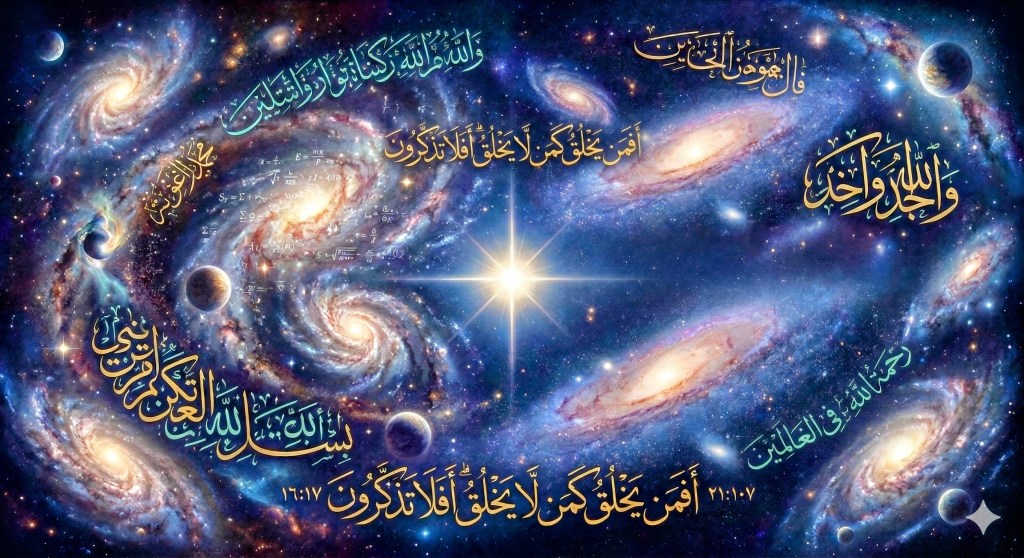
Can He Who Creates Be Compared to One Who Cannot Create?
Presented by Zia H Shah MD
A Scientific, Philosophical, and Theological Commentary on Quran 16:10–23
Abstract
Surah An-Nahl (The Bee), verses 10–23, presents one of the Quran’s most concentrated arguments for monotheism, Wikipedia moving from the observable universe to its inescapable theological conclusion. The focal verse—16:17, “Can He who creates be compared to one who cannot create? Why do you not take heed?”—functions as more than a rhetorical question. It is an ontological proof, a cosmological razor, and a hermeneutical key. This commentary examines the passage through three interlocking lenses. Scientifically, it engages the Kalam cosmological argument, the Borde-Guth-Vilenkin theorem, fine-tuning of physical constants (including Roger Penrose’s extraordinary 1 in 10^10^123 calculation), and the universal genetic code as evidence of a singular creative origin. Philosophically, it analyzes the Creator–creature distinction through Avicenna’s Necessary Existent (Wajib al-Wujud), Leibniz’s Principle of Sufficient Reason, the Russell–Copleston debate, and the problem of brute facts in materialist metaphysics. Theologically, it applies the Quranic hermeneutic of muhkamat and mutashabihat (Quran 3:7) to demonstrate that the Creator–creature distinction is the supreme foundational principle (muhkam), and that its violation—whether through polytheism, Trinitarian Christology, or materialist atheism—constitutes the fundamental epistemological error the Quran identifies as istikbar (arrogance). Drawing on classical tafsir (Ibn Kathir, al-Razi, Maududi), modern cosmology, and the scholarly work of Zia H Shah MD, this commentary argues that verse 16:17 addresses every age simultaneously: the polytheist, the Christian theologian, and the contemporary atheist each face the same irreducible question—what have your gods, your incarnate deity, or your brute-fact universe actually created?
I. The passage: Quran 16:10–23 with running commentary
The passage opens with a cascade of divine signs (ayat) in the natural world, builds to the decisive question of verse 17, and concludes with the theological and existential consequences of accepting or rejecting monotheism. Each verse is presented below with full Arabic text and the M.A.S. Abdel Haleem translation (Oxford World’s Classics). Bahai ForumsVirtual Mosque
Verse 16:10
هُوَ ٱلَّذِىٓ أَنزَلَ مِنَ ٱلسَّمَآءِ مَآءً ۖ لَّكُم مِّنْهُ شَرَابٌ وَمِنْهُ شَجَرٌ فِيهِ تُسِيمُونَ
It is He who sends down water for you from the sky, from which comes a drink for you, and the shrubs that you feed to your animals.
The passage begins not with abstract theology but with rain. Water descends from above, sustaining both human and animal life. The hydrological cycle—evaporation, condensation, precipitation—is a system of breathtaking contingency: the specific properties of water (its anomalous expansion upon freezing, its solvent capacity, its high specific heat) are themselves fine-tuned. The verse grounds the argument in the tangible, moving from what every person observes to what only reflection reveals.
Verse 16:11
يُنۢبِتُ لَكُم بِهِ ٱلزَّرْعَ وَٱلزَّيْتُونَ وَٱلنَّخِيلَ وَٱلْأَعْنَٰبَ وَمِن كُلِّ ٱلثَّمَرَٰتِ ۗ إِنَّ فِى ذَٰلِكَ لَءَايَةً لِّقَوْمٍ يَتَفَكَّرُونَ
With it He grows for you grain, olives, palms, vines, and all kinds of other crops. There truly is a sign in this for those who reflect. My Islam
The botanical diversity arising from a single element—water—is itself a sign. From one substance, an astonishing variety of plants emerge. The verse ends with the first of a series of escalating epistemic qualifiers: this sign is for those who reflect (yatafakkarun). The Quran distinguishes between passive seeing and active reflection, a distinction that anticipates the modern philosophy of science: data does not interpret itself.
Verse 16:12
وَسَخَّرَ لَكُمُ ٱلَّيْلَ وَٱلنَّهَارَ وَٱلشَّمْسَ وَٱلْقَمَرَ ۖ وَٱلنُّجُومُ مُسَخَّرَٰتٌۢ بِأَمْرِهِۦٓ ۗ إِنَّ فِى ذَٰلِكَ لَءَايَٰتٍ لِّقَوْمٍ يَعْقِلُونَ
By His command He has made the night and day, the sun, moon, and stars all of benefit to you. There truly are signs in this for those who use their reason. My Islam
The verse ascends from the botanical to the cosmic. The Arabic musakhkharat bi-amrihi (“subjected by His command”) conveys that these colossal bodies operate under divine governance. The qualifier escalates: now it is for those who use their reason (ya’qilun). The stars are not merely beautiful; they are governed. Their governance implies a Governor.
Verse 16:13
وَمَا ذَرَأَ لَكُمْ فِى ٱلْأَرْضِ مُخْتَلِفًا أَلْوَٰنُهُۥٓ ۗ إِنَّ فِى ذَٰلِكَ لَءَايَةً لِّقَوْمٍ يَذَّكَّرُونَ
He has made of benefit to you the many-coloured things He has multiplied on the earth. There truly are signs in this for those who take it to heart. My Islam
The word yazzakkarun (to take to heart, to remember) appears here—the same root (dh-k-r) that will explode in the focal verse 16:17 as tadhakkarun. Colour diversity in nature (minerals, flora, fauna) speaks to creative artistry. The qualifier now moves from intellect to heart: this is not merely rational but personal.
Verse 16:14
وَهُوَ ٱلَّذِى سَخَّرَ ٱلْبَحْرَ لِتَأْكُلُوا۟ مِنْهُ لَحْمًا طَرِيًّا وَتَسْتَخْرِجُوا۟ مِنْهُ حِلْيَةً تَلْبَسُونَهَا وَتَرَى ٱلْفُلْكَ مَوَاخِرَ فِيهِ وَلِتَبْتَغُوا۟ مِن فَضْلِهِۦ وَلَعَلَّكُمْ تَشْكُرُونَ
It is He who made the sea of benefit to you: you eat fresh fish from it and bring out jewellery to wear; you see the ships cutting through its waves so that you may go in search of His bounty and give thanks. My Islam
The ocean yields sustenance (fish), beauty (pearls), and the capacity for trade and exploration (ships). The verse moves from survival to aesthetics to economics—a comprehensive inventory of divine provision. The expected response: gratitude (tashkurun).
Verse 16:15
وَأَلْقَىٰ فِى ٱلْأَرْضِ رَوَٰسِىَ أَن تَمِيدَ بِكُمْ وَأَنْهَٰرًا وَسُبُلًا لَّعَلَّكُمْ تَهْتَدُونَ
He has made mountains stand firm on the earth, to prevent it shaking under you, and rivers and paths so that you may find your way, My Islam
Mountains as stabilizers, rivers as pathways. The geological and hydrological infrastructure that makes human civilization possible is attributed to divine design. My Islam The Arabic la’allakum tahtadun (so that you may find your way) carries a double meaning: physical navigation and spiritual guidance.
Verse 16:16
وَعَلَٰمَٰتٍ ۚ وَبِٱلنَّجْمِ هُمْ يَهْتَدُونَ
and landmarks and stars to guide people. My Islam
A brief, powerful coda. Stars guide travelers across deserts and oceans. Ibn Abbas explained that ‘alamat (landmarks) refers to mountains and hills visible by day, while the stars guide by night. My Islam +2 The verse completes the catalog of signs—terrestrial, maritime, celestial—before the hammer falls.
Verse 16:17 — The Focal Verse
أَفَمَن يَخْلُقُ كَمَن لَّا يَخْلُقُ ۗ أَفَلَا تَذَكَّرُونَ
Can He who creates be compared to one who cannot create? Why do you not take heed? My Islam
After fourteen verses cataloging what God has created—rain, crops, celestial bodies, colour, oceans, mountains, rivers, stars—the Quran delivers its theological conclusion in the form of a question so devastating in its simplicity that it requires no premise beyond what the reader’s own eyes confirm. The one who creates everything cannot be equated with anything that creates nothing. This is the ontological divide. Everything else in theology follows from it. Ibn Kathir summarizes: “Would He Who creates and brings things into existence out of nothingness be likened to him who simply can never create an entity of any kind!” Surah Quran Maududi draws out the implication: “How is it, then, that you ascribe from among the creation, a status equal to or like that of the Creator in the system of the universe created by Him?” My Islam The section that follows will analyze this verse in depth.
Verse 16:18
وَإِن تَعُدُّوا۟ نِعْمَةَ ٱللَّهِ لَا تُحْصُوهَآ ۗ إِنَّ ٱللَّهَ لَغَفُورٌ رَّحِيمٌ
If you tried to count God’s blessings, you could never take them all in: He is truly most forgiving and most merciful. My Islam
The innumerability of divine blessings drives home the asymmetry. Human ingratitude is infinite; God’s mercy covers it nonetheless. Ibn Kathir explains: “If He were to ask you to thank Him for all of His blessings, you would not be able to do so, and if He were to punish you for failing, He would be justified—but He forgives and shows mercy.” Surah Quran +2
Verse 16:19
وَٱللَّهُ يَعْلَمُ مَا تُسِرُّونَ وَمَا تُعْلِنُونَ
He knows what you conceal and what you reveal. My Islam
A transition from cosmology to epistemology: the Creator of the external world also knows the internal world of human consciousness. Nothing is hidden from the one who made the system.
Verse 16:20
وَٱلَّذِينَ يَدْعُونَ مِن دُونِ ٱللَّهِ لَا يَخْلُقُونَ شَيْـًٔا وَهُمْ يُخْلَقُونَ
Those they invoke beside God create nothing; they are themselves created. My Islam
Verse 17’s question now receives its answer in the form of a declarative statement. The false gods do not merely fail to create the heavens and earth—they create nothing at all (la yakhluquna shay’an). The double disqualification is devastating: they create nothing, and they are themselves created (hum yukhlaqun). The passive voice places them firmly on the “creature” side of the ontological divide.
Verse 16:21
أَمْوَٰتٌ غَيْرُ أَحْيَآءٍ ۖ وَمَا يَشْعُرُونَ أَيَّانَ يُبْعَثُونَ
They are dead, not living. They do not know when they will be raised up. My Islam
The false gods are characterized as dead (amwat), not living, and ignorant of eschatology. This applies to idols made of stone, but also—by theological extension—to any entity placed in God’s position that lacks the defining divine attributes of self-subsistent life and omniscience. My Islam
Verse 16:22
إِلَٰهُكُمْ إِلَٰهٌ وَٰحِدٌ ۚ فَٱلَّذِينَ لَا يُؤْمِنُونَ بِٱلْءَاخِرَةِ قُلُوبُهُم مُّنكِرَةٌ وَهُم مُّسْتَكْبِرُونَ
Your God is the One God. As for those who deny the life to come, their hearts refuse to admit the truth and they are arrogant. My Islam
The verse draws a startling connection: denial of the afterlife (al-akhirah) is linked not to intellectual doubt but to arrogance (istikbar) and hearts that refuse to admit the truth (munkirah). My Islam This connection will be explored in detail below—denial of accountability is, at root, denial of the Creator.
Verse 16:23
لَا جَرَمَ أَنَّ ٱللَّهَ يَعْلَمُ مَا يُسِرُّونَ وَمَا يُعْلِنُونَ ۚ إِنَّهُۥ لَا يُحِبُّ ٱلْمُسْتَكْبِرِينَ
There is no doubt that God knows what they conceal and what they reveal. He does not love the arrogant.
The passage closes where it began—with divine knowledge—but now that knowledge carries judicial weight. God who made the universe also sees into the arrogant heart. The ring composition is complete: from creation to accountability, from rain to resurrection.
II. The ontological proof: why 16:17 addresses polytheism, Christianity, and atheism simultaneously
Verse 16:17 operates on three theological fronts at once. Against polytheism, the argument is self-evident: the Meccan pagans already conceded that Allah was the Creator, yet they worshipped entities they knew had created nothing. As Maududi observes, the polytheists’ error “was not in denying creation but in assigning divine rights and powers to created beings within God’s own universe.” My Islam The idols of Makkah never claimed to have made the rain or the stars. How, then, could they be equated with the One who did? Surah Quran
Against Trinitarian Christianity, the argument strikes at the hypostatic union itself. If Jesus is “fully divine and fully human” as the Council of Chalcedon (451 CE) defined, then his human nature—born to Mary around 1 CE—is temporally created and could not have participated in the creation of the heavens and earth. Thequran As Zia H Shah argues in his analysis at The Glorious Quran and Science, the human nature of Jesus “did not exist eternally” and therefore presents “a logical impossibility” regarding participation in cosmic creation. Thequran The Quranic challenge of Surah Luqman applies directly:
خَلَقَ ٱلسَّمَٰوَٰتِ بِغَيْرِ عَمَدٍ تَرَوْنَهَا ۖ وَأَلْقَىٰ فِى ٱلْأَرْضِ رَوَٰسِىَ أَن تَمِيدَ بِكُمْ وَبَثَّ فِيهَا مِن كُلِّ دَآبَّةٍ ۚ وَأَنزَلْنَا مِنَ ٱلسَّمَآءِ مَآءً فَأَنۢبَتْنَا فِيهَا مِن كُلِّ زَوْجٍ كَرِيمٍ
هَٰذَا خَلْقُ ٱللَّهِ فَأَرُونِى مَاذَا خَلَقَ ٱلَّذِينَ مِن دُونِهِۦ ۚ بَلِ ٱلظَّٰلِمُونَ فِى ضَلَٰلٍ مُّبِينٍ
He created the heavens without any visible support, and He placed firm mountains on the earth—in case it should shake under you—and He spread all kinds of animals around it. We sent down water from the sky, with which We made every kind of good plant grow on earth: all this is God’s creation. Now, show Me what your other gods have created. No, the disbelievers are clearly astray. (31:10–11) My IslamThequran
“Show Me what your other gods have created” is a challenge that no entity besides God can answer. Quran.com Shah further argues that the unity of the genetic code—the fact that all thirty million species of life on earth share one molecular language—constitutes biological evidence for a single Creator. As Matt Ridley writes in Genome: “The three-letter words of the genetic code are the same in every creature. CGA means arginine and GCG means alanine—in bats, in beetles, in beech trees, in bacteria… All life is one.” thequran Shah’s conclusion is striking: “James Watson and Francis Crick’s famous one-page paper, describing the structure of DNA, appeared in Nature in 1953. In addition to being a biological epiphany, it also turned out to be an amazing religious epiphany. Trinity was no more! There could be only one creator of life on our planet earth.” thequran
Against materialist atheism, verse 16:17 poses the most fundamental question: does the universe itself create? The materialist treats the laws of nature, the constants of physics, and the existence of the cosmos as brute facts requiring no explanation. But the verse insists that the divide between Creator and non-creator is absolute. Rain does not send itself. Stars do not subject themselves. The universe does not fine-tune its own constants. Something that does not create cannot be treated as though it does.
III. Quran 3:7 as the hermeneutical key: why getting the fundamentals right determines everything
هُوَ ٱلَّذِىٓ أَنزَلَ عَلَيْكَ ٱلْكِتَٰبَ مِنْهُ ءَايَٰتٌ مُّحْكَمَٰتٌ هُنَّ أُمُّ ٱلْكِتَٰبِ وَأُخَرُ مُتَشَٰبِهَٰتٌ ۖ فَأَمَّا ٱلَّذِينَ فِى قُلُوبِهِمْ زَيْغٌ فَيَتَّبِعُونَ مَا تَشَٰبَهَ مِنْهُ ٱبْتِغَآءَ ٱلْفِتْنَةِ وَٱبْتِغَآءَ تَأْوِيلِهِۦ ۗ وَمَا يَعْلَمُ تَأْوِيلَهُۥٓ إِلَّا ٱللَّهُ ۗ وَٱلرَّٰسِخُونَ فِى ٱلْعِلْمِ يَقُولُونَ ءَامَنَّا بِهِۦ كُلٌّ مِّنْ عِندِ رَبِّنَا ۗ وَمَا يَذَّكَّرُ إِلَّآ أُولُوا۟ ٱلْأَلْبَٰبِ
It is He who has sent this Scripture down to you [Prophet]. Some of its verses are definite in meaning—these are the cornerstone of the Scripture—and others are ambiguous. The perverse at heart eagerly pursue the ambiguities in their attempt to make trouble and to pin down a specific meaning of their own: only God knows the true meaning. My Islam Those firmly grounded in knowledge say, ‘We believe in it: it is all from our Lord’—only those with real perception will take heed. Quranic Arabic Corpus (3:7)
This verse establishes the Quran’s own hermeneutical framework. Muhkamat (definite, foundational verses) are umm al-kitab—the mother of the Book, the cornerstone. Islamic Studies Mutashabihat (ambiguous, allegorical verses) require interpretation guided by the muhkamat. Quran Gallery App The Creator–creature distinction of 16:17 is the supreme muhkam principle. It admits no ambiguity: the one who creates is categorically unlike the one who does not create.
The theological consequences are profound. When the Quran describes Jesus as kalimah (“Word”) of God (4:171) or ruh (“Spirit”) from Him (4:171), these are mutashabih expressions—they carry multiple possible meanings. Classical Islamic exegesis holds that these titles refer to Jesus’s mode of creation: because he was brought into existence without a human father, through the divine command “Be” (kun), he is called a “Word” from God—not because he is God’s eternal Logos, but because he is the result of God’s creative word. As al-Tabari explains, “Jesus is a kalimah and a ruh in exactly the same way that Adam was.”
Ibn Kathir’s tafsir of 3:7 directly addresses the Christian hermeneutical error: “Christians might claim that Jesus is divine because the Quran states that he is Ruhullah (Spirit of God) and His Word, which He gave to Mary, all the while ignoring Allah’s statements: ‘He is nothing but a servant upon whom We bestowed favour’ (43:59).” Quran.com The error is precisely what 3:7 warns against: pursuing the ambiguous while ignoring the foundational. Quran The muhkam principle—only God creates (16:17), Jesus and Mary ate food (5:75), Jesus is only a servant (43:59)—must govern the interpretation of the mutashabih titles. To reverse this order, extracting divinity from metaphorical language while ignoring clear categorical statements, is what the Quran calls zaygh—deviation. Quran Gallery App
This hermeneutical framework applies beyond Christology. Any theology that begins with the ambiguous and subordinates the clear—whether it is the deification of a prophet, the worship of natural forces, or the elevation of mathematical laws to self-explanatory status—commits the same structural error. The foundational verse is always: Can He who creates be compared to one who cannot create?
IV. Denial of the afterlife as the deepest epistemological error
Verse 16:22 makes a connection that initially seems surprising: “Your God is the One God. As for those who deny the life to come, their hearts refuse to admit the truth and they are arrogant.” My Islam Why does denial of the afterlife appear in a passage about creation and monotheism?
The connection is philosophical. To deny the afterlife is to deny accountability. To deny accountability is to deny a purposeful Creator. And to deny a purposeful Creator is to treat the universe—its laws, its constants, its existence—as a brute fact: something that simply is, requiring no explanation, admitting no teleology.
Bertrand Russell crystallized this position in his 1948 BBC debate with the Jesuit philosopher F.C. Copleston: “I should say that the universe is just there, and that’s all.” thequran Russell refused to accept that the universe required explanation, arguing that “the concept of cause is not applicable to the total” Patheos and that the universe’s existence is simply a brute fact. Medium Sean Carroll, the contemporary physicist, echoes this: “Any attempt to explain why there is something rather than nothing must bottom out in a set of brute facts.” thequran
The Quran anticipates and diagnoses this position. Those who deny the afterlife do not merely lack evidence; their hearts refuse to admit the truth (qulubuhum munkirah). The refusal is volitional, not evidential. It is istikbar—arrogance—because it amounts to declaring that the contingent universe needs no explanation, that the astounding fine-tuning of physical constants is just a coincidence, that the mathematical intelligibility of nature is simply a lucky break. My Islam
Copleston’s response to Russell remains philosophically devastating. He argued that scientists and police detectives assume explanations exist for the phenomena they investigate—that science itself would be impossible without the assumption that reality is intelligible. A Level Philosophy & Religious Studies If we accept the Principle of Sufficient Reason within the universe, why abandon it for the universe itself? As Copleston put it: “If one refuses to sit at the chess board and make a move, one cannot, of course, be checkmated.” PHILOSOPHY DUNGEON Russell’s brute-fact position is not a philosophical conclusion but a philosophical refusal. Medium
The laws of nature themselves are contingent. Jean-Philippe Uzan’s definitive review in Living Reviews in Relativity establishes that fundamental constants are “contingent quantities that can only be measured”—not derivable from deeper principles, not logically necessary. PubMedPubMed Central Richard Feynman, reflecting on the fine-structure constant (~1/137), called it “one of the greatest damn mysteries of physics: a magic number that comes to us with no understanding by man. You might say the ‘hand of God’ wrote that number, and we don’t know how He pushed His pencil.” Wikipedia These constants could have been different. Their specific values demand explanation. Treating them as brute facts is not science—it is the abandonment of inquiry.
Jean-Paul Sartre, to his credit, recognized the existential weight of contingency even while rejecting God. In Nausea, his protagonist Roquentin encounters the “thereness” of objects and is overwhelmed: “The essential point is contingency. I mean that by definition existence is not necessity. To exist is simply to be there.” Luc But where Sartre saw this as proof that existence is “perfectly gratuitous,” Luc the Quran sees it as precisely the evidence that demands a Necessary Being. The contingent world screams for explanation. The heart that refuses to hear is the heart described in 16:22.
V. The cosmological arguments: from ancient kalam to modern physics
The Quran does not present its cosmological argument in the syllogistic form of Western philosophy, but its argument is unmistakable and comprehensive. Two verses crystallize it with extraordinary force:
بَدِيعُ ٱلسَّمَٰوَٰتِ وَٱلْأَرْضِ ۖ وَإِذَا قَضَىٰٓ أَمْرًا فَإِنَّمَا يَقُولُ لَهُۥ كُن فَيَكُونُ
He is the Originator of the heavens and the earth, and when He decrees something, He says only, ‘Be,’ and it is. My Islam (2:117)
The word Badi’ carries the sense of unprecedented origination—creation without prior model, without pre-existing material. This is creation ex nihilo in its purest expression: ThequranThequran kun fa-yakun, “Be, and it is.” No process, no intermediary, no pre-existing quantum vacuum mislabeled as “nothing.” As Zia H Shah emphasizes in his analysis of this verse: “Nothing existed other than Him… No matter, no energy, no souls, no mathematics, no numbers, no logic, no propositions.” Thequran
And the Quran’s own cosmological syllogism, arguably the most concise in the history of philosophy:
أَمْ خُلِقُوا۟ مِنْ غَيْرِ شَىْءٍ أَمْ هُمُ ٱلْخَٰلِقُونَ
أَمْ خَلَقُوا۟ ٱلسَّمَٰوَٰتِ وَٱلْأَرْضَ ۚ بَل لَّا يُوقِنُونَ
Were they created without any agent? Were they the creators? Did they create the heavens and the earth? No! They do not have faith. (52:35–36)
These verses present an exhaustive trilemma. Thequran Either human beings (and by extension, the universe) were created from nothing with no cause, or they created themselves, or they created the heavens and the earth. All three alternatives are absurd. The only coherent option—a transcendent Creator—is left unstated because it is self-evident. Thequran
The Kalam cosmological argument, first formulated rigorously by Abu Hamid al-Ghazali (1058–1111 CE) Reasonable Faith in Tahafut al-Falasifah and revived by William Lane Craig in 1979, formalizes this Quranic reasoning:
- Whatever begins to exist has a cause.
- The universe began to exist.
- Therefore, the universe has a cause.
The second premise has received extraordinary scientific confirmation. CrossExamined The Borde-Guth-Vilenkin theorem (2003) demonstrated that any universe (or multiverse region) that has been, on average, expanding throughout its history cannot be past-eternal—it must have a past spacetime boundary. As Alexander Vilenkin stated: “With the proof now in place, cosmologists can no longer hide behind Reasonable Faith the possibility of a past-eternal universe. There are no models at this time that provide a satisfactory model for a universe without a beginning.” Stephen Hawking concurred: “Almost everyone now believes that the universe, and time itself, had a beginning at the Big Bang.”
Craig’s conceptual analysis of the cause reveals it must be timeless, spaceless, immaterial, enormously powerful, and personal—a free agent capable of initiating a temporal effect from a timeless state. These are, point for point, the attributes the Quran ascribes to God.
Shah’s extensive treatment of these arguments across multiple essays at The Glorious Quran and Science synthesizes the philosophical and scientific evidence. He directly engages Lawrence Krauss’s claim that the universe arose from “nothing”—showing that Krauss’s “nothing” is actually a quantum vacuum with specific properties, not true nothingness. He critiques Sean Carroll’s appeal to brute facts as “abandoning rational inquiry prematurely.” And he catalogues the Quranic verses that align with the cosmological argument: 21:30 (the heavens and earth as a joined entity split apart, resonating with Big Bang cosmology), 6:73, 35:3, and 35:15 (human contingency versus divine self-sufficiency).
VI. The fine-tuning of the universe: when the numbers speak
The case from fine-tuning transforms the cosmological argument from abstract reasoning to empirical precision. The physical constants that govern our universe are not merely contingent—they are calibrated to an almost inconceivable degree.
The cosmological constant (Λ) is the most dramatic example. Quantum field theory predicts a vacuum energy density roughly 10^120 times larger than what is observed. For the universe to contain structure—galaxies, stars, planets, life—this constant must be fine-tuned to approximately 1 part in 10^120. Steven Weinberg predicted this small value before the 1998 discovery of dark energy confirmed it. As Shah notes in his analysis of cosmic fine-tuning, this represents “the worst theoretical prediction in the history of physics”—and yet the observed value sits precisely in the narrow window that permits a structured cosmos.
The strong nuclear force determines how efficiently hydrogen fuses into helium in stars. Martin Rees identifies this efficiency parameter (ε) as 0.007. If it were 0.006, protons could not bond to neutrons, and only hydrogen would exist—no complex chemistry, no life. If it were 0.008, all hydrogen would have been consumed in the Big Bang—no water, no long-lived stars. We exist in an extraordinarily narrow window.
Roger Penrose’s calculation of the probability of the universe’s initial low-entropy state is perhaps the most staggering number in all of physics: 1 in 10^10^123. Writing this number in ordinary notation would require more zeros than there are subatomic particles in the observable universe. Penrose wrote: “In order to produce a universe resembling the one in which we live, the Creator would have to aim for an absurdly tiny volume of the phase space of possible universes.” Most arrangements of particles in the dense early universe would have yielded nothing but black holes. The low-entropy initial state that made structure possible is, by Penrose’s own calculation, incomprehensibly improbable.
Martin Rees’s Just Six Numbers (1999) identifies six dimensionless constants whose fine-tuning enables the universe:
- N ≈ 10^36 (ratio of electromagnetic to gravitational force)
- ε = 0.007 (nuclear fusion efficiency)
- Ω ≈ 1 (density parameter)
- Λ ≈ 0.7 (dark energy density)
- Q ≈ 10^-5 (amplitude of primordial density fluctuations)
- D = 3 (number of spatial dimensions)
Rees observes: “If any one of them were ‘untuned,’ there could be no stars and no life.” Paul Davies adds: “The really amazing thing is not that life on Earth is balanced on a knife-edge, but that the entire universe is balanced on a knife-edge.” Fred Hoyle’s often-quoted conclusion: “A common sense interpretation of the facts suggests that a superintellect has monkeyed with physics.”
The multiverse hypothesis is often presented as an alternative to design, but it fails on multiple grounds. First, it suffers from the Boltzmann brain problem: in a multiverse of randomly ordered universes, disembodied “Boltzmann brains” arising from random fluctuations would vastly outnumber evolved observers like us. If we were typical observers in a multiverse, we should observe a tiny pocket of order surrounded by chaos—not the vast, elaborately structured cosmos we actually see. Penrose is devastating on this point: the multiverse is “worse than useless in explaining the anthropic fine-tuning.” Second, the multiverse generator mechanism itself requires explanation—its fine-tuning is merely displaced, not eliminated. Third, the multiverse is inherently unobservable and unfalsifiable, making it philosophical speculation rather than science. As Davies writes: “The multiverse theory seeks to replace the appearance of design by the hand of chance,” but “a theory which rests on entities that are in principle unobservable cannot be described as scientific.”
Shah’s treatment across multiple essays integrates these scientific findings with Quranic theology. In his analysis of Quran 67:3–4 (“You do not see in the creation of the Most Merciful any inconsistency”), he argues that the Quran’s challenge to find flaws in creation is scientifically vindicated by the discovery of fine-tuning. The universe is not merely functional; it is optimal. This optimality points beyond blind mechanism to intentional design—precisely the Creator whom 16:17 identifies as incomparable.
VII. Everything prostrates: the testimony of shadows and the unity of natural law
Later in the same surah, a remarkable passage extends the argument from creation to universal submission:
أَوَلَمْ يَرَوْا۟ إِلَىٰ مَا خَلَقَ ٱللَّهُ مِن شَىْءٍ يَتَفَيَّؤُا۟ ظِلَٰلُهُۥ عَنِ ٱلْيَمِينِ وَٱلشَّمَآئِلِ سُجَّدًا لِّلَّهِ وَهُمْ دَٰخِرُونَ
وَلِلَّهِ يَسْجُدُ مَا فِى ٱلسَّمَٰوَٰتِ وَمَا فِى ٱلْأَرْضِ مِن دَآبَّةٍ وَٱلْمَلَٰٓئِكَةُ وَهُمْ لَا يَسْتَكْبِرُونَ
Do the [disbelievers] not observe the things that God has created, casting their shadows right and left, submitting themselves to God obediently? It is to God that everything in the heavens and earth submits, every beast that moves, even the angels—they are free from arrogance. (16:48–49)
Maududi’s interpretation of this passage provides a philosophical key: “The fact that everything—a man, an animal, a tree or a mountain—casts its shadow, is a clear proof of its material nature, and everything which is made of matter is a creation of Allah and is subject to a universal law.” Casting a shadow means being material. Being material means being contingent. Being contingent means being created. Being created means being subject to God’s governance. The shadow is the visible sign of ontological dependence.
The scientific resonance is striking. The laws of physics are universal: the gravitational constant is the same in the Andromeda galaxy as it is on Earth. The speed of light is invariant across the cosmos. The electromagnetic force operates identically in every atom in the universe. This universality—what physicists call the homogeneity and isotropy of physical law—is precisely what the Quran describes as universal sujud (prostration). Everything in creation obeys the same laws because everything has the same Lawgiver.
This is the argument of Quran 21:22:
لَوْ كَانَ فِيهِمَآ ءَالِهَةٌ إِلَّا ٱللَّهُ لَفَسَدَتَا ۚ فَسُبْحَٰنَ ٱللَّهِ رَبِّ ٱلْعَرْشِ عَمَّا يَصِفُونَ
If there had been in the heavens or earth any gods but Him, both heavens and earth would be in ruins: God, Lord of the Throne, is far above the things they say. (21:22)
Multiple gods would mean multiple wills, multiple legislative principles, multiple sets of physical laws—and the result would be cosmic incoherence. Maududi identifies two dimensions of this argument: the common-sense observation that “no institution, no household, not to speak of the vast universe, can function smoothly and properly if it has two masters,” and the deeper point that “the system of the whole universe is functioning according to a universal law” requiring “proper proportion, balance, harmony and coordination” that only a single sovereign intelligence could maintain.
Shah’s essay “One God, One Universe” develops this argument extensively. He draws on Newton (“This most beautiful system of the sun, planets, and comets could only proceed from the counsel and dominion of an intelligent and powerful Being”), Einstein (“I believe in Spinoza’s God who reveals himself in the orderly harmony of what exists”), and John Polkinghorne (the universe is “rationally transparent” to us) to argue that the intelligibility of nature is itself evidence of monotheism. The scientific revolution, Shah notes, emerged in monotheistic cultures precisely because belief in one Lawgiver encouraged the search for universal laws. As Ibn al-Haytham (Alhazen) wrote: “I constantly sought knowledge and truth, and it became my belief that for gaining access to the effulgence and closeness to God, there is no better way than that of searching for truth and knowledge.”
The universal genetic code provides a biological parallel. All known life on Earth—from bacteria to whales—uses the same molecular language: the same 64 codons mapping to the same 20 amino acids. Biophysicist Hubert Yockey calculated that natural selection would have to explore approximately 1.40 × 10^70 different genetic codes to discover the one actually used. Researchers have found the code displays “multidimensional optimality” that “cannot be explained by any simple evolutionary hypothesis proposed so far.” One genetic code, one set of physical laws, one universe—the empirical evidence converges on one Creator.
VIII. God as Necessary Being: why the Creator is not a brute fact
The philosophical culmination of the argument from 16:17 is the concept of the Necessary Existent (Wajib al-Wujud), developed most rigorously by Ibn Sina (Avicenna, 980–1037 CE) in his “Proof of the Truthful” (Burhan al-Siddiqin). Avicenna’s argument begins not with the universe’s temporal beginning but with the distinction between necessary and contingent existence:
Every existent is either necessary (its essence guarantees its existence; it cannot not-exist) or contingent (its essence does not guarantee its existence; it requires an external cause). The entire collection of contingent things is itself contingent—being composed entirely of dependent parts, it cannot be self-explanatory. Therefore, there must exist a Necessary Existent whose essence is its existence, who depends on nothing external, and who grounds the existence of everything contingent.
Avicenna demonstrated that this Necessary Existent must be absolutely simple (not composed of parts, since parts would be prior to the whole, making it dependent), unique (two necessary existents would either share all properties, making them identical, or differ by some non-necessary property, making one of them contingent), and the cause of all contingent reality. As Peter Adamson notes, this was “one of the most influential medieval arguments for God’s existence” and “Avicenna’s biggest contribution to the history of philosophy.”
Fakhr al-Din al-Razi (d. 1210 CE), in his monumental Mafatih al-Ghayb, integrated Avicenna’s ontology into Quranic exegesis. For al-Razi, verse 16:17’s argument is not merely rhetorical but constitutes a burhan (demonstration): an entity whose existence is contingent cannot logically share in the prerogatives of the One whose existence is necessary and self-subsistent. Al-Razi carefully distinguished khalq (creation as measuring-out and forming) from ibda’ (absolute origination from nothing)—the latter being God’s exclusive prerogative.
This framework resolves a persistent objection: if theists can accept God as unexplained, why cannot atheists accept the universe as unexplained? The answer lies in the categorical difference between necessary and contingent existence. God, as the Necessary Existent, is self-explanatory—His essence includes His existence. He is not “unexplained” in the way the universe would be if treated as a brute fact; rather, He is the terminus of explanation, the being whose nature is explanation. The universe, by contrast, is composed entirely of contingent parts, any of which could conceivably not exist. To call the universe a brute fact is to declare that something which could have been otherwise simply has no explanation—a declaration that, as Copleston argued, undermines the very possibility of rational inquiry.
The divine attributes that flow from necessary existence—aseity (self-existence: God exists a se, from Himself, not derived from another), eternity (a necessary being cannot begin or cease), omnipotence (the ground of all contingent reality must have the power to actualize it), and oneness (Avicenna’s proof of uniqueness)—are precisely the attributes the Quran ascribes to God. Verse 16:17 is, at bottom, a statement about metaphysical categories: the Creator possesses necessary existence; the creature possesses contingent existence. To confuse these categories—whether by worshipping an idol, deifying a prophet, or treating the cosmos as self-explanatory—is the error the Quran calls shirk.
Shah’s analysis of Avicenna’s argument emphasizes the concept of divine aseity: “God’s existence is self-explanatory—His essence IS His existence.” His essay on God as the Metaphysically Necessary Being engages with the question posed by Stephen Hawking—”What puts the fire in the equations?”—noting that mathematical equations alone, however elegant, cannot actualize a universe. The laws of physics describe regularities; they do not create them. Something must, as it were, breathe fire into the equations. That something, by the logic of contingency, must be a Necessary Being—not another contingent entity, however fundamental.
IX. Conclusion: the invitation of tadhakkarun
The final word of verse 16:17—tadhakkarun, “take heed” or “remember”—carries a weight that only becomes apparent after traversing the full depth of the passage. The Arabic root dh-k-r means both to remember and to be mindful. The Quran does not present monotheism as a novelty to be learned but as a primordial truth to be remembered—a truth written into the structure of rain and stars, encoded in the genetic alphabet of every living cell, embedded in the fine-tuned constants that sustain the cosmos.
The passage moves from creation (16:10–16) to the decisive question (16:17) to the inexhaustibility of divine blessing (16:18) to divine omniscience (16:19) to the impotence of false gods (16:20–21) to the link between monotheism and accountability (16:22) to divine judgment of arrogance (16:23). This is not a sequence of disconnected themes but a single, ascending argument. The universe speaks. The question is asked. The blessings are uncountable. God sees all. The false gods create nothing. There is One God. Those who deny accountability are arrogant. God knows and judges.
Every worldview must eventually answer verse 16:17. The polytheist must explain what his gods have created. The Trinitarian must explain how a being born to Mary in the first century participated in the creation of a universe 13.8 billion years old. The materialist must explain how a universe fine-tuned to 1 part in 10^120 is simply a brute fact. The verse does not argue through compulsion; it argues through clarity. It asks only that one look at what has been created and then ask: who did this? And can anything that did not do this be placed alongside the One who did?
Al-Ghazali, Avicenna, Leibniz, Penrose, Rees, Feynman—across centuries and disciplines, the evidence converges. The universe had a beginning. Its constants are contingent. Its mathematical structure demands explanation. Its genetic code is universal. Its physical laws are uniform. And none of this explains itself.
Can He who creates be compared to one who cannot create?
The question has only one honest answer. The verse ends not with an argument but with an invitation: Why do you not take heed? The Arabic is gentle—not a condemnation but a plea. The Creator who fashioned the rain, the stars, the mountains, and the sea does not compel recognition. He asks for it. The rest is between the human heart and the truth it was made to remember.




 The Glorious Quran and Science
Leave a comment