
Epigraph:
We will show them Our Signs in the universe and also among their own selves, until it becomes manifest to them that the Quran is the truth. (Al Quran 41:53)
He is the Mighty, the Forgiving; Who created the seven heavens, one above the other. You will not see any flaw in what the Lord of Mercy creates. Look again! Can you see any flaw? Look again! And again! Your sight will turn back to you, weak and defeated. (Al Quran 67:2-4)
The Eightieth Particle and the Fingerprint of God
Presented by Zia H Shah MD with help of Claude
Abstract
The March 2026 discovery of the Ξcc⁺ (Xi-cc-plus) baryon at CERN’s upgraded Large Hadron Collider — the eightieth hadron identified by the world’s most powerful particle accelerator — presents not merely a triumph of experimental physics but a renewed occasion for metaphysical inquiry. This article examines the scientific details of this doubly charmed baryon, composed of two charm quarks and one down quark, and situates its discovery within a broader philosophical and theological framework. Drawing extensively on the cosmological writings of Zia H Shah MD, physician and editor of The Muslim Times, whose work at thequran.love synthesizes modern particle physics with classical theistic arguments, we argue that each successive discovery in subatomic physics simultaneously deepens the complexity and reveals the mathematical elegance of a universe that resists explanation as a brute fact. The Kalam cosmological argument, Thequran Leibniz’s Principle of Sufficient Reason, and contemporary fine-tuning arguments converge on a single conclusion: the layered, precisely calibrated architecture of matter — from the Higgs mechanism down to the quark configurations of exotic baryons — bears the hallmarks of intentional, transcendent design.
A doubly charmed baryon emerges from the wreckage of protons
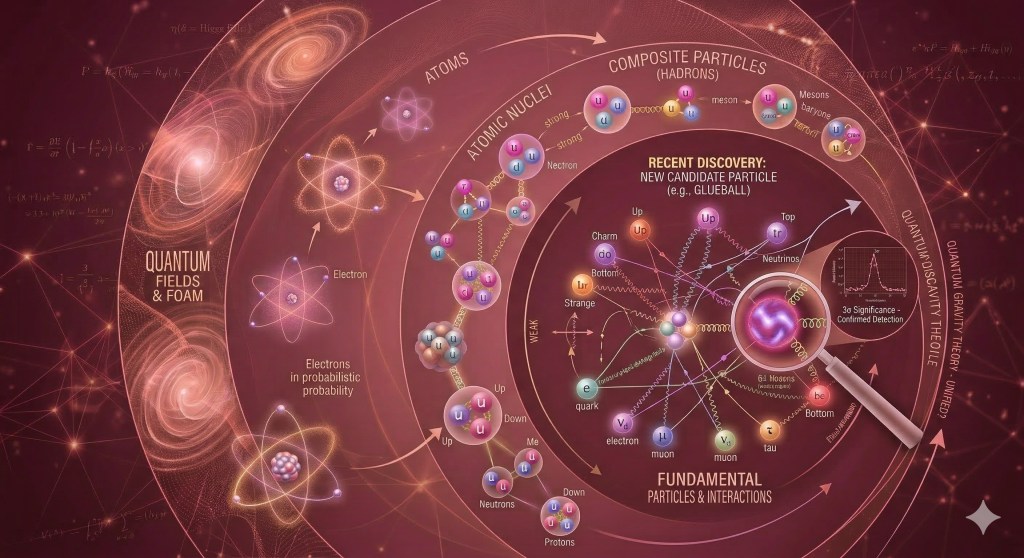
On March 16, 2026, physicists at CERN’s LHCb experiment announced they had observed something that had eluded confirmation for more than two decades: the Ξcc⁺, a baryon built from two charm quarks and one down quark, cerncern with a mass of approximately 3,620 MeV/c² — roughly four times heavier than the proton cern that constitutes the bulk of visible matter. Science Alert The discovery, presented at the Rencontres de Moriond Electroweak conference, Phys.orgcern arrived with a statistical significance of seven sigma, well beyond the five-sigma threshold that particle physicists require before they will utter the word “discovery.” CERN Approximately 915 signal events were extracted from proton–proton collision data collected in 2024 during Run 3 of the Large Hadron Collider. cern
This is no ordinary baryon. The Ξcc⁺ belongs to a rare class of doubly heavy baryons — particles in which two of the three constituent quarks are heavy charm quarks rather than the featherweight up and down quarks that compose familiar protons and neutrons. LCCI Its internal dynamics resemble a miniature planetary system: the two massive charm quarks orbit one another like a binary star, while the lighter down quark traces a wider orbit around them. LHCb spokesperson Vincenzo Vagnoni called the result a confirmation that will “help theorists test models of quantum chromodynamics, the theory of the strong force that binds quarks into not only conventional baryons and mesons but also more exotic hadrons such as tetraquarks and pentaquarks.” CERN
The discovery also resolves a lingering scientific dispute. Over twenty years ago, the SELEX experiment cern at Fermilab claimed to have observed this particle at a mass Cern of approximately 3,519 MeV/c², but no subsequent experiment could replicate the finding. The new LHCb measurement — at ~3,620 MeV/c², consistent with theoretical predictions and with the mass of the particle’s isospin partner Ξcc⁺⁺ discovered in 2017 — settles the controversy decisively in favor of the Standard Model. cern The upgraded LHCb detector, completed in 2023 interestingengineering and capable of capturing collisions forty million times per second through advanced silicon pixel tracking, made the observation possible. interestingengineering CERN Director-General Mark Thomson described the result as “a fantastic example of how LHCb’s unique capabilities play a vital role in the success of the LHC,” adding that “experimental upgrades at CERN directly lead to new discoveries.”
This particle is the eightieth hadron identified by LHC experiments CERN — a number that itself invites reflection. Eighty new composite particles, each assembled from quarks in configurations that obey the austere mathematical rules of quantum chromodynamics, each with precisely predicted masses and lifetimes, each decaying through channels that the Standard Model anticipated decades before the collisions that produced them. It is a staggering catalog of organized complexity.
Where greater complexity reveals deeper order
There is a paradox at the heart of modern particle physics that rarely receives the philosophical attention it deserves. Each new subatomic discovery makes the quantum world appear simultaneously more complex and more organized. The Ξcc⁺ is not an anomaly that shatters our models; it is a fulfillment of them. Its mass, its decay into a Λc⁺ baryon, a kaon, and a pion, its relationship to its isospin partner — all were predicted by quantum chromodynamics before the particle was ever seen. cern The discovery does not confuse the Standard Model; it confirms its layered precision.
This is a pattern that has repeated itself across the entire history of particle physics. When Murray Gell-Mann proposed the quark model in 1964, he predicted particles that did not yet exist. They were found. When Peter Higgs and others postulated the Higgs mechanism in the 1960s, the boson that would confirm it was not observed until 2012 at the LHC. thequranThequran It was found at precisely the mass range the theory required. When theorists predicted that quarks could combine into tetraquarks and pentaquarks — four- and five-quark bound states — skeptics scoffed. The LHCb experiment has now discovered dozens of them. LCCI
What emerges from this history is not a picture of chaos gradually tamed by human ingenuity, but something more profound: a universe whose subatomic foundations are built on mathematical relationships of extraordinary precision, relationships that human minds can discover but did not invent. As Zia H Shah MD writes in his essay “A Perfect Order,” exploring the fine-tuning implied by Quran 67:3–4: “The more closely we examine the universe, the more we are awed by its coherence. Our telescopes and theories peer across billions of light-years and delve into subatomic realms, and everywhere we look we see a profound orderliness — from the elegant choreography of galaxies down to the delicate balance of forces in an atom.” Thequranthequran Shah notes that “astronomers and physicists have indeed been ‘returning their vision’ to the heavens with ever more powerful instruments, from telescopes peering at distant galaxies to particle colliders probing subatomic forces” thequranThequran — and that with each return, “our sense of ‘flawlessness’ in the cosmos only deepens.” thequranThequran
The Standard Model itself is defined by roughly twenty fundamental constants — the masses of quarks, the strengths of forces, the coupling constants that govern interactions — and, as Shah emphasizes, “nobody knows why they have the specific values that they do.” thequranThequran The strong nuclear force that binds the two charm quarks inside the Ξcc⁺ must be precisely what it is: slightly stronger, and nearly all hydrogen in the early universe would have fused into helium, leaving no fuel for long-lived stars; slightly weaker, and atomic nuclei would not hold together at all. thequran The electromagnetic coupling constant is approximately 1/137 — a number that prompted Richard Feynman to remark, as Shah is fond of quoting, “You might say the hand of God wrote that number, and we don’t know how He pushed His pencil.” thequran
This is the central insight: complexity in the subatomic world is not random proliferation. It is organized complexity, complexity that obeys symmetry principles, group-theoretic structures, and conservation laws of breathtaking mathematical beauty. Every new particle that emerges from the LHC’s collisions is a new confirmation that reality is not built from accident. It is built from law.
From sufficient reason to a necessary being
The philosophical question that arises from this organized complexity is ancient, but the particle physics of 2026 gives it a peculiar and modern sharpness. Gottfried Wilhelm Leibniz formulated it in its most famous version: Why is there something rather than nothing? University of Colorado And behind that question lurks a second, equally pressing one: Why is that something so astonishingly well-ordered?
Leibniz’s Principle of Sufficient Reason holds that no fact can be real, no statement true, unless there is a sufficient reason why it is so and not otherwise. Reasonable Faith Applied to the cosmos, this principle demands an ultimate explanation — one that does not merely defer to another contingent fact but terminates in something whose existence is self-explanatory: a necessary being. Reasonable Faith Thomas Aquinas arrived at a similar conclusion through his Third Way: if everything in the universe is merely possible — capable of existing or not existing — then there must be at least one being whose existence is necessary, or nothing would exist at all. Encyclopedia Britannica
Zia H Shah MD brings these classical arguments into direct conversation with modern physics. In his detailed treatment of the Kalam cosmological argument, Shah presents the syllogism with characteristic directness: “Whatever begins to exist has a cause. The universe began to exist. Therefore, the universe has a cause.” ThequranThequran He marshals the scientific evidence for the second premise — the standard Big Bang model, the second law of thermodynamics, and especially the Borde-Guth-Vilenkin theorem, which demonstrates that any universe that has, on average, been expanding throughout its history cannot have been expanding indefinitely but must have had a past boundary. WikipediaThequran He quotes Alexander Vilenkin: “All the evidence we have says that the universe had a beginning.” Thequran And he draws the philosophical conclusion with which William Lane Craig has made the Kalam argument famous in contemporary philosophy: the cause of the universe must be “timeless, spaceless, immaterial, and personal.” ThequranThequran
But Shah does not stop with the Kalam argument. His broader project, developed across hundreds of articles at thequran.love, is a cumulative case that integrates cosmological, teleological, fine-tuning, aesthetic, and moral arguments into a unified vision. “The Quran’s cosmological argument is holistic,” he writes, “addressing causation, contingency, order, and purpose. It challenges humanity to move beyond superficial observation, urging deep reflection on existence itself.” Thequran He reads the Quranic verse “Were they created from nothing, or are they their own creators?” (52:35–36) Thequran as a challenge that “dismantles atheistic materialism, challenging the absurdity of self-creation or spontaneous generation.” Thequran
What makes Shah’s synthesis distinctive is his insistence that science does not merely fail to refute theism — it actively supports it. “The coherence of our universe at all levels, in whatever paradigm we look at it, the amazing beauty, organization and complexity in my mind has theological implications,” he writes in his essay on the Higgs boson, “unless one is already biased towards agnosticism or atheism.” thequranThequran This is a bold claim, but Shah builds it on a foundation of specific physical facts. The cosmological constant, he notes, represents “the most spectacular fine-tuning problem in physics” Thequran — the theoretical expectation overshoots the observed value by a factor of 10¹²⁰, making it “the worst theoretical prediction in the history of physics,” thequranThequran yet our universe sits in what Shah calls “a goldilocks zone” where the constant is positive but extraordinarily slight. thequranThequran
Fine-tuning and the signatures written in fundamental constants
The fine-tuning argument is perhaps the point where particle physics and theology press most urgently against each other. Shah catalogs the evidence with a physician’s precision and a theologian’s sense of wonder. If gravity were significantly stronger, stars would burn through their fuel too quickly for life to evolve; if weaker, stars might never ignite their nuclear fuel at all. thequran One second after the Big Bang, the expansion rate and density of the universe needed to balance to within one part in 10¹⁵ for galaxies to eventually form. thequran The strong nuclear force, the electromagnetic force, the masses of quarks — all of these parameters sit within narrow bands that permit the existence of stable atoms, chemistry, and life.
Shah marshals an impressive array of scientific voices in support of this picture. Fred Hoyle declared that “a common-sense interpretation of the facts suggests that a superintellect has monkeyed with physics.” thequran Paul Davies observed that “the impression of design is overwhelming” ThequranThequran and that “the entire universe is balanced on a knife-edge.” thequran Stephen Hawking conceded that “the remarkable fact is that the values of these numbers seem to have been very finely adjusted to make possible the development of life.” thequran Martin Rees noted simply: “Wherever physicists look, they see examples of fine-tuning.” thequranThequran Brian Greene warned that “even a small change of the known values of those numbers would cause the world as we know it to disappear.” thequranThequran And Freeman Dyson offered the memorable formulation that “the universe knew we were coming.” Thequran
The discovery of the Ξcc⁺ is a microcosm of this larger picture. The particle exists because the strong force has exactly the strength it does, because charm quarks have exactly the mass they do (approximately 1,275 MeV/c²), because the rules of quantum chromodynamics permit exactly these combinations of color charge and flavor. Change any of these parameters and the particle does not form. Change them further and the proton itself — the stable foundation of all atomic matter — ceases to exist. The eightieth hadron at the LHC is, in this sense, eighty confirmations that the laws of physics are set with a precision that demands explanation.
Shah frames this with a concept drawn from Quranic Arabic: the universe was created bil-Ḥaqq — “with truth, purpose, and immutable law.” Thequran In his essay on God’s creation through law and mathematics, he writes: “The Islamic framework asserts that God created the universe not only by natural laws but also by the principles of mathematics — a concept that transforms the ‘unreasonable’ effectiveness of mathematics into a profoundly reasonable sign of divine wisdom.” thequran This echoes Galileo’s famous declaration, which Shah frequently cites: “Mathematics is the language in which God has written the universe.” Thequran
The multiverse hypothesis, often offered as a naturalistic alternative to the design inference, does not escape Shah’s critical analysis. He engages it seriously and at length, but ultimately argues that it merely relocates the problem. “The multiverse idea asks us to accept a potentially infinite unseen reality to avoid one unseen God,” he observes — which may not represent “the pinnacle of scientific parsimony.” Thequran The hypothetical inflaton field that would drive the generation of bubble universes must itself have parameters in just the right range. ThequranThequran “Why that multiverse?” Shah asks. “Why should reality be such that a multiverse with those particular laws exists?” Thequran He notes the “profound irony” that “in trying to avoid a metaphysical explanation involving God, one ends up embracing another metaphysical entity — a plethora of unseen universes.” Thequran As Bernard Carr, the cosmologist, put it in the formulation Shah quotes: “If there is only one universe, you might have to have a fine-tuner. If you don’t want God, you’d better have a multiverse.” Thequran
The convergence of classical and modern arguments
What is remarkable about this moment in intellectual history is the convergence of arguments that were developed centuries apart. Al-Ghazali, the twelfth-century Persian theologian who first formulated the Kalam cosmological argument, WikipediaThequran could not have known about the Big Bang, but his insistence that an infinite regress of causes is impossible finds scientific support in the Borde-Guth-Vilenkin theorem. Aquinas could not have known about the Standard Model, but his argument from contingency — that possible beings require a necessary ground — resonates with the question of why the fundamental constants have the values they do rather than any others. Encyclopedia Britannica Leibniz could not have known about the cosmological constant, but his demand for a sufficient reason Jamesdholt finds its most dramatic illustration in the 10¹²⁰ discrepancy between the predicted and observed vacuum energy. Thequran
Shah explicitly constructs this synthesis. He traces the cosmological argument from Plato’s Timaeus and Aristotle’s Unmoved Mover Thequran through Avicenna’s Burhān al-Ṣiddīqīn — the “Proof of the Truthful,” which distinguished between essence and existence Thequran — to Aquinas’s adaptation of these Islamic and Greek sources, WikipediaThequran and finally to Craig’s modern revival of the Kalam formulation. Reasonable Faith “The cosmological argument,” Shah writes, “is for the eternal God of the Abrahamic faiths.” ThequranThequran He notes that “the laws of physics apply everywhere, suggesting one Lawgiver” and that “the fundamental constants are finely balanced, suggesting one fine-tuner.” Thequran
Shah also extends the argument into quantum mechanics itself, asking a question that sits at the intersection of physics and metaphysics: “Is quantum mechanics the interface where finite meets the Infinite God?” Thequran In his essay “Demystifying Quantum Physics: You Need It for Your Faith,” he offers a striking passage: “Deep down, nature is unknowable as the Transcendent God is Unknowable. It may be, this is where the finite meets the Infinite, and by the very nature of the meeting point, it is hidden in mystery and awe, an enigma or a riddle never to be solved!” Thequran Quantum indeterminacy, on this reading, is not a defect in our knowledge but a structural feature of a creation designed to preserve both genuine freedom and divine sovereignty. ThequranThequran
This is not an argument from ignorance. Shah is careful to distinguish between gaps in understanding that science may eventually fill and structural features of reality that point beyond the physical. The question is not whether the Ξcc⁺ can be explained by QCD — it can — but whether QCD itself, and the universe that obeys it, can be explained without reference to something beyond the physical. “In modern physics discussions,” Shah writes, “when scientists claim that quantum particles can come into existence without cause, they are taking the preexisting quantum fields and laws of physics for granted.” Thequran The fields and laws are not nothing. They are something — something breathtakingly specific and mathematically precise — and they require an explanation.
Epilogue: The psalm of quarks
There is a verse in the Quran that Zia H Shah returns to again and again: “There is not a thing but glorifies Him with His praise, but you understand not their glorification” (17:44). Thequran Shah reads this not as metaphor but as a description of reality at its deepest level. “Taking strength from all these verses,” he writes, “I see the hidden hand of God in every discovery in physics, cosmology, chemistry and biology, not only for creating everything, but also making His creation coherent and giving us the faculties to discover them.” Thequran
Consider what the LHCb detector witnessed in 2024. Protons accelerated to nearly the speed of light collided with energies that briefly recreated conditions not seen since the first microseconds after the Big Bang. From that controlled violence, for the briefest of instants, the Ξcc⁺ baryon flickered into existence — two charm quarks and a down quark bound together by gluons, held in a configuration predicted by equations written decades earlier cern by human minds working with pencil and paper. The particle lived for a fraction of a trillionth of a second, then decayed into lighter particles, each of which decayed in turn, leaving tracks in silicon detectors that were translated into data, transmitted to computers, analyzed by algorithms, and finally interpreted by physicists who recognized in the data the signature of something real.
Every step in this chain — from the laws that govern the collision, to the forces that bind the quarks, to the principles that allow silicon to detect charged particles, to the mathematics that extracts signal from noise, to the consciousness that recognizes meaning in the result — is part of a single, coherent, intelligible order. The universe did not have to be intelligible. It did not have to be mathematical. It did not have to produce minds capable of understanding it. But it is, and it did, and it does.
Fred Hoyle saw a superintellect behind the physics. thequran Feynman saw the hand of God in the fine-structure constant. thequran Freeman Dyson saw a universe that knew we were coming. Thequran Shah sees in every new discovery a confirmation of what the Quran declared fourteen centuries ago: that creation is not accidental, not purposeless, not a cosmic throw of dice, but the deliberate work of a Creator whose wisdom is written into the fabric of every force, every field, every fleeting particle that dances into being and vanishes before we can blink — yet leaves behind, in the data, in the mathematics, in the sheer improbable coherence of it all, the unmistakable trace of intention.
“Our search for flaws,” Shah writes, “has only revealed deeper beauty, leaving us humbled by the universe’s fine-tuned splendor.” thequranThequran The Ξcc⁺ is the eightieth verse in a hymn that the collider has been singing since it first fired in 2008. It will not be the last. Each new particle — each new line of that hymn — does not reduce the mystery. It deepens it. And in deepening it, it points beyond itself, beyond the detectors and the data, beyond even the mathematics, toward something that Leibniz called a necessary being, Reasonable Faith that Aquinas called the First Cause, Wikipedia that al-Ghazali called the Originator, Reasonable Faith and that Shah, with quiet conviction, calls by the name his tradition has always used: the Lord and Sustainer of all the Worlds. Thequran



 The Glorious Quran and Science
Leave a comment