
Epigraph:
We will show them Our Signs in the universe and also among their own selves, until it becomes manifest to them that the Quran is the truth. (Al Quran 41:53)
He is the Mighty, the Forgiving; Who created the seven heavens, one above the other. You will not see any flaw in what the Lord of Mercy creates. Look again! Can you see any flaw? Look again! And again! Your sight will turn back to you, weak and defeated. (Al Quran 67:2-4)
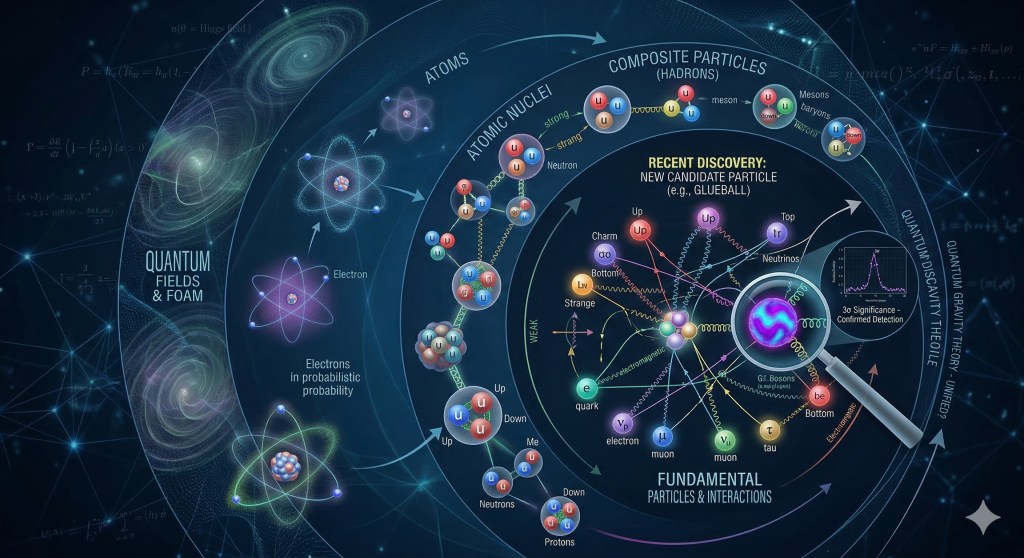
Presented by Zia H Shah MD with help of Gemini
Audio teaser: Xi-cc-plus and the grand designer
Abstract
More than 200 subatomic particles have been detected so far, and most appear to have a corresponding antiparticle (see antimatter).
The recent confirmation of the Ξcc+ (Xi-cc-plus) baryon at the Large Hadron Collider (LHC) marks a transformative milestone in the study of high-energy physics and the fundamental organization of matter. As the first significant discovery following the 2023 upgrades to the LHCb detector, this doubly charmed particle—composed of two heavy charm quarks and one down quark—provides a unique laboratory for testing the predictions of Quantum Chromodynamics (QCD). While the particle is a heavy relative of the common proton, its specific mass of 3619.97 MeV/c2 and its fleeting existence of less than a trillionth of a second offer profound insights into the complexity and order inherent in the subatomic world. This analysis argues that the subatomic registry, which has now reached eighty distinct hadrons identified at the LHC, does not reflect a chaotic or accidental reality but rather a meticulously structured architecture. By synthesizing the empirical data of the Ξcc+ discovery with the cosmological and theistic frameworks proposed by Dr. Zia H. Shah MD, this report contends that the universe is not a brute fact or a product of blind chance. Instead, the mathematical intelligibility of the subatomic zoo, the extreme fine-tuning of quark masses, and the continuous sustenance required to prevent cosmic dissolution point toward a necessary, non-contingent Agency. The Ξcc+ serves as an evidentiary sign—an āyah in the Quranic sense—demonstrating that as quantum reality becomes more complex, it simultaneously reveals a deeper, more profound organization that mirrors an intentional design.
The Empirical Foundations of the Ξcc+ Milestone
The discovery of the Ξcc+ baryon at CERN represents the culmination of more than two decades of scientific pursuit and theoretical speculation. While the subatomic world was once thought to be a simple collection of protons, neutrons, and electrons, the era of high-energy particle smashers has revealed a vast and intricate “zoo” of composite particles. The identification of the Ξcc+ is particularly significant because it occupies a rare position in the baryon family tree, being only the second particle ever observed that contains two heavy quarks.
Historical Context and the Manchester Legacy
The quest for the Ξcc+ is rooted in the legacy of Ernest Rutherford, whose basement experiments at the University of Manchester between 1917 and 1919 first identified the proton. For over a century, physicists have sought to understand the “compositeness” of these building blocks, eventually discovering that protons are not fundamental but are made of even smaller units called quarks. The standard proton consists of two light “up” quarks (u) and one light “down” quark (d), a configuration denoted as uud.
The discovery of the Ξcc+ continues this Manchester tradition by replacing the two light up quarks with much heavier “charm” (c) quarks. This substitution results in a particle that is roughly four times heavier than the proton, despite sharing many of its other quantum properties. The existence of such “heavy relatives” was predicted by the Standard Model of particle physics, yet their observation remained elusive due to the extreme energy required to produce them and the precision needed to detect their rapid decay.
The 2023 LHCb Upgrade and Detection Mechanics
The discovery was made possible by the “Run 3” operations of the Large Hadron Collider and specifically the massive upgrades to the LHCb (beauty) detector completed in 2023. This international effort involved more than 1,000 scientists and required state-of-the-art silicon pixel detector modules that function as a high-speed camera. These modules are capable of taking 40 million photographs per second, allowing physicists to capture the fleeting moments of particle collisions.
The Ξcc+ is exceptionally unstable, with a predicted lifetime six times shorter than its “sister” particle, the Ξcc++ (discovered in 2017), which contains two charm quarks and an up quark. To identify the Ξcc+, researchers analyzed data from proton-proton collisions recorded in 2024, the first year of the upgraded detector’s full operation. They looked for a specific decay chain where the original baryon breaks down into three lighter particles: a charmed lambda baryon (Λc+), a kaon (K−), and a pion (π+).
| Technical Parameter | Detail |
| Detector | Upgraded LHCb (Run 3) |
| Imaging Speed | 40 million frames per second |
| Statistical Significance | 7.0 sigma |
| Measured Mass | 3619.97±0.11 MeV/c2 |
| Quark Content | ccd (two charm, one down) |
| Decay Channel | Ξcc+→Λc+K−π+ |
The statistical significance of 7 sigma is a landmark achievement, as it far exceeds the 5-sigma gold standard required to claim a formal discovery in physics. A 7-sigma result implies that the probability of this signal being a mere fluke is less than one in ten trillion, providing nearly absolute certainty that the Ξcc+ has finally been captured.
Resolving the SELEX Discrepancy: A Twenty-Year Mystery
A primary driver for the scientific excitement surrounding this discovery is its role in settling a long-standing dispute within the particle physics community. In 2002, an experiment known as SELEX at Fermilab in the United States claimed to have observed the Ξcc+ at a mass of approximately 3520 MeV/c2. However, this measurement was significantly lower than what theoretical models of Quantum Chromodynamics suggested, and no other experiment—including previous runs at the LHC—could replicate the signal.
The “Xi-cc-plus puzzle” remained an open question for over two decades, casting doubt on either the validity of the SELEX result or the accuracy of theoretical predictions. The 2026 LHCb discovery identifies the particle at a mass that is incompatible with the SELEX claim but aligns perfectly with the theoretical expectations based on the known partner particle, the Ξcc++. This resolution demonstrates the self-correcting nature of science, where technological upgrades lead to the definitive rejection of erroneous data in favor of a coherent, mathematically consistent reality.
Implications for Quantum Chromodynamics (QCD)
The discovery of the Ξcc+ is not merely about adding a name to a list; it is a critical test of our understanding of the strong force. The strong nuclear force is the interaction that binds quarks together to form baryons and mesons. While gravity and electromagnetism are well-understood in the quantum realm, the equations governing the strong interaction are notoriously difficult to solve because the force becomes stronger as quarks are pulled apart.
Physicists use a technique called “Lattice QCD” to calculate the properties of particles. Particles containing two heavy charm quarks, like the Ξcc+, are ideal for these calculations because the heavy quarks behave somewhat like a small “solar system,” with a heavy central core (the two charm quarks) and a lighter quark (the down quark) orbiting them. This hierarchical structure allows theorists to refine their models of how the strong force organizes matter, bridging the gap between experimental fact and theoretical prediction.
Quantum Reality: Complexity as a Mirror of Organization
As the LHC continues to discover new particles—reaching a total of 80 hadrons identified since its inception—the resulting “subatomic zoo” might at first glance appear chaotic. However, a domain expert’s analysis reveals the opposite: as the complexity of the quantum realm increases, so too does the evidence for its underlying organization.
The Order of Quark “Flavors”
All matter in the observable universe is built from a small set of fundamental building blocks. According to the Standard Model, there are six “flavors” of quarks: up, down, charm, strange, top, and bottom. These quarks are characterized by specific electric charges, masses, and quantum properties that dictate how they can be combined.
| Quark Flavor | Mass Rank | Role in Matter |
| Up (u) | Light | Constituent of protons/neutrons |
| Down (d) | Light | Constituent of protons/neutrons |
| Charm (c) | Heavy | Found in high-energy collisions |
| Strange (s) | Intermediate | Found in cosmic rays and colliders |
| Top (t) | Extremely Heavy | Short-lived; mass giver |
| Bottom (b) | Heavy | Used to study matter-antimatter |
The Ξcc+ discovery highlights that nature does not simply allow random combinations of these quarks. Instead, they follow rigid patterns of symmetry and conservation laws. Every newly discovered hadron allows scientists to measure properties like mass and spin, which act as pieces of a larger puzzle. This systematic “mapping” of the hadron spectrum suggests that the universe is governed by an architectural blueprint where every possible variation of matter has a specific, pre-calculated place.
The Emergence of Exotic Hadrons
Beyond the standard baryons (three quarks) and mesons (quark-antiquark pairs), the LHC has begun to uncover “exotic” hadrons, including tetraquarks (four quarks) and pentaquarks (five quarks). These discoveries reveal that the strong interaction can organize matter in even more complex ways than previously imagined. Yet, even these exotic states follow the same underlying rules of Quantum Chromodynamics.
Zia H. Shah MD argues in his blog that this “unreasonable effectiveness of mathematics”—the fact that we can predict and find these particles using abstract equations—is a profound mystery. It suggests that reality is not a “brute fact” that just happens to exist, but a rational system that was “fashioned” or “proportioned” in a way that is intelligible to the human mind. The transition from a “simple” world of protons to a “complex” world of eighty hadrons does not indicate a move toward chaos, but rather the unveiling of a more majestic and comprehensive order.
The Cosmological Argument: Refuting the Brute Fact
The discovery of the Ξcc+ serves as a modern catalyst for the cosmological argument—the philosophical quest to identify the First Cause of the universe. Central to the writing of Zia H. Shah MD is the refutation of the idea that the universe is a “brute fact” or an “accidental product”.
The Principle of Sufficient Reason (PSR)
The “brute fact” hypothesis, famously championed by Bertrand Russell, posits that the universe simply exists without any deeper explanation. Shah argues that this position is intellectually inconsistent. While atheists often reject the statement “God just is” as unsatisfying, they apply the same logic to the universe, treating its existence as an uncaused primitive.
The existence of the Ξcc+ demonstrates that everything within the universe is contingent—meaning it depends on external factors for its existence. The mass of the Ξcc+ depends on the strength of the Higgs field and the strong nuclear force; its discovery depends on the LHC and human ingenuity. If the parts of the universe are contingent and dependent, the universe as a whole cannot be a necessary brute fact. According to the Principle of Sufficient Reason, every fact must have an explanation; the most coherent explanation for a contingent universe governed by elegant mathematical laws is a necessary, self-existent Mind.
The Firing Squad Analogy and Fine-Tuning
One of the most potent metaphors Shah employs to challenge the “accidental product” view is John Leslie’s “Firing Squad” analogy. If you are lined up before fifty expert marksmen and all of them miss, you do not simply walk away and say, “Well, if they hadn’t missed, I wouldn’t be here to observe it, so it’s just a random brute fact”. Instead, the only logical conclusion is that the miss was intentional—someone planned for you to survive.
Similarly, the physical constants that allow for the Ξcc+ and the atoms of our bodies are fine-tuned to an incredible degree. If the expansion rate of the universe were off by one part in 10*55, ten raised to the power fifty-five, or if the cosmological constant were slightly different from its value of one part in 10*120, ten raised to the power of one hundred and twenty, the universe would have collapsed or dispersed long before particles could form. The Ξcc+ is a “heavy duty” version of the proton; if the charm quark mass were even slightly different, the balance of the subatomic zoo would shift, potentially altering the stability of all matter. This “knife-edge” existence suggests that the universe was “planned, originated, and fashioned,” mirroring the Quranic attributes of God as Al-Khaliq (The Planner), Al-Bari (The Originator), and Al-Musawwir (The Fashioner).
Theistic Synthesis: The “Two Books” and the Subatomic Āyāt
Dr. Zia H. Shah’s work is characterized by the “Two Books” paradigm—the belief that God is the author of both the Book of Scripture (the Quran) and the Book of Nature (the Universe). In this framework, scientific discoveries like the Ξcc+ are viewed as contemporary interpretations of the “Signs” (āyāt) mentioned in sacred texts.
The Seen and the Unseen
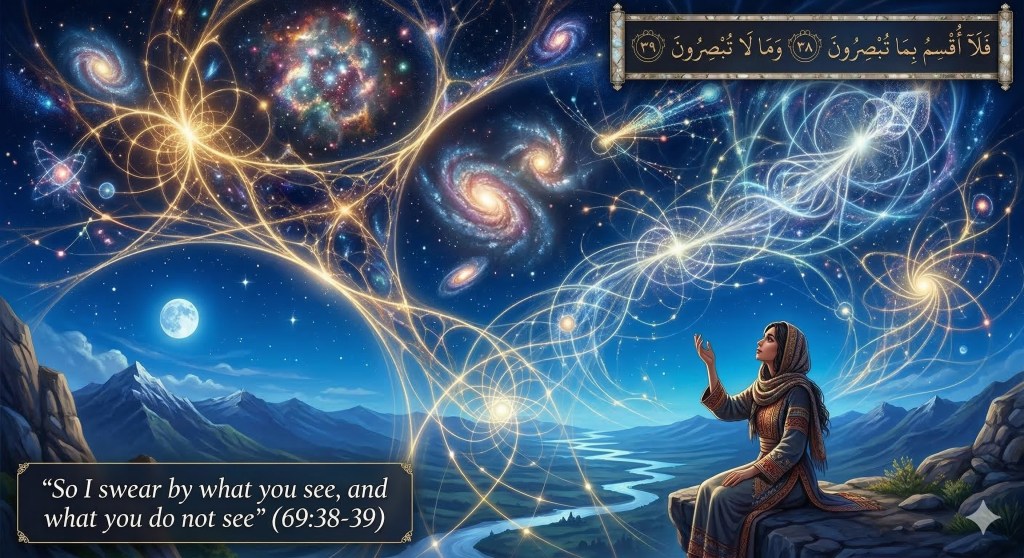
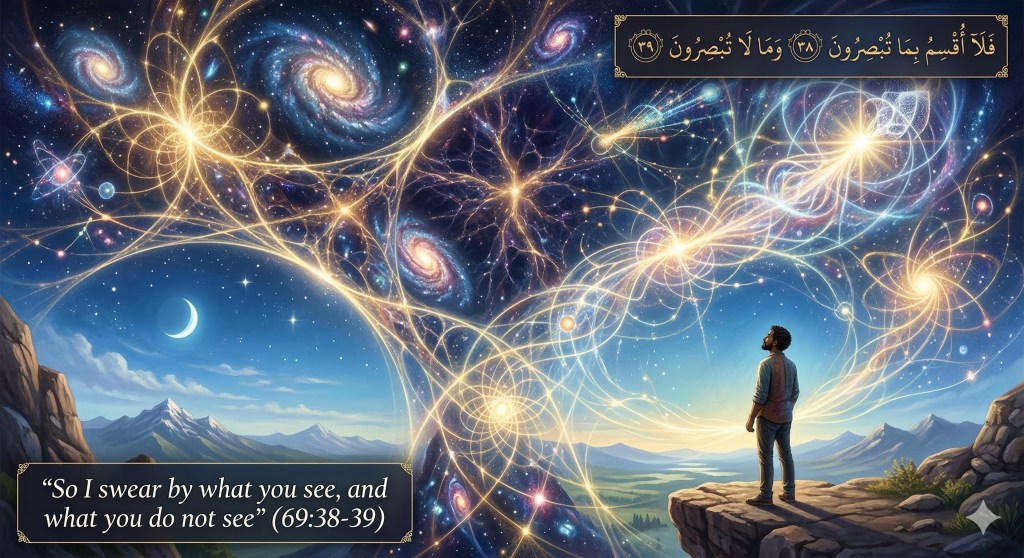
Shah provides a multidisciplinary analysis of Quranic oaths, such as “But no! I swear by what you see and what you do not see” (69:38-39). Historically, this “unseen” was limited to spiritual entities, but in the modern age, science has brought the vast majority of reality from the “unseen” into the “seen”. The Ξcc+ existed in the “unseen” for billions of years, a hidden potential of the laws of physics, until human technology brought it into the realm of the “seen” through the LHC.
This process of uncovering the hidden layers of reality—from atoms to protons to quarks and finally to exotic baryons—validates the Quranic claim that there is a structured, intentional depth to the cosmos. Shah argues that the 750 verses in the Quran urging believers to reflect on nature (one-eighth of the text) prove that empirical investigation is not a threat to faith but a form of worship.
Occasionalism and Quantum Sustenance
A central theological contribution of Shah’s blog is the revival of Al-Ghazali’s “Occasionalism,” informed by modern quantum mechanics. Al-Ghazali argued that natural laws are not inherent powers of matter but are “habits” of the Divine Will. Shah proposes that quantum indeterminacy—the “looseness at the joints” of the universe—is the mechanism through which God sustains the cosmos.
In a Newtonian universe, the past determines the future with rigid necessity. In a quantum universe, the decay of a particle like the Ξcc+ is probabilistic. While science can calculate the likelihood of a decay, it cannot predict the specific moment for a single particle. Shah interprets this as the “Inshallah Universe,” where every event is dependent on the fresh, renewing will of the Creator. This aligns with Quran 35:41: “Indeed, God holds the heavens and the earth, lest they cease”. Without this constant “holding” or sustenance, the contingent reality of the subatomic would vanish.
The Aesthetic Argument: Nature as Divine Artistry
Beyond the logical and cosmological proofs, Shah presents an aesthetic argument for God based on the “surplus beauty” of the universe. He posits that the universe contains a level of elegance and order that far exceeds what is required for biological survival.
Mathematical Elegance as a Signature
The quark model, which organizes the Ξcc+ and its seventy-nine companion hadrons, is described by physicists as “beautiful” due to its symmetry and simplicity. Shah argues that a purely random, accidental universe should be “tasteless”—a chaotic jumble of unrelated facts. Instead, we find a “meticulous geometry” governed by constants that result in stable, organized structures.
| Phenomenon | Aesthetic/Scientific Observation |
| Quark Symmetry | Predictable family relationships (Flavor SU(3)) |
| Mathematical Order | “Unreasonable effectiveness” in particle physics |
| Aesthetic Surplus | Beauty in nature beyond survival utility |
| Divine Name | Al-Jamil (The Beautiful) |
Shah draws on the work of thinkers like C.S. Lewis and Paul Dirac to argue that cosmic beauty is a “gateway to transcendence”. The human capacity to perceive this beauty—to build a multi-billion dollar machine like the LHC just to “photograph” a beautiful symmetry—is evidence of a soul that is “mirrored” to the Divine Artist. The Ξcc+ is not just a heavy proton; it is a brushstroke in a cosmic masterpiece that points toward the “Hand of the Divine Artist”.
Matter, Antimatter, and the Mystery of Existence
The research at CERN also addresses the fundamental question of why there is anything at all, rather than an empty void of light. This leads into the mystery of CP violation—the reason why matter exists while antimatter has largely vanished.
The Asymmetry of the Laws
Standard physics suggests that for every particle of matter created in the Big Bang, a particle of antimatter should have also been created. They should have annihilated each other instantly, leaving nothing. However, experiments at the LHC have discovered “tantalizing clues” that the fundamental laws of physics treat matter and antimatter differently. This asymmetry is essential for our existence.
Shah views this asymmetry as a perfect example of how the “brute fact” of physics is actually a “sign” of design. If the universe were an accident of simple, symmetrical rules, it would be empty. The fact that the “rules” are slightly skewed to favor the existence of matter—and thus life—is an indication of a purposeful “deviation” from mere randomness. This resonates with the Quranic theme that God “fashioned” the world in truth (bi’l-ḥaqq) rather than for “sport” or “play” (Quran 21:16).
The Integration of Consciousness and Quantum Reality
A final pillar of Shah’s synthesis involves the “Hard Problem of Consciousness” and its relation to the quantum world. He rejects the materialist view that consciousness is merely a byproduct of “random neuron firings”. Instead, he explores the idea that the brain is a “receiver” of consciousness rather than a “generator,” much like a radio receiving a signal.
The Mind Behind the Laws
This view of consciousness mirrors the view of the laws of nature. If the laws governing the Ξcc+ are “mind-like” in their mathematical elegance, it suggests they originate from a Mind. Shah argues that treating the universe as a brute fact while treating physical laws as necessary mathematical truths is a “fatal internal contradiction”. Mathematics is an abstract, mental construct; its effectiveness in describing physical reality suggests that the physical reality itself was “conceived” by an intelligence.
The discovery of the Ξcc+ is a victory for the human mind, but it is also a reminder of the “Great Geometer” whose “habits” we are merely cataloging. As the count of discovered particles grows, the “Elephant in the Room”—the undeniable evidence of design that many materialist thinkers try to ignore—becomes larger and more obvious.
Thematic Epilogue: The Perpetual Sign of the Subatomic
The identification of the Ξcc+ baryon at the Large Hadron Collider is more than a technical entry in the annals of particle physics; it is a profound testament to the order, complexity, and mathematical beauty of our universe. As we move beyond the simple atoms of the early twentieth century into the sophisticated “subatomic zoo” of eighty hadrons, we find that the quantum realm is not becoming more confusing, but more profoundly organized.
This discovery, when viewed through the lens of the cosmological argument and the scholarship of Zia H. Shah MD, fundamentally challenges the notion of a “brute fact” universe. The extreme fine-tuning required to produce a stable baryon with heavy charm quarks, the mathematical intelligibility that allowed for its prediction, and the persistent regularities of the strong force all point toward an intentional architecture.
The Ξcc+ is a fleeting whisper from the early universe, a particle that exists for less than a trillionth of a second, yet tells a story of eternal laws and divine sustenance. It reminds us that the “Book of Nature” is an ongoing revelation—an intellectual miracle that grows more detailed with every upgrade to our detectors. In the words of the Quranic motifs analyzed by Shah, these discoveries are “signs in every region of the earth and in themselves” (41:53), revealing the truth that the cosmos is not a cosmic accident but a purposeful home fashioned by a Necessary Being.
The “Elephant in the Room” of modern science is the reality that the deeper we look into the “unseen” foundations of matter, the more clearly we see the “Hand of the Divine Artist”. The Ξcc+ discovery is a milestone in this journey—a landmark in the human quest to understand the Mind that “holds the heavens and the earth” and gives “everything its perfect form”.
Data Synthesis and Comparison Table: The Evolution of Hadrons at the LHC
| Discovery Phase | Key Milestones | Theological/Philosophical Context (Shah) |
| Run 1 (2009-2013) | Higgs Boson discovery; first 20+ hadrons | “God of the Facts” vs. “God of the Gaps” |
| Run 2 (2015-2018) | Discovery of Ξcc++ and 50+ hadrons | Fine-tuning and the “Firing Squad” analogy |
| Upgrade/Run 3 (2023+) | Discovery of Ξcc+; 80 total hadrons | The “Two Books” paradigm; Occasionalism |
| Future (Hi-Lumi LHC) | Search for “Compositeness” and Preons | The infinite depth of the “Unseen” |


 The Glorious Quran and Science
Leave a comment