
Epigraph:
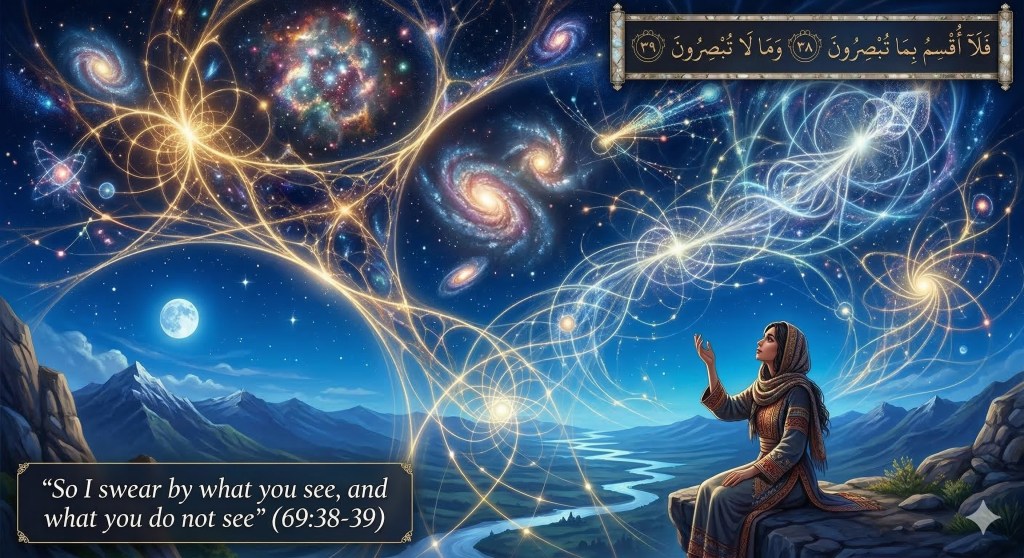
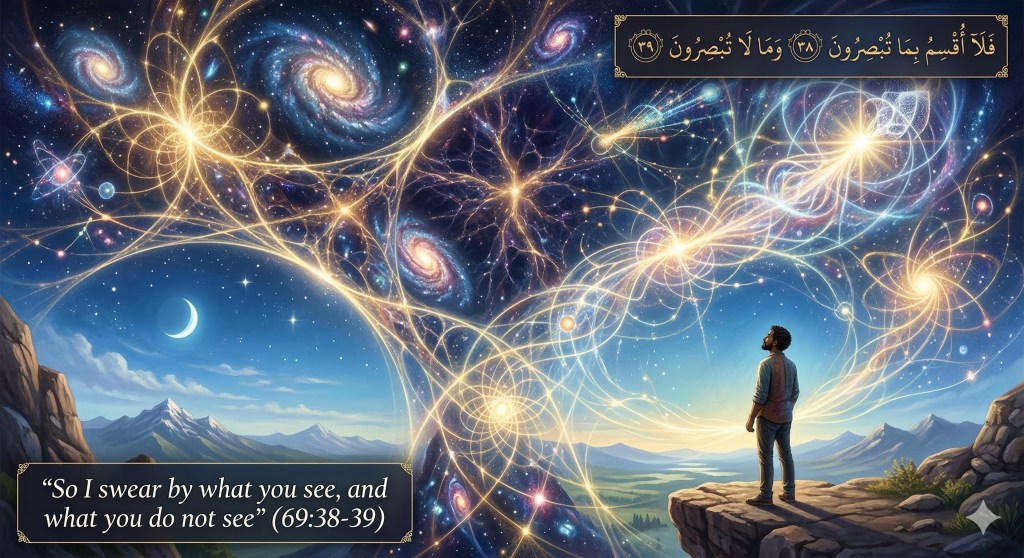
We will show them Our Signs in the universe and also among their own selves, until it becomes manifest to them that the Quran is the truth. (Al Quran 41:53)
He is the Mighty, the Forgiving; Who created the seven heavens, one above the other. You will not see any flaw in what the Lord of Mercy creates. Look again! Can you see any flaw? Look again! And again! Your sight will turn back to you, weak and defeated. (Al Quran 67:2-4)
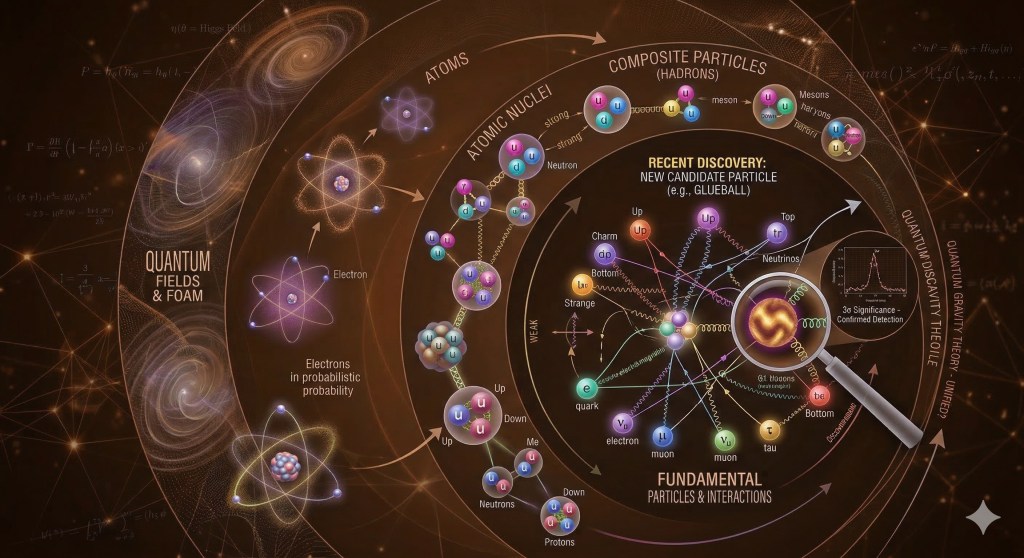
The Ξcc⁺ Discovery at the Upgraded LHCb Detector and What It Means for Physics and Metaphysics
Presented by Zia H Shah MD
Abstract
A newly reported “particle discovery” at CERN is not the unveiling of a new fundamental constituent of nature, but the observation of a new hadron—a short‑lived, composite object bound by the strong interaction—seen with the LHCb detector during Run 3 of the Large Hadron Collider. The state is the doubly charmed baryon Ξcc⁺ (quark content: ccd), identified via its decay Ξcc⁺ → Λc⁺ K⁻ π⁺ (with Λc⁺ → p K⁻ π⁺). The LHCb collaboration reports a clear invariant‑mass peak of about 915 reconstructed candidates near 3620 MeV/c² and a statistical significance above 7σ (local), surpassing the conventional 5σ discovery threshold used in particle physics.
Analytically, the most coherent interpretation is straightforward: a genuine weakly decaying three‑quark baryon long expected as the isospin partner of Ξcc⁺⁺, rather than an exotic multiquark object, a mere resonance artifact, or a statistical fluctuation. The broader scientific significance lies in how such discoveries simultaneously increase complexity (the “tower” of QCD bound states grows) and sharpen organization (symmetry patterns and QCD‑based modeling—quark model, lattice approaches, heavy‑quark symmetry—predict and systematize what appears).
Finally, the report engages—carefully and non‑conflatingly—with a theistic‑leaning interpretive frame drawn from Zia H Shah writing at The Glorious Quran and Science: the idea that the intelligibility and stable law‑structure of the universe can be read as “signs,” while remaining distinct from (and not demanded by) the strictly empirical content of particle physics.
Executive summary
The news coverage—e.g., the ScienceAlert item sourced to Agence France-Presse—accurately reports a new state called “Xi‑cc‑plus” and contextualizes it as the 80th hadron first identified by experiments at the LHC.
The core experimental claim is strong: LHCb reconstructs Ξcc⁺ in Run 3 proton–proton data (2024) as a distinct mass peak with ~915 signal candidates near 3619.97 MeV/c² and a local significance >7σ; these numbers indicate a discovery‑level observation by field norms.
The “upgrade” most directly responsible is the LHCb Upgrade I detector/trigger architecture completed in 2023, which increased the usable efficiency for hadronic final states by roughly factors of ~2–4 and enabled operation at substantially higher interaction rates; this is explicitly cited by LHCb as enabling the new discovery in its first full year of upgraded running.
Interpretively, this is best understood as a conventional (qqq) baryon bound state governed by QCD and decaying weakly—not a speculative exotic hadron category such as tetraquark/pentaquark, and not plausibly a statistical fluctuation at the stated significance—though important measurements (e.g., lifetime, production rates, branching fractions) await the forthcoming detailed paper referenced in the conference material.
Philosophically, one may read the discovery as reinforcing both (a) the universe’s generative richness at the quantum scale and (b) the patterned regularity that lets humans predict, search, and confirm such states—two features often invoked in discussions of cosmic intelligibility, including Shah’s “Two Books” framing—while still recognizing that particle physics alone does not adjudicate metaphysical conclusions.
What was observed and why the LHCb upgrade mattered
The new state is the doubly charmed baryon Ξcc⁺, with quark composition ccd (two charm quarks and one down quark). In the “proton family tree” way of speaking used in outreach, it resembles a proton (uud) in being a three‑quark baryon, but becomes far heavier when two light up quarks are replaced by two heavy charm quarks—hence the rough “~four times heavier than a proton” description that appears across CERN and media summaries.
Experimentally, LHCb infers Ξcc⁺ by reconstructing its decay products and forming their invariant mass. The key channel described is Ξcc⁺ → Λc⁺ K⁻ π⁺, with Λc⁺ itself reconstructed through p K⁻ π⁺; a clear peak of about 915 events is reported near 3620 MeV/c², with a fitted mass of 3619.97 ± 0.83 (stat) ± 0.26 (syst) and an additional asymmetric uncertainty tied to lifetime effects (+1.90/−1.30) MeV/c².
The statistical claim is explicit: LHCb reports a 7σ significance (local), and CERN reiterates that this is well above the common 5σ convention for discovery in particle physics.
The “upgrade” angle in the reporting is not merely rhetorical. LHCb Upgrade I replaced or substantially changed most sensitive detector elements and modernized triggering and readout for higher collision rates. In the Moriond presentation material, LHCb states that Upgrade I changed ~90% of sensitive detector elements and enabled enhanced capabilities at ~5× higher luminosity; it highlights a new silicon‑pixel vertex locator and upgraded particle‑ID systems (RICH) as central components.
Operationally, LHCb’s outreach detailing Upgrade I notes that, in Run 3, the proton–proton collision rate inside LHCb is ~5× higher than before and that the detector is read out at the full bunch‑crossing rate (40 MHz rather than the prior ~1 MHz) to support real‑time selection and analysis.
The Moriond slides go further in explaining the practical consequence: selection efficiency and usable yields for relevant hadronic final states increased by factors of roughly 2–4, with specific comparisons indicating ~4× yield per fb⁻¹ in a control channel relative to Run 2, attributed to improved event selection and trigger architecture changes (including removal of a limiting hardware trigger).
Interpreting the signal and separating discovery from speculation
A key reason the Ξcc⁺ announcement is scientifically persuasive is that it fits into an already‑anchored empirical and theoretical context: it is the isospin partner of Ξcc⁺⁺ (ccu), which LHCb observed in 2017 as a weakly decaying state in Λc⁺ K⁻ π⁺ π⁺ with mass 3621.40 ± 0.72 (stat) ± 0.27 (syst) ± 0.14(Λc⁺) MeV/c².
Because up and down quarks are close in mass and treated as an approximate isospin doublet, theory expects Ξcc⁺ and Ξcc⁺⁺ to be near‑degenerate, with only a small isospin splitting; the new measurement reports a mass difference ΔM ≡ M(Ξcc⁺) − M(Ξcc⁺⁺) ≈ −1.77 MeV/c² (with stated uncertainties), described as consistent with prediction.
That “organized” relationship is not merely aesthetic: it strongly narrows what a peak should look like (mass region, decay topology, lifetime scale), which reduces multiple‑testing risk and makes the “statistical fluctuation” interpretation substantially less plausible than it would be in an unconstrained, wide scan.
Historical context sharpens the inference. The SELEX collaboration reported a Ξcc⁺ candidate in 2002 at about 3519 ± 1 MeV/c² with a claimed 6.3σ significance in the same Λc⁺ K⁻ π⁺ final state—an observation that became controversial because it implied a surprisingly large isospin splitting compared with theoretical expectations and because multiple later searches failed to confirm it.
Notably, an earlier LHCb search in Run 1 data (7 TeV, 0.65 fb⁻¹) found no significant Ξcc⁺ signal in 3300–3800 MeV/c² and set upper limits on production×branching relative to Λc⁺ as a function of assumed mass and lifetime—consistent with the idea that Ξcc⁺ is difficult to observe without the Run 3/upgrade‑era capabilities and higher yields.
Technical comparison table
| Candidate interpretation | Physical picture | What one would expect experimentally | What was reported here | Strength of fit | Residual uncertainties and what could still change |
|---|---|---|---|---|---|
| Genuine Ξcc⁺ weakly decaying baryon (bound qqq state) | Conventional baryon: ccd bound by QCD, decays via weak interaction | Narrow mass peak in Λc⁺K⁻π⁺ with displaced‑vertex topology; mass near Ξcc⁺⁺; discovery‑level significance in targeted region | Peak of ~915 events near 3620 MeV/c²; mass 3619.97 MeV/c² (with stat/syst and lifetime‑linked uncertainties); local significance >7σ; ΔM relative to Ξcc⁺⁺ ≈ −1.77 MeV/c² | Very strong (most consistent with prior Ξcc⁺⁺ observation and symmetry expectations) | Full peer‑reviewed analysis not yet posted; lifetime and production properties are not yet fully documented in a journal paper (slides label the paper “in preparation”) |
| A strong‑interaction resonance or threshold effect mistakenly treated as a particle | A short‑lived strong resonance or kinematic enhancement producing a bump | Typically broader width, prompt decay at the collision point, and sensitivity to background model/fit windows | Reported as “weakly decaying” style state; analysis emphasizes upgraded vertexing and event selection; the narrative aligns with baryon spectroscopy expectations | Weak (the described decay behavior and symmetry context do not match a generic threshold bump) | Only the full paper can decisively document all cross‑checks (alternative fits, sidebands, stability tests), though the conference and outreach emphasize such validation |
| Exotic multiquark hadron (tetraquark/pentaquark) masquerading as Ξcc⁺ | Non‑minimal quark content; mixing with conventional states possible | Often appears in different channels; quantum‑number analysis needed; might not sit naturally as Ξcc partner | The quark assignment and naming are explicitly baryonic (ccd) and positioned as isospin partner of the known Ξcc⁺⁺ | Low for this particular state | QCD allows mixing in principle, but here the simplest qqq assignment is already highly explanatory; “exotic” language in press is about the broader hadron zoo, not this state’s minimal quark count |
| Statistical fluctuation / analysis artifact | Random background fluctuation or selection bias | Significance falls with trials factors; unstable under alternative selections; often not replicated | Local significance >7σ with a targeted expectation region; framed as discovery‑level by CERN and LHCb | Very unlikely given reported significance | “Local” significance is not automatically a “global” p‑value; the look‑elsewhere effect and systematic modeling are always relevant across HEP even when 5σ standards are met |
Where it sits in the particle taxonomy and why “the 20th particle” is ambiguous
The word “particle” in public reporting spans at least three different taxonomies, and each yields different “counts.”
At the deepest (fundamental) level, the Standard Model is built from quarks and leptons (matter fields), gauge bosons (force carriers), and the Higgs field/boson; the Particle Data Group reviews and updates this framework and its parameters.
At the hadronic (composite) level—where Ξcc⁺ belongs—QCD confines quarks and gluons into color‑singlet bound states. The PDG’s quark‑model review explicitly emphasizes both the “tower of many states” (complexity) and the “high degree of regularity” (organization) in the hadron spectrum, with mesons (qq̄) and baryons (qqq) as baseline categories, and tetraquark/pentaquark/glueball candidates as additional, sometimes mixed, structures.
At the “what has the LHC newly discovered?” level, there is an even narrower counting rule: a running list of first observations at the LHC, which distinguishes new fundamental particles from new hadrons. Physicist Patrick Koppenburg maintains a compiled list that, consistent with broad community understanding, states that only one new fundamental particle has been discovered at the LHC (the Higgs boson), while many new hadrons have been added through spectroscopy.
Within that LHC‑specific bookkeeping, the CERN press release explicitly states that the Ξcc⁺ observation brings the total number of hadrons discovered by LHC experiments to 80. The ScienceAlert article describes Ξcc⁺ as the “80th identified so far” by the LHC, echoing that framing.
This is where the user‑mentioned “~20th” claim becomes intrinsically unspecified/ambiguous: 20th of what? If one means “fundamental particles discovered at the LHC,” the answer (so far) is effectively one (the Higgs), not ~20. If one means “new hadrons first observed at the LHC,” the number is ~80. If one means “doubly heavy baryons of this specific type,” then the count is much smaller (Ξcc⁺⁺ and Ξcc⁺ as the two established partners in the doubly charmed isodoublet), with earlier unconfirmed claims like SELEX’s being treated cautiously.
In other words: the discovery is real and substantive, but “20th particle” cannot be assessed without the counting rule, and different legitimate counting rules yield answers differing by orders of magnitude.
How the finding makes quantum reality more complex and more organized
The complexity message is immediate: even when the underlying theory (QCD) is compactly specified, the set of possible bound states is enormous. The PDG describes the strong‑interaction spectrum as a “tower of many states,” and modern experiments keep adding to that tower—especially in heavy‑quark sectors where production and reconstruction are difficult.
But the Ξcc⁺ story is also a parable of organization. Two organizing principles stand out.
First, symmetry: Ξcc⁺ is not a random bump but an isospin partner of Ξcc⁺⁺, with a small mass splitting in line with theoretical expectations that treat up/down differences as a perturbation rather than a structural overhaul. The Brodsky–Guo–Hanhart–Meißner analysis (written in the context of skepticism about the large SELEX splitting) exemplifies the broader theoretical expectation that Ξcc isospin splittings should be small in conventional pictures; the measured ΔM is indeed tiny on the hadronic scale.
Second, instrumentation‑enabled epistemic order: the upgraded LHCb detector and trigger did not merely “collect more data.” It changed the regime in which such states become observable by improving real‑time selection, vertexing, and particle‑ID performance at much higher collision rates (e.g., 40 MHz readout; operation at significantly higher interaction rates; improved efficiencies for hadronic final states). This is a type of order not in nature alone but in the joint system of nature‑plus‑measurement, where the appearance of a predicted state becomes an expected consequence of a designed experimental pipeline.
Taken together, the discovery illustrates a core feature of quantum reality as contemporary physics encounters it: the world is “wildly generative” in what exists, yet “tightly rule‑governed” in how those existents cluster into patterns that can be modeled, predicted, and checked.
A carefully bounded cosmological and theistic reading
Any theistic or cosmological “argument” built from a particle discovery must be bounded by a clear distinction: particle physics provides evidence about which entities and regularities occur within the universe; philosophical theology addresses what, if anything, ultimately explains why there is a law‑structured universe at all. The Stanford Encyclopedia of Philosophy makes this division plain in its overview of cosmological arguments as part of natural theology’s attempt to provide evidence for God’s existence, while also surveying many divergent formulations and objections.
Within that bounded frame, Zia H Shah deploys a recognizably kalām‑style structure, presenting a causal premise and a cosmic‑beginning premise to infer a transcendent cause. In his summary formulation, he quotes (via William Lane Craig’s popular articulation): “Something cannot come from nothing. If the universe began to exist, it requires a transcendent cause.”
Shah also advances a “Two Books” motif—scripture and nature—as mutually readable sources. In an analytical overview of his work, the site states that for Shah, “Studying a cell under a microscope is… an act of exegesis parallel to studying a verse of the Quran,” collapsing the divide between scientific attention and theological interpretation into a unified practice of reading “signs.”
How does Ξcc⁺ fit such a worldview without misrepresenting the evidence?
A defensible (though not compulsory) theistic‑leaning embellishment runs like this: the Ξcc⁺ discovery dramatizes the intelligibility of nature, in that a deep, non‑everyday entity (ccd baryon) can be predicted in a symmetry‑organized family (partner to Ξcc⁺⁺) and then intentionally pursued and confirmed by upgrading instruments to match what the theory implies is there. That the universe is not only stable but mathematically tractable is precisely the kind of “order” that motivates fine‑tuning and design discussions.
Shah’s fine‑tuning writing (in a PDF hosted on his site) explicitly frames fine‑tuning as the observation that many basic features lie in narrow ranges that permit complex structures and life—and that this “remarkable fact” prompts questions about chance, multiverse, or design, speaking of the life‑friendly conditions as potentially “cry[ing] out” for explanation beyond chance. In mainstream philosophical treatment, the Stanford Encyclopedia’s fine‑tuning entry similarly defines fine‑tuning as sensitive dependence of observed phenomena on parameters restricted to extremely narrow ranges within a theory’s allowed space, and it surveys competing explanatory strategies rather than treating design as the only live option.
A balanced reading must therefore include the counter‑pressure: (a) the inference from intelligibility to theism is not deductive, and (b) fine‑tuning arguments specifically concern cosmological boundary conditions and parameter ranges, not the mere proliferation of hadronic states (which QCD arguably predicts as part of its normal behavior).
A philosophically responsible synthesis, then, is the following: Ξcc⁺ does not serve as direct evidence for a Creator; rather, it serves as another “case study” in the broader empirical backdrop that makes design‑leaning interpretations psychologically and rhetorically compelling—namely, that the universe’s deepest layers are simultaneously fecund and pattern‑legible. Shah’s approach is to treat such legibility as consonant with (and perhaps expected under) theism, while SEP‑style surveys remind us that alternative metaphysical framings and critiques remain active and substantial.
Epilogue and prioritized sources
The Ξcc⁺ story is a modern instance of a repeated scientific rhythm: theory implies a structured possibility space; instrumentation constrains which parts of that space can be seen; upgrades expand the visible domain; and an apparently new “thing” emerges as a sharpened pattern in reconstructed data. In that rhythm, quantum reality looks more complex because the best description of “what exists” keeps gaining members; it looks more organized because the new members often arrive as expected companions in symmetry families rather than as arbitrary intrusions.
From a theistic‑leaning angle like Shah’s, this can be narrated as an encounter with “signs” embedded in both scripture and nature; from a strictly scientific angle, it is an encounter with how QCD’s confining dynamics and symmetries populate the hadron spectrum and how experimental design lets those populations be inferred. The intellectual virtue is not to collapse these readings into one another, but to let them remain in disciplined conversation: physics describing the world’s inner grammar, philosophy and theology asking what, if anything, it means that there is a grammar at all.
For references, please go to Microsoft Word file:


 The Glorious Quran and Science
Leave a comment