

Epigraph
“There are only two ways to live your life. One is as though nothing is a miracle. The other is as though everything is a miracle.” (Albert Einstein)

Presented by Zia H Shah MD
Audio teaser: Surah Yusuf and the Quantum Simulation
The Metaphysics of Prophetic Vision: Surah Yousuf, Divine Omniscience, and the Occasionalist Framework
Abstract
This research report presents an exhaustive theological and philosophical investigation into the narrative of Prophet Yousuf (Joseph) as recorded in the twelfth chapter of the Glorious Quran. The analysis is structured around the four central dreams that drive the narrative arc: the childhood vision of Yousuf, the dual dreams of the fellow prisoners, and the premonitory vision of the Egyptian King. By strictly adhering to the accuracy of the Quranic account, the report argues that the precise, multi-decade fulfillment of these visions constitutes empirical evidence for Divine Omniscience, demonstrating that reality is not a product of autonomous material causes but a meticulously rendered manifestation of Divine Will. The study integrates the classical Ash’arite doctrine of occasionalism, championed by Al-Ghazali, with the modern scientific and philosophical synthesis provided by Dr. Zia H. Shah MD. Specifically, it explores how quantum indeterminacy and information theory provide a contemporary vocabulary for the “frame-by-frame” sustenance of the universe. A dedicated section explores the implications for human consciousness, framing the “heart” as the nexus between finite human awareness and the Infinite Divine presence. The report concludes with a thematic epilogue that synthesizes the historical context of the Abrahamic faiths, the philosophical necessity of occasionalism, and the overarching reality of a universe entirely dependent on its Creator.
Introduction: The Methodology of Divine Narrative and Ahsan al-Qasas
The twelfth surah of the Quran, Yusuf, is unique in its structural unity and thematic depth. It identifies itself as Ahsan al-Qasas or “the best of stories,” a claim that transcends mere literary excellence to encompass ontological and epistemological truths. Unlike other prophetic stories that are dispersed throughout the Quranic text to serve specific rhetorical or legal functions, the story of Yousuf is revealed as a continuous narrative, providing a complete psychological and spiritual biography. This cohesiveness is essential for the demonstration of Divine Omniscience; by presenting the beginning, middle, and end of a complex life within a single chapter, the Quran reveals the hidden threads of providence that connect disparate events across time and geography.
The narrative begins with an affirmation of its origin in the Ghayb (the Unseen). God addresses the Prophet Muhammad, stating that before this revelation, he was among those who knew nothing of these events. This sets the methodological tone for the report: the account is accepted as a verbatim record of Divine Knowledge, where every detail—from the wording of a dream to the specific timing of a harvest—is a “sign” (ayah) pointing toward the Sovereign Actor. The story is not merely historical; it is a metaphysical demonstration of how God “prevails in His purpose,” even when human agents believe they are acting autonomously.
The First Dream: The Cosmic Prostration and the Blueprint of Prophecy
The genesis of the narrative is a subjective experience of the young Yousuf, a dream that serves as the ontological blueprint for his entire life. This vision establishes that the final state of an individual is “known” and “recorded” before the trials of life even begin.
The Arabic Text and Translation of the First Dream
The Quran records the moment Yousuf discloses his vision to his father, the Prophet Ya’qub (Jacob):
إِذْ قَالَ يُوسُفُ لِأَبِيهِ يَا أَبَتِ إِنِّي رَأَيْتُ أَحَدَ عَشَرَ كَوْكَبًا وَالشَّمْسَ وَالْقَمَرَ رَأَيْتُهُمْ لِي سَاجِدِينَ
M.A.S. Abdel Haleem translates this verse as: “Joseph said to his father, ‘Father, I dreamed of eleven stars and the sun and the moon: I saw them all bow down before me’”.
The Metaphysics of Foreknowledge
The immediate reaction of Ya’qub is one of profound theological insight mixed with parental caution. He recognizes that the eleven stars represent Yousuf’s brothers, and the sun and moon represent his parents. His command to Yousuf not to relate the vision to his brothers reflects an understanding of the intersection between Divine Decree and human psychology. He warns that Satan is an open enemy to man, capable of exploiting jealousy to disrupt familial harmony, yet he also affirms that this dream is a sign of Yousuf’s election and his future mastery of ta’wil al-ahadith (the interpretation of events or dreams).
From an occasionalist perspective, this dream is the “Information-Theoretic” seed of the future. As Dr. Zia H. Shah MD argues, if God is to possess perfect knowledge of the future, that future must in some sense be “present” in a higher-dimensional record, such as the Lauh al-Mahfuz (the Preserved Tablet). The dream is not a mere prediction based on current trends; it is a “rendering” of a future state that God has already decreed. The jealousy of the brothers and their plot to cast Yousuf into the well are not “independent causes” that threaten the dream; rather, they are the “occasions” through which God initiates the sequence that will eventually lead Yousuf to the Egyptian throne.
The Trials of Yousuf: Secondary Causes as Divine Occasions
The narrative progression from the well to the house of the Aziz, and finally to the prison, serves as an extensive refutation of autonomous natural causality. Each event appeared to the human actors as a tragedy or a setback, yet in the Divine Plan, each was a necessary step.
The Well and the Caravan
The brothers’ plot to “kill Joseph or cast him out to some distant land” (Quran 12:9) was an exercise in human volition, yet the Quran reveals that God was the one who “settled” Yousuf in the land. When the brothers cast him into the well, God revealed to him: “You will tell them of this deed of theirs when they do not realize who you are” (Quran 12:15). This revelation, occurring in the depths of a dark pit, confirms Divine Omniscience; God already “knows” the moment of reconciliation that will happen decades later. The arrival of the caravan was not a “lucky break,” but a precisely timed event in the “frame-by-frame” rendering of reality.
The House of the Aziz and the Prison
In the house of the Aziz, Yousuf is tested by the seduction of Zuleikha. His refusal—driven by the “clear sign from his Lord” (Quran 12:24)—illustrates that human integrity is itself a gift of Divine sustenance. When he is unjustly imprisoned to save the reputation of the ruling class, the Quran remarks: “In this way We settled Joseph in that land and later taught him how to interpret dreams: God always prevails in His purpose, though most people do not realize it” (Quran 12:21).
The prison is not a place of “accidental” confinement. It is the specific “occasion” where Yousuf will meet the King’s servants, whose dreams will provide the gateway to the royal court. As Dr. Zia H. Shah MD points out, this illustrates the “subtle” (Latif) nature of Divine Agency, which works through the mundane and the tragic to achieve the miraculous.
The Second and Third Dreams: Local Determinism and the Decree
While in prison, Yousuf encounters two young men—the King’s cup-bearer and his baker—who have fallen into disgrace. Their dreams represent the second and third instances of prophetic communication in the Surah, focusing on individual destiny within the larger social structure.
The Arabic Text and Translation of the Prisoners’ Dreams
Verse 36 captures the prisoners’ descriptions of their visions:
وَدَخَلَ مَعَهُ السِّجْنَ فَتَيَانِ ۖ قَالَ أَحَدُهُمَا إِنِّي أَرَانِي أَعْصِرُ خَمْرًا ۖ وَقَالَ الْآخَرُ إِنِّي أَرَانِي أَحْمِلُ فَوْقَ رَأْسِي خُبْزًا تَأْكُلُ الطَّيْرُ مِنْهُ
M.A.S. Abdel Haleem translates this as: “Two young men went into prison alongside him. One of them said, ‘I dreamed that I was pressing grapes’; the other said, ‘I dreamed that I was carrying bread on my head and that the birds were eating it’”.
Interpretation and the Finality of the Decree
Yousuf’s interpretation is delivered with the absolute authority of one who has been taught by God: “O my fellow-prisoners! One of you will serve wine to his master, and the other will be crucified and the birds will eat from his head”. He concludes with a statement that is the essence of occasionalist determinism: “The matter about which you both inquire has been decided” (qudiya al-amr).
This “decision” implies that the future is not open-ended or probabilistic from the perspective of the Divine; it is “collapsed” into a specific outcome. The man who saw the birds eating from his head reportedly tried to deny the dream, claiming he was joking, yet Yousuf affirmed that the interpretation was a fixed reality. This reinforces Al-Ghazali’s argument against necessary causality in nature: there is no “natural” reason why one man lives and another dies; both outcomes are the result of God’s “Decree” habitually executed.
| Dream Subject | Symbolic Content | Yousuf’s Interpretation | Historical Fulfillment |
| The Cup-bearer | Pressing wine/grapes. | Restoration to royal service. | Released in 3 days; returned to the King. |
| The Baker | Bread on head; birds eating. | Execution by crucifixion. | Executed; body left for scavenger birds. |
The Fourth Dream: Macro-Providence and the King’s Vision
The narrative shifts from individual fates to the destiny of an entire civilization through the King’s dream. This vision is the mechanism through which God transitions Yousuf from the “bottom of the well” of society (prison) to the “throne of dignity”.
The Arabic Text and Translation of the King’s Dream
The King addresses his council in Verse 43:
وَقَالَ الْمَلِكُ إِنِّي أَرَىٰ سَبْعَ بَقَرَاتٍ سِمَانٍ يَأْكُلُهُنَّ سَبْعٌ عِجَافٌ وَسَبْعَ سُنْبُلَاتٍ خُضْرٍ وَأُخَرَ يَابِسَاتٍ
M.A.S. Abdel Haleem translates this as: “The king said, ‘I dreamed about seven fat cows being eaten by seven lean ones; seven green ears of corn and [seven] others withered. Counsellors, if you can interpret dreams, tell me the meaning of my dream’”.
Economic Sovereignty and Divine Habit
Yousuf’s interpretation—seven years of abundance followed by seven years of severe famine—is accompanied by a divinely inspired economic plan: “You will plant for seven years consecutively; and what you harvest leave in its spikes, except a little from which you will eat”. The recommendation to leave grain in the ear for preservation is a “Sign” of practical wisdom provided by the Sustainer.
From an occasionalist standpoint, the famine is not the result of blind meteorological cycles. It is a “custom” (sunnah) of God, who manages the weather, the Nile’s flow, and the growth of crops moment-by-moment. The King’s dream is a communication of this “Divine Habit” before it manifests in the physical world. For God to know that a famine will occur seven years after a period of plenty, His knowledge must be independent of time. This leads directly to the attribute of Omniscience, as it requires an “all-encompassing view” of the temporal landscape that is only possible for a Being who exists outside the constraints of space-time.
What it Says About Human Consciousness
The role of dreams in Surah Yousuf provides a profound window into the nature of the human self. These visions are not psychological debris or physiological accidents; they are metaphysical encounters where the “unseen” touches the “seen.”
The Heart as the Nexus of Reality
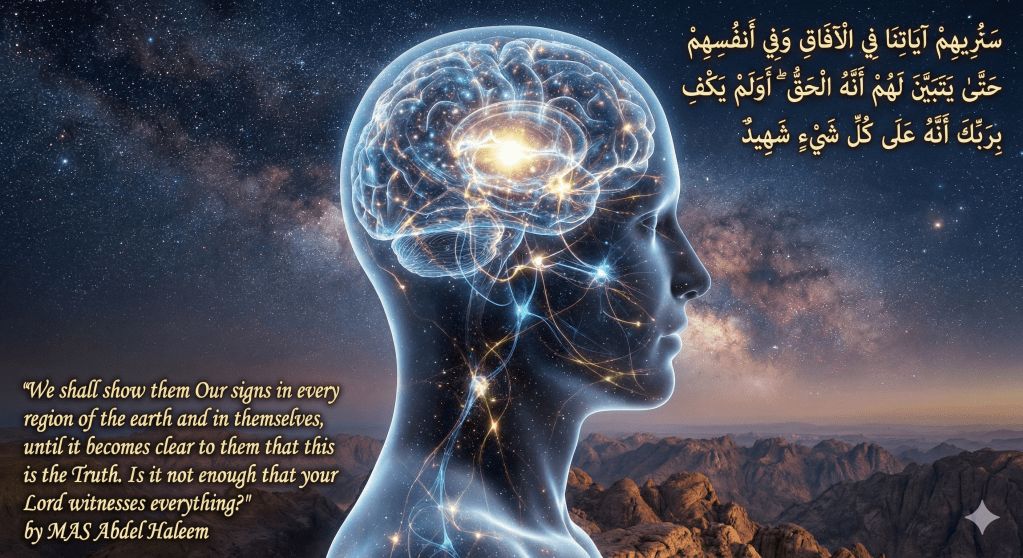
In Quranic anthropology, consciousness is centered in the qalb (heart), which serves as the seat of thought, intention, and soul. Dr. Zia H. Shah MD emphasizes the significance of Quran 8:24: “And know that Allah surely supervenes between a man and his mind.” This “supervention” or “intervention” suggests that human consciousness is not an autonomous, closed system. Rather, it is the meeting point between the finite human mind and the Infinite Divine presence.
The dreams in Surah Yousuf are examples of God “intervening” in the heart to provide knowledge that is inaccessible to the senses. This challenges the materialist paradigm, which views consciousness as a purely physical byproduct of brain chemistry. As Dr. Shah argues, if a “marble table” can never become “aware” even over trillions of years, then awareness must be an “irreducible miracle” of God’s creation—an intentional endowment that allows the creature to recognize the Creator.
Epistemology and the Unveiling of the Soul
Al-Ghazali’s theory of dreams suggests that the human soul possesses a latent capacity to perceive Divine Truths recorded in the Lauh al-Mahfuz (Preserved Tablet). During sleep, when the sensory “veils” (hijab) are temporarily lifted, the purified soul can “read” from this eternal ledger. Yousuf’s mastery of ta’wil al-ahadith is not a rational skill but a state of spiritual “readiness” to receive these emanations.
This view of consciousness as “non-local” aligns with modern discussions in quantum physics regarding entanglement and non-physical mind states. Consciousness acts as a “receiver” of information that is non-locally preserved in the fabric of reality. The dreams of the King and the prisoners were not private; they were “occasions” for a single, public Divine Decree to be made known to different subjects.
| Aspect of Consciousness | Philosophical Implication | Quranic Context (Surah Yousuf) |
| Origin | Divine Endowment (Alam al-Amr). | Yousuf’s ability is “what my Lord has taught me” (12:37). |
| Interface | The Heart (Qalb) as the meeting point. | Allah “comes between a person and their heart” (8:24). |
| Mechanism | Unveiling of the veil (Kashf al-hijab). | Dreams as access to the Preserved Tablet (Lauh Mahfuz). |
| Epistemology | Knowledge of the Unseen (Ghayb). | Interpretations are decreed and fulfilled with precision. |
Occasionalism and the “Frame-by-Frame” Universe
The precise communication of future events through dreams, followed by their exact fulfillment years later, provides the strongest scriptural support for Occasionalism. This doctrine, foundational to Ash’arite theology, posits that God is the sole immediate cause of every event in the universe.
Al-Ghazali’s Rejection of Secondary Causes
Al-Ghazali famously challenged the Peripatetic philosophers (like Ibn Sina) who argued that objects in nature possess inherent causal powers (e.g., that fire “must” burn). Ghazali argued that what we perceive as a “cause” (fire) and an “effect” (burning) is merely a habitual “conjunction” created by God. In the story of Yousuf, the “cause” of the famine was not a change in the Nile’s hydrology, and the “cause” of Yousuf’s freedom was not the King’s gratitude; rather, both were the result of God’s direct intervention at each moment.
Zia H. Shah MD: Quantum Indeterminacy and Information Theory
Dr. Zia H. Shah MD revitalizes this classical metaphysics by integrating it with modern physics. He proposes that the universe is being “rendered” frame-by-frame, much like a digital simulation where each “frame” is a fresh creative act of the Sustainer (Al-Qayyum).
- Quantum Indeterminacy as the Divine Interface: In classical Newtonian physics, the universe was a deterministic machine. However, quantum mechanics has revealed “looseness at the joints”. We can predict that a certain percentage of photons will pass through a mirror, but we cannot predict the fate of an individual photon. Dr. Shah argues that this “randomness” is actually the “Sovereign Choice of God”. This provides the “quantum gap” where Divine Will operates without violating the aggregate statistical laws of nature.
- Continuous Creation (Al-Khalq al-Jadid): Occasionalism implies that the world is being recreated at every instant. Dr. Shah uses the metaphor of a computer screen where images appear to move continuously, but are actually a series of static frames rendered at high speed. This mirrors the Quranic claim that God “holds” the heavens and the earth so they do not cease; if He were to withdraw His support for even a “blink of an eye,” reality would vanish into nothingness.
- Information Conservation: Drawing on Landauer’s Principle and quantum unitarity, Dr. Shah argues that information is never truly destroyed. The “Preserved Tablet” is a physical reality—a comprehensive universal ledger where every deed, every thought, and every dream is inscribed. The fulfillment of Yousuf’s dreams is the “retrieval” and “rendering” of this information from the Divine memory into the sensorium of the human world.
Argument for Divine Omniscience
The narrative of Surah Yousuf is not merely a moral fable; it is a logical proof for Divine Omniscience. Omniscience is the attribute of having “all-encompassing knowledge,” and the story demonstrates this through three specific domains:
1. Temporal Omniscience (Foreknowledge)
Yousuf’s childhood dream (the eleven stars, sun, and moon bowing) was fulfilled approximately 40 to 80 years later. For a vision to be realized with such precision after decades of intervening chaotic events—war, slavery, imprisonment, and famine—the Knower must possess an “outside-of-time” view of the entire timeline. This supports the “Block Universe” theory in physics, where all points in time (past, present, and future) are equally real and accessible to a higher-dimensional Observer.
2. Parameteric Omniscience (Total Control)
The fulfillment of the King’s dream required God to manage countless variables: the agricultural output of Egypt, the psychological state of the cup-bearer, the political climate of the court, and the personal growth of Yousuf’s brothers. If even one of these “secondary causes” were autonomous, the entire plan could have been derailed. The fact that the outcome was “decreed” and “fulfilled” proves that every variable is a “sign” under Divine control, reinforcing the occasionalist view that “there is no cause but God”.
3. Subjective Omniscience (Inner Awareness)
God’s knowledge extends to the “whispers” of the soul. He knew the jealousy in the hearts of the brothers (Quran 12:8), the treachery in the mind of Zuleikha (Quran 12:23), and the hidden faith of Yousuf in the well (Quran 12:15). As Dr. Shah notes, this “intimate governance” means that no thought or intention lies outside the Divine record.
Thematic Epilogue: Synthesis of Omniscience, Dreams, and Occasionalism
The story of Prophet Yousuf stands as a monumental synthesis of faith and reason, illustrating that the “Word of God” (Revelation) and the “Work of God” (Nature) are two volumes of the same truth.
Divine Omniscience and the Human Self
The four dreams in Surah Yousuf are the primary mechanisms through which the Quran bridges the gap between the material world and the Divine Mind. They demonstrate that human consciousness is an “interface” where the Infinite Divine presence interacts with the finite mind to provide guidance, warning, and hope. This refutes the bleak materialist view that the mind is a mere “biological accident” and instead presents it as a “sign” (ayah) that leads directly to the recognition of the Necessary Existent.
History of the Abrahamic Faiths
The account of Joseph is shared across the Torah, the Bible, and the Quran, yet the Quranic version is distinguished by its focus on the Oneness of Cause. While biblical accounts emphasize the “human drama” and genealogical continuity, the Quran uses the story to validate the mission of Muhammad and to assert that “Authority belongs to God alone” (Quran 12:40). It serves as a warning to those who would reject a messenger, showing that God’s plan will prevail despite human opposition.
The Necessity of Occasionalism
Ultimately, the fulfillment of these visions is the definitive argument for Al-Ghazali’s occasionalism and the modern synthesis of Dr. Zia H. Shah MD. If the world were a self-sufficient machine of independent causes, there could be no guarantee that a dream seen in childhood would find its reality in old age. The precision of the narrative necessitates a universe that is being “held in being” and “rendered frame-by-frame” by a Sustainer who is All-Knowing and All-Wise.
In the remembrance of Allah, as the Quran states, hearts find comfort (Quran 13:28). This comfort is rooted in the realization that we live in a “guided” universe, where even the most difficult trials—like the well of Yousuf or the prison of Egypt—are “occasions” for the manifestation of Divine Mercy and the fulfillment of a Perfect Plan. The story of Yousuf is thus a testament to the fact that the universe is not a chaotic clash of atoms, but a “Beautiful Story” written by the Sovereign Author of Reality.
 The Glorious Quran and Science
Leave a comment