
Epigraph
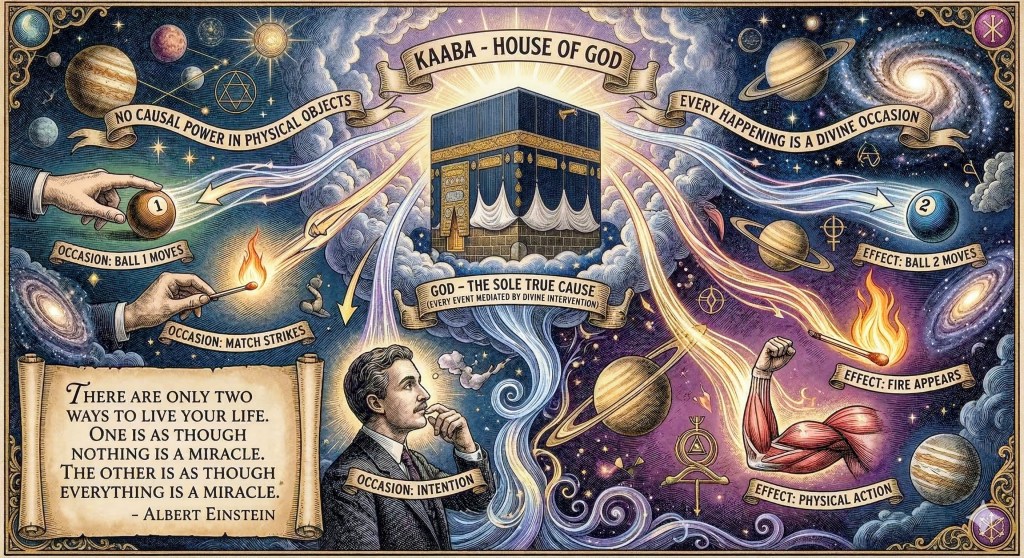
“There are only two ways to live your life. One is as though nothing is a miracle. The other is as though everything is a miracle.” (Albert Einstein)

Dreams, Omniscience, and Occasionalism in Surah Yusuf
Presented by Zia H Shah MD
Abstract
Surah Yusuf (Chapter 12) presents a single, coherent account in which four dreams—first the dream of Yusuf himself, then the two prison dreams, and finally the king’s dream—serve as decisive “turning points” that unfold over years and culminate in precise fulfillments.
Accepting the Qur’anic narrative as fully accurate on its own terms, these dreams function as advance knowledge of specific future states of the world (familial, political, and economic), communicated through a channel (dreaming) that bypasses ordinary sensory causation and anticipates later realities in detail.
In this report, the dream-centered structure is used to argue for divine omniscience in the Qur’anic sense—God’s comprehensive knowledge of particulars and outcomes—while also showing how the story’s “dream → event → fulfillment” pattern naturally supports an occasionalist reading of reality, especially as articulated in classical Islamic discussions of causation and in recent occasionalism-focused writings by Zia H. Shah.
Textual anchors of the four dreams
The Qur’an’s account foregrounds the dreams themselves before (and as) the plot unfolds. Below, each dream is given with its Arabic wording and an English rendering from M.A.S. Abdel Haleem, quoted only for the dream-content that drives the narrative forward.
Yusuf’s dream
Arabic (12:4)
إِذۡ قَالَ يُوسُفُ لِأَبِيهِ يَـٰٓأَبَتِ إِنِّي رَأَيۡتُ أَحَدَ عَشَرَ كَوۡكَبٗا وَٱلشَّمۡسَ وَٱلۡقَمَرَ رَأَيۡتُهُمۡ لِي سَٰجِدِينَ
English (Abdel Haleem, dream clause)
“Joseph said to his father, ‘Father, I dreamed of eleven stars and the sun and the moon: I saw them all bow down before me,’”
The first prison dream
Arabic dream-phrase (12:36)
إِنِّيٓ أَرَىٰنِيٓ أَعۡصِرُ خَمۡرٗا
English (Abdel Haleem, dream clause)
“I dreamed that I was pressing grapes”
The second prison dream
Arabic dream-phrase (12:36)
إِنِّيٓ أَرَىٰنِيٓ أَحۡمِلُ فَوۡقَ رَأۡسِي خُبۡزٗا تَأۡكُلُ ٱلطَّيۡرُ مِنۡهُ
English (Abdel Haleem, dream clause)
“I dreamed that I was carrying bread on my head and that the birds were eating it.”
The king’s dream
Arabic (12:43)
وَقَالَ ٱلۡمَلِكُ إِنِّيٓ أَرَىٰ سَبۡعَ بَقَرَٰتٖ سِمَانٖ يَأۡكُلُهُنَّ سَبۡعٌ عِجَافٞ وَسَبۡعَ سُنۢبُلَٰتٍ خُضۡرٖ وَأُخَرَ يَابِسَٰتٖ
English (Abdel Haleem, dream clause)
“I dreamed about seven fat cows being eaten by seven lean ones; seven green ears of corn and [seven] others withered.”
A dream-centered account of the story and its fulfillments
Surah Yusuf self-identifies as a divinely revealed narrative meant for understanding and moral reflection; it frames the whole story as a “best of stories” revelation and culminates by emphasizing that it is not fabrication, but guidance and mercy.
From Yusuf’s dream to long-delayed fulfillment
The Qur’anic story opens with Yusuf’s private dream—cosmic imagery (stars, sun, moon) “bowing down”—told to his father. The narrative immediately interprets this dream not as arbitrary symbolism but as a preview of divine election and a future destiny: Yusuf is to be chosen and taught the interpretation of dreams, and God’s blessing is to reach Yusuf and the House of Jacob; the verse closes by naming God as all-knowing and wise.
That predestined arc does not remove human conflict; rather, it unfolds through it. Yusuf’s brothers’ jealousy and the cascade of events that follow (loss, separation, slavery, false accusation, imprisonment) are narrated as real moral tests within a larger divine purpose. The Qur’anic wording explicitly asserts that God “prevails in His purpose” while most people do not perceive the full design, a theme that becomes crucial when the dream is fulfilled only after many intermediate trials.
At the end of the narrative, when Yusuf’s family has entered Egypt and the long estrangement is healed, the earlier dream is explicitly “read back” as fulfilled: the family’s gesture of bowing is presented as the interpretation (ta’wil) of that first vision, now made real by God. This “bookending” (dream at the beginning; fulfillment near the end) makes the dream not a decorative motif but the macro-structure of the whole surah.
The prison dreams as a hinge between private virtue and public salvation
The narrative then narrows to the prison, where two inmates approach Yusuf precisely because they recognize his integrity and ask for interpretation. Each dream is concrete and embodied: one sees himself pressing grapes; the other sees bread carried above the head and eaten by birds.
Yusuf’s response is not presented as personal clairvoyance or a natural skill. The Qur’anic account explicitly grounds his interpretive ability in divine teaching—“that is from what my Lord has taught me”—binding dream interpretation to revelation and to a theocentric view of agency.
The dreams then receive sharply differentiated interpretations whose gravity matches their imagery: one prisoner’s dream corresponds to restoration to service (wine), while the other corresponds to execution and birds feeding. In other words, the dream-symbols are not “vague”: they map onto specific outcomes, and the narrative treats this mapping as decisive (“the end of the matter”).
Crucially, the prison dreams also become the causal hinge (in the story’s own internal logic) by which Yusuf is eventually brought to the king’s attention: the freed prisoner later remembers Yusuf after a period of time and offers to retrieve the interpretation for the king’s troubling dream. Thus, the prison dreams function both as moral particularities (two men’s fates) and as a providential “bridge” that connects Yusuf’s hidden righteousness to a national crisis.
The king’s dream and the economic arc that reshapes history
The king’s dream introduces a societal-scale future: seven fat cows consumed by seven lean cows, and seven green ears alongside seven withered. The narrative emphasizes interpretive failure among those who are socially expected to decode symbols, which heightens the contrast between institutional power and God-given knowledge.
Yusuf interprets the symbols into a multi-year economic policy: seven years of cultivation and strategic storage, followed by seven hard years that consume reserves, followed by a year of renewed abundance in which people “press” produce again. This is not merely prediction; it is guidance for action, making the dream a means by which God (through Yusuf) provides both foreknowledge and a practical path of preservation.
The dream’s successful interpretation triggers Yusuf’s elevation: the king calls for Yusuf, speaks with him, and declares him trusted; Yusuf then requests responsibility over the storehouses, aligning personal competence with public trust. The larger fulfillment of the king’s dream is unfolded narratively through events that follow: Joseph’s governance of resources, the famine years, and the arrival of his brothers seeking provisions—an arc that ultimately becomes the means of reconciliation and the fulfillment of the first dream as well.
How the dream-fulfillment arc argues for omniscience
Within the Qur’anic frame, these dreams are not random products of the mind; they are meaningful communications whose correct referents become visible only later. The key is that the narrative repeatedly ties interpretation to divine teaching and to God’s knowledge and wisdom, rather than to autonomous human inference.
If the Qur’anic account is fully accepted as accurate, the argument toward omniscience can be stated with philosophical clarity:
First, the dreams contain specific future-directed content that is not accessible to ordinary perception at the time of dreaming: familial reversal (a child later receiving the deference of a whole family), differentiated fates for prisoners, and a multi-year economic cycle that transforms national survival.
Second, the story does not present fulfillment as coincidence; it explicitly narrates “interpretation” as correspondence between symbol and later reality, and it depicts God as the One who makes the earlier vision “come true.”
Third, the Qur’an anchors this logic in a broader doctrine of divine knowledge that includes not only generalities but particulars—exemplified by the claim that nothing as small as a falling leaf escapes God’s knowledge, and that the “keys to the unseen” belong to Him alone.
From these premises, omniscience is not merely inferred as an abstract attribute; it is dramatized: God discloses limited portions of future knowledge through dreams, at the right times, to achieve moral and salvific ends—protecting Yusuf’s mission, saving a society from famine, and reuniting a prophetic family after grave betrayal.
In this vein, the writings on “omniscience” within the occasionalism collection explicitly integrate Qur’anic statements of comprehensive divine knowledge with philosophical concerns (foreknowledge and free will) and even modern physics and time, arguing that scientific models do not undermine omniscience but can intensify a sense of its coherence and scope.
What Surah Yusuf suggests about human consciousness
A distinctive feature of the Yusuf narrative is that the decisive communications occur within dream-consciousness: the dreams are experienced privately, often ambiguously, and yet can carry truthful reference to objective future states. In other words, Surah Yusuf treats dreaming as a mode of consciousness that can be “opened” to truthful meaning beyond the dreamer’s own planning.
This coheres with a wider Qur’anic anthropology in which sleep itself is framed as a sign: God “takes the souls” of the dead and also takes the souls of the living during sleep, returning some and withholding others—language that positions consciousness and its suspension as directly under divine governance rather than merely biological accident. Another verse calls human sleep by night and by day a sign among God’s signs, linking everyday cycles of awareness and unconsciousness to meaning and reflection rather than reducing them to brute physiology.
At the same time, the Qur’an draws a boundary around what humans can claim to know about the inner dimension of personhood: “the Spirit” (al-rūḥ) is described as belonging to God’s domain, while human beings are given only “a little knowledge.” For a consciousness-focused reading of Surah Yusuf, this epistemic humility matters: dreams present genuine experiences that are not self-interpreting; the meaning is not generated solely from within the finite mind but is uncovered through divinely taught interpretation.
Modern cognitive science can be brought into the conversation without replacing the Qur’anic framing. Contemporary work commonly treats dreaming as a form of conscious experience occurring during sleep and often tied to memory processing and consolidation. That scientific picture aligns with one non-controversial point Surah Yusuf dramatizes: dream-consciousness can be phenomenologically vivid and motivating, capable of reorganizing waking decisions and social outcomes (the king’s administrative response; the prisoners’ appeal; Yusuf’s strategic plan).
Within the occasionalism-themed reflections on Qur’an 8:24, consciousness is framed as residing under God’s intimate purview—“between a person and their heart”—and therefore not adequately reducible to physical description alone; this is presented as a bridge between classical theology and contemporary philosophy of mind. Read back into Surah Yusuf, the dreams become a narrative case study: consciousness (in dreaming) is an arena where God can communicate with precision, guiding both the inner life (understanding, certainty, patience) and the outer world (policy, famine management, reconciliation).
Dreams as evidence for occasionalism
The classical philosophical core
In the classical philosophical vocabulary, “occasionalism” is the position that created things do not possess independent causal efficacy; God is the immediate cause of every event, while what humans call “causes” are regular sequences that do not entail their effects with logical necessity. Standard discussions of Islamic occasionalism often focus on the critique of necessary causal connections, using examples like cotton burning when touching fire: observation shows conjunction, but does not demonstrate a necessary bond that constrains divine will.
A crucial scholarly nuance is that interpreters debate how fully this view should be attributed to al-Ghazali: some readings treat him as a robust occasionalist, while others argue he may allow secondary causation in some sense; major reference accounts explicitly note this interpretive dispute rather than assuming a single settled view.
The Yusuf narrative through an occasionalist lens
Even without importing later philosophical terminology, Surah Yusuf repeatedly attributes both knowledge and outcome to God: God chooses Yusuf, teaches him dream-interpretation, and “always prevails in His purpose,” even through human schemes. When the dreams are read as precise communications whose outcomes later occur, an occasionalist interpretation naturally follows: the dream-content is not merely correlated with later events; rather, it is an instance of God directly causing a meaningful mental event (the dream) that corresponds to—indeed, participates in—the orchestration of later physical and social events.
This is especially vivid in the king’s dream sequence: the dream motivates inquiry, inquiry reaches Yusuf, interpretation yields policy, and policy becomes the means of survival; at each stage, the “link” is not depicted as self-sufficient mechanism but as guided unfolding under divine knowledge and will.
Zia H. Shah’s “divine habit” synthesis
Across the occasionalism collection, Zia H. Shah defines occasionalism as the claim that God alone is the true efficient cause and that observed regularities are best read as God’s stable “habit” (sunnat Allah), not as autonomous necessity resident in matter. This framing is explicitly designed to preserve both (a) the intelligibility and stability that science relies on, and (b) the metaphysical freedom needed for miracles and for direct divine action.
In the same body of writing, he repeatedly extends “divine habit” beyond outward events (rain, nature, cosmology) to inward events (intention, resolve, fear, and—critically for Surah Yusuf—dream cognition), explicitly challenging any strict wall between mind and world in an occasionalist theology.
His modern “embellishment” of occasionalism uses contemporary physics vocabulary in a pedagogical way: he argues that quantum indeterminacy can be treated as a conceptual “interface” for divine choice (without collapsing statistical regularities), that entanglement resonates with non-local coordination under a single sustaining agency, and that the simulation hypothesis can function as an analogy for “frame-by-frame” dependence of the universe on God. These moves are not presented as replacements for scripture; they are offered as modern metaphors or conceptual supports for a Qur’an-centered doctrine of continuous divine governance.
Finally, this occasionalism collection explicitly confronts the free-will problem by revisiting classical Ash‘arī strategies (especially kasb, “acquisition”) alongside modern reflections, insisting that divine control and genuine moral responsibility need not be mutually exclusive if “causal power” is located in God while “choice” is treated as morally real within God’s governance. Surah Yusuf’s moral landscape—betrayal and repentance, chastity and temptation, starvation and generosity, forgiveness and family restoration—provides a narrative theater in which that theological balance is emotionally and ethically intelligible rather than merely abstract.
Epilogue
Surah Yusuf can be read as a single long argument in narrative form: God discloses fragments of the unseen through dreams; years later those dream-fragments become visible realities; and the entire arc is repeatedly attributed to divine knowledge, will, and wisdom. In that sense, the “omniscience” on display is not a philosophical abstraction but a providential pattern: hidden knowledge becomes lived history through a chain of meaning-bearing events.
The same pattern foregrounds dreams as a privileged site for reflecting on consciousness: the Qur’anic framing of sleep, soul-taking, and the limits of human knowledge about the Spirit pushes the reader to treat consciousness as both real and epistemically partial—an arena where God can communicate truthfully, and where the human being must respond with patience, interpretation, and moral choice. Modern work that treats dreaming as conscious experience intertwined with memory processes can deepen, rather than flatten, this reading by reminding us that dream-consciousness is a genuine mode of experience capable of reorganizing waking life—precisely what the Yusuf narrative dramatizes on both personal and societal scales.
In the history of the Abrahamic faiths, the Joseph story is shared across traditions; modern Qur’anic scholarship explicitly highlights that the Qur’an’s Joseph narrative is not merely historiography but a guided, purposive story meant to strengthen and instruct, while still remaining recognizably continuous with the broader Abrahamic memory. That continuity matters for the epilogue’s final theme: occasionalism. When the dreams of Surah Yusuf are taken as true communications from God and their fulfillments as divinely enacted realities, the metaphysical intuition behind occasionalism becomes narratively plausible: not only does God know—God acts, continuously, in the world and in the mind.
For references please go to Microsoft Word file:


 The Glorious Quran and Science
Leave a comment