
The Unseen and the Visible: A Multidisciplinary Research Report on Quranic Oaths as Prophetic Signatures for the Modern Age
Presented by Zia H Shah MD
Audio teaser: Dark matter and the Quranic unseen
Abstract
The following research report provides an exhaustive multidisciplinary commentary on verses 38 through 43 of Surah Al-Haqqah (Chapter 69 of the Quran), focusing on the profound implications of the divine oath taken upon the visible and invisible dimensions of existence. By synthesizing theological exegesis, historical contextualization, and modern scientific findings, this analysis demonstrates how a message delivered in the seventh-century Arabian Peninsula—a society characterized by limited literacy and a lack of formalized scientific inquiry—serves as a timeless epiphany and a prophetic bridge to the twenty-first century. Central to this discourse is the work of Zia H. Shah MD, whose multidisciplinary commentaries emphasize the “unseen” not merely as a metaphysical concept, but as a biological, physical, and cosmological reality. The report argues that the Quranic preoccupation with the hidden layers of reality—ranging from microbial dark matter to the large-scale structure of the cosmic web—functions as a deliberate signal to the modern reader, validating the claim that the text originates from an All-Knowing Source.
The Epistemological Landscape of Seventh-Century Hijaz
To understand the weight of the oath in Surah Al-Haqqah, one must first reconstruct the intellectual and social environment of its primary audience. Seventh-century Arabia was a world of profound sensory immediacy. The inhabitants of the Hijaz were part of a culture where oral tradition was the primary vehicle for preserving history, lineage, and wisdom. Literacy was a rare skill, often reserved for merchants and scribes managing business documents or treaties. In such a world, knowledge was synonymous with what could be seen, heard, or remembered through spoken poetry.
The “unseen” in this pre-Islamic context was largely populated by folkloric entities such as jinns, spirits, and the shadows of ancestors. There was no conceptual framework for “pre-science,” let alone the rigorous methodology of modern empirical inquiry. While the Greeks and Persians had made strides in mathematics and medicine, such knowledge had not yet permeated the nomadic or mercantile societies of Mecca and Medina in any systematic way. The inhabitants were “nomadic, living in the desert away from civilization,” and their access to information was limited by the oral nature of their communication.
| Element of Worldview | Pre-Islamic Arabian Context | Modern Scientific Context |
| Primary Medium | Oral poetry and tribal lore | Peer-reviewed data and instrumentation |
| Scope of Reality | Visible horizons and immediate sensory data | Subatomic, microbial, and cosmic unseen |
| Literacy Levels | Predominantly illiterate; oral-centric | Universal education and digital information |
| The “Unseen” | Mythical, ghostly, and folkloric | Quantum particles, dark matter, and electromagnetic waves |
In this environment, a divine declaration that swears by “all that you see and all that you do not see” (69:38-39) was not merely a poetic device; it was an epistemological revolution. It challenged a people obsessed with the tangible to consider a vast, structural hiddenness within the universe—a concept that would only be substantiated fourteen centuries later by the invention of the telescope, the microscope, and the particle accelerator.
Theological and Linguistic Commentary on Quran 69:38-43
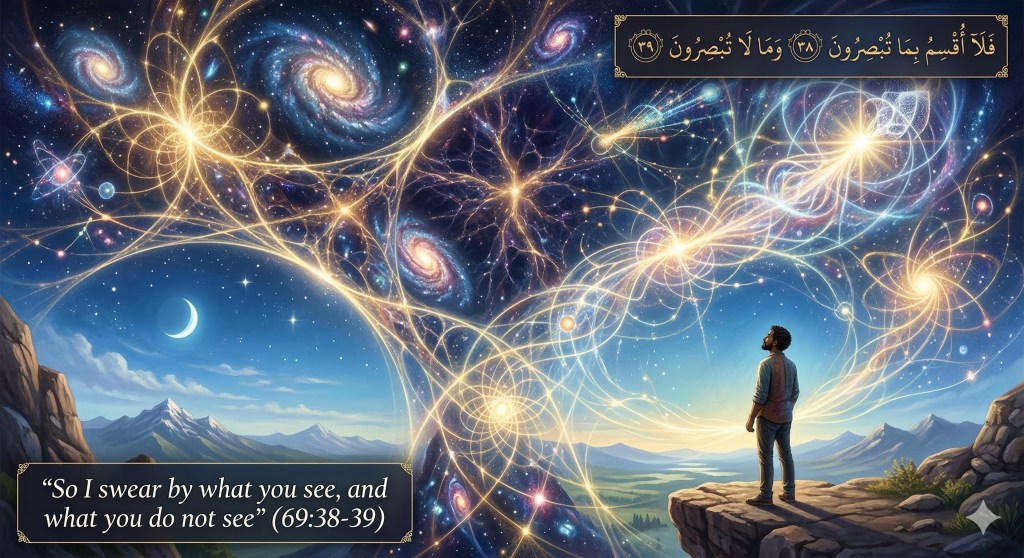
The verses 69:38-43 of Surah Al-Haqqah constitute a pivotal defense of the Quran’s divine provenance. The passage begins with the phrase Fala uqsimu bima tubsirun, wa ma la tubsirun—”But no! I swear by what you see and what you do not see”.
The Mechanics of the Divine Oath
In Quranic rhetoric, the use of qasam (oath) serves to arrest the attention of the listener and highlight the significance of the “Answer to the Oath” (jawab al-qasam) that follows. While Islamic law restricts humans to swearing only by God, the Creator swears by His creation to demonstrate His mastery over it and to elevate the objects of the oath as “signs” (Ayat) for people of understanding.
Classical scholars like Ibn Kathir and Al-Tabari interpreted “what you do not see” as referring to the angels, the spiritual realms, and the attributes of God. However, the phrasing is intentionally expansive. The Arabic particle ma (that which) is a general relative pronoun, encompassing everything that exists outside the range of human perception. By invoking the totality of existence—the observable universe and the hidden realities—the text asserts that every level of reality testifies to the truth of the revelation.
Rejection of the Poet and the Soothsayer
The verses continue: “Indeed, this [Quran] is the speech of an honored messenger. It is not the word of a poet… nor is it the word of a soothsayer” (69:40-42). In seventh-century Arabia, these were the two most common accusations leveled against Prophet Muhammad. A poet (sha’ir) was viewed as someone possessed by emotion or spirits, while a soothsayer (kahin) claimed to receive cryptic messages from jinns.
The Quran’s rejection of these labels is significant. It argues that the message is not a product of human imagination or spiritualist mumbling, but a “successive sending down” (Tanzeel) from the “Lord of the worlds”. The oath on the seen and unseen serves to validate this claim; it implies that the Author of the book is the same Author of the entire cosmos, including those dimensions that the Meccans could not possibly perceive.
The Epiphany of the Unseen: A Prophetic Sign for the Modern Age
The declaration of an oath on the “unseen” in an illiterate society stands as a historical epiphany. In a world before modern physics, the unseen was a matter of blind faith. For the modern reader, however, the unseen has become the primary focus of scientific endeavor. The Quran’s insistence on the reality of the hidden world functions as a prophecy, anticipating the twentieth and twenty-first-century reader who lives in a world defined by invisible forces.
The Scientific Unseen in the Twenty-First Century
Modern science is, essentially, the process of bringing the “unseen” into the realm of the “seen.” As Zia H. Shah MD argues in his multidisciplinary commentaries, the “unseen” mentioned in Surah Al-Haqqah perfectly aligns with the discoveries of subatomic particles, microbial life, and the vast quantities of dark matter and energy that comprise the universe.
1. The Biological Unseen: Microbial Dark Matter
For most of human history, the biological world was limited to what was visible to the naked eye. The invention of the microscope revealed a new layer of reality, but even that was just the beginning. Today, biologists speak of “Microbial Dark Matter”—the 99% of microbial species on Earth that cannot be cultured in laboratories and were entirely hidden until the advent of metagenomics.
| Discovery | Description | Connection to “The Unseen” |
| Microbial Dark Matter | Over 99% of bacteria and archaea that cannot be cultured in a lab. | Existing “under our noses” but remaining invisible for billions of years. |
| Omnitrophota | Nano-sized bacteria measuring less than 450 nanometers. | One of the world’s oldest and tiniest lineages, essentially hidden until the 21st century. |
| Metagenomics | Sequencing DNA directly from environmental samples. | The tool that “drags this lineage out of the dark”. |
These “unseen” organisms govern global ecosystems, produce oxygen, and influence human health, yet their existence was unknown when the Quran took an oath upon the “unseen”. This alignment suggests that the Quran was addressing a future audience that would possess the tools to verify these hidden realities.
2. The Cosmological Unseen: Dark Matter and Dark Energy
In the realm of physics, the “unseen” has moved from a philosophical curiosity to a mathematical necessity. Modern cosmology posits that the universe we see—stars, galaxies, and planets—is merely a small fraction of what actually exists.
| Universal Component | Approximate Percentage | Interaction with Light |
| Visible/Ordinary Matter | 5% | Absorbs, reflects, and emits light. |
| Dark Matter | 25-27% | Does not interact with light; detected by gravitational effects. |
| Dark Energy | 68-71% | An invisible force driving the accelerated expansion of the universe. |
The existence of dark matter was inferred only when astronomers realized that visible stars did not have enough mass to hold galaxies together. Dark energy was discovered even more recently, in 1998, as the cause of the universe’s accelerating expansion. For a seventh-century text to place the “unseen” on equal footing with the “seen” is a striking anticipation of this cosmological reality, where 95% of the universe is, quite literally, “that which you do not see”.
3. The Physical Unseen: Subatomic Particles and Waves
The “unseen” also includes the fundamental building blocks of matter. Neutrinos, subatomic particles that rarely interact with matter, pass through the Earth and the human body by the trillions every second. Furthermore, the electromagnetic spectrum spans far beyond visible light. We are surrounded by radio waves, infrared radiation, and ultraviolet rays that facilitate modern life but remain invisible to the naked eye. By swearing by the unseen, the Quran validates these energetic and particulate dimensions of reality long before the development of particle physics.
Zia H. Shah MD and the Multidisciplinary Commentary on Oaths
The work of Zia H. Shah MD, featured on The Quran Love, provides a comprehensive framework for understanding Quranic oaths through the lenses of science, philosophy, and theology. His articles emphasize that these oaths are “evidence exhibits” intended to prove core tenets like Tawhid (monotheism), the reality of the Akhirah (hereafter), and the divine origin of the Wahy (revelation).
Nature’s Testimony to Tawhid (Monotheism)
Shah argues that the order and harmony found in the “seen” and “unseen” worlds point to a single coordinating Lord rather than a chaotic universe governed by multiple conflicting forces.
- Order and Regulation: Oaths involving the orderly ranks of natural forces (37:1-4) or the cycles of the sun and moon (91:1-2) reinforce the message of a singular, all-powerful Creator.
- Purposeful Pairing: Oaths by the creation of “male and female” (92:3) or “night and day” (92:1-2) highlight the duality built into the fabric of existence. This duality is presented as a signature of a sole Creator.
- Fine-Tuning: Shah notes that modern science confirms the “fine-tuning” of physical constants. For instance, the Earth’s 23.5-degree axial tilt and its rotation speed are precisely calibrated to support life—a regularity that the Quran uses as proof of divine governance.
The Celestial Testimony: Night and Day
In his article on the celestial testimony, Shah explores the oaths taken by the night and the day (92:1-2, 93:1-2). He posits that these natural phenomena are “Signs” (Ayat) for people of understanding.
- Circadian Biology: The oath by the “night’s stillness” (93:2) aligns with modern chronobiology. Darkness triggers the release of melatonin, allowing the body’s “quiet clock” to repair hormones and immunity. This Quranic instruction to use the night for rest is validated by the physiological needs of the human body.
- Ecology and Photosynthesis: The “morning’s breathing” (81:18) is interpreted through the lens of photosynthesis. After the nightly pause, plants begin converting $CO_2$ back into oxygen at dawn, literally “breathing” life back into the biosphere.
- The Argument from Duality: The pairing of night and day suggests that the universe is built on complementary counterparts rather than random accidents. This duality mirrors the moral landscape of the human soul.
Surah Dhariyat and the Winds of Provision
Shah’s commentary on Surah Dhariyat (51:1-4) further illustrates the interplay between ancient oaths and modern science. The “scatterers that scatter” (winds), “bearers of loads” (clouds), “those that flow with ease” (ships or planets), and “distributors by command” (angels or natural forces) are used to affirm the truth of the afterlife.
- Meteorology: Modern science confirms that winds redistribute dust and pollen across the earth, and a single cloud can weigh over 1.1 million pounds—validating the imagery of “heavy loads”.
- Teleology: The orderly distribution of resources through these systems is seen as evidence of a purposeful Creator rather than random accidents. Just as these natural agents exist and perform their functions reliably, the Quran argues that the promise of judgment is equally certain.
Philosophical Implications of the Oath on the Unseen
Philosophically, the oath on the seen and unseen addresses the limits of human perception and the nature of reality. It challenges the materialist paradigm, which often dismisses anything that cannot be measured or observed.
Epistemology and the “Two Books”
In Islamic philosophy, knowledge is derived from two primary sources: the “Book of Scripture” (the Quran) and the “Book of Nature” (the Universe). The oath in Surah Al-Haqqah bridges these two books. It suggests that the physical laws we observe in the “seen” world are perfectly consistent with the spiritual laws described in the revelation.
- Reason and Revelation: Islam views knowledge as a harmonization between revelation and reason. Reason explores the phenomena of creation, while revelation provides the moral and transcendental values.
- The Goal of Science: In the Islamic perspective, the development of science and technology is not merely for material advancement but is a form of tafakkur (reflection) that deepens faith. By discovering the “unseen” laws of physics, humanity is effectively reading the “Book of Nature” and uncovering the majesty of the Creator.
The Duality of Reality
The Quranic treatment of the “seen and unseen” establishes reality as a multi-layered construct. This mirrors the philosophical view that the universe essentially exists in the “Creator’s Knowledge” as meaning before it is clothed in matter and made visible in the material realm.
| Degree of Existence | Description | Quranic Parallel |
| Stage 1: Meaning | Existence in the Divine Knowledge | The “Unseen” (Al-Ghaib) |
| Stage 2: Plan | Existence in the Divine Will | The Measured Decrees (Qadar) |
| Stage 3: Material | Existence in the material realm | The “Seen” (Ash-Shahadah) |
| Stage 4: Memory | Existence in human minds/texts | The “Message” (Ad-Dhikr) |
By swearing by both the seen and the unseen, the Quran asserts that the entire spectrum of existence—from the abstract meaning in the mind of the Creator to the tangible objects in the desert—is a unified testament to the truth.
The Prophecy for the Modern Reader
The most awe-inspiring aspect of the oath on the unseen is its function as a prophecy. In the seventh century, the “unseen” was a small category of religious mystery. Today, the “unseen” is a vast, technologically-mediated reality that defines our existence.
A Message for the Twentieth and Twenty-First Centuries
The Quran explicitly states that its message is for “the worlds” (Al-Alamin). This suggests that as human knowledge expands, the Quranic verses will reveal new layers of meaning. For the seventh-century reader, the oath on the unseen was an invitation to humble themselves before the mysteries of God. For the twenty-first-century reader, the oath is a challenge to recognize that the very science they use to explore the universe was anticipated by the revelation.
- The Expanding Universe: Quran 51:47 (“We are expanding it”) was a theological statement for centuries. Since 1929, it has been a foundational fact of astrophysics.
- The Cosmic Web: Quran 51:7 speaks of the “sky full of pathways” (Al-hubuk). Modern simulations show that galaxies are arranged in a “cosmic web” of filaments and sheets, mirroring the Quranic imagery of a woven fabric.
- Microscopic Precision: The Quran’s emphasis on things “hidden” and “small” aligns with the discovery of the nano-world, from subatomic particles to DNA.
These alignments strike the modern reader as an epiphany. They highlight that the Quran is not the word of a poet or a soothsayer, but a message from an All-Knowing source that understood the structural nature of the universe long before humanity developed the tools to see it.
Scientific Achievement as “Tasbīḥ” (Glorification)
Zia H. Shah MD posits that scientific discovery is, in itself, a form of tasbih or glorification of the Creator. When a scientist uncovers an elegant law of nature or a hidden biological process, they are uncovering the “letters” written by God in the Book of Nature.
- The Nobel Prize and Divine Eulogy: Shah suggests that modern scientific achievements, such as those recognized by the Nobel Prize, serve as a contemporary eulogy to the Creator. They uncover the elegant laws that humanity was invited to ponder 1,400 years ago.
- The Ethical Foundation: By positioning revelation as a moral compass and science as a technical instrument, Islam offers a balanced paradigm that avoids the traps of secular scientism or textual literalism.
The Historical Significance of Quranic Oaths
The use of oaths by natural phenomena was a powerful strategy to redirect the religious impulses of the Arabs. Ancient cultures often worshipped the sun, the moon, and the stars. The Quran, by taking an oath upon these objects, stripped them of their divinity and repositioned them as created signs.
- Desacralization of Nature: By swearing by the sun and moon, the Quran emphasizes that they have no power of their own; they are subject to divine command. This was a subtle polemic against moon-worship and astrology.
- Continuity with Previous Revelations: In Surah Al-Tin (95:1-4), God swears by the fig, the olive, Mount Sinai, and the “secure city” (Mecca). This bridges the new revelation with the legacies of Jesus and Moses, asserting that the same God who spoke to them is now speaking through Muhammad.
Thematic Epilogue: The Perpetual Epiphany of the Unseen
The divine oath in Quran 69:38-43—”I swear by what you see and what you do not see”—serves as a timeless bridge between the desert of the seventh century and the laboratories of the twenty-first. In its original context, it was a masterful rhetorical device that used the vastness of the unknown to validate the integrity of the Prophet and the divine origin of the message. To an audience that could not read and had no concept of the microscopic or the cosmic, this oath was a profound demand for faith in the All-Knowing.
However, for the modern reader, this oath has transformed from a metaphysical demand into an empirical epiphany. We live in an age where the “unseen” is no longer just a matter of spirits or ghosts, but is the very foundation of our reality. The majority of our universe is composed of dark matter and energy that we cannot see. Our bodies are sustained by a hidden world of microbial dark matter. Our communication is facilitated by invisible electromagnetic waves.
The Quran’s insistence on taking an oath upon the “unseen” is a prophetic signature. It indicates that the text was always intended to reach an audience that would eventually “see” the unseen. It identifies the Quran not as the emotional outburst of a poet or the rhythmic guessing of a soothsayer, but as a “successive sending down” from the Lord of the Universe—the same Architect who designed the subatomic particle and the cosmic web.
As Zia H. Shah MD illustrates, these oaths are not just poetic flourishes; they are invitations to multidisciplinary reflection. They urge the believer to see the “wrapping” of the day and night as a sign of Earth’s rotation, the “breathing” of the dawn as a sign of photosynthesis, and the “positions of the stars” as a sign of cosmic expansion. In doing so, the Quran collapses the artificial divide between science and religion, positioning the study of nature as the highest form of worship.
Ultimately, the oath on the seen and unseen stands as a permanent challenge to human arrogance. It reminds us that no matter how far our telescopes reach or how deep our microscopes peer, there will always be a dimension of reality—the “unseen”—that remains within the Knowledge of the Creator. For the modern reader, this realization fosters a sense of awe and humility, confirming that the message of the Quran is as relevant in the age of quantum physics as it was in the age of the camel caravan. The “epiphany of the unseen” is thus a perpetual one, continuously unfolding as humanity discovers the hidden wonders of the Lord of the Worlds.


 The Glorious Quran and Science
Leave a comment