
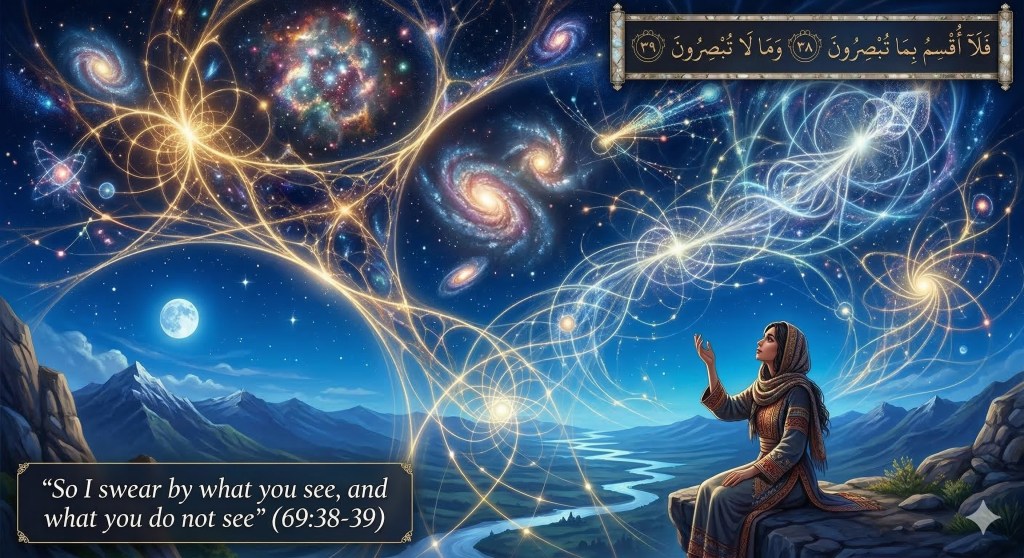
The oath on the unseen: a multidisciplinary commentary on Quran 69:38–43
Presented by Zia H Shah MD
Abstract
This commentary examines Quran 69:38–43 — the extraordinary passage in Surah Al-Haqqah where God swears by “what you see and what you do not see” to affirm the divine origin of the Quran. Through an integrated scientific, philosophical, and theological analysis, we argue that this oath constitutes one of the most intellectually remarkable declarations in all of scripture. Delivered to a seventh-century Arabian audience that possessed no microscope, no telescope, no knowledge of electromagnetic radiation beyond visible light, and no inkling that 95% of the universe’s mass-energy content would prove invisible to the human senses, Wikipedia this oath invokes the totality of existence — seen and unseen — as witness to revelation. Drawing on classical tafsīr (exegesis) from Ibn Kathīr, al-Ṭabarī, al-Rāzī, and Maududi, alongside modern scientific discoveries in quantum mechanics, dark matter, dark energy, gravitational waves, and neutrino physics, we demonstrate that the scope of “what you cannot see” has expanded almost beyond comprehension since the seventh century. The philosophical epistemology of the unseen — from Plato’s allegory of the cave through Kant’s noumenal world to al-Ghazālī’s hierarchy of knowledge — provides the conceptual architecture for understanding why swearing by the invisible is not an act of obscurantism but a profound assertion about the layered structure of reality. Insights from Zia H Shah MD’s extensive scholarship on Quranic oaths, published at The Glorious Quran and Science (thequran.love), are woven throughout to illuminate the rhetorical, scientific, and theological dimensions of the qasam (oath) tradition in the Quran. We conclude that this oath functions simultaneously as a signature of divine omniscience, a challenge to human epistemic arrogance, and what may reasonably be called a forward-looking prophecy — a declaration whose full resonance could only be appreciated in an age of scientific discovery.
I. The text: Arabic, transliteration, and translations
The Arabic
٣٨ فَلَآ أُقْسِمُ بِمَا تُبْصِرُونَ ٣٩ وَمَا لَا تُبْصِرُونَ ٤٠ إِنَّهُۥ لَقَوْلُ رَسُولٍ كَرِيمٍ ٤١ وَمَا هُوَ بِقَوْلِ شَاعِرٍ ۚ قَلِيلًا مَّا تُؤْمِنُونَ ٤٢ وَلَا بِقَوْلِ كَاهِنٍ ۚ قَلِيلًا مَّا تَذَكَّرُونَ ٤٣ تَنزِيلٌ مِّن رَّبِّ ٱلْعَـٰلَمِينَ
Transliteration
- 69:38 — Falā uqsimu bimā tubṣirūn
- 69:39 — Wa mā lā tubṣirūn
- 69:40 — Innahu laqawlu rasūlin karīm
- 69:41 — Wa mā huwa biqawli shā’irin, qalīlan mā tu’minūn
- 69:42 — Wa lā biqawli kāhinin, qalīlan mā tadhakkarūn
- 69:43 — Tanzīlun min rabbi al-‘ālamīn
Multiple English translations
Sahih International: “So I swear by what you see / And what you do not see / [That] indeed, the Qur’an is the word of a noble Messenger. / And it is not the word of a poet; little do you believe. / Nor the word of a soothsayer; little do you remember. / [It is] a revelation from the Lord of the worlds.” IqraSenseIslamAwakened
Yusuf Ali: “So I do swear by what ye see, / And what ye see not,— / That this is verily the word of an honoured Messenger; / It is not the word of a poet: little it is ye believe! / Nor is it the word of a soothsayer: little admonition it is ye receive. / (This is) a Message sent down from the Lord of the Worlds.”
Pickthall: “But nay! I swear by all that ye see / And all that ye see not / That it is indeed the speech of an illustrious messenger. / It is not poet’s speech – little is it that ye believe! / Nor diviner’s speech – little is it that ye remember! / It is a revelation from the Lord of the Worlds.” My Islam
Muhammad Asad: “Now, I do call to witness all that you can see, / as well as all that you cannot see! Islamicstudies.info / Behold, this [Qur’an] is indeed the [inspired] word of a noble apostle… / and is not — however little you may [be prepared to] believe it — the word of a poet; / and neither is it — however little you may [be prepared to] take it to heart — the word of a soothsayer: / [it is] a revelation from the Sustainer of all the worlds.”
Abdul Haleem: “So I swear by what you can see / and what you cannot see: / this [Quran] is the speech of an honoured messenger, / not the word of a poet — how little you believe! — / nor the words of a soothsayer — how little you reflect! / This [Quran] is a revelation sent down from the Lord of the Worlds.”
Maududi: “But no; I swear by what you see, / and by what you do not see, / that this is the speech of an honourable Messenger, / not the speech of a poet. Little do you believe! / Nor is this the speech of a soothsayer. Little do you reflect! / It has been revealed by the Lord of the Universe.” Islamic StudiesIslamic Studies
The convergence across translations is striking: the oath invokes the totality of perceivable and imperceivable reality, then pivots to the central assertion — this Quran is not the word of a poet or soothsayer but tanzīl, a “sending-down” from the Lord of all worlds.
II. A world that could not read, could not see, and did not know
To grasp the sheer audacity of this oath, one must enter the world in which it was first spoken. Seventh-century Arabia had no optical instruments. The microscope would not be invented for another thousand years (Antonie van Leeuwenhoek, 1670s). The telescope lay a millennium in the future (Hans Lippershey, 1608). There was no concept of the electromagnetic spectrum, no theory of atoms, no knowledge that invisible forces permeate every cubic centimeter of space. The night sky was a dome of fixed lights, and what the eye could see exhausted what most people believed existed.
Into this world — a world in which the visible was the totality of the real for the average person — the Quran makes a declaration of astonishing scope. It does not swear merely by the sun or the moon or the stars, though it does so elsewhere. It swears by everything that exists: “what you see and what you do not see.” The oath encompasses the entirety of creation, as the classical commentator al-Jalālayn stated plainly: it means “all creatures.” Islamicstudies.infoquranx Ibn Kathīr explained that Allah swears by His creation, “in which some of His signs can be seen,” and then “by the hidden things that they cannot see.” QuranX The scope is total.
But what could the original audience have understood by “what you do not see”? Classical interpreters offered several possibilities. Ibn ʿAbbās gave three layered readings: (1) the sky and earth are what you see; Paradise and Hellfire are what you cannot; (2) the sun and moon are visible; the Throne and Footstool of God are not; (3) Muhammad is seen; the angel Gabriel is not. QuranX The Maʿāriful Qur’an adds that “what you do not see” may refer to “the Being of Allah and His Attributes” or “things of the Hereafter.” Islamicstudies.info Maududi, in his Tafhīm al-Qur’an, offered an extensive enumeration: the visible evidence included the Prophet’s noble character, the unprecedented eloquence of the Quran, and the moral transformation of believers; the invisible truths included Allah’s sole sovereignty, the inevitability of Resurrection, and the truth of Muhammad’s divine appointment. My Islam +3
All of these readings coexist. The genius of the verse is that it does not specify what the unseen is — it cannot be exhausted. Each century adds new content to the category of “what you do not see,” and the oath grows more vast.
III. The epiphany of swearing by the unseen
An intellectual rupture in the history of ideas
Here we arrive at what may be the most philosophically arresting feature of the passage: the Quran swears by the invisible. In a world obsessed with tangible evidence, material proof, and the testimony of the senses — a world that continues to be so obsessed — God places the weight of His oath not merely on the stars and mountains (which He does elsewhere) but on that which the audience cannot perceive at all.
This is not a casual rhetorical move. It is an intellectual rupture. Consider the epistemological commitment it requires. A typical oath derives its force from the grandeur, familiarity, or reliability of the thing sworn by — one swears by one’s honor, by the gods, by sacred places, by powerful natural phenomena. The listener assents because the sworn-by entity is known, impressive, and uncontested. But to swear by “what you cannot see” is to claim that the most powerful testimony comes from a realm the listener cannot even access. It is to assert that reality extends immeasurably beyond the perceptual horizon and that this hidden reality is not a void of ignorance but a plenitude of being.
Zia H Shah MD, in his extensive scholarship on Quranic oaths published at The Glorious Quran and Science, has articulated precisely this insight. As he writes: “Each oath invites the reader to contemplate at three levels: Empirical — What is this thing and how does it work? Reflective — What does it mean and signify? Philosophical — What does it tell me about God and my duty?” thequran In the case of 69:38–39, the empirical level shatters open: the “thing” sworn by is everything imperceptible, which modern science has shown to be the vast majority of existence.
Shah further argues that the Quranic oaths function as a harmonization of two books: “They harmonize the ‘book of scripture’ with the ‘book of nature,’ making all creation a witness to Allah’s oneness, His justice in the hereafter, and the truth of His revelation.” Thequranthequran In 69:38–39, this harmonization reaches its zenith — the entire book of nature, visible and invisible, is summoned as a single, undivided witness.
The philosophical lineage
The oath’s implicit claim — that unseen reality is as real as, or more real than, the seen — places it in a philosophical lineage of extraordinary depth.
Plato, in the allegory of the cave (Republic, Book VII, c. 380 BCE), argued that what we perceive through the senses is mere shadow-play: flickering projections on a wall, mistaken by the prisoners for reality itself. True reality — the eternal, unchanging Forms — resides in the unseen intelligible realm accessible only through reason. The freed prisoner who exits the cave is initially blinded by the sunlight but gradually comes to perceive true objects Vocal Media and, ultimately, the Form of the Good, which illuminates all reality as the sun illuminates the physical world. Philosophy Institute The Quran’s oath by “what you cannot see” resonates with this Platonic insight: the seen world is not the totality; the unseen is not a deficit but the deeper stratum.
Immanuel Kant formalized this intuition with surgical precision in the Critique of Pure Reason (1781). Kant distinguished phenomena — things as they appear to us, structured by the mind’s a priori categories of space, time, and causality — from noumena — things-in-themselves, which exist independently of our perception but remain forever beyond direct cognitive access. TheCollector “We can have cognition of no object as a thing in itself, but only as an object of sensible intuition,” Kant wrote. Christian Leaders The noumenal world includes precisely those realities that religious traditions identify as “unseen”: God, the soul, freedom, immortality. LigonierWikipedia Kant’s famous dictum — “I must therefore abolish knowledge, to make room for belief” — acknowledges that the most important realities may lie beyond the reach of empirical knowledge. Marxists Internet Archive
Al-Ghazālī (1058–1111 CE), the great Islamic theologian and philosopher, arrived at a parallel conclusion through a different route. In his spiritual autobiography al-Munqidh min al-Ḍalāl (Deliverance from Error), he systematically doubted the reliability of the senses 1000-Word Philosophy — noting that the eye mistakes a shadow for something stationary and perceives a star as a coin-sized object when it is larger than the earth Sunnah Muakada — and then doubted reason itself. His resolution came not through argument but through “a light which God cast into my breast.” Al-Ghazālī’s epistemological hierarchy places revealed and mystical knowledge (kashf) above rational and sensory knowledge, precisely because the unseen can be accessed only through divine disclosure. As Shah has noted in his commentary on Surah Dhāriyāt, al-Ghazālī argued that “fire does not burn cotton by its own power; rather, God causes the burning each time” thequran — a radical assertion that even the visible causal order of nature is not self-sustaining but depends on an unseen divine will.
The Quran’s oath, then, is not philosophically naïve. It stands at the intersection of the deepest questions in epistemology: What can we know? What lies beyond our perception? And is the unseen merely unknown, or is it the ground of reality itself?
IV. The prophetic dimension: an oath for the future
How a seventh-century declaration addresses the twenty-first-century reader
The most extraordinary feature of the oath in 69:38–39 may be its temporal orientation. Classical commentators read it as an argument for the Quran’s divine origin addressed to the Meccans. But the verse says something that resonates with startling power across fourteen centuries: I swear by what you cannot see. In the seventh century, “what you cannot see” was a theological and metaphysical category — God, angels, Paradise, Hellfire. In the twenty-first century, that category has expanded to encompass the overwhelming majority of physical reality.
This expansion was not predicted by the original audience. No one in seventh-century Arabia could have foreseen that invisible dark matter would constitute 26.8% of the universe, that dark energy would account for another 68.2%, Wikipedia that visible light would represent a mere 0.0035% of the electromagnetic spectrum, Brainly that 100 trillion neutrinos would pass through every human body every second without detection, Fnal or that gravitational waves would ripple through the fabric of spacetime at distances measurable only in fractions of a proton’s width. These discoveries belong to the twentieth and twenty-first centuries. Yet the oath was already in place, already swearing by all of it.
This is what gives the oath its prophetic character. It does not merely state a theological truth; it makes a claim about the structure of reality that grows more confirmed with every advance in human knowledge. Zia H Shah MD has argued repeatedly in his writings on Quranic oaths that the relationship between scripture and science is not adversarial but testimonial. As he observes: “The more we understand these phenomena, the more these oaths ring with profundity.” thequran The Quran’s own promise supports this reading: “We shall show them Our signs in every region of the earth and in themselves, until it becomes clear to them that this is the Truth” (41:53) Thequran — a verse Shah places as the epigraph of his commentary on Quran 51:7 and the cosmic web. The implication is clear: the signs were placed in advance, waiting for the right instruments and the right moment to be recognized.
The great exegete Fakhr al-Dīn al-Rāzī may have anticipated this insight. In his commentary on Quran 56:75–76 — where God swears by the positions of the stars and calls it “a tremendous oath” — al-Rāzī noted that the phrase “if you only knew” hints that people of later times, possessing greater astronomical knowledge, would appreciate the oath more deeply. thequran If this principle applies to the positions of the stars, it applies a fortiori to “what you cannot see,” whose scope has expanded more dramatically than any other Quranic oath-object in the history of human knowledge.
V. What science has revealed about the unseen
Dark matter and dark energy: 95% of reality is invisible
According to ESA’s Planck mission data and the Lambda-CDM model of cosmology, the composition of the universe is approximately: 68.2% dark energy, 26.8% dark matter, and only ~5% ordinary (baryonic) matter — everything we have ever seen, touched, or detected with electromagnetic radiation. Wikipedia The remaining 95% is, by definition, invisible. Dark matter does not absorb, reflect, or emit any form of light. CERN It was first inferred by Fritz Zwicky in 1933 and confirmed by Vera Rubin’s galaxy rotation curves in the 1970s. Dark energy, responsible for the accelerating expansion of the universe discovered in 1998, is even more enigmatic — an invisible force pervading the vacuum of space. Wikipedia In March 2025, the DESI collaboration provided mounting evidence that dark energy may itself be evolving over time, deepening the mystery further.
When God swears “by what you do not see,” He swears by a cosmos that is 95% hidden from the human senses. The oath-object is not a small addendum to visible reality. It is reality’s dominant constituent.
The electromagnetic spectrum: human eyes see almost nothing
Visible light occupies wavelengths of approximately 380 to 700 nanometers NASA Science — a sliver of the full electromagnetic spectrum that ranges from radio waves (wavelengths of kilometers) to gamma rays (wavelengths of trillionths of a meter). On a linear frequency scale, visible light represents approximately 0.0035% of the total spectrum. Brainly Humans are effectively blind to 99.9965% of all electromagnetic radiation. Radio waves carry signals through walls. Infrared reveals heat signatures. Ultraviolet triggers photochemistry. X-rays penetrate flesh. Gamma rays are emitted in nuclear reactions. None of these are seen by the naked eye. The universe is drenched in information we cannot perceive.
Quantum mechanics: the invisible architecture of matter
The subatomic world — atoms, electrons, quarks, and the quantum fields that generate all particles — is entirely invisible and operates by rules that contradict everyday intuition. Particles exist in superposition (multiple states simultaneously) until measured. ScienceShot They exhibit wave-particle duality, behaving as waves in one experiment and particles in another. Wikipedia Quantum entanglement links particles across arbitrary distances in ways Einstein called “spooky action at a distance.” ScienceShot The 2022 Nobel Prize in Physics confirmed entanglement’s reality beyond doubt. The entire material world, from human bodies to galaxies, is built upon this invisible quantum substrate.
Gravitational waves: ripples in spacetime itself
Predicted by Einstein in 1915 and detected by LIGO on September 14, 2015, gravitational waves are distortions of spacetime caused by accelerating massive objects. LIGO LabMax Planck Institute They are completely imperceptible to human senses. The first detection measured a spatial distortion smaller than one ten-thousandth the width of a proton. NASA JPL EducationNASA Jet Propulsion Laboratory Since then, over 300 gravitational wave events have been recorded. In June 2023, a faint “gravitational wave background” — a cosmic hum from merging black holes throughout the universe — was announced. Live Science These waves pass through us constantly, unnoticed.
Neutrinos: the ghost particles
Approximately 100 trillion neutrinos stream through every human body every second, Fnal day and night, without interacting. They carry no electric charge Boston University and respond only to the weak nuclear force. Wolfgang Pauli predicted them in 1930 with an apology: “I have done something very bad today by proposing a particle that cannot be detected.” Smithsonian Magazine They were confirmed experimentally in 1956. Department of EnergyWikipedia A neutrino can pass through light-years of solid lead without stopping. University of Washington They are perhaps the most literal embodiment of “what you cannot see” — present in unimaginable abundance, completely imperceptible.
The cosmic microwave background and black holes
The oldest light in the universe — the cosmic microwave background radiation, emitted 380,000 years after the Big Bang at a current temperature of 2.725 K — fills every point of space in every direction, invisible to the eye. NASA Black holes, by definition, emit no light; their existence is inferred only from gravitational effects. The first image of a black hole’s shadow was captured in 2019 by the Event Horizon Telescope, but the black hole itself — the region beyond the event horizon — remains invisible by the laws of physics.
The verdict of science
The seen portion of reality is a vanishingly small fraction of the whole. When the Quran swears “by what you cannot see,” it invokes the dominant reality of the cosmos — a reality that seventh-century listeners could only take on faith but that twenty-first-century science has confirmed in exquisite, quantitative detail. As Shah writes in his comprehensive analysis of oaths by natural phenomena: “The Qur’an asserts: reality at all levels — from atoms to galaxies — bears witness to its own Author.” thequranthequran The unseen does not merely exist; it overwhelms the seen.
VI. The philosophy of the unseen: epistemology across traditions
Plato and the inadequacy of perception
Plato’s divided line (Republic, Book VI) maps four levels of cognition ascending from eikasia (the perception of shadows) through pistis (belief in physical objects) to dianoia (mathematical reasoning) and finally noesis (direct apprehension of the Forms). On this schema, sensory perception occupies the lowest rung of knowledge. The visible world, far from being the standard of truth, is the realm of mere opinion (doxa). Knowledge (episteme) begins only when one moves beyond the seen into the intelligible. Fiveable The Quran’s epistemological move in 69:38–39 mirrors this hierarchy: the visible is acknowledged but subordinated; the invisible is elevated to the status of that which testifies to ultimate truth.
Kant and the necessary limits of human cognition
Kant’s critical philosophy establishes that the human mind does not passively receive reality but actively structures it through the a priori forms of sensibility (space and time) and the categories of the understanding (causality, substance, unity). TPP What we experience as “the world” is always already filtered through these cognitive structures. Wondershare EdrawMind The noumenal world — the reality behind appearances — is not a speculative fantasy but a logical necessity: “There would follow the absurd proposition that there is an appearance without anything that appears.” QuoraWikipedia This means the “unseen” is not merely what we happen not to perceive; it is what we structurally cannot perceive through sense experience alone. The Quran’s oath by mā lā tubṣirūn aligns with Kant’s deepest insight: human perception is inherently limited, and reality extends beyond its boundaries.
Al-Ghazālī and the light cast into the breast
Al-Ghazālī’s systematic doubt anticipates Cartesian skepticism by five centuries. 1000-Word Philosophy Having doubted the senses and then reason itself, he writes: “Perhaps there is above reason another judge who, if he appeared, would convict reason of falsehood, just as reason has confuted us [the senses].” Ghazali His resolution — “a light which God cast into my breast” — establishes revelation and mystical insight as epistemically superior to both sensation and ratiocination. In Shah’s discussion of Surah Dhāriyāt, this Ghazālian principle is operative: the reliability of nature itself, al-Ghazālī argued, depends on God’s continuous volition, not on autonomous natural law. thequran The visible regularity of the world is not self-grounding; it rests on an unseen divine sustenance.
Scientific realism and the triumph of the invisible
The history of modern science is, in one sense, the progressive revelation of the unseen. Atoms were hypothetical until the early twentieth century. Electromagnetic fields were invisible theoretical constructs until their effects were demonstrated. The “no miracles” argument for scientific realism — articulated by Hilary Putnam — holds that if the theoretical entities posited by science (electrons, quarks, fields, forces) did not really exist, the success of science would be a miracle. Internet Encyclopedia of Philosophy In the 2020 PhilPapers survey, 72% of academic philosophers favored scientific realism. Science has vindicated, not refuted, the claim that unseen realities constitute the backbone of existence.
Karl Popper’s falsificationism and Thomas Kuhn’s paradigm shift theory both illuminate how science relates to the unseen. Popper showed that science operates by positing invisible theoretical entities and testing their observable consequences — the unseen is not an obstacle to science but its very subject. Kuhn demonstrated that scientific revolutions fundamentally restructure what counts as real: what was once invisible and inconceivable becomes the new orthodoxy. Each paradigm shift reveals new unseen dimensions of reality.
Al-Ghayb: the Islamic epistemology of the unseen
The concept of al-ghayb (الغيب) — from the root غ-ي-ب, literally “the hidden,” derived from “the depth of a well whose contents are undeterminable” — appears in approximately 49–60 places in the Quran. Wikipedia It is divided into al-ghayb al-muṭlaq (absolute unseen, known only to God) and al-ghayb al-nisbī (relative unseen, hidden from some but known to others). Crucially, belief in the unseen is the first quality of the guided in the Quran: “This is the Book about which there is no doubt, a guidance for those conscious of Allah — who believe in the unseen” (2:2–3). IslamAwakened As Shah argues in his commentary on these verses, the Quran’s guidance “is inherently conditioned on an openness to” unseen realities; it will not guide “those staunch atheists who insist that nothing exists beyond the physical world.” Thequran Faith in the unseen is not credulity — it is an epistemological posture that recognizes the limits of human perception and the possibility of knowledge through revelation.
VII. The architecture of divine oaths in the Quran
What is a qasam and why does God swear?
A qasam (oath) in the Quran consists of three structural elements: the fi’l al-qasam (verb of oath, often implicit), the muqsam bihi (object sworn by), and the muqsam ‘alayhi or jawāb al-qasam (the truth being affirmed). The Kaafiyah Channel The Quran contains oaths in more than fifteen surahs, predominantly in the early Meccan revelations. As Shah documents extensively in his article “Oaths in the Qur’an: Nature’s Testimony to Tawhid, Resurrection, and Revelation,” these oaths serve multiple interlocking purposes: thequran
First, they emphasize core beliefs. God swears by the orderly ranks of angels to affirm His oneness (37:1–4). thequran +2 The seven stacked oaths of Surah al-Shams — sun, moon, day, night, sky, earth, soul — represent the most intensive oath-sequence in the Quran, signaling the supreme importance of what follows: “He succeeds who purifies his soul, and he fails who corrupts it” (91:9–10). thequranThequran
Second, they affirm the divine origin of the Quran. In 56:75–76, God swears “by the positions of the stars” and adds, remarkably, “if you only knew, it is a tremendous oath” Thequranthequran — the only place in the Quran where the magnitude of an oath is explicitly commented upon. thequranthequran Shah notes that modern astronomy has confirmed the positions of the stars to be “a tremendous thing — today we know stars are gigantic suns scattered across unimaginable distances.” thequran
Third, they argue for the reality of the Hereafter. The oaths by natural cycles — dawn after darkness, rain reviving dead earth, winds scattering then nourishing — serve as analogies for resurrection. thequran As Shah writes in his commentary on Surah Dhāriyāt: “The reliable winds that revive dead land are a sign of reliable revelation that revives dead hearts.” Athari Creedthequran In 51:1–6, four oaths by winds, clouds, ships, and angels culminate in the declaration: “Indeed, what you are promised is true, and indeed the Recompense will surely occur.” Thequran +2
Fourth, they serve as evidence. The scholar Ḥamīd al-Dīn Farāhī (d. 1930) argued that Quranic oaths are not mere rhetorical flourishes but pieces of reasoning — the muqsam bihi serves as dalīl (evidence) and shahādah (testimony) for the truth of the jawāb al-qasam. Islamic Awareness In this framework, when God swears by the seen and the unseen in 69:38–39, He presents the entirety of creation as evidence for the Quran’s divine origin.
The unique formula: falā uqsimu
The opening phrase فَلَا أُقْسِمُ (falā uqsimu) literally reads “I do not swear” but is universally understood by Muslim scholars as an emphatic affirmation. IQRA This formula appears in seven places in the Quran: 56:75, 69:38, 70:40, 75:1, 81:15, 84:16, and 90:1. Classical grammarians offer several explanations: the lā rejects the preceding false claims of the disbelievers (“No! [You are wrong.] I swear by…”); or it is an emphatic particle (lām al-tawkīd); IQRA or, in a striking recent linguistic hypothesis, uqsimu from the root q-s-m may carry original connotations of “divination,” making lā uqsimu a deliberate assertion: “I do not practice soothsaying” The Muslim Vibe — precisely distinguishing the Quran from the pronouncements of the kāhin (soothsayer), as verses 41–42 go on to state explicitly.
What makes the oath of 69:38–39 unique
Among all Quranic oaths, this one is singular in its totalizing scope. Other oaths invoke specific phenomena — the sun, the moon, the stars, the fig, the olive, the dawn, the winds. This oath invokes everything: all that is perceived and all that is not. As al-Jalālayn stated, it means God swears by “all creatures.” quranx No other oath in the Quran casts so wide a net. And the jawāb al-qasam — the truth it affirms — is correspondingly maximal: the Quran is not the word of a poet or a soothsayer but tanzīlun min rabbi al-‘ā alimlamīn, “a revelation from the Lord of all the worlds.” My Islam The universality of the oath matches the universality of the claim.
Shah’s observation about the interplay between the books of scripture and nature reaches its most comprehensive expression here. When God swears by “the entirety of creation,” he makes the entire cosmos — seen and unseen — testify to the Quran’s truth. As Shah writes: “Through these oaths, the Qur’an asserts: reality at all levels — from atoms to galaxies — bears witness to its own Author.”
VIII. The theological horizon: divine knowledge, human limitation, and revelation as bridge
The nature of divine knowledge
The oath in 69:38–39 implicitly reveals something about the knower behind the oath. To swear by “what you cannot see” is to claim knowledge of it. A human being, limited to the seen, could not meaningfully invoke the unseen as testimony — one cannot offer as evidence that of which one is ignorant. The oath therefore functions as what we might call a divine signature: only an omniscient being could authentically swear by the totality of the unseen. The Quran states this directly: “With Him are the keys of the unseen — no one knows them except Him” (6:59). The very act of placing an oath upon invisible realities is an implicit claim to the knowledge that encompasses all reality.
This is amplified by the surah’s name — Al-Ḥāqqah, meaning “The Reality,” “The Inevitable Truth,” or “The Sure Calamity.” The surah opens by asking: “The Reality! What is the Reality? And what will make you know what the Reality is?” (69:1–3). The word al-ḥāqqah derives from ḥaqq — truth, reality, that which is inescapably real. The surah’s theme is that there exists an ultimate, inescapable reality — and the Quran, sworn to by the seen and the unseen, is its authentic disclosure.
Revelation as the bridge between seen and unseen
In Islamic epistemology, human beings have two primary avenues of knowledge: sense perception and reason. Both are limited. The senses cannot access what lies beyond their frequency range. Reason, as al-Ghazālī demonstrated, can be doubted and is itself dependent on presuppositions it cannot verify. Revelation (waḥy) is the third epistemological channel — the one that bridges the gap between the seen and the unseen, between human limitation and divine omniscience.
The oath of 69:38–43 enacts this bridging function in its very structure. It begins in the seen world (bimā tubṣirūn), extends into the unseen (wa mā lā tubṣirūn), and then declares that the Quran is the authoritative word that connects both realms: tanzīlun min rabbi al-‘ālamīn. The revelation “descends” (tanzīl, from the root n-z-l, “to descend”) from the Lord of all worlds — all realms of existence, visible and invisible — into the world of human perception, making accessible what was previously hidden.
Shah has argued across multiple writings that this is the essential function of Quranic oaths: they make the natural world a testimony to theological truth. As he writes in his comprehensive survey of oaths: “By swearing upon these familiar yet awe-inspiring phenomena, the Qur’an invites the reader to reflect on their harmony, precision, and purpose.” The oaths do not merely assert truth; they show it, pointing to the visible evidence of an invisible Creator. In 69:38–39, this pattern reaches its most universal expression: all of reality, seen and unseen, is marshalled as a single coherent witness.
The challenge to human epistemic arrogance
The passage contains a sharp rebuke: qalīlan mā tu’minūn… qalīlan mā tadhakkarūn — “little do you believe… little do you reflect.” The Arabic word qalīlan (little, scarcely) is devastating in its understatement. The disbelievers are not accused of total blindness but of insufficient perception — they believe “a little” and reflect “a little.” They see the visible and stop. They observe the natural order and fail to ask what sustains it. The oath by the unseen is thus a challenge: the universe is vastly larger and deeper than what your eyes report. To stop at the visible is to mistake the shadow for the object, the cave wall for the sunlit world.
This is strikingly consonant with Shah’s repeated theme that the Quran anticipates and incorporates the testimony of science. In his analysis of the oath “by the sky full of pathways” (51:7), Shah documents how classical scholars praised the sky’s beauty while modern cosmology has revealed the cosmic web — filaments of galaxies stretching across billions of light-years in an interwoven structure. The phrase dhāt al-ḥubuk (full of pathways or woven tracks) acquires new layers of meaning with every astronomical discovery. Similarly, the Quran’s “We are expanding it” (51:47) — read classically as “We made it vast” — now resonates with the measured expansion of the universe, discovered by Hubble in 1929 and confirmed to be accelerating in 1998.
IX. Synthesis: the seen and the unseen as a unified testimony
The oath of 69:38–43 achieves something rare in the history of sacred texts: it makes an epistemological claim of unlimited scope that becomes more rather than less compelling with the passage of time. The structure is elegant in its totality:
| Verse | Function |
|---|---|
| 69:38 | Invokes the seen as witness |
| 69:39 | Invokes the unseen as witness — expanding the testimony to all reality |
| 69:40 | Declares the Quran the word of a noble Messenger |
| 69:41 | Negates it being poetry — challenges the listener’s faith |
| 69:42 | Negates it being soothsaying — challenges the listener’s reflection |
| 69:43 | Affirms the Quran as a revelation from the Lord of all worlds |
The movement is from cosmology to epistemology to theology. Look at what you can see. Now consider what you cannot. The entirety of existence testifies: this is not human speech. It is divine revelation. The rhetorical power lies in the fact that no honest listener can claim to have surveyed the unseen — and therefore no honest listener can dismiss the testimony of the oath. The unseen is, by definition, beyond the disbeliever’s ability to refute.
As Shah has written: “Our Lord, You have not created all this without meaning — Glory be to You!” (3:191). The oath in 69:38–39 declares that even what we cannot see has been created with meaning and purpose — and that meaning and purpose converge on the truth of divine revelation.
Thematic epilogue: the ever-expanding oath
There is something breathtaking about an oath that grows. Most sworn statements are fixed at the moment of utterance — they invoke known entities and their force remains constant. The oath of Quran 69:38–39 is different. It invokes the unseen, and the unseen expands.
In the seventh century, “what you cannot see” meant God, angels, Paradise, the Throne, the soul. In the seventeenth century, it grew to include microscopic organisms — van Leeuwenhoek’s “animalcules” — and Galileo’s moons of Jupiter. In the nineteenth century, it encompassed electromagnetic fields, infrared and ultraviolet radiation, radio waves. In the twentieth century, it swallowed the subatomic world — quarks, neutrinos, quantum fields — and the cosmic scaffolding of dark matter. In the twenty-first century, it includes gravitational waves, dark energy, the cosmic microwave background, and the quantum vacuum that seethes with virtual particles.
With every instrument built, every equation solved, every detection confirmed, the category of mā lā tubṣirūn — what you cannot see — does not shrink. It grows. For every invisible reality that science renders visible, it reveals ten more that remain hidden. Dark energy accelerates the expansion of the universe, and we do not know what it is. Consciousness animates the brain, and we cannot explain how matter gives rise to subjective experience. Quantum mechanics describes the probabilistic foundations of reality, and its interpretation remains fiercely debated after a century.
The oath does not age. It deepens.
This is what Shah, across his prolific body of work at The Glorious Quran and Science, has labored to demonstrate: that the Quran is not a relic of the seventh century but a living text whose signs unfold across time. The promise of 41:53 — “We shall show them Our signs in every region of the earth and in themselves, until it becomes clear to them that this is the Truth” — finds perhaps its most striking fulfillment in the oath of 69:38–39. The signs are being shown. The unseen is being revealed. And at every turn, the Quran’s oath — sworn by the totality of what lies beyond human vision — rings with a deeper and more resonant truth.
For the thoughtful reader, this is not merely an argument. It is an invitation. The Quran does not ask you to close your eyes to the world. It asks you to open them wider — wider than the visible spectrum, wider than the range of human senses, wider than the current reach of human instruments — and to recognize that the Author of this oath knew what lay beyond, because He made it all.
Tanzīlun min rabbi al-‘ālamīn.
A revelation from the Lord of all the worlds.

 The Glorious Quran and Science
Leave a comment