
Presented by Zia H Shah MD
Abstract
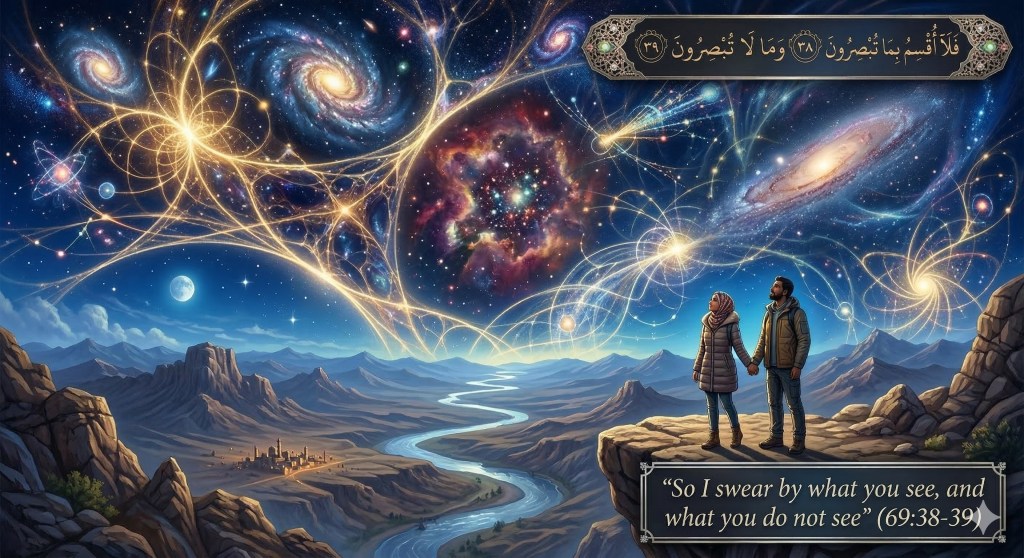
Surah Al-Haqqah’s oath—“by whatever you see” and “whatever you cannot see”—is not an ornamental flourish but a deliberate epistemic and theological move: it recruits all reality (the sensible and the hidden) as witness to the Qur’an’s claim to be revelation, while simultaneously dismantling the dominant seventh-century interpretive frames that dismissed revelation as poetry or soothsaying. This report argues that the oath’s power lies in its ability to (a) shift the listener from a “world of the visible” into a disciplined openness to unseen dimensions of existence, and (b) make the natural order itself function as courtroom testimony for the divine origin of the message—an approach emphasized in Zia H Shah’s writings on Qur’anic oaths as a “summons to attention” that pushes from the visible cosmos toward “invisible but decisive truths.”
In a culture where oral persuasion carried a unique weight, such an oath compresses into a few words what later centuries would learn repeatedly through instruments and theory: that the most consequential layers of reality are often not directly visible, yet still real, ordered, and intelligible. This does not make the Qur’an a physics textbook—an explicit caution in Shah’s “Nature’s Testimony” essay—but it does make the oath philosophically fertile for modern readers living after the microscope, telescope, and modern physics’ revolution in the concept of “the real.”
Text and exegetical anchor
The passage consists of an oath (qasam) followed immediately by the claim it is meant to secure (the jawāb / answer of the oath): the Qur’an is not poet’s craft, not soothsayer’s muttering, but “a revelation from the Lord of all worlds.”
A representative English rendering (Quran.com) reads:
- “Now, I do swear by whatever you see,” (69:38)
- “and whatever you cannot see!” (69:39)
- “Indeed, this ˹Quran˺ is the recitation of a noble Messenger.” (69:40)
- “It is not the prose of a poet ˹as you claim˺, ˹yet˺ you hardly have any faith.” (69:41)
- “Nor is it the mumbling of a fortune-teller, ˹yet˺ you are hardly mindful.” (69:42)
- “˹It is˺ a revelation from the Lord of all worlds.” (69:43)
Two interpretive details are load-bearing for a theological and philosophical reading.
First, the Qur’an swears not by one datum in nature but by a totality: the visible and the invisible together. Classical commentary preserved on Quran.com notes that this oath “comprehends the entire body of creation,” with variant views: “what you see” as the mortal world and “what you do not see” as the Hereafter, or “what you do not see” as the divine reality and attributes. This plurality in tafsīr is itself instructive: the text resists confinement to a single referent and instead establishes a schema—reality is wider than what is immediately present to perception.
Second, “word/recitation of a noble messenger” is framed, in exegetical tradition, not as authorship by the Messenger but as the function of conveyance: the messenger conveys what originates elsewhere. In Ibn Kathir’s exposition, this phrase points to the Prophet as “messenger” in the sense of transmitter, while acknowledging that the same expression is used elsewhere for the angelic messenger—underscoring that “messenger” is a role within a chain of communication, not the source of the message.
Divine oaths as rhetoric, evidence, and metaphysics
Zia H Shah’s essays repeatedly describe Qur’anic oaths as a rhetorical technology tuned to oral culture: they “grab the listener’s attention,” heighten the gravity of what follows, and invite reflection on the sign-value of the sworn object. But his more philosophically ambitious claim is stricter: Qur’anic oaths are not decorative; the object sworn by and the message that follows are “intimately connected,” turning the “book of nature” into a standing witness to the “book of scripture.”
This is not merely modern devotional language; it parallels an important line in Qur’anic oath theory associated with Farahi, summarized in a scholarly web exposition: the oath functions as dalīl (argument) and shahādah (evidence), where what is sworn by furnishes evidence for what is sworn about. In other words, the oath’s force is not “I promise harder” but “Look—reality itself is structured such that it bears witness.”
Shah’s “Celestial Testimony” piece makes this structure explicit by presenting the classical components of an oath—object sworn by (al-muqsam bihi) and claim sworn to (al-muqsam ʿalayhi)—and then interpreting their correlation as “cosmic harmony where natural laws mirror moral truths.” This framework clarifies why 69:38–43 is so concentrated: the oath is maximally inclusive (seen + unseen), while the sworn claim is maximally foundational (revelation’s divine provenance).
Within this logic, “seen and unseen” is not random poetry; it is a metaphysical statement about the scope of reality and the scope of testimony. The phrase says, in effect: the evidentiary base for this claim is not restricted to whichever objects you can point at in this moment; rather, the entire ontology—what human perception reaches and what it does not yet reach—stands under God’s dominion and can be invoked as witness.
Seventh-century Arabia and the shock-value of the unseen
A careful historical framing matters here. “Unseen” language resonates in any culture, but it lands differently in a society whose public knowledge is transmitted predominantly by speech, memory, and performance. Scholarly literature on Qur’anic rhetoric and pre-Islamic literary ecology commonly emphasizes that pre-Islamic Arabic poetry was deeply shaped within oral culture, and that the Qur’an reconfigures familiar natural motifs within a broader metaphysical framework, turning nature into “signs (āyāt)” that point beyond themselves.
At the same time, the question of how literate the early Hijaz was remains debated in modern scholarship. A recent review essay in Cambridge’s Bulletin of the School of Oriental and African Studies reports that Stephen Shoemaker’s reconstruction relies in part on the premise that “the supposed Quranic milieu of the seventh-century Hijaz was largely illiterate,” though the reviewer treats this as part of Shoemaker’s argument rather than a settled conclusion of the field. The upshot for interpretation is straightforward even without absolutizing the claim: the Qur’an’s first public life is recited and heard in a culture where oral authority was powerful, and where writing existed but did not function as the dominant everyday epistemic medium. Evidence from within Islamic historical narrative itself points to structured oral preservation alongside written recording by scribes during the Prophet’s lifetime, reinforcing that the Qur’an’s early transmission environment integrates both modalities with heavy emphasis on oral recitation.
Against that backdrop, the polemical targets in 69:41–42 become clearer. A “poet” in Arabian society was not merely an artist but a public-maker of meaning; and soothsayers (kuhhān) were associated with an ecstatic, enigmatic speech style often cast as messages from supernatural sources. Academic work on pre-Islamic soothsayers emphasizes their use of rhymed, rhythmic, formulaic utterances perceived as emanating from otherworldly beings. Classical Arabic literary reference works likewise identify sajʿ (rhymed prose) as a style connected to soothsayers that later developed into ornate prose across Islamic cultures.
So the Qur’an’s move is double: it denies the two dominant “explanatory boxes” available to its hearers (poetry and soothsaying), while grounding its claim not in esoteric secrecy, but in a universal oath that includes the unseen. This is precisely what makes the oath existentially disruptive: it insists that the ultimate validation of the revelation does not come from the performer’s charisma (poet) nor from occult technique (soothsayer), but from reality’s full breadth—visible and invisible—standing as witness to the origin of the message.
Scientific and philosophical resonance for modern readers
The user’s central intuition—that an oath “on the unseen” is uniquely arresting in a pre-instrumental world—becomes sharper when stated with precision. “Unseen” has multiple layers:
- Metaphysical unseen (God, angels, accountability, resurrection): the Qur’an consistently treats belief in the unseen as a first-order epistemic virtue; for example, it praises the God-conscious as “those who believe in the unseen.”
- Empirically unseen (entities and structures beyond unaided senses): microbes, cellular structures, distant galaxies, radiation, fields—realities accessible only via instruments and inference.
- Conceptually unseen (theoretical structures required by our best explanations): for instance, the modern physics revolution that emerged in the early twentieth century, including relativity (1905/1915) and the crystallization of quantum mechanics (mid-1920s), reconfigured what counts as “real” beyond everyday intuition.
Historically, the key point is not that seventh-century people had no contact with knowledge traditions (they did, through trade and regional networks), but that the technological mediation of reality that now feels normal was absent. The compound microscope is credited to late sixteenth-century developments, and the telescope’s documentary record begins in the early seventeenth century, centuries after the Qur’an’s first recitations.
This matters because it clarifies what “whatever you cannot see” can mean without forcing the verse into a narrow “scientific miracle” reading. The oath can be taken as an epistemological provocation: the listener is asked to treat “the unseen” not as mere fantasy, but as a real domain continuous with the seen, under the same divine sovereignty.
Zia H Shah’s corpus of oath-focused essays presses exactly this continuity. In “Night and Day as Divine Testimony,” he argues that oaths by natural phenomena function as a summons that presses from the visible cosmos toward invisible truths—oneness of God, integrity of revelation, credibility of the Prophet’s experience, and certainty of resurrection and judgment. In “Nature’s Testimony,” he adds a methodological rule: the Qur’an is not a science textbook, but it does make nature evidentiary; therefore, “well-established scientific fact” about those phenomena can enrich exegesis without displacing the text’s moral-spiritual intent, precisely because both “book of scripture” and “book of nature” point to one truth. In “Oaths by Natural Phenomena,” he frames the oaths as inviting reflection on created signs and using the order of nature “as evidence of the truth of God’s message.” And in “The Quranic Oath in the Beginning of Surah Dhariyat,” he enumerates recurring aims of oaths: emphasizing core beliefs, affirming the Qur’an’s divine origin, and validating the Prophet’s mission—precisely the triad at work in 69:38–43.
The user’s proposal that this oath acts as “prophecy” toward modern readers can be articulated (and bounded) in two responsible ways.
One is exegetical: at least one modern tafsīr line preserved on Quran.com glosses the phrase “whatever you see and whatever you do not see” as including both knowledge present at the time of revelation and knowledge that would come within human reach later—explicitly claiming that future knowledge will not contradict the Qur’an’s truth. This reading aligns with Shah’s broader claim that scientific discovery functions as a kind of retrospective “verification” of the Qur’an’s invitation to contemplate signs.
The other is scriptural-rhetorical: the Qur’an itself contains a forward-looking epistemic promise—“We will show them Our signs in the universe and within themselves until it becomes clear to them that this ˹Quran˺ is the truth.” Shah’s “By the Sky Full of Pathways” essay uses this verse (41:53) as an epigraph to frame cosmic structure as ongoing testimony, explicitly placing Qur’anic cosmological oaths in conversation with expanding human understanding of the universe. If 41:53 is read as an unfolding disclosure of signs over time, then 69:38–39 can be understood as a compact rhetorical anticipation of that unfolding: the oath already includes what you see now and what you do not yet see—an intentionally open category, capable of addressing later audiences without rewriting the verse.
A methodological caution is still necessary. “Nature’s Testimony” stresses that the Qur’an is not reducible to scientific content, even while it invites scientific reflection. The literature on “scientific miracle” apologetics (often called Bucailleism) shows why: overly specific alignments between verses and shifting scientific theories can distort both scripture and science. A peer-reviewed analysis in Zygon describes how criticisms of Bucailleism target its naïve philosophy of science and selective, tendentious readings. Even Zia H Shah’s own engagement with Maurice Bucaille is framed as “analysis” rather than simple triumphalism, recognizing that these debates are methodological as much as theological.
Within those bounds, the oath of seen/unseen becomes philosophically luminous for modernity: it refuses the reduction of reality to “what is visible,” and it refuses the reduction of knowledge to “what the tribe already knows.” In one line it affirms an epistemic humility (the real exceeds perception) and an epistemic confidence (the real is ordered, meaningful, and testifies).
Thematic epilogue
Surah Al-Haqqah’s oath by “what you see” and “what you cannot see” functions like a hinge between worlds. On one side stands a community tempted to interpret prophetic speech through familiar social categories—poet, soothsayer—while remaining anchored to what can be immediately perceived. The text answers by denying those categories and by asserting revelation from “the Lord of all worlds,” relocating the Qur’an’s source beyond human craft.
On the other side stands the modern reader, saturated with images and yet increasingly aware that the decisive layers of reality are not visible to the eye: from microscopic life to deep cosmic structure to quantum behavior and relativistic spacetime. The Qur’an’s oath does not depend on any one scientific discovery; rather, it cultivates a stable posture toward reality—listening for testimony in creation and allowing the unseen to be rationally thinkable without being trivially domesticated.
In Shah’s terms, the oath is a summons that bridges the visible order toward invisible truths, making “the book of nature” a standing witness to “the book of scripture,” while keeping clear the distinction between guidance and textbook. The result is an ethic of knowing: humility before what we do not see, gratitude for what we are permitted to see, and accountability to the One who—by the logic of the oath—governs both.
For references, please go to Microsoft Word file:

 The Glorious Quran and Science
Leave a comment