

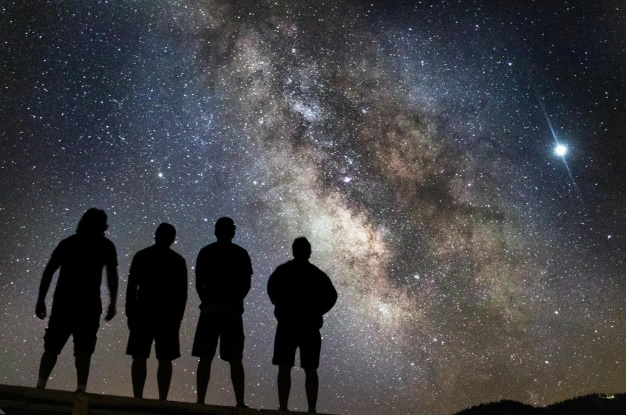
The protected ceiling: a multi-disciplinary Quranic commentary on the sky, cosmic order, and divine design
Presented by Zia H Shah MD
Abstract
This commentary presents a comprehensive multi-disciplinary analysis of five Quranic passages that address the nature, structure, and theological significance of the sky (al-samāʾ) as a divinely constructed, protected, and sustained entity. The verses examined — Surah al-Anbiyāʾ 21:32, Surah al-Infiṭār 82:1–5, Surah Qāf 50:6, Surah al-Ḥajj 22:65, and Surah al-Mulk 67:3–4 — collectively articulate a Quranic cosmology in which the heavens serve as both a physical shield for terrestrial life and a theological sign (āyah) directing human consciousness toward the Creator. Each verse is analyzed through four interlocking lenses: classical Quranic exegesis (tafsīr) drawing on the works of Ibn Kathīr, al-Ṭabarī, Fakhr al-Dīn al-Rāzī, al-Qurṭubī, and al-Zamakhsharī; philosophical dimensions encompassing Islamic natural theology, the teleological argument, and the fine-tuning of cosmic constants; theological dimensions including divine providence, occasionalism, and the eschatological dissolution of cosmic order; and scientific dimensions examining modern atmospheric science, astrophysics, and planetary protection mechanisms. A dedicated section catalogues nine distinct layers of Earth’s protection from outer space — from atmospheric ablation of meteors to the galactic habitable zone — contextualizing the Quranic concept of saqfan maḥfūẓan (“a protected ceiling”) within the nested architecture of planetary defense now understood by science. The commentary engages with the modern iʿjāz ʿilmī (scientific miraculousness) movement through the works of Maurice Bucaille and Zaghloul El-Naggar, while incorporating the critical methodological refinements proposed by Nidhal Guessoum, who advocates multi-level readings of the Quran rather than claims of specific scientific prediction. The thematic epilogue synthesizes these dimensions, arguing that the Quranic vision of a protected, beautiful, and divinely sustained cosmos invites a mode of inquiry in which empirical observation and theological reflection are not rivals but partners in the apprehension of truth.
Verse 1 — Surah al-Anbiyāʾ (21:32): the sky as a protected ceiling
Arabic text and translation
وَجَعَلْنَا ٱلسَّمَآءَ سَقْفًا مَّحْفُوظًا ۖ وَهُمْ عَنْ ءَايَٰتِهَا مُعْرِضُونَ
“We made the sky a protected ceiling, yet still they turn away from Our signs.” — M.A.S. Abdel Haleem, The Qur’an (Oxford World’s Classics)
Classical exegesis (tafsīr)
The phrase سَقْفًا مَّحْفُوظًا (saqfan maḥfūẓan) is among the most architecturally evocative descriptions of the heavens in the Quran. The word saqf literally means “roof” or “ceiling,” casting the sky as a constructed canopy over the earth, while the passive participle maḥfūẓan — “preserved,” “guarded,” “protected” — implies an external agent performing the protection: God Himself.
Ibn Kathīr (d. 774 AH / 1373 CE) explains that the sky is “a roof, safe and well-guarded,” meaning it covers the earth “like a dome or canopy” and is “high and protected from anything reaching it.” thequran He cross-references 13:2 (heavens raised without visible pillars) and 22:65 (God holding the sky from falling), treating these as an interconnected network of cosmic signs. Surah Quran He notes that the early exegete Mujāhid interpreted maḥfūẓan as “raised up,” while others connected the protection to the shooting stars (shuhub) that repel eavesdropping devils, referencing 37:6–10 and 15:17–18. thequran
Al-Ṭabarī (d. 310 AH / 923 CE), in his Jāmiʿ al-Bayān, presents the view that the sky is preserved by God’s power so that it neither collapses upon the earth nor dissipates. He cites 22:65 as internal Quranic evidence that maḥfūẓ denotes God’s active safeguarding of the sky from falling Thequranthequran — making the sky’s preservation an ongoing, continuous divine act rather than a completed event.
Al-Qurṭubī (d. 671 AH / 1273 CE) records five distinct classical interpretations of the “protected ceiling”: (1) protected by the stars from devils (shayāṭīn), quoting the linguist al-Farrāʾ; Thequran (2) preserved without the need for supporting pillars; (3) safeguarded from any creature’s ability to breach or ruin it; (4) protected from shirk and sin — the heavens, unlike the earth, contain no disobedience to God; thequran and (5) the “signs” (āyāt) referenced are the sun, moon, stars, and the cycles of day and night. Thequranthequran This range of interpretations reveals a classical consensus that the sky’s protection is multi-dimensional — physical, spiritual, and structural.
Fakhr al-Dīn al-Rāzī (d. 606 AH / 1209 CE) synthesizes these views in his Mafātīḥ al-Ghayb, emphasizing that all interpretations converge on a single theological point: God’s power and wisdom (ḥikma) in constructing the heavens. The sky’s design — held aloft without pillars, untouchable by worldly means — reflects what al-Rāzī calls tadbīr: intentional divine planning that maintains the universe’s harmony. Thequran
Philosophical dimensions
This verse constitutes one of the Quran’s clearest expressions of what Islamic philosophers call dalīl al-ʿināyah — the argument from providence or design. Ibn Rushd (Averroes, d. 1198 CE) considered this the strongest and most Quranically grounded proof for God’s existence, Muslim Philosophy arguing in Al-Kashf ʿan Manāhij al-Adillah that “the aim of philosophy is nothing other than the consideration of existing things and their examination, insofar as they manifest the Creator.” muslimphilosophy The sky as saqfan maḥfūẓan functions as precisely such a manifest sign: a structure whose protective function implies intentional engineering by an intelligent agent.
The teleological resonance deepens when read alongside the modern fine-tuning argument. The physical constants that permit Earth’s atmosphere to exist — the strength of gravity, the electromagnetic force governing molecular bonding, the mass of the planet enabling atmospheric retention — fall within extraordinarily narrow ranges. Philosophy Institute The sky is not merely “a ceiling” but a ceiling whose existence depends on a cascade of precisely calibrated parameters. Al-Ghazālī’s (d. 1111 CE) insistence in the Iḥyāʾ that “anyone who reflects on the amazing creation of the earth and heavens would come to realize that this wonderful regularity could not be independently run without an intelligent and creative being” Wikishia anticipates, in theological language, what physicists now formalize as the anthropic fine-tuning problem.
The passive construction of maḥfūẓan carries philosophical weight. The sky is not self-protecting; it is made to be protected — a distinction that separates Islamic cosmology from both ancient Greek self-sustaining cosmos models and modern deism. thequranQuranFaith The universe, in this framework, is radically contingent: it requires an external sustainer. Wikipedia
Theological dimensions
The verse’s closing phrase — وَهُمْ عَنْ ءَايَٰتِهَا مُعْرِضُونَ (“yet still they turn away from Our signs”) — transforms the cosmological observation into a moral indictment. The Arabic āyāt functions doubly: as the physical “signs” embedded in the sky (sun, moon, stars, protective function) and as the Quranic verses describing them. Thequranthequran To turn away from the sky’s signs is simultaneously to ignore both natural evidence and scripture. Seyyed Hossein Nasr articulates this principle as the concept of a “cosmic Quran” — nature itself is a revelation, its phenomena are āyāt just as the verses of the Book are āyāt, IslamiCity and both “speak forth the presence and the work of God.” Islam-science
Theologically, the concept of ḥifẓ (preservation) in this verse connects to the divine names al-Ḥāfiẓ (The Preserver) and al-Muhaymin (The Guardian). God is not merely the originator (al-Khāliq) of the sky but its ongoing sustainer (al-Razzāq), a distinction fundamental to Islamic theology’s rejection of deism.
Scientific dimensions
Modern atmospheric science reveals that the sky functions as a literal protective ceiling through multiple overlapping mechanisms. thequran The atmosphere absorbs nearly all incoming X-rays, gamma rays, and UV-C radiation. Islamweb The ozone layer blocks 97–99% of the Sun’s medium-frequency ultraviolet light. The magnetosphere deflects the solar wind — a torrent of charged particles traveling at 400–800 km/s that would otherwise strip away the atmosphere entirely, as occurred on Mars after it lost its magnetic field approximately 4 billion years ago. Thequran +2 The mesosphere incinerates an estimated 48.5 tons of meteoritic material daily, with roughly 95% of all incoming space debris destroyed before reaching the surface. Sciencing
Proponents of iʿjāz ʿilmī such as Zaghloul El-Naggar Thequran and followers of Maurice Bucaille argue that the description saqfan maḥfūẓan is scientifically prescient — no 7th-century observer could have known about the ozone layer, the magnetosphere, or solar wind. Thequran Nidhal Guessoum, while acknowledging the resonance, proposes a more methodologically cautious approach: Cosmos on Nautilus the Quran’s layered language permits readings compatible with modern science without requiring a claim of specific scientific prediction. PhilPapers +2 The most defensible scholarly position recognizes that the verse’s language is genuinely consistent with what we now know about atmospheric protection, while understanding this consistency as a feature of the Quran’s multi-level semantic richness rather than a narrow scientific forecast.
Verse 2 — Surah al-Infiṭār (82:1–5): the eschatological unmaking of the sky
Arabic text and translation
إِذَا ٱلسَّمَآءُ ٱنفَطَرَتْ ﴿١﴾ وَإِذَا ٱلْكَوَاكِبُ ٱنتَثَرَتْ ﴿٢﴾ وَإِذَا ٱلْبِحَارُ فُجِّرَتْ ﴿٣﴾ وَإِذَا ٱلْقُبُورُ بُعْثِرَتْ ﴿٤﴾ عَلِمَتْ نَفْسٌ مَّا قَدَّمَتْ وَأَخَّرَتْ ﴿٥﴾
“When the sky is torn apart, when the stars are scattered, when the seas are made to explode, when the graves are opened, each soul will know what it has sent ahead and what it has left behind.” — M.A.S. Abdel Haleem
Classical exegesis (tafsīr)
These verses open with a sequence of four catastrophic conditional clauses — each beginning with idhā (“when”) — that accelerate toward the final reckoning in verse 5. The rhetorical structure itself mimics the cascading chaos it describes: short, percussive clauses shattering the reader’s sense of stability.
Ibn Kathīr interprets infaṭarat (ٱنفَطَرَتْ) straightforwardly as “splits” or “is cleft asunder,” cross-referencing 73:18 and 84:1. My Islam On the stars’ scattering (intatharat), he explains they “scatter and fall from their places.” For the seas (fujjirat), he records multiple interpretations from Ibn ʿAbbās (“God will cause some of it to burst forth over other parts of it”), al-Ḥasan (“its water will go away”), and Qatādah (“its fresh water will mix with its salt water”). Quran.com Ibn Kathīr also transmits a ḥadīth from Imām Aḥmad, via Ibn ʿUmar, in which the Prophet ﷺ said: “Whoever would be pleased to look at the Day of Resurrection with his own eyes, let him recite [Surahs 81, 82, and 84].” Wikipedia
Al-Ṭabarī records Ibn ʿAbbās’s striking interpretation of the stars’ scattering: “they fall black, with no light in them” WordPress (تسقط سوداء لا ضوء لها). wordpress This is not merely spatial dispersion but total luminous extinction — the stars do not simply move but die, losing the very light that defined them. The image is one of absolute cosmic darkness preceding the new creation.
Commentators note that infaṭarat can mean both “split apart” and “vanished, became abolished entirely,” wordpressWordPress suggesting that the eschatological event transcends mere physical damage — it is ontological annihilation. The sky does not merely crack; it ceases to exist as a coherent structure.
Philosophical dimensions
The philosophical power of these verses lies in the contrast they establish with the present cosmic order described in 21:32, 50:6, and 67:3–4. The drama of the sky being “torn apart” presupposes that it is currently intact — ordered, structured, and functionally coherent. The eschatological dissolution reveals what philosophy calls the radical contingency of the created order: the cosmos does not exist necessarily. Its stability is not an inherent property but a granted condition, maintained moment by moment by divine will and revocable by the same will.
This connects to Ashʿarī occasionalism, the theological doctrine that God recreates the universe at every instant. Al-Ghazālī argued in the Tahāfut al-Falāsifah that Thequran the relation between what we observe as cause and effect is “merely one of correlation and is purely contingent; the one real, productive cause of all things is God.” Muslim Philosophy The sky’s present coherence and its future dissolution are not governed by different metaphysical principles — both are direct expressions of divine will. The sky stands firm not because of intrinsic structural necessity but because God wills it so. When God ceases to will its stability, it simply ceases to be stable.
The contrast between cosmic beauty and cosmic destruction also raises what might be called the aesthetics of contingency: the present universe’s beauty is rendered more profound, not less, by its impermanence. Just as a flower’s beauty is deepened by its transience, the sky’s current perfection — “no rifts,” “no flaws” — gains philosophical gravity from the knowledge that it will one day be unmade.
Theological dimensions
Eschatologically, these verses belong to the Quran’s extensive apocalyptic corpus describing the events preceding the Day of Judgment (Yawm al-Qiyāmah). Islam365 +2 The dissolution of the sky is not a natural process but a divinely orchestrated deconstruction: the same God who built the sky with no rifts (50:6) will tear it apart by His command. This establishes the theological principle that creation and annihilation are symmetrical expressions of divine omnipotence.
The final verse — “each soul will know what it has sent ahead and what it has left behind” — shifts from cosmology to moral accountability. The unmaking of the physical universe serves as the precondition for the ultimate moral reckoning. wordpress The Quran thus frames the physical cosmos as inherently oriented toward a moral purpose: it exists not as an end in itself but as a stage upon which the drama of human moral choice unfolds, and its dissolution marks the transition from trial to judgment.
Scientific dimensions
While these verses are primarily eschatological and not typically invoked in iʿjāz ʿilmī discourse, some contemporary commentators have noted intriguing parallels with scientific scenarios of cosmic termination. The “sky being torn apart” has been compared to the theoretical Big Rip — a cosmological model in which accelerating dark energy expansion eventually tears apart galaxies, stars, atoms, and spacetime itself. The “stars scattered” resonates with the reality of stellar death: stars do exhaust their nuclear fuel, collapse as white dwarfs, neutron stars, or black holes, and can be scattered by gravitational disruption of galaxies. The “seas exploding” has been loosely connected to the extreme tidal forces and heating events that would accompany certain catastrophic astrophysical scenarios.
However, most mainstream Muslim scholars maintain that these verses describe supernatural eschatological events beyond the scope of natural science. The verse’s primary function is theological, not predictive — it establishes that the present cosmic order, however magnificent, is temporary and subject to divine prerogative.
Verse 3 — Surah Qāf (50:6): the sky without rifts
Arabic text and translation
أَفَلَمْ يَنظُرُوا إِلَى ٱلسَّمَآءِ فَوْقَهُمْ كَيْفَ بَنَيْنَٰهَا وَزَيَّنَّٰهَا وَمَا لَهَا مِن فُرُوجٍ
“Have they not looked at the sky above them – how We constructed it and made it beautiful and how there are no rifts in it?” — M.A.S. Abdel Haleem
Classical exegesis (tafsīr)
Three key terms structure this verse’s meaning. Banaynāhā (بَنَيْنَٰهَا, “We constructed/built it”) employs the language of deliberate architectural construction — the sky is not a natural accident but a built structure. Zayyannāhā (زَيَّنَّٰهَا, “We made it beautiful/adorned it”) refers, according to classical consensus, to the stars, understood as both aesthetic ornaments and functional markers. Furūj (فُرُوجٍ, “rifts, gaps, cracks”) derives from farj — an opening or gap — and its negation asserts the seamless integrity of the celestial structure.
Ibn Kathīr explains that God here “notifies the servants of His infinite power, which He demonstrated by creating what is bigger than that which they wondered about.” On furūj, he quotes Mujāhid (via al-Ṭabarī 22:332): the word means “clefts” (shuqūq), while “others said that furūj means rifts or cracks. All these meanings are close to one another.” honey for the heart He then cross-references 67:3–4, emphasizing that the sky is “flawless, without any imperfection or shortcoming.”
Al-Ṭabarī interprets the verse’s opening — afalām yanẓurū (“Have they not looked?”) — as a direct call to empirical observation: a divine argument from observable evidence. The sky above is presented as proof of God’s power; its construction is seamless, beautiful, and without any cracks visible to the human eye.
The classical understanding of “beautification” (zīnah) uniformly identifies the stars as the sky’s adornment, honey for the heart connecting to 37:6 (“We have adorned the nearest heaven with stars”) and 67:5 (“We have beautified the nearest heaven with lamps”). This beauty is simultaneously aesthetic and functional — the stars serve as ornament, navigational aids, and, in the classical spiritual understanding, projectiles against eavesdropping jinn.
Philosophical dimensions
The verse’s most philosophically significant feature is its epistemological framework: afalām yanẓurū — “Have they not looked?” This is not a casual question but a theological rebuke framed as an empirical challenge. Disbelief, the verse implies, is an epistemic failure — a refusal to attend to evidence that is plainly visible. Thequran The sky above is treated as publicly accessible data that any rational observer can evaluate.
This aligns with what Islamic philosophers call istiḍlāl — evidence-based argumentation from the observed features of creation. Ibn Rushd championed this approach, arguing that “revelation definitely enjoins the consideration of existing things” muslimphilosophyMuslim Philosophy and that the study of nature is not merely permitted but religiously obligatory for those capable of it. The verse thus establishes a remarkable epistemological principle: looking at the natural world is a theological act, and empirical observation is a pathway to knowledge of God.
The assertion that the sky has “no rifts” (mā lahā min furūj) raises the philosophical concept of structural perfection — the absence of gaps, inconsistencies, or failures in a system. In Aristotelian terms, the sky perfectly realizes its intended form (ṣūrah). In modern philosophical terms, it exhibits what design theorists call “specified complexity”: a system whose components are arranged in a functionally integrated pattern that resists explanation by chance alone.
The aesthetic dimension — zayyannāhā — adds a layer that transcends mere functionality. The sky is not only protective and structurally sound; it is beautiful. Al-Fārābī (d. 950 CE) argued in Al-Madīna al-Fāḍilah that beauty is primarily ontological: “the more any being attains its final perfection, the more beautiful it is.” Muslim Philosophy The sky’s beauty, then, is a manifestation of its perfect realization of divine intent — a visible sign of invisible wisdom.
Theological dimensions
The verse’s context is critical: it appears in Surah Qāf, which opens with the disbelievers’ astonishment that the dead could be resurrected. God’s response is to direct their attention upward: if He can construct something as vast and flawless as the sky, can He not reconstruct a human body? My Islam The sky functions here as a minor-to-major argument (qiyās awlawī): the God who built the greater (the heavens) can certainly accomplish the lesser (resurrection). This rhetorical strategy is a hallmark of Quranic theological argumentation.
The notion of the sky as “without rifts” also connects to the broader Quranic theme of itqān al-ṣunʿ — the perfection of divine craftsmanship. Quran 27:88 states: “It is the work of God, who has perfected everything” (ṣunʿa Allāhi alladhī atqana kulla shayʾ). The sky without gaps is one instance of a universe in which every detail is precisely calibrated — a theological claim that resonates with the modern concept of fine-tuning.
Scientific dimensions
The assertion that the sky has “no rifts” finds interesting correspondence in atmospheric science. Earth’s atmosphere provides continuous, seamless coverage — there are no gaps or holes through which space radiation freely penetrates to the surface. The atmosphere transitions smoothly from one layer to the next (troposphere to stratosphere to mesosphere to thermosphere to exosphere), with each layer contributing its own protective function. Even the so-called “ozone hole” over Antarctica is not a literal hole but a region of reduced ozone concentration; the atmosphere itself remains physically continuous.
The magnetosphere similarly provides unbroken coverage, extending tens of thousands of kilometers into space on the sunward side and millions of kilometers in the magnetotail. The Van Allen radiation belts create toroidal shields of trapped charged particles that encircle the entire planet. Thequran Modern satellite observation confirms that these protective systems operate without spatial gaps — they are, in the language of the verse, without rifts.
Verse 4 — Surah al-Ḥajj (22:65): God holds the sky from falling
Arabic text and translation
…وَيُمْسِكُ ٱلسَّمَآءَ أَن تَقَعَ عَلَى ٱلْأَرْضِ إِلَّا بِإِذْنِهِۦٓ…
“…He holds the sky from falling on the earth without His permission…” — M.A.S. Abdel Haleem
Classical exegesis (tafsīr)
The verb يُمْسِكُ (yumsiku) — “He holds, withholds, restrains, sustains” — from the root m-s-k (to grasp, hold fast) is the central operative term. It conveys active, ongoing restraint: God is not described as having once established the sky’s stability but as continuously holding it in place.
Ibn Kathīr provides the fullest commentary: “If He willed, He could give the sky permission to fall on the earth, and whoever is in it would be killed, but by His kindness, mercy, and power, He withholds the heaven from falling on the earth.” Surah Quran +2 In his tafsīr of the parallel verse 13:2, Ibn Kathīr records that Iyās ibn Muʿāwiyah said: “The heaven is like a dome over the earth” — without pillars, sustained purely by divine power. QuranX +2 The phrase إِلَّا بِإِذْنِهِ (“except by His permission”) is understood as a temporal limit: the sky will be “permitted” to fall only at the Day of Judgment. QuranX
Al-Ṭabarī connects this verse to 35:41 — “Verily, God grasps the heavens and the earth lest they should move away from their places” Al-Islam — establishing a Quranic pattern of divine cosmic restraint. He reports that the caliph ʿUmar ibn al-Khaṭṭāb used to swear: “By the One by Whose command the heaven and the earth stand,” reflecting the earliest Muslim understanding that cosmic stability is a direct product of divine command. Quran.com
The Tanwīr al-Miqbās (attributed to Ibn ʿAbbās) interprets: “He prevents the heaven from falling on the earth until the Day of Judgment.” QuranX Mawdūdī broadens the referent, explaining that “the heaven” here implies “the whole of the universe above and below the earth, where everything is held in its own place and sphere.” My IslamSurah Quran
Philosophical dimensions
This verse marks one of the sharpest divergences between Islamic theology and deism. Deism conceives of God as a “clockmaker” who designs the universe, sets it in motion, and withdraws. The Quranic yumsiku envisions the opposite: God’s sustaining action is continuous and indispensable. The sky does not persist by its own structural integrity or by natural laws operating independently; it persists because God actively holds it in place at every moment.
This aligns precisely with Ashʿarī occasionalism, articulated most forcefully by al-Ghazālī. In this framework, what we call “natural laws” are really God’s customary patterns (ʿādah) — habits He freely maintains but could alter at any moment. Thequran Gravity does not “hold” the atmosphere in place independently; rather, God wills the phenomenon we describe as gravitational attraction at each instant. The “laws of physics” are, theologically speaking, descriptions of divine consistency, not autonomous forces.
The philosophical implication is profound: the universe is not merely created (a past-tense event) but continuously sustained (a present-tense action). This ontological dependence means that existence itself is a gift renewed at every moment Stanford Encyclopedia of Philosophy — a concept that al-Ghazālī developed into a full metaphysics of radical contingency, and that the 20th-century physicist-theologian Basil Altaie has connected to quantum mechanical indeterminacy, proposing that moment-by-moment divine re-creation could underlie quantum phenomena. Cosmos on Nautilus
The exception clause — “except by His permission” — introduces an element of divine freedom: God is not constrained by the order He maintains. He could, at any moment, allow the sky to fall. The present stability of the cosmos is thus an expression of mercy (raḥmah), not necessity — a theological point Ibn Kathīr explicitly makes. Surah QuranQuranX
Theological dimensions
The verse embodies the Islamic doctrine of imsakiyyah — divine holding or sustaining — which positions God as the active maintainer of all cosmic processes. This goes beyond the theological concept of creation (khalq) to encompass preservation (ḥifẓ) and governance (tadbīr). mehbooba The divine name al-Muqīt (The Sustainer) captures this function: God does not merely initiate existence but nourishes and maintains it continuously.
The eschatological “exception” — that the sky will be permitted to fall at the End Times — creates a theological arc connecting this verse to 82:1–5. The same God who holds the sky now will release it then, demonstrating sovereignty over both cosmic order and cosmic dissolution. The present stability of the heavens becomes, paradoxically, evidence of the same divine power that will dismantle them.
Scientific dimensions
Modern physics reveals multiple mechanisms by which the “sky” — understood as both the atmosphere and the broader cosmic environment — is “held” from falling. Earth’s gravitational field (surface acceleration: 9.81 m/s², escape velocity: 11.2 km/s) NAAP Astronomy Labs holds the atmosphere bound to the planet. This gravitational retention depends critically on Earth’s mass (~5.97 × 10²⁴ kg): significantly less mass would result in atmospheric loss, as occurred on Mars (escape velocity: only 5.0 km/s, current surface pressure less than 1% of Earth’s). Iere
At the cosmic scale, orbital mechanics hold celestial bodies in stable configurations. Answering Islam The balance between gravitational attraction and orbital velocity prevents the Moon from falling to Earth, prevents Earth from spiraling into the Sun, and maintains the architecture of the entire solar system. The stability of these orbits over billions of years depends on precisely calibrated gravitational relationships — what physicists describe as dynamic equilibrium.
The phrase “holds the sky from falling” thus resonates with a multi-scale physical reality: gravity holds the atmosphere in place, orbital mechanics hold celestial bodies in stable paths, and the fine-tuning of fundamental constants holds the cosmic structure together. Whether one reads “holds” as describing these physical mechanisms or as describing the divine will that underlies them, the verse captures a genuine feature of the universe’s architecture.
Verse 5 — Surah al-Mulk (67:3–4): seven heavens without flaw
Arabic text and translation
ٱلَّذِى خَلَقَ سَبْعَ سَمَٰوَٰتٍ طِبَاقًا ۖ مَّا تَرَىٰ فِى خَلْقِ ٱلرَّحْمَٰنِ مِن تَفَاوُتٍ ۖ فَٱرْجِعِ ٱلْبَصَرَ هَلْ تَرَىٰ مِن فُطُورٍ ﴿٣﴾ ثُمَّ ٱرْجِعِ ٱلْبَصَرَ كَرَّتَيْنِ يَنقَلِبْ إِلَيْكَ ٱلْبَصَرُ خَاسِئًا وَهُوَ حَسِيرٌ ﴿٤﴾
“He who created seven heavens, one above the other. You will not see any flaw in what the Lord of Mercy creates; look again – can you see any rifts? Look again and again – your sight returns to you, dazzled and worn out.” — M.A.S. Abdel Haleem
Classical exegesis (tafsīr)
This passage is one of the Quran’s most remarkable: a divine challenge to the human observer to scrutinize creation as thoroughly as possible and find any imperfection.
The key terms demand careful analysis. Tibāqan (طِبَاقًا) means “in layers” or “one above another” — the seven heavens are stacked concentrically. Tafāwut (تَفَاوُتٍ) denotes “disproportion, incongruity, inconsistency” — two things being out of accord with each other. Fuṭūr (فُطُورٍ) means “cracks, rifts, fissures” — related to furūj in 50:6 but with an additional connotation of structural breaking. Khāsiʾan (خَاسِئًا) means “humiliated, dazzled, despised.” Ḥasīr (حَسِيرٌ) means “worn out, exhausted, fatigued.”
Ibn Kathīr provides extensive commentary. On the seven heavens, he describes a concentric cosmological structure where each heaven encompasses the one below it: “The distance between the first heaven and the earth is five hundred years from every direction… and its thickness is also five hundred years.” On tafāwut, he affirms that no defect or flaw exists in creation. On fuṭūr, he quotes Qatādah: “Do you see any defects, O Son of Adam?” The climactic description — sight returning “dazzled and worn out” — signifies that “if you continuously looked, no matter how much you look, your sight will return to you khāsiʾ due to the inability to see any flaw, and ḥasīr — meaning exhausted and broken down in feebleness due to the great amount of repeated looking without being able to detect any deficiency.”
Mawdūdī provides a particularly lucid synthesis of the classical view. On tafāwut: “You will not see any indiscipline, any disorder and discordance anywhere in the universe; there is nothing disjointed and out of proportion.” On fuṭūr: “The whole universe is so closely well-knit and everything in it, from a particle on the earth to the huge galaxies, so well connected and coherent that the continuity of the system of the universe seems to break nowhere, however hard one may try to probe and investigate.”
Philosophical dimensions
The verse’s double challenge — “look again… look again and again” — is philosophically extraordinary. It represents a divine invitation to empirical investigation predicated on absolute confidence in creation’s perfection. This is not a faith claim that avoids scrutiny; it is a faith claim that demands scrutiny, asserting that the more closely one examines the universe, the more one will find order rather than chaos.
This resonates powerfully with the fine-tuning argument in contemporary philosophy of religion. The physical constants of the universe — the cosmological constant, the strength of the strong nuclear force, the ratio of electromagnetic force to gravitational force — are calibrated within ranges so narrow that physicist Roger Penrose calculated the odds of the universe’s low-entropy initial conditions occurring by chance at approximately 1 in 10^(10^123). The Quran’s challenge to “find a flaw” anticipates, in theological language, what modern physics confirms empirically: the universe exhibits a degree of order and coherence that resists explanation by chance.
The concept of tafāwut — the absence of disproportion — connects to the Islamic philosophical tradition of aesthetic perfection. Al-Fārābī argued that beauty is ontological: the more perfectly a being realizes its nature, the more beautiful it is. God’s beauty, being “essential, not accidental,” surpasses all other beauty because “the source of God’s beauty is His own substance.” The universe’s absence of tafāwut thus reflects the beauty of its Maker — a philosophical point that transforms cosmology into theology.
The outcome — sight returning “dazzled and worn out” — encodes an epistemological principle: human cognitive faculties are overwhelmed by the scale and depth of cosmic order. This is not anti-intellectual obscurantism but a recognition of epistemic limits: the universe is more perfect than human perception can fully grasp. Every new layer of investigation reveals further order, from the macroscopic to the quantum level, until the investigator’s capacity — not the creation’s coherence — is exhausted.
Theological dimensions: the seven heavens
The concept of sabʿa samāwāt (سَبْعَ سَمَاوَاتٍ, “seven heavens”) has generated extensive classical and modern commentary. Classical scholars generally understood the seven heavens as literal, concentric celestial structures — each a physical dome or sphere surrounding the one below it. This mapped onto the Ptolemaic cosmological model prevalent in medieval Islamic civilization, where planetary spheres were stacked concentrically around the earth.
Modern interpreters have proposed several alternative readings. Some correlate the seven heavens with atmospheric layers (troposphere, stratosphere, mesosphere, thermosphere, exosphere, ionosphere, and magnetosphere), though this faces the objection that standard atmospheric science recognizes five primary layers, not seven, and the Quran places stars “in the lowest heaven” (41:12), which cannot be an atmospheric layer. Others propose cosmic tiers — the solar system, the Milky Way, the local group, and successively larger cosmic structures. Still others argue that “seven” (sabʿah) in Arabic conventionally signifies completeness and multiplicity rather than a precise numerical count — a usage well attested in classical Arabic literature and ḥadīth.
The strongest scholarly position, articulated by Guessoum and others, holds that the “seven heavens” resist definitive identification with any single scientific scheme. The Quran’s language is open enough to accommodate multiple readings across eras, and insisting on one specific scientific mapping risks both misreading the text and subordinating it to a scientific framework that may itself change.
Scientific dimensions
The challenge to “find a flaw” in creation resonates with the scientific observation that the universe’s fundamental structure is governed by remarkably consistent and mathematically elegant laws. The Standard Model of particle physics describes the behavior of all known fundamental particles and three of the four fundamental forces with extraordinary precision. General relativity describes gravity with a precision tested to one part in 10 trillion. The cosmic microwave background radiation — the afterglow of the Big Bang — is uniform to one part in 100,000 across the entire observable universe, reflecting initial conditions of staggering homogeneity.
At the atmospheric level, the “layered” structure (ṭibāqan) of the heavens finds a concrete parallel in Earth’s atmosphere, which is stratified into distinct thermal and compositional layers, each performing specific protective functions in a hierarchical arrangement. The seamlessness of this arrangement — no gaps between layers, no point at which protection fails — corresponds to the verse’s assertion of an absence of fuṭūr (rifts).
Earth’s protective mechanisms: the architecture of the “protected ceiling”
The Quranic description of the sky as saqfan maḥfūẓan — a protected ceiling — finds its most comprehensive scientific elaboration in the nested series of protective mechanisms that shield Earth from the dangers of outer space. These operate across scales ranging from molecular chemistry to galactic structure, forming what might be called a multi-layered architecture of planetary defense.
The atmosphere: five layers of graduated protection
Earth’s atmosphere, with a total mass of approximately 5.15 × 10¹⁸ kg, constitutes the planet’s first and most direct line of defense against space-borne threats. It divides into five principal layers defined by temperature gradients, each contributing distinct protective functions.
The troposphere extends from the surface to roughly 12 km altitude (18–20 km at the equator, 6 km at the poles) and contains approximately 75% of the atmosphere’s total mass and 99% of its water vapor. Temperature decreases with altitude at roughly 6.5°C per kilometer, from an average surface temperature of 17°C to approximately −51°C at the tropopause. This densest layer provides the initial deceleration of incoming debris, moderates surface temperatures through the greenhouse effect, and sustains nearly all weather systems that distribute heat across the planet.
The stratosphere (12–50 km) contains roughly 19% of atmospheric gases and hosts the ozone layer — the primary shield against ultraviolet radiation. Temperature increases with altitude here, rising from −51°C at its base to roughly 0°C near the stratopause, precisely because ozone absorbs UV energy and converts it to heat. This thermal inversion creates a stable barrier that suppresses vertical mixing, effectively sealing the lower atmosphere from the upper layers.
The mesosphere (50–85 km) is the atmosphere’s primary meteor defense zone. Temperature again decreases with altitude, reaching the coldest temperatures in the Earth system: approximately −85°C to −90°C at the mesopause. Though its gases are thin — pressure is well below 1% of sea level — they are dense enough to cause frictional heating and ablation of incoming meteoroids, with most burning up at altitudes of 80–120 km.
The thermosphere (80–500/1,000 km) absorbs the most energetically dangerous forms of solar radiation — X-rays and extreme ultraviolet (EUV). Temperatures here reach 500°C to 2,000°C or higher during intense solar activity, though the extreme low molecular density means little heat is actually transferred. The International Space Station orbits within this layer (370–460 km). The ionosphere, overlapping largely with the thermosphere, contains ionized gas particles that reflect radio waves and contribute to the aurora borealis and australis.
The exosphere (500/1,000 km to approximately 10,000 km, with some definitions extending it to 190,000 km — nearly halfway to the Moon) marks the gradual transition from Earth’s atmosphere to interplanetary space. Composed almost entirely of hydrogen and helium atoms so sparse they can travel a kilometer without collision, this outermost layer hosts many orbiting satellites and represents the atmosphere’s final, tenuous frontier.
The ozone layer: Earth’s ultraviolet shield
Concentrated in the stratosphere between 15 and 35 km altitude, the ozone layer is a region of enhanced O₃ concentration that constitutes Earth’s primary defense against ultraviolet radiation. Despite being a trace gas — if compressed to sea level pressure, the entire ozone column would form a layer only 3 mm thick — ozone performs a disproportionately critical function. The global average ozone column measures approximately 300 Dobson Units (DU), with normal values ranging from 250 to 450 DU.
The protective chemistry operates through the Chapman cycle: molecular oxygen (O₂) is photolyzed by UV-C radiation into atomic oxygen (O), which recombines with O₂ to form O₃. Ozone then absorbs UV radiation in the 200–310 nm wavelength range, dissociating back into O₂ and O in a continuous cycle. The result is that all UV-C radiation (100–280 nm) — the most biologically destructive wavelength — is completely blocked before reaching the surface. Approximately 95% of UV-B (280–315 nm) is absorbed, with the attenuation at 290 nm reaching a factor of 350 million between the top of the atmosphere and the surface. Without this layer, UV radiation would destroy DNA, sterilize surfaces, and render terrestrial ecosystems impossible.
The magnetosphere and Van Allen belts: deflecting the solar wind
Generated by convective currents of liquid iron and nickel in Earth’s outer core — the geodynamo — Earth’s magnetic field projects a protective bubble extending tens of thousands of kilometers into space. The magnetopause sits at approximately 10 Earth radii (~65,000 km) on the sunward side, while the magnetotail stretches millions of kilometers downwind of the solar wind.
The magnetosphere deflects the solar wind — a continuous torrent of charged particles (mainly protons and electrons) traveling at 400–800 km/s — and attenuates galactic cosmic rays. Embedded within it are the Van Allen radiation belts, discovered by James Van Allen in 1958 using Explorer 1 data. The inner belt (640–12,000 km) contains high-energy protons exceeding 100 MeV, primarily produced through cosmic ray albedo neutron decay. The outer belt (13,000–60,000 km) traps high-energy electrons from the solar wind, with greatest intensity at 4–5 Earth radii. A transient third belt was discovered by the Van Allen Probes mission in 2012.
Mars provides the cautionary counterexample. After losing its global magnetic field approximately 4 billion years ago when its internal dynamo cooled and shut down, Mars’s atmosphere was progressively stripped away by the solar wind — a process confirmed by NASA’s MAVEN mission. Mars’s surface pressure today is less than 1% of Earth’s, starkly illustrating the magnetosphere’s indispensability.
Earth’s gravity: the invisible chain holding the atmosphere
Earth’s gravitational field, producing a surface acceleration of 9.81 m/s² and an escape velocity of 11.2 km/s, is the fundamental mechanism binding the atmosphere to the planet. Whether any atmospheric molecule escapes depends on the ratio of its thermal velocity to the planet’s escape velocity: if the average thermal velocity of a gas species exceeds approximately one-sixth of the escape velocity at the exobase temperature, that gas leaks away over geological time.
For Earth, heavy molecules (N₂, O₂, CO₂, H₂O) have thermal velocities far below this threshold and are firmly gravitationally bound. Only the lightest species — hydrogen and helium — slowly escape, at a rate of roughly 93,000 tonnes of hydrogen per year. Earth’s mass of approximately 5.97 × 10²⁴ kg produces a gravitational field strong enough to retain a thick nitrogen-oxygen atmosphere over billions of years. The Moon, with an escape velocity of only 2.4 km/s, cannot retain any substantial atmosphere. Mars, at 5.0 km/s, has lost the vast majority of its atmospheric envelope. Jupiter, at 59.5 km/s, retains even hydrogen and helium. Earth occupies the critical middle ground: massive enough to keep its atmosphere, not so massive that it becomes a gas giant.
The Moon: stabilizer of Earth’s axial tilt
Earth’s Moon (diameter 3,476 km, mass approximately 1/81 of Earth’s) performs a protective function that is subtle but foundational: it stabilizes Earth’s axial tilt. Earth’s current obliquity of 23.4° varies by only 2.4° (between 22.1° and 24.5°) over a 41,000-year cycle — a remarkable stability due to the Moon’s gravitational pull on Earth’s equatorial bulge. In 1993, French mathematicians Jacques Laskar and Philippe Robutel demonstrated that without the Moon, Earth’s obliquity could vary chaotically between 0° and 85° due to gravitational perturbations from the Sun, Venus, and Jupiter. Such extreme variations would produce catastrophic climate instability, making the evolution of complex life exceedingly unlikely.
Mars, with only two tiny captured-asteroid moons (Phobos and Deimos) providing negligible gravitational stabilization, has experienced obliquity swings between approximately 10° and 60°, contributing to dramatic climatic oscillations. The Moon also generates ocean tides approximately twice as strong as solar tides, driving currents that transport heat from equator to poles and moderating global climate. Its cratered surface records billions of years of impacts from objects that might otherwise have struck Earth, providing a limited but real physical shielding effect.
Jupiter: the solar system’s gravitational sentinel
Jupiter, the solar system’s largest planet at 318 Earth masses, has long been credited with shielding the inner solar system from dangerous comets and asteroids. The evidence, however, is more nuanced than the popular “Jupiter shield” narrative suggests.
Jupiter’s enormous gravitational field attracts and captures or ejects many small bodies. The cometary impact rate on Jupiter is estimated at 2,000–8,000 times higher than on Earth. The spectacular 1994 impact of Comet Shoemaker-Levy 9 — a ~1.5–2 km comet that was captured, tidally fragmented into 21+ pieces, and slammed into Jupiter at 221,000 km/h, releasing energy equivalent to 300 million atomic bombs — dramatically demonstrated Jupiter’s gravitational dominance. Had an equivalent object struck Earth, the consequences would have rivaled the Cretaceous–Paleogene extinction event.
However, research by Kevin Grazier (NASA JPL) and Jonti Horner has complicated this picture. Grazier’s simulations demonstrate that Jupiter is “just as likely to send comets at Earth as deflect them away” — it creates Jupiter Family Comets by capturing trans-Neptunian objects into short-period, Earth-crossing orbits even as it deflects others. The current scientific consensus is that Jupiter acts as both shield and sniper, effective at deflecting long-period Oort Cloud comets while simultaneously creating new short-period threats. Its most important contribution to habitability may have been delivering volatiles (water and organics) to the early Earth rather than purely protecting it.
Meteor ablation: the mesosphere’s daily defense
Earth’s atmosphere serves as a remarkably effective incinerator of incoming space debris through the process of ablation. An estimated 25 million meteoroids and other particles enter the atmosphere daily, totaling approximately 48.5 tons (44,000 kg) of meteoritic material per day — roughly 15,000–44,000 tonnes per year.
When meteoroids enter at hypersonic velocities between 11 and 72 km/s (averaging ~20 km/s), the air ahead is compressed adiabatically, heating to extreme temperatures that cause the surface material to vaporize, ionize, and glow — the “shooting star” phenomenon. This is primarily compressive heating, not friction. Most meteors begin glowing at approximately 80–130 km altitude and burn up completely between 50–95 km altitude, within the mesosphere. Approximately 95% of all incoming meteoritic material is destroyed before reaching the surface. Most objects smaller than 25 meters disintegrate entirely in the atmosphere. The 2013 Chelyabinsk event — a ~20-meter asteroid that exploded at 20 km altitude, releasing 500 kilotons of energy — illustrates both the atmosphere’s effectiveness and its limits against larger impactors.
The heliosphere: the Sun’s protective magnetic bubble
The heliosphere is the vast, bubble-like region of space inflated by the solar wind and the Sun’s magnetic field, extending far beyond the orbits of all planets. It acts as a protective cocoon for the entire solar system against interstellar radiation.
The solar wind — charged plasma emanating at roughly 400–800 km/s — inflates this bubble outward until it encounters the interstellar medium. The boundary where solar wind pressure balances interstellar medium pressure, called the heliopause, was crossed by Voyager 1 on August 25, 2012, at 121.6 AU (~18.2 billion km) and by Voyager 2 on November 5, 2018, at 119.0 AU. When Voyager 1 crossed this boundary, cosmic ray intensity jumped by approximately a factor of three — demonstrating that the heliosphere blocks roughly two-thirds of low-energy galactic cosmic rays from reaching the inner solar system. ESA scientist Richard Marsden stated: “Without the heliosphere, life would certainly have evolved differently — and maybe not at all.”
The galactic habitable zone: our fortunate cosmic address
The Solar System occupies a remarkably favorable position within the Milky Way Galaxy, located in the Orion Arm (a minor spiral arm) at approximately 26,700 light-years from the Galactic Center — roughly halfway out in the disk. This position falls within what astronomers call the Galactic Habitable Zone (GHZ), first formally proposed by Guillermo Gonzalez.
Several factors make this location exceptionally conducive to life. The intermediate distance provides “Goldilocks” metallicity — sufficient heavy elements for terrestrial planet formation without the high radiation and gravitational disruption of the inner galaxy. A lethal supernova at the Sun’s distance occurs roughly once per billion years — far less frequently than in the stellar-dense inner regions. Most critically, the Sun orbits at approximately the co-rotation radius, where its orbital velocity matches the rotation speed of the galaxy’s spiral arm pattern. This minimizes dangerous spiral arm crossings — passages through regions dense with massive, short-lived stars destined to explode as supernovae, giant molecular clouds capable of perturbing the Oort Cloud, and elevated gamma-ray burst risks. The Sun’s unusually circular galactic orbit further reduces the chance of dipping into hazardous regions, a combination of orbital characteristics that more than 95% of Milky Way stars may lack.
Thematic epilogue: where observation meets revelation
The five Quranic verses examined in this commentary articulate a unified vision of the cosmos that is at once physical, philosophical, and theological. The sky is a constructed edifice (banaynāhā, 50:6) — not a random atmospheric phenomenon but a deliberately engineered structure. It is protected (maḥfūẓan, 21:32) — shielded by multiple overlapping mechanisms whose cumulative effect is the preservation of terrestrial life. It is sustained (yumsiku, 22:65) — held in place by continuous divine action, not by autonomous physical necessity. It is beautiful (zayyannāhā, 50:6) — adorned beyond mere utility with an aesthetic dimension that classical Islamic philosophy treats as a reflection of divine beauty (jamāl). It is flawless (mā tarā fī khalqi al-Raḥmāni min tafāwut, 67:3) — exhibiting a coherence and consistency that intensifies rather than diminishes under closer examination. And it is temporary (idhā al-samāʾu infaṭarat, 82:1) — its current magnificence is not eternal but contingent on divine will, subject to eschatological dissolution that reveals its radical dependence on its Maker.
Modern science has uncovered an architecture of protection that resonates remarkably with this Quranic vision. Nine nested layers of defense — from the chemistry of stratospheric ozone to the galactic position of the solar system — collectively create what the Quran calls a “protected ceiling.” The fine-tuning of physical constants, the calibration of Earth’s mass for atmospheric retention, the fortuitous presence of a large Moon, the heliosphere’s cosmic ray deflection, and the solar system’s privileged galactic orbit represent a convergence of favorable conditions whose probability, calculated by physicists, approaches the infinitesimal.
The theological question these convergences raise is not new. Ibn Rushd framed it in the 12th century as the dalīl al-ʿināyah — the argument from providence. Al-Ghazālī, in the 11th century, insisted that anyone who reflects genuinely on the “amazing creation of the earth and heavens” would recognize an intelligent Creator. The Quran itself, eight centuries before either philosopher, posed the challenge with startling directness: “Look again — can you see any rifts? Look again and again — your sight returns to you, dazzled and worn out” (67:3–4).
The methodological question of how to relate scripture and science remains legitimately contested. The iʿjāz ʿilmī movement, represented by scholars like Zaghloul El-Naggar and drawing on Maurice Bucaille’s pioneering work, treats the correspondence between Quranic descriptions and modern science as evidence of miraculous foreknowledge. Critics like Nidhal Guessoum, while affirming the Quran’s compatibility with science, insist on a more cautious hermeneutic: the Quran’s layered language sustains multiple readings across eras, and this semantic richness is itself a sign of depth, not a collection of encoded predictions waiting to be deciphered. The distinction between tafsīr ʿilmī (using science to illuminate meaning) and iʿjāz ʿilmī (claiming scientific prediction) remains crucial for intellectual honesty.
What is not contested — by proponents or critics of scientific exegesis — is the Quran’s consistent insistence that empirical observation is a pathway to knowledge of God. The repeated imperative to “look” (unẓurū, irjiʿ al-baṣar) establishes an epistemological framework in which the natural world is not a secular domain cordoned off from sacred meaning but a field of signs (āyāt) through which the divine communicates. Nature, in Seyyed Hossein Nasr’s formulation, is a “cosmic Quran” — its phenomena are verses of a revelation written in matter and energy rather than ink, and the human vocation is to read both books attentively.
The eschatological dimension completes the picture. The present cosmos, for all its beauty and perfection, is not the final reality. Its dissolution at the End Times (82:1–5) reveals what philosophy calls its contingency — it exists not by its own right but by the will of a Creator who can unmake what He has made. This awareness infuses the present order with a quality that neither pure science nor pure theology alone can capture: the cosmos is simultaneously magnificent and transient, a masterwork that points beyond itself. The “protected ceiling” is not merely a physical shelter; it is a sign — an āyah in both senses of the word — inviting those who observe it to perceive, behind the layered physics of atmospheric chemistry and magnetic fields, the hand of the One who built it, sustains it, adorned it with beauty, and will one day fold it up “like a scroll of writing” (21:104).
The final irony — and the moral center of these verses — is the phrase that closes 21:32: وَهُمْ عَنْ ءَايَٰتِهَا مُعْرِضُونَ (“yet still they turn away from Our signs”). The protected ceiling performs its function whether or not its beneficiaries acknowledge its Designer. The atmosphere shields the ungrateful and the grateful alike. The magnetosphere makes no distinction between the believer and the denier. But the Quran insists that the moral and epistemic distinction matters: to live beneath a protected ceiling and never look up — never wonder at its construction, its beauty, its seamless perfection — is to inhabit the universe as a stranger in one’s own home, present in body but absent in comprehension. The invitation, repeated across all five verses, is simply this: look.

 The Glorious Quran and Science
Leave a comment